
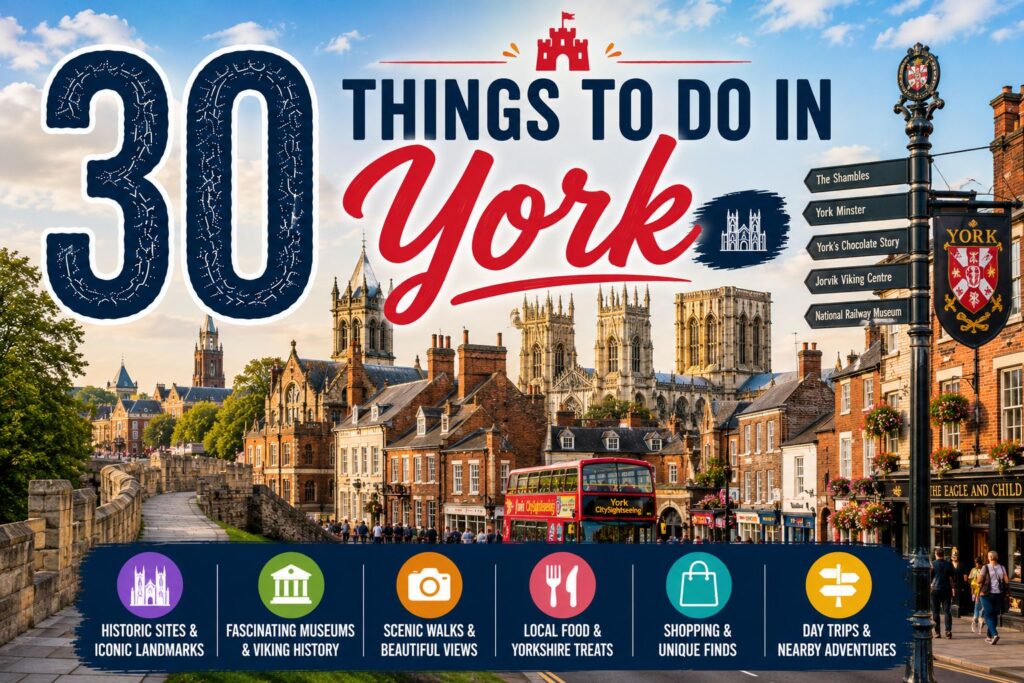
York is a city built in layers. The Romans founded Eboracum here in 71 AD and built the fortress that is still visible in the Multangular Tower in the Museum Gardens. The Vikings captured it in 866 AD, called it Jórvík, and settled it so thoroughly that the entire Viking-era city was discovered intact beneath the Coppergate shopping centre in 1976. The Normans built the Minster over the Saxon minster over the Roman headquarters building, and York Minster’s foundations still rest on Roman stone. The medieval walls that the Romans built and the Vikings rebuilt and the Normans reinforced are still intact for 3.4 kilometres and still walkable for free, daily.
The Shambles – the best-preserved medieval street in the world, the overhanging timber-framed butchers’ houses dating from the 14th century still leaning over a street too narrow for two people to pass with bags – is the street most widely cited as J.K. Rowling’s inspiration for Diagon Alley. Guy Fawkes was born near Stonegate in 1570, baptised in St Michael-le-Belfrey church adjacent to the Minster. Dick Turpin the highwayman was hanged on the Knavesmire (now York Racecourse) in 1739. The first railway journey from York to London was made in 13 hours in 1840; the National Railway Museum, which holds the Flying Scotsman and the Japanese bullet train Shinkansen 0 Series, is free and a 10-minute walk from the city centre.
Every layer is visible. York has the most concentrated historical content per square mile of any English city, and most of it is accessible within a 30-minute walk of York Railway Station. This guide covers all 30 best things to do in York, in strict numerical order from 1 through 30, with current 2026 data throughout.
For more UK city guides, visit Travel Destinations Plan. For other Yorkshire and UK destination guides, read our things to do in Edinburgh and our things to do in Manchester.
York At a Glance: Quick Reference Table
| # | Activity | Area | Entry | Duration | Best For | Best Time |
|---|---|---|---|---|---|---|
| 1 | York Minster | City Centre | ~£16-18 adults; book at tickets.yorkminster.org | 1.5 to 2 hours | All visitors, first-timers | Weekday mornings; book online |
| 2 | The Shambles and Harry Potter Trail | City Centre | Free | 1 to 1.5 hours | All visitors; Harry Potter fans | Early morning before 9 AM |
| 3 | York City Walls Walk | City Centre perimeter | Free | 1.5 to 2.5 hours | Walkers, photographers | Morning year-round |
| 4 | National Railway Museum | Leeman Road, NRM | Free | 2 to 3 hours | All visitors, families, rail enthusiasts | Weekday mornings |
| 5 | JORVIK Viking Centre | Coppergate, City Centre | ~£18 adults; pre-book at jorvikvikingcentre.co.uk | 1 to 1.5 hours | History lovers, families | Weekday mornings; always pre-book |
| 6 | York Castle Museum | Eye of York | ~£13 adults | 2 to 3 hours | Families, history lovers | Weekday mornings |
| 7 | Yorkshire Museum and Gardens | Museum Street | Museum ~£8-10; Gardens free | 1.5 to 2 hours | History and Roman remains lovers | Year-round mornings |
| 8 | Clifford’s Tower | Eye of York | ~£7 adults (English Heritage) | 45 to 60 minutes | History lovers, view seekers | Year-round |
| 9 | Betty’s Café Tea Rooms | St Helen’s Square | No entry cost; afternoon tea from ~£30 | 1 to 1.5 hours | Afternoon tea lovers, all visitors | Morning opening for shortest wait |
| 10 | York Ghost Tours | City Centre | From £8 to £14 adults | 1.5 to 2 hours | Adults and older children; atmosphere seekers | Evening year-round |
| 11 | Guy Fawkes Trail and Stonegate | City Centre, Stonegate | Free | 1 hour | History lovers | Year-round |
| 12 | York Food and Drink Scene | City Centre and Gillygate | Free to walk; meals from £10 | 2 to 3 hours | Food lovers | Year-round |
| 13 | River Ouse Boat Trip | Lendal Bridge and Kings Staith | ~£9 to £12 adults | 1 hour | Families, relaxed sightseers | April to October |
| 14 | York Art Gallery | Exhibition Square | ~£8 adults | 1.5 to 2 hours | Art lovers, ceramics enthusiasts | Weekday afternoons |
| 15 | Treasurer’s House (National Trust) | Minster Yard | ~£9 adults (NT members free) | 1 to 1.5 hours | History lovers; Roman soldier ghost story | Year-round |
| 16 | DIG York Archaeological Experience | St Saviour’s Church | ~£8 to £10 adults | 1 to 1.5 hours | Families, children, archaeology lovers | Year-round |
| 17 | Fossgate and Goodramgate Walk | City Centre | Free | 1 to 1.5 hours | Shoppers, independent culture seekers | Saturday mornings |
| 18 | York Chocolate Story | King’s Square | ~£15 adults | 1 to 1.5 hours | Families, chocolate lovers | Year-round |
| 19 | Barley Hall | Coffee Yard, off Stonegate | ~£7 adults | 45 to 60 minutes | Medieval history lovers | Year-round |
| 20 | York Racecourse | Knavesmire | Race day from ~£20; grounds free outside race days | Half to full day | Horse racing fans, groups | Race days April to October |
| 21 | Merchant Adventurers’ Hall | Fossgate | ~£6 adults | 45 to 60 minutes | Medieval history lovers | Year-round |
| 22 | Museum Gardens and St Mary’s Abbey | Museum Street | Free | 1 to 1.5 hours | Walkers, history lovers, picnickers | Spring and summer |
| 23 | Day Trip to Castle Howard | 15 miles northeast of York | ~£21 adults (house and grounds) | Half to full day | Architecture and garden lovers | April to October |
| 24 | York Dungeon | Tower Street | ~£18 to £20 adults; book online | 1.5 hours | Thrill seekers, older children | Year-round; book ahead |
| 25 | Fairfax House | Castlegate | ~£9 adults | 1 to 1.5 hours | Georgian architecture lovers | Closed Mondays |
| 26 | Day Trip to Whitby | 45 minutes by rail or bus | Train ~£8-12 return; town free | Full day | Coastal lovers, Dracula fans | Year-round; summer best |
| 27 | York’s Chocolate Village and Terry’s Story | Bishopthorpe Road | Free area; specific tours extra | 1 to 2 hours | Food history lovers | Year-round |
| 28 | JORVIK Viking Festival | City Centre | Free outdoor events; indoor ticketed | Full days | All visitors | February annually (Feb 2027 next) |
| 29 | Cycling the York to Selby Railway Path | York to Selby | Free | 2 to 4 hours | Cyclists, active visitors | Year-round; summer best |
| 30 | York Minster Tower Climb | York Minster | Included with Minster ticket (~£6 separately) | 45 to 60 minutes | View seekers, those comfortable with heights | Clear days; limited capacity |
1. York Minster
Area: City Centre, Deangate, YO1 7HH | Entry: ~£16-18 adults; book at tickets.yorkminster.org; costs £30,000 per day to run | Duration: 1.5 to 2 hours minimum; 2.5 to 3 hours for the full circuit including tower | Best time: Weekday mornings at opening; book online to skip the ticket queue
York Minster is the largest Gothic cathedral north of the Alps – a 158-metre nave, 76-metre transepts, and a central tower 60 metres tall, built on the site of the Roman headquarters building and the subsequent Saxon and Norman churches in a construction process that ran from approximately 1220 to 1472. The building contains more than half of all the medieval stained glass in England – approximately 128 windows covering 2,000 square metres of glass spanning 800 years of production from the 12th-century Five Sisters Window (the largest expanse of grisaille glass in the world, 1260, 15 metres tall, five lancets in the north transept) to the Great East Window (the Great East Window is the largest medieval stained glass window in the world at 23 by 9 metres, depicting the beginning and end of the world in 117 panels from 1405-1408).
The Minster costs £30,000 per day to run, maintain, and staff – a specific figure that the Minster publishes to contextualise why the admission charge exists for what is technically a working Anglican parish church. The admission price directly funds the conservation of the glass, the stone, and the fabric of a building that cannot receive public grant funding on the scale its conservation requires. Membership (from approximately £50 per year) provides unlimited free entry and the most cost-effective access for visitors who plan to return.
York Minster’s Great East Window – the largest medieval stained glass window in the world at 23 by 9 metres, depicting the beginning and end of the world in 117 panels painted between 1405 and 1408 by John Thornton of Coventry, still in its original position in the east end of the largest Gothic cathedral north of the Alps – is the single most significant medieval object accessible in the North of England, and standing beneath it in the morning light provides the specific understanding of scale that the superlative descriptions cannot convey.
Practical tips:
- Book tickets at tickets.yorkminster.org before your visit to skip the ticket queue and confirm your visit – the Minster can close for special services or events without notice, and the online booking system shows current availability and any scheduled closures.
- The Central Tower can be climbed (included in the standard Minster ticket, or separately priced at approximately £6) via 275 spiral steps – covered separately at activity 30, but combining the interior visit with the tower climb makes the most complete Minster experience available.
- The Minster’s free daily Evensong service (typically 5:15 PM on weekdays, 4 PM on Sundays) is the most atmospheric and least expensive way to experience the building – attendance at Evensong is free, and the specific acoustic quality of the Gothic nave with the choir in full voice is the sensory experience that the daytime visitor ticket does not provide.
2. The Shambles and Harry Potter Trail
Area: City Centre, off King’s Square, YO1 7LX | Entry: Free | Duration: 1 to 1.5 hours | Best time: Before 9 AM for the emptiest possible Shambles; Harry Potter tours available from multiple operators
The Shambles is the best-preserved medieval street in Europe – a narrow lane of overhanging timber-framed buildings dating from the 14th century where the upper floors of facing houses lean toward each other until they almost touch at the top, blocking the sky and creating the specific enclosed medieval alleyway that no other English street replicates at this length and this quality of preservation. The street takes its name from “Fleshammels” (the Old English for flesh-shelves) – the wooden shelves visible on the exterior of some buildings are the original butchers’ hooks and display surfaces from when every property on the Shambles was a butcher’s shop, a tradition maintained until the late 19th century.
The Harry Potter connection is the most specific and most debated of the Shambles’ cultural associations – the street is widely cited as an inspiration for Diagon Alley in the Harry Potter series, and while J.K. Rowling has not specifically confirmed the Shambles as the exact reference, the visual correspondence between the overhanging medieval lane and the fictional wizarding shopping street has made it the most popular single Harry Potter photography location in the North of England. Multiple operators run dedicated Harry Potter tours of York (the Original Harry Potter Locations Tour from visityork.org/things-to-do covers the Shambles, King’s Square, and the surrounding area with a guide who covers the specific connections between York’s medieval geography and Rowling’s fictional world).
The Shambles at 7:30 AM on a summer weekday, before the first tourists have arrived and when the morning light is coming through the gaps between the overhanging timber-framed floors and the medieval street hooks on the building exteriors are visible in the low light and there is no one else on the cobblestones – is the most historically specific street experience available in England and the one that photographs cannot adequately prepare you for because the scale of the overhang is not apparent until you are standing in the lane.
Practical tips:
- Arrive at the Shambles before 9 AM for the most undisturbed experience – by 10 AM in summer, the street fills with visitor groups and the specific atmospheric quality of the empty medieval lane becomes essentially unavailable until the shops close in the early evening.
- The Shambles Market (between Shambles Street and Parliament Street) runs Wednesday through Sunday with independent food and craft stalls in the covered market area behind the Shambles – the market’s food section is one of the best accessible cheap lunches in the city centre.
- The Harry Potter locations tour (Original Harry Potter Locations Tour, available from multiple York tour operators, approximately £12 to £16 per person, 75 minutes) covers the Shambles, King’s Square where Diagon Alley’s wizarding atmosphere is most visible, the Minster Yard, and the surrounding medieval streets with specific references to Rowling’s documented visits to York.
3. York City Walls Walk
Area: City Centre perimeter | Entry: Free | Duration: 1.5 to 2.5 hours for the full 3.4km circuit; individual sections shorter | Best time: Morning year-round; spring and autumn for the clearest views over the city
York’s city walls are the most complete circuit of medieval and Roman defensive walls in England – 3.4 kilometres of intact walkable walls dating in their original Roman form from 71 AD, rebuilt and modified through the Viking and Norman periods to the current medieval walls that define the city’s perimeter. The walls are free to walk at any time and represent the most specifically historical free activity available in York – covering 2,000 years of defensive architecture in a continuous circuit that provides the best elevated views of the Minster, the city, and the surrounding Vale of York available from any publicly accessible vantage point.
The four main gateways (bars) through the walls – Bootham Bar (northwest, the oldest of the four, with medieval portcullis still in place), Micklegate Bar (southwest, the royal entrance to York where the heads of executed traitors were displayed on spikes into the 18th century), Monk Bar (northeast, the most complete of the four bars with a working portcullis mechanism), and Walmgate Bar (southeast, the only surviving bar with its original barbican, the outer defensive gatehouse) – are the most architecturally specific points on the wall circuit and worth stopping at individually. The section of wall between Bootham Bar and Monk Bar provides the most complete view of York Minster’s north transept, the Chapter House, and the central tower from a level that the city streets below cannot provide.
York City Walls between Bootham Bar and Monk Bar on a clear October morning – the north transept of York Minster visible over the wall’s inner parapet, the Chapter House dome visible above the Minster’s east end, the city’s medieval street grid visible below on both sides of the wall, and the Hambleton Hills visible on the horizon 20 miles north – is the most specifically historical free walk available in any English city and the one that most directly shows what a medieval walled city looked like from its own defensive perimeter.
Practical tips:
- The wall circuit can be walked in either direction – the most commonly walked section is the short stretch from Bootham Bar to Monk Bar (approximately 700 metres, 15 to 20 minutes) for the Minster views, and the longest uninterrupted stretch runs from Micklegate Bar clockwise to Bootham Bar along the south and east walls.
- The wall has limited descent points and the most useful exits for planning a circuit-plus-attractions day are at Bootham Bar (for the Minster and Yorkshire Museum), Monk Bar (for the Treasurer’s House and the eastern city), Walmgate Bar (for Fossgate and the Castle Museum), and Micklegate Bar (for the station approach).
- The Multangular Tower in the Museum Gardens (the best preserved section of the Roman wall still standing to near-original height, dating from approximately 300 AD) connects the medieval wall circuit to the Roman phase – free and accessible from the Museum Gardens entrance on Museum Street.
4. National Railway Museum
Area: Leeman Road, YO26 4XJ | Entry: Free | Duration: 2 to 3 hours | Best time: Weekday mornings; the Great Hall is at its most photogenic in the morning light
The National Railway Museum in York is the largest railway museum in the world, holding over 100 locomotives and 200 items of rolling stock covering the complete history of British and international rail transport from George Stephenson’s Rocket (the original in the Science Museum, a replica here) through the Victorian express locomotives that made Britain’s railways the model for the world, to the Flying Scotsman (the most famous steam locomotive in the world, LNER Class A1, which in 1934 became the first steam locomotive officially authenticated to reach 100 mph), the Japanese Shinkansen 0 Series bullet train (the first high-speed railway in the world, donated by Japan Railways and visible at the NRM as the most obviously anachronistic object in a Victorian engine shed), the record-breaking Mallard (holder of the world steam speed record at 126 mph, set in 1938), and the operational fleet of locomotives that the museum steams regularly on specific event days.
The museum is entirely free and houses what is comprehensively the most significant railway heritage collection in the world in the specific city where British railway history was made – York was at the geographic centre of the Victorian railway network, the home of the North Eastern Railway, and the destination of the first long-distance express service from London in 1840. The Great Hall (the former York North motive power depot, now holding the most significant engines in the collection) produces one of the most impressive single-hall museum interiors in Britain when the locomotives are displayed under the original depot roof.
The National Railway Museum’s Great Hall – the former York North motive power depot holding the Flying Scotsman, the Mallard, the Japanese bullet train, and the Victorian express locomotives that defined British rail engineering in the most impressive railway museum hall available anywhere in the world, entirely free – is the most cost-effective single attraction in York and the one that most consistently produces the specific response of standing in front of a very large and very beautiful piece of engineering and understanding immediately why the people who built it were proud of it.
Practical tips:
- The Flying Scotsman’s operational status changes regularly – check railwaymuseum.org.uk before visiting for the current display location and whether the locomotive is in steam at the museum or out on the main line for excursion duties; when it is in the NRM and in steam for an event day, the queue to photograph it from close range builds quickly.
- The Warehouse section of the NRM (the smaller collection building adjacent to the Great Hall) holds the largest collection of railway photographs, documents, and artefacts in the world – largely visited by enthusiasts and researchers but open to all visitors, and the archive’s specific holdings make it the most comprehensive railway research resource outside the National Archives.
- The NRM is a 10 to 15-minute walk from York city centre via Museum Street or a very short taxi from the station – combining the NRM with the Museum Gardens and Yorkshire Museum (activity 22 and 7) makes the most efficient western corridor of the York day, covering railway history, Roman history, and medieval ruins in a single connected route.
5. JORVIK Viking Centre
Area: Coppergate, City Centre, YO1 9WT | Entry: ~£18 adults; pre-booking essential at jorvikvikingcentre.co.uk | Duration: 1 to 1.5 hours | Best time: Weekday mornings; always pre-book as walk-ins may be refused
JORVIK Viking Centre stands on the actual site of the most significant urban Viking archaeological excavation in the world – the Coppergate excavation carried out by the York Archaeological Trust between 1976 and 1981, which revealed the complete physical remains of the Viking-era city of Jórvík beneath the existing Coppergate shopping centre. The excavation uncovered the houses, workshops, backyards, and refuse deposits of a densely occupied Viking neighbourhood dated to approximately 975 AD, including the organic materials (wood, leather, textile, food remains, and human waste) that normally perish but were preserved by the waterlogged clay of the York riverbank. Among the artefacts recovered was the Lloyds Bank Coprolite – a Viking-era fossilised human stool 20 centimetres long, described by a Guinness World Records representative as “the most significant find from the Viking Age in Britain” – which is now one of the museum’s most visited objects.
The JORVIK ride is a time-car journey through a full-scale reconstruction of the 975 AD Coppergate neighbourhood at the level of the original excavation floor, with 3D figurines, authentic period sounds, and the specific smells of the Viking city reproduced by modern fragrance technology (including the Coppergate’s characteristic smell of fish, smoke, and the general effluent of a densely occupied medieval settlement). The ride takes approximately 20 minutes. The archaeological gallery above the ride level displays the actual artefacts recovered from the excavation, including the fossilised stool, the leather shoes, the Viking jewellery, and the carved wooden objects that survive from the 975 AD occupation.
JORVIK Viking Centre is built on the actual site of the most significant Viking urban excavation in the world – standing in the museum means standing in the physical space that was Viking York in 975 AD, and the time-car ride at the excavation floor level passes through a reconstruction of houses and workshops that were excavated from directly beneath where visitors are sitting.
Practical tips:
- Pre-booking at jorvikvikingcentre.co.uk is essential – walk-in visitors may be turned away if timed entry slots are full, and summer and school holidays sell out significantly in advance; weekday morning slots are the easiest to book with shortest wait times.
- The JORVIK dark ride cannot be photographed during the vehicle journey through the reconstructed Viking neighbourhood – plan photography for the entry area and the archaeological gallery above, where the actual artefacts are displayed.
- The combined ticket covering JORVIK Viking Centre and DIG York (activity 16) is available at approximately £22 for adults and provides the best value pairing of York Archaeological Trust’s two visitor attractions – both are within the same Coppergate area and the DIG hands-on archaeological experience complements the JORVIK reconstruction.
6. York Castle Museum
Area: Eye of York, Tower Street, YO1 9RY | Entry: ~£13 adults; book at yorkcastlemuseum.org.uk | Duration: 2 to 3 hours | Best time: Weekday mornings; allow the full 3 hours for the complete collection
York Castle Museum is the most comprehensive social history museum in the North of England – a collection of everyday objects from the 18th century to the 20th century displayed in the former Female Prison and Debtors’ Prison buildings of York Castle, with the most specific feature being Kirkgate, the recreated Victorian street that runs through the heart of the museum. Kirkgate is a full-length replica of a Victorian shopping street, complete with period shopfronts, period merchandise, and the specific material culture of an 1870s English market town street that the museum has been developing and expanding since its opening in 1938. It is the most visited single feature in any York museum and the most specifically immersive social history experience available.
The museum holds the actual cell where Dick Turpin the highwayman was imprisoned before his execution at Knavesmire in 1739 – the specific stone cell is preserved and accessible, and the interpretive display covers the myth versus reality of Turpin’s career (he was primarily a violent thief rather than the romantic horseman of the Black Bess legend, a transformation the Harrison Ainsworth novel Dick Turpin of 1834 produced). The collection extends from the Victorian period backward to the 18th century and forward to the mid-20th century, covering domestic life, fashion, toys, food culture, and the specific material evidence of how ordinary people lived in Yorkshire across 250 years.
York Castle Museum’s Kirkgate – the full-length recreated Victorian street running through the former prison building’s ground floor, complete with period shopfronts, a hansom cab, and the specific sensory environment of an 1870s market town street, developed continuously since 1938 – is the most atmospherically immersive single museum feature in the North of England and the one that most consistently produces the ‘stepping back in time’ response that most heritage attractions aim for and fewer achieve.
Practical tips:
- Allow at least 2.5 to 3 hours for York Castle Museum – the combination of the recreated Kirkgate street, the Dick Turpin cell, the half-moon prison building’s Georgian prison collections, and the domestic history galleries requires this time to cover properly, and most visitors report running out of time.
- The Half Moon Court (a recreated early 20th-century shopping area alongside the Victorian Kirkgate) has been extended with mid-century additions – the specific social history of the 1930s and 1940s domestic life sections are the most recently updated and most specifically engaging for visitors interested in the 20th century rather than the Victorian period.
- York Castle Museum is adjacent to Clifford’s Tower (activity 8) on the Eye of York – combining both as a castle area morning is the most efficient approach, as the English Heritage members who visit Clifford’s Tower and the museum visitors have the same Eye of York entry point.
7. Yorkshire Museum and Gardens
Area: Museum Street, YO1 7FR | Entry: Museum ~£8-10 adults; Museum Gardens free | Duration: Museum 1.5 to 2 hours; gardens 45 to 60 minutes | Best time: Museum weekday mornings (closed July 7-12, 2026 for maintenance); gardens spring and summer for the best planting
The Yorkshire Museum on Museum Street holds the most significant Roman and Viking artefacts from York and Yorkshire outside the British Museum in London – the Ryedale Hoard (a 4th-century Roman silver treasure), the Middleham Jewel (a 15th-century gold pendant considered the finest example of late medieval goldsmithing in England, found by a metal detectorist in 1985 and acquired by the museum for £2.5 million), and the Eboracum Roman collection covering 400 years of Roman York from Hadrian’s visit in 122 AD through the building of the Multangular Tower and the Constantine the Great proclamation in York in 306 AD (Constantine the Great, later the first Christian Roman Emperor, was proclaimed Emperor by his troops in York on the death of his father Constantius – a specific historical event that made York the most consequential single location in early Christian history outside Rome itself).
The Museum Gardens surrounding the building are free and contain the most significant visible Roman and medieval ruins available in any English city – the Multangular Tower (the west corner tower of the Roman legionary fortress, dating from approximately 300 AD and standing to near-original height), the ruins of St Mary’s Abbey (covered at activity 22), and the specific medieval hospital ruins that are visible throughout the garden landscape. The gardens are a managed English Heritage site of considerable botanical significance alongside the historical interest.
The Middleham Jewel in the Yorkshire Museum – a 15th-century gold pendant set with a large sapphire and engraved with the Trinity, considered the finest example of late medieval goldsmithing in England, found by a metal detectorist in 1985 and acquired for £2.5 million – is the single most valuable and most artistically significant object in any York museum, visible for the museum admission price in a display that allows examination at the level of the individual goldsmith’s tool marks.
Practical tips:
- The Museum Gardens (free, open daily except 25 and 26 December and 1 January) are accessible independently of the museum – the Roman Multangular Tower and the Abbey ruins are visible from the garden paths without entering the museum, making the gardens a free 45-minute addition to any Museum Street visit.
- The Yorkshire Museum is closed for maintenance from July 7 to 12, 2026 – check yorkshiremuseum.org.uk for any other closure periods before visiting.
- The museum’s temporary exhibition programme (check the website before visiting) supplements the permanent Roman and Viking collections with rotating shows covering archaeology, natural history, and cultural history – the Eboracum Roman Festival (an annual event held in the Museum Gardens, covering Roman living history demonstrations) is the most family-oriented event in the museum’s calendar.
8. Clifford’s Tower
Area: Eye of York, Tower Street, YO1 9SA | Entry: ~£7 adults (English Heritage); members free | Duration: 45 to 60 minutes | Best time: Year-round; clear days for the best city views from the roof
Clifford’s Tower is the most visible and most historically charged single building in York – the 13th-century stone shell keep built by Henry III on the artificial mound constructed by William the Conqueror in 1068, at the highest point of the Eye of York overlooking the Castle Area. The tower is most historically specific for the events of 16 March 1190, when 150 Jewish citizens of York, who had taken refuge in the tower from a mob, set fire to the building and died by mass suicide rather than surrender. It is the most significant single site of medieval antisemitic violence in England, and the memorial plaques and historical interpretation inside the tower provide the most substantive account of the York Massacre of 1190 available at any accessible site in the city.
The building is a quatrefoil shell keep (four interlocking circles, an unusual design found at only one other English castle) with the roof level providing panoramic views of the York city centre, the Minster, the castle area, and the River Ouse. The roofline is the most practical elevated view of central York available without climbing the Minster tower (activity 30), and the combination of the historical content about the 1190 massacre and the architectural curiosity of the quatrefoil plan makes Clifford’s Tower the most historically charged 45-minute visit available in York.
Clifford’s Tower’s roof platform provides the most clearly elevated view of central York available for a sub-£10 admission – York Minster visible to the north, the Ouse visible to the west, the castle area and the Yorkshire Museum roofline visible throughout – and the 1190 Jewish massacre that the tower witnessed is the most historically consequential single event that occurred in any accessible York building.
Practical tips:
- English Heritage members enter Clifford’s Tower free – for families with multiple English Heritage site visits planned, the membership cost-benefit calculation versus individual admissions is worthwhile; the Heritage Charity Membership from approximately £60 per adult covers unlimited entry to all English Heritage properties.
- The tower is adjacent to York Castle Museum (activity 6) in the Eye of York – combining both in the same castle-area morning covers 800 years of York’s judicial history from the Norman motte construction through the 18th-century prison building that is now the Castle Museum.
- The inner face of the tower’s shell wall shows the fire damage from the 1190 massacre – the specific scorching visible on the original masonry provides the most directly physical evidence of the historical event and is the most affecting single detail in the building for visitors who have read the history before arriving.
9. Betty’s Café Tea Rooms
Area: St Helen’s Square, YO1 8QP | Entry: No cover charge; afternoon tea from approximately £30 per person | Duration: 1 to 1.5 hours | Best time: Morning opening (9 AM) for the shortest queue; avoid weekend afternoons
Betty’s is the tea room institution that has defined York’s café culture since 1919 – a Swiss-inspired confectioner and café founded by Frederick Belmont in Harrogate in 1919 (the Harrogate original preceded the York branch) and expanded to York’s St Helen’s Square in 1936. The York branch has occupied the same premises and maintained the same distinctive interior (the mirrored Imperial Room on the first floor, the ground-floor café, the art deco wooden fittings) since the 1930s expansion. Betty’s is the most visited single food establishment in York, the most consistently cited café in Yorkshire, and one of the most photographed heritage tea rooms in England.
The queue at Betty’s on a summer Saturday afternoon has been documented at up to 90 minutes for a table – a fact that produces divided responses (locals consider it an indignity, visitors consider it worth it). The practical solution is to arrive at 9 AM when the café opens or at 3:30 PM when the afternoon tea rush has passed. Betty’s own baked goods (the Fat Rascal – a citrus and fruit scone unique to Betty’s, the Swiss Rosti, and the Yorkshire Curd Tart) are the specific items most consistently recommended by visitors over a full afternoon tea, and the Victorian bar downstairs (the Bar and Bistro) operates with shorter wait times than the main café.
Betty’s in York is the tea room that operates a 90-minute queue on summer Saturdays and where the queue is considered by the people in it to be worth it – the Fat Rascal (a citrus and fruit scone unique to Betty’s baking), the Yorkshire Curd Tart, and the specific quality of a tea room that has been baking to the same standards since 1919 in the same St Helen’s Square room are the specific reasons.
Practical tips:
- Arrive at Betty’s at 9 AM when it opens for the morning service (breakfast and morning coffee) – the 9 AM opening queue rarely exceeds 10 to 15 minutes and provides the same baked goods, the same interior, and the same service quality as the afternoon tea at a fraction of the wait.
- The Betty’s craft bakery on Stonegate (a smaller, takeaway-focused shop within 3 minutes walk of the main St Helen’s Square tea room) sells the Fat Rascal, the Yorkshire Curd Tart, and the full range of Betty’s baked goods without the café queue – the most practical compromise for visitors who want the baked goods without the tea room wait.
- Betty’s Harrogate original (1 Parliament Street, Harrogate, 20 minutes by train from York) is architecturally the more impressive of the two Betty’s locations – the Imperial Suite’s art deco interior is the most elaborate Betty’s dining room available, and Harrogate is worth visiting for the full Victorian spa town character alongside the café experience.
10. York Ghost Tours
Area: City Centre; various departure points | Entry: From £8 to £14 adults depending on operator and tour type | Duration: 1.5 to 2 hours | Best time: Evening year-round; the Tour After Dark versions are the most atmospheric
York has more recorded ghost sightings than any other city in the United Kingdom – a claim made by the York Tourism Board and supported by the specific concentration of 2,000 years of continuous occupation, burial, battle, execution, and industrial accident in a compact urban area that has experienced more historical violence than almost any comparable English city. The ghost tour industry in York is correspondingly extensive, with multiple operators offering walking tours of varying quality and orientation, from the historically grounded (covering the documented evidence of supernatural claims in specific York buildings with appropriate scepticism) to the purely theatrical (the Ghost Bus Tours’ theatrical performance on a converted Routemaster bus).
The Treasurer’s House (activity 15) is the specific York building most associated with the city’s most documented ghost story – the 1953 account by Harry Martindale of Roman soldiers marching through the cellar wall, visible only from the knee upward (he later discovered that the Roman road surface from which they were marching was buried below the current cellar floor, explaining the apparent levitation). The Snickelways of York (the network of medieval alleyways connecting the major streets) provide the most atmospherically appropriate setting for evening ghost tour circuits and appear on virtually every York ghost tour route.
The York ghost tour market encompasses everything from historically rigorous walking tours to theatrically produced performances – the specific value of any ghost tour in York is not primarily the ghost content but the specific access to the medieval snickelways, the medieval churchyards, and the night-time city streets that the tourist attractions are closed to, and the best tours deliver historical content alongside the atmospheric setting that justifies the evening walk.
Practical tips:
- The Ghost Bus Tour (the theatrical performance version on a converted Routemaster bus, departing from Exhibition Square) is the most specifically produced and most consistently reviewed of the theatrical ghost experiences in York – book at ghostbustours.com and expect a horror-comedy theatrical performance rather than a historically oriented walking tour.
- The Original Ghost Walk of York (departing from the Shambles most evenings, approximately £8 to £10 per adult) is the oldest running ghost walk in the world, operating continuously since 1973, and provides the most historically informed content of the walking tour options – the guides’ knowledge of the documented supernatural claims at specific York buildings is the most substantive available in the walking format.
- Children under approximately 10 should be considered carefully before a York ghost tour – the theatrical content of the most popular tours is designed for adults and older children, and the combination of dark medieval streets and ghost story content has frightened younger children on multiple documented occasions.
11. Guy Fawkes Trail and Stonegate
Area: City Centre, Stonegate area | Entry: Free | Duration: 1 hour | Best time: Year-round; the Stonegate area shops are most active Thursday to Saturday
Guy Fawkes – the leader of the 1605 Gunpowder Plot to blow up the Houses of Parliament and kill King James I – was born in York in April 1570, baptised in the Church of St Michael-le-Belfrey immediately adjacent to York Minster on 16 April 1570, and grew up in the Stonegate area of York before converting to Catholicism and eventually joining the conspiracy that made him the most famous person in the history of 5th November. The specific York connection – the baptism record in the St Michael-le-Belfrey registers, the house on Gillygate where his family lived, and the school at St Peter’s where he was educated – makes York the birthplace of England’s most celebrated failed revolutionary.
Stonegate itself is the most characterful medieval commercial street in York after the Shambles – a pedestrianised street running from Petergate to St Helen’s Square that follows the course of the Roman Via Praetoria (the street connecting the Roman fortress’s north and south gates) and holds the highest concentration of independent shops, antique dealers, and medieval-era buildings in York. The Street signs around Stonegate retain their historic names – Petergate (the Roman road from the gate toward the Praetorium), Coffee Yard (a snickelway off Stonegate where York’s first coffee house opened in 1669, making it the site of one of the first coffee houses in England), and the specific accretions of history that the street’s signage preserves.
Stonegate follows the course of the Roman Via Praetoria – the 2,000-year-old road connecting the Roman fortress’s two main gates – and the shops, cafés, and antique dealers on both sides occupy buildings whose medieval foundations rest on the Roman road surface that Guy Fawkes walked to school on, in a street whose Coffee Yard snickelway hosted one of England’s first coffee houses in 1669.
Practical tips:
- The Church of St Michael-le-Belfrey on High Petergate (adjacent to the Minster, free to enter) holds the baptism register recording Guy Fawkes’s baptism on 16 April 1570 – the register is in archival storage but the church provides interpretive material covering the Fawkes connection and the building is the most specifically Guy Fawkes-associated accessible building in York.
- Coffee Yard, the medieval snickelway off Stonegate, holds the Black Swan pub (at the Stonegate end) and the alley’s specific medieval passage character – at 2 metres wide for its length, it is one of the most atmospherically narrow snickelways in the city centre and the most specific historical food and drink address in the street.
- The Guy Fawkes Inn on High Petergate (the pub that occupies the building traditionally identified as the house of Guy Fawkes’s birth, though the specific identification is contested) has a carved stone Guy Fawkes figure on its exterior – the pub is a working public house with standard Yorkshire bitter and the specific heritage association that makes it the most photographically visited single exterior in the Stonegate area.
12. York Food and Drink Scene
Area: City Centre, Gillygate, Bootham, and Micklegate | Entry: Free to walk; meals from £10 | Duration: 2 to 3 hours | Best time: Year-round; lunchtime for the most active food market activity
York’s food scene is compact, quality-oriented, and increasingly nationally cited – a city whose restaurant and café culture has developed significantly since the 2010s into a culinary destination that the Yorkshire food community specifically credits for the most concentrated independent restaurant density in the county. The Shambles Market food stalls (activity 2), the Fossgate and Gillygate restaurant corridors, and the Micklegate area’s food and bar concentration cover the most significant eating areas in the city.
The specific York food experiences worth seeking: the Shambles Market’s artisan producers (cheese, bread, charcuterie, and fresh produce from Yorkshire farms and food makers), the Gillygate corridor’s independent restaurants (Roots at the Grand Hotel, voted Yorkshire’s best restaurant in multiple county awards and one of the most ambitious restaurants in the North), the Micklegate area’s independent café culture (Brew & Brownie on Museum Street is the most consistently cited independent café in York), and the specific Yorkshire food traditions (the Yorkshire Fat Rascal at Betty’s, the Yorkshire Curd Tart at multiple bakeries, and the proper Yorkshire chip shop culture that operates around Stonegate and Goodramgate).
York’s food scene in 2026 has the most concentrated independent restaurant density of any English city of comparable size – the Roots at the Grand Hotel tasting menu, the Gillygate café corridor, and the Shambles Market’s artisan producers combine to produce a culinary city break experience that the city’s 2 million annual visitors are increasingly treating as a primary rather than secondary reason to visit.
Practical tips:
- Roots at the Grand Hotel (Station Rise, YO1 6GD) is the most ambitious restaurant in York – the tasting menu format from Tommy Banks (who also runs the Black Swan at Oldstead, a Michelin-starred village restaurant 25 miles north) requires advance booking at rootsyork.co.uk and provides the most sophisticated single dining experience available in the city.
- Brew & Brownie on Museum Street (1 Museum Street, YO1 7DT) serves the most consistently recommended independent café lunch in York – the brownies, the filter coffee, and the sourdough options at prices that reflect independent café economics rather than tourist location overhead.
- York Butter Market (Newgate Market, running Monday to Saturday in the square adjacent to the Shambles) is the most practical outdoor food shopping experience in the city centre – the fresh produce, the Yorkshire artisan food producers, and the hot food stalls serving Yorkshire street food at market prices are the most value-rich food stop available in central York.
13. River Ouse Boat Trip
Area: Lendal Bridge and Kings Staith landing stages | Entry: ~£9 to £12 adults; book with City Cruises York | Duration: 1 hour (standard cruise); 2 hours (longer cruise) | Best time: April to October; afternoon for the most pleasant light on the riverbanks
The River Ouse runs through the heart of York, passing directly below the city walls at the Skeldergate Bridge and the Ouse Bridge, and the river cruise from Lendal Bridge downstream to the city’s southern reaches provides the most specific water-level perspective on York’s medieval geography available from any vessel. City Cruises York operates the primary passenger service on the Ouse, running regular 1-hour and 2-hour cruises from the Lendal Bridge landing stage with narrated commentary covering the buildings, bridges, and riverside history visible from the water.
The river view of York shows the city’s specific relationship to the Ouse – the medieval merchants’ houses that back onto the river at Kings Staith (the low-lying riverfront that floods regularly in wet winters, with the flood marks on the Ouse Bridge recording the highest water levels since 1565), the city walls approaching the river from the south at Skeldergate Bridge, and the specific riverside character of a city whose entire medieval commerce passed through this waterway. The open-top evening cruises with barbecue service in summer are the most popular single experience City Cruises York runs.
The River Ouse from Lendal Bridge at water level – the medieval Kings Staith merchant houses visible from below, the flood marks on the Ouse Bridge showing the high-water lines going back to 1565, the city walls approaching the river from the south, and the specific understanding of York as a river city rather than a road city that the boat level provides – is the most immediately clarifying geographic perspective available on York’s relationship to the water that shaped its entire commercial and defensive history.
Practical tips:
- Book City Cruises York at citycruisesyork.com at least 1 to 2 days in advance during summer and bank holiday periods – the most popular evening barbecue cruises sell out, and the main sightseeing cruises fill on summer weekend afternoons.
- The best riverside viewing positions from the land are Kings Staith landing stage (south of Ouse Bridge, with the city walls visible upstream and the medieval buildings immediately accessible) and the Skeldergate Bridge path (which allows a water-level view of the city walls meeting the river at their southernmost point).
- Combine the river cruise with a walk along the river path north from Lendal Bridge toward Poppleton (the footpath follows the Ouse for 4 miles from the city centre through the riverside meadows that were the flood plain of the medieval city) for the most connected York water experience.
14. York Art Gallery
Area: Exhibition Square, YO1 7EW | Entry: ~£8 adults; free for under 16s | Duration: 1.5 to 2 hours | Best time: Weekday afternoons; the Tower Gallery is best in afternoon light
York Art Gallery in the Victorian building on Exhibition Square (the most formally imposing civic building on the north side of the Minster area) holds the most significant ceramic collection in any UK regional gallery alongside a permanent collection of European Old Masters and specifically important Hockney works. The gallery reopened in 2015 after a £8 million renovation that created the Centre of Ceramic Art (CODA) – the most significant dedicated ceramics gallery in the UK, holding approximately 5,000 ceramic works from the prehistoric period through the contemporary Yorkshire studio pottery tradition that has made the county the most significant region for studio ceramics in England.
The William Etty collection (Etty was a York-born painter of the early 19th century and the most successful Northern English academic painter of his period – and one of the most controversial, for his persistent choice of nude subject matter that made his work both celebrated and disputed in Victorian York) gives the gallery its most specifically York content in the permanent collection. The gallery’s Old Master holdings include works by Luca Signorelli, Joachim Wtewael, and the Flemish school that the Yorkshire aristocracy collected in the 17th and 18th centuries.
York Art Gallery’s Centre of Ceramic Art (CODA) – the most significant dedicated ceramics gallery in the UK, holding 5,000 works from prehistoric to contemporary studio pottery, in a renovated Victorian exhibition gallery that won the Museum of the Year shortlist in 2016 – is the most specifically international art world-regarded attraction in York and the one least often mentioned by visitors who focus on the Minster, the Shambles, and the Viking history.
Practical tips:
- The CODA Centre of Ceramic Art is on the upper floors of the gallery and requires taking the stairs or lift – the most visually dramatic installation pieces in the CODA collection are in the first-floor gallery rooms and the Tower Gallery at the top of the building, which provides additional views over Exhibition Square.
- The gallery’s permanent Old Master collection (ground floor, free with gallery admission) is the most accessible starting point for visitors unfamiliar with the CODA’s specific ceramics focus – the Etty paintings and the Flemish works provide the traditional gallery context before the ceramic collections’ more contemporary orientation.
- Exhibition Square outside the gallery holds the equestrian statue of William Etty by G.W. Milburn (1911) and the specific civic composition of the Bootham Bar medieval gate, the Art Gallery Victorian facade, and the De Grey Rooms (the Regency ballroom building on the square’s south side) that makes Exhibition Square the most formally architectural open space in York.
15. Treasurer’s House (National Trust)
Area: Minster Yard, YO1 7JL | Entry: ~£9 adults; National Trust members free | Duration: 1 to 1.5 hours | Best time: Year-round; the cellar tour covers the most famous ghost story; check NT seasonal hours
The Treasurer’s House on Minster Yard is a 17th-century townhouse built on the site of the medieval residence of the Treasurer of York Minster, now held by the National Trust and furnished with the collections of the York industrialist Frank Green who donated the house to the NT in 1930. The house is most specifically visited for the events of 1953 when a young apprentice plumber named Harry Martindale was working in the cellar and witnessed a Roman soldier emerge from the wall, followed by more soldiers and a horse – all visible only from the knee upward. He later fainted, and when the story reached archaeologists, it was noted that the Roman road surface lay beneath the current cellar floor at precisely the level at which the soldiers would have been ‘walking’ had they been at their original elevation.
The cellar in which the sighting occurred is accessible on the standard Treasurer’s House tour and is the most specifically documented supernatural claim in any English historic house. Whether the account is credible or not, the specific detail of the soldiers being visible only from the knee upward and the subsequent archaeological explanation for the apparent levitation is the most compelling single ghost story in any accessible York building – and the National Trust’s interpretive approach to the story (neither wholly credulous nor wholly dismissive) is the most balanced available.
The Treasurer’s House cellar – where Harry Martindale in 1953 witnessed Roman soldiers walking through the wall at knee height, an apparent levitation later explained by the discovery that the Roman road surface was buried beneath the current cellar floor – is the most specifically documented and most architecturally verifiable ghost story in any accessible building in York, and visiting the actual cellar space where the reported encounter occurred is the most directly primary-source ghost tourism available in the city.
Practical tips:
- The Treasurer’s House is only a 3-minute walk from York Minster – combining the Minster visit (activity 1) with the Treasurer’s House on the same Minster Yard morning is the most efficient use of the Minster area concentration.
- National Trust members enter the Treasurer’s House free of charge – for NT members visiting York, this is one of the most specifically rewarding NT properties available in the North of England for the combination of the house’s architectural interest, Frank Green’s collection, and the ghost story.
- The Treasurer’s House gardens (accessible with house admission) provide the best ground-level view of York Minster’s south face and Chapter House from close range – the Chapter House octagonal form visible from the garden is the most photogenic single architectural feature of the Minster at garden-level viewing distance.
16. DIG York Archaeological Experience
Area: St Saviour’s Church, St Saviourgate, YO1 8NN | Entry: ~£8 to £10 adults; combined with JORVIK ~£22 | Duration: 1 to 1.5 hours | Best time: Year-round; families with children from age 7 are the primary audience**
DIG York is the second visitor attraction operated by the York Archaeological Trust (alongside JORVIK) and is housed in the former St Saviour’s Church on St Saviourgate – a conversion that preserves the church’s original Victorian interior while creating a hands-on archaeological excavation experience in the nave. Visitors are given trowels and take part in a supervised simulated excavation of four archaeological trenches covering the Viking, medieval, Roman, and Victorian periods of York’s history, guided by costumed characters who provide the archaeological context for the finds.
The attraction specifically addresses the question of what actually happens at an archaeological dig – the preparation, the methodology, the significance of context (where a find is relative to the surrounding material is as important as the find itself), and the specific skills that professional archaeologists apply to excavation. The DIG experience complements the JORVIK Viking Centre by showing the excavation process that produced the artefacts on display at JORVIK, making the combined visit more coherent as an introduction to York’s archaeological heritage than either attraction alone.
DIG York in the converted Victorian church of St Saviour’s – children handling replica artefacts in a simulated excavation guided by costumed archaeologists who explain the specific methodology of the York Archaeological Trust’s work – is the most directly educational of York’s paid heritage attractions and the one that produces the most consistently enthusiastic response from families with children aged 7 to 14.
Practical tips:
- Book DIG York at digyork.com in advance, particularly during school holidays – the hands-on excavation format means each session is capacity-limited to allow genuine participation, and the most popular times (Saturday mornings, school holiday afternoons) sell out.
- The combined DIG and JORVIK ticket (approximately £22 for adults) is the most cost-effective way to experience both York Archaeological Trust attractions – book the combined ticket on either attraction’s website.
- The costumed interpreter format at DIG means the experience is guide-dependent in a way that JORVIK’s automated ride is not – asking the guides questions during the excavation session is the specific way to get the most out of the educational content rather than treating the session as purely an activity for children.
17. Fossgate and Goodramgate Walk
Area: Fossgate and Goodramgate, city centre | Entry: Free | Duration: 1 to 1.5 hours | Best time: Saturday mornings; independent shops typically open Thursday to Sunday**
Fossgate and Goodramgate are the two most independently commercial streets in York after the Shambles and Stonegate – the streets that hold the highest concentration of independent bookshops, vintage and antique shops, independent jewellers, and the specific small-shop York retail character that distinguishes the city from purely tourist-facing shopping areas. Fossgate runs from the Fossbridge south of the city centre toward the Merchant Adventurers’ Hall, and the stretch between the bridge and the Hall is the most consistently cited independent shopping corridor in York by the local resident community.
The Antiques Centre York at 41 Stonegate (accessible from both Stonegate and the Fossgate area, open daily) is the largest antiques centre in York – 60-plus dealers on multiple floors of a Victorian building selling the full range of 18th to 20th-century objects. The specific York antique market character (silver, ceramics, vintage clothing, militaria, and the specific category of Victorian ephemera that a market-town antique trade produces) makes the Antiques Centre the most productively diverse single antiques venue in the city.
Fossgate on a Saturday morning – the independent bookshop (Forum Books, the most consistently cited independent bookshop in York), the vintage clothing shops, and the specific retail character of a street that is primarily visited by people who live in York and use it for the genuine independent shopping that the pedestrianised tourist centre has progressively replaced – is the most locally-facing shopping experience available in the city centre.
Practical tips:
- Forum Books on Fossgate (14 Fossgate, independent bookshop) is the most consistently cited independent bookshop in York – the curated selection, the staff recommendations, and the specific character of an independent bookshop that has survived in a competitive city centre context are worth visiting independent of any other Fossgate shopping.
- The Goodramgate entrance to the Minster Yard (at the far end of Goodramgate) provides the most obscured and most dramatic first view of the Minster for visitors approaching from the northeast – the street narrows before the Minster’s north transept suddenly appears at the end, producing the specific York visual surprise that approaches from the wider streets around the Minster don’t generate.
- The Little Shambles (the short alley connecting the Shambles to the Shambles Market) is the most compact version of the Shambles’ overhanging medieval character – a 15-metre passage that replicates the Shambles’ medieval geometry at even closer range and is accessible free from either end.
18. York Chocolate Story
Area: King’s Square, YO1 7LD | Entry: ~£15 adults; book at yorkschocolatestory.com | Duration: 1 to 1.5 hours | Best time: Year-round; book in advance for weekend visits**
York’s connection to chocolate manufacturing is the most specifically important commercial heritage in the city’s Victorian and 20th-century economic history – Rowntree’s (founded in York in 1862 by the Quaker Joseph Rowntree, now part of Nestlé) invented the Kit Kat, the Aero, the Quality Street, and the Fruit Pastille in York. Terry’s (founded in York in 1767) invented the Chocolate Orange in the Terry’s factory on Bishopthorpe Road. York Chocolate Story at King’s Square covers this history in a guided tour format that includes the tasting of chocolate at multiple points during the 75-minute experience – the most practically delicious museum experience available in York.
The confectionery brands developed in York between 1862 and the 1930s transformed British chocolate and confectionery culture from an elite luxury product to a mass-market commodity, and the specific social history of how Rowntree’s Quaker principles shaped its approach to worker welfare (the New Earswick village outside York, designed for Rowntree’s workers by Raymond Unwin and Barry Parker, was one of the first planned garden villages in England) is the most significant York industrial heritage story that the city’s tourists consistently underrate in comparison with the medieval and Viking content.
York Chocolate Story’s tour covers the specific York origin of Kit Kat, the Aero, Quality Street, and the Chocolate Orange – the most consequential confectionery innovations in British food manufacturing history, all invented in the same city in a 70-year period starting in 1862, and all tasted in the course of a 75-minute guided tour whose combination of history and chocolate delivery is the most specifically enjoyable heritage experience in York.
Practical tips:
- Book at yorkschocolatestory.com for the timed guided tours – walk-up visits are sometimes available but summer weekends book out, and the 75-minute guided format means entry is specifically timed.
- The tour includes chocolate making demonstrations and tasting at multiple points – wear comfortable clothing appropriate for a hands-on kitchen environment, and note that the tour involves a specific amount of chocolate consumption that may be relevant for visitors with dietary restrictions.
- The Terry’s Chocolate Orange story features specifically in the tour’s coverage of York’s two main confectionery dynasties – the rivalry between Rowntree’s and Terry’s is the most specifically York chapter of the national chocolate history and the one that produces the most consistently engaged response from visitors who know both brands.
19. Barley Hall
Area: Coffee Yard, off Stonegate, YO1 8AR | Entry: ~£7 adults | Duration: 45 to 60 minutes | Best time: Year-round; closed Mondays**
Barley Hall is the most complete surviving medieval townhouse in York – a 15th-century hall house that was concealed within later additions and completely unknown until the York Archaeological Trust’s investigations in the 1980s and 1990s revealed its extent behind the Victorian shopfronts that had been built in front of it. The building dates from approximately 1360 in its earliest phase and was remodelled for William Snawsell, a goldsmith and Lord Mayor of York, in approximately 1483 – the specific period when the house is reconstructed and displayed for visitors.
The reconstruction approach at Barley Hall is the most authentically research-based of any York medieval heritage site – the furnishings, textiles, utensils, and decorative items are reproduced from documented 15th-century sources rather than Victorian or 20th-century approximations, and the specific research that informs the displayed items is the most genuinely archaeological approach to furnishing a historic house available in York. Barley Hall is operated by the York Archaeological Trust (alongside JORVIK and DIG) and reflects the same research-based ethos that distinguishes YAT’s interpretive approach from commercial heritage attractions.
Barley Hall is a 15th-century medieval hall house that was completely hidden within later Victorian shopfronts until York Archaeological Trust’s investigations in the 1980s revealed its full extent – a building that was invisible from the street for 400 years and is now the most research-accurate reconstruction of a York medieval merchant’s house accessible to visitors.
Practical tips:
- Barley Hall is accessed through Coffee Yard, the medieval snickelway off Stonegate – the approach through the narrow alley is itself part of the medieval experience, and the building’s entrance is not visible from Stonegate.
- The combined Barley Hall and JORVIK/DIG visit is available through the York Archaeological Trust’s joint ticketing – visitors interested in the full YAT experience can cover Barley Hall, DIG, and JORVIK in a single comprehensive York archaeology day.
- The guide-led presentations in the Great Hall at Barley Hall (run at specific times during the day) add significantly to the self-guided visit by covering the specific research that informs each element of the reconstruction – check the daily schedule on arrival.
20. York Racecourse
Area: Knavesmire, York, YO23 1EX | Entry: Race day tickets from approximately £20; free to walk the Knavesmire outside race days | Duration: Half to full day for race meetings | Best time: Race days April to October; the Ebor Festival in August is the most prestigious**
York Racecourse on the Knavesmire is one of the most historically celebrated flat-racing venues in Britain – a race meeting has been held on the Knavesmire since 1709, making it one of the oldest continuously operating racecourses in England. The Ebor Festival (August meeting, including the Ebor Handicap, one of the most valuable flat handicap races in Europe) is the most prestigious of York’s approximately 15 annual race days and draws the largest crowd. The Knavesmire was also, historically, the York city gallows – Dick Turpin was hanged here in 1739 and the site was used for public executions until the 19th century.
York Racecourse’s setting is the most enclosed and most specifically atmospheric of the major northern England flat-racing venues – the course runs around the Knavesmire’s perimeter, the city skyline including the Minster’s towers is visible from the main stands, and the combination of the racing culture and the urban backdrop makes it more visually connected to the city than most racecourses. Non-race day walks on the Knavesmire (the city-owned common land on which the course operates) are free and provide the most open green space accessible from York city centre.
York Racecourse on the Knavesmire – the flat-racing venue where Dick Turpin was hanged in 1739, where racing has been held since 1709, and where the August Ebor Festival is visible against the York Minster skyline – is the most historically freighted racecourse in the North of England and the one whose cultural history extends furthest beyond the sport itself.
Practical tips:
- The Ebor Festival (August, typically the third week) is York Racecourse’s most prestigious meeting and the one for which accommodation in York should be booked months in advance – the meeting draws visitors from across the UK for the combination of flat racing quality and the York summer setting.
- Non-race day morning walks on the Knavesmire (the land is publicly accessible outside race meetings) provide the most open space for cycling and walking accessible from York city centre, and the specific view of the Minster from the southern Knavesmire is the most distant and most complete view of the Minster’s silhouette available from ground level.
- The York Racecourse website at yorkracecourse.co.uk lists all 2026 race dates with current ticket prices – the standard race day general admission tickets provide access to the course and the racing without the expensive hospitality packages that the Ebor Festival premium pricing represents.
21. Merchant Adventurers’ Hall
Area: Fossgate, YO1 9XD | Entry: ~£6 adults | Duration: 45 to 60 minutes | Best time: Year-round; closed Sundays out of season**
The Merchant Adventurers’ Hall is the largest and best-preserved medieval guildhall in England – the hall of the Guild of Merchant Adventurers of York, which received its royal charter in 1357 and traded specifically with the Low Countries in wool, cloth, and the luxury goods of the Baltic trade. The building was constructed in stages from 1357 through the 15th century and is still owned and operated by the Company of Merchant Adventurers – making it the only medieval York building still in active use by the organisation that built it.
The Great Hall (the main upper floor, used for the guild’s trading and ceremonial functions) is an open-timbered space 30 metres long with the original 14th-century roof structure intact. The undercroft beneath the hall (a vaulted stone space that served as a hospital and almshouse for the guild’s poor members) holds the most significant surviving display of medieval charitable institutional practice available in any York building. The guild’s collection of silver, paintings (including a portrait of Henry VIII), and the documented records of 650 years of continuous operation provide the most specifically commercial historical content of any York heritage attraction.
The Merchant Adventurers’ Hall Great Hall – the 14th-century open-timbered trading hall of the guild that has owned this building continuously for 650 years, still operated by the Company that received its royal charter in 1357, with the original roof structure intact above a space where medieval York’s most significant international merchants conducted the cloth trade with the Low Countries – is the most directly continuous institutional heritage in York after the Minster itself.
Practical tips:
- The Merchant Adventurers’ Hall is on Fossgate, 5 minutes walk from the Shambles and the JORVIK Viking Centre – combining the Hall with a Fossgate walk (activity 17) and JORVIK makes the most efficient eastern city centre circuit.
- The undercroft hospital is the most atmospheric single space in the building – the vaulted stone ceiling, the original chapel at the east end, and the specific sense of a medieval charitable institution preserved in its original physical form are the most affecting element of the building for visitors interested in social history.
- The Great Hall is used for contemporary functions and events – occasional corporate and civic events mean the hall may be closed to visitors; confirming current access at merchantadventurerssyork.co.uk before visiting is recommended for midweek visits.
22. Museum Gardens and St Mary’s Abbey Ruins
Area: Museum Street, YO1 7FR | Entry: Free | Duration: 1 to 1.5 hours | Best time: Spring for the garden planting; summer evenings for the most pleasant outdoor time; the Yorkshire Museum is within the gardens**
The Museum Gardens on Museum Street are the most historically concentrated public gardens accessible in York – a Victorian botanical garden established in 1830 by the Yorkshire Philosophical Society that occupies the grounds of the dissolved St Mary’s Abbey, the most powerful Benedictine monastery in the North of England before its dissolution by Henry VIII in 1539. The garden paths run between and through the ruins of the abbey church (the north arcade of the nave standing to near-original height), the abbey’s precinct wall (largely intact and visible from inside the garden), the Multangular Tower of the Roman fortress (the best-surviving section of the Roman wall, dating from approximately 300 AD and standing to 10 metres), and the medieval Hospitium (the abbey’s guest house, now used by the Yorkshire Museum for events).
The specific combination of Roman, Viking, medieval monastic, and Georgian botanical heritage in a single free public garden makes the Museum Gardens the most densely historical green space in England – the Multangular Tower is Roman, the abbey ruins are medieval, the gardens are Georgian, and the Yorkshire Museum building is Victorian, and all four layers are visible from the same garden path. York Mystery Plays have been performed in the grounds periodically, and the gardens host the annual Yorkshire Museum events programme.
The Museum Gardens contain Roman city walls from 300 AD, the ruins of the most powerful monastery in northern England before its 1539 dissolution, and the Victorian botanical garden planted around both – the most historically dense free public garden in England, where a single garden path connects Roman masonry from the legionary fortress to medieval abbey stonework from the Benedictine priory that occupied the same site 1,200 years later.
Practical tips:
- The Museum Gardens are free and accessible daily (except Christmas Day and Boxing Day) from dawn to dusk – the gardens provide the most visually dramatic free experience in the Museum Street area and are accessible without entering either the Yorkshire Museum or the National Railway Museum.
- The St Mary’s Abbey ruins within the gardens are the single most visually dramatic medieval ruins accessible in any English city-centre garden – the north nave arcade stands to near-original height above the garden path, providing the most immediately impressive free-standing medieval masonry available in York without visiting an indoor museum.
- The Multangular Tower at the gardens’ southwest corner is best approached from the Museum Street entrance rather than the Marygate entrance – the tower’s relationship to the medieval wall section that continues from it, and the specific stratification where Roman masonry at the base transitions to medieval rebuilding above, is most clearly visible from the Museum Street garden path.
23. Day Trip to Castle Howard
Area: 15 miles northeast of York; A64 or bus service | Entry: ~£21 adults (house and grounds); grounds only ~£14 | Duration: Half to full day | Best time: April to October for the gardens; year-round for the house
Castle Howard is the most famous country house in the North of England – a baroque palace designed by John Vanbrugh and completed in 1712 for the 3rd Earl of Carlisle, most widely known internationally as the setting for the BBC television adaptation of Evelyn Waugh’s Brideshead Revisited (1981) and the 2008 film version. The house covers 1,000 rooms across the baroque main block and the flanking wings, set in 10,000 acres of parkland containing Vanbrugh’s Temple of the Four Winds (a baroque temple viewpoint at the edge of the formal gardens), the Mausoleum (the most significant baroque funerary building in England, designed by Nicholas Hawksmoor), and the largest private lake in North Yorkshire visible from the house’s south front.
The “Brideshead” connection is the most potent single cultural hook for Castle Howard internationally – the specific scenes filmed in the Great Hall, the Long Gallery, and the grounds are identifiable by anyone who has seen the series, and the house’s guides provide the most specific production history available at any British film location. The Atlas Fountain in the South Parterre (the centrepiece of the formal garden, with the mythological fountain visible from the house’s principal south-facing rooms) and the Ray Wood garden (the most significant woodland garden in the north of England, covering 30 acres with tree collections from the Himalayan, Chinese, and North American ranges) are the most specifically garden-focused reasons to visit.
Castle Howard – the baroque palace that stands in for Brideshead in Waugh’s novel and both television and film adaptations, with the Mausoleum by Nicholas Hawksmoor and the Temple of the Four Winds by Vanbrugh visible in the parkland and the Atlas Fountain in the South Parterre framed by the garden facade – is the most architecturally significant accessible country house in Yorkshire and the one whose cultural references require the most specific contextual knowledge to fully appreciate.
Practical tips:
- Take the YorBus service from York railway station to Castle Howard (operates April to October, check castlehoward.co.uk for current bus schedule) rather than driving – the bus service runs on specific days and requires advance checking, but eliminates parking and allows the full day at the house without driving back.
- Castle Howard’s kitchen garden (the Walled Kitchen Garden, accessible with grounds admission) is the most productive and most specifically kitchen-garden-focused element of the Castle Howard grounds and one of the largest surviving kitchen gardens in Yorkshire – worth specific allocation within the grounds visit.
- The Christmas at Castle Howard events (running typically in November and December) transform the house interior with period decorations and themed programming and are the most popular single annual event at the house – book tickets months in advance for the November-December Castle Howard Christmas season.
24. York Dungeon
Area: Tower Street, YO1 9SA | Entry: ~£18 to £20 adults; book online at thedungeons.com | Duration: 1.5 hours | Best time: Year-round; book ahead especially for weekends**
The York Dungeon is the theatrical heritage attraction covering York’s most violent history in a walk-through live performance format – costumed actors, elaborate set design, and theatrical lighting recreating the most dramatic moments of York’s 2,000 years of public violence, execution, and historical unpleasantness. The content covers Guy Fawkes (appropriate for a city that produced him), Dick Turpin (appropriate for a city that hanged him), the Viking invasion of 867 AD, the York Massacre of Jews in 1190, and the specific category of historical events that the Dungeons format uses to deliver theatrical experience rather than conventional museum presentation.
The Dungeons format is family-oriented toward older children and adults – the live theatrical presentation uses jump scares, theatrical mist, and costumed performer interaction in enclosed sets to produce an experience more akin to Halloween entertainment than conventional heritage. Visitors who approach the Dungeon expecting museum content are consistently disappointed; visitors who approach it expecting theatrical fun are consistently satisfied. The booking is strongly recommended for weekends and school holidays.
York Dungeon covers 2,000 years of York’s most violent history in a live performance walk-through format – the Guy Fawkes scene, the Dick Turpin hanging, the Viking invasion, and the 1190 Jewish massacre are all covered by costumed actor in dedicated theatrical sets, in an experience that produces the most specifically theatrical response to historical content available in any York attraction.
Practical tips:
- Minimum age recommendation for York Dungeon is approximately 8 to 10 years – the jump-scare and theatrical mist elements are specifically designed for shock response, and younger children have been frightened to the point of distress; parental judgement based on knowledge of specific children’s fear responses is more useful than any general age guide.
- Book at thedungeons.com/york at least 3 to 5 days in advance for summer and school holiday visits – the Dungeon is capacity-limited by the theatrical format and peak-season walk-up availability is unreliable.
- The York Dungeon is adjacent to Clifford’s Tower (activity 8) and within 3 minutes of York Castle Museum (activity 6) – the three together form the most concentrated history-focused afternoon in the Eye of York area, and the Dungeon’s theatrical presentation provides an accessible contrast to the more conventionally museum-oriented Castle Museum.
25. Fairfax House
Area: Castlegate, YO1 9RN | Entry: ~£9 adults | Duration: 1 to 1.5 hours | Best time: Closed Mondays; check current hours at fairfaxhouse.co.uk**
Fairfax House is the finest Georgian townhouse interior available to visitors in York – a 1762 neoclassical townhouse designed by John Carr for Viscount Fairfax and his daughter, with the most elaborate plasterwork ceiling programme in any private house of comparable scale in northern England. The interiors were restored to their 1760s appearance using the Noel Terry Bequest of furniture (Terry of the York chocolate company family, whose collection of 18th-century furniture, silver, and clocks is the most significant provincial collection of Georgian decorative art in Yorkshire).
The drawing room ceiling is the most technically accomplished single piece of plasterwork available in any accessible York building – the combination of the rococo ceiling with the original colour scheme (restored from evidence found under later paint layers) and the Noel Terry furniture in the room as it was configured in the 1760s provides the most complete Georgian domestic interior experience available in York. Fairfax House is consistently cited by architectural historians as one of the most important Georgian houses in England, and its relative obscurity in the York visitor narrative (consistently overshadowed by the Viking and medieval content) makes it the most consistently surprising single building for visitors who find it.
Fairfax House’s drawing room – the 1762 neoclassical townhouse interior with the most elaborate plasterwork ceiling programme in any private house of comparable scale in northern England, restored to the 1760s appearance with the original colour scheme and the Noel Terry Collection of Georgian furniture – is the most specifically architecturally important accessible building in York that most visitors leave without knowing exists.
Practical tips:
- Fairfax House is closed on Mondays – plan the visit for Tuesday through Sunday and check current hours at fairfaxhouse.co.uk, as the house has specific seasonal hours that differ between winter and summer.
- The Noel Terry Collection of clocks (one of the most significant private clock collections in England, displayed throughout the house) is the most specifically decorative-art content in the building alongside the plasterwork – the guides’ specific knowledge of the clock collection and its provenance is the most useful single enhancement to the visit.
- Combine Fairfax House with York Castle Museum (activity 6) and Clifford’s Tower (activity 8) as a Castlegate area afternoon – all three are on Castlegate or adjacent streets, and together cover Georgian domestic architecture, Victorian social history, and Norman military architecture in the most concentrated historical architecture sequence available in York.
26. Day Trip to Whitby
Area: Whitby, North Yorkshire; 45 minutes by bus (X93 from York station) or 30 minutes by train in summer | Entry: Train approximately £8-12 return; Whitby town and harbour free | Duration: Full day | Best time: Year-round; summer for the best coastal weather; Goth Weekend (April and October) for the most atmospheric**
Whitby is the North Yorkshire coastal town most specifically associated with Bram Stoker’s Dracula (1897) – Stoker visited Whitby in 1890 and used the specific geography of the town (the ruined clifftop Abbey, the 199 Church Steps to St Mary’s Church, the harbour where the Demeter wrecked in the novel) as the English setting for Dracula’s arrival. Whitby Abbey (English Heritage, approximately £8 adults) is the most dramatically positioned medieval ruin in Northern England – the Benedictine abbey founded in 657 AD perches on the headland above the harbour with the North Sea visible on three sides, producing the specific visual quality that Stoker incorporated directly into the novel’s description of Count Dracula surveying his new domain from a clifftop.
The town itself is one of the most characterful coastal towns in England – the older east side of the harbour has maintained its fishing village character more completely than comparable North Yorkshire coastal towns, the smokehouse on the quay (Fortune’s Kippers, smoking herring in the original smokehouses since 1872) is the most specific Whitby food experience, and the jet jewellery shops (Whitby jet is a Victorian black organic gemstone found on the local cliffs and extensively used in Victorian mourning jewellery) are the most specifically local retail available in any Yorkshire coastal town.
Whitby Abbey on the clifftop above the harbour – the ruined 13th-century Benedictine abbey whose specific geometry (the west front and north transept walls still standing to near-original height above the cliff edge) inspired Bram Stoker’s descriptions in Dracula, with the North Sea visible on three sides and the 199 Church Steps below – is the most dramatically positioned and most culturally charged medieval ruin in Northern England.
Practical tips:
- The X93 Yorkshire Coastliner bus from York railway station to Whitby runs throughout the year and is the most practical approach if the seasonal train service is not running – confirm the current X93 schedule at coastliner.co.uk and the Whitby rail service at northernrailway.co.uk for the specific summer period timetable.
- Fortune’s Kippers at 22 Henrietta Street (the traditional kippers smokehouse operating since 1872) is the most specifically Whitby food experience – hot smoked kippers available to eat on the premises or cold smoked kippers available to take away, from the only remaining smokehouse operating in the traditional Whitby method.
- Whitby Goth Weekend (April and October annually, free to attend the street events) transforms the town into the UK’s most concentrated alternative culture gathering – the combination of Dracula tourism, Victorian mourning jewellery culture, and contemporary goth fashion produces the most visually specific street environment of any Yorkshire coastal event calendar.
27. Terry’s Chocolate Heritage and Bishopthorpe Road
Area: Bishopthorpe Road and Chocolate Works, York | Entry: Free to walk | Duration: 1 to 2 hours | Best time: Year-round; weekday mornings for the cafés on Bishopthorpe Road**
The Terry’s Chocolate Works building on Bishopthorpe Road (the Art Deco factory opened in 1926 and continuously associated with the production of Terry’s Chocolate Orange and All Gold until Kraft/Mondelēz closed the factory in 2005) has been converted into the Chocolate Works development – a mixed retail, residential, and commercial complex that retains the Art Deco factory exterior, including the clock tower and the specific 1926 architecture that makes it the most visible evidence of York’s confectionery heritage. The building is not a public museum but is accessible externally, and the Art Deco clock tower on Bishopthorpe Road is the most specifically York-chocolate-heritage architectural landmark available from the public street.
Bishopthorpe Road (“Bishy Road” to York locals) is the most characterful independent neighbourhood shopping street in York outside the city walls – a 0.8km stretch of independent shops, cafés, and food businesses that serves the south York residential community and is consistently cited by York locals as the most lived-in and most York-daily-life commercial experience available. The specific combination of independent food shops, the Bishopthorpe Road artisan market (running on specific dates), and the Terry’s building at the southern end makes Bishy Road the most specifically York neighbourhood cultural experience accessible without being in the tourist centre.
Bishopthorpe Road is the York that the tourist centre does not show – the independent bakery, the second-hand bookshop, the neighbourhood café where regulars are known by name, and the Art Deco Terry’s Chocolate Works clock tower visible at the street’s southern end providing the most specifically York confectionery heritage landmark accessible from a public pavement.
Practical tips:
- The 1 bus from York city centre (Parliament Street) runs along Bishopthorpe Road directly – approximately 10 minutes from the centre, the bus drops you at the heart of the independent shopping stretch without requiring a 20-minute walk from the city walls.
- The Bishopthorpe Road independent market (check local community websites for current dates) runs on specific weekends and provides the most specifically neighbourhood artisan market experience available in York – distinct from the Shambles Market in the city centre and more oriented toward the south York residential community.
- York Cocoa Works on Gillygate (separate from the Terry’s heritage, a contemporary craft chocolate operation) offers chocolate making workshops and tasting experiences that cover the current York chocolate production tradition alongside the Terry’s and Rowntree’s historical legacy.
28. JORVIK Viking Festival
Area: City Centre, Parliament Street, Coppergate, and venues throughout York | Entry: Free outdoor events; indoor events ticketed | Duration: Full days across the festival period | Best time: February annually (February 2027 next edition; 2026 edition ran February 16-22, 2026)
The JORVIK Viking Festival is the largest Viking festival in the world, running annually in February in York and drawing approximately 40,000 visitors for the week-long programme of Viking encampments, battle re-enactments, historical demonstrations, and the March to Coppergate (when several hundred costumed Vikings march through the city centre from Deans Park to Parliament Square in a free outdoor procession that uses York’s medieval street grid as the most historically appropriate single Viking spectacle available in England). The 2026 edition ran February 16-22 and included the Battle for York at the Eye of York, the Viking Games on Parliament Street, and the Poo Week educational programme at DIG York.
The festival is built around the Coppergate excavation that created JORVIK Viking Centre, and the week’s events use the actual Roman and medieval street plan of York to create the most geographically specific Viking re-enactment festival available anywhere in Europe. The February timing (the festival’s traditional month) is the most historically appropriate – February is the specific Viking winter period when Jórvík’s markets and festivals traditionally occurred – and the combination of the outdoor spectacle and the heated Viking encampment tents makes the winter festival character specific rather than inconvenient.
The JORVIK Viking Festival March to Coppergate – several hundred costumed Viking warriors marching through the medieval street grid of York from Deans Park to Parliament Square on a February afternoon, using the actual route that Viking Jórvík’s processions used in 975 AD, in the city where the most significant Viking urban excavation in the world revealed the physical remains of that same city beneath the current street surface – is the most specifically historically grounded Viking spectacle available in England.
Practical tips:
- The 2026 JORVIK Viking Festival ran February 16-22, 2026; the 2027 festival dates will be announced on jorvikvikingcentre.co.uk in autumn 2026 – plan a York visit around the festival by monitoring the JORVIK website for date announcements.
- The March to Coppergate (free outdoor event) is the most publicly accessible festival highlight and requires no ticket – the viewing positions along Parliament Street and St Sampson’s Square are consistently the most atmospheric, with the procession passing at close range on the street level.
- Festival accommodation in York books out months in advance – the February JORVIK Viking Festival is the single most in-demand York visitor week and hotel availability at reasonable prices disappears by October for the following February event.
29. Cycling the York to Selby Railway Path
Area: York city centre to Selby (23 miles) | Entry: Free; bike hire available from York city centre hire points | Duration: 2 to 4 hours for the full route; sections shorter | Best time: Year-round; spring and summer most comfortable**
The York to Selby Railway Path is the most accessible and most level long-distance cycling route from York city centre – 23 miles on the trackbed of the former York to Selby railway line (closed 1983, now part of Sustrans National Cycle Route 65), entirely traffic-free, passing through the flat Vale of York landscapes with the Minster visible on clear days on the northern section. The path begins at Fishergate (a 10-minute cycle from York city centre) and runs dead straight across the Vale of York to Selby through farmland, wetland, and the specific flat cycling landscape of the Yorkshire lowlands that makes the route accessible to all fitness levels.
The Naburn section of the route (approximately 6 miles from York) passes through the most specifically natural landscape on the route – the Naburn Lock area of the River Ouse provides the most specific wildlife-watching position on the York-Selby cycle, with kingfisher, grey heron, and the waders that use the Ouse riverside in summer visible from the path level. York Cycle Routes provides printed and digital mapping for the full York cycle network including the Selby path.
The York to Selby Railway Path on the old railway trackbed – dead straight, entirely traffic-free, 23 miles through the flat Vale of York with the Minster visible on clear days from the northern section – is the most accessible long-distance traffic-free cycle route available from any English cathedral city and the best single experience of the specific flat Yorkshire landscape that surrounds York on all sides.
Practical tips:
- Bike hire is available from multiple York city centre points including Cycle Heaven on Museum Street (cycle-heaven.co.uk) and York Cycle Hire at the railway station – hire a bicycle for the day and cycle as much of the Selby path as your fitness and time allow, returning the same way on the same path.
- The Naburn Swing Bridge (approximately 5 miles from York on the Selby path) is a Victorian swing bridge over the Ouse that provides the path’s most historically specific infrastructure stop – the bridge still opens for river traffic and the mechanism is visible from the path level.
- The full York to Selby route requires Sustrans mapping available free at sustrans.org.uk/find-a-route/ncn-65 – the National Cycle Route 65 waymarking on the path itself is adequate for navigation but downloading the route to a smartphone GPS before departure is the most reliable approach.
30. York Minster Tower Climb
Area: York Minster, Deangate, YO1 7HH | Entry: Included in standard Minster ticket (~£16-18 adults); or ~£6 as separate add-on; timed entry | Duration: 45 to 60 minutes | Best time: Clear days; morning before crowds build; timed slot required**
The York Minster Central Tower climb ascends 275 spiral stone steps to the top of the 60-metre central tower and provides the most complete elevated view of York available from any publicly accessible point in the city. The view from the tower roof encompasses: York’s full street grid visible as the medieval pattern of streets, closes, and yards that has remained essentially unchanged since the 14th century; the full circuit of the city walls visible as a continuous defensive line below; the Yorkshire Plain extending to the North York Moors on the horizon on clear days; the Vale of York south and west; and the specific view downward into the Minster’s own nave, chapter house roof, and east end from directly above.
The spiral staircase to the tower top is narrow, enclosed, and continuous for 275 steps with no significant breaks – visitors with claustrophobia should consider this carefully, and the descent on the same narrow staircase after the top requires comfortable footwear and some physical confidence on steep stone stairs. The tower is weather-dependent in its maximum views but provides some panorama in all conditions, and the architectural view downward into the Minster’s own roofline is available regardless of the external weather visibility.
The York Minster Central Tower at 60 metres elevation – the medieval street grid of the entire York city centre visible below as the pattern of streets unchanged since the 14th century, the complete city wall circuit visible as a continuous defensive line around the medieval perimeter, and the Minster’s own nave visible directly below through the architecture of the crossing – is the single best overview of York’s historical geography available from any accessible public building.
Practical tips:
- The tower climb is included in the standard Minster admission ticket but requires a separate timed entry booking – at the ticket desk or online at tickets.yorkminster.org, book the tower climb slot for immediately after your Minster interior visit to make the most efficient use of a single admission.
- Wear comfortable flat shoes for the tower climb – the 275 stone spiral steps are worn smooth by centuries of use and the descent in particular requires flat-soled footwear for safe negotiation; high heels or walking sandals produce genuine safety concerns on the descent.
- The tower is closed in bad weather and at the Minster’s discretion for safety reasons – confirm tower access on the day of your visit at the Minster’s visitor services desk before planning the day around the tower experience.
York Practical Guide
Getting Around York
York is the most walkable city in the North of England for visitor purposes. The entire city centre within the walls is accessible on foot in 20 to 30 minutes from any point, and the majority of visitor attractions (York Minster, the Shambles, JORVIK, York Castle Museum, Clifford’s Tower, the Merchant Adventurers’ Hall, York Art Gallery, Betty’s, and the Treasurer’s House) are within a 15-minute walk of each other. A map from the York visitor centre on Museum Street or the Visit York website provides the orientation that a first-visit walker needs to move between attractions without transport.
The National Railway Museum, the Yorkshire Museum, and the Museum Gardens are a 15-minute walk west of the city walls along Museum Street – accessible on foot from the railway station or from Bootham Bar without requiring any transport. Bishopthorpe Road (Bishy Road, activity 27) is accessible by the 1 bus from Parliament Street. The York to Selby Railway Path (activity 29) starts at Fishergate, a 10-minute walk from the city centre.
York Railway Station (on Station Road, immediately outside the city walls to the southwest) is the main arrival and departure point. Trains run directly from London King’s Cross (approximately 2 hours, multiple daily services), Leeds (25 minutes), Manchester (1 hour 10 minutes), and Edinburgh (2 hours 30 minutes). The station is 10 minutes walk from the Minster via the Lendal Bridge approach.
Parking: York city centre has severely limited parking within the walls. The Park and Ride system (operating from sites at Rawcliffe, Monks Cross, Askham Bar, Grimston Bar, and Designer Outlet) is the most practical approach for visitors arriving by car – the Park and Ride buses run every 10 minutes into the city centre and eliminate the parking charge and the car park queue in the historic core.
Where to Stay in York
City Centre Within the Walls (£80 to £250 per night): The Grand Hotel and Spa on Station Rise (the former North Eastern Railway headquarters building, the most historically significant hotel in York), the Middletons Hotel on Cromwell Road, and the multiple boutique hotels and B&Bs in the Georgian streets of the city centre. Best for first-time visitors who want immediate walking access to all major attractions.
Georgian Terraces and Outside the Walls (£60 to £150 per night): The Victorian and Georgian terraces of Bootham, Gillygate, and the Bishopthorpe Road area provide the most comfortable and best-value York accommodation – slightly outside the medieval walls but typically 10 to 15 minutes walk from the Minster. The Minster Gate area and the Gillygate terrace B&Bs are the most consistently recommended for value.
Boutique Properties (£120 to £300 per night): The Grays Court Hotel in the Minster Yard (the most specifically located luxury hotel in York, within the Minster precincts), the Hotel Indigo York on Walmgate, and the Dean Court Hotel directly opposite the Minster on Duncombe Place.
York Budget Guide
Budget traveller (B&B or hostel outside the walls, walking for all transport, free attractions as primary focus, Betty’s takeaway, one paid attraction): Expect £40 to £65 per day. York’s free attractions are among the most significant of any English city: the National Railway Museum, the City Walls (3.4km), the Shambles, the Museum Gardens and St Mary’s Abbey ruins, the Merchant Adventurers’ Hall exterior, Betty’s queue permitting, and the entire medieval street grid require no admission at all. A B&B outside the walls from £45 per night, a National Railway Museum full day for £0, and a Shambles walk at dawn costs the price of breakfast.
Mid-range traveller (city centre boutique B&B or hotel, York Minster, JORVIK, York Castle Museum, Betty’s afternoon tea, one evening ghost tour): Budget £100 to £180 per day. A mid-range city centre hotel runs £80 to £130 per night. York Minster at £16 to £18. JORVIK at £18. York Castle Museum at £13. Betty’s afternoon tea at approximately £30. Ghost tour at £10. A good York pub dinner at £25 to £40 per person.
Luxury traveller (Grays Court or Grand Hotel, tasting menu at Roots, private tour, Fairfax House, Treasurer’s House, Castle Howard day trip): Plan £250 to £450 per day. Grays Court starts at £180 per night. Roots tasting menu at approximately £90 to £120 per person without wine. A private York archaeological walking tour from the York Archaeological Trust at £150 to £200 for a group. Castle Howard at £21 per adult plus transport.
The Visit York Pass
The Visit York Pass (1 day approximately £55, 2 day £70, 3 day £85) covers entry to more than 30 York attractions including York Minster, JORVIK Viking Centre, York Dungeon, York Chocolate Story, Clifford’s Tower, Treasurer’s House, Fairfax House, and York’s Chocolate Story. For visitors planning to visit 4 or more paid attractions in a single or two-day period, the pass represents good value – particularly when the higher-priced York Minster (£16-18) and JORVIK (£18) are included. Check yorkpass.com for the current included attractions list, as it changes periodically.
Best Time to Visit York
Spring (March to May) for the Museum Gardens’ first flowering, the Easter programming at JORVIK and the Castle Museum, and the pre-summer visitor levels that make attraction queuing more manageable. April and May are specifically recommended for combining the full attraction circuit with comfortable weather.
Summer (June to August) is York’s peak visitor season – the longest daylight hours, the warmest walking weather, and the highest accommodation prices and attraction queues. The city is genuinely busy in July and August, and the Shambles is standing-room-only by mid-morning most summer weekdays.
Autumn (September to November) is the best value and most characterful visiting period – lower prices, the specific York fog that produces the most atmospheric medieval city photographs, and the full autumn programme at the theatre, museum, and Fairfax House. October is specifically recommended for the combination of the autumn light quality, the lower crowd levels, and the specific York autumn food festival programme.
Winter (December to January) brings the York Christmas Market (typically November through December, one of the most atmospheric in England), the quiet of January (the most genuinely empty York period), and the specific character of the medieval city in winter light. February brings the JORVIK Viking Festival.
Frequently Asked Questions About York
How many days do you need in York? Two days is the ideal minimum for a first visit. Day one for the Minster (morning), the City Walls walk from Bootham Bar to Monk Bar, the Shambles, Betty’s (queue depending), the Merchant Adventurers’ Hall, and an evening ghost tour. Day two for JORVIK Viking Centre (morning, pre-booked), York Castle Museum, Clifford’s Tower, and the Yorkshire Museum and Gardens. Three days adds the National Railway Museum, Fairfax House, Fossgate and Goodramgate shopping, and a Castle Howard or Whitby day trip. Four days adds the full complement plus the Whitby railway path, Barley Hall, and DIG York.
Is York worth visiting for Harry Potter fans? Yes – specifically for the Shambles, which is the most photographed Harry Potter real-world location in the North of England and the street most widely cited as an inspiration for Diagon Alley. Multiple Harry Potter walking tour operators run dedicated tours covering the Shambles, King’s Square, the Minster Yard, and the surrounding medieval streets with specific references to the series.
What is the most free thing to do in York? The National Railway Museum (free, world’s largest railway collection), the City Walls walk (3.4km, free), the Shambles (free), the Museum Gardens and St Mary’s Abbey ruins (free), and the Yorkshire Museum Gardens (free) are the most significant free experiences in York. The National Railway Museum is specifically the best value of any free attraction in the city.
When is the JORVIK Viking Festival? The JORVIK Viking Festival runs annually in February – the 2026 edition ran February 16-22, 2026. The 2027 dates will be announced at jorvikvikingcentre.co.uk in autumn 2026. The festival includes free outdoor events (March to Coppergate, Viking Encampment, Battle for York) and ticketed indoor events at JORVIK and DIG York.
Is York easy to get to from London? Yes – the fastest Avanti West Coast trains from London King’s Cross to York take 1 hour 48 minutes to 2 hours 10 minutes with multiple daily services. Advance tickets can be as low as £30 to £45 each way, and walk-up anytime return tickets are available (more expensive). York is also 25 minutes from Leeds by train and 1 hour 10 minutes from Manchester.
Final Word: The City That Never Stopped Being Built
The Romans built the fortress walls in 71 AD. The Vikings rebuilt them in 866 AD. The Normans built a castle on the mound in 1068. The medieval guilds built the Merchant Adventurers’ Hall in 1357. Henry Carr completed York Minster’s central tower in 1472. The Rowntrees built a chocolate factory in 1862. The York Archaeological Trust excavated the Viking city from beneath the Coppergate in 1976.
Every century, someone in York has been building. The specific character of the city in 2026 – the Shambles with its medieval hooks, the Roman wall’s Multangular Tower visible from the Georgian botanical gardens, the Viking city museum built on the actual Viking city beneath the 1980s shopping centre, the Betty’s tea rooms in the building they have occupied since 1936 – is the result of that continuous building rather than any single act of preservation.
York is not a museum. It is a living city that has accumulated its history in layers that are visible simultaneously. The city walls you walk for free today were built by Romans, rebuilt by Vikings, maintained by medieval guilds, damaged in the Civil War, and restored by Victorian antiquarians. They are all four of those things at once. That is the specific quality that makes York unlike any other city in the North of England – not older, not better preserved, but more fully visible in all its layers simultaneously.
For more UK city guides and destination inspiration, visit Travel Destinations Plan.
What York layer stopped you – the Roman wall, the medieval street, the Viking city beneath the shopping centre, or something else entirely? Drop it in the comments.