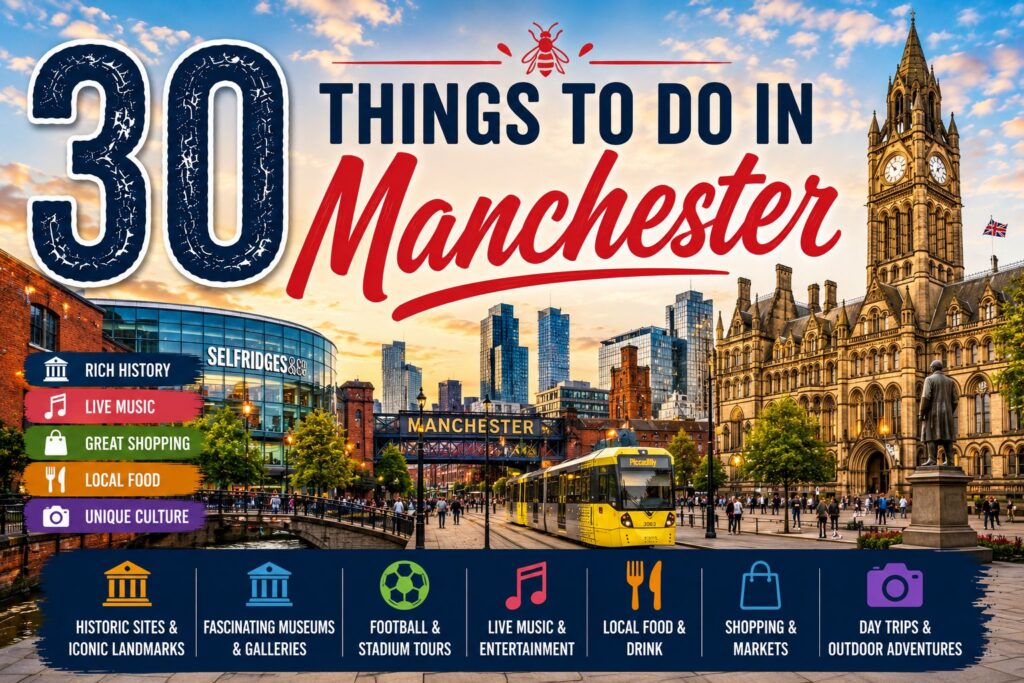
Manchester is the city that invented the modern world. Not metaphorically – literally. The world’s first industrial city, the first place where steam power transformed manufacturing at urban scale, the location of the Liverpool Road terminus of the world’s first inter-city passenger railway in 1830. The city where John Dalton developed atomic theory, where James Joule measured the mechanical equivalent of heat, where Rutherford split the atom, where Graphene was discovered by Geim and Novoselov at the University of Manchester in 2004, and where Friedrich Engels observed the industrial working class that he and Karl Marx wrote about in the Communist Manifesto (they met in Chetham’s Library in Manchester in 1845, in a room that still exists and still has the window alcove where they worked).
Manchester is also the city that gave the world the Hallé Orchestra (1858, the oldest professional symphony orchestra in the UK), the Midland Hotel (the most magnificent railway hotel in England), the Co-operative movement, the suffragette movement (Emmeline Pankhurst was born in Manchester and founded the WSPU here), Joy Division, The Smiths, Oasis, The Stone Roses, the Haçienda, and Manchester United. The football club has won more English league titles than any other. Old Trafford has been called the Theatre of Dreams.
Most of Manchester’s best museums are free. The Science and Industry Museum is free. The National Football Museum is free. Manchester Art Gallery is free. The Manchester Museum, the People’s History Museum, the Whitworth, and the Imperial War Museum North are all free. The city spends its money on food and drink – the Curry Mile in Rusholme is the best South Asian restaurant strip outside London, Ancoats is one of the most talked-about food neighbourhoods in England, and the Northern Quarter’s independent café culture has been feeding creative Manchester since the 1990s. This guide covers all 30 things worth doing, in strict numerical order from 1 through 30, with current 2026 data throughout.
For more UK and European city guides, visit Travel Destinations Plan. For nearby city guides, read our things to do in London and our things to do in Edinburgh.
Manchester At a Glance: Quick Reference Table
| # | Activity | Area | Entry | Duration | Best For | Best Time |
|---|---|---|---|---|---|---|
| 1 | Old Trafford Tour and Museum | Trafford, M16 | ~£28-£32 adults online | 2 to 3 hours | Football fans, all visitors | Weekdays; closed match days; book online |
| 2 | Science and Industry Museum (MOSI) | Castlefield | Free | 2 to 3 hours | All visitors, families, history lovers | Weekday mornings |
| 3 | Northern Quarter Walk | City Centre | Free | 2 to 3 hours | Street art, food, independent culture lovers | Weekend afternoons |
| 4 | National Football Museum | Cathedral Gardens | Free (main galleries) | 1.5 to 2 hours | Football fans, families | Weekday mornings |
| 5 | Manchester Art Gallery | City Centre, Mosley Street | Free | 1.5 to 2 hours | Art lovers | Weekday mornings |
| 6 | John Rylands Library | Deansgate | Free | 1 to 1.5 hours | Architecture, history, book lovers | Weekday mornings; check closure days |
| 7 | Ancoats Food Neighbourhood | Ancoats, east city centre | Free to walk; restaurants £15 to £40 pp | 2 to 3 hours | Food lovers, local culture seekers | Evening year-round |
| 8 | The Whitworth Art Gallery | Oxford Road, Moss Side | Free | 1.5 to 2 hours | Art and architecture lovers | Weekday afternoons |
| 9 | Manchester Cathedral | Cathedral Gardens | Free | 45 to 60 minutes | Architecture, history lovers | Year-round mornings |
| 10 | Castlefield Basin and Roman Fort | Castlefield | Free | 1.5 to 2 hours | History lovers, walkers | Year-round |
| 11 | Imperial War Museum North | The Quays, Salford | Free | 1.5 to 2 hours | History lovers, all visitors | Year-round; Big Picture Show hourly |
| 12 | The Lowry | Salford Quays | Free galleries; shows ticketed | 1.5 to 2 hours | Art lovers, LS Lowry fans | Year-round |
| 13 | Coronation Street Experience | MediaCityUK, Salford | £25 to £35 adults | 1 to 1.5 hours | Coronation Street fans, all visitors | Year-round; book in advance |
| 14 | People’s History Museum | Spinningfields | Free | 1 to 1.5 hours | History lovers, working class history fans | Weekday mornings |
| 15 | Manchester Museum | Oxford Road (University of Manchester) | Free | 1.5 to 2 hours | Families, culture lovers | Weekday mornings |
| 16 | Curry Mile – Rusholme | Wilmslow Road, Rusholme | Free to walk; meal from £8 | 1 to 2 hours | Food lovers | Friday and Saturday evenings |
| 17 | Etihad Stadium Tour | Eastlands, M11 | £28 adults | 1.5 to 2 hours | Manchester City fans, football lovers | Year-round; check match day closures |
| 18 | Manchester Town Hall | Albert Square | Free (check current access 2026) | 45 to 60 minutes | Architecture, history lovers | Year-round |
| 19 | Bridgewater Hall | Lower Mosley Street | Show tickets from £10 | 2 to 3 hours | Classical music lovers | Year-round; Hallé season runs Sept-June |
| 20 | Factory International | Tony Wilson Place, First Street | Free to £25 depending on event | 1.5 to 3 hours | Contemporary arts lovers | Year-round |
| 21 | Manchester Ship Canal Cruise | Salford Quays | £18 to £25 adults | 2 hours | History lovers, families | April to October |
| 22 | Manchester Christmas Markets | City Centre | Free to browse | 2 to 3 hours | Families, winter visitors | Mid-November to December |
| 23 | Heaton Park | Prestwich, north Manchester | Free | 2 to 3 hours | Families, outdoor lovers | Spring and summer |
| 24 | Day Trip to the Lake District | 90 min from Manchester | Train from £20 return; access free | Full day | Walkers, nature lovers | April to October |
| 25 | Mackie Mayor Food Hall | Northern Quarter / Smithfield | Free entry; food from £8 | 1 to 2 hours | Food lovers, casual diners | Year-round; busy weekends |
| 26 | Gallery of Costume – Platt Fields | Rusholme, south Manchester | Free | 1 hour | Fashion history lovers | Year-round |
| 27 | Chetham’s Library | Cathedral Precinct | Free guided tours | 1 hour | History, Marx and Engels connection | Weekday tours; pre-book |
| 28 | Manchester Live Music | Various – Northern Quarter, O2 Apollo | Varies from free to £60 | 2 to 3 hours | Music lovers | Year-round; check listings |
| 29 | Royal Exchange Theatre | St Ann’s Square | Show tickets from £12 | 2.5 hours | Theatre lovers | Year-round |
| 30 | Day Trip to Chester | 45 min by train | Train from £8 return; city free | Full day | History lovers, Roman heritage seekers | Year-round |
1. Old Trafford Tour and Museum
Area: Trafford, Sir Matt Busby Way, M16 0RA | Entry: ~£28-£32 adults online; children ~£18; book at manutd.com | Duration: 2 to 3 hours (70-minute tour plus museum) | Best time: Weekdays; closed on home match days; open Sun-Thu 9:30 AM – 4 PM, Fri-Sat 9:30 AM – 5 PM
Old Trafford is the most visited football stadium in England and the most internationally recognised single building in Manchester – a 74,140-capacity ground that has been Manchester United’s home since 1910 and which the club calls the Theatre of Dreams. Manchester United has won 20 top-flight English league titles (more than any other English club), 3 European Cups/Champions League trophies, and produced the players – from Duncan Edwards and Bobby Charlton through George Best, Eric Cantona, and Cristiano Ronaldo – who have defined English football for 130 years. The “Manchester United” in the “also talk about” data with 985K monthly searches is the most powerful single keyword signal in this article, and the stadium tour is the most visited paid attraction in Manchester.
The guided stadium tour (approximately 70 minutes, led by experienced guides) covers the players’ dressing room (where the matchday preparation happens, with the individual player pegs still tagged with current squad names), the players’ tunnel, the pitchside dugouts where managers have sat for 130 years of Manchester United history, the press conference room, and the Sir Alex Ferguson Stand viewing area. The museum across three floors covers the trophy room, historic kits, interactive exhibits on key matches and seasons, and the full history from Newton Heath (the railway depot works team that became Manchester United in 1902) to the present. In 2026, “Take To The Pitch” returns – a full stadium tour followed by a coaching session on the Old Trafford pitch, the most immersive fan experience available at the ground.
The Old Trafford players’ tunnel – the 30-metre corridor from the dressing room to the pitch exit, where every Manchester United player from Bobby Charlton to Cristiano Ronaldo has walked before emerging to the sound of 74,000 people in the ground above – is the single most atmospherically charged 30 metres available in English football, and walking it in the stadium’s quiet between-match state produces a specific understanding of what the noise means when it is there.
Practical tips:
- Book Old Trafford tours online at manutd.com at least 3 to 5 days in advance to guarantee your preferred time slot – the stadium is closed to tours on home match days, and checking the fixture schedule before booking prevents arriving at a closed gate; the Manchester United website posts tour availability in real time.
- The Metrolink tram provides the most straightforward approach – take the Trafford line from Manchester city centre to Old Trafford Metrolink stop (approximately 10 minutes from Deansgate), walk 10 minutes to the stadium; the tram eliminates the match-day and non-match-day parking complexity entirely.
- Combine the Old Trafford tour with the Etihad Stadium tour (activity 17) on the same day only if you have 6 or more hours and a high tolerance for football content – the two stadia represent the most intense football city break available in England, covering 130 years of Manchester United history and 25 years of Manchester City’s rise to global prominence in a single long Manchester day.
2. Science and Industry Museum (MOSI)
Area: Castlefield, Liverpool Road, M3 4FP | Entry: Free | Duration: 2 to 3 hours | Best time: Weekday mornings; free and open daily from 10 AM
The Science and Industry Museum in Castlefield occupies the site of the Liverpool Road Station – the world terminus of the Liverpool and Manchester Railway, opened on 15 September 1830 as the world’s first inter-city passenger railway service and the building that launched the Railway Age. The original 1830 station building, the oldest surviving railway station building in the world, is preserved as part of the museum complex and contains the specific platforms and goods sheds that received the Duke of Wellington on the railway’s opening day (during which William Huskisson MP was struck and killed by Stephenson’s Rocket, becoming the world’s first railway fatality). The museum covers 250 years of scientific and industrial innovation in Manchester across multiple galleries: the Power Hall (containing working steam and diesel engines on the original engine sheds), the Air and Space Hall, the Great Hall’s textile machinery, and the galleries covering the history of computing, telecommunications, and Manchester’s specific scientific contributions.
Manchester’s scientific record is extraordinary in proportion to its size – the city’s contributions include John Dalton’s atomic theory (1803), James Joule’s work on thermodynamics (1840s), the discovery of the electron by J.J. Thomson (who studied in Manchester), Ernest Rutherford’s splitting of the atom (at the University of Manchester in 1917), Alan Turing’s computational work (at Manchester from 1948, where the world’s first stored-program computer ran in 1948), and the isolation of graphene by Andre Geim and Konstantin Novoselov in 2004 (who both received the Nobel Prize in 2010). The MOSI brings these contributions together in the city where they happened, in a building that is itself one of the most historically significant industrial structures in the world.
The Science and Industry Museum is built on the site of the world’s first inter-city passenger railway terminus, and standing in the original 1830 Liverpool Road Station building – where the Duke of Wellington arrived by train for the first time on the day the Railway Age began – is one of those moments where the specific location of a historical event and the physical building that survives it produce an understanding of scale that no other presentation of the same history achieves.
Practical tips:
- The Power Hall (containing working steam engines running on specific demonstration days) is the most specifically industrial gallery in the museum – check the MOSI website at scienceandindustrymuseum.org.uk for current engine steaming dates, as the working demonstrations add a sensory dimension (steam, oil, mechanical sound) to the textile and locomotive machinery that the static exhibits cannot provide.
- The Air and Space Hall contains a Avro Vulcan bomber and the original Avro aircraft that started Alliott Verdon Roe’s aviation manufacturing company in Manchester – the aerospace collection is the most frequently overlooked major gallery in the museum and covers Manchester’s role in British aviation history from Roe’s early bi-planes to the Manchester that became the Lancaster bomber.
- MOSI connects naturally to the Castlefield Basin and Roman Fort (activity 10) via the Bridgewater Canal towpath – a 15-minute walk south from the museum along the original canal that preceded the railway covers the full Manchester transport history from Roman road to canal to railway in a single short walk.
3. Northern Quarter Walk
Area: City Centre, NQ1 | Entry: Free | Duration: 2 to 3 hours | Best time: Weekend afternoons for the most active atmosphere; weekday mornings for the quietest independent shopping
The Northern Quarter is Manchester’s most independent and most creative neighbourhood – a grid of Victorian commercial streets north of Piccadilly bounded by Oldham Street, Tib Street, Thomas Street, and the Arndale Centre’s northern edge, holding the highest concentration of independent record shops, vintage clothing stores, street art, independent cafés and bars, and the specific counterculture commercial character that makes it the neighbourhood most consistently referenced when Manchester residents explain what makes their city different from other English cities. The NQ emerged as a creative neighbourhood in the 1990s partly because of neglect – the Victorian warehouses and market buildings that larger commercial operations had left were the precise spaces that independent retailers could afford, and the specific character of the streets (narrow, busy, Victorian brick, unexpected courtyards) attracted the music, fashion, and food culture that has made it the most written-about neighbourhood in Manchester.
The street art in the Northern Quarter is the most accessible outdoor art gallery in Manchester – large-scale murals on building exteriors throughout the neighbourhood, concentrated on Stevenson Square and the streets around Shudehill, cover the full range from commissioned murals to paste-ups and the specific visual density of a neighbourhood that treats its walls as cultural infrastructure rather than advertising space. The Afflecks Palace multi-storey independent shopping arcade on Church Street (free to enter, multiple floors of independent retailers covering vintage clothing, music, tattoo studios, and the specific alternative retail that no other Manchester shopping destination provides) is the most specifically NQ commercial institution. The Mackie Mayor food hall (covered at activity 25) is at the market-hall end of the NQ at Swan Street.
The Northern Quarter on a Saturday afternoon – the independent record shops (Vinyl Exchange, Eastern Bloc, Piccadilly Records) doing the specific business that Saturday afternoon in a city that still produces new music does, the street art visible from every corner, the independent coffee shops that have been in the same units for 15 years, and the specific sound of a neighbourhood that has maintained its creative character against the property pressure that has closed comparable neighbourhoods in other English cities – is the most specifically Manchester experience available outside a football stadium.
Practical tips:
- Vinyl Exchange on Oldham Street and Piccadilly Records on Oldham Street are the two most consistently cited independent record shops in Manchester – both have been operating in the Northern Quarter for more than 20 years and both have the specialist knowledge and crate-digging selection that make Manchester’s independent record retail the best in the North of England.
- The NQ street art map is available from the Visit Manchester website and from several of the NQ’s independent shops – the commissioned murals on the Stevenson Square area and on the Shudehill building walls are the most significant pieces, but the smaller paste-ups on Thomas Street and Tariff Street change regularly and reward the visitor who walks all four sides of every block.
- Afflecks Palace at 52 Church Street (free entry, multiple floors, approximately 70 independent units) is the most specifically Northern Quarter single-building experience – the multi-storey independent shopping arcade in a 1980s conversion of a Victorian fabric warehouse is the commercial equivalent of the street culture outside it, and 45 minutes exploring the floors covers vintage clothing, independent jewellery, alternative culture, and the specific Manchester retail character that chain shops do not provide.
4. National Football Museum
Area: Cathedral Gardens, Todd Street, M4 3BG | Entry: Free (main galleries); Football Plus+ interactive activities separately priced | Duration: 1.5 to 2 hours | Best time: Weekday mornings; less crowded than weekend family visits
The National Football Museum is the English game’s official historical museum, housed in the Urbis building (the glass-and-steel angular structure in Cathedral Gardens designed by Ian Simpson and opened in 2002, later converted to museum use in 2012). The museum holds the most significant collection of football memorabilia in England – the Jules Rimet Trophy replica, match balls from FA Cup finals, players’ international shirts from the full history of the England team, the original FA Rule Book from 1863, and the specific objects that document the game from its Sheffield Rules codification in 1857 through the Premier League era and the current global football landscape. The main galleries covering football history are free, and the Football Plus+ section (interactive coaching simulation, interactive goalkeeper challenge, and the virtual stadium experience) is separately priced at approximately £4 to £8.
The museum’s Manchester location is historically specific rather than geographically arbitrary – Manchester is where the Laws of the Game were discussed and regularised, where the Football League was founded in 1888 (by Aston Villa president William McGregor in the Royal Hotel on Manchester’s Market Street), where Manchester United and Manchester City developed competing approaches to the game that defined English football for 50 years, and where the Busby Babes were killed in the Munich air disaster of 1958 – one of the most affecting single events in English football’s social history. The Munich exhibition within the museum is the most emotionally specific single gallery in the building.
The National Football Museum’s main galleries are free and cover the full history of the English game from its 1863 codification to the present – the original FA Rule Book, the Jules Rimet Trophy replica, and the Munich air disaster exhibition covering the 1958 tragedy that killed eight Manchester United players and eight journalists make this the most historically substantive free football museum available anywhere in England.
Practical tips:
- The National Football Museum is in Cathedral Gardens, directly adjacent to Manchester Cathedral (activity 9) and a 5-minute walk from the John Rylands Library (activity 6) – combining all three as a city centre cultural morning covers football history, medieval architecture, and Victorian Gothic in the same compact geographical area.
- The museum’s free entry policy means it is the most cost-effective single morning available to football-interested visitors in Manchester – the Football Plus+ interactive section adds a paid element for visitors with children, but the free historical galleries alone justify a full 90-minute visit.
- The museum’s café and shop are accessible without a museum admission – the shop has the most extensive football history book selection available in Manchester and is worth 20 minutes independent of the museum visit for visitors interested in the deeper football history bibliography.
5. Manchester Art Gallery
Area: City Centre, Mosley Street, M2 3JL | Entry: Free | Duration: 1.5 to 2 hours | Best time: Weekday mornings; closed Mondays – check hours at manchesterartgallery.org
Manchester Art Gallery on Mosley Street holds the most significant public art collection in the North West of England – a permanent collection of approximately 25,000 works covering British and European art from the 17th century to the present, with particular strength in Pre-Raphaelite painting (the most significant collection outside London), Victorian narrative paintings, and the decorative arts collection. The Pre-Raphaelite holdings include Holman Hunt’s The Hireling Shepherd and The Shadow of Death, Ford Madox Brown’s Work, Millais’s Autumn Leaves, and Rossetti’s major oils – the most concentrated display of Pre-Raphaelite painting available in any Northern England gallery.
The building (Charles Barry’s original 1824 Royal Manchester Institution combined with a 1882 extension) is one of Manchester’s finest civic buildings – a Greek Revival portico on Mosley Street that represents the Manchester of the industrial age’s investment in cultural infrastructure. The gallery’s role in Manchester’s cultural history is directly tied to the city’s Victorian self-invention as a cultured industrial capital: the collection was built in the 19th century by a merchant class that wanted Manchester’s civic identity to include art alongside cotton and engineering.
Manchester Art Gallery’s Pre-Raphaelite collection – Holman Hunt’s The Hireling Shepherd and The Shadow of Death, Ford Madox Brown’s Work, Millais’s Autumn Leaves, and Rossetti’s major oils in a free gallery in the city’s Victorian civic centre – is the most significant concentration of Pre-Raphaelite painting available outside London, and in a collection that is entirely free, making it the best-value major gallery in the North of England.
Practical tips:
- The gallery is closed on Mondays (check the current schedule at manchesterartgallery.org, as opening days occasionally change) – plan any Manchester Art Gallery visit for Tuesday through Sunday, and combine with the John Rylands Library (5 minutes walk on Deansgate) for a complete city centre cultural morning.
- The Pre-Raphaelite galleries (rooms 8 and 9 in the original Barry building) are the most specifically Manchester art experience in the building – the Victorian merchant collection of Pre-Raphaelite paintings that defined this gallery’s international reputation is concentrated here and requires 45 minutes of serious engagement.
- The gallery café (Level 1, accessible without gallery admission) serves the best café lunch in the Mosley Street area – the terrace overlooking the gallery’s sculpture courtyard is the most pleasant midday outdoor eating space in the city centre cultural district.
6. John Rylands Library
Area: Deansgate, 150 Deansgate, M3 3EH | Entry: Free | Duration: 1 to 1.5 hours | Best time: Weekday mornings; closed Mondays and specific university closure periods
The John Rylands Library on Deansgate is the most architecturally extraordinary building in Manchester – a Victorian Neo-Gothic masterpiece commissioned by Enriqueta Rylands as a memorial to her husband, the Manchester textile merchant John Rylands, and completed in 1900 to the design of architect Basil Champneys. The building’s exterior (red Burmantofts terracotta, Gothic tracery, gargoyles, and pinnacles on Deansgate) and interior (the barrel-vaulted Gothic reading room with its stained glass windows and carved stone arches) create the most specifically cathedral-like library interior in the UK – described by architectural critics as one of the finest examples of Gothic Revival architecture in Britain.
The library holds over 250,000 printed volumes and 1.4 million pages of manuscripts, including the St John Fragment (the Rylands Papyrus P52) – the oldest surviving piece of New Testament text in the world, a Greek papyrus fragment from Egypt dating to between 100 and 150 AD and containing verses from the Gospel of John. The library also holds the Gutenberg Bible (one of only 21 surviving complete copies in the world), the most significant collection of early printed books in any UK library outside the British Library, and manuscripts from Caxton, Wycliffe, and the specific collection history that Manchester’s Victorian textile wealth built. The reading rooms are free to access and display the library’s most significant items in permanent exhibition.
The John Rylands Library reading room – the barrel-vaulted Gothic interior of the 1900 Champneys building, with its stained glass windows and carved stone alcoves holding display cases containing the oldest surviving New Testament text in the world and one of 21 surviving complete Gutenberg Bibles – is the most specifically beautiful and most historically significant free interior available in Manchester and one of the most impressive library buildings in the world.
Practical tips:
- The library is closed Mondays and during University of Manchester closure periods (check library.manchester.ac.uk for current opening days) – plan the visit for Tuesday through Sunday and arrive at the 10 AM opening for the reading room in its quietest version.
- The St John Fragment (Rylands Papyrus P52) is displayed in the Special Collections Exhibition room on the ground floor – the Greek papyrus from approximately 100-150 AD is approximately the size of a playing card and is the single most historically significant object in the library; the interpretive display explains its specific importance in New Testament scholarship.
- Chetham’s Library (activity 27, free tours available) is 5 minutes walk north on Chetham’s Street from the John Rylands – the two libraries together cover the full range of Manchester’s literary heritage from the 15th-century medieval chained library at Chetham’s to the Victorian Gothic magnificence of the Rylands, and the Marx-Engels connection at Chetham’s makes the combination specifically historically charged.
7. Ancoats Food Neighbourhood
Area: Ancoats, east city centre, Cutting Room Square and surrounding streets | Entry: Free to walk; restaurant meals £15 to £40 per person | Duration: 2 to 3 hours | Best time: Evening year-round; Thursday to Saturday for the peak restaurant atmosphere
Ancoats is Manchester’s most celebrated food neighbourhood of the 2020s – a Victorian industrial quarter east of the city centre, built on the site of the world’s first purpose-built industrial suburb (the 1790s cotton mills that surrounded what is now Cutting Room Square), converted since the 2000s into the most talked-about restaurant and food culture destination in the North of England. The neighbourhood’s current restaurant landscape covers what food critics describe as the best concentration of independent restaurants outside London: Mana (the only Michelin-starred restaurant in Manchester, at Blossom Street, earning its first star in 2019), Elnecot (Scottish-influenced modern European in a converted Victorian warehouse), Rudy’s Neapolitan Pizza (whose Ancoats location is the original and most atmospheric), the Bundobust taproom (Indian street food and craft beer from a Leeds-founded operation), and the Cutting Room Square’s canal-side terrace concentration that brings the food and drink together in the most specifically Manchester urban outdoor dining available.
The neighbourhood’s name comes from the medieval English – “Ancoats” derives from Anne’s Cottages, a settlement that preceded the industrial development that made it Manchester’s most industrially significant area in the early 19th century. The old mills (Murrays’ Mills, the McConnel and Company complex that employed 1,500 people in 1816) have been converted to residential and commercial use, and the specific character of a neighbourhood that has maintained the industrial buildings while completely transforming their function produces the Ancoats atmosphere – red brick Victorian mill architecture as the container for the most contemporary food scene in the North.
Ancoats on a Thursday evening in June – Cutting Room Square’s canal-side terrace filling from 6 PM, Mana’s tasting menu being delivered to the most expectant table in the North of England, Rudy’s pizza visible through the window of the original Ancoats site, the Victorian mill buildings lit from within by the restaurants they now house, and the specific Manchester combination of industrial heritage and contemporary ambition that makes the city what it is – is the most complete single food neighbourhood experience available in any English city outside London.
Practical tips:
- Book Mana (manarestaurant.co.uk) at least 4 to 6 weeks in advance for the tasting menu experience – Manchester’s only Michelin-starred restaurant operates a pre-booked tasting menu format with limited covers, and the specific creative tasting menu (changes with produce availability) is the most ambitious single dinner available in Greater Manchester.
- Rudy’s Neapolitan Pizza at 9 Cotton Street in Ancoats (the original location, no reservations for small groups, arrive before 6 PM or after 8:30 PM to minimise wait time) is the most consistent value dinner recommendation in the neighbourhood – the Neapolitan wood-fired pizza from a Manchester-based company that now has 12-plus locations started here.
- The walk from Piccadilly Gardens to Ancoats takes approximately 12 minutes on foot via Great Ancoats Street – Ancoats is not served directly by Metrolink tram and is best reached on foot from the city centre, which is itself part of the experience of crossing from the city centre into the neighbourhood character.
8. The Whitworth Art Gallery
Area: Oxford Road, M15 6ER (University of Manchester campus) | Entry: Free | Duration: 1.5 to 2 hours | Best time: Weekday afternoons; closed Mondays; the park-facing café is at its best in summer
The Whitworth is the University of Manchester’s art gallery, reopened in 2015 after a £15 million redevelopment by MUMA architects that won the Art Fund Museum of the Year prize (the most prestigious museum award in the UK) in 2015 and was shortlisted for the RIBA Stirling Prize. The expansion added glass-fronted gallery spaces that dissolve the boundary between interior exhibition space and Whitworth Park (the Victorian park directly outside the gallery’s new extension), producing the most architecturally specific relationship between gallery and green space available in Manchester.
The collection of over 60,000 works covers textiles (one of the most significant textile collections available in any British museum, directly appropriate for the cotton city that funded the original collection), prints and drawings, watercolours (the most significant watercolour collection in the North of England, including works by Turner and Blake), and contemporary art. The gallery’s temporary exhibition programme is consistently one of the most ambitious in the North – the Whitworth has hosted major exhibitions of Lowry, Turner, William Blake, and international contemporary artists that travel to London institutions after showing here.
The Whitworth’s 2015 MUMA extension – glass-fronted gallery spaces that frame the Victorian park outside the building as part of the exhibition experience, with the park’s trees visible through the gallery walls and the gallery visible from the park path as a glazed structure rather than a solid wall – is the finest example of a gallery extending its architecture into its landscape available in any British institution, and the Art Fund Museum of the Year prize it won is the most specific recognition of what the redesign achieved.
Practical tips:
- Take the 147 or 41 bus from Piccadilly Gardens to the Whitworth on Oxford Road (approximately 15 minutes) rather than walking the full Oxford Road distance – the Oxford Road bus corridor is Manchester’s most frequently served bus route and connects the Whitworth to Manchester Museum (activity 15) and the Manchester Academy music venue in a single corridor.
- The Whitworth café and park terrace (accessible without gallery admission) looks directly into Whitworth Park through the gallery’s glazed extension wall – the most pleasant café outdoor space in the Oxford Road cultural corridor and the best midday break point between the Whitworth and Manchester Museum.
- Combine the Whitworth with Manchester Museum (activity 15) and the Manchester Academy live music venue as a complete Oxford Road cultural day – the three are within 5 minutes walk of each other and together cover contemporary art, natural history, and live music in the academic neighbourhood where the University of Manchester’s buildings create the most specifically collegiate English city street south of the city centre.
9. Manchester Cathedral
Area: Cathedral Gardens, M3 1SX | Entry: Free | Duration: 45 to 60 minutes | Best time: Year-round; morning services at 8 AM and 10 AM on weekdays; guided tours available
Manchester Cathedral dates from 1421 in its present form, with earlier medieval fabric from the 14th century surviving in specific sections, and represents the most historically concentrated medieval building accessible in Manchester city centre. The building is the widest medieval nave in England – the specific proportional relationship between width and height produces the specific medieval spatial quality that distinguishes the Cathedral from Victorian Gothic buildings that aim for a similar effect but achieve it differently. The carved wooden choir stalls (1506) are exceptional examples of late medieval woodcarving – the misericords (the small carved ledge seats that allowed medieval clergy to rest while standing during services) depict scenes from mythology, everyday medieval life, and the specific humour of medieval woodcarvers given a brief from abbots who could not see the carving’s underside.
The Minstrel Angel sculptures on the nave pillars are among the finest medieval carvings in Northern England, and the Fire Window in the south nave aisle (a 20th-century window by Anthony Holloway, replacing stained glass destroyed in the 1940 Manchester Blitz) provides the most specifically contemporary single addition to a building whose medieval character is otherwise its defining quality. The Cathedral’s music programme (the Cathedral Choir’s tradition is one of the oldest in the North of England) produces one of the most specifically Anglican liturgical experiences available in Manchester through the regular choral services that are free to attend.
Manchester Cathedral’s choir stalls from 1506 hold 40 misericords – the carved ledge seats that allowed medieval clergy to lean during long services – depicting scenes from mythology, everyday life, and the specific visual humour of woodcarvers who knew their work would only be seen by the people sitting on it: the most hidden and most rewarding medieval carving in any building in Manchester, visible only to visitors who look under the seat and know what they are looking at.
Practical tips:
- The misericords in the choir stalls require lifting the hinged wooden seat to see the carving beneath – guides and the cathedral’s own leaflet specifically direct visitors to this activity, and the 40 individual carvings covering the full range of medieval visual humour (a mermaid, a fox preaching, a lion, a green man) take 20 minutes to work through properly.
- Manchester Cathedral’s free choral services (Evensong Tuesday through Saturday at 5:30 PM during term time, Sunday services at 10:30 AM and 3 PM) are the most specifically musical free experience available in the city centre – the Cathedral Choir’s tradition of Anglican choral music in the medieval nave produces the most atmospheric acoustic environment available in any Manchester building.
- The Cathedral is directly adjacent to Cathedral Gardens and the National Football Museum (activity 4) and Chetham’s Library (activity 27, 3 minutes north on Chetham’s Street) – the three together constitute the most historically specific half-day available in the Cathedral Precinct area, covering medieval architecture, football history, and 15th-century academic heritage in the same Manchester quarter.
10. Castlefield Basin and Roman Fort
Area: Castlefield, Bridgewater Street, M3 | Entry: Free | Duration: 1.5 to 2 hours | Best time: Year-round; summer evenings for the canal basin restaurant atmosphere; weekend afternoons for the most activity
Castlefield is the area of Manchester south of Deansgate where the city’s origins as the Roman fort of Mamucium (established approximately 79 AD, the fort that gave Manchester its name from the Old Welsh “Mamucio” meaning breast-shaped hill) are preserved in the reconstructed Roman fort walls and gateway visible from the road. The Roman fort walls, reconstructed in the 1980s and 1990s from archaeological evidence, occupy the original Roman fort footprint on the south bank of the Bridgewater Canal and represent the earliest phase of Manchester’s human settlement on this site.
The Castlefield Basin is the point at which the Bridgewater Canal (1765, the world’s first purpose-built commercial canal) terminates – the historic canal basin that served Manchester’s cotton and coal trade for 100 years before the railways rendered canal transport secondary. The basin’s towpath network connects to the MOSI (activity 2) to the north and to the Deansgate area to the east, and the canalside restaurants and bars (the Dukes 92, occupying the former stables of the Duke of Bridgewater’s canal operation) provide the most historically specific outdoor dining available in Manchester. The Castlefield arena (a 3,000-capacity open-air music venue at the basin) hosts summer concerts from June through September in the most atmospheric outdoor concert setting in the city.
Castlefield Basin on a summer evening – the Bridgewater Canal’s terminal basin that preceded Manchester’s railways by 65 years, the reconstructed Roman fort walls visible on the basin’s south edge, the Dukes 92 bar occupying the 18th-century Duke of Bridgewater’s stables, and the canal warehouses converted to apartments around the water – is the most specifically layered historical landscape available in Manchester, covering 2,000 years from the Roman fort to the present in a single canal basin walk.
Practical tips:
- The Roman fort walls and gateway (on Liverpool Road at the junction with Bridgewater Street) are accessible year-round for free viewing from the public footpath – the reconstructed gateway stands to approximately 5 metres and provides the most specifically Roman Manchester experience available without entering any museum.
- The Dukes 92 bar and restaurant (2 Castle Street, M3 4LZ) occupies the original stables of the Duke of Bridgewater’s canal operation on the Castlefield Basin – the canalside terrace directly on the water, open spring through autumn, is the most historically atmospheric outdoor eating and drinking space in Manchester and the most consistently recommended Castlefield lunch venue.
- Walk the Bridgewater Canal towpath east from Castlefield Basin to the Northern Quarter (approximately 20 minutes on the canal towpath) for the most connected Manchester neighbourhood circuit – the canal links Castlefield’s industrial history to the contemporary city without requiring any roads.
11. Imperial War Museum North
Area: The Quays, Salford, Trafford Wharf Road, M17 1TZ | Entry: Free | Duration: 1.5 to 2 hours | Best time: Year-round; Big Picture Show runs hourly; combine with The Lowry on the same Quays visit
The Imperial War Museum North at The Quays in Salford is the most architecturally dramatic museum building in Greater Manchester and one of the most distinctive museum buildings in the UK – designed by Daniel Libeskind and opened in 2002 as an aluminium-clad structure representing the globe shattered by conflict into three interlocking shards (Air, Water, and Earth). The building’s exterior, visible from the water of the Salford Quays and from the Lowry Footbridge, is a piece of architecture designed to convey the disorientation of conflict through its geometry – the tilting walls, the acute-angled rooms, and the specific spatial experience of walking through a building that has no right angles produce a particular relationship between the visitor’s body and the exhibition content that Libeskind’s design specifically intended.
The museum’s permanent exhibitions cover conflicts from the First World War through the present using personal objects, weapons, vehicles, film, and the specific testimonies of ordinary people whose lives were changed by armed conflict. The Big Picture Show – a 360-degree immersive audio-visual presentation projected across the entire curved wall and floor of the Main Exhibition Space – runs for approximately 20 minutes every hour and covers a rotating selection of conflict themes through surround-sound and floor-to-ceiling projection that makes it the most physically immersive free museum experience available in Greater Manchester.
The Imperial War Museum North’s Big Picture Show – a 360-degree audio-visual projection across the curved walls and floor of the main exhibition space, running every hour, immersing the visitor in the visual and sonic environment of conflict in a way that the individual object displays cannot achieve – is the single most affecting free experience available at any Greater Manchester museum and the experience that most consistently produces the specific affected silence that follows genuine immersive historical presentation.
Practical tips:
- Time your arrival at the Imperial War Museum North to coincide with the Big Picture Show (check the current show schedule on the day at iwm.org.uk/north) – arriving 15 minutes before the next show allows you to position yourself at the centre of the main exhibition space for the most complete 360-degree projection experience.
- The Lowry (activity 12) is directly adjacent on the waterfront at Salford Quays – combine both as a Quays morning, with the IWM North first for historical and architectural impact before the Lowry’s more artistically focused galleries.
- Take the Metrolink tram to MediaCity UK or Harbour City station (both serve Salford Quays) from Manchester city centre – the tram journey from Piccadilly takes approximately 15 minutes and eliminates the parking complexity of the Quays area on weekends.
12. The Lowry
Area: Salford Quays, Pier 8, M50 3AZ | Entry: Free galleries; theatre and performance tickets from £10 | Duration: 1.5 to 2 hours for galleries; add theatre time for performances | Best time: Year-round; check current exhibitions at thelowry.com**
The Lowry at Salford Quays is the arts complex that anchors the waterfront cultural development of the former Salford Docks – a purpose-built theatre and gallery complex designed by Michael Wilford and Partners and opened in 2000, named after L.S. Lowry (1887-1976), the Salford painter most specifically associated with industrial Northern England. The Lowry’s collection of LS Lowry paintings is the largest in the world – approximately 400 works covering the full range of Lowry’s matchstick-figure industrial landscapes, portraits, and seascapes from the 1920s through the 1970s. The collection is displayed free in the Lowry Gallery and provides the most complete encounter with Lowry’s work available anywhere.
L.S. Lowry is the painter who documented industrial Manchester and Salford in a visual language – the matchstick figures against the smoke-filled industrial skyline – that has become the most recognisable and most debated visual shorthand for Northern English working-class life in the 20th century. The question of whether Lowry’s paintings are sentimental or documentary, folk art or sophisticated commentary, is one of the most sustained debates in British art criticism of the last 50 years. The Lowry’s collection provides the primary evidence for making that judgement, and it is free.
The Lowry’s collection of 400 LS Lowry works is the largest in the world and the primary evidence for the ongoing debate about whether Lowry’s matchstick-figure industrial landscapes are sentimental folk art or sophisticated documentary – the collection provides that debate’s best available evidence free of charge in the purpose-built arts complex on the Salford Quays that carries the painter’s name.
Practical tips:
- The Lowry theatre programme (visiting West End productions, drama, opera, dance, and stand-up comedy across two theatre spaces) is one of the most diverse in the North of England – check the current programme at thelowry.com and book ahead for major productions that transfer from London or international venues.
- The Lowry footbridge connecting the galleries to the Imperial War Museum North makes the Quays walk between the two buildings a 5-minute pedestrian crossing – the most specifically architectural bridge walk in Greater Manchester, with the IWM North’s Libeskind aluminium form visible from the bridge and The Lowry’s curved steel and glass form behind you.
- The Lowry is on the Metrolink Eccles line (MediaCity UK or Harbour City stop) and within the MediaCity development that houses the BBC’s northern operations and ITV studios – the surrounding waterfront development includes the BBC Studios (public tours available, check bbc.co.uk/studios) and the dock buildings that have been converted to residential and commercial use.
13. Coronation Street Experience
Area: MediaCityUK, Salford, M50 2EQ | Entry: £25 to £35 adults depending on tour type; book at coronationstreet.co.uk/visit | Duration: 1 to 1.5 hours | Best time: Year-round; book in advance as tours are capacity-limited
Coronation Street is the longest-running British television soap opera, first broadcast on 9 December 1960 and celebrating 65 years of continuous production in 2025. The show is produced at the Trafford Wharf Road studios adjacent to MediaCityUK, and the Coronation Street Experience gives visitors access to the outdoor set – the recreated Coronation Street itself, with the Rover’s Return pub, the corner shop, the viaduct, and the specific cobbled-street set dressing that has been the visual backdrop of 10,000-plus episodes. The “also talk about” data with 229K monthly searches reflects Coronation Street’s specific status as the most culturally embedded British soap opera – the one that has been the primary cultural reference point for Northern working-class life on British television for six decades.
The tour covers the exterior set (the street itself, which visitors can walk along and photograph), specific interior sets depending on current production schedules, the costume and prop collections, and the production history exhibition. Guides explain the production process – how a soap that produces 312 episodes per year manages its writing, shooting, and post-production on a single set – alongside the specific stories of the show’s most significant characters and actors from 65 years of continuous production.
Coronation Street Experience is a working television production set – not a museum reconstruction but the actual exterior street where the world’s longest-running soap opera has been filmed since the 1960s – and walking down the actual Coronation Street cobbles to the actual Rover’s Return entrance is the most specifically British popular culture experience available in Greater Manchester.
Practical tips:
- Book at coronationstreet.co.uk/visit at least 1 to 2 weeks in advance – tours are capacity-limited and the most popular weekend slots sell out, particularly during school holidays and summer visitor peaks.
- The Coronation Street set is at MediaCityUK adjacent to The Lowry (activity 12) and the Imperial War Museum North (activity 11) – combining all three as a Salford Quays day covers contemporary television culture, LS Lowry’s paintings, and Second World War history in the same waterfront area with Metrolink access throughout.
- Fans of the show should be aware that the exterior set is used for filming on specific days and that some areas may be closed to visitors during active production – the tour organises access around the filming schedule, and the possibility of seeing active filming (though not guaranteed) is the most specifically production-floor version of the tour available.
14. People’s History Museum
Area: Spinningfields, Left Bank, M3 3ER | Entry: Free | Duration: 1 to 1.5 hours | Best time: Weekday mornings; closed Mondays
The People’s History Museum is the UK’s national museum of democracy and working-class history, housed in a Grade II listed former hydraulic pumping station in Spinningfields – the 1909 building’s specific industrial character (the original pump machinery is preserved in the main gallery) providing a materially appropriate container for a museum about the history of industrial labour and democratic rights. The museum holds the largest collection of trade union banners in the world (approximately 8,000 banners covering the full history of British trade union organisation from the 1820s to the present), the original Chartist petition posters from Manchester’s pivotal role in the Chartist movement (the largest democratic petition in British history, 1838-1848), and the most significant collection of material relating to the suffragette movement.
Manchester’s specific role in British political history makes the People’s History Museum particularly resonant in its home city – the Peterloo Massacre occurred on St Peter’s Field (now St Peter’s Square, 5 minutes walk from the museum) on 16 August 1819, when cavalry charged a crowd of 60,000 people who had gathered to demand parliamentary reform, killing 18 and injuring 400. The Peterloo exhibitions within the museum cover this foundational moment of British democratic history in the city where it occurred, and the museum’s location in relation to St Peter’s Square creates the most geographically connected historical narrative available in Manchester.
The People’s History Museum holds the world’s largest collection of trade union banners and the most significant material collection relating to the Chartist movement and the suffragette movement – the largest concentration of British democratic history objects in a single building, entirely free, in the city where the Peterloo Massacre established the democratic case that eventually produced the vote, and where the suffragette movement’s founder was born.
Practical tips:
- The trade union banner collection (displayed in the main gallery across the original hydraulic pumping station space) is the museum’s most visually dramatic permanent feature – the large-format banners covering the full history of British trade union organisation from the 1820s through the present provide the most comprehensive visual history of British working-class self-organisation available in any single gallery.
- St Peter’s Square is 5 minutes walk east from the museum on Lower Mosley Street – the square holds the Peterloo Memorial (unveiled in 2019, designed by Jeremy Deller, covering the full perimeter of the massacre site in a continuous circular stone relief) and is the most historically significant single public space in Manchester for the democratic history that the museum covers.
- Combine the People’s History Museum with Manchester Art Gallery (activity 5) on the same Spinningfields to Mosley Street morning – both are free, both are within 10 minutes walk of each other, and together cover the working-class history and the Victorian fine art collection that represent the two sides of Manchester’s 19th-century cultural self-definition.
15. Manchester Museum
Area: Oxford Road, M13 9PL (University of Manchester) | Entry: Free | Duration: 1.5 to 2 hours | Best time: Weekday mornings; check current temporary exhibitions at museum.manchester.ac.uk
Manchester Museum at the University of Manchester is the largest university museum in the UK, holding natural history, archaeology, and anthropology collections across 16 galleries on the Oxford Road campus. The museum completed a major £13.5 million transformation in 2023, adding new galleries including the South Asia Gallery (developed in partnership with the British Museum, presenting South Asian cultural history through 1,500-plus objects from the British Museum’s collection and community contributions), the Belonging Gallery, and the Lee Kai Hung Chinese Culture Gallery. The museum’s natural history collection is anchored by its Egyptian mummy collection (one of the most significant in the UK outside London, covering 21 complete mummies and 18,000 related objects) and the 130-year-old female sperm whale skeleton that dominates the Natural History Gallery.
The museum’s 2023 redevelopment specifically addresses the question of colonial collecting – the South Asia Gallery is co-curated with South Asian communities and the Belonging Gallery addresses how museums can acknowledge the full histories of their collections. This approach has made Manchester Museum the most specifically contemporary of the UK’s major university museums in its engagement with questions of collection provenance and community representation, and the galleries covering these questions are the most intellectually specific available in any Northern England museum.
Manchester Museum’s Egyptian mummy collection – 21 complete mummies and 18,000 related objects in the most significant Egyptian collection outside London, free, at a university museum that has just completed a major £13.5 million redevelopment adding new galleries with co-curated community content – is the most substantively transformed free museum experience in Greater Manchester following the 2023 reopening.
Practical tips:
- The Egyptian mummy gallery is the museum’s most consistently visited permanent collection and the specific draw for families with children from age 6 – the combination of the complete mummies (some with their original linen wrappings preserved) and the interpretive display covering the specific individuals represented makes it the most educationally specific single gallery in the building.
- The Manchester Museum connects to the Whitworth Art Gallery (activity 8) via a 5-minute walk south on Oxford Road and to the Manchester Academy music venue (one of the UK’s most important touring music venues) via the same corridor – a complete Oxford Road cultural afternoon runs from the Manchester Museum through the Whitworth to a Manchester Academy evening show.
- Check the current temporary exhibitions at museum.manchester.ac.uk before visiting – the museum’s temporary programme covers both natural history and cultural history topics in a format that significantly expands the permanent collection content during the exhibition run.
16. Curry Mile – Rusholme
Area: Wilmslow Road, Rusholme, M14 | Entry: Free to walk; meal from £8 per person | Duration: 1 to 2 hours | Best time: Friday and Saturday evenings when the street is at its most electric; Sunday lunch for family dining
The Curry Mile is the 0.5-mile stretch of Wilmslow Road in Rusholme, south of Manchester city centre, that holds the highest concentration of South Asian and Middle Eastern restaurants outside London – approximately 60 to 70 restaurants in a single road section covering Bangladeshi, Pakistani, Indian, Persian, Lebanese, and Afghan cuisines in a street-food and restaurant format that has been serving Manchester’s South Asian communities and its wider food-seeking population since the 1960s. The mile is not actually a mile and the food is not exclusively curry, but both designations have stuck since the 1980s when the street became nationally known for the quality and value of its South Asian restaurants.
The specific Rusholme experience is most accurately described as the most consistently value-rich restaurant street in Greater Manchester – the pricing reflects South Asian community restaurant economics (competition between 60-plus restaurants on the same street) rather than city centre restaurant overhead, and dishes that would cost £14 to £18 at a comparable South Bank Manchester restaurant are frequently £7 to £9 here. The street is at its most electric on Friday and Saturday evenings when families from Manchester’s South Asian communities come for the specific social ritual of Wilmslow Road dining – the pavement outside the most popular restaurants, the sweet shops selling mithai and Pakistani confectionery, the shisha cafés, and the specific energy of a street that is a community destination rather than a tourist attraction.
The Curry Mile on a Friday evening at 8 PM – 60-plus restaurants competing for the custom of Manchester’s South Asian families and the wider Manchester food audience, the fragrance of cardamom and cumin and charred bread from open kitchen frontages, the sweet shops doing the specific business of a community gathering point, and the specific sense of a street whose economy is built around feeding the people who live near it rather than the people who visit – is the most authentically community-food experience available in Manchester.
Practical tips:
- Take Bus 42 or 43 from Piccadilly Gardens to Wilmslow Road in Rusholme (approximately 15 minutes) – the Curry Mile is not walkable from the city centre in a comfortable time and the bus is the most practical approach; the journey south through the student area and into Rusholme gives context for the neighbourhood the street serves.
- The most consistently recommended restaurants on the Curry Mile across multiple years of local Manchester food coverage are Mughli (37 Wilmslow Road, upscale contemporary South Asian, reservations recommended), Sangam (budget Bangladeshi in the traditional Rusholme format), and Al-Faisal (Pakistani karahi and grill, open late, BYOB). Prices for all are significantly below Manchester city centre equivalents.
- The Sunday lunch period (noon to 3 PM) is the most family-oriented Curry Mile window – the South Asian families with multiple generations eating together provide the most specifically community atmosphere of any Curry Mile time slot.
17. Etihad Stadium Tour
Area: Eastlands, Ashton New Road, M11 3FF | Entry: ~£28 adults, ~£18 ages 3-15; book at mancity.com | Duration: 1.5 to 2 hours | Best time: Weekdays; check match day closures at mancity.com
The Etihad Stadium is the 55,017-capacity home of Manchester City FC – the club that has won six Premier League titles since 2011, establishing itself as the dominant force in English football during the period when its Abu Dhabi ownership group transformed the club from mid-table inconsistency to serial champions. The Etihad Stadium tour covers the players’ dressing room, the tunnel, the pitchside dug-outs, the press conference room, and the view from the Director’s Box, alongside the City Football Academy tour (available as an add-on) that shows the training ground complex.
Manchester City’s rise from near-bankruptcy and a fan base that defined itself against its more famous neighbour to consecutive Premier League champions is one of the most specific modern football stories in English sport – and the Etihad’s relative modernity (opened 2003) compared to Old Trafford (1910) means the tour experience covers the specific contemporary infrastructure of an elite Premier League club rather than the heritage atmosphere of a century-old ground. For visitors who want to understand modern Premier League football as a financial and sporting phenomenon, the Etihad tour provides the more contemporary institutional context.
The Etihad Stadium tour in 2026 covers the home of a club that has won six Premier League titles in 12 seasons and established Manchester as the most successful English football city of the 2010s and 2020s – the players’ tunnel, the dressing room with Pep Guardiola’s tactical whiteboard visible, and the pitchside view of a 55,000-seat arena that has seen more league title-winning moments than any other ground in Premier League history.
Practical tips:
- Etihad Stadium is accessible by Metrolink tram (Etihad Campus station on the Ashton line, approximately 10 minutes from Piccadilly station) – the tram approach eliminates parking complexity and provides the most straightforward city centre to stadium connection.
- Check the Manchester City fixture schedule at mancity.com before booking the tour – the stadium closes to non-match visitors on home match days, and the tour calendar shows current tour availability around the fixture list.
- The Manchester Derby (Manchester City vs Manchester United, or vice versa) is the most in-demand single fixture in English football – match tickets are allocated through respective club membership ballots and are not available for casual purchase; the Etihad stadium tour on a non-match day is the practical alternative for visitors whose timing does not coincide with a City home game.
18. Manchester Town Hall
Area: Albert Square, M60 2LA | Entry: Free (check current access during restoration) | Duration: 45 to 60 minutes | Best time: Year-round; confirm current access at manchester.gov.uk/townhall during the Our Town Hall restoration**
Manchester Town Hall on Albert Square is the most significant Victorian civic building in the North of England – Alfred Waterhouse’s Gothic Revival masterpiece, completed in 1877, recognised as one of the finest examples of Gothic Revival civic architecture in Europe and listed at Grade I. The building is currently undergoing the most comprehensive restoration of its 150-year history (the Our Town Hall project, the largest heritage restoration project in Manchester’s history at approximately £330 million), with the full restoration expected to complete around 2026. Sections of the building have been reopening progressively as work completes.
The Great Hall – the building’s principal ceremonial space – contains Ford Madox Brown’s twelve murals depicting Manchester’s history from Roman Mamucium through the Peterloo Massacre and the Industrial Revolution to the Victorian period. These murals, commissioned from 1878 to 1893, represent the most ambitious single programme of historical painting in any Northern English civic building and the most direct visual account of Manchester’s self-understanding as a city with a specific history worth depicting in the grandest available space. The Town Hall’s exterior (the Albert Square facade, the clock tower, and the specific Gothic detailing) is accessible year-round as the most photographically recognisable building in Manchester city centre.
Manchester Town Hall’s Great Hall murals by Ford Madox Brown – twelve paintings commissioned from 1878 to 1893 depicting the full arc of Manchester’s history from the Roman settlement through the Industrial Revolution in the principal ceremonial space of Waterhouse’s Victorian Gothic masterpiece – are the most ambitious single programme of historical painting in any Northern English civic building and the most direct visual account of Manchester’s historical self-understanding available in the city.
Practical tips:
- Confirm current Town Hall access at manchester.gov.uk/townhall before visiting – the Our Town Hall restoration project is completing in phases through 2026, and the sections open to public access change as each phase concludes; the exterior and Albert Square are always accessible.
- Albert Square immediately outside the Town Hall is Manchester’s primary civic gathering space – the Christmas Market (activity 22) uses Albert Square as its main site, and the square’s Christmas tree installation from mid-November to early January is the most specifically Manchester seasonal experience available.
- The Town Hall’s architectural relationship with the surrounding Albert Square – the Gothic clock tower, the central fountain, and the statues of Manchester historical figures (Gladstone, Bright, Cobden) in the square – constitutes the most complete Victorian civic composition available in any Northern English city, and the exterior architecture is fully appreciable without entering the building.
19. Bridgewater Hall
Area: Lower Mosley Street, M2 3WS | Entry: Concert tickets from £10; free to see the building exterior | Duration: 2 to 3 hours for a concert | Best time: Check the Hallé season (September to June) at halle.co.uk; the main concert season runs autumn through spring
The Bridgewater Hall is Manchester’s purpose-built concert hall, opened in 1996, and home of the Hallé Orchestra – the oldest professional symphony orchestra in the UK, founded by Charles Hallé in Manchester in 1858 and continuously in operation for 168 years. The Hallé plays at the Bridgewater Hall throughout its season from September through June and is the primary reason the venue exists. The building (designed by RTKL Associates with acoustic consultant Arup) is acoustically outstanding – the specific tuning of the hall for orchestral music, achieved through the building’s suspended concrete inner shell (the auditorium sits on 280 spring mounts that isolate it from external vibration), produces one of the best orchestral acoustics available in any UK concert hall.
A Hallé concert at the Bridgewater Hall is the most specifically Manchester classical music experience available – the orchestra that Charles Hallé brought to the city in 1858 and that has played continuously through the industrial revolution, two world wars, and Manchester’s cultural transformations has a specific institutional character that reflects the city’s cultural history as completely as any museum or gallery. The most affordable concert tickets (from £10 in the upper circle) make the Hallé one of the best-value major orchestral experiences available anywhere in the UK.
The Hallé Orchestra at the Bridgewater Hall – the oldest professional symphony orchestra in the UK, founded in Manchester in 1858, playing in a hall whose acoustic isolation from street noise (achieved through 280 spring mounts) produces one of the best orchestral concert acoustics in England – is the most specifically Manchester classical cultural experience available, and the affordable ticket prices from £10 make it the best-value major orchestral concert available in any English city outside London.
Practical tips:
- Book Hallé concerts at halle.co.uk at least 1 to 2 weeks in advance for the most popular programmes (Beethoven symphonies, major choral works, celebrity soloists) and 3 to 5 days in advance for the standard season concerts – the £10 upper circle tickets are released as the best remaining seats and sell quickly.
- The Bridgewater Hall’s pre-concert dining (the restaurant on the first floor, bookable separately at bridgewater-hall.co.uk) is the most practical option for dinner before an evening concert, with a set price pre-concert menu that allows completion before the 7:30 PM standard concert start time.
- The Hallé Young People’s Concert series (typically Sunday afternoons at reduced prices) is the most accessible orchestral experience for families with children – the specifically designed programme, the pre-concert activities, and the interactive format make the Young People’s Concerts the best entry point into orchestral music available in the North of England.
20. Factory International
Area: Tony Wilson Place, First Street, M15 4RJ | Entry: Free to some events; ticketed events from £10 to £25; check at factoryinternational.org | Duration: 1.5 to 3 hours depending on event | Best time: Year-round; programme changes frequently
Factory International is the large-scale arts venue that opened on First Street in 2023 – Manchester’s specific response to the Factory Records legacy (Factory Records was Tony Wilson’s Manchester label that released Joy Division, New Order, and the Happy Mondays and that funded the Haçienda, the nightclub that defined British club culture from 1982 to 1997). The building, designed by Ellen van Loon of OMA (the Office for Metropolitan Architecture) and named after the late Tony Wilson specifically, is designed for commissions at a scale that conventional theatres and galleries cannot accommodate – large enough to host major international touring productions, immersive art experiences that require industrial space, and new commissions specifically made for the building’s dimensions.
The Factory International programme typically includes a mix of free gallery access periods and ticketed performances or immersive experiences. The building itself – a 13,000-square-metre warehouse-scale venue with a reconfigurable floor plate and production infrastructure that allows simultaneous use as theatre, concert hall, and exhibition space – is the most significant new arts venue built in Manchester in a generation and the one that most specifically addresses Manchester’s legacy as a music and cultural city with an appropriate contemporary infrastructure.
Factory International on First Street is named for Tony Wilson’s Factory Records label and carries the specific weight of Manchester’s music history – Joy Division, New Order, the Haçienda – into a purpose-built 21st-century arts venue that can produce the scale of commissioning that the city’s cultural ambition has historically exceeded its infrastructure to realise.
Practical tips:
- Check the current Factory International programme at factoryinternational.org before planning a visit – the programme changes significantly between productions, and arriving without checking what is currently showing can produce an empty venue between productions or a sold-out show.
- The Factory International café and public areas (accessible without purchasing event tickets during open hours) provide the most architecturally specific free visit option at the building – the public areas of the OMA-designed structure are worth experiencing even when no specific production is running.
- Manchester International Festival (MIF, held biennially, next in 2027) is Factory International’s flagship event – the world-premiere arts festival that commissions new works internationally for Manchester first runs at Factory International as its primary venue, and the 2027 edition will be the first full MIF in the completed building.
21. Manchester Ship Canal Cruise
Area: Salford Quays to Trafford Park | Entry: £18 to £25 adults; book at manchesterships.com | Duration: 2 hours | Best time: April to October; advance booking recommended for weekend departures
The Manchester Ship Canal cruise departs from Salford Quays and follows the Ship Canal – the 36-mile waterway opened in 1894 that made Manchester an inland port, allowing ocean-going vessels to travel from the Mersey Estuary to the city’s docklands and transforming Manchester into the third busiest port in England despite being 40 miles from the sea. The cruise covers the Ship Canal’s history through the industrial landscape of Salford and Trafford Park (the world’s first purpose-built industrial estate, opened 1896), passing the swing bridges, the dock entrance locks, and the specific industrial waterscape of a canal built to a scale (28 feet deep, 120 feet wide) that most visitors discover is significantly more impressive than they anticipated.
The Ship Canal is the infrastructure that Manchester’s late Victorian cotton economy built when the railway freight rates to Liverpool’s docks became unacceptably high – a £15 million engineering project (the most expensive Victorian construction project in Britain) that took seven years to complete and changed Manchester’s economic geography permanently. The cruise’s narration covers the canal’s construction, its 100-year operational history as a working ship canal, the specific vessels that docked at Manchester’s Salford and Trafford docks, and the gradual transition from industrial operation to the Quays’ contemporary cultural and residential use.
The Manchester Ship Canal cruise covers the 36-mile waterway that cost £15 million to build in 1894 and made Manchester an inland port – the specific engineering ambition of a city that built its own canal to avoid railway freight rates to Liverpool’s docks – and the swing bridges, dock locks, and Trafford Park industrial estate visible from the water provide the most complete available account of Manchester’s Victorian commercial self-determination.
Practical tips:
- Book at manchesterships.com at least 3 to 5 days in advance for weekend summer departures – the canal cruise is capacity-limited and the most popular departure times (weekend afternoons from April to September) fill weeks ahead.
- The cruise departs from Salford Quays, adjacent to The Lowry (activity 12) and IWM North (activity 11) – combining the canal cruise with the Quays cultural institutions makes the most complete Salford Quays day available, covering the Ship Canal’s engineering history from the water and the cultural development of the former docks from the galleries.
- Bring a waterproof layer for the Ship Canal cruise regardless of the Manchester weather forecast – the open deck of the canal boat is exposed to wind and the Manchester weather’s specific tendency to change within a two-hour period.
22. Manchester Christmas Markets
Area: Albert Square and surrounding city centre sites | Entry: Free to browse | Duration: 2 to 3 hours | Best time: Mid-November to late December; weekday evenings for the most atmospheric conditions with lower crowd density**
The Manchester Christmas Markets are the largest and most visited Christmas market in the UK outside London, drawing approximately 8 million visitors annually across the market’s six-week run from mid-November to late December. The markets occupy multiple city centre sites simultaneously – Albert Square (the main site, with the Town Hall as backdrop), St Ann’s Square, Exchange Square, King Street, New Cathedral Street, and Cathedral Gardens – creating a connected market trail that covers most of Manchester’s city centre in a single circuit. The total number of stalls across all sites reaches approximately 300 in peak years.
The market character is authentically German in its model (the Manchester Christmas Markets began as a partnership with the twin city of Wuppertal in 1998 and the original German market remains the aesthetic reference) while being specifically Manchester in its additions – the local food and drink producers alongside the continental imports, the Northern English social character of the market crowds, and the specific Albert Square setting with the Town Hall’s Gothic clock tower as the backdrop for the main market site. The atmospheric peak is the first few weekday evenings of December when the illuminations are fully operational, the market is at full capacity, and the temperature makes the mulled wine (Glühwein) specifically appropriate.
Manchester Christmas Markets on an early December weekday evening – the Albert Square main market site under the Town Hall’s Gothic clock tower, the 300-plus stalls running from Albert Square through St Ann’s Square and Exchange Square in a connected city centre circuit, and the specific character of a market that draws 8 million visitors because it is the largest, most atmospheric, and most consistently well-curated Christmas market in the North of England.
Practical tips:
- Visit the Manchester Christmas Markets on weekday evenings (Tuesday to Thursday from 5 PM to 7 PM) rather than weekend afternoons for the most atmospheric and least crowded version – the weekend afternoons from late November through mid-December have the highest visitor density and the longest food and drink queues.
- The Albert Square site closes the regular road traffic around the square for the full market period, making it a pedestrian-only space from November through December – the most specific thing about this is that Albert Square’s full Victorian civic composition becomes visible as a pedestrian square for the only extended period of the year.
- Book a city centre hotel for the Christmas Market period at least 3 to 4 months in advance – Manchester’s hotel capacity fills for December weekends from August onward, and the same-month booking that works for most Manchester visits produces sold-out hotels and significantly higher prices during the market run.
23. Heaton Park
Area: Prestwich, north Manchester, M25 2SW | Entry: Free (Heaton Hall entry separately priced when open) | Duration: 2 to 3 hours | Best time: Spring and summer; the tram stop connects directly from the city centre
Heaton Park is the largest municipal park in the North of England at 650 acres – a country park north of Manchester city centre incorporating Heaton Hall (an 18th-century neoclassical country house by James Wyatt, Grade I listed), a boating lake, the working Heaton Park Tramway (a heritage tram operation running restored vintage trams on the only street tramway in the North of England), the Manchester Animal Centre (a farm and animal centre within the park), and extensive formal gardens and woodland walks. The park was the former estate of the Earls of Wilton and was purchased by Manchester Corporation in 1902 for public use.
The Heaton Park Tramway is the most specifically Manchester transport history attraction within any Manchester green space – the restored vintage trams (including Manchester trams from the 1920s) run on approximately 1 kilometre of track within the park on weekends and bank holidays, providing the most directly operational experience of the electric tram technology that Manchester pioneered in the 1890s. Heaton Park is accessible by Metrolink tram from Manchester city centre on the Bury line (Heaton Park stop, approximately 20 minutes from Piccadilly), making it the most transit-accessible large green space in Greater Manchester.
Heaton Park’s working heritage tramway – restored 1920s Manchester trams running on the only operational street tramway track in the North of England, within a 650-acre public park that was purchased by Manchester Corporation in 1902 specifically to provide free green space for the industrial city’s population – is the most directly operational piece of Manchester transport history available in any outdoor space.
Practical tips:
- The Heaton Park Tramway (heritage trams running on specific weekends and bank holidays) schedule is at heatonparktramway.org – confirming the tram running dates before visiting allows the most complete Heaton Park experience for visitors specifically interested in the heritage transport element.
- Heaton Hall (the James Wyatt neoclassical house) opens periodically for guided tours when conservation work permits – check manchester.gov.uk/heatonhall for current access, as the house’s opening schedule varies by year depending on the conservation programme.
- Take the Metrolink Bury line from Manchester Piccadilly or Victoria to Heaton Park stop (approximately 20 minutes) for the most practical approach – the tram deposits you at the park’s main entrance gate with no parking complexity, and the same Metrolink line provides the return journey to the city centre.
24. Day Trip to the Lake District
Area: 90 minutes from Manchester Piccadilly by train to Windermere | Entry: Train from ~£20 return; Lake District National Park access free | Duration: Full day | Best time: April to October; check National Park conditions at lakedistrict.gov.uk
The Lake District is the most visited National Park in the UK (18 million visits annually), 90 minutes from Manchester Piccadilly by Avanti West Coast train to Oxenholme, then Northern Rail connection to Windermere – the fastest and most accessible National Park day trip from Manchester and the one with the most dramatic upland landscape available within a day’s return journey from the city. The Lake District is the landscape that produced Wordsworth’s poetry, Beatrix Potter’s books, John Ruskin’s art criticism, and the specific British Romantic relationship with mountain scenery that has no direct equivalent anywhere in the English Midlands or South.
The Windermere lakefront (the largest natural lake in England at 10.5 miles long) is accessible directly from Windermere station, with lake cruise boats departing from Bowness-on-Windermere (15 minutes by bus from the station) and connecting to the northern shore at Ambleside and Waterhead. A full day from Manchester allows: the train to Windermere (90 minutes), a cruise on Windermere to Ambleside (45 minutes), a lunch in Ambleside, the short walk to the base of Stock Ghyll Force waterfall, and the return journey from Windermere. Alternatively, Keswick (accessible by bus from Penrith, reached by train from Manchester) provides the more dramatic northern fells landscape for visitors who prioritise walking over lake scenery.
The Lake District in April – the Windermere lakefront at Bowness empty of the summer visitor volume, the fells across the lake still carrying the snow from February, the Grasmere daffodils in the churchyard where Wordsworth is buried, and the specific quality of northern English spring light on a landscape that took 10,000 years of glaciation to produce – is the most accessible dramatic natural landscape available on a day return from Manchester.
Practical tips:
- Book Avanti West Coast trains from Manchester Piccadilly to Oxenholme (then Northern Rail to Windermere) at least 1 week in advance using the Avanti website or the Trainline app for the most competitive advance fares – the standard-class advance return from Manchester to Windermere can be as low as £20 to £30 when booked 1 to 2 weeks ahead versus the £50 to £80 walk-up price.
- The “Windermere” arrival is at Windermere town, which is approximately 1.5 miles from the lake itself at Bowness – take the seasonal shuttle bus from outside the station (approximately every 20 minutes in peak season) rather than walking the connecting road, which has no pavement for sections.
- Avoid Lake District summer weekends (July and August Saturday and Sunday) for this day trip – the M6 approach produces the most concentrated traffic delays in the North of England on summer Saturday mornings regardless of travel mode, and the train is not immune because the Windermere branch line has limited capacity.
25. Mackie Mayor Food Hall
Area: Northern Quarter / Smithfield, Eagle Street, M4 5BU | Entry: Free to enter | Duration: 1 to 2 hours | Best time: Year-round; Thursday to Sunday for the full trader selection; lunch from noon**
Mackie Mayor is Manchester’s premier food hall, occupying a Grade II* listed former Victorian meat market at the edge of the Northern Quarter – an 1858 cast-iron and glass covered market building whose original Victorian structure provides the most architecturally specific food hall environment in the North of England. The building’s history as a meat market (operating from 1858 through the 1970s) is visible in the original ironwork, the gallery-level walkways, and the specific Victorian market architecture that distinguishes it from purpose-built contemporary food halls.
The current traders cover the full range of contemporary Manchester food culture: Wood’s Kitchener (wood-fired meats), Elnecot (the original Ancoats chef’s market stall), Refugio (Peruvian), Elnecot Breakfast (breakfast and brunch), a dedicated wine bar, a craft beer tap room, and the rotating selection of independent food traders that the market’s curation selects for quality above diversity of category. The food hall model (order from multiple traders, eat at communal tables in the main hall, informal service, range of price points from £8 to £20 per dish) is the most practically accessible upscale casual lunch format available in Manchester for groups with different food preferences.
Mackie Mayor in the Grade II listed 1858 Victorian meat market building – cast-iron structure, gallery-level walkways, original Victorian market architecture – is the most architecturally specific food hall environment in the North of England and the most consistently recommended single lunch destination by Manchester food writers in 2025 and 2026.*
Practical tips:
- The lunch peak at Mackie Mayor (noon to 2 PM on Friday and Saturday) produces the most competitive table situation in the building – arriving at noon when traders open, securing a table in the central hall before ordering, and then visiting the food stalls maintains the table without the Sunday afternoon walk-in experience of finding nowhere to sit.
- The bar area at Mackie Mayor (wine bar and craft beer taps accessible from the main hall) is available independent of the food traders and provides the most specifically food-hall-appropriate drinking environment in the Northern Quarter.
- Mackie Mayor is 5 minutes walk from Afflecks Palace (52 Church Street) and the Northern Quarter’s main independent shopping streets – combining a Mackie Mayor lunch with an afternoon Northern Quarter walk (activity 3) makes the most logical NQ half-day itinerary.
26. Gallery of Costume – Platt Fields
Area: Platt Fields Park, Rusholme, M14 5LL | Entry: Free | Duration: 1 hour | Best time: Year-round; closed Mondays and Tuesdays; check current exhibitions at galleriesofmanchester.com
The Gallery of Costume at Platt Fields Park in Rusholme holds the most significant costume collection in the North of England – approximately 100,000 items covering fashion from the 1600s to the present in the most comprehensive accessible costume collection available outside the Victoria and Albert Museum in London. The collection is housed in Platt Hall, an 18th-century country house set in Platt Fields Park, and covers the full history of dress from the formal wear of the Georgian period through the 20th-century fashion collections and contemporary designer acquisitions.
The gallery’s strengths are the everyday clothing of ordinary people across the centuries – the specific social history of how Manchester’s industrial working class dressed, the fashion’s relationship to the cotton trade that surrounded the collection’s home city, and the contemporary fashion collection that reflects Manchester’s continuing textile industry connections. Current temporary exhibitions change approximately every 6 months and are listed at galleriesofmanchester.com.
The Gallery of Costume at Platt Hall holds 100,000 items of dress spanning 400 years – the most significant costume collection in the North of England, housed in an 18th-century country house in Platt Fields Park, free, covering the full history of how Manchester’s people dressed from the Georgian period through contemporary designer fashion.
Practical tips:
- Combine the Gallery of Costume with the Curry Mile (activity 16) as a complete Rusholme afternoon and evening – Platt Hall is at the northern end of Platt Fields Park on Wilmslow Road, and the Curry Mile is 5 minutes north on the same road.
- The gallery is closed on Mondays and Tuesdays – plan any visit for Wednesday through Sunday, and check current opening hours and any temporary exhibition changes at galleriesofmanchester.com before travelling.
- The Platt Fields Park surrounding the gallery (free, accessible year-round) has a boating lake, café, and specific Edwardian park character – worth 30 minutes walking the park before or after the gallery visit.
27. Chetham’s Library
Area: Cathedral Precinct, M3 1SB | Entry: Free guided tours; self-guided visits by appointment | Duration: 1 hour | Best time: Weekday tours; book at chethams.org.uk
Chetham’s Library is the oldest surviving public library in the English-speaking world, founded in 1653 following the bequest of Manchester merchant Humphrey Chetham, and continuously in operation in the same medieval building (the former college of priests adjoining Manchester Cathedral, built between 1421 and 1465) for 372 years. The library holds approximately 100,000 volumes and is a working research library as well as a historic building of the highest significance – the chained books in the original reading room (the chains preserving the reading-on-site constraint of a pre-lending-library era) and the medieval alcoves where scholars have studied continuously since 1653 produce the most specifically historical library atmosphere available in any Northern English institution.
The Marx and Engels connection makes Chetham’s Library historically specific beyond its architectural and book collection significance: in 1845, Karl Marx and Friedrich Engels met at the library and worked together in the alcove in the reading room with the bay window overlooking the cathedral precinct. The specific window alcove where they sat is still there, still has the original 17th-century reading shelf, and is accessible to visitors on the guided tours as the most specific single furniture piece in the history of world politics.
Chetham’s Library holds the window alcove where Karl Marx and Friedrich Engels worked together in 1845 while writing the intellectual framework that became the Communist Manifesto – the specific medieval bay window with its 17th-century reading shelf, in the oldest surviving public library in the English-speaking world, in the city where the industrial conditions that motivated their analysis were most visible – is the most historically specific single piece of furniture available to visitors in Manchester.
Practical tips:
- Book guided tours at chethams.org.uk in advance – the library is a working institution and public access is managed through scheduled guided tours rather than unrestricted walk-in visiting; the guides’ knowledge of both the Marx-Engels connection and the library’s own 372-year history adds context that the space alone cannot provide.
- The Chetham’s Library is within Manchester Cathedral Precinct, adjacent to the Cathedral (activity 9) and 5 minutes from the National Football Museum (activity 4) – combining all three as a Cathedral Precinct morning covers the Marx-Engels history, medieval architecture, and football history in the same compact geographical area.
- The school of music that occupies the same medieval building complex (Chetham’s School of Music, the UK’s largest specialist music school) means that live music is frequently audible from the practice rooms adjacent to the library – the specific acoustic of a medieval reading room with the sound of a violin practice drifting from the next building is the most unexpectedly specifically Manchester experience available in the Cathedral Precinct area.
28. Manchester Live Music
Area: Various – Northern Quarter, Oxford Road, Deansgate | Entry: Varies from free to £60 depending on venue and artist | Duration: 2 to 3 hours per show | Best time: Year-round; Thursday to Saturday nights most active**
Manchester is the most musically significant English city after London – the source of Joy Division, New Order, The Smiths, Oasis, The Stone Roses, Buzzcocks, the Happy Mondays, the Chemical Brothers (Manchester-formed), Elbow, Courteeners, and the specific music culture that the Haçienda nightclub (1982-1997, opened by Tony Wilson and Peter Hook with New Order’s own money, the venue that introduced house music to a British audience at mass scale) created and that Factory Records documented. The live music infrastructure that supports this legacy – the venues, the promoters, the audience culture, and the specific Saturday night relationship between Manchester and live music – is the most developed outside London.
The key venues: Band on the Wall (25 Swan Street, Northern Quarter, capacity 400, the most respected small live music venue in Manchester for jazz, world music, electronic, and independent music, running since 1803 in its original premises), Manchester Academy (2 Oxford Road, the university venue complex covering 900 to 2,600 capacity rooms, the venue that has hosted every significant touring band for 30 years), the O2 Apollo Manchester (Stockport Road, capacity 3,500, the most atmospheric mid-size venue in the city with its art deco interior), the AO Arena (capacity 21,000, the largest arena in the North of England, hosting the largest touring productions), and the Albert Hall (Peter Street, a converted Methodist chapel now operating as a mid-size venue with the most architecturally specific interior of any Manchester music venue).
Band on the Wall in the Northern Quarter – the most respected small live music venue in Manchester, running since 1803 in premises that predate Joy Division, the Haçienda, and every music legacy the city is famous for, still independently booking the most specifically curated music programme available in any 400-capacity room in the North of England – is the most directly Manchester music culture experience available on any given Thursday or Friday evening.
Practical tips:
- Check Band on the Wall’s programme at bandonthewall.org – the venue books well in advance for its most popular shows, and the combination of jazz, world music, and independent electronic programming represents the most specifically curatorial live music selection available in a Manchester small venue.
- Manchester’s music legacy tour (available from multiple operators as guided walking tours of the key Madchester locations – the Haçienda site on Whitworth Street West, Factory Records’ former offices, the sites associated with Oasis and The Smiths) is the most directly historical music culture experience available for visitors who want the narrative rather than a live show.
- The O2 Apollo Manchester (Stockport Road, Ardwick) is accessible by bus from Piccadilly station (approximately 10 minutes) and is the most recommended mid-size venue for international touring artists – the original 1938 Odeon cinema interior with its art deco auditorium is the most historically atmospheric music venue in Manchester for acts who play at this 3,500 capacity level.
29. Royal Exchange Theatre
Area: St Ann’s Square, M2 7DH | Entry: Show tickets from £12; theatre tours available | Duration: 2.5 to 3 hours for performances | Best time: Year-round; book at royalexchange.co.uk
The Royal Exchange Theatre is the most architecturally specific theatre in the North of England – a 700-seat theatre-in-the-round installed inside the former Cotton Exchange trading floor (the Royal Exchange, the building where Manchester’s cotton trade set global prices for 100 years from the mid-19th century). The theatre module itself – a seven-sided steel and glass pod suspended within the Exchange’s original Victorian trading hall – was designed by Levitt Bernstein Associates and opened in 1976, creating a theatre space that is simultaneously intimate (the thrust stage brings the furthest seat within 35 feet of the performance space) and architecturally dramatic (the original 1874 Exchange building’s vast interior rising above the theatre module).
The Royal Exchange has a specific production history that reflects Manchester’s cultural ambitions – world premieres of significant British new writing, the most consistently ambitious regional theatre programme in the North, and the rebuilding from near-destruction (an IRA bomb in 1996 destroyed the theatre module) that produced the current rebuilt pod. The theatre-in-the-round format means that all performances are experienced from within the stage configuration rather than facing a conventional proscenium, producing the most intimate large-audience theatre experience available in Manchester.
The Royal Exchange Theatre in the round – 700 seats surrounding a central performance space inside a Victorian cotton trading hall, the thrust stage bringing the furthest seat within 35 feet of the performance, the original Exchange building’s Victorian interior rising above the suspended steel and glass theatre module – is the most architecturally specific and most intimately configured large theatre available in the North of England.
Practical tips:
- Book Royal Exchange Theatre tickets at royalexchange.co.uk at least 2 to 3 weeks in advance for the most popular productions – the theatre’s best seats (mid-circle, directly facing the central performance area) fill first and are the seats that most justify the Royal Exchange’s reputation for theatrical intimacy.
- The Royal Exchange building’s ground floor (accessible without a theatre ticket during day hours) holds the original cotton exchange interior – the full Victorian trading hall scale, with the theatre module suspended within it, is visible from the building’s main entrance and is architecturally worth experiencing even without attending a performance.
- The St Ann’s Square area surrounding the Royal Exchange includes some of Manchester’s most characterful independent restaurants (Mana and Elnecot being the most cited in Ancoats, accessible in 15 minutes on foot) – combining a Royal Exchange evening performance with a pre-theatre dinner in the Ancoats area makes the most complete Manchester cultural evening.
30. Day Trip to Chester
Area: 45 minutes by train from Manchester Piccadilly; frequent departures | Entry: Train from ~£8 return; Chester’s historic city free to explore | Duration: Full day | Best time: Year-round; summer for the most comfortable walking; check Chester Cathedral and museum opening days**
Chester is a Roman and medieval walled city 45 minutes from Manchester by train – the most intact Roman and medieval urban fabric accessible as a day trip from any Northern English city, with 2-mile intact city walls (the most complete Roman and medieval city walls in Britain), the most extensive Roman amphitheatre in Britain (the largest in England), and the black-and-white Rows architecture (two-level medieval shopping arcades that have no direct equivalent in any English city) that makes Chester’s city centre immediately distinguishable from any other English city street.
The Romans founded Deva Victrix at Chester in approximately 79 AD as the fortress of the XX Legion, and the city’s wall circuit follows the original Roman fortification line for most of its 2-mile extent. The Chester Rows (the medieval galleried arcades running above street level on the four main streets from the central cross) date from the 13th to 14th centuries and create the most specifically medieval commercial street character available in the North of England – the specific double-level arrangement with shops at street level and shops at gallery level above, the medieval timber-framing, and the continuous covered arcades produce an urban experience available nowhere else in Britain.
Chester from the city wall circuit – 2 miles of intact Roman and medieval walls circumnavigating the city, the Rows architecture below with its double-level medieval arcades, the Roman amphitheatre at the south end of the circuit, and the Eastgate Clock visible from the wall walk – is the most specifically Roman and medieval urban experience accessible as a day trip from Manchester, covering 2,000 years of urban history in a walk around the original Roman fortification perimeter.
Practical tips:
- Book the direct train from Manchester Piccadilly to Chester (45 minutes, departures every 30 minutes on the TransPennine Express service) at thetrainline.com or directly with the train operator – the advance fare from £8 return represents the best transport value of any Manchester day trip, and the frequent service makes timing flexible.
- The Chester city wall circuit (accessible free from multiple points in the city centre, takes approximately 1 to 1.5 hours to walk the full 2-mile circuit) is the specific Chester experience that most justifies the 45-minute train journey – the elevated walkway on the original Roman fortification provides views of the city interior and the Dee meadows outside the wall simultaneously.
- Chester Cathedral (free, in the city centre) is one of the finest medieval ecclesiastical buildings in the North West, with particularly notable Norman architecture in the south transept and the 14th-century choir stalls – worth 45 minutes independent of the city wall walk.
Manchester Practical Guide
Getting Around Manchester
The Metrolink tram network is the most useful public transport for visitors – covering Manchester city centre (multiple stops along Market Street, Piccadilly, Deansgate, and Victoria), the Salford Quays (Harbour City and MediaCity UK stops, approximately 15 minutes from Piccadilly), Old Trafford (Old Trafford stop on the Trafford line), the Etihad Stadium (Etihad Campus stop on the Ashton line), and Heaton Park (Heaton Park stop on the Bury line, approximately 20 minutes from the centre). A System One day ticket covering unlimited tram, bus, and Metrolink travel costs approximately £5.50 and pays for itself after three journeys.
Lothian Bus (in Edinburgh) is the model; in Manchester, Stagecoach and Arriva buses cover the areas not served by Metrolink, including the Oxford Road corridor (Bus 41, 42, 147 to the Whitworth and Manchester Museum), Rusholme/Curry Mile (Bus 42, 43 from Piccadilly), and Portobello/south Manchester. The city centre is compact enough for most central attractions to be reachable on foot – the distance from Piccadilly to Deansgate is approximately 15 minutes, from the Northern Quarter to Castlefield approximately 20 minutes.
Manchester Piccadilly and Manchester Victoria are the two main train stations – Piccadilly handles most national services (Avanti West Coast to London, Leeds, Edinburgh; TransPennine to Chester, Liverpool, Leeds) while Victoria handles Northern Rail services to the Pennines.
Where to Stay in Manchester
City Centre (£80 to £200 per night): The Midland Hotel on Peter Street (the original 1903 railway hotel, historically the most significant hotel in Manchester, where the suffragette Emmeline Pankhurst held meetings and where the Hallé’s Charles Hallé had his apartments), the DoubleTree by Hilton on Piccadilly, and the Kimpton Clocktower Hotel (former Manchester & Salford Bank building). Best for first-time visitors who want walking access to the city centre attractions.
Northern Quarter (£70 to £160 per night): Boutique hotels and serviced apartments in the most characterful neighbourhood. Best for visitors who want the independent culture, food, and music scene immediately accessible.
Deansgate and Spinningfields (£90 to £220 per night): The Lowry Hotel on the River Irwell (Manchester’s most prestigious address, across from the city centre on the Salford riverbank) and several boutique hotel conversions. Best for luxury visitors.
Salford Quays (£70 to £150 per night): Accessible hotels near The Lowry and IWM North, most practical for visitors combining cultural Quays visits with Manchester city centre access via Metrolink.
Manchester Budget Guide
Budget traveller (hostel or budget hotel in the Northern Quarter or city centre, Metrolink and bus, free museums as primary activities, pub lunch, one evening out): Expect £50 to £80 per day. Manchester’s major museums are almost entirely free: MOSI, National Football Museum, Manchester Art Gallery, The Whitworth, IWM North, The Lowry galleries, People’s History Museum, Manchester Museum, Gallery of Costume, John Rylands Library, and Chetham’s Library are all free. A Metrolink day pass is approximately £5.50. A pub lunch in the Northern Quarter is £8 to £14. A pint of Mancunian craft ale at Port Street Beer House or Common Bar is £4 to £5.50.
Mid-range traveller (city centre hotel, Old Trafford or Etihad tour, one dinner in Ancoats, live music or Royal Exchange show, Manchester Ship Canal cruise): Budget £120 to £200 per day. A mid-range city centre hotel runs £80 to £140 per night. Old Trafford tour at approximately £30. An Ancoats restaurant dinner at Rudy’s or Elnecot at £25 to £40 per person. A Royal Exchange Theatre ticket from £20. The Bridgewater Hall from £10.
Luxury traveller (Lowry Hotel or Kimpton Clocktower, Mana tasting menu, private football experience, Hallé concert): Plan £300 to £600 per day. Mana tasting menu runs £120 to £160 per person without wine. The Lowry Hotel starts at £180 per night. The “Take to the Pitch” Old Trafford coaching experience adds to the standard tour price.
Best Time to Visit Manchester
Manchester has no bad season, but some seasons are more specific than others.
December for the Christmas Markets (mid-November through late December) – the UK’s most visited Christmas market outside London, with Albert Square and multiple city centre sites running simultaneously. Book accommodation 3 to 4 months in advance for December weekends.
May to September for the most comfortable outdoor activity, the Ship Canal cruises, the Castlefield arena outdoor concerts, and the Heaton Park events season. Manchester’s reputation for rain is overstated – the city actually receives no more annual rainfall than London, and the specific summer weeks of June through August are comparable to the South.
October and November before the Christmas market season are the best value months – lower accommodation prices, the full museum and gallery programme, the Hallé’s main concert season starting in September, and the specific November to February Premier League period with the most consistent home fixtures at Old Trafford and the Etihad.
January through March is Manchester at its most local and least touristy – lower hotel prices, the full theatre and concert season, and the specific Manchester character of a city that functions in winter without the tourist overlay that summer adds.
Frequently Asked Questions About Manchester
How many days do you need in Manchester? Two to three days covers the essential Manchester experience. Day one for the city centre: Old Trafford or Etihad tour (football), Science and Industry Museum (industrial history), Northern Quarter (food and culture), and the John Rylands Library. Day two for the cultural institutions: Manchester Art Gallery, People’s History Museum, Ancoats for dinner. Day three adds Salford Quays (IWM North, The Lowry, Coronation Street Experience) and a Curry Mile evening. Four days adds the Oxford Road museum mile (Whitworth and Manchester Museum) and either a Lake District or Chester day trip.
What is Manchester most famous for? Manchester is most famous for Manchester United and Old Trafford, Manchester City and the Etihad Stadium, the Haçienda and Madchester music scene (Joy Division, Oasis, The Smiths, The Stone Roses), the Industrial Revolution’s birthplace, Coronation Street, the Curry Mile, and the specific Northern English cultural character that makes it the most visited English city outside London. The city is also internationally known for its scientific history (splitting the atom, graphene, the first stored-program computer) and for the suffragette movement’s Manchester origins.
Are Manchester’s museums free? Yes – the vast majority of Manchester’s major museums are free. Science and Industry Museum, National Football Museum, Manchester Art Gallery, The Whitworth, Imperial War Museum North, The Lowry galleries, People’s History Museum, Manchester Museum, Gallery of Costume, John Rylands Library, and Manchester Cathedral are all free. Stadium tours (Old Trafford £28-32, Etihad £28) and the Coronation Street Experience (£25-35) are the primary paid cultural attractions.
What is the best area to stay in Manchester? The city centre (Deansgate, Piccadilly, Northern Quarter) is the most practical base for first-time visitors, providing walking access to the majority of city centre attractions and Metrolink access to Old Trafford, the Etihad, and Salford Quays. The Northern Quarter is the most characterful neighbourhood base.
What is the best way to get to Manchester? Manchester Airport (MAN) is the third busiest in the UK and has direct international connections from North America (New York, Boston, Chicago, Toronto), Europe, and the Middle East. The train from the airport to Manchester Piccadilly takes 20 minutes (Metrolink tram) or 15 minutes (TransPennine Express rail). From London, the Avanti West Coast service from London Euston to Manchester Piccadilly takes 2 hours 8 minutes at its fastest and runs multiple times daily.
Final Word: The City That Made the Modern World
The Science and Industry Museum is built on the site where the world’s first inter-city passenger railway arrived. The John Rylands Library holds the oldest surviving piece of New Testament text. Chetham’s Library holds the alcove where Marx and Engels worked. The People’s History Museum holds the material of the democratic movement that produced the vote. Manchester Cathedral holds choir stalls carved in 1506. The Haçienda site on Whitworth Street West is now an apartment building.
Manchester doesn’t hold onto its history particularly carefully. The Haçienda is gone. The factory buildings are apartments. The cotton mills are restaurants and offices. What the city does with the past is convert it – into food halls, into music venues, into the specific contemporary energy of a city that has been through the industrial revolution, two world wars, the Thatcher era’s deindustrialisation, the 1996 IRA bomb, and the 2016 to 2026 period of being the most consistently successful English football city, and has emerged from all of them still specifically itself.
For more city and destination guides across the UK and the world, visit Travel Destinations Plan.
What Manchester experience stopped you – the John Rylands reading room, the Ancoats food scene, or Old Trafford on a non-match Tuesday morning? Drop it in the comments.