
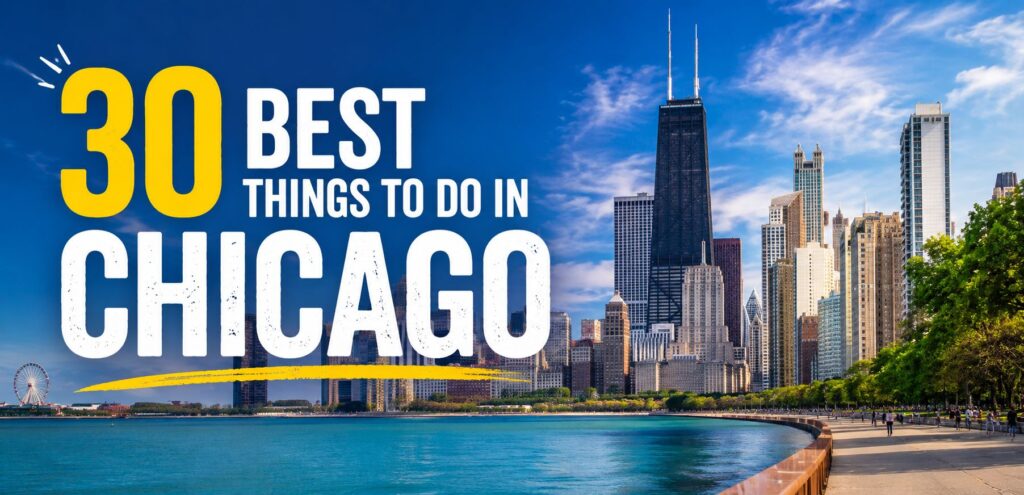
It was 7 AM on an October morning and I was standing on the Michigan Avenue bridge looking west down the Chicago River. The canyon of buildings on both sides, glass and stone and steel rising 30 and 40 and 50 stories above the water, was catching the first light from the east. The Wrigley Building was white against a sky that was still partly dark. The Tribune Tower was gothic limestone going gold. The Marina City corncobs were catching the sun on their rounded faces. Nobody else was on the bridge.
I have been to Chicago six times across every season, and I have taken the Architecture Boat Tour on each visit. October is when the city is at its best. Locals will tell you the same thing. The summer crowds are gone, the heat has broken, the Cubs season is either ending in glory or ending in the specific Chicago way, and the light on the river and the lake in October is the finest urban light in the American Midwest.
Chicago is the American city that most people visit third, after New York and Los Angeles, and with lower expectations than either. This is the mistake that most benefits the people who make it. Because Chicago is quieter than New York and more real than Los Angeles, it has a lake that is not an ocean but is more beautiful than most oceans, a food scene that beats both cities in specific categories, and a relationship with its own architecture that no other American city comes close to.
Chicago at a glance: 30 activities organized by neighborhood. Best month: October. Architecture Boat Tour is the one unmissable thing. Completely free: Millennium Park, Lincoln Park Zoo, Lakefront Trail 18 miles, Buckingham Fountain. Budget range: $123 to $390/day. Three days minimum. Jump to Quick Reference Table · Jump to Pricing · Jump by trip type
This guide covers the 30 best things to do in chicago organized by neighborhood and category. Every entry is written from personal visits. For our complete USA planning guide, read our best places to visit in the USA.
Chicago Trip Cost, How Much Does a Chicago Trip Cost?
Chicago is more affordable than New York or San Francisco but more expensive than Nashville or Savannah. The great advantage of Chicago for budget travelers is that several of its finest experiences are free or very low cost, the Art Institute of Chicago has a suggested admission, Lincoln Park Zoo is free, the lakefront trail is free, and Millennium Park costs nothing.
| Budget Level | Hotel/night | Food/day | Activities/day | Transport/day | Total/day per person |
|---|---|---|---|---|---|
| 🎒 Budget | $80–$120 | $25–$40 | $10–$30 | $8–$12 | $123–$202 |
| ✈️ Mid-range | $140–$220 | $50–$80 | $40–$70 | $15–$20 | $245–$390 |
| 💎 Luxury | $280–$500 | $100–$180 | $80–$150 | $25–$40 | $485–$870 |
Chicago’s best free experiences: Millennium Park, The Bean, Lincoln Park Zoo, Chicago Lakefront Trail 18 miles, Buckingham Fountain, Grant Park, most neighborhood walking, Chicago Cultural Center. A full day of Chicago for almost nothing is entirely achievable.
What costs money: Willis Tower Skydeck ($33), Shedd Aquarium ($45), Field Museum ($27), Art Institute ($26), Architecture Boat Tour ($47–$55), Wrigley Field ($25–$120 depending on game).
Plan Your Chicago Visit by Trip Type
Before the full 30-activity guide, use this to find your personal Chicago in 60 seconds.
First time, 2 days: Architecture Boat Tour (10 AM) > Millennium Park > Art Institute > deep dish at Lou Malnati’s > Riverwalk at dusk. Day 2: Willis Tower > Field Museum > Green Mill Friday night. You will leave wanting a third day.
Budget traveler, under $60/day: Millennium Park (free) > Lakefront Trail (free) > Lincoln Park Zoo (free) > Buckingham Fountain (free) > Blues Festival June (free) > Pilsen murals (free). A full Chicago day for under $20 is entirely possible.
Food focused: Deep dish at Lou Malnati’s > Italian beef at Portillo’s > hot dog at Gene and Jude’s (rideshare, worth it) > Girl and the Goat dinner West Loop (book ahead) > Logan Square brunch at Lula Cafe.
Architecture lover: Architecture Boat Tour > Willis Tower > Tribune Tower lobby (free) > Frank Lloyd Wright Oak Park half-day (Green Line, 25 mins).
Music and culture: Green Mill Friday night (Red Line to Lawrence, two blocks west, arrive before 9 PM) > Buddy Guy’s Thursday > Second City late Saturday > Pilsen murals and Mexican Art Museum (free).
With children: Field Museum (Sue the T-rex) > Shedd Aquarium > Lincoln Park Zoo (free) > Museum of Science and Industry > Navy Pier.
One perfect day only: Architecture Boat Tour (10 AM) > Millennium Park > Art Institute (2 hrs) > Riverwalk drink at dusk > deep dish dinner. The best single day in Chicago.
Chicago At a Glance, Quick Reference Table
| Activity | Neighborhood | Entry | Duration | Best For | Best Time |
|---|---|---|---|---|---|
| Architecture Center River Tour | River North | $47–$55 | 90 mins | Architecture, city understanding | May–Oct |
| Millennium Park and The Bean | Loop | Free | 1–2 hrs | Photos, outdoor, all ages | Morning |
| Art Institute of Chicago | Loop | $26 | 2–3 hrs | World-class art | Thu evening |
| Willis Tower Skydeck | Loop | $33 | 1 hr | Aerial city views | Clear days |
| Chicago Riverwalk | Loop | Free | 1–2 hrs | Walking, bars, views | Evening |
| Buckingham Fountain and Grant Park | Loop | Free | 30–45 mins | Photos, relaxing | Dusk |
| Chicago Lakefront Trail | Lakeshore | Free | 1–4 hrs | Cycling, walking, skyline | Morning |
| Navy Pier | Streeterville | Free–varies | 2–3 hrs | Families, lake views | Afternoon |
| Field Museum | Museum Campus | $27 | 2–3 hrs | Natural history, Sue the T-rex | Any time |
| Shedd Aquarium | Museum Campus | $45 | 2–3 hrs | Marine life, families | Weekday |
| Adler Planetarium | Museum Campus | $15–$30 | 1–2 hrs | Space, lakefront view | Any time |
| Deep Dish Pizza | Various | $18–$28/pp | Dinner | Chicago-specific food | Dinner |
| Chicago-Style Hot Dog | Various | $4–$8 | Quick | Authentic Chicago food | Lunch |
| Chicago Italian Beef | Various | $8–$14 | Quick | Local institution | Lunch |
| West Loop and Fulton Market | West Loop | $30–$80/pp | Dinner | Best dining in Chicago | Dinner |
| Garrett Popcorn | Magnificent Mile | $8–$20 | Quick | Chicago souvenir food | Any time |
| Green Mill Jazz Club | Uptown | $12–$20 cover | Evening | Authentic Chicago jazz | Fri–Sat night |
| Buddy Guy’s Legends | South Loop | $20–$30 cover | Evening | Chicago blues | Thu–Sat night |
| Second City Comedy | Old Town | $22–$35 | Evening | Improv, famous alumni | Thu–Sat night |
| Steppenwolf Theatre | Lincoln Park | $20–$99 | Evening | World-class theater | Year-round |
| Chicago Blues/Jazz Festival | Grant Park | Free | Full day | Live music, locals | June/July |
| Wicker Park and Bucktown | Wicker Park | Free | 2–3 hrs | Indie culture, local food | Afternoon |
| Logan Square | Logan Square | Free | 2–3 hrs | Best brunch in Chicago | Weekend morning |
| Pilsen | Pilsen | Free | 2–3 hrs | Mexican culture, murals, art | Weekend |
| Hyde Park and Univ. of Chicago | Hyde Park | Free | 2–3 hrs | Architecture, Obama, intellect | Any time |
| Andersonville | Far North | Free | 2–3 hrs | Swedish heritage, local feel | Afternoon |
| Wrigley Field | Wrigleyville | $25–$120 | 3–4 hrs | Baseball, atmosphere | Game days |
| Lincoln Park and Lincoln Park Zoo | Lincoln Park | Free (zoo) | 2–3 hrs | Free zoo, park, lakefront | Morning |
| Museum of Science and Industry | Hyde Park | $23 | 2–3 hrs | Interactive, families | Weekday |
| Frank Lloyd Wright’s Oak Park | Oak Park | $18–$40 | Half day | Architecture, genius | Year-round |
Chicago Architecture, The City That Changed How the World Builds
Chicago invented the skyscraper. This is not a marketing claim. It is a historical fact. After the Great Chicago Fire of 1871 destroyed most of the city, Chicago rebuilt itself with an entirely new structural technology, the steel frame, that allowed buildings to rise to heights masonry construction could never reach. The architects who worked in Chicago between 1880 and 1930, from Louis Sullivan through Frank Lloyd Wright to Ludwig Mies van der Rohe, produced the foundational vocabulary of modern architecture that every city on Earth has been speaking ever since.
You can understand this in books. Or you can take the Chicago Architecture Center boat tour and understand it in 90 minutes on the water, with the buildings in front of you and someone explaining what you are looking at.
Do the second one.
1. Chicago Architecture Center River Boat Tour
Neighborhood: River North | Entry: $47–$55 | Duration: 90 minutes | Best time: May through October, weekday morning
This is the most important thing to do in Chicago. Not the most famous, not the most photographed, the most important. The Chicago Architecture Center’s boat tour navigates the Chicago River through the downtown canyon of buildings and covers the complete history of American commercial architecture in 90 minutes of expert commentary and extraordinary views. I have taken this tour three times and learned something new each time.
The specific section of the tour where the boat passes under the Michigan Avenue bridge and the river corridor opens on both sides to reveal the full depth of the architectural canyon is one of those moments where the scale of human building becomes physically overwhelming in a way that walking the streets never delivers. You are inside the city’s structure in a way that has no equivalent from the sidewalk.
The chicago river architecture tour operates three boats on the river simultaneously in peak season. The Shoreline Architecture Cruise and the Chicago Architecture Foundation River Cruise both cover the river circuit. The longer version, the Chicago Architecture Center Classic Boat Tour, extends north and south on the river and is worth the additional 30 minutes.
Daily cost: $47 to $55. Book online at cacchicago.org. Combination tickets with Art Institute save $8.
Practical tips:
- Book the 10 AM weekday departure in summer. The Saturday afternoon boat is full. The weekday morning boat has open seating with space to move between sides.
- Sit on the right side of the boat facing forward for the Wrigley Building approach. Every local who has taken this tour more than once knows this, that is the finest single architectural sequence on the tour.
- The Architecture Center building on the Riverwalk at 111 East Wacker has a free exhibition covering Chicago architecture history. Visit before the boat for context that makes the tour twice as good.
2. Millennium Park Chicago and Cloud Gate
Neighborhood: Loop | Entry: Free | Duration: 1 to 2 hours | Best time: Early morning, any season
Cloud Gate, which Chicago calls The Bean and which is officially neither of these things but a 110-ton polished steel ellipsoid by artist Anish Kapoor, installed in 2006, is the most successful piece of public art in America. I mean this seriously. It reflects the skyline, it reflects the people standing in front of it, it reflects both simultaneously at a distortion that makes the familiar strange, and it invites everyone, children, adults, tourists who came to see it, businesspeople who walk past it daily, to participate in the same experience.
Most public art is observed. The Bean is inhabited.
Millennium Park surrounds the Bean with the Frank Gehry-designed Jay Pritzker Pavilion, a large outdoor concert venue with a steel trellis overhead that carries the sound system over the lawn, and the Lurie Garden, a large native plant garden that is one of the most underrated free outdoor spaces in the city. The Crown Fountain, two 50-foot glass towers that display the faces of Chicagoans and periodically send water through the mouths of the projected faces, is either delightful or unsettling depending on your sensibility. Both responses are acceptable.
Daily cost: Completely free. The Pritzker Pavilion summer concert series includes free performances on the lawn on Thursday and Friday evenings.
Practical tips:
- The Bean at 6:30 AM in summer reflects an empty Millennium Park and a sunrise skyline. This photograph does not exist in most people’s Chicago albums because most people are not awake at 6:30 AM. That is the point.
- The Jay Pritzker Pavilion free summer concerts run June through August. Check the Millennium Park website for the schedule. Bring a blanket. Arrive early for lawn space.
- Millennium Park connects directly to the Art Institute of Chicago via a pedestrian bridge that is, itself, a piece of significant architecture.
3. Art Institute of Chicago
Neighborhood: Loop | Entry: $26 adults, $16 children | Free: Residents under 14 always; Thursday evenings for Illinois residents | Duration: 2 to 3 hours | Best time: Thursday evening
The Art Institute of Chicago is the finest art museum in the United States outside New York and, in specific categories, the finest in the country without qualification. Georges Seurat’s “A Sunday on La Grande Jatte,” the pointillist painting of Paris park life that defined Post-Impressionism and is the most famous painting in Chicago, hangs in Gallery 240. Edward Hopper’s “Nighthawks,” the diner painting that has become the defining image of American urban solitude, hangs in Gallery 262. Grant Wood’s “American Gothic”, the pitchfork-holding farmer and his daughter that became the most parodied image in American art, hangs in Gallery 263.
These three paintings are within a three-minute walk of each other. All three are original works. None are behind glass. On a quiet Thursday evening with reduced visitor numbers, you can stand in front of “Nighthawks” for as long as you want.
The Impressionist and Post-Impressionist collection on the second floor of the Modern Wing is one of the three finest accessible collections of its kind in the world, alongside the Musée d’Orsay and the Metropolitan Museum. The Thorne Miniature Rooms, 68 tiny furnished rooms representing European and American interiors from different historical periods, built at one-inch-to-one-foot scale by Narcissa Thorne in the 1930s, are the most unexpected and most captivating exhibition in the museum and one of the most original things in any American art institution.
Daily cost: Adults $26, children under 14 free. Book online to save queuing time.
Practical tips:
- Thursday evenings from 5 to 8 PM offer reduced visitor numbers for the same entry price. “Nighthawks” and “A Sunday on La Grande Jatte” in near-quiet are experiences that the museum’s busier hours cannot replicate.
- The Thorne Miniature Rooms are in the basement of the original building. Almost nobody knows about them. Allocate 30 minutes. You will stay for 45.
- The Art Institute restaurant in the Modern Wing serves a genuinely good lunch at $14 to $22, significantly better than most museum dining and worth staying for.
4. Willis Tower Skydeck (The Sears Tower)
Neighborhood: Loop | Entry: $33 | Duration: 1 hour | Best time: Clear days, sunset
The Willis Tower, which every Chicagoan still calls the Sears Tower and which was officially renamed in 2009 in a rebrand the city largely ignored, was the tallest building in the world from its completion in 1973 until 1998, when it was surpassed by the Petronas Towers in Kuala Lumpur. At 108 stories and 1,450 feet it remains the tallest building in the western hemisphere and the finest elevated view of Chicago available to the public. The Skydeck at the 103rd floor offers 360-degree views of the city, Lake Michigan, and on a clear day four states: Illinois, Indiana, Wisconsin, and Michigan.
The Ledge, four glass boxes cantilevered 4.3 feet out from the building face, allows visitors to stand on transparent floor panels 1,353 feet above the street. This is either exhilarating or immediately inadvisable depending on your relationship with heights. Both responses are equally valid.
Daily cost: $33. Pre-book online to skip queues that can reach 90 minutes on summer weekends.
Practical tips:
- The view from Willis Tower is objectively superior to the view from One World Trade Center in New York for understanding a city’s geography. Chicago’s flat lakeside setting means you can see the full grid of the city clearly from 103 floors.
- Clear days with low humidity in October and November provide the finest visibility. Summer haze reduces visibility significantly.
- The ground-floor exhibition on Chicago’s architectural history is free and takes 15 minutes, worth doing before the elevator to provide context for what you will see from above.
5. Chicago Riverwalk
Neighborhood: Loop | Entry: Free | Duration: 1 to 2 hours | Best time: Evening
The Chicago Riverwalk, the pedestrian promenade running the length of the main river branch from Lake Shore Drive to Lake Street, is one of the finest urban waterfront redesigns in any American city. The mile-long walkway at water level, completed in its current form in 2016, sits below the street grid and below the bridge level, placing you inside the architectural canyon rather than above it.
The restaurants and bars along the Riverwalk, River Roast, City Winery, Offshore, operate on pontoons and platforms that extend over the water. Sitting on the Riverwalk at dusk with a drink, watching the city lights come on above you and the river reflecting them below, is the most specifically Chicago experience available for free. The view up to the bridges, the buildings rising behind them, and the specific amber color of Chicago’s evening light on limestone and glass is the thing I have tried most often and least successfully to photograph.
Daily cost: Free to walk. Riverwalk bar or restaurant drinks and food $8 to $22.
Practical tips:
- The Riverwalk bars fill up quickly after 5 PM on weekdays when the financial district empties. Arrive before 4:30 PM for a waterside seat.
- The east end of the Riverwalk at the lake delivers the most dramatic city view, the canyon of buildings opening to the full horizontal expanse of Lake Michigan.
- The Chicago Water Taxi, $6 to $10 per trip, operates along the river and is both practical transport and the finest low-cost way to see the river architecture from the water.
<a name=”arts”></a>
Art, Parks and the Chicago Waterfront
6. Buckingham Fountain and Grant Park
Neighborhood: Loop | Entry: Free | Duration: 30 to 45 minutes | Best time: Dusk (fountain light show), spring
Buckingham Fountain in Grant Park is one of the largest fountains in the world and the most recognizable image of Chicago’s lakefront. The 1927 Baroque fountain displays water from 134 jets in a central column that reaches 150 feet during its 20-minute programmed display, which runs every hour from 9 AM to 10:35 PM from April through October. The evening light show, when colored lights illuminate the water columns after dusk, is the finest free evening spectacle in Chicago.
Grant Park itself, the 319-acre green space between the Loop and Lake Michigan, is the open lung of the city. During summer it hosts the Chicago Blues Festival, the Chicago Jazz Festival, the Taste of Chicago, and Lollapalooza, the most concentrated outdoor events calendar of any American park.
Daily cost: Free.
Practical tips:
- The fountain display runs every hour on the hour. Arrive 10 minutes before the hour for the full 20-minute show.
- The 9:30 PM dusk show in summer, with the city lights behind the fountain and the colored water jets against a darkening sky, is the finest version of the fountain and one of the finest free spectacles in Chicago.
- The path from Buckingham Fountain south along the lakefront to the Museum Campus is a 20-minute walk that delivers the finest ground-level view of the Museum Campus approach.
7. Chicago Lakefront Trail
Neighborhood: Throughout the lakeshore | Entry: Free | Duration: 1 to 4 hours | Best time: Morning
The Chicago lakefront trail runs 18 miles along Lake Michigan from Ardmore Avenue in the north to 71st Street in the south, through a continuous chain of public beaches, parks, and harbors that has been protected from private development since 1836 by Daniel Burnham’s “forever open, clear and free” city plan. This is an extraordinary civic achievement that no other major American lakefront has replicated.
From the lakefront trail, looking west, Chicago’s skyline is the most dramatic thing in the American Midwest. From the south end of Museum Campus, the Loop towers rise directly behind the park and the lake in a vertical concentration that looks more European than American. From North Avenue Beach in July, the skyline behind the volleyball nets and the crowded summer beach is the most specifically Chicago image I know.
You do not need to walk 18 miles to understand why this matters. Walk from Navy Pier south to Museum Campus, 2 miles, and the lakefront will have explained itself.
Daily cost: Free. Bicycle rental available at multiple points along the trail from $15 to $25/hour.
Practical tips:
- Divvy, Chicago’s bike share system, is $15 for a day pass and gives access to 6,000 bikes at 600+ stations along the lakefront. The finest way to cover the trail.
- North Avenue Beach, Ohio Street Beach, and 31st Street Beach are the most accessible swimming beaches. Water quality is tested and posted daily. Lake Michigan is cleaner than most ocean beaches.
- The trail is shared between cyclists and pedestrians with designated lanes. Pedestrians on the cycling side are a consistent hazard. Use the correct lane.
8. Navy Pier
Neighborhood: Streeterville | Entry: Free to access, attractions extra | Duration: 2 to 3 hours | Best time: Afternoon or evening
Navy pier chicago is the city’s most visited attraction and one of its most debated. The 3,000-foot pier extending into Lake Michigan offers the finest view of the Chicago skyline from the lake, looking west from the end of the pier, the city rises behind the harbor in a panorama that no photograph taken from the street delivers.
Beyond the view, Navy Pier is primarily a commercial entertainment complex with restaurants, a Ferris wheel ($18), a children’s museum, IMAX theater, and seasonal programming. It is excellent for families with children and for the specific experience of being on the lake with the skyline behind you. It is less interesting if you are looking for the real Chicago food or culture scene, which exists elsewhere.
Daily cost: Free access. Ferris wheel $18. Chicago restaurant prices $18 to $35 per person.
Practical tips:
- The Navy Pier Ferris wheel at dusk delivers the finest aerial view of the lakefront north of downtown. Clear evenings only.
- The Chicago Shakespeare Theater at Navy Pier is one of the finest Shakespeare performance companies in the United States. Tickets $35 to $90.
- Walk to the very end of the pier. The view west of the full downtown skyline from the pier’s end is the best accessible lake-level skyline photograph in Chicago.
Museum Campus, Three World-Class Institutions in One Place
Museum Campus is a 57-acre park on the lakefront just south of Grant Park that houses the Field Museum, Shedd Aquarium, and Adler Planetarium within a 15-minute walk of each other. It is the finest concentration of museum quality per square kilometer in the American Midwest and one of the finest in the United States.
Plan a full day. Two days if you have children.
9. Field Museum
Neighborhood: Museum Campus | Entry: $27, or City Pass | Duration: 2 to 3 hours | Best time: Any time, weekday mornings quietest
The Field Museum of Natural History is the finest natural history museum in the American Midwest and among the finest in the world. Sue, the most complete and best-preserved T. rex skeleton ever discovered at 40.5 feet long, stands in the Stanley Field Hall at the center of the building, the most impressive single natural history specimen accessible in any American museum. Sue was excavated in South Dakota in 1990 and transferred to the Field Museum in 1997 after a $8.36 million auction.
The Egyptian collection, one of the largest outside Egypt, covers 5,000 years of Egyptian cultural history with original artifacts and complete tomb reconstructions. The Evolving Planet exhibition covering 4 billion years of life on Earth with original fossil specimens is as scientifically sophisticated as any equivalent in American museum science.
Daily cost: Adults $27. City Pass Chicago ($119) covers Field Museum, Shedd Aquarium, Skydeck Willis Tower, Adler Planetarium, and Museum of Science and Industry, excellent value over 3 days.
Practical tips:
- Sue the T. rex has been moved from the Stanley Field Hall to a dedicated gallery with better lighting and interpretive context. The hall now displays Máximo, the longest dinosaur specimen ever mounted, a 122-foot titanosaur cast. Both are worth seeing.
- The 3D theater inside the Field Museum shows natural history documentaries at $6 additional, skip it and use the time in the collection.
- The museum café is acceptable but the food truck park outside on the Museum Campus lawn serves better food at lower prices on warm days.
10. Shedd Aquarium
Neighborhood: Museum Campus | Entry: $45, or City Pass | Duration: 2 to 3 hours | Best time: Weekday mornings
The Shedd Aquarium, opened in 1930 and the world’s largest indoor aquarium at its opening, houses over 32,000 animals across 1,500 species in one of the most comprehensively designed aquarium facilities in the United States. The Amazon Rising exhibition, the Caribbean Reef exhibit with its 90,000-gallon circular tank viewable from all sides, and the Beluga Encounter program with Chicago’s resident beluga whales are the primary experiences.
The dolphin and whale shows in the Abbott Oceanarium are the most popular programming at the Shedd. They are well-produced and professionally presented. They are also the most crowded section of the aquarium. If marine biology rather than performance is your interest, the quieter collection galleries are considerably more rewarding.
Daily cost: Adults $45, children $30. Book online. Weekday morning entry avoids the worst weekend and school group crowds.
Practical tips:
- The Beluga Encounter behind-the-scenes program ($20 additional) allows supervised close-contact interaction with the beluga whales. Worth booking for families with children over 7.
- The aquarium is busiest between 10 AM and 2 PM on weekends. The 4 PM Saturday session is significantly quieter.
- The City Pass at $119 includes Shedd Aquarium and is the best value if you are also visiting the Field Museum, Willis Tower, Adler Planetarium, and Museum of Science and Industry.
11. Adler Planetarium
Neighborhood: Museum Campus | Entry: $15–$30 | Duration: 1 to 2 hours | Best time: Evening for sky shows
The Adler Planetarium, opened in 1930 as the first modern planetarium in the western hemisphere, occupies the eastern point of Museum Campus in a position that delivers the most complete panoramic view of the Chicago skyline available from any publicly accessible location. The view from the Adler’s terrace looking west, the full loop towers, the lakefront, the park, is the finest single static city view in Chicago and it costs nothing beyond the park entry.
The planetarium’s sky shows in the Grainger Sky Theater and the Definiti Space Theater cover astronomy, space exploration, and the night sky with projection technology that is among the finest publicly accessible in the country.
Daily cost: Grounds and terrace free. Planetarium entry $15 to $30. City Pass included.
Practical tips:
- The Adler terrace at sunset looking west over the lake toward the downtown skyline is the finest free photography position in Chicago for the skyline. No entry ticket required.
- The America’s Courtyard exhibit covering the history of American space exploration from Mercury through the present is the strongest permanent collection in the planetarium.
- Evening sky shows on clear nights occasionally extend to rooftop telescope viewing, which is free with planetarium admission.
<a name=”food”></a>
Chicago Food, What the City Actually Eats
Chicago’s food identity is built on three specific things that exist nowhere else in the same form: the deep dish pizza, the Chicago-style hot dog, and the Italian beef sandwich. All three require direct explanation before your first day in the city.
Beyond these three, Chicago has developed a restaurant culture over the past 20 years that has produced what I believe is the finest mid-range and upper-mid-range dining scene of any American city outside New York. The West Loop and Fulton Market neighborhood specifically has transformed from a meatpacking district into the most concentrated dining destination in the city.
12. Chicago Deep Dish Pizza
Where: Lou Malnati’s, Giordano’s, Pequod’s, Pizzeria Uno | Cost: $18–$28 per person | Duration: Dinner | Best time: Dinner, go hungry
Chicago deep dish pizza is not the same thing as a thick pizza. It is an entirely different construction philosophy. The crust forms a bowl rather than a base, the cheese layer goes directly on the crust, the toppings go on top of the cheese, and the tomato sauce goes on top of everything. It is baked in a deep cast-iron pan and takes 45 minutes. You eat it with a fork, not your hands. It is an experience, not just a meal.
The deep dish conversation in Chicago has one clear answer and it is Lou Malnati’s. While you are in the Loop, also order the Palmer House Hotel brownie, it was invented specifically for the 1893 World’s Fair and has not changed since. It is not a tourist gimmick. It is a 130-year-old Chicago recipe. The butter crust at Malnati’s is the single most important element of a Chicago deep dish and nobody does it better. Giordano’s is the tourist choice. Pequod’s, in Lincoln Park, is the local choice for caramelized crust enthusiasts. My recommendation is Lou Malnati’s on North Wells Street in the Gold Coast, go at lunch, when the wait is shorter.
Honest assessment: If you are not very hungry and you are eating alone, deep dish is not your meal. It is a substantial communal food. Get one medium pizza for two people. That is enough.
Daily cost: $18 to $28 per person. Lunch waits shorter than dinner.
Practical tips:
- Order at Lou Malnati’s at lunch on a weekday. The dinner wait on weekends runs 45 to 90 minutes.
- Pequod’s in Lincoln Park is for the caramelized crust specifically, the pan-glazed cheese edge is a completely different experience from the Malnati’s butter crust. Try both across different meals.
- If you genuinely prefer thin crust, Chicago’s tavern-style thin crust pizza (cut in squares, not triangles) is excellent and completely ignored by most visitors. Vito & Nick’s on Pulaski is the definitive version.
13. Chicago-Style Hot Dog
Where: Portillo’s, Gene & Jude’s, Gold Coast Dogs | Cost: $4–$8 | Duration: Quick lunch | Best time: Lunch
The Chicago-style hot dog is a specific preparation with specific rules. An all-beef frankfurter in a steamed poppy seed bun with yellow mustard, chopped white onion, bright green sweet pickle relish, a dill pickle spear, tomato slices, sport peppers, and a dash of celery salt. No ketchup. Ever. Under any circumstances. A Chicagoan who hears you ask for ketchup at a hot dog stand has a specific look. You do not want that look. Chicago’s relationship with ketchup on a hot dog is the city’s most strongly held culinary position and it is non-negotiable.
Portillo’s is the chain version, reliable, accessible, available. Gene & Jude’s in River Grove is the correct answer for visitors willing to travel 20 minutes for what a serious hot dog person would call a life-defining experience. The Depression dog at Gene & Jude’s comes with fries on top of the dog inside the bun. There are no seats. You eat standing at a counter. It is perfect.
Daily cost: $4 to $8. Cash only at Gene & Jude’s.
Practical tips:
- Do not ask for ketchup at any serious Chicago hot dog stand. I am telling you this to protect you from the specific quality of Chicago social disapproval.
- Gene & Jude’s at 2720 N River Road requires a rideshare, there is no convenient public transit, but it is worth it. Go at lunch. The Depression dog is the order.
- Chicago hot dogs are a lunch food. The best version is eaten standing, in paper, with a wax-paper-wrapped bag of fries.
14. Chicago Italian Beef
Where: Portillo’s, Al’s Beef, Johnnie’s Beef | Cost: $8–$14 | Duration: Quick lunch | Best time: Lunch
The Italian beef sandwich, thin-sliced roast beef cooked in spiced Italian seasoning, served on a long Italian roll dipped into the cooking juices, topped with giardiniera (spicy pickled vegetables) or sweet peppers, is the most genuinely Chicago food experience that visitors most consistently overlook in favor of deep dish pizza.
Order it “dipped” (the entire roll submerged in the cooking juices before assembly) and “hot” (giardiniera rather than sweet peppers). Hold it over the counter when you eat it. Juice will run down your arms. This is the correct experience. Portillo’s serves the most accessible version. Johnnie’s Beef in Elmwood Park is the correct answer for people who are serious about it. Al’s Beef on West Taylor Street in the Italian Village neighborhood is the historic original.
Daily cost: $8 to $14.
Practical tips:
- Portillo’s on Ontario Street in River North serves both the Chicago hot dog and the Italian beef in a building that is itself an example of Chicago maximalism. Lunch here covers both classic Chicago foods in one meal.
- Dipped. Hot. Standing at the counter. These are the only instructions you need.
15. West Loop and Fulton Market Dining
Neighborhood: West Loop | Cost: $30–$80 per person | Best time: Dinner Thursday to Saturday
The west loop chicago and the adjacent Fulton Market district represent the most significant transformation in Chicago’s food identity over the past decade. The former meatpacking and warehouse district west of the river is now the address of the finest restaurant concentration in Chicago: Girl & the Goat (Stephanie Izard), Oriole (two Michelin stars), The Publican, Avec, Little Goat Diner, and the street-level food market at 800 West Fulton.
Girl & the Goat is the restaurant that defined Chicago’s West Loop food identity. Stephanie Izard’s share-plates menu built around whole animal cooking, global spice influences, and a specifically Chicago directness about what food is for, pleasure, not performance, is the best single restaurant meal available in the West Loop for visitors who want to understand what Chicago food has become.
Daily cost: Casual $25 to $40. Mid-range $45 to $65. Oriole tasting menu $285.
Practical tips:
- Girl & the Goat requires reservations made 4 to 6 weeks in advance for Thursday through Saturday evenings. The bar seats are first-come first-served and available with walk-in patience on weeknights.
- The Publican on Fulton Market is the finest beer and pork restaurant in Chicago and the best value in the West Loop for quality. The beer list is a document of regional American brewing. Go for the charcuterie and oysters at the bar.
- The morning coffee and breakfast on Randolph Street in the West Loop (Little Goat Diner, The Publican Quality Meats) before the lunch crowds arrive is the finest West Loop food experience that does not require a reservation.
16. Garrett Popcorn and the Magnificent Mile
Neighborhood: Streeterville | Cost: $8–$20 | Duration: 30 minutes | Best time: Any time
Garrett Popcorn has been making Chicago Mix, CaramelCrisp and CheeseCorn in the same bag, at its Chicago shops since 1949. The original shop at 26 West Randolph Street is a block from Millennium Park. The line is always present. The Chicago Mix is genuinely extraordinary, the combination of sweet caramel and savory cheese works in a way that no description prepares you for.
Michigan Avenue, the Magnificent Mile, runs north from the Chicago River through the primary luxury shopping corridor of the Midwest. The architecture along the street, the Wrigley Building and Tribune Tower at the south end, the Water Tower (one of the only buildings to survive the Great Chicago Fire of 1871), the 875 North Michigan Avenue building, makes it worth walking even if shopping is not your purpose.
Daily cost: Garrett Popcorn Chicago Mix tin $8 to $20 depending on size.
Practical tips:
- The Garrett Popcorn tin is the finest Chicago food souvenir that is practical to carry. Buy it at the end of your trip.
- The Chicago Water Tower at Michigan and Pearson Streets is free to enter and houses the City Gallery, which presents photography exhibitions about Chicago.
- The Tribune Tower lobby at 435 North Michigan is free to enter. The wall contains fragments of stone from 149 historically significant buildings from around the world, embedded by Tribune correspondents over decades, the Great Wall of China, the Taj Mahal, the Parthenon, Westminster Abbey, the White House.
Chicago Music, Blues, Jazz, Comedy and the Stage
Chicago gave the world the electric blues, post-bop jazz, and improv comedy as a performance art form. These are not minor cultural contributions. The Chicago blues tradition from Muddy Waters and Howlin’ Wolf created the vocabulary that became rock and roll. The Second City comedy school created John Belushi, Bill Murray, Tina Fey, Stephen Colbert, and an unbroken chain of American comedy talent since 1959.
The venues where this culture still lives are among the finest reasons to stay in Chicago for an extra night.
17. Green Mill Jazz Club
Neighborhood: Uptown | Entry: $12–$20 cover | Best time: Friday and Saturday night, 9 PM onward
The Green Mill, at 4802 North Broadway in the Uptown neighborhood, has been operating as a jazz venue since 1907 and is the oldest continuously operating jazz club in Chicago. Al Capone used to drink here. The booth in the back left where he sat had a view of both doors. The curved bar, the semicircular ceiling, the red leather booths, the specific quality of the light, nothing has been renovated. Nothing looks like it needs to be.
The music is the reason to come. Chicago jazz played in the Green Mill by musicians who take the tradition seriously, in a room where the tradition has been taken seriously for over a century, is one of those specific live music experiences that exists only in a handful of places in the United States. I have been here three times. Each time the music started at 9:30 PM and I did not want to leave at midnight.
Take the Red Line to Lawrence. Walk two blocks. Go on a Friday. Stay until at least 11.
Daily cost: $12 to $20 cover charge. Drinks $8 to $14.
Practical tips:
- The Sunday Uptown Poetry Slam at the Green Mill, running since 1991, is the original slam poetry competition in the United States. Doors at 6 PM, slam at 7 PM. No cover charge. The energy in the room is unlike any other night.
- Arrive before 9 PM on weekends to secure a table. After 10 PM on Friday and Saturday, standing room only.
- The Green Mill does not serve food. Eat before you go.
18. Buddy Guy’s Legends Blues Club
Neighborhood: South Loop | Entry: $20–$30 | Best time: Thursday through Saturday night
Buddy Guy, the Chicago blues guitarist who directly influenced Eric Clapton, Stevie Ray Vaughan, and Jimi Hendrix and whose 1965 recordings are among the foundational documents of electric blues, owns and operates this club at 700 South Wabash. Buddy Guy himself plays at the club regularly in January, the dates announced on the website. The rest of the year, the house band and rotating Chicago blues musicians maintain a standard that is consistently among the finest Chicago blues accessible to visitors.
The Chicago blues tradition, the specific electrification and urbanization of Mississippi Delta blues that happened in Chicago’s South and West Side clubs from the 1940s through the 1960s, is the direct ancestor of every electric guitar tradition that followed it. Buddy Guy’s is where you hear what that original tradition sounds like when it is still alive.
Daily cost: $20 to $30 cover. Dinner menu available $14 to $28.
Practical tips:
- Buddy Guy’s January residency runs 4 to 6 weeks of shows. If your Chicago visit falls in January, this is the most important ticket in the city. Book immediately when dates are announced.
- The restaurant at Buddy Guy’s serves decent Louisiana-influenced food. The gumbo is honest.
- Thursday nights are the best non-weekend nights at most Chicago blues venues. Fewer tourists, more serious audience, often more interesting music.
19. Second City Comedy Club
Neighborhood: Old Town | Entry: $22–$35 | Best time: Thursday through Saturday
Second City opened in 1959 in Old Town and has been the primary training ground and launching platform for American television and film comedy ever since. The list of alumni who developed their craft on the Second City mainstage includes John Belushi, Bill Murray, Gilda Radner, Dan Aykroyd, Mike Myers, Tina Fey, Stephen Colbert, Steve Carell, Amy Poehler, and approximately 40 years of Saturday Night Live cast members.
The Mainstage performance is a scripted revue of sketch comedy and original music. The training center and e.t.c. stage present newer company members in development. Both are worth seeing. The specific quality of the Second City performance style, political, local, intelligent, physically precise, and funny without being desperate, is one of those specific Chicago cultural experiences that exists only here.
Daily cost: $22 to $35. Book online in advance for weekend shows.
Practical tips:
- The late show at Second City on Friday and Saturday nights, after the main performance, is partially improvised based on audience suggestions. This is the finest version of what the company does.
- The Second City Training Center offers public improv and sketch comedy workshops. A 3-hour workshop runs $80 to $120 and is the most interesting paid daytime cultural activity in Chicago for visitors interested in comedy.
- Old Town itself, the neighborhood around Second City, is one of Chicago’s finest for a pre-show dinner. Twin Anchors ribs (Frank Sinatra’s Chicago restaurant) is a 5-minute walk.
20. Steppenwolf Theatre
Neighborhood: Lincoln Park | Entry: $20–$99 | Best time: Year-round
The Steppenwolf Theatre, founded in 1976 by Gary Sinise, Jeff Perry, and Terry Kinney in a church basement, has developed into one of the finest regional theater companies in the United States and arguably the most influential in shaping the American theater aesthetic of the past 40 years. The ensemble includes John Malkovich, Gary Sinise, Laurie Metcalf, and Tracy Letts, among others.
The quality of a Steppenwolf production is consistently above what most major cities outside New York and London offer. If you have any interest in serious theater, check the schedule for your Chicago dates and buy tickets if something is running.
Daily cost: $20 to $99 depending on production and seat location.
Practical tips:
- Rush tickets at $20 are available at the box office 90 minutes before weekday performances when house is not full. Worth checking.
- The Steppenwolf restaurant, 1700 North, is one of the finer pre-theater dinners in the Lincoln Park neighborhood.
21. Chicago Blues and Jazz Festivals
Location: Grant Park | Entry: Free | Best time: June (Blues Festival), July (Jazz Festival)
The Chicago Blues Festival in early June is the largest free blues festival in the world. For three days, multiple stages in Grant Park present three days of blues from regional and national artists, continuing the tradition of the city that invented the electric blues. The Chicago Jazz Festival in late August extends over Labor Day weekend with similar programming.
Both festivals are free. Both are primarily attended by Chicagoans rather than tourists. Both represent the finest free live music events available in any American city.
Daily cost: Free.
Practical tips:
- The main stage at both festivals begins attracting large crowds from 4 PM onward. Arrive at 2 PM for good position without the crush.
- The side stages at the Blues Festival frequently present more interesting programming than the main stage. Check the full schedule before attending.
- The Taste of Chicago food festival runs simultaneously with the Blues Festival in June, Chicago restaurant booths serving samples at $2 to $10 per item across Grant Park.
Chicago Neighborhoods, Where the Real City Lives
The Chicago most visitors see, the Loop, the Magnificent Mile, Navy Pier, is Chicago’s public face. The Chicago that Chicagoans actually live in is the neighborhoods: 77 of them, each with its own character, its own architecture, its own specific relationship with the city’s ethnic and cultural history.
You do not need to visit all 77. But you need to visit at least two neighborhoods beyond the Loop to understand what Chicago actually is.
22. Wicker Park and Bucktown
Neighborhood: Wicker Park | Entry: Free | Duration: 2 to 3 hours | Best time: Weekend afternoon or evening
Wicker Park and the adjacent Bucktown neighborhood, centered on the six-way intersection of North, Damen, and Milwaukee Avenues, is Chicago’s most concentrated independent culture neighborhood, record shops, vintage clothing, independent bookstores, chef-driven restaurants, and the specific energy of a neighborhood that has been creative and irreverent for 40 years without becoming entirely commercial.
The Milwaukee Avenue corridor through Wicker Park is the finest strip for independent retail in Chicago. Reckless Records is the finest used record shop in Chicago. Myopic Books is the finest used bookshop. The architecture along Wicker Park’s residential streets, elaborate Victorian-era Painted Ladies and Queen Anne row houses from the 1880s and 1890s, is the finest preserved Victorian residential streetscape in the city.
Daily cost: Free to walk. Restaurants $14 to $40.
Practical tips:
- The Blue Line El to Damen station drops you at the center of Wicker Park within 20 minutes from the Loop. The elevated train platform at Damen gives a brief aerial view of the neighborhood’s Victorian rooftops.
- The Empty Bottle bar at 1035 N Western Ave is the finest independent music venue in Wicker Park. The monthly calendar covers jazz, indie rock, and electronic music at $10 to $20 cover.
- The brunch scene in Wicker Park on Sunday mornings, Dove’s Luncheonette for the Nashville hot chicken, Lula Cafe in Logan Square, Bang Bang Pie for the biscuits, is the finest free-range brunch experience in Chicago.
23. Logan Square
Neighborhood: Logan Square | Entry: Free | Duration: 2 to 3 hours | Best time: Weekend morning for brunch
Logan Square, anchored by the Logan Square Boulevard with its 1917 Illinois Centennial Monument and its tree-lined residential boulevards designed by Frederick Law Olmsted, is the neighborhood that best represents Chicago’s current creative and culinary evolution. The restaurant density on Milwaukee Avenue through Logan Square, the coffee shops, the food-focused small businesses, and the weekend farmers market on the boulevard combine to create the finest single neighborhood food morning in Chicago.
The Logan Square Farmers Market runs Sunday mornings from May through October on the boulevard’s median strip with local produce, prepared food, and artisan goods from Chicago’s regional food producers.
Daily cost: Free. Brunch $14 to $24.
Practical tips:
- Lula Cafe, open since 1999 and a founding institution of Chicago’s farm-to-table movement, is the best single brunch in Logan Square. Book ahead for Sunday brunch.
- The Logan Square neighborhood streets radiating from the central boulevard contain some of the finest early 20th-century residential architecture in Chicago, greystones, two-flats, and large single-family homes built between 1900 and 1930.
24. Pilsen
Neighborhood: Pilsen | Entry: Free | Duration: 2 to 3 hours | Best time: Weekend afternoon
Pilsen, the Mexican-American neighborhood on Chicago’s Lower West Side, is the most visually distinctive neighborhood in Chicago, and the one that longtime Chicagoans talk about with a specific pride, the pride of a neighborhood that has kept its identity. The buildings along 18th Street, Halsted Street, and Blue Island Avenue are covered in murals, 300 or more documented murals depicting Mexican cultural history, Aztec imagery, Chicago labor history, and neighborhood life, painted across the full facades of two and three-story commercial buildings in a concentration that makes Pilsen the finest outdoor mural experience in the American Midwest.
The Mexican Fine Arts Center Museum (now the National Museum of Mexican Art), located in Harrison Park, houses the largest collection of Mexican art in the United States and is free to enter. The Pilsen food scene, authentic Mexican restaurants, panaderías, and taquerías on 18th Street, is the most consistently excellent and most affordable neighborhood food in Chicago.
Daily cost: Free. Tacos $2 to $4 each. Restaurant lunch $8 to $16.
Practical tips:
- The National Museum of Mexican Art is free and one of the finest accessible collections of Mexican visual and cultural art in the United States. Allow 90 minutes.
- El Milagro tortilleria at 3048 West 26th makes fresh tortillas daily. Buy a bag. Eat them the same day.
- The Thalia Hall concert venue in Pilsen, a restored 1892 building, presents the finest independent music programming in Chicago south of the Loop.
25. Hyde Park and University of Chicago
Neighborhood: Hyde Park | Entry: Free | Duration: 2 to 3 hours | Best time: Any time
Hyde Park, the South Side neighborhood surrounding the University of Chicago, is the most intellectually concentrated neighborhood in Chicago. It is also the neighborhood where Barack Obama lived from 1993 until his election to the Senate in 2004 and where the Obama Presidential Center, currently under construction in Jackson Park, will open within the next several years.
The University of Chicago campus, designed in English Gothic Revival style with quadrangles that deliberately reference Oxford and Cambridge, is one of the finest architectural ensembles in any American university. The Smart Museum of Art and the Oriental Institute Museum on campus are both free and both contain collections of extraordinary quality that receive a fraction of the attention they deserve.
The Robie House at 5757 South Woodlawn Avenue, Frank Lloyd Wright’s 1910 Prairie Style masterpiece, sits one block from the university campus and operates guided tours. It is the single most significant residential architectural work accessible to the public in Chicago.
Daily cost: Free. Robie House tours $18.
Practical tips:
- The Oriental Institute Museum is free and houses one of the finest collections of ancient Near Eastern art and archaeology in the United States. The Mesopotamian, Egyptian, and Persian collections are world-class.
- The Medici Restaurant on East 57th Street is the oldest continuously operating student café adjacent to any American university campus and serves breakfast and lunch at prices that have barely changed in 30 years.
- The Metra Electric Line from Millennium Station reaches Hyde Park in 15 minutes. Far faster than the CTA.
26. Andersonville
Neighborhood: Far North Side | Entry: Free | Duration: 2 hours | Best time: Afternoon
Andersonville, the Swedish-heritage neighborhood on Clark Street in Chicago’s Far North Side, is the most overlooked neighborhood in Chicago for visitors and among the most rewarding for a slow afternoon. The main commercial strip on North Clark Street between Foster and Berwyn retains Swedish bakeries and restaurants alongside a newer generation of independent bookshops, wine bars, and specialty food shops that make it the most walkable and most locally-scaled commercial neighborhood in the city.
Daily cost: Free. Coffee shops $4 to $7. Lunch $12 to $22.
Practical tips:
- Women & Children First bookstore on North Clark is the finest independent feminist and progressive bookshop in Chicago with an extraordinary events programme. Check the schedule before visiting.
- The Hopleaf bar at 5148 N Clark serves the finest Belgian beer selection in Chicago alongside one of the best mussels preparations in the city. Arrive before 6 PM to guarantee seating.
Sports, Parks and Day Trips from Chicago
27. Wrigley Field
Neighborhood: Wrigleyville | Entry: $25–$120 | Duration: 3 to 4 hours | Best time: Day games, April through September
Wrigley Field chicago, built in 1914 and the second-oldest Major League Baseball stadium in the United States after Fenway Park, is the finest stadium experience in American baseball for visitors who want to understand what baseball means as a neighborhood and cultural institution rather than simply as a sport. The stadium sits inside the Wrigleyville neighborhood with residential buildings on the surrounding blocks, some with rooftop bleachers that have operated as unofficial viewing areas since the 1980s.
A Cubs game at Wrigley is not about baseball. Locals will tell you this honestly. It is about the ivy on the outfield wall, the rooftop bars on Waveland Avenue, the Wrigleyville neighborhood bars open from noon, and the specific culture of an afternoon in Chicago’s North Side in good weather. An afternoon Cubs game at Wrigley on a sunny April day, when the ivy on the outfield wall is still light green and the neighborhood bars on Addison Street are full from noon, is one of the finest specific sports-adjacent days available in any American city regardless of your interest in baseball.
Daily cost: Bleacher seats $25 to $45. Lower level $60 to $120. Game day tickets on StubHub often cheaper than box office.
Practical tips:
- Day games at Wrigley are fundamentally different from night games. The atmosphere in the afternoon, with the Wrigleyville neighborhood fully alive around the stadium, is worth the day specifically.
- The Red Line to Addison drops you at the main gate. No driving necessary and no parking available in practical distance.
- Rooftop club tickets on Waveland and Sheffield Avenues, the residential buildings overlooking the stadium, run $100 to $200 and include food and drinks. A genuinely unique baseball experience.
28. Lincoln Park and Lincoln Park Zoo
Neighborhood: Lincoln Park | Entry: Park free, Zoo free | Duration: 2 to 3 hours | Best time: Morning
Lincoln park chicago, the 1,208-acre public park running along the lakefront through the North Side, is Chicago’s largest park and one of the finest urban parks in the United States. Lincoln Park Zoo, occupying 35 acres within the park, is the last free major metropolitan zoo in the United States and has been free since its founding in 1868.
The zoo houses over 200 species across its collection, with particular strength in African and Asian large mammals. The gorilla house, the sea lion pool, and the big cat exhibit are the most consistently popular. The zoo’s location within Lincoln Park, with the Chicago lakefront immediately to the east and the park’s lagoons and gardens to the west, makes the surrounding landscape as rewarding as the zoo itself.
Daily cost: Lincoln Park free. Lincoln Park Zoo completely free.
Practical tips:
- The Lincoln Park Conservatory adjacent to the zoo is free and houses permanent collections of tropical plants, ferns, and orchids in a Victorian glass conservatory built in 1893.
- North Pond restaurant inside Lincoln Park, in a 1912 warming house for ice skaters, is the finest restaurant in the park and one of the finest farm-to-table restaurants on Chicago’s North Side. Book ahead.
- The lakefront path directly east of Lincoln Park delivers the finest North Side skyline view in Chicago. Walk south from Fullerton Avenue to Navy Pier in 45 minutes.
29. Museum of Science and Industry
Neighborhood: Hyde Park | Entry: $23 | Duration: 2 to 3 hours | Best time: Weekday
The Museum of Science and Industry in Hyde Park, the largest science museum in the Western Hemisphere, occupies the former Palace of Fine Arts building constructed for the 1893 World’s Columbian Exposition in a palazzo that is one of Chicago’s finest Beaux-Arts structures. The museum’s permanent collection covers coal mining, space exploration, weather, genetics, and mathematics through interactive exhibits of consistently high production quality.
The U-505 German submarine, captured in the Atlantic Ocean in 1944 in one of the most dangerous naval operations of World War II and now housed in a dedicated underground gallery, is the most historically significant single object in the museum. The Coal Mine exhibit, a working recreation of a 1930s Illinois coal mine with actual mining equipment operating on a conveyor system, is the most specifically Illinois cultural experience in the collection.
Daily cost: Adults $23. City Pass included.
Practical tips:
- The U-505 submarine tour is $8 additional and requires timed entry tickets. Book when you purchase museum admission.
- The Christmas Around the World exhibition from mid-November through January, displaying over 50 decorated Christmas trees representing world cultures, is the most popular seasonal exhibition in any Chicago museum.
30. Frank Lloyd Wright’s Oak Park
Location: Oak Park, 9 miles west of downtown | Entry: $18–$40 | Duration: Half day | Best time: Year-round
Oak Park, the suburb immediately west of Chicago accessible by Green Line El in 25 minutes from downtown, contains the largest concentration of Frank Lloyd Wright buildings in the world. Wright lived and worked in Oak Park from 1889 to 1909, during the period when he developed the Prairie Style that defined his career and influenced 20th-century residential architecture globally.
The Frank Lloyd Wright Home and Studio at 951 Chicago Avenue, where Wright lived with his family and designed over 150 buildings from 1889 to 1909, operates guided tours. The Unity Temple on Lake Street, the only public building Wright designed during this period, is a UNESCO World Heritage Site. The self-guided Oak Park walking tour map from the Frank Lloyd Wright Trust covers 26 Prairie Style homes visible from the public streets within a 1-mile radius.
Daily cost: Home and Studio tour $18. Unity Temple $10. Combination ticket $40.
Practical tips:
- The Green Line El from downtown to the Harlem/Lake station in Oak Park takes 25 minutes and costs $2.50, significantly better value and faster than driving.
- The self-guided walking tour map from the Frank Lloyd Wright Trust covers 26 exterior-viewable Prairie houses for free after the map purchase. The neighborhood itself is the finest accessible collection of Prairie Style residential architecture in the world.
- The Oak Park Visitor Center on Lake Street provides historical context and walking tour audio guides that add considerably to the architectural experience.
What Is New in Chicago in 2026
Chicago 2026 is a significant year for the city. Several major openings and events make this a particularly strong time to visit.
Obama Presidential Center, Opening Spring 2026 The Obama Presidential Center in Jackson Park, Hyde Park, opens to the public in spring 2026 after years of construction. The center includes a museum documenting the Obama presidency, a branch of the Chicago Public Library, a recording studio, a sports facility, and a public park redesigned by landscape architect Michael Van Valkenburgh. Hyde Park, already one of Chicago’s most intellectually interesting neighborhoods, adds the most significant new public institution in the city in a decade.
Bally’s Chicago Casino, Opening Fall 2026 Bally’s Chicago, the new riverfront entertainment complex on the Chicago River at the former Tribune Publishing site, opens in fall 2026 with a casino, a 500-room hotel, a theater venue, restaurants, and a public park along the river. The riverfront location adds a new architectural and entertainment presence to the northern edge of the Loop.
Route 66 Centennial, Year-Round Events Chicago is the official starting point of Route 66, and 2026 marks the road’s 100th anniversary. Year-round events, exhibitions, and activations across the city celebrate the centennial of America’s most iconic road trip. The Grant Park cultural campus and the Chicago Cultural Center are among the primary venues.
Illinois 250, America’s 250th Anniversary Chicago is a primary venue for Illinois 250, the state’s participation in the nationwide America 250 anniversary celebrating the country’s 250th year of independence. The year-long programming across cultural institutions, parks, and public spaces makes 2026 one of the more event-rich years in Chicago’s recent history.
<a name=”practical”></a>
Chicago Practical Guide
Chicago for US Visitors, What Locals Know
Illinois residents: The Museum of Science and Industry, Field Museum, and Shedd Aquarium offer free or discounted entry on specific days for Illinois residents. Check each museum’s website for the current schedule.
From other US cities: Chicago is accessible by Amtrak from New York (18 hours), Washington DC (18 hours), Los Angeles (40 hours), and Minneapolis (8 hours). For midwest visitors driving in, the I-90/94 expressway exits directly into the downtown Loop but parking costs $30 to $50 per day. Drive to a Blue Line L station in Rosemont or Forest Park and take the train in instead.
American travelers specifically: Chicago’s weather in January and February is more extreme than most of the country experiences. The wind off Lake Michigan is genuinely different from standard cold weather. Pack for 10 degrees Fahrenheit colder than the forecast temperature suggests. July and August are humid in a specific Midwest way that visitors from dry-climate states underestimate significantly.
Cubs vs White Sox: This is Chicago’s genuine dividing line. North Side residents are Cubs fans. South Side residents are White Sox fans. Both teams play baseball in Chicago. The correct approach for a visitor is to acknowledge both exist, have an opinion on neither, and enjoy whichever game fits your schedule.
Getting Around Chicago
The L (El) Train: Chicago’s elevated and subway train system is the second largest in the United States and covers the entire city. A single ride costs $2.50. A 1-day unlimited pass costs $10, a 3-day pass $20. The Blue Line connects O’Hare Airport to downtown in 45 minutes for $5. The Red Line runs the full North-South spine of the city. The Green Line reaches Hyde Park. The Orange Line connects Midway Airport to the Loop.
The L is the correct way to get around Chicago. Chicagoans do not drive downtown if they can avoid it. The L costs $2.50. An Uber from O’Hare to downtown costs $35 to $55 depending on surge. The math is obvious. The L is the correct way to get around Chicago. It is fast, reliable, and covers every destination in this guide. Download the Ventra app for real-time arrivals and contactless payment.
Divvy Bikes: Chicago’s bike share system operates 6,000 bikes at 600+ stations throughout the city. A day pass is $15 with unlimited 3-hour rides. The lakefront trail is designed for cycling and covers the full Museum Campus to Navy Pier to Lincoln Park circuit in 45 minutes.
Walking: The Loop, Millennium Park, Grant Park, the Riverwalk, Navy Pier, and the lakefront are all walkable from any downtown hotel. The Michigan Avenue corridor from the river to the Water Tower is 1.2 miles.
Where to Stay in Chicago
The Loop and River North: Best for first-time visitors wanting direct access to Millennium Park, the Art Institute, the Riverwalk, and the Architecture Boat Tour. Hotels from $120 to $350/night.
Lincoln Park and Gold Coast: Best for visitors who want the North Side neighborhood character with easy L access downtown. Quieter than the Loop. $100 to $280/night.
West Loop: Best for food-focused visitors who want the Fulton Market dining corridor on their doorstep. The fastest-growing hotel neighborhood in Chicago. $140 to $350/night.
Wicker Park: Best for independent-minded visitors who want the authentic neighborhood Chicago experience. Blue Line access downtown. $90 to $200/night.
Best Time to Visit Chicago
September and October: Chicago’s finest season without question. The humidity of summer breaks, the light on the lake and the river reaches its annual best, the colors in the parks and along the lakefront trails begin to change, and the crowds drop sharply from August levels. October in Chicago is the month I would choose above all others if I could visit only once.
June through August: Hot and humid (85 to 95 degrees Fahrenheit with high humidity) but energetically the most alive the city gets. Every outdoor festival, every rooftop bar, every lakefront beach, every street fair runs in summer. The Chicago Blues Festival in June and the Taste of Chicago are the summer anchors.
April and May: Variable weather from 40 to 75 degrees but increasingly pleasant and far less crowded than summer. Cubs Opening Day is a Chicago event regardless of the season’s forecast.
November through March: Cold in a way that visitors from warmer states are not fully prepared for. The wind off Lake Michigan does not feel like cold air, it feels like a physical force. Lows regularly below 20 degrees Fahrenheit and windy in a way that Chicago’s lake-influenced climate produces with particular effectiveness. The indoor museum culture, Art Institute, Field Museum, Shedd Aquarium, is at its uncrowded best. The Christmas decorations on the Magnificent Mile and Millennium Park are genuinely excellent.
Frequently Asked Questions About Things to Do in Chicago
-
Three days covers the essential Chicago attractions: the Architecture River Tour, Millennium Park and the Art Institute on day one; Museum Campus on day two; a neighborhood deep dive into Wicker Park, Logan Square, or Pilsen on day three. Four days adds a baseball game at Wrigley Field, the Green Mill, and a West Loop dinner. Five days gives you Oak Park, Hyde Park, and the full lakefront trail. Do not try to see Chicago in two days. The architecture tour alone is worth a third day.
-
Chicago is famous for its architecture, specifically the invention of the skyscraper and the Chicago School of architecture; for deep dish pizza, the Chicago-style hot dog, and the Chicago Italian beef sandwich; for the electric blues and jazz traditions; for Second City comedy; for the Chicago Cubs and Wrigley Field; and for a lakefront that has been protected as public space for nearly 200 years. It is also famous for wind, which is less dramatic in practice than the reputation suggests.
-
The deep dish pizza conversation is the one everyone has. The honest answer is more complex: a deep dish at Lou Malnati’s is essential. A Chicago-style hot dog from Gene & Jude’s is essential. A dinner in the West Loop at Girl & the Goat or The Publican is where Chicago’s current food identity lives. The Pilsen taqueria scene is the best-value food in the city. The Chicago food answer is never one thing.
-
The tourist areas of Chicago — the Loop, Magnificent Mile, River North, Lincoln Park, Wicker Park, Hyde Park, the Museum Campus, and the lakefront — are safe for visitors at all hours. Chicago’s crime statistics, which reflect violence primarily in specific South and West Side neighborhoods far from the tourist circuit, do not reflect the experience of visiting the city’s attractions. Standard urban awareness applies.
-
The Chicago lakefront trail on a clear October morning — with the skyline to the west and Lake Michigan to the east — is free and is the most Chicago experience available. Millennium Park is free. Lincoln Park Zoo is free. The Chicago Blues Festival in June is free. The Riverwalk at dusk is free. The Architecture Center building has a free exhibition. Chicago rewards budget travel considerably more than its major city status suggests.
-
There is no correct single answer. For food: West Loop. For music: Wicker Park and Pilsen. For architecture: the Loop. For park life and families: Lincoln Park. For the most authentic neighborhood feel: Logan Square or Andersonville. For understanding Chicago’s full ethnic and cultural history: Pilsen and Hyde Park. Visit two or three. They will each give you a different version of the same city.
Final Word: Chicago Earns the Third Day
Most people who visit Chicago give it two days and feel they were efficient. They have done the Loop, they have done deep dish, they have done the Bean. What they have not done is stayed long enough for Chicago to become itself rather than a checklist.
The third day is when it happens. You take the L somewhere that is not on the tourist map. You walk a neighborhood for two hours with no destination. You end up at the Green Mill at 10 PM on a Friday because someone told you about it. You sit on the Riverwalk at dusk with a drink and realize that you have been in this city for three days and you have not thought about any other city once.
That is what Chicago does. It is the American city most likely to surprise you into loving it. Give it the time that requires.
For more US city guides, read our complete guides to things to do in Nashville, things to do in Seattle, things to do in Washington DC, and things to do in San Francisco. Our full USA planning guide is at best places to visit in the USA.
What surprised you most about Chicago? Tell us in the comments.
Pingback: 25 Best Things to Do in Cincinnati 2026 (Local Guide)