
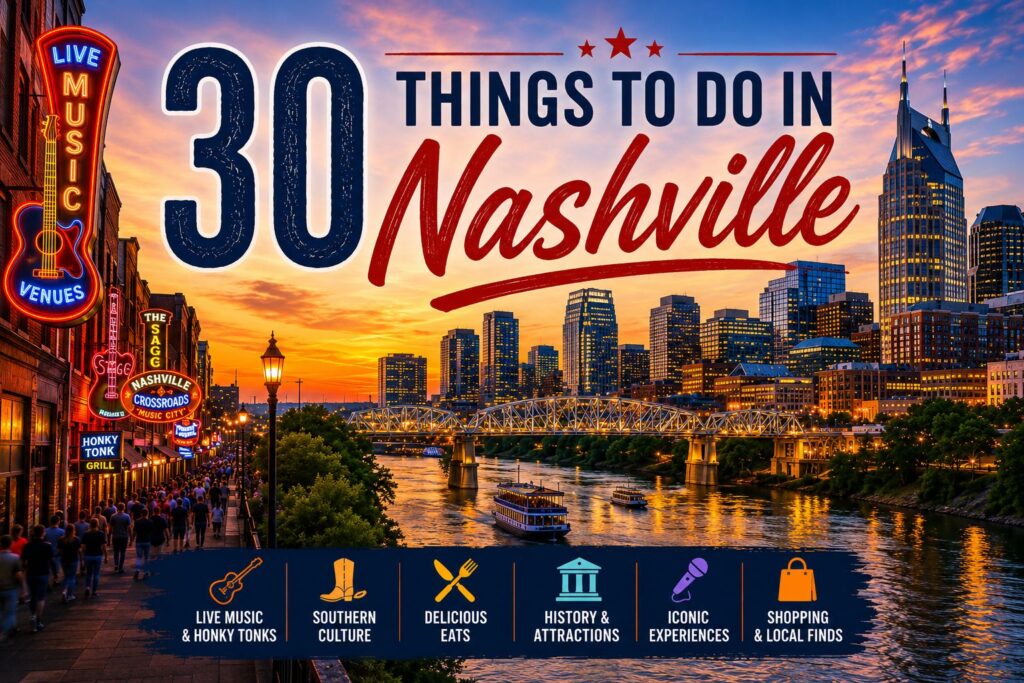
Lower Broadway at 3 PM on a Thursday afternoon is the finest free music experience in the United States. Every bar on the strip runs a live band from noon until 3 AM seven days a week. No cover charge at any of them. Not a suggested donation. Not a drink minimum functioning as a cover. Free. You walk into Tootsie’s Orchid Lounge or Robert’s Western World or The Stage on Broadway, order a beer for $6, and hear country music performed by musicians who know what they are doing. I have done this on four visits to Nashville and it surprises me every time not the quality of the music, which is what you expect, but the specific generosity of the arrangement.
Nashville is the American city most misrepresented by its reputation. Visitors expect bachelorette parties and cowboy hats and a city that exists primarily to perform Southernness for tourists. They find that too, particularly on Lower Broadway on a Friday night. But they also find the Ryman Auditorium, which is the most significant music venue in the history of American recorded sound. They find Radnor Lake State Park ten minutes from downtown, where the trail around a wildlife preserve feels like rural Tennessee rather than a major city. They find 12 South and East Nashville and Germantown, neighborhoods with the specific character of a city that has grown rapidly without losing its relationship to the people who lived here before the growth.
This guide covers the 30 best things to do in nashville organized by neighborhood, from Lower Broadway’s free music to the finest hidden gems locals know about. It is written for visitors planning a Nashville trip from any US city and covers every budget from the completely free to the genuinely splendid. For more travel destinations in Southern US city guides, read our complete articles on things to do in Dallas, things to do in Savannah GA and things to do in Chicago.
Nashville At a Glance: Quick Reference Table
| Activity | Neighborhood | Entry | Duration | Best For | Best Time |
|---|---|---|---|---|---|
| Lower Broadway Honky-Tonks | Downtown | Free | All day or evening | Nashville music culture | Thursday or Sunday |
| Robert’s Western World | Lower Broadway | Free + $7 Recession Special | 2 to 3 hours | Best honky-tonk, traditional country | Thursday to Saturday night |
| Tootsie’s Orchid Lounge | Lower Broadway | Free | 1 to 2 hours | Historic venue, live music | Any time |
| Ryman Auditorium | Downtown | $30 to $45 tour, $40 to $120 show | Tour 1 hr, show evening | Country music history, finest acoustics | Evening show or weekday tour |
| Country Music Hall of Fame | Downtown | $30 to $35 | 2 to 3 hours | Comprehensive country music history | Weekday morning |
| Johnny Cash Museum | Downtown | $22 to $26 | 1.5 hours | Cash legacy, personal collection | Any time |
| Grand Ole Opry | Opryland | $40 to $120 | 2.5 to 3 hours | Country music live broadcast | Tuesday or Friday show |
| Bluebird Cafe | Green Hills | $8 to $15 cover | 2 to 3 hours | Acoustic songwriter night, intimate | Sunday, reserve 3 weeks ahead |
| Third Man Records | Gulch area | Free to enter | 45 minutes | Jack White, finest vinyl store | Any time |
| Station Inn | Gulch | $10 to $15 cover | Evening | Finest bluegrass in Nashville | Thursday night |
| 12 South Neighborhood | South Nashville | Free | 2 to 3 hours | Best local walkable street | Sunday morning |
| The Gulch | Downtown adjacent | Free | 1 to 2 hours | Nashville mural, restaurants, bars | Evening |
| East Nashville / Five Points | East Nashville | Free | 2 to 3 hours | Finest local bars and restaurants | Thursday to Saturday evening |
| Germantown | North Nashville | Free | 2 to 3 hours | Best Nashville dining neighborhood | Saturday evening |
| Printer’s Alley | Downtown | Free | Evening | Historic nightlife, hidden Nashville | Evening |
| Centennial Park and Parthenon | West End | Free | 1 to 1.5 hours | Architecture, family, park | Any time |
| Radnor Lake State Park | South Nashville | Free | 1 to 2 hours | Wildlife, woodland trail, nature | Early morning |
| Percy Warner Parks | Belle Meade | Free | 1 to 3 hours | Hiking, steeplechase, views | Morning |
| Tennessee State Museum | Downtown | Free | 1.5 to 2 hours | Tennessee and Civil War history | Any time |
| Bicentennial Capitol Mall | Downtown | Free | 30 to 45 minutes | State history, Capitol view | Any time |
| Cheekwood Estate and Gardens | Belle Meade | $20 to $25 | 1.5 to 2 hours | Gardens, art, seasonal blooms | Spring and fall |
| Nashville Hot Chicken | Prince’s, Hattie B’s | $10 to $18 | Lunch or dinner | The genuinely Nashville food | Lunch weekday |
| Arnold’s Country Kitchen | Near downtown | $12 to $16 | Weekday lunch | Finest meat and three in Nashville | Weekday 11 AM to 2 PM |
| Martin’s BBQ Joint | Multiple locations | $15 to $28 | Lunch or dinner | Best Nashville whole-hog BBQ | Weekday lunch |
| Rolf and Daughters | Germantown | $40 to $65 | Dinner | Finest restaurant in Nashville | Reserve ahead, Sat evening |
| Fort Negley | South Nashville | Free | 45 minutes | Civil War site, best skyline view | Any time |
| Lane Motor Museum | East Nashville | $10 to $15 | 1 to 1.5 hours | Most unusual car collection in the South | Any time |
| Jack Daniel’s Distillery | Lynchburg, 90 minutes | $15 to $25 | 2 to 3 hours | Tennessee whiskey, history, day trip | Weekday |
| Franklin, Tennessee | 20 minutes south | Free (town walk) | Half day | Finest small Southern town near Nashville | Any time |
| Andrew Jackson’s Hermitage | 12 miles east | $20 to $28 | 1.5 to 2 hours | Presidential history, plantation site | Any time |
Lower Broadway and the Downtown Music Strip
Lower Broadway is the three-block strip of honky-tonk bars running from 1st Avenue to 5th Avenue along Broadway in downtown Nashville. It is where the country music tradition has been performed continuously, in bar after bar, since the 1940s. Every building is a Victorian commercial storefront from the 1880s and 1890s, stacked with bars on multiple floors, each running a live band from noon until last call. What makes Lower Broadway unlike any comparable music district in the United States is the one fact that most visitors do not know before they arrive: there is no cover charge, ever, at any venue on the strip.
1. Lower Broadway Honky-Tonks
Neighborhood: Downtown | Entry: Free | Duration: All day or evening | Best time: Thursday afternoon, Sunday evening
The Lower Broadway honky-tonks are free and this changes every calculation you make about a Nashville visit. The music runs from noon to 3 AM. The cover charge is zero. Every venue on the strip Tootsie’s Orchid Lounge, Robert’s Western World, The Stage on Broadway, Honky Tonk Central, Legends Corner operates this way, every day of the week, regardless of season or who is playing.
The strip runs both sides of Broadway from 1st Avenue to 5th Avenue. Most buildings are stacked three floors high, each floor running a different band simultaneously. The ground floors are the loudest and most crowded. The upper floors frequently have better acoustics, better sightlines, and a fraction of the crowd.
My specific routing through Lower Broadway: begin at the south end of 5th Avenue at Robert’s Western World, walk north to Tootsie’s for one drink, cross to The Stage, then end at Honky Tonk Central for the rooftop view over the strip. The full evening on this route costs whatever you spend at the bar. In four Nashville visits I have never once paid a door charge.
Practical tips:
- Thursday night is the finest version of Lower Broadway. The crowd is primarily local Nashville residents and music fans rather than the bachelorette party groups that arrive on weekends. The music is the same quality but the audience is completely different
- Upper floors of every Broadway honky-tonk are less crowded and the view from the balconies over the street below is worth the extra flight of stairs
- Lower Broadway is walking distance from every downtown Nashville hotel. WeGo bus service runs two blocks north on Church Street
2. Robert’s Western World
Neighborhood: Lower Broadway | Entry: Free | Food: $7 Recession Special | Best time: Thursday to Saturday night
Robert’s Western World at 416 Broadway is the finest honky-tonk in Nashville and the home of the Recession Special, which is a fried bologna sandwich, a bag of chips, a Moon Pie, and a Pabst Blue Ribbon for $7. This meal has cost $7 since at least the early 2000s and it will cost $7 next year. Robert’s started as a Western wear store in the 1940s and converted to a bar and music venue gradually across the following decades. The original boots and Western wear are still mounted on the walls.
The music at Robert’s plays traditional country rather than the contemporary bro-country that has taken over most of the Broadway strip. The bands cover Hank Williams, Merle Haggard, Patsy Cline, and the complete Nashville Sound catalog with specific skill. The jukebox in the back corner of Robert’s, operational at all hours, is the finest country music jukebox in Nashville and worth $5 of quarters.
Practical tips:
- Order the Recession Special as soon as you sit down. It sells out
- Robert’s does not have a second floor. The stage is the full bar, and there is no bad seat in the room
- Friday and Saturday bands from 10 PM onward are the finest traditional country music available on Lower Broadway without paying a cover charge anywhere
3. Tootsie’s Orchid Lounge
Neighborhood: Lower Broadway | Entry: Free | Duration: 1 to 2 hours | Best time: Any time
Tootsie’s Orchid Lounge at 422 Broadway is the most historically significant bar on Lower Broadway. The alley entrance of Tootsie’s opened directly onto the backstage door of the Ryman Auditorium across the alley, and from 1943 to 1974 the Ryman Opry years every significant country music artist who ever performed at the Grand Ole Opry came through Tootsie’s back door. Willie Nelson was discovered at Tootsie’s. Kris Kristofferson cleaned toilets there while trying to get his songs heard.
The purple exterior, the low ceilings, the photographs covering every wall from floor to ceiling, and the specific smell of old wood and beer create an atmosphere that no new bar can replicate. Tootsie’s is genuinely what it claims to be and that is rare on Lower Broadway.
Practical tips:
- The second floor of Tootsie’s, accessible from the Broadway entrance, is significantly more atmospheric than the ground floor and usually less crowded
- The alley behind Tootsie’s is the original stage door alley of the Ryman Auditorium. Walk through it and stand in it for a moment
- Tootsie’s merchandise is the only Broadway gift shop purchase worth making
4. Ryman Auditorium
Neighborhood: Downtown | Entry: $30 to $45 self-guided tour, $40 to $120 evening show | Duration: 1 hour tour, full evening for shows | Best time: Evening show, or weekday morning for tour
The Ryman Auditorium at 116 Fifth Avenue North is the most historically significant music venue in the United States. The church pew seating, curved hardwood walls, stained glass windows, and acoustics built for a revivalist preacher’s voice in 1892 create a room unlike any other in American performance history. Johnny Cash played here. Hank Williams played here. Patsy Cline, Elvis Presley, Dolly Parton, Emmylou Harris the complete canon of American country and roots music ran through this building across three decades of Grand Ole Opry broadcasts from 1943 to 1974.
The building is still in active use as a performance venue, hosting shows most weeks of the year. I attended a show at the Ryman on my second Nashville visit and I will say this directly: the acoustics are the finest of any music venue I have sat in. The curved wood walls distribute sound so evenly that every seat sounds like the front row. The church pew is genuinely uncomfortable for shows over 90 minutes. Bring a cushion or accept the specific physical cost of excellent acoustics.
The self-guided daytime tour, available when no shows are scheduled, accesses the stage, the green room, and the Mother Church historical exhibition covering the Opry years. The exhibition is thorough and worth 45 minutes independently of any performance.
Practical tips:
- Book evening show tickets 3 to 6 weeks ahead for popular artists. The Ryman’s website calendar is worth checking before finalizing Nashville trip dates
- The lower balcony is the finest acoustic position in the building. The curved wooden overhang concentrates sound directly below and every word from the stage arrives with equal clarity
- The tour includes access to the stage floor where you can stand in the same physical spot as every significant country artist since 1943
5. Country Music Hall of Fame and Museum
Neighborhood: Downtown | Entry: $30 to $35 adults | Duration: 2 to 3 hours | Best time: Weekday morning
The Country Music Hall of Fame at 222 Fifth Avenue South is the most comprehensive presentation of American country music history accessible to the public. The 350,000-square-foot building holds over 2.5 million artifacts covering the full arc of the genre from Appalachian roots through the Nashville Sound of the 1950s and 1960s to the present. Elvis Presley’s gold-leaf piano, Hank Williams Sr.’s pale blue 1952 Cadillac convertible, and the Hall of Fame rotunda with its oval wall of inductee plaques these objects make an argument for the importance of country music more effectively than any written explanation.
The Studio B tour, available as a combination ticket with museum admission, visits the actual RCA recording studio on Music Row where Elvis, Dolly Parton, Roy Orbison, and hundreds of other artists recorded between 1957 and 1977. The original recording floor, the control room glass, and the session furniture are all preserved.
Practical tips:
- The museum requires a full morning to cover properly. Visitors who spend 45 minutes are reading exhibit labels rather than understanding them
- The Hank Williams Sr. section on the second floor is the finest single exhibit in the building. His life, his specific position in the history of American music, and the tragic brevity of his career are covered with the depth they deserve
- Buy tickets online. The museum regularly sells out weekend morning entry slots in spring and fall
6. Johnny Cash Museum
Neighborhood: Downtown | Entry: $22 to $26 | Duration: 1.5 hours | Best time: Any time
The Johnny Cash Museum at 119 Third Avenue South covers the life and career of one of the most significant American artists of the 20th century with a personal collection that makes a compelling case for why Cash belongs in a museum separate from the Country Music Hall of Fame. The Ring of Fire guitar, the Man in Black stage costumes, the personal correspondence, the American Recordings album artwork from the late-career Rick Rubin sessions these are objects that carry genuine emotional weight. The section on Cash’s friendship with Bob Dylan and his position as a cultural bridge between country and rock audiences is the most intellectually interesting part of the exhibition.
The Patsy Cline Museum operates on the upper floors of the same building. The combined ticket is worth it if country music history is your primary reason for visiting Nashville.
Practical tips:
- The Johnny Cash Museum gift shop has the finest Cash vinyl and merchandise selection in Nashville, significantly better than anything on Lower Broadway
- The museum is a 10-minute walk from the Country Music Hall of Fame. Build both into the same downtown morning
- Allow the full 1.5 hours. The American Recordings section alone warrants 30 minutes
Nashville Music Venues Beyond Lower Broadway
7. Grand Ole Opry
Neighborhood: Opryland, east Nashville | Entry: $40 to $120 | Duration: 2.5 to 3 hours | Best time: Tuesday night show
The Grand Ole Opry is the longest-running radio broadcast in American history, running continuously since 1927. The current Opry House at 2802 Opryland Drive, opened in 1974, seats 4,400 and hosts three shows per week. A Grand Ole Opry show is not a concert. It is a variety program in the traditional radio broadcast format multiple artists performing two or three songs each, with the circular inlaid ring of oak from the Ryman Auditorium stage at the center, where every performer who steps onto it stands in the same spot as Hank Williams, Patsy Cline, and Dolly Parton stood.
The Tuesday night Opry draws a more local Nashville audience than the Friday and Saturday shows and the music is identical in quality. The backstage tour, available before select shows, is worth adding for anyone with a serious interest in country music history.
Practical tips:
- Book tickets at opry.com at least 2 to 3 weeks ahead for any show, longer for the Friday and Saturday performances in spring and fall
- The Opry is in Opryland east of downtown. Drive or rideshare WeGo service to Opryland is limited. Allow 30 minutes from downtown
- The backstage tour corridors, lined with photographs of every performer since 1974, are the most concentrated physical record of country music history in Nashville
8. Bluebird Cafe
Neighborhood: Green Hills, south Nashville | Entry: $8 to $15 cover, two-drink minimum | Duration: 2 to 3 hours | Best time: Sunday Writer’s Night reserve exactly 3 weeks ahead
The Bluebird Cafe at 4104 Hillsboro Pike is the most important small music venue in Nashville. Taylor Swift was discovered here in 2005. Garth Brooks was signed to his first record deal following a Bluebird performance. The Sunday Writer’s Night format, where four songwriters sit in a circle facing each other rather than the audience and trade original songs with explanations of how each was written, is the most intimate and most specifically Nashville music experience accessible to visitors.
The Bluebird holds approximately 100 people. The no-phones policy is strictly enforced and is the reason the shows feel the way they do. Tickets for Sunday Writer’s Night release online at exactly 3:30 PM, 21 days before each show. They sell out within the hour. Set a calendar reminder.
Practical tips:
- Sunday Writer’s Night tickets go on sale online at 3:30 PM exactly, 21 days before the show date. There is no other reliable way to secure them
- Green Hills is a 15-minute drive from downtown. Rideshare is the practical option. There is no realistic WeGo route
- The Bluebird does not allow photographs or phones during performances. This policy maintains the atmosphere that makes the venue what it is
9. Third Man Records and Station Inn
Neighborhood: Gulch area | Entry: Third Man free to enter, Station Inn $10 to $15 cover | Best time: Third Man any time, Station Inn Thursday night
Third Man Records at 623 Seventh Avenue South is Jack White’s Nashville label and public store. The retail floor sells Third Man vinyl releases and a curated selection of American music across every genre. The Third Man photo booth, a 1947 machine purchased by White, produces four photographs for $3. The results are sepia, slightly blurry, and the finest $3 Nashville souvenir available. The store is worth 45 minutes.
The Station Inn at 402 12th Avenue South, two blocks away, is the finest bluegrass and acoustic roots music venue in Nashville. The room holds about 200 people. The Thursday night bluegrass shows draw the people who actually drive the Nashville acoustic music scene these are not tourist performances. Cash only at the door, $10 to $15 cover, arrive 45 minutes early.
Practical tips:
- Third Man and Station Inn are both in the Gulch neighborhood, walkable from each other. Combine for a Thursday evening: Third Man in the late afternoon, Station Inn for the 9 PM show
- The live performance space in the back of Third Man hosts occasional shows check the calendar before visiting
- Station Inn accepts cash only at the door. There is an ATM nearby but not in the venue
Nashville Neighborhoods
10. 12 South Neighborhood
Neighborhood: 12 South, south Nashville | Entry: Free | Duration: 2 to 3 hours | Best time: Sunday morning
12 South on a Sunday morning, when the coffee shops open at 8 AM and the brunch restaurants fill from 10 AM and the street is occupied primarily by Nashville residents doing their weekend, is the most honest version of Nashville available to a visitor. The neighborhood centers on 12th Avenue South between Linden and Kirkwood, in small-scale 1920s commercial buildings that have been independently owned and independently occupied for decades.
The Frothy Monkey at 2719 12th Avenue South has anchored 12 South since 2004. The coffee is good. The breakfast is better. The specific ease of the room at 9 AM on a Sunday half local regulars, half visitors who have discovered the neighborhood is what 12 South offers that the downtown tourist economy does not. Emporium Pies at 314 Bishop Avenue (technically in the adjacent Bishop Arts pocket) is the finest pie shop in Nashville. The Drunken Nut pecan pie has been consistently excellent since 2012 and is not optional.
Practical tips:
- Arrive before 10 AM for Frothy Monkey on weekends. The brunch queue builds to 45 minutes by 10:30 AM and does not shorten until after 1 PM
- The I Believe in Nashville mural at the north end of 12th Avenue is the most photographed public art in the city. It exists. You will photograph it. This is acceptable
- WeGo bus route 55 reaches 12 South from downtown in 20 minutes
11. The Gulch
Neighborhood: West downtown | Entry: Free | Duration: 1 to 2 hours | Best time: Evening
The Gulch, the former industrial neighborhood immediately west of downtown that has transformed since 2008 into Nashville’s most upscale residential and commercial destination, has Nashville’s highest concentration of rooftop bars and new restaurants. The angel wings mural on the Gulch wall the What Lifts You installation is the most photographed street art in Nashville and is worth knowing about before you arrive so you can decide whether to photograph it sincerely or with full awareness of its Instagram provenance. Both are acceptable choices.
Biscuit Love at 316 11th Avenue South is the finest breakfast biscuit in Nashville. The line builds from 9 AM. Arrive before 8:30 AM for under a 20-minute wait. The Gulch is a 20-minute walk from Lower Broadway or a $6 rideshare.
Practical tips:
- Biscuit Love opens at 7 AM on weekdays and 8 AM on weekends. The morning biscuit at the opening hour, before the Gulch fills with people, is the correct experience
- Whiskey Kitchen on 11th Avenue South has the finest Tennessee whiskey selection in the Gulch area and the best outdoor patio for an evening drink
- The walk from the Gulch north to Third Man Records takes 8 minutes
12. East Nashville and Five Points
Neighborhood: East Nashville | Entry: Free | Duration: 2 to 3 hours | Best time: Thursday to Saturday evening
East Nashville, the collection of neighborhoods east of the Cumberland River centered on the Five Points intersection, is Nashville’s most creative and most genuinely local neighborhood. The musicians, chefs, artists, and independent business owners who are not catering to Broadway’s tourist economy actually live and work here. Five Points on a Thursday night is the finest version of Nashville’s local bar and music culture and the version that most accurately represents what the city is like when it is not performing for visitors.
The Pharmacy Burger Parlor at 731 McFerrin Avenue is the finest burger in Nashville. The house-made sodas are worth the additional $4. The 5 Spot on Woodland Street has live music most nights with no cover charge. Barista Parlor on Gallatin Avenue is the finest espresso operation in East Nashville, in an industrial space with a specific commitment to coffee quality that is recognizably East Nashville in its seriousness.
Practical tips:
- East Nashville is a 10-minute rideshare from downtown. The WeGo bus reaches Five Points from downtown but the route is indirect
- Henrietta Red on Sixth Avenue North serves the finest oysters and seafood in Nashville and is the best reservation in East Nashville for a Friday dinner. Reserve one week ahead
- The East Nashville neighborhood streets north of Gallatin Avenue Fatherland Street, Woodland Street, Holly Street contain the finest intact pre-WWII residential architecture in Nashville
13. Germantown
Neighborhood: North Nashville | Entry: Free | Duration: 2 to 3 hours | Best time: Saturday evening for dinner
Germantown, the Victorian neighborhood immediately north of downtown along 5th and 6th Avenues, is Nashville’s finest historic residential neighborhood and the location of the best restaurant in the city. The 1870s and 1880s brick townhouses and commercial buildings were restored beginning in the 1990s. The Nashville Farmers’ Market at the south end of Germantown operates Tuesday through Sunday with permanent indoor vendors and the best accessible selection of Tennessee agricultural products in the city.
Rolf and Daughters at 700 Taylor Street is the finest restaurant in Nashville. The pasta-focused menu built on Tennessee agricultural products, executed in an open kitchen in a former textile mill, is the specific combination of place and craft that defines what a great American regional restaurant should be. Reserve three to four weeks ahead for weekend dinners. Reservations open 30 days in advance at 10 AM.
Practical tips:
- Rolf and Daughters reservations open online 30 days in advance at 10 AM exactly. Set a reminder
- The Germantown neighborhood morning walk Farmers’ Market, then north through the residential streets to the Madison Street commercial strip takes 45 minutes and shows the finest surviving Victorian residential streetscape in Nashville
- WeGo bus route 14 reaches Germantown from downtown in 15 minutes
14. Printer’s Alley
Neighborhood: Downtown | Entry: Free | Duration: Evening | Best time: Evening
Printer’s Alley, the historic block of bars running between Church and Commerce Streets two blocks from Lower Broadway, is the most historically concentrated nightlife corridor in Nashville that most visitors never find. The alley was the center of Nashville’s printing industry in the 19th century and transitioned to entertainment during Prohibition, when its narrow width and internal location made it a natural location for speakeasies. Skull’s Rainbow Room has been operating in the alley in some form since the 1940s. The interior is unchanged.
The bars in Printer’s Alley draw a significantly different crowd from Lower Broadway older, more local, less costumed. It is two blocks from the Broadway strip and functionally invisible to most visitors who concentrate on the main street.
Practical tips:
- Skull’s Rainbow Room is the most atmospheric bar in the alley. The drinks are strong and the decor has not been updated since the Opry years, which is its entire appeal
- Printer’s Alley is best visited after your first Broadway honky-tonk, when the comparison between the tourist strip and the historic alternative is most instructive
- The alley is fully outdoor. In summer it is hot. In October it is perfect
Parks and Outdoor Nashville
15. Centennial Park and the Parthenon
Neighborhood: West End | Entry: Free (park), $6.50 Parthenon interior | Duration: 1 to 1.5 hours | Best time: Any time
Centennial Park contains the most unexpected structure in Nashville a full-scale permanent concrete replica of the Athenian Parthenon, built in 1897 for the Tennessee Centennial Exposition and rebuilt permanently in 1931. The building is the only full-scale Parthenon replica in the world, and the interior houses a 42-foot gilded replica of the Athena Pheidias statue the largest indoor sculpture in the United States. The replica should not work as a Nashville landmark. It works completely.
The 132-acre park surrounding it, with mature trees and walking paths, is the finest urban park in central Nashville. The contrast between the ancient Greek temple and the Nashville skyline visible beyond it is a specifically Tennessee juxtaposition that is worth experiencing before deciding what to make of it.
Practical tips:
- The Parthenon interior is worth the $6.50 entry specifically for the Athena statue, which is overwhelming in scale in a way that photographs cannot prepare you for
- Centennial Park is a 20-minute walk from Vanderbilt University’s campus. The Vanderbilt campus itself is worth 30 minutes of walking for its architecture
- WeGo bus route 3 reaches Centennial Park from downtown in 20 minutes
16. Radnor Lake State Park
Neighborhood: South Nashville, 8 miles from downtown | Entry: Free | Duration: 1 to 2 hours | Best time: Early morning
Radnor Lake is the finest natural area accessible from any American city at Nashville’s scale. The 1,368-acre state park 8 miles south of downtown contains a 75-acre lake surrounded by old-growth forest with six miles of hiking trails. Great blue herons, wood ducks, white-tailed deer, river otters, and bald eagles are routinely visible from the main lakeshore trail in numbers that seem impossible for a park within a major metropolitan area.
I walked the South Cove Trail at 6:30 AM on a November morning when frost was on the leaves and a heron was standing completely still in the water 20 feet from the trail. That specific combination of silence and wildlife, ten minutes from the center of a city of 715,000 people, is not something I expected from Nashville and remains one of the finest things it has to offer any visitor who arrives before 8 AM.
Practical tips:
- The South Cove Trail around the south end of the lake is the most level and most wildlife-productive trail. Arrive before 7:30 AM on weekend mornings the parking lot reaches capacity by 9 AM in spring and fall
- Dogs are not permitted on any Radnor Lake trails. This policy maintains the wildlife viewing quality and is enforced consistently
- The main lakeshore trail is 2.1 miles. Allow 1 hour at a comfortable pace with stops for the herons
17. Percy Warner Parks
Neighborhood: Belle Meade, southwest Nashville | Entry: Free | Duration: 1 to 3 hours | Best time: Morning
Percy Warner Parks, the 3,182-acre public park system in southwest Nashville, is the finest hiking destination within the city and the place that most clearly demonstrates Nashville’s unusual combination of urban density and genuine natural landscape. The 25 miles of trails through hardwood forest, the stone steeplechase course, and the ridge overlooks above the city make this the outdoor asset that most surprises visitors who expect a flat Southern city. The Percy Warner Steeplechase, held annually in late April, is Tennessee’s oldest continuously run equestrian event and a free outdoor spectacle.
Practical tips:
- The Hills of Percy Warner trail system in the upper portion of the park is more challenging and significantly less crowded than the lower Mossy Ridge trail
- The stone steps at the main entrance 154 steps carved from the hillside are a Nashville landmark and the most direct route to the upper trails from the parking area
- The drive south to Percy Warner through the Belle Meade neighborhood passes some of the finest residential architecture in Nashville
History and Museums in Nashville
18. Tennessee State Museum
Neighborhood: Downtown | Entry: Free | Duration: 1.5 to 2 hours | Best time: Any time
The Tennessee State Museum is completely free and is the finest state history museum in the American South. The permanent collection covers 15,000 years of Tennessee history from prehistoric Native American cultures through the Civil War, Reconstruction, and the 20th century with a scholarly depth and exhibition quality above what most state museums achieve. Tennessee was more deeply divided by the Civil War than any other Confederate state, with large Unionist populations in East Tennessee and major battles across the full length of the state. The museum’s treatment of enslaved people’s experiences and the state’s complicated post-war history is more direct and more specific than most Civil War museum narratives.
Practical tips:
- The Tennessee State Museum is in the Bicentennial Capitol Mall State Park complex. Combine both in a single morning downtown walk
- Allow the full 2 hours. The Civil War collection alone warrants 45 minutes
- The museum gift shop has the finest selection of Tennessee history publications and regional literature in Nashville
19. Bicentennial Capitol Mall State Park
Neighborhood: Downtown | Entry: Free | Duration: 30 to 45 minutes | Best time: Any time
The Bicentennial Capitol Mall State Park, the 19-acre outdoor mall running north from the Tennessee State Capitol, is the most thoughtfully designed piece of public history space in Nashville. The 31 fountains representing each county in Tennessee, the granite map of the state in the main plaza, and the 200-foot wall of Tennessee history carved in stone make the mall a specific and rewarding public history experience rather than a ceremonial green space. The Tennessee State Capitol at the south end, completed in 1859, is one of the finest examples of Greek Revival civic architecture in the American South and is open for free public tours on weekdays.
Practical tips:
- The Capitol building tours are free, run on weekdays, and take 45 minutes. The building’s interior is significantly more impressive than the exterior suggests
- The Bicentennial Mall Farmers’ Market, operating on the mall on weekends, is quieter and more browseable than the main Nashville Farmers’ Market in Germantown
- The Tennessee State Museum is directly adjacent and entry is free combining both makes a complete morning of Nashville history at zero cost
20. Cheekwood Estate and Gardens
Neighborhood: Belle Meade, southwest Nashville | Entry: $20 to $25 | Duration: 1.5 to 2 hours | Best time: April to May spring bloom, October to November fall foliage
Cheekwood, the 55-acre botanical garden and art museum in Belle Meade, is Nashville’s finest estate garden and one of the finest accessible gardens in the American South. The 1930s English country house, built for the Maxwell House coffee family, houses a permanent collection of American art with particular strength in 19th and early 20th-century landscape painting. The spring Cheekwood in Bloom festival from late February through May, when thousands of tulips, daffodils, and spring bulbs bloom simultaneously across the estate, is the finest single seasonal garden event in Tennessee.
The contemporary sculpture trail through the estate grounds is permanently installed and free to walk during regular admission hours. The trail represents the finest accessible outdoor sculpture collection in Nashville.
Practical tips:
- The Cheekwood in Bloom spring festival increases admission to $30 for adults but adds tens of thousands of flowers that make the estate a genuinely different experience from the standard visit
- Book weekend tickets online. Cheekwood regularly reaches capacity during the spring bloom period
- The Japanese garden on the estate grounds is the most peaceful outdoor space in Nashville and the most consistently photographic in any season
Nashville Food: From Hot Chicken to Fine Dining
Nashville has developed two distinct food cultures in the past decade. The tourist food economy of Lower Broadway serves inflated versions of Nashville standards at prices calibrated for convention traffic. The actual Nashville food culture Prince’s Hot Chicken, Arnold’s meat and three, Peg Leg Porker, the Germantown restaurant strip, the East Nashville taqueria network is one of the most specific and most rewarding regional food cultures in the American South.
21. Nashville Hot Chicken
Where: Prince’s Hot Chicken Shack (East Nashville), Hattie B’s (multiple locations) | Cost: $10 to $18 | Best time: Weekday lunch
Nashville hot chicken is a specific dish invented in Nashville in the 1930s and that exists in its authentic form only in Nashville. The preparation fried chicken coated in a cayenne and lard spice paste applied hot directly after frying, served on white bread with pickle chips is not a recipe that fast food chains have successfully replicated, and eating it at Prince’s on Dickerson Road in East Nashville makes that immediately clear.
Prince’s Hot Chicken Shack is the original, still run by the Prince family, still serving the dish that Thornton Prince created. Order the Original Hot. Do not begin with Extra Hot unless you have a verifiable and recent history with genuinely extreme food. Hattie B’s on Broadway is the accessible version cleaner, consistent, genuinely good, and not Prince’s.
Practical tips:
- Prince’s closes when they run out of chicken, which on weekends can be as early as 7 PM. Arrive at lunch on a weekday for the most reliable experience
- The heat levels at Prince’s do not correspond to Hattie B’s heat levels. Original Hot at Prince’s is approximately equivalent to Hot at Hattie B’s
- Prince’s has no dining room in the traditional sense. Order at the counter, wait, eat at the tables
22. Arnold’s Country Kitchen
Neighborhood: Near downtown, 8th Avenue South | Cost: $12 to $16 | Best time: Weekday 10:30 AM to 2:30 PM only
Arnold’s Country Kitchen at 605 8th Avenue South is the finest meat and three restaurant in Nashville and the best argument for the specifically Southern cafeteria tradition of American food. One protein, three sides from a rotating daily menu, served on a cafeteria tray with cornbread baked fresh hourly. At Arnold’s, the daily rotating menu of vegetables cooked in pork fat and proteins running from pot roast to fried chicken creates a lunch that costs $14 and tastes like it costs $40. The line extends out the door from 11 AM onward. It moves quickly.
Arnold’s is open for lunch only, weekdays only. Cash only. There is an ATM inside.
Practical tips:
- The turnip greens at Arnold’s are the finest cooked greens in Nashville. Order them regardless of what else you select
- Arnold’s closes at 2:30 PM and does not negotiate. Arrive before 2 PM or plan for another day
- The line is genuinely intimidating at 12:30 PM. It moves in 15 minutes. Do not leave because of the line
23. Martin’s BBQ Joint
Neighborhood: Multiple locations, downtown and Nolensville Pike | Cost: $15 to $28 | Best time: Weekday lunch
Martin’s BBQ Joint is the finest whole-hog BBQ restaurant in Nashville. Pat Martin built his reputation on pitching entire hogs over hardwood coals for 24 hours, and the Redneck Taco at Martin’s smoked pork on a cornbread hoecake with house slaw and Alabama white sauce is the finest single menu item in Nashville BBQ and the one dish worth going to Martin’s specifically to eat.
The downtown Martin’s on Broadway is the most accessible but also the most tourist-facing version. The Nolensville Pike location, 20 minutes south, is where the local regulars eat and the whole-hog quality is most consistently excellent.
Practical tips:
- The smoked chicken at Martin’s is frequently the best protein on weekday visits when the whole-hog timing is most perfectly aligned
- Order the Redneck Taco. Order the smoked corn as a side. Do not overthink the menu
- Martin’s is open for lunch and dinner. Weekday lunch is the least crowded and the most reliably stocked version
24. Rolf and Daughters
Neighborhood: Germantown, 700 Taylor Street | Cost: $40 to $65 per person | Best time: Saturday evening, reserve ahead
Rolf and Daughters is the finest restaurant in Nashville and the dining experience that most specifically represents what the city’s food culture has become. The pasta-focused menu changes seasonally, built on Tennessee agricultural products, executed in a former textile mill with an open kitchen running at full capacity. The experience of eating at Rolf and Daughters on a Saturday evening the noise, the quality, the specific combination of Southern ingredients and Italian technique is the clearest evidence available that Nashville is not only a music city.
Reserve three to four weeks ahead for Saturday dinner. Reservations open 30 days in advance at 10 AM online.
Practical tips:
- Rolf and Daughters has no bad item on the menu. Order what appeals and trust the kitchen
- The bar at Rolf and Daughters accepts walk-ins when tables are unavailable. Dinner at the bar is the same menu and the same quality
- Arrive at the Germantown Farmers’ Market on Saturday morning, walk the neighborhood, and hold the Rolf and Daughters dinner as the close of the day
Hidden Nashville
25. Fort Negley
Neighborhood: South Nashville | Entry: Free | Duration: 45 minutes | Best time: Any time
Fort Negley, the largest stone fort constructed in the American interior during the Civil War, sits on a hilltop in south Nashville and provides the most complete view of the Nashville skyline available from any publicly accessible elevated point in the city. The fort was built in 1862 by Union forces using the forced labor of approximately 2,760 enslaved and free Black men, and the site’s interpretation of that history is among the most honest of any Civil War fortification in the American South.
The visitor center has a small but well-researched exhibition on the fort’s construction and the wartime experience of Nashville’s Black population. The skyline view from the upper rampart, looking north over the Cumberland River to the Nashville towers, is the finest accessible panoramic city view in Nashville.
Practical tips:
- The Fort Negley Visitor Center is open Tuesday through Sunday. The grounds and ramparts are accessible during daylight hours
- The view from the fort at dusk, when the Nashville downtown lights begin to come on, is the finest free evening photography location in the city
- Combine with a Germantown dinner the drive from Fort Negley to Germantown is 10 minutes
26. Lane Motor Museum
Neighborhood: East Nashville, Murfreesboro Pike | Entry: $10 to $15 | Duration: 1 to 1.5 hours | Best time: Any time
The Lane Motor Museum houses the largest collection of European microcars and unusual automobiles in the United States 500 vehicles including cyclecars, bubble cars, amphibious cars, and the world’s largest collection of Czechoslovakian automobiles outside the Czech Republic. The museum’s acquisition philosophy is entirely counterintuitive: they collect what no one else wants. The result is the most interesting automotive collection in the American South and probably in the country.
The museum is perpetually undervisited. Weekend mornings frequently have more staff than visitors, and the docents know the collection with unusual depth. Ask them to show you the current favorites.
Practical tips:
- The rotating Race to 500 gallery displays different vehicles from the collection’s depth each quarter. Half the museum changes every three months
- The Lane Museum is genuinely free of the self-consciousness that affects most unusual collections. It exists because someone wanted to preserve these things, not because anyone expected visitors to come
- Combine with East Nashville dinner Murfreesboro Pike is 15 minutes from Five Points
Day Trips from Nashville
27. Jack Daniel’s Distillery
Location: Lynchburg, Tennessee, 90 minutes south | Entry: $15 to $25 | Duration: 2 to 3 hours | Best time: Weekday
The Jack Daniel’s Distillery in Lynchburg is the oldest registered distillery in the United States, established in 1866, and the most visited tourist attraction in Tennessee. Moore County, where the distillery sits, is a dry county. You can taste Jack Daniel’s whiskey at the distillery but you cannot legally purchase alcohol to take home in Lynchburg itself. This is the most specifically Tennessee fact about the Jack Daniel’s experience and the one that surprises most visitors.
The Angel’s Share tour at $25 is the most comprehensive option, including the barrel warehouse and the full Tennessee Whiskey flight. Miss Mary Bobo’s Boarding House in Lynchburg, a family-style Southern lunch restaurant operating since 1908, requires reservations weeks ahead and is worth it.
Practical tips:
- The drive south from Nashville on Highway 231 through the Tennessee rolling hills in October, when the hardwood forests are at peak fall color, is the finest autumn drive in Middle Tennessee
- Lynchburg is not accessible by public transit. The distillery requires a car or organized tour
- The Cave Spring on the distillery grounds, the limestone cave spring water source for all Jack Daniel’s production, is the most interesting single feature of the distillery tour
28. Franklin, Tennessee
Location: 20 miles south of Nashville, 30 minutes | Entry: Free (town walking) | Duration: Half day | Best time: Any time
Franklin, the historic county seat of Williamson County 20 miles south of Nashville, is the finest small Southern town accessible as a Nashville day trip. The Carter House, the site of the Battle of Franklin on November 30, 1864, has the highest concentration of bullet damage of any structure surviving from the Civil War over 1,000 documented bullet holes in the walls and outbuildings from a battle that produced 9,500 casualties in five hours.
Franklin’s Main Street historic district is the best-preserved 19th-century commercial streetscape in Middle Tennessee. The Saturday morning Franklin Farmers’ Market is the finest weekly market in the Nashville region.
Practical tips:
- The Carter House tour at $15 to $20 is essential. The bullet-scarred kitchen outbuilding alone warrants the trip from Nashville
- Puckett’s Grocery on Main Street serves the finest accessible country cooking in Franklin and one of the finest in the Nashville region at any price point
- Franklin is 30 minutes from downtown Nashville on I-65. No practical transit option drive or rideshare
29. Andrew Jackson’s Hermitage
Location: 12 miles east of downtown Nashville | Entry: $20 to $28 | Duration: 1.5 to 2 hours | Best time: Any time
The Hermitage, President Andrew Jackson’s 1,000-acre plantation estate 12 miles east of Nashville, is the most completely preserved and most honestly interpreted presidential site in Tennessee. The interpretation of the enslaved workers’ experience their quarters, their daily labor, their specific position in the political economy of a president who owned 150 people is more direct and more historically grounded than most presidential site interpretations manage.
The mansion, formal garden, enslaved workers’ quarters, and the tomb of Jackson and his wife Rachel are all accessible in a single visit. The self-guided audio tour is well-researched and takes 1.5 hours at a comfortable pace.
Practical tips:
- The enslaved workers’ quarters and the audio tour that accompanies them are the most important part of the Hermitage visit more historically significant than the mansion interior
- The Hermitage Garden, laid out by Rachel Jackson in 1819, is the finest surviving example of an early 19th-century formal American garden and is at its most beautiful in April during the tulip season
- The Music City Star commuter rail from downtown Nashville reaches Hermitage station, a 10-minute walk from the site, for $2.50
30. Natchez Trace Parkway
Location: Begins at Nashville, runs 444 miles southwest to Natchez, Mississippi | Entry: Free | Duration: Half day minimum | Best time: October for fall foliage
The Natchez Trace Parkway, the National Park Service road following the historic route from Nashville to Natchez, Mississippi, begins at its northern terminus 10 miles southwest of Nashville and runs through some of the finest natural scenery accessible by car in Middle Tennessee. The 444-mile parkway prohibits commercial vehicles and has no billboards, gas stations, or development for its full length. Driving the first 50 miles south of Nashville in October, when the hardwood forest turns simultaneously along both roadsides, is the finest fall foliage drive in Middle Tennessee.
The parkway is also the finest cycling road in the Nashville region, with smooth pavement, low traffic, and consistent pull-offs at historical sites.
Practical tips:
- The northern terminus of the Natchez Trace Parkway is at Highway 96, 10 miles southwest of Nashville. Take I-40 west to the Pasquo exit
- The Gordon House at mile 407.7 and the Meriwether Lewis burial site at mile 385.9 are the most historically significant stops on the Tennessee portion of the parkway
- The parkway speed limit is 50 mph and is enforced. It is not a highway. It is a slow drive through a national historic landscape
Nashville Practical Guide
Getting Around Nashville
WeGo Metro Transit: Nashville’s bus network covers downtown, the Arts District, 12 South, Germantown, East Nashville, and Centennial Park. A single ride costs $2. A day pass costs $4. The Music City Star commuter rail runs east to Donelson and Hermitage for $2.50.
Ride Share: Uber and Lyft are reliable throughout Nashville. Most cross-neighborhood trips cost $8 to $15. For the Bluebird Cafe in Green Hills, the Grand Ole Opry at Opryland, and most East Nashville destinations, rideshare is significantly more practical than transit.
Walking: Lower Broadway, the Country Music Hall of Fame, Ryman Auditorium, and the Johnny Cash Museum are all within a 10-minute walk of each other in downtown. 12 South and the Gulch are walkable neighborhoods. East Nashville requires a rideshare from downtown.
Driving: Nashville is built for cars and parking is available at most Nashville attractions. Downtown garage parking costs $15 to $25 per day. Do not drive to Lower Broadway on Friday or Saturday nights.
Where to Stay in Nashville
Downtown and Lower Broadway: Best for first-time visitors wanting walking access to the honky-tonks, Ryman, and Country Music Hall of Fame. The highest-priced and most tourist-facing accommodation zone. $130 to $400 per night.
12 South and Music Row: Best for visitors wanting the finest Nashville neighborhood experience with walkable streets, independent restaurants, and some distance from the Broadway tourist economy. $100 to $250 per night.
East Nashville: Best for visitors who want the genuinely local music and restaurant culture and do not mind a 10-minute rideshare to downtown. $80 to $200 per night.
Germantown: Best for visitors focused on the finest Nashville dining and walking access to the Farmers’ Market. $110 to $280 per night.
Nashville Budget Guide
Budget traveler (hostel or budget hotel, Arnold’s lunch, free attractions): $90 to $150 per day. Nashville’s free experiences are exceptional. Lower Broadway free music, Tennessee State Museum free, Centennial Park free, Radnor Lake free, Bicentennial Mall free, and a Robert’s Western World $7 Recession Special constitute a completely free and genuinely excellent Nashville day with $7 in food spending.
Mid-range traveler (hotel, restaurant meals, paid attractions): $185 to $310 per day. Ryman Auditorium tour, Country Music Hall of Fame, Nashville hot chicken at Hattie B’s, Arnold’s lunch, dinner at a Germantown restaurant, and WeGo transit for movement covers the essential Nashville experience at this range.
Luxury traveler (boutique hotel, fine dining, premium experiences): $380 and above per day. Rolf and Daughters dinner reservation, Bluebird Cafe Sunday night show, Grand Ole Opry premium seating, Cheekwood Estate, and the full Jack Daniel’s Distillery tour represent Nashville at its most considered.
Best Time to Visit Nashville
March to May: The finest Nashville season. Cheekwood is in full spring bloom from late February through April. The Steeplechase in Percy Warner Parks runs in late April. Temperatures range 65 to 80 degrees Fahrenheit. CMA Fest runs in early June if that is your reason to visit, plan accordingly or add one day before it starts.
October to November: The second-best season. Fall foliage arrives in the Nashville area hills in mid-October. Temperatures drop to comfortable walking range. The bachelorette party volume drops significantly from the summer peak. The Natchez Trace Parkway is at its most spectacular.
June to August: Hot and humid in a way that genuinely limits outdoor enjoyment. The Tennessee summer heat is more serious than visitors from dry-climate states expect. Museum culture the Hall of Fame, Ryman, Tennessee State Museum works well in summer. Plan outdoor activities before 10 AM or after 5 PM from June through August.
December to February: Mild compared to most of the US (highs in the 50s and 60s Fahrenheit on most days) but with occasional ice storms that close roads without warning. Nashville infrastructure handles ice poorly. The honky-tonks on Broadway run identically year-round regardless of weather.
Frequently Asked Questions About Nashville
How many days do you need in Nashville? Three days covers the essential nashville things to do: Lower Broadway and the honky-tonks, Ryman Auditorium, Country Music Hall of Fame, and Prince’s hot chicken on day one. The Grand Ole Opry or Bluebird Cafe, 12 South or East Nashville, and Radnor Lake on days two and three. Four days adds a Fort Negley visit and Germantown dinner. Five days allows the Jack Daniel’s Distillery day trip and the full Cheekwood experience. Do not attempt Nashville in two days. The Ryman Auditorium alone justifies a third night.
Are the honky-tonks on Lower Broadway really free? Yes. No cover charge at any venue on the strip. No drink minimum functioning as a cover. Every honky-tonk on Lower Broadway operates continuous live music from noon to 3 AM seven days a week with zero entry fee. You pay for drinks. This is one of the most remarkable cultural facts about Nashville and one that most visitors do not know before they arrive.
What is Nashville hot chicken? Nashville hot chicken is fried chicken coated in a cayenne and lard spice paste applied hot directly after frying, served on white bread with pickle chips. It was invented in Nashville in the 1930s by Thornton Prince and exists in its authentic form only in Nashville. Prince’s Hot Chicken Shack on Dickerson Road in East Nashville is the original. Order the Original Hot. Do not start with Extra Hot.
Is Nashville just for country music fans? No. Nashville has Radnor Lake State Park, the Tennessee State Museum (free), the Bicentennial Capitol Mall, 12 South as a walkable independent neighborhood, the finest small historic town in Middle Tennessee 20 minutes south at Franklin, the Cheekwood Estate, the Lane Motor Museum, and the Ryman as a performance venue for all genres. Country music is the lens through which most visitors experience Nashville. It is not the only thing worth experiencing.
When is the worst time to visit Nashville? Friday and Saturday nights on Lower Broadway are the worst version of Nashville for anyone who wants to hear music rather than observe Nashville performing for bachelorette parties. Thursday nights and Sunday evenings are the finest versions of the same strip at identical cost. The worst season is peak summer humidity from July through August, not for cultural reasons but physical ones.
What is the best free thing to do in nashville tn? The Lower Broadway honky-tonks are the best free experience in Nashville and one of the best free experiences in the United States. The Tennessee State Museum is the finest free museum in the American South. Radnor Lake is the finest free natural area in any American city at Nashville’s scale. Centennial Park and the Parthenon exterior, Bicentennial Capitol Mall, and Fort Negley skyline view are all free and together constitute a complete Nashville day at zero cost.
Final Word: Nashville Rewards the Visit That Nobody Expected to Love
The most consistent thing I hear from visitors who come to Nashville with low expectations is that they did not expect to love it as much as they did. They expected Broadway bars and performance Southern culture. They found those things. They also found the Bluebird Cafe, which stopped them. They found Radnor Lake at dawn, which surprised them. They found Robert’s Western World on a Thursday afternoon the Recession Special, the traditional country music, the specific unhurried ease of a bar that has been doing this since the 1940s and they understood something about Nashville that the reputation does not communicate.
Nashville does not announce its finest qualities. The Tennessee State Museum does not announce itself with an entry fee. The Ryman does not announce its acoustics until you are sitting in the pew. The honky-tonks do not announce the quality of the music until the band actually starts.
Go on a Thursday. Start at Robert’s Western World. Order the Recession Special. Stay for the first band. The city makes its own case from there.
For more US city guides, read our complete articles on things to do in Chicago, things to do in Washington DC, things to do in Seattle and things to do in Dallas. The full USA planning guide is at best places to visit in the USA.
What surprised you most about Nashville? Tell us in the comments below.
Pingback: 25 Best Things to Do in Cincinnati 2026 (Local Guide)