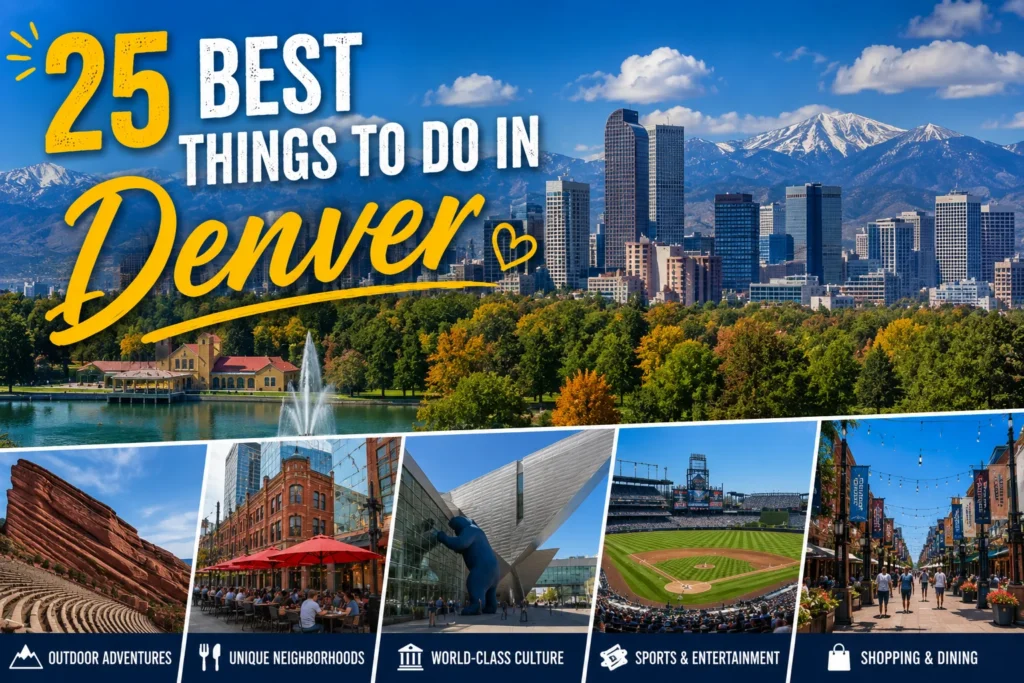
25 Best Things to Do in Denver in 2026 (Complete City Guide)
By Sarah Mitchell | Travel Expert and Founder
I have planned Denver trips for years, and the thing I tell everyone first is the one that changes how they pack their days: this is a city where the outdoor adventure and the urban culture sit twenty minutes apart, not two hours. A world-class concert venue carved into 300-million-year-old sandstone sits fifteen minutes from downtown. A national park with a road that climbs above 12,000 feet is a 90-minute drive. And the craft beer scene here predates most of the national boom by a decade, which is exactly why locals get quietly irritated when visitors act surprised by how good it is.
The other thing I tell first-timers: the altitude is real, and it catches people who arrive expecting a normal Tuesday. Denver sits at exactly one mile above sea level, and if you have just flown in from somewhere near sea level, the thinner air genuinely affects how the first day feels, especially if that first day includes a hike or a few beers too many. This guide covers the 25 best things to do in Denver in 2026, ordered the way I would actually plan a trip, with current prices, honest time estimates, and the specific 2026 update worth knowing: Red Rocks opened a new Connection Trail this year, linking the Upper Lot directly to the Trading Post, which changes how you can approach a non-concert visit to the venue. For more of the Southwest, see my things to do in Arizona and things to do in Albuquerque guides on Travel Destinations Plan.
Denver At a Glance: Quick Reference Table
| # | Activity | Area | Entry | Duration | Best For | Best Time |
|---|---|---|---|---|---|---|
| 1 | Red Rocks Park & Amphitheatre | Morrison, ~15 mins west | Free (non-concert days) | 1.5 to 3 hours | All visitors; hikers; music fans | Sunrise or weekday mornings; book concerts ahead |
| 2 | Rocky Mountain National Park | ~90 mins northwest | ~$30 per vehicle | Full day | Hikers; nature lovers | Weekday; early morning entry |
| 3 | Denver Art Museum | Golden Triangle | ~$18-22 adults | 2 to 3 hours | Art lovers | Weekday mornings |
| 4 | Meow Wolf Denver: Convergence Station | Ball Arena area | ~$45-50 | 2 to 4 hours | Art lovers; families; the curious | Book ahead; weekday |
| 5 | Denver Botanic Gardens | Cheesman Park area | ~$18-20 adults | 1.5 to 2.5 hours | Garden lovers; families | Spring through fall; summer concerts |
| 6 | Union Station & LoDo | Downtown | Free to walk | 1.5 to 2 hours | Foodies; architecture fans | Evening |
| 7 | Larimer Square | LoDo | Free to walk | 1 to 1.5 hours | Foodies; shoppers | Evening |
| 8 | Denver Museum of Nature & Science | City Park | ~$22-25 adults | 2.5 to 3 hours | Families | Weekday mornings |
| 9 | Denver Zoo Conservation Alliance | City Park | ~$22-25 adults | 3 to 4 hours | Families | Morning; weekdays |
| 10 | RiNo Art District | River North | Free to walk | 2 to 3 hours | Art lovers; brewery fans | Evening; First Friday |
| 11 | Coors Field (Rockies game) | LoDo | Tickets from ~$15 | 3 to 3.5 hours | Baseball fans; families | April to September |
| 12 | Colorado State Capitol | Civic Center | Free | 45 mins to 1 hour | History and architecture lovers | Weekday mornings |
| 13 | 16th Street Mall & Civic Center Park | Downtown | Free | 1 to 1.5 hours | Walkers; a downtown orientation | Anytime |
| 14 | Molly Brown House Museum | Capitol Hill | ~$18 adults | 1 hour | History lovers | Weekday afternoons |
| 15 | Denver Craft Brewery Crawl | RiNo & LoDo | Pints ~$6-8 | 2 to 4 hours | Beer lovers | Afternoon into evening |
| 16 | Confluence Park | Downtown / LoDo edge | Free; kayak rental ~$20 | 1 to 2 hours | Kayakers; a free river break | Summer afternoons |
| 17 | City Park & City Park Jazz | East Denver | Free | 1.5 to 2 hours | Families; music lovers | Summer Sunday evenings |
| 18 | Cherry Creek Trail | Downtown to Cherry Creek | Free | 1 to 3 hours | Cyclists; runners | Morning |
| 19 | Mount Blue Sky Scenic Byway | ~40 mins west | Fee at Summit Lake area | Half day | Scenic drivers; view seekers | July to Labor Day (road season) |
| 20 | US Mint Denver | Downtown | Free (tours) | 45 mins | History and coin enthusiasts | Book tour ahead |
| 21 | Dinosaur Ridge | Morrison, near Red Rocks | ~$5 suggested donation | 1 to 2 hours | Families; fossil enthusiasts | Weekday mornings |
| 22 | Denver Performing Arts Complex | Downtown | Show tickets vary | 2 to 3 hours | Theater and music lovers | Check show calendar |
| 23 | Cherry Creek Shopping District | Cherry Creek | Free to walk | 1.5 to 2 hours | Shoppers | Afternoon |
| 24 | Buffalo Bill Museum & Grave, Lookout Mountain | ~30 mins west | ~$5 museum | Half day | History lovers; view seekers | Morning |
| 25 | Garden of the Gods (day trip) | Colorado Springs, ~1 hour south | Free | Half day | Hikers; photographers | Sunrise or sunset |
1. Red Rocks Park & Amphitheatre
Area: Morrison, about 15 minutes west of downtown | Entry: Free on non-concert days (park opens 5 AM, closes two hours after sunset) | Duration: 1.5 to 3 hours | Best time: Sunrise or weekday mornings; book concerts weeks ahead
Red Rocks is a natural amphitheatre carved between two 300-million-year-old sandstone monoliths, and its acoustics are legendary enough that artists specifically seek out a Red Rocks date over larger, more conventional venues. New for 2026, the park added a Connection Trail linking the Upper Lot parking directly to the Trading Post, making a non-concert visit meaningfully easier to plan around than in past years.
Red Rocks Amphitheatre, carved into 300-million-year-old sandstone, is one of the most acoustically celebrated concert venues in the world, and it is free to visit on non-concert days. Its new 2026 Connection Trail makes a casual visit easier than ever.
Practical tips:
- Hike the Trading Post Trail, a 1.4-mile loop through the red sandstone formations that surround the venue, even if no concert is scheduled during your visit.
- Concert tickets ($50 and up) sell out fast for major acts; book the moment a lineup you want is announced.
- What I tell first-timers: arrive early on show days regardless of your seat, since even the walk-up experience through the rock formations before a concert is part of what makes this venue what it is.
2. Rocky Mountain National Park
Area: About 90 minutes northwest of Denver | Entry: ~$30 per vehicle (valid 1 day); timed-entry permits required for the Bear Lake corridor in peak season | Duration: Full day | Best time: Weekday; enter early morning
Rocky Mountain National Park, established in 1915, covers 265,000 acres with the Continental Divide running through its center, its highest point at Longs Peak (14,259 feet). Trail Ridge Road, the park’s signature drive, climbs to 12,183 feet, giving one of the most dramatic above-treeline drives in the country.
Rocky Mountain National Park’s Trail Ridge Road climbs to 12,183 feet, the highest continuous paved road in the National Park System, through a landscape shaped by the Continental Divide. It is the essential mountain day trip from Denver.
Practical tips:
- Timed-entry permits are required for the popular Bear Lake corridor during peak season (roughly late May through mid-October); book through recreation.gov before you go.
- The altitude here is significant even by Denver standards; pace yourself, hydrate more than usual, and watch for signs of altitude sickness on the higher trails.
- What I tell people with limited time: even without hiking, driving Trail Ridge Road round trip from Denver is a full but genuinely worthwhile day on its own.
3. Denver Art Museum
Area: Golden Triangle, near Civic Center | Entry: ~$18-22 adults | Duration: 2 to 3 hours | Best time: Weekday mornings
The Denver Art Museum holds one of the most significant collections of American Indian art in the world, alongside a genuinely eclectic broader collection spanning Western American, Asian, and contemporary work, housed in a striking angular building designed by Daniel Libeskind that is itself worth the visit.
The Denver Art Museum’s collection of American Indian art is one of the most significant in the world, housed in a striking Daniel Libeskind-designed building. It is the best art museum experience in the Rocky Mountain region.
Practical tips:
- The Libeskind building’s sharp, angular architecture is genuinely disorienting in a deliberate way; give yourself extra time to navigate between galleries.
- Weekday mornings are noticeably calmer than weekends, when the museum draws its heaviest local family traffic.
- It sits within walking distance of the Colorado State Capitol (entry 12), making the two an easy combined downtown morning.
4. Meow Wolf Denver: Convergence Station
Area: Near Ball Arena, west of downtown | Entry: ~$45-50 adults | Duration: 2 to 4 hours | Best time: Book ahead; weekdays for a calmer visit
Convergence Station is Meow Wolf’s third permanent installation, a four-story immersive art experience built around the fiction of a multiversal transit hub, with four distinct alien worlds to explore, hidden puzzles woven throughout, and a genuinely disorienting, non-linear structure that rewards slow, curious exploration over a quick pass-through.
Meow Wolf Denver’s Convergence Station is a four-story immersive art experience built around four alien worlds and hundreds of hidden interactive puzzles. It is the most genuinely unique attraction in Denver and unlike any conventional museum.
Practical tips:
- Budget a real two to four hours minimum; some visitors spend six to eight hours here trying to uncover every hidden detail.
- Book online ahead, since specific time slots do sell out, especially on weekends.
- What I tell first-timers: do not try to follow a linear path. Wander into every side room and pull every lever; the puzzles reward genuine curiosity over efficiency.
5. Denver Botanic Gardens
Area: Near Cheesman Park | Entry: ~$18-20 adults | Duration: 1.5 to 2.5 hours | Best time: Spring through fall; summer for the concert series
Denver Botanic Gardens spans 24 acres in the heart of the city, holding one of the most diverse mid-altitude plant collections in the country, from a Japanese garden to extensive high-plains and alpine collections reflecting Colorado’s own specific ecology, alongside a summer outdoor concert series that draws locals as much as visitors.
Denver Botanic Gardens’ 24 acres hold one of the most diverse mid-altitude plant collections in the country, with a summer concert series drawing serious local crowds. It is the best garden experience in the Rocky Mountain region.
Practical tips:
- Check the summer concert series calendar specifically; these evening shows in the garden setting are a genuinely popular local tradition worth planning around.
- The Japanese Garden section is a particular highlight, offering a specific, meditative contrast to the surrounding high-plains plantings.
- Spring and fall give the most comfortable walking weather, though the gardens are maintained and interesting year-round.
6. Union Station & LoDo
Area: Downtown | Entry: Free to walk | Duration: 1.5 to 2 hours | Best time: Evening
Denver Union Station, restored from its historic 1914 train station shell into a food-and-drink destination with a boutique hotel inside, anchors the Lower Downtown (LoDo) district, Denver’s oldest neighborhood, now filled with restored Victorian-era warehouses converted into restaurants, bars, and galleries.
Denver Union Station’s restored 1914 train hall anchors LoDo, the city’s historic warehouse district now filled with restaurants and bars. It is the best downtown evening destination in Denver.
Practical tips:
- The Great Hall inside Union Station, with its restored historic architecture and communal seating, is worth a stop even if you are not dining at one of its restaurants.
- LoDo’s brick warehouse streets are genuinely pleasant for an evening walk, with a density of good restaurants that rewards wandering rather than pre-booking a single spot.
- It sits close to Larimer Square (entry 7) and Coors Field (entry 11), making it easy to combine with either on the same evening.
7. Larimer Square
Area: LoDo | Entry: Free to walk | Duration: 1 to 1.5 hours | Best time: Evening
Larimer Square is Denver’s oldest and most historic commercial block, its restored Victorian-era buildings now holding some of the city’s most acclaimed restaurants and boutiques, with string lights and a genuinely charming, walkable character distinct from the broader LoDo district around it.
Larimer Square, Denver’s oldest historic commercial block, combines restored Victorian architecture with the city’s most acclaimed restaurants under a canopy of string lights. It is the most charming single block in downtown Denver.
Practical tips:
- Evening is when the string lights and restaurant energy are at their best; this is a dinner destination first and a daytime shopping stop second.
- It is compact, just a single block, making it an easy addition to a broader LoDo or Union Station evening rather than a standalone destination.
- Book ahead at the most acclaimed restaurants here specifically, since this block holds some of the most in-demand tables in the city.
8. Denver Museum of Nature & Science
Area: City Park | Entry: ~$22-25 adults | Duration: 2.5 to 3 hours | Best time: Weekday mornings
The Denver Museum of Nature & Science holds an extensive dinosaur and prehistoric life collection, a planetarium, and an IMAX theater, all set within City Park alongside the Denver Zoo, making it one of the two anchor attractions for a full family day in this specific green space.
The Denver Museum of Nature & Science combines an extensive dinosaur collection with a planetarium and IMAX theater in City Park. It is the best family science attraction in Denver.
Practical tips:
- Combine it directly with the Denver Zoo (entry 9), since both sit within the same City Park campus.
- The planetarium and IMAX films typically require a small additional ticket; check the current schedule and book alongside general admission.
- Weekday mornings are calmer than weekends, when both museum and zoo draw heavy local family traffic to the same park.
9. Denver Zoo Conservation Alliance
Area: City Park | Entry: ~$22-25 adults | Duration: 3 to 4 hours | Best time: Morning; weekdays
The Denver Zoo, recently rebranded as the Denver Zoo Conservation Alliance to emphasize its conservation mission, holds more than 3,000 animals across naturalistic habitats, with a strong emphasis on sustainability and conservation programming that distinguishes it from a purely exhibition-focused zoo.
The Denver Zoo Conservation Alliance holds over 3,000 animals with a strong conservation and sustainability mission, set within City Park. It is the best full-day family wildlife attraction in Denver.
Practical tips:
- Go in the morning, especially in summer, when Denver’s dry heat and intense high-altitude sun both peak by early afternoon.
- Combine it with the Museum of Nature & Science (entry 8) for a full City Park day covering both wildlife and natural history.
- The zoo’s scale genuinely rewards a full morning or afternoon rather than a rushed hour.
10. RiNo Art District
Area: River North, north of downtown | Entry: Free to walk | Duration: 2 to 3 hours | Best time: Evening; First Friday for the gallery walk
RiNo (River North) transformed from an industrial district into Denver’s most concentrated arts and brewery neighborhood, with more commissioned street murals per block than almost anywhere else in the city, alongside a dense cluster of craft breweries and independent restaurants housed in converted warehouses.
RiNo’s converted warehouses now hold Denver’s densest concentration of street murals, breweries, and independent restaurants. It is the most creatively vibrant neighborhood in the city.
Practical tips:
- First Friday of the month brings an organized gallery walk with extended hours across the district’s studios and galleries.
- The murals here are genuinely extensive; walk the side streets, not just the main commercial strip, for the fullest concentration.
- Combine with a brewery crawl (entry 15), since RiNo holds one of the two densest brewery clusters in the city.
11. Coors Field (Rockies Game)
Area: LoDo | Entry: Tickets from ~$15 general admission | Duration: 3 to 3.5 hours | Best time: April through September (MLB season)
Coors Field, home of the Colorado Rockies since 1995, sits at the exact altitude where a purple row of seats in the upper deck marks the precise one-mile elevation point, a specific quirk that makes this stadium unlike any other in Major League Baseball. The thin air here is also famous among players for helping fly balls travel further than at sea-level ballparks.
Coors Field’s purple row of seats marks the exact one-mile elevation point, a specific quirk unique to this ballpark in Major League Baseball. It is the best warm-weather sports experience in downtown Denver.
Practical tips:
- Find the purple seats in the upper deck, marking exactly 5,280 feet above sea level; it is a specific, free photo opportunity even if your actual seats are elsewhere.
- Weekday games against less prominent opponents typically offer the cheapest tickets and a more relaxed atmosphere.
- It sits directly in LoDo, making it easy to combine a game with dinner at Union Station or Larimer Square beforehand.
12. Colorado State Capitol
Area: Civic Center | Entry: Free | Duration: 45 minutes to 1 hour | Best time: Weekday mornings
The Colorado State Capitol, completed in 1908, is topped with a dome sheathed in real gold leaf, a nod to the state’s mining history, and its west entrance steps mark the exact spot, at the 13th step, where a plaque confirms the precise one-mile-high elevation that gives Denver its Mile High City nickname.
The Colorado State Capitol’s gold-leaf dome and its marked 13th step, at exactly one mile above sea level, give Denver its Mile High City identity in physical form. It is the best free historical stop in downtown Denver.
Practical tips:
- Find the marked step on the west entrance stairs confirming the exact 5,280-foot elevation; it is one of the most specific, quietly interesting free photo stops in the city.
- Free guided tours run on a regular weekday schedule; check the current times before arriving if you want the full history rather than a self-guided walk.
- It sits within walking distance of the Denver Art Museum (entry 3), making the two an easy combined civic-district morning.
13. 16th Street Mall & Civic Center Park
Area: Downtown | Entry: Free | Duration: 1 to 1.5 hours | Best time: Anytime
The 16th Street Mall is Denver’s pedestrian-and-shuttle spine through downtown, connecting Union Station to the Civic Center area, with Civic Center Park providing green space directly between the Capitol and the Denver Art Museum, making the whole corridor a natural walking route through the city’s downtown core.
The 16th Street Mall’s pedestrian corridor connects Union Station to Civic Center Park, giving downtown Denver its central walking spine. It is the best orientation walk for first-time visitors to the city.
Practical tips:
- The free shuttle running the length of the mall is a practical option if you would rather not walk the entire corridor.
- Civic Center Park sits directly between the Capitol and the Denver Art Museum, making it a natural midpoint stop on a downtown day.
- Use this corridor as your first-day orientation walk before diving into specific neighborhoods like LoDo or RiNo.
14. Molly Brown House Museum
Area: Capitol Hill | Entry: ~$18 adults | Duration: 1 hour | Best time: Weekday afternoons
The Molly Brown House Museum preserves the Denver home of Margaret “Molly” Brown, famously known as the “Unsinkable” Molly Brown for her actions helping fellow passengers survive the sinking of the Titanic in 1912, with guided tours covering both her Titanic story and her broader life as a Denver social reformer and philanthropist.
The Molly Brown House Museum preserves the home of the “Unsinkable” Molly Brown, whose actions during the Titanic disaster made her a genuine Denver legend. It is the most specifically Denver historical house museum in the city.
Practical tips:
- The guided tour covers far more than the Titanic connection alone; Molly Brown’s broader life as a suffragist and philanthropist gives real depth beyond the famous single story.
- It is compact enough for a focused hour, making it an easy add-on to a Capitol Hill neighborhood walk.
- Good for history-minded visitors wanting a specifically Denver figure’s story rather than a generic historic house tour.
15. Denver Craft Brewery Crawl
Area: RiNo and LoDo, with breweries citywide | Entry: Pints ~$6-8 | Duration: 2 to 4 hours | Best time: Afternoon into evening
Denver has one of the highest concentrations of craft breweries per capita of any American city, a reputation that predates the current national craft beer boom by more than a decade, with RiNo and LoDo holding the two densest walkable clusters for an organized crawl between multiple taprooms in a single afternoon.
Denver’s craft brewery scene, one of the highest concentrations per capita in the country, predates the national craft beer boom by more than a decade. A RiNo or LoDo brewery crawl is one of the most essential Denver activities.
Practical tips:
- RiNo and LoDo are the two most walkable clusters; pick one district rather than trying to drive between distant breweries across the city.
- Order flights rather than full pints if visiting multiple breweries in an afternoon; pacing matters given Denver’s altitude, which affects alcohol more than visitors from sea level expect.
- What I tell out-of-town beer enthusiasts: Denver’s brewing culture is genuinely foundational to the national craft movement, not just a recent trend riding on it.
16. Confluence Park
Area: Where Cherry Creek meets the South Platte River, downtown/LoDo edge | Entry: Free; kayak or tube rental ~$20 | Duration: 1 to 2 hours | Best time: Summer afternoons
Confluence Park sits at the literal confluence of Cherry Creek and the South Platte River, a free urban gathering spot with a genuine river-beach atmosphere in summer, popular for kayaking, tubing, and simply cooling off in the water within walking distance of downtown.
Confluence Park, at the meeting point of Cherry Creek and the South Platte River, offers a free urban river-beach experience with kayaking and tubing just steps from downtown. It is the best free summer water activity in Denver.
Practical tips:
- Rent a kayak or tube from a nearby outfitter (roughly $20) if you want to get on the water rather than just watching from the banks.
- Summer afternoons bring the park to its liveliest, genuinely feeling like an urban beach day in the middle of the city.
- It connects directly to the Cherry Creek Trail (entry 18), making it a natural stop on a longer bike or walking route.
17. City Park & City Park Jazz
Area: East Denver | Entry: Free | Duration: 1.5 to 2 hours | Best time: Summer Sunday evenings for the free jazz concerts
City Park is Denver’s largest urban park, holding both the Denver Zoo and the Museum of Nature & Science, plus Ferril Lake (boating available for a small fee) and the free City Park Jazz concert series that draws locals with picnic blankets throughout the summer.
City Park Jazz brings free live music to Denver’s largest urban park throughout the summer, alongside the zoo, the science museum, and boating on Ferril Lake. It is the best free summer evening activity in the city.
Practical tips:
- Check the City Park Jazz summer schedule specifically; this free concert series is a beloved local tradition worth timing a visit around.
- The sunrise view of the downtown skyline from the park’s western edge is a specific, quietly excellent free photo opportunity.
- Combine with the zoo or museum (entries 8 and 9) for a full day-into-evening in the same park.
18. Cherry Creek Trail
Area: Runs from downtown to the Cherry Creek neighborhood | Entry: Free | Duration: 1 to 3 hours | Best time: Morning
The Cherry Creek Trail is a paved, mostly car-free path running roughly 40 miles from downtown Denver out through the suburbs, with the most popular urban stretch connecting Confluence Park to the upscale Cherry Creek Shopping District, giving cyclists and runners a genuinely pleasant car-free route through the city.
The Cherry Creek Trail’s paved, car-free route connects downtown to the Cherry Creek Shopping District along the creek. It is the best cycling and running path in the city.
Practical tips:
- The downtown-to-Cherry Creek stretch is the most popular and most practical section for visitors without committing to the trail’s full extended length.
- Morning gives the calmest conditions before the trail’s heaviest commuter and recreational traffic builds.
- It connects directly to Confluence Park (entry 16) at one end and the Cherry Creek Shopping District (entry 23) at the other.
19. Mount Blue Sky Scenic Byway
Area: About 40 minutes west of Denver | Entry: Fee applies at the Summit Lake area | Duration: Half day | Best time: July through Labor Day (the road’s operating season)
The Mount Blue Sky Scenic Byway, formerly known as Mount Evans, is one of the highest paved roads in North America, climbing to over 14,000 feet with dramatic overlooks along the way, including a stop at Echo Lake Park roughly at the midway point that most first-time drivers use as a rest stop before the final climb.
The Mount Blue Sky Scenic Byway climbs to over 14,000 feet, making it one of the highest paved roads in North America, with a seasonal operating window from roughly July through Labor Day. It is the most dramatic high-altitude drive near Denver.
Practical tips:
- The road operates on a limited seasonal schedule, typically summer only; check current opening dates before planning a trip specifically around this drive.
- Stop at Echo Lake Park at roughly the midway point, a popular and worthwhile rest stop before the final push to the summit area.
- The altitude at the top is extreme; take the drive slowly and watch for signs of altitude sickness, especially if you have not acclimatized in Denver for at least a day or two first.
20. US Mint Denver
Area: Downtown | Entry: Free guided tours, booked in advance | Duration: 45 minutes | Best time: Book well ahead
The Denver branch of the US Mint produces billions of coins annually and offers free guided tours covering the minting process, though security requirements mean tours must be booked well in advance and identification is strictly required, making this one of the more unusual free attractions in the city for visitors who plan ahead.
The US Mint in Denver offers free guided tours of its coin production process, though advance booking and strict security requirements apply. It is one of the most unusual free attractions in the city.
Practical tips:
- Book tours well ahead through the official Mint website; walk-up availability does not exist given the security protocols involved.
- Bring valid photo identification, since security screening here is genuinely strict and non-negotiable.
- Good for visitors specifically interested in this kind of behind-the-scenes government facility tour; it is a niche but genuinely interesting free stop.
21. Dinosaur Ridge
Area: Morrison, near Red Rocks | Entry: ~$5 suggested donation | Duration: 1 to 2 hours | Best time: Weekday mornings
Dinosaur Ridge is an outdoor museum featuring genuine dinosaur fossils and footprints embedded directly in the exposed rock, with new augmented reality displays added in 2026 that let visitors use their smartphones to visualize the prehistoric landscape overlaid on the actual site.
Dinosaur Ridge displays genuine dinosaur fossils and footprints embedded in exposed rock, with new 2026 augmented reality displays letting visitors visualize the prehistoric landscape through their phones. It is the best family fossil experience near Denver.
Practical tips:
- The main trail takes about 1 to 2 hours and is suitable for most fitness levels, with the fossils and footprints visible directly along the path.
- Try the new 2026 AR feature specifically; it is a genuinely useful addition for visualizing what the landscape looked like when these tracks were made.
- Combine with Red Rocks (entry 1), since both sit in the same general Morrison area a short drive apart.
22. Denver Performing Arts Complex
Area: Downtown | Entry: Show tickets vary widely by performance | Duration: 2 to 3 hours | Best time: Check the current show calendar
The Denver Performing Arts Complex is one of the largest performing arts campuses in the country, home to the Colorado Symphony, Denver Center Theatre Company, and Colorado Ballet, all within a compact downtown footprint that makes catching a show a genuinely easy addition to any Denver evening.
The Denver Performing Arts Complex, one of the largest arts campuses in the country, hosts the Colorado Symphony, ballet, and theater within a single compact downtown footprint. It is the best cultural performance venue in Denver.
Practical tips:
- Check the current calendar well ahead of your trip, since programming varies significantly by season and popular shows can sell out.
- Its central downtown location makes combining a show with dinner in LoDo or Larimer Square straightforward.
- Good option for an evening that offers something beyond the city’s more outdoor-and-brewery-focused reputation.
23. Cherry Creek Shopping District
Area: Cherry Creek, southeast of downtown | Entry: Free to walk | Duration: 1.5 to 2 hours | Best time: Afternoon
Cherry Creek is Denver’s upscale shopping and dining district, anchored by the Cherry Creek Shopping Center and surrounded by tree-lined streets of boutiques, galleries, and restaurants, offering a more polished, affluent counterpart to the grittier creative energy of RiNo.
Cherry Creek’s upscale shopping district offers a polished, tree-lined counterpart to RiNo’s grittier creative energy. It is the best refined shopping and dining neighborhood in Denver.
Practical tips:
- Reachable directly via the Cherry Creek Trail (entry 18) from downtown, making a bike ride here a pleasant alternative to driving.
- The dining scene here skews more upscale than RiNo or LoDo, worth choosing specifically for a special-occasion meal.
- Good for a shopping-focused afternoon distinct from the city’s more outdoor and brewery-centered reputation.
24. Buffalo Bill Museum & Grave, Lookout Mountain
Area: About 30 minutes west of Denver | Entry: ~$5 museum admission; grave site free | Duration: Half day | Best time: Morning
Lookout Mountain holds the grave of Buffalo Bill Cody, the famous Wild West showman, alongside a small museum covering his life and the broader mythology of the American West he helped create, with a panoramic viewpoint over the Denver metro area that makes the drive worthwhile independent of the history.
Lookout Mountain’s Buffalo Bill grave and museum sit alongside one of the best panoramic viewpoints over the Denver metro area. It is the most specifically Wild West historical stop near the city.
Practical tips:
- The viewpoint from Lookout Mountain over the Denver plains is worth the drive on its own, even for visitors without a specific interest in Buffalo Bill’s history.
- The small museum gives useful context on how Cody’s Wild West shows shaped the popular American mythology of the frontier.
- Combine with a broader foothills day covering Red Rocks and Dinosaur Ridge, all in the same general western direction from Denver.
25. Garden of the Gods (Day Trip)
Area: Colorado Springs, about 1 hour south of Denver | Entry: Free | Duration: Half day | Best time: Sunrise or sunset
Garden of the Gods is a free public park of massive, dramatically tilted red sandstone formations against the backdrop of Pikes Peak, one of the most visually striking free natural attractions in Colorado, with an extensive trail network suitable for both casual walkers and more serious hikers.
Garden of the Gods’ massive red sandstone formations against Pikes Peak make it one of the most visually dramatic free natural attractions in Colorado. It is the best day trip from Denver for photographers and hikers alike.
Practical tips:
- Sunrise or sunset gives the most dramatic light on the red rock formations, and both are significantly less crowded than midday.
- The main paved trails are accessible for most fitness levels; more serious hikers can extend into the surrounding trail network for a longer day.
- It is entirely free, making it one of the best-value full day trips on this entire list relative to what it delivers.
Denver Practical Guide
Getting Around Denver
Downtown, LoDo, and RiNo are all walkable or connected by a short rideshare, and the free 16th Street Mall shuttle covers the core downtown corridor. A car becomes genuinely necessary for Red Rocks, Rocky Mountain National Park, Mount Blue Sky, and most of the day trips in this guide, since Denver’s light rail system does not reach most of these destinations directly.
One thing I always tell first-timers: the altitude is not a minor detail. Denver sits at exactly 5,280 feet, and the thinner air affects hydration, alcohol tolerance, and hiking stamina more than most visitors from lower elevations expect. Give yourself a day to acclimatize before attempting Rocky Mountain National Park or Mount Blue Sky, and drink more water than feels necessary.
Where to Stay in Denver
Downtown / LoDo: Walkable to Union Station, Larimer Square, Coors Field, and the 16th Street Mall. Best for first-timers wanting everything central and walkable.
RiNo: Close to the breweries, murals, and creative energy of River North, a short rideshare from downtown proper. Best for visitors prioritizing the arts and brewery scene.
Cherry Creek: Quieter, more upscale, close to the Cherry Creek Trail and shopping district. Best for travelers wanting a calmer base with strong dining nearby.
Denver Budget Guide
Budget traveler (budget hotel, free attractions like Red Rocks on non-concert days, the Capitol, Confluence Park, and City Park Jazz, casual brewery visits): roughly $100 to $160 per day. Denver’s genuinely strong roster of free outdoor and downtown attractions does real work against a tight budget.
Mid-range traveler (comfortable hotel, the Denver Art Museum or Meow Wolf, a Rockies game, sit-down dining in LoDo or RiNo): roughly $200 to $320 per day.
Higher-spend traveler (upscale hotel, a Red Rocks concert, Rocky Mountain National Park day with a guide, fine dining, multiple museum visits): $400 or more per day, driven by concert tickets and premium guided experiences.
Frequently Asked Questions About Denver
How many days do you need in Denver? Three days covers Red Rocks, downtown (Union Station, Larimer Square, the Capitol), one major museum, and a RiNo brewery evening comfortably. Four to five days lets you add Rocky Mountain National Park, Meow Wolf, and a deeper exploration of Cherry Creek or City Park.
Is Denver expensive to visit? Mid-range by major US city standards. Red Rocks on non-concert days, the Capitol, City Park Jazz, and Confluence Park are all free, which balances a tight budget well. The main costs are museum admissions ($18-25), Meow Wolf ($45-50), and any Red Rocks concert tickets, which vary widely by artist.
What is Denver most famous for? Red Rocks Amphitheatre, its status as the gateway to the Rocky Mountains and Rocky Mountain National Park, one of the highest concentrations of craft breweries per capita in the country, its Mile High elevation, and a thriving arts scene anchored by institutions like the Denver Art Museum and Meow Wolf’s Convergence Station.
Do I need to book Denver attractions in advance? Book Red Rocks concert tickets well ahead for major acts, Rocky Mountain National Park’s timed-entry permits for the Bear Lake corridor in peak season, and Meow Wolf’s Convergence Station for weekend visits. Free attractions like the Capitol, Confluence Park, and non-concert Red Rocks visits need no advance booking.
When is the best time to visit Denver? June through August for Red Rocks concert season and City Park Jazz, though summer afternoon thunderstorms are common in the mountains. September and October offer excellent Rocky Mountain National Park foliage with fewer crowds. Spring (March through May) brings wildflowers and milder temperatures for hiking without summer crowds.
Do I need a car in Denver? Not for downtown, LoDo, and RiNo, all walkable or reachable by short rideshare. A car is genuinely necessary for Red Rocks, Rocky Mountain National Park, Mount Blue Sky, Dinosaur Ridge, and the Garden of the Gods day trip, since Denver’s transit system does not reach most of these destinations.
The Final Word
If you take one thing from this guide, take this: Denver’s specific advantage over almost every other American city is how close the mountains actually are to the urban core. Red Rocks, fifteen minutes from downtown, is a legitimate world-class concert venue carved into ancient sandstone. Rocky Mountain National Park, ninety minutes away, has a road that climbs above 12,000 feet. Most cities offer you one or the other. Denver offers both within the same afternoon if you plan it right.
Where I would spend the money: a Red Rocks concert if the lineup lines up with your dates, Meow Wolf’s Convergence Station for something genuinely unlike anywhere else, and a full Rocky Mountain National Park day. Where the magic is free: Red Rocks on a non-concert morning, the Capitol’s marked mile-high step, City Park Jazz on a summer Sunday, and Confluence Park’s urban river-beach scene. The mistake I watch visitors make is underestimating the altitude on day one, then wondering why the first hike or the first few beers hit differently than expected. Drink the water. Give yourself a day. Denver rewards patience just as much as it rewards adventure.
Have a Denver tip I missed, or a favorite RiNo brewery, or an opinion on Red Rocks versus Meow Wolf for a first-timer’s must-do? Tell me in the comments. I update this guide as prices, seasons, and concert calendars change.
For more Rocky Mountain and Southwest travel guides, visit Travel Destinations Plan.