
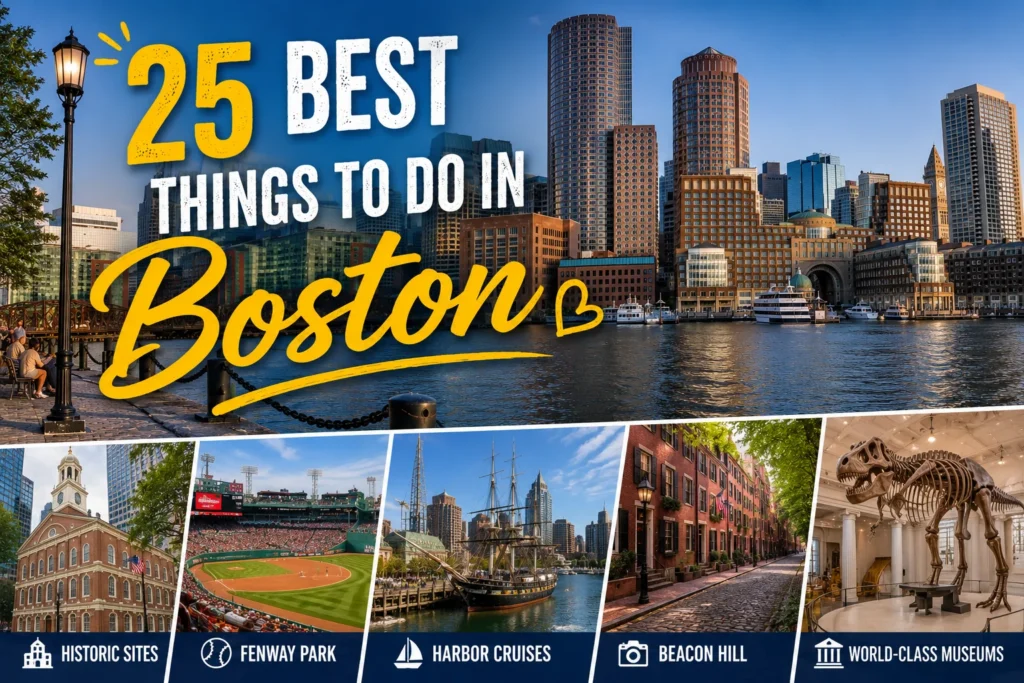
25 Best Things to Do in Boston in 2026 (Complete City Guide)
By Sarah Mitchell | Travel Expert and Founder
I have planned Boston trips for years, and if you are reading this after August 2026, you are visiting a city still buzzing from the biggest sporting event it has ever hosted. Boston Stadium, Gillette Stadium’s temporary name during the tournament, held seven FIFA World Cup 2026 matches in Foxborough between June 13 and July 9, drawing more than 400,000 fans across group-stage games through England versus Ghana, and the Fenway neighborhood spent five straight weeks as a genuine World Cup headquarters, with Time Out Market Boston streaming every match on its big screen. That energy has not fully faded, and the infrastructure built for it, the special MBTA Commuter Rail schedule to Foxborough among other upgrades, means getting around the wider Boston region is genuinely smoother than it was a year ago.
Past that recent chapter, Boston remains what it has always been: the most walkable history lesson in America, sixteen Revolutionary sites strung along a 2.5-mile red brick line, the oldest ballpark in the country, and a North End Italian bakery rivalry (Mike’s Pastry versus Modern Pastry) that locals take more seriously than most political debates. This guide covers the 25 best things to do in Boston in 2026, ordered the way I would actually plan a trip, with current prices, honest time estimates, and the specific free things, the Freedom Trail’s outdoor markers, the Public Garden, the Rose Kennedy Greenway, that do real work against a city where museum tickets now run $30 apiece. For more of New England, see my things to do in Cape Cod and things to do in New York guides on Travel Destinations Plan.
Boston At a Glance: Quick Reference Table
| # | Activity | Area | Entry | Duration | Best For | Best Time |
|---|---|---|---|---|---|---|
| 1 | The Freedom Trail | Downtown to Charlestown | Free (outdoor); indoor sites $6-15 | 2 to 4 hours | All visitors; first-timers | Morning; guided tour for context |
| 2 | Fenway Park | Fenway | Tour ~$25; game tickets vary | 1 hour (tour); 3 hours (game) | Baseball fans; all visitors | Book tours ahead; check Red Sox schedule |
| 3 | Museum of Fine Arts | Fenway | ~$30 adults | 2.5 to 4 hours | Art lovers | Weekday mornings |
| 4 | Isabella Stewart Gardner Museum | Fenway | ~$20-22 adults | 1.5 to 2 hours | Art and architecture lovers | Weekday afternoons |
| 5 | Boston Common & Public Garden | Downtown | Free; swan boats ~$5 | 1.5 to 2 hours | All visitors; families | Morning; spring for swan boats |
| 6 | Faneuil Hall & Quincy Market | Downtown | Free to enter | 1.5 to 2 hours | Foodies; shoppers | Lunch |
| 7 | North End & Italian bakeries | North End | Free to walk | 2 to 3 hours | Foodies | Late morning |
| 8 | New England Aquarium | Waterfront | ~$35 adults | 2 to 3 hours | Families | Weekday mornings |
| 9 | USS Constitution & Charlestown Navy Yard | Charlestown | Ship free; museum donation-based | 1.5 to 2 hours | History lovers | Morning |
| 10 | Harvard Square & Harvard Yard | Cambridge | Yard free; museum ~$15 | 2 to 3 hours | Culture and academia fans | Afternoon |
| 11 | Museum of Science | Cambridge side of Charles River | ~$30 adults | 2.5 to 3 hours | Families | Weekday mornings |
| 12 | Boston Tea Party Ships & Museum | Waterfront | ~$32 adults | 1 to 1.5 hours | History lovers; families | Morning |
| 13 | Beacon Hill | Downtown | Free to walk | 1 to 1.5 hours | Architecture lovers; photographers | Morning |
| 14 | Charles River Esplanade | Back Bay / Cambridge side | Free | 1 to 2 hours | Walkers; cyclists; picnickers | Evening; summer |
| 15 | Boston Harbor Islands | Boston Harbor | Ferry ~$25 round trip | Half day | Nature lovers; a beach escape | Summer weekdays |
| 16 | Institute of Contemporary Art | Seaport | ~$20 adults | 1.5 hours | Contemporary art lovers | Weekday afternoons |
| 17 | Boston Duck Tours | Departs near Museum of Science / Prudential | ~$55 adults | 80 minutes | Families; first-timers | Afternoon |
| 18 | Bunker Hill Monument | Charlestown | Free | 45 mins to 1 hour | History lovers; view seekers | Morning |
| 19 | Newbury Street | Back Bay | Free to walk | 1.5 to 2 hours | Shoppers | Afternoon |
| 20 | Samuel Adams Brewery tour | Jamaica Plain | ~$20 with tastings | 1 hour | Beer lovers | Afternoon |
| 21 | JFK Presidential Library & Museum | Dorchester | ~$18 adults | 2 hours | History lovers | Weekday mornings |
| 22 | Rose Kennedy Greenway | Downtown / Waterfront | Free | 1 to 1.5 hours | Walkers; families | Summer for the carousel and food trucks |
| 23 | TD Garden (Celtics or Bruins game) | Downtown | Tickets vary | 2.5 to 3 hours | Basketball and hockey fans | Check season schedule |
| 24 | Salem day trip | ~45 mins north | Museum entries ~$15-20 | Full day | History and the curious | Weekday; October is peak |
| 25 | Cape Cod day trip | ~1.5 to 2 hours south | Free beaches; activities vary | Full day | Beach lovers; a coastal escape | Summer weekdays |
1. The Freedom Trail
Area: Downtown Boston to Charlestown | Entry: Free to walk the outdoor trail; individual indoor sites charge $6-15 | Duration: 2 to 4 hours | Best time: Morning; a guided tour adds essential context
The Freedom Trail is a 2.5-mile line of red brick (or painted red where brick is impractical) connecting sixteen sites central to the American Revolution, from Boston Common through the North End to the Bunker Hill Monument in Charlestown, passing Faneuil Hall, the Paul Revere House, and the Old North Church along the way. Walking it costs nothing; the individual house museums along the route each charge separately.
The Freedom Trail’s 2.5-mile red-brick line connects sixteen Revolutionary-era sites from Boston Common to Bunker Hill, free to walk in full. It is the essential first activity for any Boston visit.
Practical tips:
- A costumed guided walking tour (roughly $20-30, typically covering the shorter 1.2-mile Boston Common to Faneuil Hall stretch) adds genuine historical storytelling that the self-guided red line alone will not give you.
- The Paul Revere House ($6-7) and the Old North Church are the two indoor stops most worth the individual admission if you are being selective.
- What I tell first-timers: you do not need to walk the entire 2.5 miles across the water to Charlestown in one go. Split it into a downtown-and-North-End morning and a separate Charlestown afternoon if the full distance feels like too much in one day.
2. Fenway Park
Area: Fenway neighborhood | Entry: Ballpark tour ~$25; game tickets vary widely by opponent and date | Duration: 1 hour for a tour; 3 hours for a game | Best time: Book tours ahead; check the current Red Sox home schedule
Fenway Park, opened in 1912, is the oldest active Major League Baseball stadium in the country, and its quirks, the 37-foot left field wall known as the Green Monster chief among them, make it one of the most distinctive ballparks anywhere in professional sports. Guided tours run throughout the season and give access to areas closed to regular ticket holders, including a close look at the Monster itself.
Fenway Park, opened in 1912, is the oldest active ballpark in Major League Baseball, famous for its 37-foot Green Monster left field wall. It is the essential Boston sports experience, whether or not a game is on your dates.
Practical tips:
- Book a ballpark tour ahead specifically during peak summer months; these sell out on weekends, especially with the neighborhood’s elevated 2026 profile after hosting Fenway FC’s World Cup watch-party programming through mid-July.
- If catching an actual game, check the schedule for Red Sox concerts and special theme nights that run alongside the regular season.
- What I tell non-baseball fans: the tour alone is worth doing purely for the ballpark’s history and the Green Monster access; you do not need to care about the sport to appreciate the building.
3. Museum of Fine Arts
Area: Fenway neighborhood | Entry: ~$30 adults, ~$14 youth 7-17, free for children 6 and under and members | Duration: 2.5 to 4 hours | Best time: Weekday mornings
The Museum of Fine Arts is one of the largest and most comprehensive art museums in the United States, spanning ancient Egyptian artifacts, Monet and the Impressionists, American period rooms, and contemporary installations all within a single visit, in galleries grand enough to feel significant without becoming exhausting.
The Museum of Fine Arts spans ancient Egyptian artifacts through contemporary installations in one of the most comprehensive art collections in the US. It is the best single art museum experience in Boston.
Practical tips:
- Advance tickets are recommended, particularly for any current special exhibition, since those can sell out on weekends.
- It sits directly across from the Isabella Stewart Gardner Museum (entry 4), making the two an obvious combined art-focused day.
- Weekday mornings are noticeably calmer than weekend afternoons, when the museum draws its heaviest crowds.
4. Isabella Stewart Gardner Museum
Area: Fenway neighborhood, steps from the MFA | Entry: ~$20-22 adults | Duration: 1.5 to 2 hours | Best time: Weekday afternoons
The Isabella Stewart Gardner Museum is built around a stunning Venetian-style courtyard, its collection assembled personally by Gardner herself and displayed exactly as she arranged it before her death, per the terms of her will, giving the museum a genuinely intimate, idiosyncratic character unlike any larger institutional collection. It is also famous for the still-unsolved 1990 art heist, the largest property theft in history, whose empty frames remain on the walls as a condition of her bequest.
The Isabella Stewart Gardner Museum’s Venetian courtyard and personally curated collection remain displayed exactly as Gardner arranged them, with the empty frames from the unsolved 1990 art heist still hanging as required by her will. It is the most intimate and unusual major museum experience in Boston.
Practical tips:
- The courtyard itself, with its rotating seasonal floral displays, is worth the visit independent of the art collection surrounding it.
- Ask about the empty frames specifically if a guide or docent is available; the story of the 1990 heist adds a genuinely fascinating layer to the visit.
- It sits a short walk from the MFA, making the two Fenway museums an easy combined afternoon.
5. Boston Common & Public Garden
Area: Downtown, adjoining the start of the Freedom Trail | Entry: Free; swan boat rides ~$5 | Duration: 1.5 to 2 hours | Best time: Morning; spring through fall for the swan boats
Boston Common, established in 1634, is the oldest public park in the United States, and it connects directly to the more formally landscaped Public Garden, home to the beloved Swan Boats, a Boston tradition running since 1877, and the bronze “Make Way for Ducklings” sculptures inspired by the classic children’s book.
Boston Common, the oldest public park in the country, connects to the Public Garden’s beloved Swan Boats, running since 1877. It is the best free green space in the city and the natural starting point for the Freedom Trail.
Practical tips:
- The Swan Boats operate seasonally (typically spring through early fall); check current dates if riding one is a priority for your visit.
- The “Make Way for Ducklings” bronze statues are a specific, low-key photo stop that families with young children particularly enjoy.
- This is the official starting point of the Freedom Trail (entry 1), making it the natural first stop of any Boston day.
6. Faneuil Hall & Quincy Market
Area: Downtown | Entry: Free to enter | Duration: 1.5 to 2 hours | Best time: Lunch
Faneuil Hall has served as a public meeting hall and marketplace since 1742, earning the nickname “the Cradle of Liberty” for the Revolutionary-era speeches given inside, and the adjoining Quincy Market building now houses a food hall of Boston specialties, from clam chowder to lobster rolls, alongside street performers and shops.
Faneuil Hall, “the Cradle of Liberty” since 1742, connects to Quincy Market’s food hall of Boston classics like clam chowder and lobster rolls. It is the best combined history and food stop in downtown Boston.
Practical tips:
- Eat at Quincy Market for a genuine sampling of Boston food specialties in one stop rather than committing to a single sit-down restaurant.
- Faneuil Hall’s upper meeting room, when open to the public, is worth a quick look for the Revolutionary-era history embedded in the space.
- It sits directly on the Freedom Trail, making it a natural lunch stop mid-walk.
7. North End & Italian Bakeries
Area: North End | Entry: Free to walk | Duration: 2 to 3 hours | Best time: Late morning
The North End is Boston’s historic Italian neighborhood, its narrow streets lined with red-sauce restaurants and, most famously, the rival bakeries Mike’s Pastry and Modern Pastry, whose cannoli competition locals debate with genuine passion. The neighborhood also holds the Paul Revere House and the Old North Church, both Freedom Trail stops.
The North End’s rival bakeries, Mike’s Pastry and Modern Pastry, anchor a genuinely competitive cannoli debate that locals take seriously. It is the best food neighborhood in Boston and a core Freedom Trail stop.
Practical tips:
- Try both Mike’s Pastry and Modern Pastry cannoli on the same visit and form your own opinion; the rivalry is real and worth experiencing firsthand rather than taking anyone else’s word for it.
- Weekend mornings bring open-air markets and the neighborhood’s espresso culture into full swing.
- Combine with the Paul Revere House and Old North Church, both Freedom Trail anchors sitting directly within this neighborhood.
8. New England Aquarium
Area: Waterfront, Central Wharf | Entry: ~$35 adults | Duration: 2 to 3 hours | Best time: Weekday mornings
The New England Aquarium holds more than 800 marine species under one roof, centered on a massive multi-story ocean tank that visitors circle via a spiraling ramp, alongside seal and sea lion exhibits and the Simons IMAX Theatre, New England’s largest movie screen, next door.
The New England Aquarium’s 800-plus marine species, viewed via a spiraling ramp around a massive central tank, make it the best marine life experience in Boston. It sits directly on the harbor waterfront.
Practical tips:
- Weekday mornings are significantly calmer than weekend visits, when the aquarium draws heavy family crowds.
- The adjacent Simons IMAX Theatre is a worthwhile add-on if a film matching your interests is currently showing.
- It sits on Long Wharf, the same departure point for Boston Harbor Islands ferries (entry 15) and whale-watching cruises, making it easy to combine with a harbor activity.
9. USS Constitution & Charlestown Navy Yard
Area: Charlestown, at the far end of the Freedom Trail | Entry: The ship itself is free to board; the adjacent museum operates on suggested donation | Duration: 1.5 to 2 hours | Best time: Morning
The USS Constitution, nicknamed “Old Ironsides,” is the oldest commissioned warship still afloat in the world, launched in 1797 and still crewed by active-duty US Navy sailors who lead free tours of the deck. The adjacent museum covers the ship’s history in more depth, operating on a suggested donation of roughly $10-15.
The USS Constitution, the oldest commissioned warship still afloat in the world, is free to board and crewed by active-duty Navy sailors leading tours. It is the most historically significant free attraction at the end of the Freedom Trail.
Practical tips:
- Boarding the ship itself is genuinely free; only the separate museum building operates on a suggested donation basis.
- This marks the Charlestown end of the Freedom Trail, making it a natural pairing with the Bunker Hill Monument (entry 18) nearby.
- Active-duty Navy sailors lead the deck tours, giving genuine firsthand naval context beyond what a standard museum guide would offer.
10. Harvard Square & Harvard Yard
Area: Cambridge, across the Charles River | Entry: Harvard Yard is free to walk; the Harvard Art Museums charge roughly $15 | Duration: 2 to 3 hours | Best time: Afternoon
Harvard Square and the adjoining Harvard Yard give visitors a genuine look at America’s oldest university, founded in 1636, with student-led yard tours, an eclectic mix of independent bookshops and cafes surrounding the square, and the Harvard Art Museums holding a genuinely significant collection across three merged institutions.
Harvard Yard, at America’s oldest university founded in 1636, offers free student-led tours alongside Harvard Square’s independent bookshops and cafes. It is the best academic and cultural neighborhood experience across the river in Cambridge.
Practical tips:
- Student-led walking tours of the Yard are typically free or very low cost and give a genuinely different, more current perspective than a standard tourist guide.
- The Harvard Museum of Natural History (included in some combined tickets) holds the famous glass flowers collection, a specific and genuinely unusual highlight.
- Reach it easily via the Red Line, a straightforward subway ride from downtown Boston.
11. Museum of Science
Area: On the Charles River, connecting Boston and Cambridge | Entry: ~$30 adults | Duration: 2.5 to 3 hours | Best time: Weekday mornings
The Museum of Science combines hundreds of hands-on exhibits with a planetarium and an Omni IMAX theater, positioned dramatically on a dam spanning the Charles River between Boston and Cambridge, making it one of the best full-day family science attractions in New England.
The Museum of Science combines hands-on exhibits, a planetarium, and an IMAX theater on a dramatic dam site spanning the Charles River. It is the best family science attraction in Boston.
Practical tips:
- Weekday mornings are calmer than weekend visits, when school groups and families both converge heavily.
- The planetarium shows and IMAX films typically require a small additional ticket beyond general admission; check the current schedule and book alongside your entry.
- Its location directly on the Charles River makes for a scenic approach and an easy combination with an Esplanade walk (entry 14).
12. Boston Tea Party Ships & Museum
Area: Waterfront, Congress Street Bridge | Entry: ~$32 adults | Duration: 1 to 1.5 hours | Best time: Morning
The Boston Tea Party Ships & Museum lets visitors board full-scale replica ships and, in the interactive centerpiece, throw a real crate of tea into the harbor exactly as the original 1773 protesters did, alongside multimedia exhibits and live reenactors bringing the story of one of the Revolution’s defining events to life.
The Boston Tea Party Ships & Museum lets visitors throw tea into the harbor just as the original 1773 protesters did, aboard full-scale replica ships with live reenactors. It is the most interactive Revolutionary history experience in the city.
Practical tips:
- The tea-throwing interactive moment is the specific highlight; this is genuinely hands-on rather than a passive museum walk-through.
- It sits on the waterfront near the Rose Kennedy Greenway (entry 22), making it easy to combine with a Greenway walk before or after.
- Book ahead in peak season, since group tour bookings can fill the more popular time slots.
13. Beacon Hill
Area: Downtown, adjacent to Boston Common | Entry: Free to walk | Duration: 1 to 1.5 hours | Best time: Morning
Beacon Hill is Boston’s most photogenic historic neighborhood, its narrow, gas-lamp-lined streets fronted by Federal-style brick rowhouses, with the famous Acorn Street (one of the most photographed streets in America) tucked among its steep, cobblestoned lanes just steps from the Massachusetts State House.
Beacon Hill’s gas-lamp-lined streets and Federal-style brick rowhouses, including the famously photogenic Acorn Street, make it the most visually striking historic neighborhood in Boston. It is a must for architecture lovers and photographers.
Practical tips:
- Acorn Street is the single most photographed lane in the neighborhood; visit early morning for the best light and fewest other photographers.
- The Massachusetts State House, with its distinctive gold dome, sits directly at the edge of the neighborhood and is itself a Freedom Trail stop.
- It is a genuinely quick, dense walk, easy to fold into a downtown or Boston Common day without a significant detour.
14. Charles River Esplanade
Area: Back Bay side of the Charles River | Entry: Free | Duration: 1 to 2 hours | Best time: Evening; summer
The Charles River Esplanade is a landscaped parkland strip running along the river’s Boston side, with walking and cycling paths, the Hatch Shell (an outdoor concert venue hosting free summer performances), and consistently good views across the water toward Cambridge and the Boston skyline.
The Charles River Esplanade offers free waterside walking and cycling paths alongside the Hatch Shell’s free summer concerts. It is the best outdoor recreational space in central Boston.
Practical tips:
- Check the Hatch Shell’s summer concert schedule; free outdoor performances run regularly and are a genuinely good evening activity at no cost.
- Rent a bike to cover more of the Esplanade’s length than a walk would comfortably allow in the same amount of time.
- Evening light along the river, with the Boston skyline and the Longfellow Bridge visible, gives some of the best photography conditions in the city.
15. Boston Harbor Islands
Area: Boston Harbor, ferries departing from Long Wharf | Entry: Ferry ~$25 round trip | Duration: Half day | Best time: Summer weekdays
Boston Harbor Islands National and State Park comprises more than 30 islands scattered across the harbor, several reachable by ferry, with hiking trails, historic fort ruins, and beaches that give a genuinely different, quieter side of Boston than the downtown historic core, all within a short boat ride of the city.
Boston Harbor Islands National and State Park’s 30-plus islands offer hiking, historic forts, and beaches just a short ferry ride from downtown. It is the best nature escape without leaving the greater Boston area.
Practical tips:
- Ferries run seasonally, primarily late spring through early fall; check current schedules before planning a trip specifically around this.
- Georges Island, with its 19th-century Fort Warren ruins, is the most commonly visited and has the most developed visitor facilities among the accessible islands.
- Weekday visits give a noticeably quieter island experience than the more crowded summer weekend ferries.
16. Institute of Contemporary Art
Area: Seaport | Entry: ~$20 adults | Duration: 1.5 hours | Best time: Weekday afternoons
The Institute of Contemporary Art occupies a striking cantilevered glass building directly on the Boston Harbor waterfront in the Seaport district, with rotating contemporary exhibitions and a building design that is itself one of the more architecturally significant modern structures in the city.
The Institute of Contemporary Art’s cantilevered glass building on the Seaport waterfront houses rotating contemporary exhibitions in one of Boston’s most architecturally striking modern spaces. It is the best contemporary art complement to the more classical MFA.
Practical tips:
- The building’s harbor-facing glass architecture is worth appreciating on its own, independent of whatever exhibition is currently showing.
- Check the current rotating exhibition schedule before visiting, since the specific artist focus changes and drives much of the appeal.
- The Seaport district surrounding it has developed significantly in recent years, with strong dining options for combining a museum visit with a waterfront meal.
17. Boston Duck Tours
Area: Departing near the Museum of Science or the Prudential Center | Entry: ~$55 adults | Duration: 80 minutes | Best time: Afternoon
Boston Duck Tours uses World War II-style amphibious vehicles to cover the city’s historic streets before driving directly into the Charles River for a water-based finale, giving a genuinely different orientation tour for first-timers wanting a broad overview before diving into specific neighborhoods on foot.
Boston Duck Tours’ amphibious WWII-style vehicles cover historic streets before driving directly into the Charles River. It is the most novel orientation tour for first-time visitors wanting a broad city overview.
Practical tips:
- This works best as a first-day orientation activity, giving a broad geographic sense of the city before you commit to detailed neighborhood walks like the Freedom Trail.
- Book ahead specifically during peak summer season and any period with elevated visitor numbers, given Boston’s heightened 2026 profile after the World Cup.
- The Charles River portion of the tour is the specific highlight and the reason to choose this over a standard land-only bus tour.
18. Bunker Hill Monument
Area: Charlestown | Entry: Free | Duration: 45 minutes to 1 hour | Best time: Morning
The Bunker Hill Monument, a 221-foot granite obelisk, commemorates the June 1775 battle (fought largely on the adjacent Breed’s Hill) that marked one of the first major engagements of the Revolutionary War, and climbing its 294 interior steps rewards visitors with a panoramic view over Charlestown and the harbor.
The Bunker Hill Monument’s 221-foot granite obelisk commemorates the pivotal 1775 battle and rewards a 294-step climb with panoramic Charlestown and harbor views. It is the dramatic conclusion to the Freedom Trail.
Practical tips:
- The climb is genuinely 294 steps with no elevator; pace yourself and expect a real physical effort for the summit view.
- It marks the official end of the Freedom Trail, making it the natural final stop after a full day walking the route.
- Combine with the USS Constitution (entry 9), both sitting within the same Charlestown neighborhood a short walk apart.
19. Newbury Street
Area: Back Bay | Entry: Free to walk | Duration: 1.5 to 2 hours | Best time: Afternoon
Newbury Street is Boston’s premier shopping boulevard, eight blocks of Victorian brownstones converted into boutiques, galleries, and restaurants, running parallel to the more residential Commonwealth Avenue and giving Back Bay its specific upscale character.
Newbury Street’s eight blocks of Victorian brownstones-turned-boutiques form Boston’s premier shopping street. It is the best browsing and people-watching walk in Back Bay.
Practical tips:
- The street shifts character from higher-end luxury retail near the Public Garden end to more independent and casual shops further out; walk the full length to see both.
- Outdoor cafe seating fills quickly on warm afternoons, making an early or late lunch more reliable for a table.
- It connects easily to a broader Back Bay walk, including Commonwealth Avenue’s tree-lined mall a block over.
20. Samuel Adams Brewery Tour
Area: Jamaica Plain | Entry: ~$20 including tastings | Duration: 1 hour | Best time: Afternoon
The Samuel Adams Brewery in Jamaica Plain offers tours of its working facility, covering the brewing process and the company’s history from its 1984 founding, ending with tastings of current and seasonal beer releases, making it a genuinely good afternoon activity beyond the standard historic sightseeing circuit.
The Samuel Adams Brewery tour in Jamaica Plain covers the brewing process and history, ending with tastings of current releases. It is the best beer-focused activity in the Boston area.
Practical tips:
- It requires a short trip outside the immediate downtown core, via the Orange Line or a rideshare, to reach Jamaica Plain.
- The included tastings are a genuine part of the value, so pace other activities accordingly if visiting later in the day.
- Good option for an activity that breaks up a trip otherwise dominated by museums and historic sites.
21. JFK Presidential Library & Museum
Area: Dorchester, on Columbia Point overlooking the harbor | Entry: ~$18 adults | Duration: 2 hours | Best time: Weekday mornings
The John F. Kennedy Presidential Library and Museum, designed by architect I.M. Pei, sits dramatically on Columbia Point overlooking Boston Harbor, its exhibits tracing Kennedy’s presidency through original artifacts, speeches, and a genuinely moving memorial room, giving Massachusetts’ most significant political figure a fitting and architecturally striking home.
The JFK Presidential Library, designed by I.M. Pei on a dramatic harbor-side site, traces Kennedy’s presidency through original artifacts and a moving memorial room. It is the most significant presidential library in New England.
Practical tips:
- The building’s I.M. Pei architecture and its harbor-side setting are worth appreciating as part of the overall visit, not just the exhibits inside.
- It sits somewhat outside the main downtown tourist core in Dorchester, requiring a short drive or public transit connection.
- Weekday mornings give the calmest visiting conditions before any tour groups arrive later in the day.
22. Rose Kennedy Greenway
Area: Downtown / Waterfront, tracing the path of the former elevated highway | Entry: Free | Duration: 1 to 1.5 hours | Best time: Summer, for the carousel and food trucks
The Rose Kennedy Greenway is a series of connected parks built directly above the tunnel that replaced Boston’s old elevated Central Artery highway, now holding free public art installations, food trucks, and a seasonal carousel, linking the waterfront neighborhoods that the old highway once physically divided.
The Rose Kennedy Greenway transforms the former elevated highway’s footprint into connected parks with free public art, food trucks, and a seasonal carousel. It is the best example of Boston’s modern urban reinvention.
Practical tips:
- The seasonal carousel and rotating food truck lineup are most active in the warmer months; check current operating dates.
- It connects several neighborhoods that were historically divided by the old highway, making it a genuinely pleasant connective walk between downtown and the waterfront.
- Free public art installations rotate periodically, giving repeat visitors something new to see on subsequent trips.
23. TD Garden (Celtics or Bruins Game)
Area: Downtown, above North Station | Entry: Tickets vary widely by opponent, date, and sport | Duration: 2.5 to 3 hours | Best time: Check the current season schedule
TD Garden is home to both the NBA’s Boston Celtics, one of the most storied franchises in professional basketball, and the NHL’s Boston Bruins, giving visitors the chance to catch a genuinely major professional sports event in a city with an intensely passionate fan culture, directly above North Station in the heart of downtown.
TD Garden hosts both the Boston Celtics and Boston Bruins, two of the most storied franchises in their respective sports, directly above North Station downtown. It is the best major indoor sports experience in the city.
Practical tips:
- Its downtown location directly above North Station makes it one of the most transit-convenient major sports venues in the country.
- Weeknight games against less prominent opponents typically offer better ticket availability and pricing than premium weekend matchups.
- Check both the Celtics (October through April, further if in the playoffs) and Bruins (similar season) schedules, since the venue alternates between the two.
24. Salem Day Trip
Area: About 45 minutes north of Boston | Entry: Individual museum entries roughly $15-20 | Duration: Full day | Best time: Weekday; October is dramatically the busiest month
Salem, forever associated with the 1692 witch trials, offers several museums covering that history alongside a genuinely charming historic seaport town with maritime museums and well-preserved colonial architecture, making it one of the most popular and most straightforward day trips from Boston.
Salem, site of the 1692 witch trials, combines historical museums with a charming colonial seaport town, all within 45 minutes of Boston. It is the most popular and easiest day trip from the city.
Practical tips:
- October brings dramatically higher crowds and prices due to Halloween-season tourism; visit another month if you want the historical sites without the seasonal circus atmosphere.
- The Salem Witch Museum and the Peabody Essex Museum (a genuinely significant art and culture institution beyond the witch trial theme) are the two most worthwhile paid stops.
- Reachable by commuter rail directly from Boston, making this an easy car-free day trip.
25. Cape Cod Day Trip
Area: About 1.5 to 2 hours south of Boston | Entry: Free public beaches; individual activities vary | Duration: Full day | Best time: Summer weekdays
Cape Cod offers a genuinely different pace from Boston’s historic density: sandy beaches, quaint seaside towns like Provincetown and Chatham, and classic New England seafood shacks, all reachable as a long but rewarding day trip or, better, an overnight extension if your schedule allows.
Cape Cod’s beaches and classic New England seaside towns offer a complete change of pace from Boston’s urban history, roughly 1.5 to 2 hours south. It is the best coastal escape from the city, especially in summer.
Practical tips:
- This is a genuinely long day if done as a single round trip; consider an overnight stay if your itinerary allows, since the drive itself takes real time each way.
- Summer weekdays avoid both the worst Cape Cod traffic (notoriously bad on summer weekends) and the most crowded beaches.
- Choose a specific town or beach as your anchor rather than trying to see the whole peninsula in one day; the Cape rewards a focused visit over a rushed tour.
Boston Practical Guide
Getting Around Boston
Downtown Boston, Beacon Hill, the North End, and Back Bay are all comfortably walkable, and the MBTA subway system (the T) connects the wider city efficiently, including a direct Red Line connection to Harvard Square in Cambridge. For Gillette Stadium in Foxborough, the MBTA Commuter Rail runs a special schedule that was built out for the 2026 World Cup and remains a genuinely improved connection to the stadium and Patriot Place for any future events there. A car is useful for Cape Cod and helpful but not essential for Salem, which is easily reached by commuter rail.
One thing I always tell visitors in the back half of 2026 specifically: Boston’s profile has been elevated significantly by hosting seven World Cup matches this summer, and hotel demand and pricing across the wider region may run somewhat higher than a typical year through the remainder of 2026 as a result. Book accommodation with a bit more lead time than you might have in a normal year.
Where to Stay in Boston
Downtown / Beacon Hill: Walkable to the Freedom Trail, Boston Common, and Faneuil Hall. Best for first-timers wanting to be at the center of the historic core.
Back Bay: Close to Newbury Street, the Charles River Esplanade, and a short walk or T ride to the Fenway museums. Best for shoppers and visitors prioritizing Back Bay’s architecture and dining.
Fenway / Kenmore: Walkable to Fenway Park, the MFA, and the Isabella Stewart Gardner Museum. Best for baseball fans and art-focused visitors, particularly given the neighborhood’s heightened energy through 2026.
Boston Budget Guide
Budget traveler (budget hotel, the free Freedom Trail, Boston Common, the Esplanade, and North End window shopping, casual dining): roughly $120 to $180 per day. Boston’s free historic core does real work against the city’s generally premium museum pricing.
Mid-range traveler (comfortable hotel, one or two major museums, a Fenway Park tour, sit-down dining in the North End): roughly $250 to $380 per day.
Higher-spend traveler (upscale hotel, a Red Sox or Celtics/Bruins game, multiple museum visits, fine dining, a Cape Cod day trip): $450 or more per day, driven by ticketed sports events and premium dining.
Frequently Asked Questions About Boston
Did Boston really host World Cup matches in 2026? Yes. Gillette Stadium in Foxborough, temporarily rebranded Boston Stadium, hosted seven FIFA World Cup 2026 matches between June 13 and July 9, including England versus Ghana, drawing more than 400,000 fans across all seven games. The Fenway neighborhood ran a parallel “Fenway FC” celebration through mid-July with watch parties and live match screenings at Time Out Market Boston.
How many days do you need in Boston? Three days covers the Freedom Trail, Fenway Park, one or two Fenway-area museums, and the North End comfortably. Four to five days lets you add Harvard Square, the Harbor Islands, and a day trip to Salem or Cape Cod without rushing.
Is Boston expensive to visit? Museum admission has risen meaningfully in recent years, with the MFA and Museum of Science both around $30 and the Aquarium at $35. The Freedom Trail’s outdoor sites, Boston Common, the Public Garden, and the Charles River Esplanade remain free, which balances a tight budget significantly.
What is Boston most famous for? The Freedom Trail and its Revolutionary War history, Fenway Park (the oldest active MLB ballpark), Harvard and MIT across the river in Cambridge, the North End’s Italian food culture, and, as of 2026, hosting seven FIFA World Cup matches at Gillette Stadium in nearby Foxborough.
Do I need to book Boston attractions in advance? Book Fenway Park tours ahead in peak summer season, particularly given the neighborhood’s elevated 2026 profile, along with the MFA for any current special exhibition. Free attractions like the Freedom Trail, Boston Common, and the Esplanade need no advance booking.
Do I need a car in Boston? No, and a car is a genuine hindrance downtown given narrow historic streets and expensive, scarce parking. The T subway and walking cover the city center and Cambridge thoroughly; a car helps only for Cape Cod and is optional for Salem, which is easily reached by commuter rail.
The Final Word
If you take one thing from this guide, take this: Boston in the back half of 2026 is a city still carrying the energy of the biggest sporting event it has ever hosted, and that is worth knowing whether you came for the World Cup’s afterglow or had no idea it happened here at all. The Fenway neighborhood specifically spent five weeks as a genuine global gathering point this summer, and the infrastructure and attention that came with it have not simply evaporated now that the tournament has moved on.
Where I would spend the money: a Fenway Park tour regardless of your interest in baseball, the Museum of Fine Arts, and the Isabella Stewart Gardner Museum for its genuinely unusual, personally curated character. Where the magic is free: the full Freedom Trail walk, Boston Common and the Public Garden, the Charles River Esplanade at golden hour, and window-shopping the cannoli rivalry in the North End before you actually commit to a slice from either side. The mistake I watch visitors make is trying to cover Boston and Cambridge in a single rushed day. Give Harvard Square its own afternoon, and let the Freedom Trail’s sixteen stops breathe across a full morning rather than a sprint.
Have a Boston tip I missed, or a strong opinion on Mike’s versus Modern, or a World Cup moment from this summer worth sharing? Tell me in the comments. I update this guide as prices, schedules, and seasons change.
For more New England and US travel guides, visit Travel Destinations Plan.
Pingback: 25 Best Things to Do in New York 2026 (Local Guide)