25 Best Things to Do in Atlanta in 2026 (Complete City Guide)
By Sarah Mitchell | Travel Expert and Founder
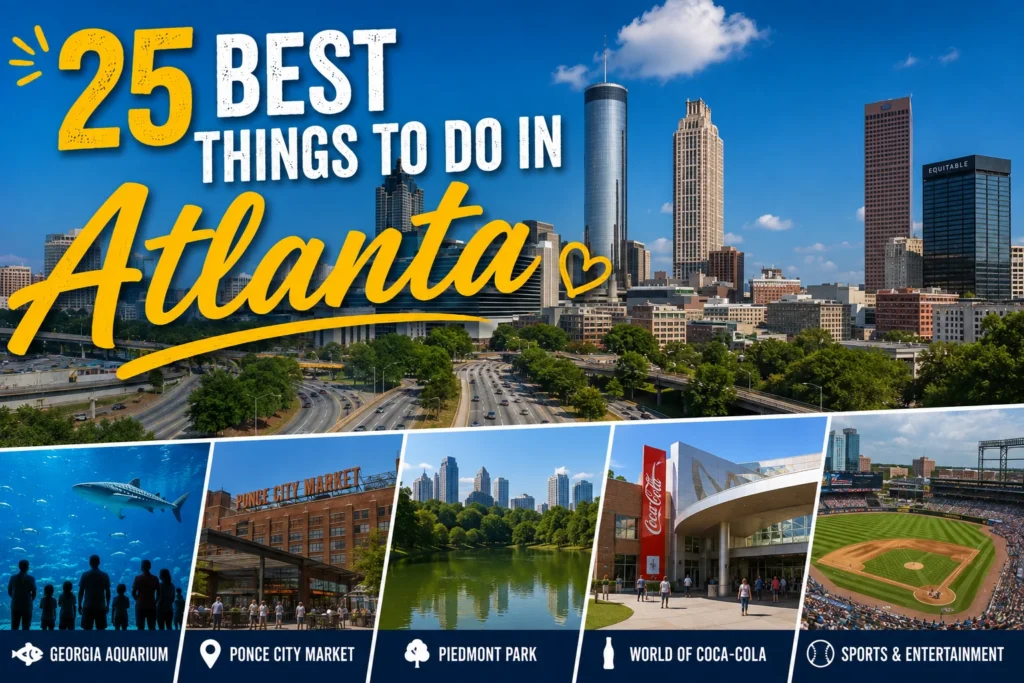
I have planned Atlanta trips for years, and if you are reading this after August 2026, you are visiting a city still riding the high of the biggest month it has ever had. Mercedes-Benz Stadium, temporarily rebranded Atlanta Stadium, hosted eight FIFA World Cup matches between June 15 and July 15, including a semifinal, with more than $500 million in expected economic impact and a free Fan Festival in Centennial Olympic Park that ran the entire tournament. What made Atlanta specifically stand out among host cities is something most other cities could not offer: the stadium, the park, the aquarium, the World of Coca-Cola, and the College Football Hall of Fame all sit inside the same walkable downtown grid, so a single afternoon could genuinely cover four or five real stops without ever needing a rideshare.
Past that recent chapter, Atlanta remains what it has always been: the birthplace of Martin Luther King Jr. and the geographic center of the American Civil Rights Movement, the headquarters of Coca-Cola and CNN, home to the largest aquarium in the Western Hemisphere, and a city whose BeltLine transformed an old rail corridor into one of the most genuinely successful urban trail projects in the country. This guide covers the 25 best things to do in Atlanta in 2026, ordered the way I would actually plan a trip, with current prices, honest time estimates, and one specific 2026 update worth knowing: Georgia Aquarium welcomed two rescued beluga whales from Marineland Canada this year, alongside a new “Sharks! Predators of the Deep” gallery. For more of the South, see my things to do in Nashville Tennessee and things to do in Charlotte guides on Travel Destinations Plan.
Atlanta At a Glance: Quick Reference Table
| # | Activity | Area | Entry | Duration | Best For | Best Time |
|---|---|---|---|---|---|---|
| 1 | Centennial Olympic Park | Downtown | Free | 1 to 1.5 hours | All visitors; families | Morning; evening for the fountain show |
| 2 | Georgia Aquarium | Downtown | ~$55-65 dynamic pricing | 3 to 4 hours | Families; marine life fans | Weekday mornings; book ahead |
| 3 | World of Coca-Cola | Downtown | ~$27-30 adults | 1.5 to 2 hours | Families; the curious | Combine with the aquarium |
| 4 | Martin Luther King Jr. National Historical Park | Sweet Auburn | Free | 2 to 3 hours | History lovers; all visitors | Morning; book the Birth Home tour |
| 5 | Atlanta BeltLine (Eastside Trail) | Old Fourth Ward to Piedmont Park | Free | 1.5 to 3 hours | Walkers; cyclists; foodies | Evening; weekday mornings |
| 6 | Piedmont Park | Midtown | Free | 1.5 to 2 hours | Families; a green escape | Weekend afternoons |
| 7 | High Museum of Art | Midtown | ~$18-23 adults | 2 hours | Art lovers | Weekday mornings |
| 8 | Fox Theatre | Midtown | Tour ~$15-20; show tickets vary | 1 hour (tour); 2.5 hours (show) | Architecture and theater lovers | Book tours ahead |
| 9 | Atlanta History Center | Buckhead | ~$25 adults | 2.5 to 3 hours | History lovers | Weekday mornings |
| 10 | Mercedes-Benz Stadium | Downtown | Tour ~$20-25; game tickets vary | 1.5 hours (tour); 3.5 hours (game) | Sports fans; architecture fans | Check season and tour schedule |
| 11 | College Football Hall of Fame | Downtown | ~$25-28 adults | 2 hours | Football fans; families | Anytime |
| 12 | National Center for Civil and Human Rights | Downtown | ~$21-24 adults | 1.5 to 2 hours | History lovers | Weekday afternoons |
| 13 | Zoo Atlanta | Grant Park | ~$25-30 adults | 3 to 4 hours | Families | Morning; weekdays |
| 14 | Ponce City Market | Old Fourth Ward | Free to enter | 1.5 to 2 hours | Foodies; shoppers | Lunch |
| 15 | Krog Street Market | Inman Park | Free to enter | 1 to 1.5 hours | Foodies | Lunch |
| 16 | Stone Mountain Park | ~25 mins east | ~$20-25 per vehicle | Half to full day | Families; hikers | Morning; summer laser show evenings |
| 17 | SkyView Atlanta | Downtown, at the park | ~$15-18 | 30 to 45 mins | View seekers; families | Sunset |
| 18 | CNN Center & Studio Tour | Downtown | ~$18-20 | 1 hour | Media and news enthusiasts | Weekday mornings |
| 19 | Atlanta Botanical Garden | Midtown, edge of Piedmont Park | ~$28 adults | 1.5 to 2.5 hours | Garden lovers; families | Spring through fall |
| 20 | Little Five Points | East Atlanta | Free to walk | 1.5 to 2 hours | The curious; vintage shoppers | Afternoon into evening |
| 21 | Oakland Cemetery | Grant Park area | Free (donations welcomed) | 1 to 1.5 hours | History lovers; photographers | Morning |
| 22 | Jimmy Carter Presidential Library & Museum | Poncey-Highland | ~$10 adults; free for 16 and under | 1.5 hours | History lovers | Weekday mornings |
| 23 | Fernbank Museum of Natural History | Druid Hills | ~$22 adults | 2 to 2.5 hours | Families; dinosaur fans | Anytime |
| 24 | Truist Park (Atlanta Braves game) | Cobb County | Tickets from ~$20 | 3 to 3.5 hours | Baseball fans | April to September |
| 25 | Chattahoochee River National Recreation Area | North Atlanta suburbs | Free; tube/kayak rental ~$20-30 | Half day | Nature lovers; a summer escape | Summer weekdays |
1. Centennial Olympic Park
Area: Downtown | Entry: Free | Duration: 1 to 1.5 hours | Best time: Morning; evening for the Fountain of Rings light show
Centennial Olympic Park was built for the 1996 Summer Olympics and remains downtown Atlanta’s central green space, anchored by the Fountain of Rings, an interactive fountain shaped like the Olympic rings that runs choreographed light-and-water shows and doubles as a genuine splash pad for kids in summer. In 2026, the park served as home to the free FIFA Fan Festival throughout the World Cup, with four massive screens and month-long programming that made it the city’s unofficial tournament headquarters.
Centennial Olympic Park, built for the 1996 Olympics, anchored Atlanta’s free FIFA Fan Festival throughout the 2026 World Cup with four massive screens. It remains the best free downtown gathering space in the city year-round.
Practical tips:
- The Fountain of Rings runs on a schedule throughout the day; check current times if the light-and-water show specifically is what you want to catch.
- It sits within walking distance of Georgia Aquarium, World of Coca-Cola, the College Football Hall of Fame, and SkyView Atlanta, making it the natural anchor point for a downtown day.
- What I tell everyone: this is where downtown Atlanta breathes. Start any first day here before fanning out to the surrounding attractions.
2. Georgia Aquarium
Area: Downtown, Pemberton Place | Entry: Dynamic pricing from ~$55, rising to $65 or more on peak dates | Duration: 3 to 4 hours | Best time: Weekday mornings; book online ahead
Georgia Aquarium is the largest aquarium in the Western Hemisphere and the only aquarium outside Asia housing whale sharks, the largest fish species on earth, alongside a 100-foot underwater viewing tunnel and live dolphin and sea lion presentations. In 2026, the aquarium welcomed two rescued beluga whales from Marineland Canada and opened a new “Sharks! Predators of the Deep” gallery, its most significant addition in recent years.
Georgia Aquarium is the only aquarium outside Asia with whale sharks and, as of 2026, home to two newly rescued beluga whales from Marineland Canada. It is the single most essential attraction in Atlanta.
Practical tips:
- Buy online in advance; the aquarium uses dynamic pricing, and off-peak weekday dates run noticeably cheaper than weekends and holidays.
- Dolphin and sea lion presentations are included with admission but require a separate seat reservation made on the day of your visit; book this the moment you arrive.
- The combo ticket bundling admission with the adjacent World of Coca-Cola (roughly $80-90, saving up to $15-20 over separate tickets) is worth it given how close the two attractions sit to each other.
3. World of Coca-Cola
Area: Downtown, next to Georgia Aquarium | Entry: ~$27-30 adults | Duration: 1.5 to 2 hours | Best time: Combine with a Georgia Aquarium visit on the same trip
World of Coca-Cola traces the history of Atlanta’s most famous corporate export through interactive exhibits, a vault holding the brand’s secret formula, and the Taste It! room, where visitors sample dozens of Coca-Cola products from around the world, several of which are genuinely unavailable anywhere else in the United States.
World of Coca-Cola’s Taste It! room lets visitors sample dozens of Coca-Cola products from around the world, several unavailable anywhere else in the US. It is the most distinctly Atlanta corporate museum experience in the country.
Practical tips:
- The Taste It! tasting room is the highlight for most visitors; pace yourself across the dozens of available flavors rather than rushing through.
- It sits directly next to Georgia Aquarium, making the combo ticket (entry 2) genuinely worth buying if visiting both.
- Good for a shorter, lighter activity to pair with a longer museum or history stop on the same day.
4. Martin Luther King Jr. National Historical Park
Area: Sweet Auburn | Entry: Free | Duration: 2 to 3 hours | Best time: Morning; book the Birth Home tour ahead
The Martin Luther King Jr. National Historical Park preserves King’s birth home, Ebenezer Baptist Church where he and his father both preached, and the King Center, where King and his wife Coretta Scott King are entombed, together forming the most historically significant Civil Rights Movement site in the country, entirely free to visit.
The MLK Jr. National Historical Park preserves King’s birth home, his church, and his tomb, together forming the most historically significant Civil Rights Movement site in the country. It is completely free and the essential Atlanta experience.
Practical tips:
- The Birth Home tour is free but requires a timed ticket, available same-day at the visitor center on a first-come basis or reservable in advance through the National Park Service; book ahead if possible.
- Ebenezer Baptist Church and the King Center sit within a short walk of the birth home, making the full site walkable in a single visit.
- What I tell everyone regardless of background: this is not optional sightseeing. It is the most important thing to do in Atlanta, and it costs nothing.
5. Atlanta BeltLine (Eastside Trail)
Area: Running from the Old Fourth Ward through Inman Park to Piedmont Park | Entry: Free | Duration: 1.5 to 3 hours | Best time: Evening; weekday mornings for a quieter walk
The Atlanta BeltLine converted a historic rail corridor circling the city into a network of walking and cycling trails, public art, and connected neighborhoods, with the Eastside Trail (linking the Old Fourth Ward, Inman Park, and Piedmont Park) the most developed and most walkable stretch, passing breweries, restaurants, and rotating outdoor art installations along the way.
The Atlanta BeltLine’s Eastside Trail transformed an old rail corridor into the city’s most successful public trail project, connecting neighborhoods with public art, breweries, and restaurants. It is the best single activity for understanding modern Atlanta.
Practical tips:
- Rent a bike to cover more of the trail than a walk allows, especially if connecting all the way from the Old Fourth Ward to Piedmont Park.
- The rotating public art installations along the trail change periodically, giving repeat visitors something new on subsequent trips.
- Ponce City Market and Krog Street Market (entries 14 and 15) both sit directly on or steps from this trail, making food stops easy to fold in.
6. Piedmont Park
Area: Midtown | Entry: Free | Duration: 1.5 to 2 hours | Best time: Weekend afternoons
Piedmont Park is Atlanta’s largest and most beloved green space, 189 acres holding walking paths, a lake, sports fields, and the Atlanta Botanic Garden at its northern edge, hosting major annual events including the Atlanta Jazz Festival and Music Midtown, and serving as the natural endpoint of the BeltLine’s Eastside Trail.
Piedmont Park’s 189 acres form Atlanta’s largest green space, hosting major festivals and connecting directly to the BeltLine and the Botanical Garden. It is the best all-purpose park experience in the city.
Practical tips:
- Check the event calendar before your visit, since major festivals here can significantly affect crowd levels and park access on specific dates.
- It connects directly to the Atlanta Botanical Garden at its northern edge, making the two an easy combined stop.
- Weekend afternoons show the park at its liveliest, with locals genuinely using the space rather than just tourists passing through.
7. High Museum of Art
Area: Midtown, on the Woodruff Arts Center campus | Entry: ~$18-23 adults | Duration: 2 hours | Best time: Weekday mornings
The High Museum of Art is the leading art museum in the Southeast, holding a strong collection spanning American, European, and contemporary art, housed in a striking white-tiled building designed by Richard Meier, with rotating major exhibitions that regularly bring significant international loans to Atlanta.
The High Museum of Art, housed in a striking Richard Meier-designed building, is the leading art museum in the Southeast with strong American and contemporary collections. It is the best fine art experience in Atlanta.
Practical tips:
- Check the current rotating exhibition schedule before visiting, since major traveling shows are often the highlight of a given visit.
- The building’s white-tiled Richard Meier architecture is itself worth appreciating, both from outside and in how natural light moves through the interior galleries.
- It sits on the Woodruff Arts Center campus alongside the Atlanta Symphony, making it easy to combine a museum visit with an evening performance.
8. Fox Theatre
Area: Midtown | Entry: Guided tour ~$15-20; show tickets vary widely | Duration: 1 hour for a tour; 2.5 hours for a performance | Best time: Book tours ahead; check the current show calendar
The Fox Theatre, opened in 1929, is one of the most extravagant surviving movie palaces in the country, its Moorish and Egyptian Revival interior designed to evoke an open-air courtyard under a ceiling of twinkling artificial stars, now operating as a premier concert and touring Broadway venue.
The Fox Theatre’s 1929 Moorish Revival interior, designed to evoke an open-air courtyard under artificial stars, is one of the most extravagant surviving movie palaces in America. It is the most architecturally spectacular venue in Atlanta.
Practical tips:
- A guided daytime tour is the way to see the building’s full interior detail if you are not attending an evening performance.
- Attending an actual show, whether a touring Broadway production or a concert, is the fullest way to experience the space, with the ceiling’s twinkling star effect at its best after dark.
- Book tours ahead specifically, since group tour slots can fill during peak tourist season.
9. Atlanta History Center
Area: Buckhead | Entry: ~$25 adults | Duration: 2.5 to 3 hours | Best time: Weekday mornings
The Atlanta History Center covers 33 acres in Buckhead, combining museum exhibits on the city’s Civil War and 20th-century history with the historic Swan House mansion and extensive period gardens, giving one of the most comprehensive single-site history experiences in the city.
The Atlanta History Center’s 33 acres combine museum exhibits with the historic Swan House mansion and gardens, covering the city’s full Civil War and modern history. It is the most comprehensive history museum experience in Atlanta.
Practical tips:
- Budget real time for both the indoor museum exhibits and the Swan House mansion tour, plus the surrounding gardens; rushing any one element undersells the site.
- It sits in Buckhead, requiring a car or rideshare from downtown, distinct from the more centrally located downtown attractions.
- The Civil War exhibits here are genuinely substantial and give useful context for visitors also planning a Stone Mountain visit (entry 16).
10. Mercedes-Benz Stadium
Area: Downtown | Entry: Guided tour ~$20-25; game tickets vary widely by event and date | Duration: 1.5 hours for a tour; 3.5 hours for a game | Best time: Check the current Falcons, Atlanta United, or tour schedule
Mercedes-Benz Stadium, home to the NFL’s Atlanta Falcons and MLS’s Atlanta United, is famous for its retractable roof modeled on a camera aperture, and in 2026 it earned a genuinely historic distinction: temporarily rebranded Atlanta Stadium, it hosted eight FIFA World Cup matches between June 15 and July 15, including a semifinal, drawing hundreds of thousands of fans and an estimated $500 million in economic impact to the city.
Mercedes-Benz Stadium, with its distinctive camera-aperture retractable roof, hosted eight FIFA World Cup matches including a semifinal in summer 2026, one of the largest single events in Atlanta’s history. It is the most significant sports venue in the city.
Practical tips:
- Guided stadium tours run on non-event days and cover the roof mechanism, the field, and premium seating areas closed to regular ticket holders.
- Falcons games run September through January and Atlanta United matches run roughly March through October, giving multiple windows to catch a live event depending on your travel dates.
- What I tell sports fans specifically: this stadium’s 2026 World Cup semifinal is a genuine piece of history now, and the tour guides will have plenty to say about it for years to come.
11. College Football Hall of Fame
Area: Downtown | Entry: ~$25-28 adults | Duration: 2 hours | Best time: Anytime
The College Football Hall of Fame celebrates the specifically American tradition of college football with interactive exhibits, a massive video wall displaying every helmet of every Division I program, and hands-on activities that let visitors test their own throwing and kicking accuracy, making it one of the most interactive sports museums in the country.
The College Football Hall of Fame’s massive helmet wall and hands-on throwing and kicking activities make it one of the most interactive sports museums in America. It is the best sports-focused attraction in downtown Atlanta.
Practical tips:
- The hands-on activities (throwing, kicking, and simulator experiences) are the highlight for most visitors, not just the static exhibits.
- It sits within the same walkable downtown corridor as Centennial Olympic Park and Georgia Aquarium, making it an easy addition to a full downtown day.
- Good for college football fans specifically, though the interactive elements engage visitors regardless of prior sport knowledge.
12. National Center for Civil and Human Rights
Area: Downtown, adjacent to Centennial Olympic Park | Entry: ~$21-24 adults | Duration: 1.5 to 2 hours | Best time: Weekday afternoons
The National Center for Civil and Human Rights connects the American Civil Rights Movement to ongoing global human rights struggles, with a specifically visceral exhibit simulating a segregated lunch counter sit-in that most visitors describe as the most emotionally direct experience in the entire museum.
The National Center for Civil and Human Rights connects the American Civil Rights Movement to global human rights struggles, including a visceral lunch counter sit-in simulation. It is the most emotionally powerful museum experience in downtown Atlanta.
Practical tips:
- The lunch counter sit-in simulation is genuinely intense; prepare for an emotionally direct experience rather than a passive historical walk-through.
- It sits directly adjacent to Centennial Olympic Park, making it easy to combine with the other downtown attractions in the same corridor.
- Pair this with the MLK Jr. National Historical Park (entry 4) for the fullest picture of Atlanta’s central role in the Civil Rights Movement.
13. Zoo Atlanta
Area: Grant Park | Entry: ~$25-30 adults | Duration: 3 to 4 hours | Best time: Morning; weekdays
Zoo Atlanta holds one of the largest giant panda exhibits outside China and a strong collection of primates, including one of the most significant gorilla breeding programs in North America, set within the historic Grant Park neighborhood alongside Oakland Cemetery.
Zoo Atlanta holds one of the largest giant panda exhibits outside China and a significant gorilla breeding program. It is the best family wildlife attraction in Atlanta.
Practical tips:
- Go in the morning, especially in summer, when Atlanta’s heat and humidity peak significantly by early afternoon.
- Check current panda exhibit status before visiting specifically for that reason, since international panda loan agreements periodically change.
- Combine with Oakland Cemetery (entry 21), both sitting within the same general Grant Park area.
14. Ponce City Market
Area: Old Fourth Ward, directly on the BeltLine | Entry: Free to enter | Duration: 1.5 to 2 hours | Best time: Lunch
Ponce City Market occupies a massive converted 1926 Sears, Roebuck & Co. distribution warehouse, now a food hall of independent vendors alongside retail and a rooftop amusement area with skee-ball and mini-golf, sitting directly on the BeltLine’s Eastside Trail.
Ponce City Market’s converted 1926 Sears warehouse now holds a food hall, shops, and a rooftop amusement area, sitting directly on the BeltLine. It is the best combined food and BeltLine stop in Atlanta.
Practical tips:
- The rooftop area (Skyline Park) has skee-ball, mini-golf, and city views, worth the visit beyond just the ground-floor food hall.
- It sits directly on the BeltLine’s Eastside Trail, making it a natural stop mid-walk or mid-ride.
- Order from multiple vendors and share, since the food hall format rewards grazing across several stalls rather than committing to one.
15. Krog Street Market
Area: Inman Park, near the BeltLine | Entry: Free to enter | Duration: 1 to 1.5 hours | Best time: Lunch
Krog Street Market is a smaller, more curated food hall in a converted industrial warehouse in Inman Park, with a specific concentration of acclaimed independent restaurants and bars that has made it one of the most consistently recommended food stops in the city, a short walk from the BeltLine.
Krog Street Market’s converted Inman Park warehouse holds a curated selection of acclaimed independent restaurants. It is a more intimate alternative to Ponce City Market’s larger scale, just steps from the BeltLine.
Practical tips:
- It is smaller and more curated than Ponce City Market, making it a good choice if you prefer a more focused selection over a larger, busier hall.
- Combine with a BeltLine walk through Inman Park, one of the most architecturally charming historic neighborhoods along the trail.
- Good for a quieter, less crowded food hall experience than the larger downtown or Old Fourth Ward options.
16. Stone Mountain Park
Area: About 25 minutes east of downtown | Entry: ~$20-25 per vehicle | Duration: Half to full day | Best time: Morning; summer evenings for the laser show
Stone Mountain Park centers on the largest exposed granite monolith in the world, carved with a massive Confederate memorial relief on its northern face, and offers hiking trails to the summit, a cable car alternative, and, in summer, a laser light show projected directly onto the mountain’s face after dark.
Stone Mountain Park’s granite monolith, the largest exposed piece of granite on earth, offers summit hikes and a summer laser show projected directly onto the mountain face. It is the most geologically dramatic day trip near Atlanta.
Practical tips:
- The hike to the summit is moderate and takes about an hour each way; the Skyride cable car is the alternative for those who prefer not to hike.
- Check the current summer laser show schedule specifically, since this seasonal evening event is a major draw and worth timing a visit around.
- Approach the Confederate memorial carving with awareness of its specifically contested history and significance before visiting.
17. SkyView Atlanta
Area: Downtown, directly at Centennial Olympic Park | Entry: ~$15-18 | Duration: 30 to 45 minutes | Best time: Sunset
SkyView Atlanta is a 20-story observation wheel sitting directly across from Centennial Olympic Park, giving enclosed, climate-controlled cabin views over the downtown skyline, including a direct sightline to Mercedes-Benz Stadium.
SkyView Atlanta’s 20-story observation wheel, directly across from Centennial Olympic Park, offers enclosed cabin views over the downtown skyline including Mercedes-Benz Stadium. It is the best elevated view in the city center.
Practical tips:
- Sunset gives the best light over the downtown skyline and the stadium in the same frame.
- Its location directly at Centennial Olympic Park makes it one of the most convenient additions to a downtown day, requiring no separate transportation.
- Quick to fit in, 30 to 45 minutes, making it an easy add-on rather than a dedicated half-day plan.
18. CNN Center & Studio Tour
Area: Downtown, adjacent to Centennial Olympic Park | Entry: ~$18-20 | Duration: 1 hour | Best time: Weekday mornings
The CNN Studio Tour takes visitors through the working newsroom and broadcast studios of the network’s global headquarters, giving a genuine behind-the-scenes look at how a 24-hour news operation functions, distinct from a purely static media museum.
The CNN Studio Tour offers a genuine behind-the-scenes look at the working newsroom of a global news network’s headquarters. It is the most distinctly Atlanta media and journalism experience in the city.
Practical tips:
- Weekday mornings show the newsroom in more active operation than weekends, giving a more genuine sense of a working broadcast environment.
- It sits directly adjacent to Centennial Olympic Park, making it easy to combine with the other downtown attractions.
- Good for visitors specifically interested in media and journalism, though the behind-the-scenes access is engaging regardless of prior interest.
19. Atlanta Botanical Garden
Area: Midtown, at the edge of Piedmont Park | Entry: ~$28 adults | Duration: 1.5 to 2.5 hours | Best time: Spring through fall
Atlanta Botanical Garden spans 30 acres adjacent to Piedmont Park, with a Fuqua Orchid Center, a canopy walk elevated through the tree line, and seasonal exhibitions that regularly include large-scale sculptural installations set among the plantings.
Atlanta Botanical Garden’s 30 acres include an elevated canopy walk and a significant orchid center, sitting directly at the edge of Piedmont Park. It is the best garden experience in the city.
Practical tips:
- The elevated canopy walk gives a genuinely different, tree-line-level perspective on the garden not available from ground-level paths alone.
- Check for current seasonal exhibitions, since large-scale installations (often glass or sculptural art integrated into the plantings) rotate periodically.
- It connects directly to Piedmont Park, making the two an easy combined Midtown outing.
20. Little Five Points
Area: East Atlanta | Entry: Free to walk | Duration: 1.5 to 2 hours | Best time: Afternoon into evening
Little Five Points is Atlanta’s most bohemian, countercultural neighborhood, a small commercial district of vintage shops, independent bookstores, tattoo parlors, and music venues that has retained a genuinely different character from the city’s more polished districts, with street performers and a specifically eclectic street life.
Little Five Points is Atlanta’s most bohemian neighborhood, with vintage shops, independent bookstores, and a genuinely eclectic street life distinct from the city’s more polished districts. It is the best counterculture neighborhood walk in the city.
Practical tips:
- Vintage clothing shops here are genuinely good, worth browsing with real time rather than a quick pass-through.
- The neighborhood’s street performers and general eclectic energy are most active in the afternoon and evening.
- Good for visitors wanting a contrast to the more corporate, polished downtown and Buckhead districts.
21. Oakland Cemetery
Area: Grant Park area, near downtown | Entry: Free; donations welcomed for guided tours | Duration: 1 to 1.5 hours | Best time: Morning
Oakland Cemetery, established in 1850, is Atlanta’s oldest public cemetery and the final resting place of golf legend Bobby Jones, Gone with the Wind author Margaret Mitchell, and 25 Confederate generals, its Victorian-era landscaping and elaborate mausoleums making it one of the most historically significant and visually striking free sites in the city.
Oakland Cemetery, Atlanta’s oldest public cemetery, is the resting place of Margaret Mitchell and Bobby Jones, with Victorian landscaping that makes it one of the most visually striking free sites in the city.
Practical tips:
- Guided tours (donation-based) add significant historical context on the specific figures buried here and the cemetery’s role in Atlanta’s development.
- Morning light gives the best conditions for photographing the Victorian mausoleums and landscaping.
- It sits close to Zoo Atlanta (entry 13), making the two an easy combined Grant Park area morning.
22. Jimmy Carter Presidential Library & Museum
Area: Poncey-Highland | Entry: ~$10 adults; free for visitors 16 and under | Duration: 1.5 hours | Best time: Weekday mornings
The Jimmy Carter Presidential Library and Museum documents the life and presidency of Georgia’s own Jimmy Carter, from his Plains, Georgia origins through his post-presidency humanitarian work with the Carter Center, giving genuine insight into one of the most active post-presidential careers in American history.
The Jimmy Carter Presidential Library documents Georgia’s own president, from his origins through his extensive post-presidency humanitarian work. It is the most affordable presidential library experience in the country.
Practical tips:
- At roughly $10 for adults and free for anyone 16 and under, this is one of the best-value museum experiences in this entire guide.
- The post-presidency humanitarian work exhibits, covering the Carter Center’s global health and democracy initiatives, are a specific highlight beyond the standard presidential term coverage.
- It sits in the quieter Poncey-Highland neighborhood, giving a calmer museum experience than the busier downtown attractions.
23. Fernbank Museum of Natural History
Area: Druid Hills | Entry: ~$22 adults | Duration: 2 to 2.5 hours | Best time: Anytime
Fernbank Museum of Natural History holds a significant dinosaur collection, including one of the largest dinosaur skeletons on public display in the world, alongside an IMAX theater and exhibits on Georgia’s own natural history, set within a forested campus in Druid Hills.
Fernbank Museum of Natural History displays one of the largest dinosaur skeletons on public exhibit anywhere in the world, set within a forested Druid Hills campus. It is the best natural history museum in Atlanta.
Practical tips:
- The dinosaur hall’s massive skeleton display is the specific highlight and genuinely impressive in scale.
- The surrounding forested campus includes walking trails, giving a nature component beyond the indoor exhibits alone.
- Check current promotional pricing, since discounted admission days run periodically throughout the year.
24. Truist Park (Atlanta Braves Game)
Area: Cobb County, northwest of downtown | Entry: Tickets from ~$20 general admission | Duration: 3 to 3.5 hours | Best time: April through September (MLB season)
Truist Park, home of the Atlanta Braves since 2017, sits within The Battery Atlanta, a large mixed-use entertainment district surrounding the stadium with restaurants, bars, and shops that make a game day into a genuine full evening rather than just the game itself.
Truist Park sits within The Battery Atlanta, a full entertainment district surrounding the stadium with restaurants and bars. It is the best baseball and entertainment-district combination experience in the region.
Practical tips:
- Arrive well before first pitch to explore The Battery Atlanta’s surrounding restaurants and bars, which are genuinely part of the overall experience.
- Weekday games against less prominent opponents typically offer the cheapest tickets and a more relaxed atmosphere.
- It sits in Cobb County, requiring a car or rideshare from downtown Atlanta, distinct from the more centrally located attractions.
25. Chattahoochee River National Recreation Area
Area: North Atlanta suburbs, along the Chattahoochee River | Entry: Free; tube or kayak rental ~$20-30 | Duration: Half day | Best time: Summer weekdays
The Chattahoochee River National Recreation Area protects a series of parks and access points along the river running through north Atlanta, with tubing and kayaking among the most popular summer activities, giving a genuine nature escape within a short drive of the city.
The Chattahoochee River National Recreation Area offers free river access with popular summer tubing and kayaking, all within a short drive of north Atlanta. It is the best warm-weather nature escape near the city.
Practical tips:
- Summer tubing is genuinely popular and can draw crowds on weekends; weekdays give a noticeably calmer river experience.
- Rental outfitters along the river handle tube and kayak rentals along with shuttle service back to your starting point.
- Good for a half-day nature break from Atlanta’s more urban, museum-heavy itinerary.
Atlanta Practical Guide
Getting Around Atlanta
Downtown Atlanta’s core attractions, Centennial Olympic Park, Georgia Aquarium, World of Coca-Cola, the College Football Hall of Fame, and SkyView, are all within a single walkable grid, connected by MARTA (Atlanta’s rail and bus transit system) to the wider city including the airport. A car becomes genuinely useful for Buckhead, Stone Mountain, Truist Park, and the Chattahoochee River, all of which sit meaningfully outside the downtown core and are not well served by transit alone.
One thing I always tell visitors in the back half of 2026 specifically: Atlanta’s profile has been significantly elevated by hosting eight World Cup matches including a semifinal this summer, and hotel demand across downtown, Midtown, and Buckhead may run somewhat higher than a typical year through the remainder of 2026 as a result. Book accommodation with a bit more lead time than usual.
Where to Stay in Atlanta
Downtown: Walkable to Centennial Olympic Park, Georgia Aquarium, Mercedes-Benz Stadium, and the College Football Hall of Fame. Best for first-timers wanting the core attractions on foot.
Midtown: Close to the High Museum, Piedmont Park, the Fox Theatre, and the Atlanta Botanical Garden, with MARTA access to downtown. Best for art and culture-focused visitors.
Old Fourth Ward / Inman Park: Directly on the BeltLine, walkable to Ponce City Market and Krog Street Market. Best for foodies and visitors prioritizing the BeltLine and neighborhood dining scene.
Atlanta Budget Guide
Budget traveler (budget hotel, free attractions like the MLK Historical Park, Centennial Olympic Park, the BeltLine, and Piedmont Park, casual dining): roughly $100 to $160 per day. Atlanta’s genuinely significant free historical and outdoor attractions do real work against a tight budget.
Mid-range traveler (comfortable hotel, Georgia Aquarium and World of Coca-Cola combo, one additional museum, sit-down dining): roughly $220 to $340 per day.
Higher-spend traveler (upscale hotel, the Atlanta CityPASS covering five major attractions, a Falcons or Braves game, fine dining): $400 or more per day, driven by premium sports tickets and attraction bundles.
Frequently Asked Questions About Atlanta
Did Atlanta really host World Cup matches in 2026? Yes. Mercedes-Benz Stadium, temporarily rebranded Atlanta Stadium, hosted eight FIFA World Cup matches between June 15 and July 15, 2026, including a semifinal, with more than $500 million in expected economic impact. Centennial Olympic Park ran a free Fan Festival throughout the tournament with four massive screens and month-long programming.
How many days do you need in Atlanta? Three days covers the MLK Historical Park, downtown’s walkable attraction cluster (Georgia Aquarium, World of Coca-Cola, Centennial Olympic Park), and the BeltLine comfortably. Four to five days lets you add the High Museum, Stone Mountain, and a deeper Buckhead or Midtown exploration.
Is Atlanta expensive to visit? Mid-range by major US city standards. Georgia Aquarium ($55-65) is the most expensive single attraction, but the Atlanta CityPASS bundles five major attractions for meaningful savings. Free experiences like the MLK Historical Park, the BeltLine, Centennial Olympic Park, and Piedmont Park balance the budget significantly.
What is Atlanta most famous for? The birthplace of Martin Luther King Jr. and the center of the American Civil Rights Movement, Georgia Aquarium (the largest in the Western Hemisphere), the Coca-Cola and CNN corporate headquarters, the Atlanta BeltLine, and, as of 2026, hosting eight FIFA World Cup matches including a semifinal at Mercedes-Benz Stadium.
Do I need to book Atlanta attractions in advance? Book Georgia Aquarium ahead given its dynamic pricing structure, the MLK Birth Home tour for a guaranteed timed slot, and Fox Theatre tours in peak season. Free attractions like the BeltLine, Centennial Olympic Park, and Piedmont Park need no advance booking.
Do I need a car in Atlanta? Not for downtown’s core attraction cluster, which is walkable and MARTA-connected. A car is genuinely useful for Buckhead, Stone Mountain, Truist Park, and the Chattahoochee River, all of which sit meaningfully outside the downtown walkable core.
The Final Word
If you take one thing from this guide, take this: Atlanta in the back half of 2026 is a city that just proved something to itself and to the world, that its downtown corridor was genuinely built for exactly this kind of moment. Eight World Cup matches including a semifinal, hundreds of thousands of visiting fans, and a free month-long Fan Festival in a park that sits walking distance from the largest aquarium in the Western Hemisphere. That is not a small thing for any city to pull off, and the energy from it has not simply evaporated now that the tournament has moved on.
Where I would spend the money: Georgia Aquarium (especially with the new beluga whales and shark gallery), the combo ticket with World of Coca-Cola, and the Atlanta History Center for genuine depth on the city’s Civil War and modern history. Where the magic is free: the Martin Luther King Jr. National Historical Park, which is not optional, the BeltLine’s Eastside Trail at golden hour, Centennial Olympic Park, and Oakland Cemetery’s Victorian quiet just steps from the zoo. The mistake I watch visitors make is treating Atlanta as a business-travel layover city rather than a genuine destination. It is not. Give it three full days, and the MLK site alone will make the case for why.
Have an Atlanta tip I missed, or a favorite BeltLine food stop, or a World Cup semifinal memory from this summer worth sharing? Tell me in the comments. I update this guide as prices, schedules, and seasons change.
For more Southern and US travel guides, visit Travel Destinations Plan.