
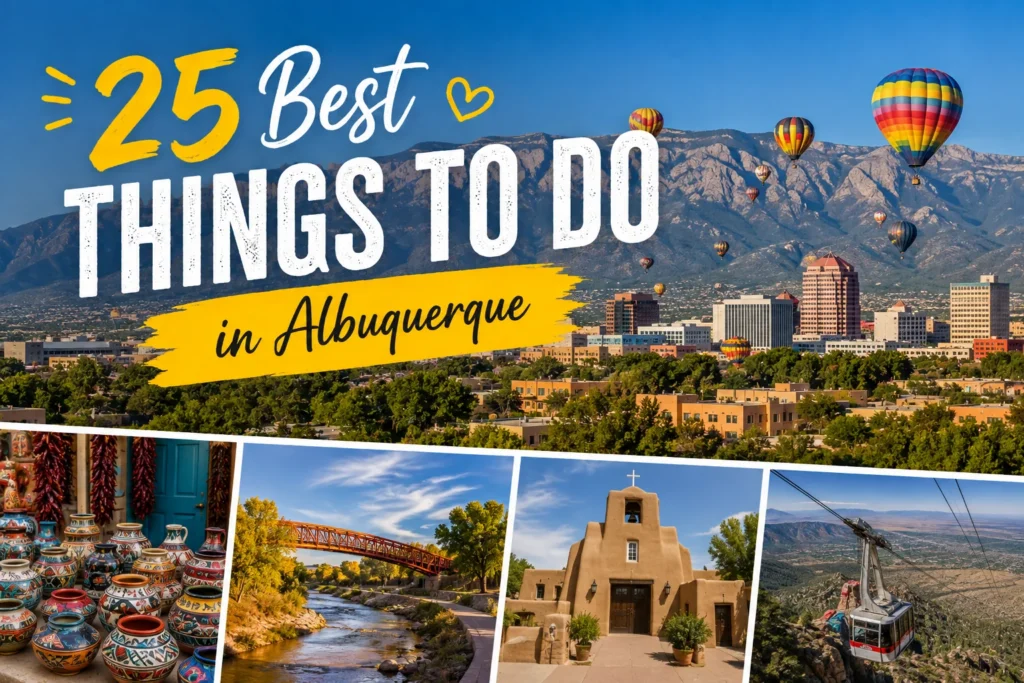
25 Best Things to Do in Albuquerque in 2026 (Complete City Guide)
By Sarah Mitchell | Travel Expert and Founder
I have sent travelers to Albuquerque for years, and the thing I tell every one of them first is the one that rewires how they think about the place: this is not a city you visit for one thing. Yes, the Balloon Fiesta in October is the most photographed event on earth and the reason most people first hear about Albuquerque. But the city sitting underneath those 500 balloons has 300 years of Spanish colonial history, 15,000 prehistoric petroglyphs on a volcanic escarpment, the longest aerial tram ride in North America, a food culture built on red and green chile that exists nowhere else in the country, and a Route 66 heritage that runs straight through downtown on Central Avenue. Most visitors come for the balloons and leave surprised by everything else.
This guide covers the 25 best things to do in Albuquerque in 2026, ordered the way I would actually work through a trip, with current prices, honest time estimates, and the one thing nobody warns first-timers about: the altitude. Albuquerque sits at 5,312 feet, and the Sandia Peak tram takes you to 10,378. If you have just arrived from sea level, the headache and shortness of breath are real. Drink water, go easy on day one, and save the tram for day two. For more of the Southwest, see my things to do in Arizona and things to do in Denver guides on Travel Destinations Plan.
Albuquerque At a Glance: Quick Reference Table
| # | Activity | Area | Entry | Duration | Best For | Best Time |
|---|---|---|---|---|---|---|
| 1 | Albuquerque International Balloon Fiesta | Balloon Fiesta Park | ~$15 general; parking $20 | Full morning or evening | All visitors; photographers | First week of October |
| 2 | Sandia Peak Tramway | Northeast edge | ~$34 adults | 2 to 3 hours | Views; hikers; all visitors | Clear days; sunset |
| 3 | Old Town Albuquerque | Old Town | Free to walk | 1.5 to 2.5 hours | History and culture lovers | Morning |
| 4 | Petroglyph National Monument | West Mesa | Free | 1.5 to 3 hours | History lovers; hikers | Morning; cooler months |
| 5 | Hot air balloon ride (year-round) | Citywide launch | ~$200 to $250 per person | 3 to 4 hours total | Bucket-list seekers; couples | Sunrise; any season |
| 6 | Indian Pueblo Cultural Center | Near Old Town | ~$12 adults | 1.5 to 2 hours | Culture and history lovers | Weekends for traditional dances |
| 7 | ABQ BioPark (Zoo, Aquarium, Garden) | Old Town area | ~$15 adults combo | 3 to 5 hours | Families | Morning; weekdays |
| 8 | Route 66 / Central Avenue | Citywide corridor | Free to drive or walk | 2 to 3 hours | Road-trip fans; photographers | Evening for neon |
| 9 | Nob Hill | East Central Ave | Free to walk | 2 to 3 hours | Foodies; nightlife; shopping | Evening |
| 10 | Breaking Bad locations tour | Citywide | ~$75 to $100 per person | 3 to 4 hours | Fans of the show | Anytime; book ahead |
| 11 | New Mexico Museum of Natural History & Science | Old Town | ~$10 adults | 1.5 to 2 hours | Families; dinosaur fans | Anytime |
| 12 | National Museum of Nuclear Science & History | East side | ~$18 adults | 1.5 to 2 hours | History and science fans | Anytime |
| 13 | Albuquerque Museum | Old Town | ~$6 adults | 1.5 to 2 hours | History and art lovers | Free Sunday mornings |
| 14 | Rio Grande Bosque Trail | Along the Rio Grande | Free | 1 to 3 hours | Walkers; cyclists; birders | Morning; spring and fall |
| 15 | Tingley Beach | Near Old Town | Free | 1 to 2 hours | Families; a quiet break | Morning |
| 16 | Turquoise Trail to Santa Fe (day trip) | East of city, ~1 hour | Free to drive; shops vary | Full day | Road-trippers; shoppers | Clear days |
| 17 | Santa Fe (day trip) | ~1 hour north | Rail Runner ~$11 round trip | Full day | Culture; art; history lovers | Any season |
| 18 | Elena Gallegos Open Space | Sandia foothills | ~$2 per vehicle | 1 to 3 hours | Hikers; views | Morning |
| 19 | New Mexico chile food crawl | Citywide | Meals vary | 2 to 3 hours | Foodies | Lunch and dinner |
| 20 | Sawmill Market | Downtown / Old Town edge | Free to enter | 1 to 1.5 hours | Foodies | Lunch |
| 21 | KiMo Theatre | Downtown | Free to view lobby; shows vary | 45 mins to show length | Architecture; arts lovers | Check show schedule |
| 22 | San Felipe de Neri Church | Old Town | Free | 30 mins | History lovers | Morning |
| 23 | Tent Rocks / Kasha-Katuwe (day trip) | ~45 mins southwest | ~$10 per vehicle | Half day | Hikers; photographers | Morning; check access status |
| 24 | Rio Grande Nature Center | North Valley | ~$5 adults | 1 to 1.5 hours | Birders; families | Morning |
| 25 | ABQ BioPark River of Lights | BioPark Botanic Garden | ~$16 adults | 1.5 hours | Families; holiday visitors | Late November through December |
1. Albuquerque International Balloon Fiesta
Area: Balloon Fiesta Park, north Albuquerque | Entry: ~$15 general admission; parking ~$20 per session | Duration: Full morning (dawn mass ascension) or evening (balloon glow) | Best time: First full week of October; nine days total
The Balloon Fiesta is the single most iconic event in New Mexico and one of the most photographed in the world: over 500 hot air balloons lifting off at dawn from a single field in the Rio Grande Valley, with the Sandia Mountains glowing pink in the background. The mass ascension, when hundreds of balloons rise simultaneously at sunrise, is genuinely breathtaking, and the evening balloon glow, when the grounded balloons illuminate from inside after dark, is its own spectacle.
The Albuquerque International Balloon Fiesta launches over 500 hot air balloons at sunrise during nine days every October, making it the largest balloon event on earth. It is the single most spectacular thing to see in New Mexico.
Practical tips:
- Arrive at Balloon Fiesta Park by 5 AM for the mass ascension. Parking fills fast and the predawn launch prep is part of the experience: you walk among inflating balloons in the dark.
- The Special Shapes Rodeo (novelty balloons in every shape imaginable) and the evening Balloon Glow are the two sessions I recommend most for first-timers.
- What I always warn people: book accommodation months ahead. Every hotel in Albuquerque and even Santa Fe fills during Fiesta week, and prices double or triple. If you cannot get October, balloon rides are available year-round (entry 5).
2. Sandia Peak Tramway
Area: Northeast Albuquerque, base of the Sandias | Entry: ~$34 adults, ~$29 seniors/military/teens, ~$24 youth | Duration: 2 to 3 hours including ride and summit time | Best time: Clear days; sunset for the best light
The Sandia Peak Tramway is the longest aerial tramway in the Americas: a 2.7-mile ride from the desert floor at 6,559 feet to the 10,378-foot crest of the Sandia Mountains. On a clear day, the view from the top stretches 11,000 square miles across New Mexico. The tram celebrates its 60th anniversary in 2026, and the summit holds hiking trails in summer, skiing in winter, and the TEN 3 restaurant year-round.
The Sandia Peak Tramway is the longest aerial tram in the Americas, climbing 2.7 miles to 10,378 feet with a view stretching 11,000 square miles. It is the single best view in New Mexico and celebrating its 60th anniversary in 2026.
Practical tips:
- Go for sunset. Riding up in daylight and watching the sun set from the summit, then descending as the city lights come on below, is the best way to experience it.
- The TEN 3 restaurant at the summit serves a genuinely good meal at 10,000 feet. Book a table for the sunset window.
- One honest tip: the altitude change is significant and fast. If you have just arrived from sea level, give yourself a day to adjust before riding to 10,378 feet.
3. Old Town Albuquerque
Area: Old Town, near downtown | Entry: Free to walk | Duration: 1.5 to 2.5 hours | Best time: Morning, before the afternoon heat and tour groups
Old Town is where Albuquerque began: a 300-year-old Spanish colonial plaza founded in 1706, anchored by the San Felipe de Neri Church (one of the oldest surviving churches in New Mexico), ringed by adobe buildings now housing galleries, shops, and restaurants. It is the historic heart of the city and the most concentrated piece of Southwest heritage in one walkable area.
Old Town Albuquerque is a 300-year-old Spanish colonial plaza founded in 1706, anchored by the San Felipe de Neri Church and surrounded by adobe galleries. It is the historic heart of the city and the essential first stop.
Practical tips:
- Walk the plaza and the narrow streets around it slowly; the architecture and the handcraft are the point, not speed.
- Several of the city’s best museums (Albuquerque Museum, Natural History, BioPark) sit within a few blocks of the plaza, so Old Town is the natural anchor for a full day.
- What I skip: the mass-produced souvenir shops. What I do not: the genuine Native American jewelry sellers under the portal outside the Albuquerque Museum, whose work is handmade and worth buying.
4. Petroglyph National Monument
Area: West Mesa, west side of the city | Entry: Free; some areas have a small parking fee | Duration: 1.5 to 3 hours | Best time: Morning; cooler months (the exposed trails have no shade)
Petroglyph National Monument preserves more than 15,000 ancient rock carvings etched into a volcanic escarpment along a 17-mile stretch of Albuquerque’s western edge. The petroglyphs, created by ancestral Pueblo peoples and later Spanish settlers, span centuries of human presence. Three main trail areas (Boca Negra Canyon, Piedras Marcadas, and Rinconada) offer different hike lengths and concentrations of carvings.
Petroglyph National Monument holds over 15,000 ancient rock carvings on a volcanic escarpment stretching 17 miles along Albuquerque’s west side. It is the largest and most accessible petroglyph site in the American Southwest.
Practical tips:
- Boca Negra Canyon is the most popular and developed section, with short, paved trails and the densest concentration of carvings. Start here if time is limited.
- There is no shade on the escarpment. Go early morning, especially in summer, and bring water and sun protection.
- What I tell everyone: these are sacred to Pueblo peoples. Do not touch, trace, or chalk the petroglyphs.
5. Hot Air Balloon Ride (Year-Round)
Area: Launch sites around the city | Entry: ~$200 to $250 per person | Duration: 3 to 4 hours total (1 hour flight plus setup and champagne toast) | Best time: Sunrise; any season
Albuquerque’s dry climate, calm morning air, and the “Albuquerque Box” wind pattern (a rare meteorological phenomenon where winds at different altitudes blow in opposite directions, allowing balloons to navigate back to their launch point) make it the undisputed ballooning capital of the world. Sunrise balloon rides operate year-round, not just during the October Fiesta, and drifting over the Rio Grande Valley with the Sandias glowing gold is a bucket-list experience.
Albuquerque is the ballooning capital of the world, with the rare “Albuquerque Box” wind pattern enabling year-round sunrise flights over the Rio Grande Valley. A balloon ride here is one of the great bucket-list experiences in the American Southwest.
Practical tips:
- Rainbow Ryders is the official operator of the Balloon Fiesta and the one I recommend: sunrise flights include about an hour of flight, a champagne toast at landing, and a certificate.
- Flights launch at sunrise, so expect a very early pickup from your hotel (often 5 to 6 AM). Worth it.
- You do not need to come in October to fly. Year-round flights mean you can do this any season and skip the Fiesta crowds entirely.
6. Indian Pueblo Cultural Center
Area: Near Old Town, I-40 corridor | Entry: ~$12 adults | Duration: 1.5 to 2 hours | Best time: Weekends for traditional Pueblo dances
The Indian Pueblo Cultural Center is owned and operated by the 19 Pueblos of New Mexico and tells the story of Pueblo history, culture, and art through exhibits, galleries, and, on weekends, live traditional dances. It celebrates its 50th anniversary in 2026, making this a landmark year to visit. It is the most authentic and respectful place in the state to learn about the Pueblo peoples.
The Indian Pueblo Cultural Center is owned by the 19 Pueblos of New Mexico and celebrates its 50th anniversary in 2026. It is the most authentic place in the state to learn about Pueblo history and see traditional dances.
Practical tips:
- Time your visit for a weekend when traditional Pueblo dances are performed; they are genuine cultural presentations, not staged tourist shows.
- The gift shop carries authentic Pueblo pottery, jewelry, and art directly supporting Pueblo artisans. It is one of the best places to buy genuine Native work in New Mexico.
- The Pueblo Harvest Cafe inside serves Pueblo-inspired cuisine that is genuinely excellent and hard to find anywhere else.
7. ABQ BioPark (Zoo, Aquarium, Botanic Garden)
Area: Near Old Town, along the Rio Grande | Entry: ~$15 adults combo ticket for all venues | Duration: 3 to 5 hours | Best time: Morning; weekdays
The ABQ BioPark combines a zoo, an aquarium, a botanic garden, and Tingley Beach (fishing ponds, model boat sailing, walking trails) in one connected complex along the Rio Grande near Old Town. The combo ticket covers all venues, and the whole thing sits in a cottonwood-shaded stretch of the river valley that feels worlds away from the desert heat.
The ABQ BioPark combines a zoo, aquarium, botanic garden, and fishing beach in one Rio Grande complex near Old Town. It is the best all-day family attraction in Albuquerque.
Practical tips:
- The ~$15 combo ticket covers everything and is genuine value for a full family day.
- The botanic garden is the quietest part and worth exploring; the Japanese garden section is a particular highlight.
- In late November through December, the Botanic Garden hosts the River of Lights (entry 25), one of the best holiday light shows in the Southwest.
8. Route 66 / Central Avenue
Area: Runs east-west through the city along Central Avenue | Entry: Free to drive or walk | Duration: 2 to 3 hours | Best time: Evening for the neon signs
Historic Route 66 runs directly through the heart of Albuquerque as Central Avenue, and unlike most cities on the Mother Road, the neon motel signs, vintage diners, and roadside character here are largely intact. Driving or walking the Central Avenue corridor, from the Nob Hill neighborhood through downtown and past the old motor courts, is a genuine living piece of Route 66 heritage.
Historic Route 66 runs through Albuquerque as Central Avenue, with more intact original neon signs, motels, and diners than almost any other stretch of the Mother Road. It is the best free Route 66 experience in the country.
Practical tips:
- Drive or walk it after dark when the vintage neon comes on. The El Vado motel, the De Anza sign, and the KiMo Theatre marquee are the standouts.
- The Nob Hill section (entry 9) is the most vibrant stretch for eating and shopping; the western stretch past Old Town has the most vintage roadside character.
- One honest tip: Central Avenue is long. Do not try to walk the entire thing; pick a section or drive it and stop at the spots that catch your eye.
9. Nob Hill
Area: East Central Avenue, roughly Girard to Carlisle | Entry: Free to walk | Duration: 2 to 3 hours | Best time: Evening
Nob Hill is Albuquerque’s most walkable, liveliest neighborhood: a stretch of Central Avenue (Route 66) packed with independent restaurants, vintage shops, craft breweries, cocktail bars, and a creative energy that makes it the real center of the city’s nightlife and dining. It is the Albuquerque locals know and love, distinct from the tourist-facing Old Town.
Nob Hill is Albuquerque’s most walkable, creative neighborhood, packed with independent restaurants and bars along Route 66. It is where locals go out and the best evening destination in the city.
Practical tips:
- Walk it in the evening when the restaurants and bars are at their liveliest and the Route 66 neon is glowing.
- The food here ranges from excellent New Mexican to Vietnamese to craft cocktails, all independent and all within walking distance.
- Where I send people for a real Albuquerque evening: Nob Hill over Old Town, every time. Old Town closes early; Nob Hill is the real nightlife.
10. Breaking Bad Locations Tour
Area: Citywide | Entry: ~$75 to $100 per person (guided tour) | Duration: 3 to 4 hours | Best time: Anytime; book ahead
Albuquerque is where Breaking Bad, Better Call Saul, and El Camino were filmed, and the city has embraced it completely. Guided tours in a replica RV visit Walter White’s house, the car wash, Tuco’s office, the crossroads motel, and dozens of other locations, with behind-the-scenes stories from guides who worked on the productions. For fans, it is a genuinely fun half day.
Breaking Bad was filmed entirely in and around Albuquerque, and guided tours visit dozens of real filming locations in a replica RV. For fans of the show, it is the most fun themed tour in the city.
Practical tips:
- Book a guided tour rather than self-driving; the guides add context, stories, and access you cannot get alone.
- Walter White’s house is a private residence. The owners have asked visitors not to approach; respect that, and view it from the tour vehicle.
- If you are not a fan of the show, skip this entirely. It is built for people who know the series and want to see the real locations.
11. New Mexico Museum of Natural History & Science
Area: Old Town area | Entry: ~$10 adults | Duration: 1.5 to 2 hours | Best time: Anytime; good heat or rain escape
This museum covers New Mexico’s natural history from the age of the dinosaurs through the space age, with a full-scale Tyrannosaurus rex skeleton, a walk-through Ice Age cave, a planetarium, and a startup gallery telling the story of early personal computing (Microsoft was founded in Albuquerque before it moved to Seattle). It is a solid, affordable family museum steps from Old Town.
The New Mexico Museum of Natural History holds a full T. rex skeleton and the startup story of Microsoft’s Albuquerque origins. It is the best affordable family museum in the city.
Practical tips:
- It is right next to Old Town, so combine the two easily in one morning.
- The planetarium shows are worth the small surcharge, especially for younger kids.
- The Microsoft startup exhibit is a surprising, fun footnote: Bill Gates and Paul Allen launched the company from an Albuquerque office in 1975.
12. National Museum of Nuclear Science & History
Area: East Albuquerque, near Kirtland AFB | Entry: ~$18 adults | Duration: 1.5 to 2 hours | Best time: Anytime
New Mexico is where the nuclear age began, and this Smithsonian-affiliated museum tells the full story: the Manhattan Project at Los Alamos, the Trinity test, Cold War weapons development, and the science of nuclear energy, with an outdoor “Heritage Park” of actual missiles, bombers, and submarines. It is more nuanced and thoughtful than you might expect.
The National Museum of Nuclear Science & History tells the story of the nuclear age from the Manhattan Project to the present, with actual missiles and bombers outside. It is the most significant nuclear-history museum in the country.
Practical tips:
- The outdoor Heritage Park with the B-52, the submarines, and the missile collection is worth a separate walk-through after the indoor exhibits.
- It is more thoughtful and less jingoistic than you might assume; the exhibits genuinely grapple with the ethics and consequences of nuclear weapons alongside the science.
- Allow 1.5 to 2 hours; there is more depth here than the building size suggests.
13. Albuquerque Museum
Area: Old Town | Entry: ~$6 adults; free Sunday mornings and first Wednesday of the month | Duration: 1.5 to 2 hours | Best time: Free Sunday mornings
The Albuquerque Museum covers 400 years of the city’s history and the Middle Rio Grande Valley, from the earliest Pueblo and Spanish colonial periods through the present, with a strong permanent art collection of Southwestern work. It is small, well curated, and genuinely good, and at $6 it is one of the best museum values in the city.
The Albuquerque Museum covers 400 years of city and Southwest history with a strong art collection, all for $6 or free on Sunday mornings. It is the best-value museum in the city.
Practical tips:
- Go Sunday morning for free admission (9 AM to 1 PM) or the first Wednesday of the month.
- It sits right at the edge of Old Town, so combine it with a plaza walk.
- The Native jewelry sellers under the portal outside the museum sell genuine handmade work and are worth spending time with.
14. Rio Grande Bosque Trail
Area: Along the Rio Grande, through the city | Entry: Free | Duration: 1 to 3 hours | Best time: Morning; spring and fall
The Bosque Trail is a paved and dirt path running for miles along the Rio Grande through Albuquerque’s cottonwood forest (the bosque), one of the largest cottonwood forests in North America. It is flat, shaded, and full of birds, and it is the most peaceful free outdoor experience in the city, a world away from the desert mesa a few miles to the west.
The Rio Grande Bosque Trail runs through one of the largest cottonwood forests in North America, along the river through the heart of Albuquerque. It is the best free outdoor walk in the city.
Practical tips:
- Access it from multiple points, including Tingley Beach and the BioPark area, for easy combining with other Old Town activities.
- It is flat and shaded, making it the rare Albuquerque outdoor activity that is comfortable even in summer if you go in the morning.
- Bring binoculars: the bosque is a major birding corridor, with sandhill cranes in fall and great blue herons year-round.
15. Tingley Beach
Area: Near Old Town, along the Rio Grande | Entry: Free | Duration: 1 to 2 hours | Best time: Morning
Tingley Beach is a set of fishing ponds, a model boat pond, and walking paths along the Rio Grande, next to the BioPark and connected to the Bosque Trail. It is completely free, surprisingly peaceful, and a genuinely lovely place to spend a quiet morning feeding ducks, watching model boats, or just sitting by the water. It is the Albuquerque the locals love.
Tingley Beach is a free set of fishing ponds and walking paths along the Rio Grande, connected to the Bosque Trail. It is the most peaceful, low-key free spot in Albuquerque.
Practical tips:
- It is free and rarely crowded, making it a genuine hidden gem steps from the BioPark.
- Rent a model sailboat and putter around the pond; it is cheap, silly, and a favorite with families.
- Combine it with a Bosque Trail walk and the BioPark for a full riverside morning near Old Town.
16. Turquoise Trail to Santa Fe (Day Trip)
Area: NM-14, running northeast from Albuquerque to Santa Fe | Entry: Free to drive; shops and attractions in towns vary | Duration: Full day | Best time: Clear days; fall for the color
The Turquoise Trail is a 52-mile scenic byway from Albuquerque to Santa Fe through the old mining towns of Cerrillos, Madrid, and Golden, set in the Sandia and Ortiz mountain foothills. Madrid (pronounced MAD-rid) is the highlight: a former ghost town now alive with art galleries, quirky shops, and a creative, off-grid character. It is the best scenic drive near Albuquerque and a more interesting route to Santa Fe than the interstate.
The Turquoise Trail is a 52-mile scenic byway from Albuquerque to Santa Fe through old mining towns and art galleries. It is the most interesting drive in the region and a far better route to Santa Fe than I-25.
Practical tips:
- Stop in Madrid for at least an hour; its galleries and shops in old coal-mining buildings are the highlight of the drive.
- The trail ends in Santa Fe (entry 17), so do the Turquoise Trail as your route up and the interstate as your route back, or vice versa.
- Fall is beautiful along this route, with yellowing cottonwoods against red rock; clear, cool days are ideal.
17. Santa Fe (Day Trip)
Area: About 1 hour north | Entry: Rail Runner Express ~$11 round trip; car about 1 hour on I-25 | Duration: Full day | Best time: Any season; fall and holiday season are prime
Santa Fe is the oldest state capital in the US (founded 1610) and one of the great art cities in America, with the Georgia O’Keeffe Museum, the Santa Fe Plaza, Canyon Road’s gallery row, world-class restaurants, and adobe architecture everywhere you look. It is the essential day trip from Albuquerque and can be reached by car, the scenic Turquoise Trail, or the Rail Runner commuter train.
Santa Fe is America’s oldest state capital and one of its great art cities, reachable from Albuquerque by train for $11 round trip. It is the essential day trip from Albuquerque.
Practical tips:
- The Rail Runner Express train is the relaxed way to get there, about 90 minutes, with views of the Rio Grande valley; check the current schedule at riometro.org.
- Canyon Road’s gallery row is a must for art lovers, free to stroll and genuinely world-class in quality and variety.
- If you drive, take the Turquoise Trail (entry 16) one way and the interstate the other for the best of both routes.
18. Elena Gallegos Open Space
Area: Sandia foothills, northeast edge of the city | Entry: ~$2 per vehicle | Duration: 1 to 3 hours | Best time: Morning
Elena Gallegos Open Space is the most accessible trailhead into the Sandia foothills, with multiple trails winding through piñon and juniper forest at the base of the mountains, offering sweeping views back over the city and the Rio Grande valley. It is a gentle, affordable way to hike the Sandias without committing to the full tram ride.
Elena Gallegos Open Space offers trails into the Sandia foothills with views over the city for just $2 a car. It is the best easy, affordable hiking in Albuquerque.
Practical tips:
- The trails here range from flat and easy to moderate climbs into the foothills, making it suitable for all fitness levels.
- Go in the morning when the light on the Sandias is best and the temperature is cool.
- It is the locals’ everyday hiking spot, which means it is well maintained and genuinely pleasant, not a tourist attraction.
19. New Mexico Chile Food Crawl
Area: Citywide | Entry: Meals vary | Duration: 2 to 3 hours | Best time: Lunch and dinner
Albuquerque’s food is defined by one question: “Red or green?” The Hatch green chile and dried red chile that define New Mexico cuisine are in everything here, from enchiladas to breakfast burritos to cheeseburgers, and the flavor is unlike anything you will find outside the state. Eating your way through the city’s chile-centric food is as essential as any museum.
Albuquerque’s New Mexico chile cuisine is unlike any other regional food in America, built on the “red or green?” choice that defines every meal. Eating your way through it is as essential as any attraction.
Practical tips:
- Order “Christmas” to get both red and green chile on the same plate and compare them side by side.
- The Frontier Restaurant near UNM, Duran Central Pharmacy’s lunch counter, and Cocina Azul near Old Town are three very different and genuine New Mexican experiences.
- What I tell first-timers: the heat level is real, and New Mexico chile is a completely different flavor from Mexican or Tex-Mex. Start with a green chile cheeseburger and work up from there.
20. Sawmill Market
Area: Downtown, near Old Town | Entry: Free to enter | Duration: 1 to 1.5 hours | Best time: Lunch
Sawmill Market is Albuquerque’s modern food hall in a converted lumber warehouse: a collection of local vendors under one roof serving everything from New Mexican to Korean to craft beer to pastries, in a bright, airy industrial space. It is the most curated food experience in the city and a good lunch anchor for an Old Town day.
Sawmill Market is a modern food hall in a converted lumber warehouse, with local vendors serving diverse cuisine under one roof. It is the best centralized lunch stop in Albuquerque.
Practical tips:
- It is walkable from Old Town and a natural lunch stop during a museum day.
- The vendors rotate, so check what is current; the New Mexican and pastry options are consistently strong.
- Go at lunch for the full buzz; it is quieter (and some vendors close) earlier and later in the day.
21. KiMo Theatre
Area: Downtown, Central Avenue | Entry: Free to view the lobby; show tickets vary | Duration: 45 minutes lobby visit, or show length | Best time: Check the show schedule
The KiMo Theatre is a 1927 Pueblo Deco movie palace, the only building of its kind in the world: a fusion of Art Deco and Pueblo Native American architectural motifs, with a stucco and terracotta exterior, hand-painted ceiling beams, and a lavish lobby. It is a genuine architectural one-of-a-kind and hosts live performances, film screenings, and community events.
The KiMo Theatre is a 1927 Pueblo Deco palace, the only building in the world blending Art Deco with Pueblo architectural motifs. It is one of the most unique historic theaters in America.
Practical tips:
- The lobby is free to view during open hours and worth a quick stop to see the interior detailing.
- Catching a show or film here is the ideal way to experience the space; check the current schedule at cabq.gov/kimo.
- It sits on Central Avenue (Route 66), so walk past it on your Route 66 neon drive or Nob Hill evening.
22. San Felipe de Neri Church
Area: Old Town plaza | Entry: Free | Duration: 30 minutes | Best time: Morning
San Felipe de Neri Church has stood on the Old Town plaza since 1793 (with an earlier iteration dating to 1706), making it one of the oldest surviving churches in New Mexico. It is a simple, beautiful adobe church, still an active parish, and the spiritual and historical anchor of Old Town. Stepping inside for a few quiet minutes is worth the time.
San Felipe de Neri Church has anchored Old Town plaza since 1793 and is one of the oldest surviving churches in New Mexico. It is the spiritual and historical heart of Albuquerque.
Practical tips:
- It is a functioning church, so visit quietly and respectfully, especially during services.
- The small garden and the adjoining museum (small fee) add context to the church’s long history.
- It is right on the Old Town plaza, so it takes only a few minutes to step inside during your Old Town walk.
23. Tent Rocks / Kasha-Katuwe (Day Trip)
Area: About 45 minutes southwest, on Cochiti Pueblo land | Entry: ~$10 per vehicle; managed by Cochiti Pueblo | Duration: Half day | Best time: Morning; check current access status before driving out
Kasha-Katuwe Tent Rocks National Monument is a landscape of cone-shaped rock formations carved by volcanic eruptions and erosion, with a slot-canyon trail winding between towering hoodoos to a mesa-top viewpoint. It is one of the most dramatic short hikes in New Mexico. Access is managed by Cochiti Pueblo and has been periodically closed in recent years, so checking current status before visiting is essential.
Kasha-Katuwe Tent Rocks is a dramatic landscape of volcanic cone-shaped hoodoos with a slot-canyon trail, about 45 minutes from Albuquerque. It is one of the most visually stunning short hikes in New Mexico.
Practical tips:
- Check current access status before you go. The monument is on Cochiti Pueblo land and has been closed and reopened multiple times in recent years; do not assume it is open without verifying.
- Go in the morning when the light hits the cones and the slot canyon is shaded and cool.
- The trail is moderate but gains elevation quickly on the last section to the mesa viewpoint. Bring water and real shoes.
24. Rio Grande Nature Center
Area: North Valley, along the Rio Grande | Entry: ~$5 adults | Duration: 1 to 1.5 hours | Best time: Morning
The Rio Grande Nature Center is a quiet reserve along the river with a visitor center built partly underground, offering viewing windows into a pond where birds, turtles, and other wildlife feed at close range. Walking trails loop through the cottonwood bosque along the river. It is the most peaceful, hidden, and genuinely nature-focused stop in the city.
The Rio Grande Nature Center offers underground viewing windows into a wildlife pond and walking trails through the riverside bosque. It is the most peaceful hidden gem in Albuquerque.
Practical tips:
- Go in the morning for the most active bird life and the quietest trails.
- It is a perfect cool-down from the exposed desert sights; the cottonwood shade along the river is a genuine relief.
- Great for birders: the bosque corridor hosts migrating sandhill cranes in fall and resident herons, hawks, and woodpeckers year-round.
25. ABQ BioPark River of Lights
Area: BioPark Botanic Garden, near Old Town | Entry: ~$16 adults | Duration: 1.5 hours | Best time: Late November through December
The River of Lights is the ABQ BioPark Botanic Garden’s holiday light show: the garden paths illuminated with millions of lights sculpted into animals, plants, and New Mexico themes, with music, hot chocolate, and a genuinely festive atmosphere. It is one of the best holiday events in the Southwest and the single best reason to visit Albuquerque in December.
The River of Lights transforms the BioPark Botanic Garden into a holiday wonderland of millions of sculpted lights. It is the best holiday event in the Southwest.
Practical tips:
- Buy tickets in advance; popular evenings sell out, especially weekends in December.
- Dress warmly; Albuquerque evenings in late November and December are genuinely cold, often in the 20s and 30s°F.
- Go on a weeknight for shorter lines and a calmer walk through the lights.
Albuquerque Practical Guide
Getting Around Albuquerque
Albuquerque is a spread-out western city and you genuinely need a car for most of this guide. The attractions span the Rio Grande valley, the West Mesa, the Sandia foothills, and day trips in multiple directions, and public transit does not cover most of them. The Rapid Ride ART bus runs along Central Avenue (Route 66) and is useful for the Old Town-to-Nob Hill corridor, but everywhere else requires driving. The Rail Runner Express train connects to Santa Fe, which is the one great public-transit day trip.
One thing I always tell first-timers: the altitude is real. Albuquerque sits at 5,312 feet, the Sandia tram summit is 10,378 feet, and if you have just flown in from sea level, headaches, fatigue, and breathlessness are common on day one. Drink extra water, go easy on alcohol the first evening, and save the tram and the higher hikes for day two or later.
Where to Stay in Albuquerque
Old Town / Downtown: Closest to Old Town, the museums, the BioPark, and Sawmill Market. Best for first-timers who want walkable access to the historic core.
Nob Hill / University area: On Central Avenue (Route 66), walkable to the best restaurants and nightlife, with a local, creative neighborhood feel. Best for foodies and evening-oriented travelers.
North Albuquerque / Balloon Fiesta area: Closest to Balloon Fiesta Park and the Sandia Tram base. Best for visitors here specifically for the Fiesta or wanting easy tram access.
Albuquerque Budget Guide
Budget traveler (budget hotel on Route 66, free attractions like Old Town, Petroglyphs, Bosque Trail, and Tingley Beach, New Mexican food at local spots): roughly $80 to $130 per day. Many of Albuquerque’s best experiences, including the petroglyphs, the bosque, and Old Town, are free.
Mid-range traveler (comfortable hotel, Sandia Tram, BioPark, museum day, sit-down dining, a day trip): roughly $180 to $300 per day.
Higher-spend traveler (premium hotel, sunrise balloon ride, tram plus summit dinner, a Breaking Bad tour, fine dining, multiple day trips): $400 or more per day, with the balloon ride as the single biggest cost.
Frequently Asked Questions About Albuquerque
How many days do you need in Albuquerque? Three to four days covers Old Town, the Sandia Peak Tramway, the Petroglyphs, the major museums, and the food scene comfortably. Five days lets you add a balloon ride, a day trip to Santa Fe or the Turquoise Trail, and more time exploring Nob Hill and the bosque. A Balloon Fiesta visit needs at least two to three full mornings at the field.
Is Albuquerque expensive to visit? No. It is one of the more affordable major-city trips in the American Southwest. Many of the best attractions (petroglyphs, Old Town, the bosque, Tingley Beach, Route 66) are free, museum prices are modest, and food is excellent and cheap. The main splurge items are the Sandia Tram (~$34) and a balloon ride (~$200+).
What is Albuquerque most famous for? The Albuquerque International Balloon Fiesta (the world’s largest balloon event, every October), the Sandia Peak Tramway, Old Town’s 300-year-old Spanish colonial plaza, Route 66 running through the city, New Mexico’s red and green chile cuisine, the Petroglyph National Monument, and its role as the filming location for Breaking Bad.
When is the best time to visit Albuquerque? October for the Balloon Fiesta and perfect weather, or spring (March to May) and fall (September to November) for comfortable temperatures and blue skies. Summer is hot (90s to 100s°F) but dry, and the altitude takes the edge off. Winter is cold and quiet, with the River of Lights as a holiday draw.
Do I need to book Albuquerque attractions in advance? Book ahead for: Balloon Fiesta (accommodations months ahead; general admission is available at the gate), hot air balloon rides (especially in October), Breaking Bad tours, and the TEN 3 summit restaurant. Most museums, Old Town, the Petroglyphs, and the Bosque Trail need no booking.
Do I need a car in Albuquerque? Yes, for most of the city. The ART bus covers Central Avenue (Old Town to Nob Hill), and the Rail Runner reaches Santa Fe, but the tram, the petroglyphs, the day trips, and most other attractions require a car. Rent one unless your trip is entirely within the Central Avenue corridor.
The Final Word
If you take one thing from this guide, take this: Albuquerque is not just a Balloon Fiesta stop. The Fiesta is extraordinary and worth planning a trip around, but the city underneath it has 300 years of history, 15,000 ancient petroglyphs, the longest aerial tram in the Americas, a food culture built on chile that exists nowhere else in the country, and a Route 66 heritage that most other cities on the Mother Road have paved over. Most visitors come for the balloons and leave surprised by everything else. I want you to not be surprised, because you already knew.
Where I would spend the money: a sunrise balloon ride with Rainbow Ryders (year-round, not just October), the Sandia Peak Tram at sunset with dinner at TEN 3, and the Indian Pueblo Cultural Center on its 50th anniversary. Where the magic is free: the petroglyphs at dawn, the Bosque Trail along the Rio Grande, Old Town in the morning light, and Route 66 neon after dark. The mistake I watch people make is either coming only for the Fiesta and seeing nothing else, or skipping Albuquerque entirely on the way to Santa Fe. Both are wrong. Give it three or four days.
Have an Albuquerque tip I missed, or a favorite chile spot, or a Balloon Fiesta hack? Tell me in the comments. I update this guide as prices and seasons change.
For more Southwest and US travel guides, visit Travel Destinations Plan.
Pingback: 25 Best Things to Do in Denver 2026 (Local Guide)