
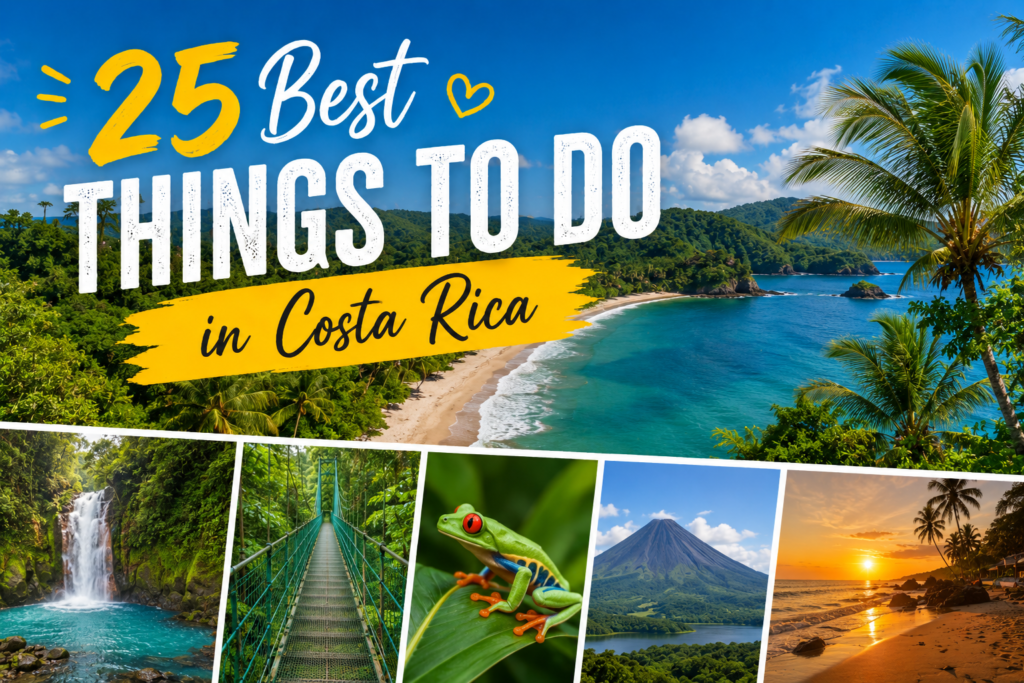
25 Best Things to Do in Costa Rica in 2026 (Complete Guide)
By Sarah Mitchell | Travel Expert and Founder
I have planned Costa Rica trips for years, and the mistake I watch first-timers make is trying to see the whole country in a week. Costa Rica is small on a map but enormous in transit time: mountain roads wind, bridges wash out in green season, and “three hours away” on Google Maps can mean five in reality. So I tell everyone the same thing: pick two or three bases, go deep rather than wide, and stop trying to squeeze Arenal, Monteverde, Manuel Antonio, and the Caribbean into seven days. Two of those, done well, beats all four done badly.
The other thing nobody tells you upfront: Costa Rica is not cheap. It is significantly pricier than its Central American neighbors, with park fees, guided tours, and tourist-area restaurants adding up fast. But it earned that pricing by protecting 25 percent of its land, abolishing its army to fund national parks, and building the most developed ecotourism infrastructure in the Americas. You are paying for a country that has been getting conservation right for decades. This guide covers the 25 best things to do in Costa Rica in 2026, with current prices, honest time estimates, and the practical details most guides skip. For more of the region, see my things to do in Mexico and things to do in Colombia guides on Travel Destinations Plan.
Costa Rica At a Glance: Quick Reference Table
| # | Activity | Region | Entry / Cost | Duration | Best For | Best Time |
|---|---|---|---|---|---|---|
| 1 | Arenal Volcano & hot springs | La Fortuna | Park ~$15; hot springs ~$45 to $99 | 2 to 3 days | First-timers; adventure seekers | Dec to Apr dry; Jun to Aug green sweet spot |
| 2 | Manuel Antonio National Park | Central Pacific | ~$18 foreigners; closed Tuesdays | Half to full day | Wildlife watchers; beach lovers | Early morning; dry season |
| 3 | Monteverde Cloud Forest | Monteverde / Santa Elena | ~$25 reserve entry | 1 to 2 days | Birders; hikers; nature lovers | Feb to Apr for fewer clouds |
| 4 | Corcovado National Park | Osa Peninsula | ~$15; guide required | 1 to 3 days | Serious wildlife seekers | Dec to Apr |
| 5 | Zip-lining | Monteverde / Arenal | ~$50 to $85 | 2 to 3 hours | Adventure seekers; families | Any season |
| 6 | Hot springs at Arenal | La Fortuna | Free (river) to ~$99 (Tabacón) | 2 to 4 hours | Couples; relaxation | Evening; any season |
| 7 | Tortuguero National Park | Caribbean | ~$15; boat access only | 2 to 3 days | Turtle nesting; remote nature | Jul to Oct for turtles |
| 8 | La Fortuna Waterfall | La Fortuna | ~$18 | 1.5 to 2 hours | Swimmers; hikers | Morning |
| 9 | Whitewater rafting, Pacuare River | Turrialba | ~$100 to $150 per person | Full day or multi-day | Adventure seekers | Jun to Oct for best rapids |
| 10 | Hanging bridges | Arenal / Monteverde | ~$28 | 2 to 3 hours | Families; birders | Morning for wildlife |
| 11 | Surfing | Tamarindo / Santa Teresa / Caribbean | Lessons ~$50 to $75 | Half day | Surfers; beginners | Varies by coast and break |
| 12 | Cahuita National Park | Caribbean coast | ~$5 donation | Half to full day | Snorkelers; budget travelers | Feb to Apr; Sep to Oct |
| 13 | Coffee plantation tour | Central Valley | ~$30 to $50 | 2 to 3 hours | Foodies; culture lovers | Any season |
| 14 | Poás Volcano | Central Valley | ~$15; check activity status | 2 to 3 hours | Day-trippers from San José | Morning for clearest crater views |
| 15 | Puerto Viejo & Caribbean coast | Caribbean | Free to walk; activities vary | 2 to 3 days | Culture seekers; foodies; surfers | Feb to Apr; Sep to Oct |
| 16 | Rincón de la Vieja | Guanacaste | ~$15 | Full day | Hikers; hot springs seekers | Dec to Apr |
| 17 | Whale and dolphin watching | Uvita / Drake Bay | ~$75 to $100 | 3 to 4 hours | Wildlife lovers | Aug to Oct humpback migration |
| 18 | Night wildlife walk | Arenal / Monteverde | ~$25 to $40 | 2 hours | Wildlife lovers; families | Any season; after dark |
| 19 | Sloth sanctuary or rescue center | Caribbean / Central Valley | ~$30 to $40 | 1.5 to 2 hours | Animal lovers; families | Any season |
| 20 | Nauyaca Waterfalls | Near Dominical | ~$10 to $12 | Half day | Hikers; swimmers | Morning; dry season |
| 21 | Snorkeling at Caño Island | Off Osa Peninsula | ~$90 to $120 boat tour | Full day | Divers; snorkelers | Dec to Apr for visibility |
| 22 | Cerro Chirripó (highest peak) | Chirripó National Park | ~$18; permit required | 2 days | Serious hikers | Feb to Apr |
| 23 | San José: Central Market & museums | San José | Market free; museums ~$5 to $15 | Half to full day | Culture seekers; foodies | First or last day |
| 24 | Sunset sailing / catamaran tour | Tamarindo / Papagayo / Manuel Antonio | ~$80 to $120 | 3 to 4 hours | Couples; families | Dry season |
| 25 | Soak in pura vida at a soda | Nationwide | Meals ~$5 to $8 | 1 hour | Budget travelers; foodies | Any time; lunch is prime |
1. Arenal Volcano & Hot Springs
Region: La Fortuna, northern lowlands | Entry: Arenal Volcano National Park ~$15; hot springs vary from free to ~$99 | Duration: 2 to 3 days as a base | Best time: December to April (dry season); June to August (green-season sweet spot: lower prices, morning sun, afternoon rain)
Arenal is Costa Rica’s adventure capital and the stop I recommend first for first-timers: a near-perfect volcanic cone towering over a valley of hot springs, zip lines, hanging bridges, waterfalls, and some of the best wildlife spotting in the country. La Fortuna, the small town at its base, is the most practical hub in Costa Rica, with everything accessible within a short drive.
Arenal Volcano and the La Fortuna area combine a photogenic volcanic cone, thermal hot springs, waterfalls, and adventure activities within one compact base. It is the essential first stop in Costa Rica and the best introduction to the country.
Practical tips:
- The volcano itself has not erupted since 2010, and you cannot hike to the summit. The Arenal 1968 trail through old lava fields gives the best views and the closest approach.
- Hot springs range from the free river springs (ask locals for directions) to Tabacón (~$99 with dinner, genuinely luxurious) to Baldi (~$45, more affordable and just as hot). See entry 6 for the full breakdown.
- What I tell everyone: base yourself in La Fortuna for at least two nights. One is not enough to do the volcano, the springs, the waterfall, and the hanging bridges without rushing.
2. Manuel Antonio National Park
Region: Central Pacific coast | Entry: ~$18 for foreigners; closed Tuesdays | Duration: Half to full day | Best time: Arrive at opening; dry season (December to April) for the best beach weather
Manuel Antonio is the most accessible wildlife-and-beach combination in the country: a small, well-maintained national park where white-sand beaches sit alongside trails where sloths, monkeys (all three local species: capuchins, howlers, and squirrel monkeys), iguanas, and toucans are reliably visible. It is the park I send families and first-timers to because the wildlife-to-effort ratio is the highest in Costa Rica.
Manuel Antonio combines white-sand beaches with some of the most reliably visible wildlife in Costa Rica, including sloths and three monkey species, in a compact, easy trail system. It is the best park in the country for first-timers.
Practical tips:
- The park is closed every Tuesday. Arrive at opening (7 AM) for the best wildlife spotting and the quietest trails; by midday it is crowded.
- A certified naturalist guide (~$25 per person) is not required but transforms the experience: they spot animals you will walk past, especially sloths high in the canopy.
- Straight talk: Manuel Antonio is the most visited park in Costa Rica, so do not expect solitude. What you get instead is the densest, most accessible wildlife viewing in the country, which is why it is this popular.
3. Monteverde Cloud Forest
Region: Monteverde / Santa Elena, central highlands | Entry: Monteverde Cloud Forest Reserve ~$25; Santa Elena Reserve ~$20 | Duration: 1 to 2 days | Best time: February to April for the best chance of clearer skies; mornings year-round
Monteverde is unlike anywhere else in Costa Rica: a high-altitude cloud forest where the trees drip with moss and epiphytes, the air is cool and damp, and the birdlife, including the resplendent quetzal, is extraordinary. Walking the trails at dawn, with mist threading through the canopy and hummingbirds hovering at eye level, is one of the great wildlife experiences in the Americas.
Monteverde’s cloud forest is a misty, moss-draped world of extraordinary biodiversity, home to the resplendent quetzal and hundreds of hummingbird species. It is the most unique ecosystem you can visit in Costa Rica.
Practical tips:
- Two reserves operate here: the Monteverde Cloud Forest Reserve (more famous, more crowded) and the Santa Elena Cloud Forest Reserve (cheaper, quieter, equally beautiful). I often send people to Santa Elena.
- The roads to Monteverde are rough. Expect 2 to 3 hours from La Fortuna on unpaved mountain roads; a 4×4 is strongly recommended.
- Hire a guide for the birding. The quetzal and many of the most spectacular birds are nearly impossible to spot without a trained eye, and the guides here are among the best in the country.
4. Corcovado National Park
Region: Osa Peninsula, southern Pacific | Entry: ~$15; certified guide required | Duration: 1 to 3 days | Best time: December to April (dry season)
Corcovado is the crown jewel: National Geographic called the Osa Peninsula “the most biologically intense place on earth,” and Corcovado, its core national park, is where you see the species the rest of Costa Rica only promises. All four monkey species, tapirs (the country’s most elusive large mammal), scarlet macaws in flocks, and the densest biodiversity per square foot of any park in the system.
Corcovado National Park on the Osa Peninsula is considered the most biologically intense place on earth, with all four Costa Rican monkey species, tapirs, and scarlet macaws. It is the ultimate wildlife destination in the country.
Practical tips:
- A certified guide is mandatory for all entries. Book through a lodge in Drake Bay or Puerto Jiménez, the two gateway towns.
- Getting here is the challenge: fly to Drake Bay or Puerto Jiménez, or drive (long, rough roads). The remoteness is what keeps it wild.
- Who I send here: serious wildlife seekers willing to invest the time and effort. If you want easy, go to Manuel Antonio. If you want the real thing, come here.
5. Zip-lining
Region: Monteverde (the original) and Arenal (the biggest) | Entry: ~$50 to $85 per person | Duration: 2 to 3 hours | Best time: Any season; morning for the best light
Costa Rica invented modern canopy zip-lining, and the Monteverde and Arenal areas have the best courses in the country. Flying through the cloud forest canopy 200 feet above the forest floor, over river gorges and past volcanic views, is one of the most exhilarating two hours you can spend in Central America.
Costa Rica invented canopy zip-lining, and the Monteverde and Arenal courses fly you through rainforest and cloud forest hundreds of feet above the ground. It is the country’s signature adventure activity.
Practical tips:
- Monteverde’s original canopy tour has the history; Arenal’s 100% Aventura Park has the longest zip line in Latin America (over a mile). Both are excellent.
- Minimum age and weight requirements vary by operator; check before booking with young children.
- What I tell nervous first-timers: you do not need to be athletic or brave. The harness does the work, the guides are professionals, and the views make everyone forget they were scared.
6. Hot Springs at Arenal
Region: La Fortuna | Entry: Free (river) to ~$99 (Tabacón) | Duration: 2 to 4 hours | Best time: Evening; any season
The volcanic geology under Arenal heats dozens of natural springs, and the La Fortuna area has hot-spring options at every price point: the free public river springs where locals soak (ask at your hotel for the current best access point), mid-range resorts like Baldi (~$45 with pools and slides), and the luxury Tabacón (~$99 including dinner), where volcanic water flows through a landscaped tropical garden.
Arenal’s hot springs range from free public river soaks to the luxurious Tabacón thermal resort, all heated by the volcano’s geology. Soaking in volcanic water with the jungle around you is one of Costa Rica’s most iconic experiences.
Practical tips:
- Tabacón is the most beautiful and the priciest; Baldi is the best mid-range family option; the free river springs are the locals’ secret. All three are legitimately good.
- Go in the evening, after a day of hiking or adventure, when the cooler air makes the hot water feel best.
- What I actually do: one evening at the free river springs (bring a headlamp and shoes you can get wet) and one evening at Tabacón for the splurge. Both are worth it.
7. Tortuguero National Park
Region: Caribbean coast, northeast | Entry: ~$15; accessible only by boat or small plane | Duration: 2 to 3 days | Best time: July to October for green sea turtle nesting; year-round for wildlife
Tortuguero is Costa Rica’s “little Amazon”: a network of jungle canals and lagoons accessible only by boat, where you drift past caimans, river turtles, monkeys, toucans, and the occasional manatee. From July through October, green sea turtles come ashore at night to nest on the park’s long Caribbean beach, and watching them under starlight is one of the most extraordinary wildlife experiences in the Americas.
Tortuguero is a jungle canal system accessible only by boat, where green sea turtles nest on the beach from July to October. It is the most remote and immersive wildlife experience in Costa Rica.
Practical tips:
- Book a multi-night lodge package that includes boat transport, guided canal tours, and (in season) the nighttime turtle walk. Going independently is difficult here.
- The turtle nesting is strictly managed: guides lead small groups at night, and no flashlights or cameras with flash are allowed. Follow the rules; they protect the turtles.
- It rains here year-round, Caribbean side. Bring a rain jacket and dry bags for electronics regardless of season.
8. La Fortuna Waterfall
Region: La Fortuna | Entry: ~$18 | Duration: 1.5 to 2 hours | Best time: Morning for the best light and fewest people
La Fortuna Waterfall is a 230-foot cascade plunging into a turquoise swimming hole surrounded by jungle, reached by a steep descent of roughly 500 concrete steps. Swimming at the base with the falls thundering above you and the forest rising on all sides is one of the most memorable swims in Costa Rica.
La Fortuna Waterfall drops 230 feet into a turquoise jungle pool, reached by 500 steps down through the forest. It is one of the most beautiful and swimmable waterfalls in Costa Rica.
Practical tips:
- The 500 steps down are easy; the 500 steps back up are a genuine workout. Go slow and bring water.
- Morning is the best time for softer light in the gorge and fewer crowds at the pool.
- Combine it with a Mistico Hanging Bridges walk (entry 10) and an evening at the hot springs for a perfect La Fortuna day.
9. Whitewater Rafting on the Pacuare River
Region: Turrialba, central highlands | Entry: ~$100 to $150 per person (day trip with transport); multi-day trips from ~$300 | Duration: Full day or 2-day trip | Best time: June to October for the highest water and best Class III to IV rapids
The Pacuare River is consistently ranked among the top whitewater rivers in the world: a jungle-lined gorge with Class III to IV rapids, waterfalls dropping into the river from the canyon walls, and the genuine feeling of being deep in the wilderness. Multi-day trips include a night at a riverside lodge accessible only by raft.
The Pacuare River is one of the world’s best whitewater rafting runs, through a jungle gorge with Class III to IV rapids and canyon waterfalls. It is the most thrilling single-day adventure in Costa Rica.
Practical tips:
- Day trips from La Fortuna or San José include transport and run about $100 to $150. The 2-day trip with an overnight jungle lodge is the premium version and worth the extra cost.
- No experience is needed for the standard day trip; guides manage the raft and give instructions.
- June to October (green season) has the best water levels and strongest rapids; dry season runs are gentler.
10. Hanging Bridges
Region: Arenal (Mistico) and Monteverde | Entry: ~$28 at Mistico Arenal; varies at Monteverde locations | Duration: 2 to 3 hours | Best time: Morning for the best wildlife spotting
Hanging bridges suspend you in the rainforest canopy on walkways and bridges strung between the trees, giving a bird’s-eye view of the forest that ground-level trails cannot match. Mistico Arenal Hanging Bridges, with 16 bridges and Arenal Volcano views through the canopy, is the best single hanging-bridge experience in the country.
Mistico Arenal Hanging Bridges offer 16 bridges through the rainforest canopy with views of Arenal Volcano. Walking at treetop level is one of the most immersive, accessible ways to experience the rainforest.
Practical tips:
- Go early morning when the wildlife (toucans, monkeys, sloths) is most active in the canopy around the bridges.
- It is family-friendly and does not require fitness or bravery; the bridges are sturdy and wide.
- A guided walk (~$50 with guide) dramatically increases what you see versus going self-guided; the guides spot animals you will miss entirely.
11. Surfing
Region: Tamarindo (Pacific, beginner-friendly), Santa Teresa (Pacific, intermediate-advanced), Puerto Viejo (Caribbean, reef breaks) | Entry: Lessons ~$50 to $75 including board | Duration: Half day | Best time: Varies by coast; Tamarindo is best for beginners year-round
Costa Rica is one of the world’s great surf destinations, with warm water, consistent swell on both coasts, and a range of breaks from gentle beginner beach breaks to powerful reef points. Tamarindo on the Pacific is the classic beginner spot, with dozens of surf schools and forgiving waves. Santa Teresa is wilder and better for experienced surfers. The Caribbean side around Puerto Viejo has reef breaks with a completely different, reggae-infused character.
Costa Rica offers world-class surfing on both the Pacific and Caribbean coasts, with warm water year-round and breaks for every level. It is one of the best surf destinations on earth.
Practical tips:
- First time? Tamarindo is the move: gentle beach breaks, warm water, great instructors, and a fun town to hang out in after.
- Rainy season (May to November) generally brings bigger Pacific swells; dry season is calmer and better for beginners.
- Bring or buy reef-safe sunscreen. Costa Rica takes marine protection seriously and so should you.
12. Cahuita National Park
Region: Caribbean coast | Entry: ~$5 donation (Puerto Vargas entrance has a fixed fee of ~$5) | Duration: Half to full day | Best time: February to April and September to October (driest Caribbean months)
Cahuita is the Caribbean’s answer to Manuel Antonio: a beachfront national park with hiking trails through coastal jungle, white-sand beaches, and the only developed coral reef in Costa Rica, accessible by snorkeling directly from shore. Unlike Manuel Antonio, it runs on a donation system at its main entrance, making it one of the best-value parks in the country.
Cahuita National Park combines Caribbean beaches, jungle trails, and Costa Rica’s only accessible coral reef, all for a voluntary donation. It is the best-value national park in the country.
Practical tips:
- Enter from the Cahuita village side (donation entry) rather than Puerto Vargas (fixed fee) for the most flexible, cheapest option.
- Snorkel the reef directly from the beach; the coral and tropical fish are right there, no boat needed.
- The Caribbean coast gets rain on a different schedule than the Pacific. Check the forecast; the driest windows are February to April and September to October.
13. Coffee Plantation Tour
Region: Central Valley (near San José) | Entry: ~$30 to $50 per person | Duration: 2 to 3 hours | Best time: Any season; harvest (November to March) for the most active farms
Costa Rica produces some of the best coffee on earth, and the Central Valley around San José is where most of it is grown. Plantation tours walk you through the process from cherry to cup, with tastings that ruin you for supermarket coffee forever. Doka Estate and Hacienda Alsacia (Starbucks’ only company-owned farm, open for tours) are the two best-known options.
Costa Rica’s Central Valley grows some of the world’s best coffee, and plantation tours from cherry to cup are a highlight of any visit. It is the best way to understand what “single origin” actually means.
Practical tips:
- Hacienda Alsacia (Starbucks’ farm) and Doka Estate are both near San José and make an easy half-day tour on your first or last day.
- Book ahead, especially for Hacienda Alsacia, which limits daily visitors.
- Where I send serious coffee people: the smaller, family-run farms in Tarrazú or the Orosi Valley, where the tours are more personal and the coffee is often better.
14. Poás Volcano
Region: Central Valley, about 1 hour from San José | Entry: ~$15; advance reservation required | Duration: 2 to 3 hours | Best time: Early morning for the clearest crater views
Poás Volcano has one of the world’s largest active craters, a mile wide, with a bubbling acid lake at its center visible from a viewing platform at the rim. It is the most accessible volcano from San José, making it a popular morning day trip. The volcano is occasionally closed due to increased activity, so checking current status before visiting is essential.
Poás Volcano has one of the world’s largest active craters, with a mile-wide acid lake visible from a rim viewing platform. It is the most accessible volcano day trip from San José.
Practical tips:
- Advance online reservation is required. Visits are limited to 20-minute windows at the crater due to volcanic gas exposure, so arrive on time.
- Go as early as possible; clouds typically roll in by late morning and obscure the crater entirely.
- Check the park’s status before making the drive; Poás closes periodically when activity increases.
15. Puerto Viejo & the Caribbean Coast
Region: Caribbean coast, southern Limón province | Entry: Free to walk; activities vary | Duration: 2 to 3 days | Best time: February to April and September to October (driest windows)
Puerto Viejo is the laid-back, Afro-Caribbean soul of Costa Rica: a small beach town with reggae and calypso in the air, rice-and-beans (cooked in coconut milk, a Caribbean tradition entirely different from the Pacific side), reef breaks for surfing, and Playa Cocles, one of the most beautiful beaches in the country. It is a completely different Costa Rica from the Pacific tourist corridor.
Puerto Viejo is Costa Rica’s Afro-Caribbean beach town, with reggae culture, coconut-milk rice and beans, reef surfing, and a laid-back vibe unlike anywhere else in the country. It is the best place to see the Caribbean side of Costa Rica.
Practical tips:
- Rent a bicycle; Puerto Viejo and the surrounding beaches (Cocles, Chiquita, Manzanillo) are best explored on two wheels.
- Eat the Caribbean food: rice and beans (not the same as the Pacific “gallo pinto”), patí (spiced meat pies), and fresh ceviche. It is the most distinct regional cuisine in the country.
- One honest tip: the Caribbean coast is rainier and less developed than the Pacific. That is the charm. If you want polished resort infrastructure, stay Pacific. If you want character, come here.
16. Rincón de la Vieja
Region: Guanacaste, northwest | Entry: ~$15 | Duration: Full day | Best time: December to April (dry season)
Rincón de la Vieja is the volcano most visitors have never heard of, and it is one of my favorites in the country: an active volcano surrounded by mud pots, natural hot springs, waterfalls, and hiking trails through both dry tropical forest and cloud forest. It gets a fraction of Arenal’s crowds and delivers a rawer, wilder volcanic experience.
Rincón de la Vieja is an active volcano with mud pots, hot springs, waterfalls, and far fewer tourists than Arenal. It is the best volcanic experience in Costa Rica for visitors wanting to avoid crowds.
Practical tips:
- The Pailas sector has the best trail to the volcanic mud pots and hot pools; the hike is moderate and well marked.
- There are no resort-style hot springs here like Arenal; the springs are natural, in the forest, and free with park entry. That is the appeal.
- Combine it with the Guanacaste beach towns (Tamarindo, Papagayo) since it is in the same region.
17. Whale and Dolphin Watching
Region: Uvita / Drake Bay, southern Pacific | Entry: ~$75 to $100 per person (boat tour) | Duration: 3 to 4 hours | Best time: August to October and December to March (humpback migration seasons)
Costa Rica’s southern Pacific coast sits on one of the world’s great whale migration routes, and humpback whales from both the Northern and Southern Hemispheres pass through at different times of year, giving the country one of the longest whale-watching seasons anywhere. The Marino Ballena National Park at Uvita, shaped like a whale’s tail from above, is the departure point.
Costa Rica’s southern Pacific coast hosts humpback whales from both hemispheres, giving it one of the longest whale-watching seasons in the world. A boat tour from Uvita or Drake Bay is the best marine wildlife experience in the country.
Practical tips:
- Two seasons: Southern Hemisphere humpbacks from August to October, Northern Hemisphere from December to March. Both windows are excellent.
- Tours from Uvita or Drake Bay run 3 to 4 hours and often include dolphin pods, sea turtles, and snorkeling at Caño Island.
- Marino Ballena’s whale-tail sandbar (visible at low tide) is itself worth a visit; it is the most photographed natural formation on the southern coast.
18. Night Wildlife Walk
Region: Arenal and Monteverde (most popular) | Entry: ~$25 to $40 per person with guide | Duration: 2 hours | Best time: Any season; starts at dusk
Costa Rica’s rainforest comes alive after dark: red-eyed tree frogs, sleeping sloths, kinkajous, tarantulas, snakes, and a world of nocturnal insects emerge once the sun goes down. Guided night walks with a naturalist guide and a flashlight are one of the most surprisingly memorable experiences in the country, and they operate year-round.
Guided night walks in Arenal or Monteverde reveal red-eyed tree frogs, sleeping sloths, and kinkajous that are invisible by day. It is one of the most unexpectedly memorable wildlife experiences in Costa Rica.
Practical tips:
- A guide is essential; you will see almost nothing on your own in the dark. The guides know exactly where to look and what to listen for.
- Wear closed-toe shoes, long pants, and bring insect repellent. The forest floor at night is a different world.
- Who loves this: everyone, including kids. The red-eyed tree frog reveal is consistently the highlight, and even adults who are squeamish about bugs get drawn in.
19. Sloth Sanctuary or Rescue Center
Region: Caribbean coast (Sloth Sanctuary of Costa Rica) and Central Valley (Rescate Wildlife Center) | Entry: ~$30 to $40 | Duration: 1.5 to 2 hours | Best time: Any season
Costa Rica has both two-toed and three-toed sloths, and seeing them in the wild is common but fleeting, they are high in the canopy and asleep most of the day. Rescue centers and sanctuaries offer close, ethical encounters with sloths and other rescued wildlife, and the best ones are genuine conservation operations, not tourist traps.
Costa Rica’s sloth rescue centers offer close, ethical encounters with both two-toed and three-toed sloths alongside genuine conservation work. They are the best way to see sloths up close and support wildlife rehabilitation.
Practical tips:
- Choose centers that are genuine rescue-and-release operations, not holding facilities disguised as sanctuaries. The Rescate Wildlife Rescue Center near San José is the most reputable.
- You will not hold sloths at reputable centers; that stresses the animals. Ethical centers let you observe, learn, and photograph from a respectful distance.
- One honest tip: you will likely see sloths in the wild at Manuel Antonio, Arenal, or Monteverde with a good guide. The centers add context and support conservation, but are not the only way to see them.
20. Nauyaca Waterfalls
Region: Near Dominical, central Pacific | Entry: ~$10 to $12 | Duration: Half day | Best time: Morning; dry season for clearer pools
Nauyaca is a dramatic two-tiered waterfall deep in the jungle near Dominical, reached by a 4-kilometer hike or horseback ride through farmland and forest. The lower falls drop into a massive, swimmable pool surrounded by rock walls and jungle. It is less visited than La Fortuna Waterfall and, for many visitors, more beautiful.
Nauyaca is a stunning two-tiered jungle waterfall with a massive natural swimming pool, less crowded than La Fortuna. It is one of the most beautiful waterfalls in Costa Rica.
Practical tips:
- The hike in is about 4 km each way, mostly downhill on the way in (uphill back); alternatively, horseback tours are available from the entrance.
- Bring a swimsuit and water shoes; the pool at the base of the lower falls is deep, swimmable, and worth the hike.
- Go in the morning for the best light in the gorge and fewer people at the pool.
21. Snorkeling at Caño Island
Region: Off the Osa Peninsula, southern Pacific | Entry: ~$90 to $120 per person (boat tour from Drake Bay) | Duration: Full day | Best time: December to April for the best water visibility
Caño Island is a biological reserve about 20 km off the Osa Peninsula coast, surrounded by some of the best snorkeling and diving water in Costa Rica: sea turtles, reef sharks, manta rays, dolphins, and schools of tropical fish in water that is often 60 to 80 feet of visibility. The boat trip from Drake Bay is part of the experience, with dolphin pods frequently swimming alongside.
Caño Island offers the best snorkeling and diving in Costa Rica, with sea turtles, reef sharks, and manta rays in crystal-clear water. It is the top marine wildlife destination in the country.
Practical tips:
- Book a full-day tour from Drake Bay that includes the boat trip, snorkeling at the island, and often a stop for dolphins on the way.
- Dry season (December to April) gives the best visibility; green season is rougher and murkier.
- Bring your own mask if you have one; rental gear on tour boats varies in quality.
22. Cerro Chirripó (Highest Peak)
Region: Chirripó National Park, southern highlands | Entry: ~$18; permit required, booked months ahead | Duration: 2 days (hike up, summit at dawn, hike down) | Best time: February to April (driest, clearest)
Cerro Chirripó is the highest point in Costa Rica at 12,536 feet, and summiting it at dawn for a view that stretches to both the Pacific and the Caribbean simultaneously is one of the great hikes in Central America. The route is a strenuous but non-technical 20-km trail from the trailhead to the summit shelter, with the final push to the top in the dark for sunrise.
Cerro Chirripó at 12,536 feet is Costa Rica’s highest peak, with a summit sunrise view spanning both oceans. It is the most rewarding serious hike in the country.
Practical tips:
- Permits book out months ahead, especially for February to April. Apply through the SINAC system (costaricapass.com) the moment your dates are set.
- The hike is strenuous (20 km, 2,400 meters elevation gain) but not technical. Good fitness and proper gear (layers for near-freezing summit temperatures) are essential.
- The overnight shelter at Crestones has bunks and cooking facilities; bring warm layers, a headlamp, and food.
23. San José: Central Market & Museums
Region: San José, capital | Entry: Central Market free; National Museum ~$13; Gold Museum ~$15 | Duration: Half to full day | Best time: First or last day, before or after the rest of the country
Most travelers treat San José as a layover and a mistake. The Mercado Central is a vibrant, chaotic public market where you eat a casado (the traditional rice-beans-meat-salad lunch plate) for under $5 at a counter elbow-to-elbow with locals. The National Museum (in a former fortress) and the Pre-Columbian Gold Museum are both genuinely good and worth a couple of hours.
San José’s Mercado Central and its two small but excellent museums make a worthwhile first or last day before heading to the coast or volcanoes. It is not just a transit point.
Practical tips:
- Eat at the Mercado Central: find a counter, order a casado or an olla de carne (beef stew), and pay $5 for one of the most authentic meals in the country.
- The National Museum and the Gold Museum are both compact and close to each other; two hours covers both.
- Where I tell people to stay near the airport on the first or last night: the suburb of Escazú or Alajuela, calmer and safer than downtown San José.
24. Sunset Sailing / Catamaran Tour
Region: Tamarindo, Papagayo, or Manuel Antonio | Entry: ~$80 to $120 per person | Duration: 3 to 4 hours | Best time: Dry season (December to April) for the calmest seas
Sunset catamaran tours along the Pacific coast are one of Costa Rica’s most reliably enjoyable paid experiences: a few hours of sailing with open bar, snorkeling, music, and a front-row seat to a Pacific sunset that drops straight into the ocean. Multiple operators run from Tamarindo, the Papagayo peninsula, and Manuel Antonio.
Sunset catamaran tours along the Pacific coast offer snorkeling, open bar, and Pacific sunsets on the water. They are one of the most enjoyable paid group experiences in Costa Rica.
Practical tips:
- Most tours include open bar and snorkeling gear; check what is included when you book.
- Go during dry season for calmer water and clearer sunsets; green-season tours still run but the weather is less predictable.
- What I tell honeymooners: this is the one splurge activity that consistently delivers. Every couple I have sent on one has loved it.
25. Soak in Pura Vida at a Soda
Region: Nationwide | Entry: Meals ~$5 to $8 | Duration: 1 hour | Best time: Lunch
A soda is a small, family-run Costa Rican restaurant, usually a counter and a few tables, serving casados (the national lunch plate: rice, beans, salad, plantain, and a protein) for $5 to $8. Eating at a soda is how Costa Ricans actually eat, and it is the single best way to understand pura vida, the unhurried, grateful, life-is-good ethos that defines the culture. Every town has one. Eat there.
Sodas are the family-run restaurants where Costa Ricans actually eat, serving casado lunch plates for $5 to $8. Eating at one is the most authentic, affordable, and genuinely pura vida thing you can do in the country.
Practical tips:
- Look for the places with the most locals sitting at the counter. That is the soda. The food is always better and cheaper than the tourist restaurants.
- Order the casado and say “con pollo” (chicken), “con pescado” (fish), or “con carne” (beef). You will be fed a mountain of food for almost nothing.
- This is where you understand what pura vida actually means: not a slogan, but a way of feeding people generously without pretension.
Costa Rica Practical Guide
Getting Around Costa Rica
A rental car (4×4 strongly recommended) gives you the most freedom and is worth the investment if you are visiting more than one region. Roads between major destinations are paved but slow, mountain roads to places like Monteverde are rough, and Google Maps transit times are optimistically wrong, often by an hour or more. Domestic flights (Sansa Airlines) connect San José to La Fortuna, Drake Bay, Tamarindo, and other destinations and save hours of driving.
Public buses connect major towns cheaply but slowly. Shared shuttles (Interbus, Tropical Shuttle) run between the main tourist hubs and are the practical middle ground between a bus and a rental car.
One thing I always tell first-timers: do not plan to drive across the country in a single day. A trip that looks like 200 km on the map can take 4 to 5 hours on winding mountain roads. Pick two or three bases and go deep in each rather than rushing between five.
When to Visit Costa Rica
Dry season (December to April): The classic high season. Pacific coast is sunny and hot, wildlife is easier to spot (animals congregate around water), and roads are in their best condition. Prices are highest, especially around Christmas, New Year, and Easter.
Green season (May to November): Lower prices (often 30 to 40% cheaper), fewer tourists, lush green landscapes, and mornings that are usually clear with afternoon rain. June through August is the sweet spot, with the best balance of weather and value. September and October are the wettest months.
Caribbean coast: Runs on its own weather pattern. The driest Caribbean months are February to April and September to October, which overlap with both the Pacific dry and green seasons.
Where to Stay in Costa Rica
La Fortuna / Arenal: The best all-round base for first-timers. Volcano, hot springs, waterfall, hanging bridges, adventure activities, and good tourist infrastructure all in one area.
Manuel Antonio area: The best base for families and beach lovers wanting wildlife. Close to the most accessible national park, with beach hotels at every price point.
Monteverde / Santa Elena: The best base for birders, cloud forest lovers, and travelers seeking a cooler, quieter mountain experience.
Costa Rica Budget Guide
Budget traveler (hostels, sodas, public buses, free beach time, one or two park entries): roughly $50 to $80 per day. Costa Rica is pricier than Guatemala or Nicaragua but still possible on a budget if you eat at sodas, take public buses, and focus on free beaches and affordable parks like Cahuita.
Mid-range traveler (comfortable lodges, rental car, guided tours and park entries, sit-down dining): roughly $150 to $300 per day, with guided tours and car rental as the biggest costs.
Higher-spend traveler (boutique eco-lodges, private guides, Tabacón hot springs, catamaran tours, domestic flights, multi-day Corcovado or Pacuare trips): $350 or more per day. Costa Rica’s luxury ecotourism is genuinely world-class.
Frequently Asked Questions About Costa Rica
How many days do you need in Costa Rica? Seven to ten days covers a satisfying loop of two or three regions, typically Arenal plus Manuel Antonio, or Arenal plus Monteverde plus a Pacific beach town. Two weeks lets you add the Caribbean coast or the Osa Peninsula. A long weekend is too short to justify the travel time.
Is Costa Rica expensive? It is the most expensive country in Central America, significantly pricier than Guatemala, Nicaragua, or Honduras. Park fees, guided tours, and tourist-area restaurants add up. But the infrastructure, safety, and conservation are far ahead of the region, and eating at sodas and staying in mid-range lodges keeps costs reasonable.
What is Costa Rica most famous for? Its extraordinary biodiversity (5% of the world’s species on 0.03% of its land), its national parks and conservation ethic (25% of the country is protected), its adventure activities (zip-lining, rafting, surfing), its volcanoes and hot springs, and the pura vida culture.
When is the best time to visit Costa Rica? December to April (dry season) for the Pacific coast and most popular parks. June to August for the best green-season value: lower prices, fewer crowds, and mornings that are usually sunny. The Caribbean coast has its own weather pattern with the driest months in February to April and September to October.
Do I need a rental car in Costa Rica? A 4×4 rental car is the most practical option if visiting more than one region. Roads are slow and winding, and some destinations (Monteverde, Osa Peninsula) have rough unpaved roads. Shared shuttles between tourist hubs are the alternative if you prefer not to drive. Public buses are cheap but slow.
Is Costa Rica safe? Yes, Costa Rica is the safest country in Central America for tourists. Standard precautions apply: do not leave valuables visible in your car, be aware of petty theft at beaches and in San José, and lock your accommodations. The main tourist areas (Arenal, Manuel Antonio, Monteverde, Tamarindo, Puerto Viejo) have strong tourist infrastructure and low crime.
The Final Word
If you take one thing from this guide, take this: pick two or three bases and go deep. Costa Rica is small on a map and enormous on the ground, and the trip I watch people regret is the one where they drove six hours a day trying to see everything and ended up exhausted on a beautiful beach they were too tired to enjoy. Arenal and Manuel Antonio cover the volcano, the hot springs, the waterfall, the wildlife, and the beach in two bases. Add Monteverde or the Caribbean if you have the days. Do not try to add everything.
Where I would spend the money: a sunrise balloon ride over the Valley (if you want the view), the Pacuare River raft trip (genuinely world-class), a guided night walk in Arenal (surprisingly the highlight for many travelers), and one evening at Tabacón hot springs. Where the magic is free or cheap: a soda lunch for $5, Cahuita’s coral reef on a donation, the free river hot springs at Arenal, the Bosque trail at Monteverde at dawn, and a sunset from any Pacific beach with a cold Imperial in hand. That is pura vida, and you do not need to spend a fortune to feel it.
Have a Costa Rica tip I missed, or a favorite soda, or a hidden waterfall? Tell me in the comments. I update this guide as park fees, roads, and seasons change.
For more Central America and travel guides, visit Travel Destinations Plan.