25 Best Things to Do in Miami in 2026 (Complete City Guide)
By Sarah Mitchell | Travel Expert and Founder
I have planned Miami trips for years, and the first correction I make for almost everyone in 2026 is this: the Miami Seaquarium permanently closed on October 12, 2025, after 70 years of operation. Its animals have been transferred to sanctuaries, conservation facilities, and partner aquariums across North America, and the Virginia Key site is no longer selling tickets. A surprising number of older guides and even some recently published articles still list it as an active attraction with prices. It is not. If marine animal encounters matter to your trip, Zoo Miami and Jungle Island are the two real alternatives now, and I cover both below.
Past that correction, Miami remains exactly what draws people here: 800-plus Art Deco buildings on South Beach in pastel pink and turquoise, a street art district that turned an industrial warehouse zone into one of the best open-air galleries in the country, and a Cuban cultural core in Little Havana that makes this the most genuinely Latin American city in the United States. This guide covers the 25 best things to do in Miami in 2026, ordered the way I would actually plan a trip, with current prices, honest time estimates, and the specific free things, the Art Deco district, Wynwood’s surrounding streets, Little Havana’s domino parks, that together represent the city’s actual character better than any single paid attraction. For more of Florida, see my things to do in Florida and things to do in Fort Lauderdale guides on Travel Destinations Plan.
Miami At a Glance: Quick Reference Table
| # | Activity | Area | Entry | Duration | Best For | Best Time |
|---|---|---|---|---|---|---|
| 1 | South Beach & Ocean Drive Art Deco District | Miami Beach | Free | 2 to 4 hours | All visitors; first-timers | Morning for architecture; evening for energy |
| 2 | Wynwood Walls & Arts District | Wynwood | Walls interior ~$10-15; surrounding streets free | 2 to 3 hours | Art lovers; photographers | Late morning; free walking anytime |
| 3 | Little Havana & Calle Ocho | Little Havana | Free to walk | 2 to 3 hours | Culture and food lovers | Afternoon; Friday nights for Viernes Culturales |
| 4 | Vizcaya Museum and Gardens | Coconut Grove | ~$22-25 adults | 2 to 3 hours | History and architecture lovers | Early morning |
| 5 | Everglades National Park airboat tour | ~45 mins southwest | Park entry ~$35/vehicle; airboat ~$25-75 | Half day | Nature lovers; families | Morning; dry season (Nov-Apr) |
| 6 | Pérez Art Museum Miami (PAMM) | Museum Park, Downtown | ~$16 adults; free first Thursday evening | 2 hours | Contemporary art lovers | First Thursday evening |
| 7 | Miami Beach Boardwalk | Miami Beach | Free | 1 to 2 hours | Walkers; joggers; sunrise seekers | Early morning |
| 8 | Lincoln Road | South Beach | Free to walk | 1.5 to 2 hours | Shoppers; foodies; people-watchers | Evening |
| 9 | The Bass Museum of Art | South Beach | ~$15 adults; free first Wednesday evening | 1 to 1.5 hours | Contemporary art lovers | First Wednesday evening |
| 10 | Holocaust Memorial Miami Beach | South Beach | Free (donations welcomed) | 30 to 45 mins | History and reflection | Anytime |
| 11 | Biscayne Bay boat tour (Millionaire’s Row) | Downtown / Bayside | ~$18-30 per person | 1.5 hours | Sightseers; couples | Late afternoon |
| 12 | Bayside Marketplace & Bayfront Park | Downtown | Free entry | 1.5 to 2 hours | Families; a free break | Evening |
| 13 | Metromover (free downtown loop) | Downtown / Brickell | Free | 30 to 45 mins | Budget travelers; sightseers | Anytime |
| 14 | Design District | Midtown | Free to walk | 1.5 to 2 hours | Shoppers; architecture fans | Afternoon |
| 15 | Coral Gables (Biltmore Hotel & Venetian Pool) | Coral Gables | Pool ~$25; hotel grounds free | 2 to 3 hours | History lovers; swimmers | Morning |
| 16 | Coconut Grove | Coconut Grove | Free to walk | 1.5 to 2 hours | Foodies; a quiet evening | Evening |
| 17 | Frost Science Museum | Museum Park, Downtown | ~$30 adults | 2.5 to 3 hours | Families | Weekday mornings |
| 18 | Zoo Miami | South Miami-Dade | ~$25 adults | 3 to 4 hours | Families | Morning; weekdays |
| 19 | Jungle Island | Watson Island | ~$45 adults | 2.5 to 3 hours | Families with young kids | Morning |
| 20 | Key Biscayne & Bill Baggs Cape Florida State Park | Key Biscayne | Park ~$8/vehicle | Half day | Beach lovers; lighthouse fans | Morning |
| 21 | Fairchild Tropical Botanic Garden | Coral Gables | ~$25 adults | 1.5 to 2.5 hours | Garden lovers; families | Morning |
| 22 | South Pointe Park | South Beach | Free | 1 to 1.5 hours | Sunset watchers; cruise-ship photographers | Sunset |
| 23 | Freedom Tower | Downtown | Free (limited public hours) | 30 to 45 mins | History lovers | Check current opening hours |
| 24 | Key West day trip | ~3.5 hours by car | Varies | Full day | Adventurous day-trippers | Very early start |
| 25 | Coral Castle day trip | ~45 mins south | ~$18 adults | 1.5 hours | The curious; roadside oddity fans | Afternoon |
1. South Beach & Ocean Drive Art Deco District
Area: Miami Beach | Entry: Free | Duration: 2 to 4 hours | Best time: Morning for the architecture and photos; evening for the full energy
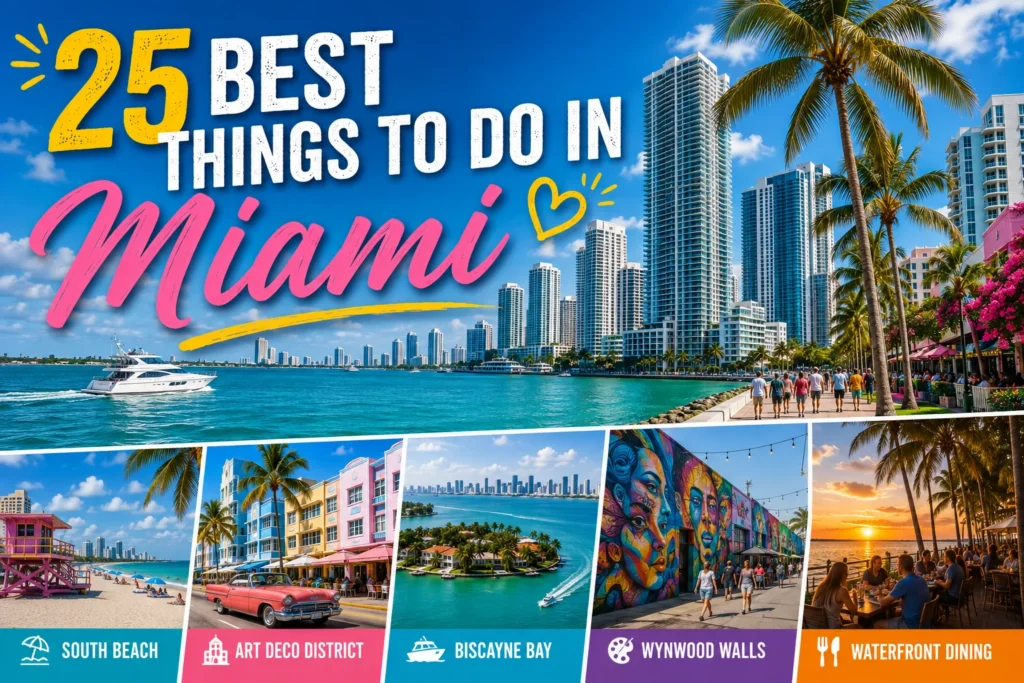
South Beach holds more than 800 Art Deco buildings from the 1930s and 40s, painted in the pastel pinks, turquoises, and mint greens that have become Miami’s signature visual identity, concentrated along Ocean Drive and the surrounding streets in the largest collection of this architectural style anywhere in the world. The beach itself runs for miles behind it, completely free and open to the public.
South Beach’s 800-plus Art Deco buildings, in their signature pastel palette, form the largest collection of this architectural style anywhere on earth. It is the single essential Miami experience, and it costs nothing.
Practical tips:
- Walk Ocean Drive in the morning specifically for photography; the light is softer and the buildings’ colors read more accurately than under the harsh midday sun.
- A short guided architecture walking tour (widely available, roughly 90 minutes) adds real context on the specific buildings and design history that a self-guided walk will miss.
- What I tell first-timers: skip the souvenir shops and the aggressive restaurant hosts calling out on Ocean Drive itself; walk a block inland for the same neighborhood at fairer prices.
2. Wynwood Walls & Arts District
Area: Wynwood | Entry: Walls interior courtyard ~$10-15; surrounding neighborhood streets free | Duration: 2 to 3 hours | Best time: Late morning; the free surrounding streets work anytime
Wynwood Walls, founded in 2009 by developer Tony Goldman, is an outdoor museum of more than 35 commissioned murals by internationally known street artists including Shepard Fairey, Kenny Scharf, and Os Gemeos, now requiring a paid ticket to enter its curated inner courtyard. The genuinely good news for budget travelers: the surrounding blocks of NW 2nd Avenue and the streets around it hold dozens more murals, constantly refreshed, completely free to walk and photograph.
Wynwood Walls’ curated inner courtyard now requires a paid ticket, but the surrounding streets hold dozens of equally impressive, constantly refreshed murals for free. It is one of the best street art districts in the country, at any budget.
Practical tips:
- Skip the paid Walls ticket if budget is a concern; the free surrounding blocks (NW 2nd Avenue, 23rd Street, 25th Street) deliver comparable quality without the entrance fee.
- Give yourself at least two hours; the murals reward slow walking and photography rather than a rushed pass-through.
- The neighborhood also holds a strong brewery and food hall scene, making it easy to turn a morning of art into a full afternoon.
3. Little Havana & Calle Ocho
Area: Little Havana | Entry: Free to walk | Duration: 2 to 3 hours | Best time: Afternoon; Friday evenings for Viernes Culturales
Little Havana is Miami’s Cuban cultural heart, centered on Calle Ocho (8th Street), where Cuban immigrants settled beginning in 1960, and where Café Versailles still serves its famous colada (Cuban coffee shots) to a mixed crowd of longtime residents and visitors. Maximo Gomez Park, better known as Domino Park, is where elderly locals play dominoes daily in a scene that has become genuinely iconic.
Little Havana’s Calle Ocho, anchored by Café Versailles and Domino Park, preserves the most authentic Cuban cultural experience in the United States. It is the essential cultural neighborhood in Miami, and walking it costs nothing.
Practical tips:
- Get a colada (a shot of strong, sweet Cuban coffee, meant to be shared among a small group) from Café Versailles’s walk-up window rather than sitting for a full meal if time is short.
- Domino Park is free to watch from the sidewalk; the players are serious and the games are genuinely competitive, not a staged tourist show.
- If your dates land on the second Sunday of March, the Calle Ocho Festival draws roughly a million people for the largest Hispanic street festival in the country; plan for serious crowds if attending, or avoid the neighborhood that specific day if crowds are not your thing.
4. Vizcaya Museum and Gardens
Area: Coconut Grove | Entry: ~$22-25 adults | Duration: 2 to 3 hours | Best time: Early morning, before the heat and crowds build
Vizcaya is an Italian Renaissance-style villa built in 1916 as the winter retreat of businessman James Deering, its 34 rooms filled with original European art and furniture, surrounded by formal gardens overlooking Biscayne Bay that took a small army of craftsmen years to complete. It is the most architecturally significant historic estate in South Florida.
Vizcaya, a 1916 Italian Renaissance villa with 34 original rooms and formal gardens on Biscayne Bay, is the most architecturally significant historic estate in South Florida. It is the best single history and design experience in the city.
Practical tips:
- Arrive early morning specifically; the outdoor formal gardens have limited shade and become genuinely uncomfortable in Miami’s midday heat and humidity.
- It is a popular wedding venue, so check the estate’s calendar before visiting, since some garden areas may have limited access around scheduled events.
- Budget real time for both the interior rooms and the gardens; rushing either half undersells what makes this estate worth the ticket price.
5. Everglades National Park Airboat Tour
Area: About 45 minutes southwest of Miami | Entry: Park entry ~$35 per vehicle; airboat tours ~$25-75 per person separately | Duration: Half day | Best time: Morning; dry season (November through April) for the most concentrated wildlife
Everglades National Park, a UNESCO World Heritage Site covering roughly 6,500 square kilometres, is America’s only subtropical wilderness of this scale, and an airboat tour through the sawgrass marsh gives close encounters with alligators, wading birds, and the specific “River of Grass” ecosystem found nowhere else in the country. Coopertown Airboats, operating since 1945, is the most historically established operator.
Everglades National Park, a UNESCO site covering 6,500 square kilometres, is America’s only subtropical wilderness of its kind, and an airboat tour is the most accessible way to see its alligators and sawgrass marsh up close. It is the best nature day trip from Miami.
Practical tips:
- Dry season (November through April) concentrates wildlife around smaller water pools, making alligator sightings significantly more reliable than during the wetter summer months.
- Book directly with an established operator like Coopertown Airboats rather than a resold tour package for better pricing and more direct scheduling control.
- Combine the airboat tour with one of the park’s short walking boardwalk trails (Anhinga Trail is the most popular) for wildlife viewing on foot as well as by boat.
6. Pérez Art Museum Miami (PAMM)
Area: Museum Park, Downtown | Entry: ~$16 adults; free on the first Thursday evening of each month | Duration: 2 hours | Best time: First Thursday evening for free admission
PAMM is one of the best contemporary art museums in the United States, housed in a striking waterfront building designed by Herzog & de Meuron, with hanging gardens on its exterior terraces and a collection focused specifically on international and Latin American contemporary art that reflects Miami’s own cultural position.
PAMM, housed in a striking Herzog & de Meuron waterfront building with hanging exterior gardens, is one of the best contemporary art museums in the US, with a specific strength in Latin American art. It is the best paid museum experience in Miami.
Practical tips:
- Visit on the first Thursday evening of the month for free admission, one of the best-value cultural events in the city.
- The building’s waterfront terraces and hanging gardens are worth appreciating on their own, independent of the exhibitions inside.
- It sits in Museum Park alongside Frost Science (entry 17), making the two an easy combined cultural afternoon.
7. Miami Beach Boardwalk
Area: Miami Beach, running roughly from South Beach to Surfside | Entry: Free | Duration: 1 to 2 hours | Best time: Early morning
The Miami Beach Boardwalk is a shaded, elevated wooden walkway running several miles along the dunes behind the beach, giving joggers, walkers, and cyclists a car-free route with ocean views the entire way, distinct from the more crowded sidewalk scene directly on Ocean Drive.
The Miami Beach Boardwalk offers a shaded, car-free walking and jogging route along the dunes for several miles, distinct from Ocean Drive’s crowded sidewalks. It is the best free way to experience the beach at a slower pace.
Practical tips:
- Early morning gives the coolest temperatures and the calmest version of the boardwalk before the day’s heat and crowds build.
- It runs well north of the South Beach party strip, giving a genuinely different, quieter Miami Beach experience.
- Good for a sunrise walk if you are staying anywhere along Collins Avenue, since most beachfront hotels have direct boardwalk access.
8. Lincoln Road
Area: South Beach | Entry: Free to walk | Duration: 1.5 to 2 hours | Best time: Evening
Lincoln Road is South Beach’s pedestrian-only mall, a wide, tree-lined promenade of restaurants, shops, and outdoor cafes running between Collins Avenue and Alton Road, with restaurant prices generally running 20 to 30 percent cheaper than the tourist-facing spots on Ocean Drive without sacrificing quality.
Lincoln Road’s pedestrian promenade offers the same quality dining as Ocean Drive at 20 to 30 percent lower prices, without the aggressive restaurant touts. It is the best evening walking and dining street in South Beach.
Practical tips:
- Choose Lincoln Road over Ocean Drive specifically for dinner; the price difference is real and the food quality is generally comparable or better.
- It is genuinely excellent for people-watching, with a mix of locals and visitors rather than Ocean Drive’s more purely tourist-facing crowd.
- The Bass Museum of Art (entry 9) sits directly on this street, making it easy to combine an evening walk with a museum stop.
9. The Bass Museum of Art
Area: South Beach, on Collins Park | Entry: ~$15 adults; free on the first Wednesday evening of each month | Duration: 1 to 1.5 hours | Best time: First Wednesday evening for free admission
The Bass Museum of Art occupies a striking Art Deco building on Collins Park, holding a world-class contemporary art collection with rotating exhibitions that punch well above what its compact size suggests, making it South Beach’s best paid museum stop for visitors who assume the neighborhood is purely about beach and nightlife.
The Bass Museum, housed in a striking Art Deco building on Collins Park, holds a world-class contemporary collection despite its compact size. It is the best paid cultural stop directly within South Beach.
Practical tips:
- Free admission on the first Wednesday evening of the month, 5 to 9 PM, is one of the best-value cultural evenings in South Beach.
- The building’s Art Deco architecture is itself worth appreciating alongside the contemporary art inside.
- It sits close to Lincoln Road (entry 8), making the two an easy combined South Beach cultural evening.
10. Holocaust Memorial Miami Beach
Area: South Beach | Entry: Free; donations welcomed | Duration: 30 to 45 minutes | Best time: Anytime
The Holocaust Memorial Miami Beach sits just two blocks from the beach, its centerpiece a monumental bronze sculpture of an outstretched arm bearing a concentration camp tattoo, surrounded by a sculpture garden and wall of names. It is a genuinely powerful, unexpected stop for a neighborhood most visitors associate purely with beach leisure.
The Holocaust Memorial Miami Beach, just two blocks from the beach, features a monumental bronze sculpture and wall of names in a genuinely powerful, free memorial space. It is the most emotionally significant stop in South Beach, and it costs nothing.
Practical tips:
- It is free, though donations are welcomed and support the memorial’s ongoing maintenance and educational programming.
- The proximity to the beach makes this an easy addition to a South Beach day without significant detour.
- Approach it with the quiet respect the site deserves; it is a genuine memorial, not simply another photo stop.
11. Biscayne Bay Boat Tour (Millionaire’s Row)
Area: Departing from Downtown or Bayside | Entry: ~$18-30 per person | Duration: 1.5 hours | Best time: Late afternoon
A Biscayne Bay boat tour, commonly branded around “Millionaire’s Row,” cruises past the waterfront mansions of Star Island and the surrounding bay, with narrated commentary on the celebrities and business figures who have owned specific properties, giving a genuinely legitimate, low-cost version of the Miami wealth-and-glamour experience from the water.
A Biscayne Bay boat tour past Millionaire’s Row shows the waterfront mansions of Star Island with narrated celebrity ownership history. It is the most affordable way to experience Miami’s waterfront glamour from a boat.
Practical tips:
- Late afternoon gives good light for photographs of the waterfront estates and the Miami skyline in the same frame.
- Tours typically depart from Downtown or the Bayside Marketplace area, making this easy to combine with entry 12 on the same outing.
- At roughly $18-30 per person, this is one of the better value-for-experience paid activities in the entire city.
12. Bayside Marketplace & Bayfront Park
Area: Downtown | Entry: Free to enter | Duration: 1.5 to 2 hours | Best time: Evening
Bayside Marketplace is an open-air waterfront shopping and dining complex with free entry, live music, and views across the bay to PortMiami’s cruise ships, sitting directly alongside Bayfront Park, which hosts free concerts, community yoga, and cultural events throughout the year on its waterfront lawns.
Bayside Marketplace’s free waterfront shopping and dining sits directly beside Bayfront Park’s calendar of free concerts and cultural events. It is the best combined free evening entertainment stop in Downtown Miami.
Practical tips:
- Check the Bayfront Park events calendar before your visit; free concerts and cultural programming run regularly throughout the year.
- The waterfront views toward PortMiami’s docked cruise ships are a genuinely striking sight, particularly in the evening.
- One honest tip: unless a specific free event draws you here, this is a place to pass through rather than plan a dedicated half day around, since the shopping itself is fairly standard mall retail.
13. Metromover (Free Downtown Loop)
Area: Downtown / Brickell | Entry: Free | Duration: 30 to 45 minutes | Best time: Anytime
The Metromover is Miami’s free, automated elevated train looping through Downtown, Brickell, and Museum Park, giving an elevated, low-cost way to see the skyline and waterfront without paying for a guided tour or renting a car for a short urban circuit.
The Metromover, Miami’s free automated elevated train, loops through Downtown, Brickell, and Museum Park at no cost. It is the best free sightseeing tool in the entire city, and most visitors never know it exists.
Practical tips:
- It requires no ticket or fare at all, making it one of the most genuinely surprising free experiences in any major American city.
- Ride a full loop for the elevated skyline and Biscayne Bay views before getting off for a specific stop like Museum Park or Brickell.
- What I tell budget-conscious visitors specifically: use this instead of a paid hop-on-hop-off bus tour for covering the same general Downtown and Brickell ground.
14. Design District
Area: Midtown | Entry: Free to walk | Duration: 1.5 to 2 hours | Best time: Afternoon
The Design District is Miami’s luxury shopping and design showcase, with more than 130 high-end stores alongside significant public art installations and architecturally striking flagship stores designed by internationally known architects, making it worth a walk even without a shopping budget.
The Design District’s 130-plus luxury stores are matched by significant public art and architecturally striking flagship buildings designed by internationally known architects. It is the best browsing and architecture walk for design-minded visitors, regardless of shopping budget.
Practical tips:
- The public art installations scattered throughout the district are worth seeking out even if luxury shopping is not your interest.
- Several flagship stores were designed by significant architects specifically as showpieces; look up before assuming this is a standard shopping strip.
- It sits close to Wynwood (entry 2), making the two districts an easy combined afternoon covering both street art and high design.
15. Coral Gables (Biltmore Hotel & Venetian Pool)
Area: Coral Gables | Entry: Venetian Pool ~$25; Biltmore Hotel grounds free | Duration: 2 to 3 hours | Best time: Morning
Coral Gables is one of Miami’s most architecturally planned neighborhoods, its centerpiece the 1926 Biltmore Hotel, a National Historic Landmark with a grand Mediterranean Revival design, and the nearby Venetian Pool, a genuinely unique public swimming pool carved from a former coral rock quarry and fed by natural spring water.
Coral Gables’ 1926 Biltmore Hotel and the nearby Venetian Pool, a swimming hole carved from a former coral rock quarry, together give the most architecturally distinctive neighborhood experience in Miami. It is worth a full morning for history and architecture lovers.
Practical tips:
- The Biltmore Hotel’s grounds and public areas are free to walk through even if you are not a guest; the lobby and exterior architecture are worth seeing regardless.
- The Venetian Pool has a modest admission fee and is a genuinely unusual, historically significant public swimming spot rather than a standard pool.
- Coral Gables’ broader street grid, with its distinctive plazas and fountains, rewards a slow drive or walk beyond just these two specific landmarks.
16. Coconut Grove
Area: Coconut Grove | Entry: Free to walk | Duration: 1.5 to 2 hours | Best time: Evening
Coconut Grove is Miami’s oldest continuously inhabited neighborhood, with a bohemian, tree-canopied character distinct from the glossier Brickell and South Beach districts, holding a strong independent restaurant scene and direct access to Vizcaya (entry 4) at its edge.
Coconut Grove, Miami’s oldest continuously inhabited neighborhood, offers a bohemian, tree-canopied atmosphere with strong independent dining, distinct from the city’s glossier districts. It is the best quiet evening neighborhood in Miami.
Practical tips:
- It pairs naturally with a Vizcaya visit, since the estate sits at the neighborhood’s edge.
- The tree canopy here provides genuine shade, making it a more comfortable walking neighborhood in Miami’s heat than more exposed areas.
- Good for an evening that prioritizes a relaxed, less club-focused dining and walking experience than South Beach.
17. Frost Science Museum
Area: Museum Park, Downtown | Entry: ~$30 adults | Duration: 2.5 to 3 hours | Best time: Weekday mornings
The Frost Museum of Science combines a planetarium, an aquarium wing focused on the Gulf Stream ecosystem, and hands-on interactive science exhibits in a striking modern building on Biscayne Bay, making it the best full-day family science attraction in Miami, particularly worthwhile if traveling with children.
The Frost Science Museum combines a planetarium, a Gulf Stream aquarium, and hands-on exhibits in a striking Biscayne Bay building. It is the best family science attraction in Miami, especially valuable with kids.
Practical tips:
- It is genuinely most worth the ~$30 admission specifically for families with children; solo travelers or couples without kids may find better value elsewhere on this list.
- Weekday mornings avoid the heaviest school-group and weekend family crowds.
- It sits directly alongside PAMM (entry 6) in Museum Park, making the two an easy combined cultural day.
18. Zoo Miami
Area: South Miami-Dade | Entry: ~$25 adults | Duration: 3 to 4 hours | Best time: Morning; weekdays
Zoo Miami is one of the largest zoos in the United States by land area, with naturalistic, cageless habitats across its tropical setting, and has become one of the two genuine alternatives for wildlife-focused family visitors now that the Miami Seaquarium has permanently closed.
Zoo Miami, one of the largest US zoos by land area, offers naturalistic habitats across a sprawling tropical campus. It is now one of the two best wildlife attractions in Miami following the Seaquarium’s permanent closure.
Practical tips:
- Go in the morning, especially in summer, when Miami’s heat and humidity peak significantly by early afternoon.
- The zoo’s scale is genuinely large; budget the better part of a day rather than treating it as a quick stop.
- Given the Seaquarium’s closure in October 2025, this is now the primary large-scale zoo experience for Miami visitors traveling with children.
19. Jungle Island
Area: Watson Island | Entry: ~$45 adults | Duration: 2.5 to 3 hours | Best time: Morning
Jungle Island is an interactive wildlife park on Watson Island between Downtown and South Beach, with exotic bird shows, a petting zoo area, and up-close animal encounters, giving a more compact, more interactive alternative to Zoo Miami’s larger scale, and now, alongside Zoo Miami, one of the two main animal-focused attractions remaining in the city.
Jungle Island offers interactive exotic animal encounters and bird shows on Watson Island between Downtown and South Beach. It is the more compact, interactive alternative to Zoo Miami, especially convenient for visitors based near the beach.
Practical tips:
- Its location between Downtown and South Beach makes it significantly more convenient than Zoo Miami for visitors not renting a car.
- The interactive animal encounters here are more hands-on than Zoo Miami’s larger naturalistic habitats; choose based on which format your family prefers.
- Morning visits give the most active animal viewing and the coolest walking temperatures.
20. Key Biscayne & Bill Baggs Cape Florida State Park
Area: Key Biscayne | Entry: Park entry ~$8 per vehicle | Duration: Half day | Best time: Morning
Key Biscayne is a barrier island south of Miami Beach, connected by the scenic Rickenbacker Causeway, with Bill Baggs Cape Florida State Park at its southern tip holding a historic 1825 lighthouse, one of the oldest structures in South Florida, alongside a genuinely excellent, less crowded beach than the main Miami Beach strip.
Bill Baggs Cape Florida State Park, at the southern tip of Key Biscayne, holds a historic 1825 lighthouse and one of the least crowded quality beaches near Miami. It is the best beach escape for visitors wanting a break from South Beach’s density.
Practical tips:
- The drive over the Rickenbacker Causeway itself offers excellent Biscayne Bay and skyline views, worth the trip independent of the destination.
- The 1825 lighthouse is one of the oldest surviving structures in South Florida and can be climbed on a guided tour schedule; check current availability.
- Morning visits give the calmest beach conditions and the most comfortable walking and lighthouse-climbing temperatures.
21. Fairchild Tropical Botanic Garden
Area: Coral Gables | Entry: ~$25 adults | Duration: 1.5 to 2.5 hours | Best time: Morning
Fairchild Tropical Botanic Garden spans 83 acres in Coral Gables, holding one of the most significant tropical plant collections in the United States, including an extensive palm collection and a butterfly-filled rainforest conservatory, making it the best dedicated garden experience in the Miami area.
Fairchild Tropical Botanic Garden’s 83 acres hold one of the most significant tropical plant collections in the US, including an extensive palm collection and butterfly conservatory. It is the best garden experience in Miami.
Practical tips:
- Morning visits give the most comfortable walking temperatures before Miami’s midday heat and humidity peak.
- The butterfly-filled rainforest conservatory is a specific highlight worth prioritizing if time is limited.
- Combine with the Biltmore Hotel and Venetian Pool (entry 15), both in the same general Coral Gables area.
22. South Pointe Park
Area: South Beach, at the southern tip | Entry: Free | Duration: 1 to 1.5 hours | Best time: Sunset
South Pointe Park sits at the very southern tip of Miami Beach, where Biscayne Bay meets the open Atlantic, with a scenic pier giving close-up views of cruise ships departing PortMiami and one of the best free sunset viewpoints in the entire South Beach area.
South Pointe Park’s pier at the southern tip of Miami Beach offers close-up cruise ship views and one of the best free sunset spots in South Beach. It is the most scenic quiet corner of an otherwise busy neighborhood.
Practical tips:
- Time a visit to catch a cruise ship departure from PortMiami; the pier gives a genuinely close vantage point as the ships head out to sea.
- It is significantly quieter than the main Ocean Drive strip just a short walk north, making it a good escape from the busier tourist density.
- Sunset here, with both the bay and open ocean visible, is one of the most underrated free experiences in South Beach.
23. Freedom Tower
Area: Downtown | Entry: Free; check current limited public opening hours | Duration: 30 to 45 minutes | Best time: Check current opening hours before visiting
The Freedom Tower, a 1925 Mediterranean Revival building modeled on Seville’s Giralda tower, served as the processing center for Cuban refugees arriving in Miami during the 1960s and 70s, earning it the nickname “Ellis Island of the South” and making it one of the most historically significant buildings in the city’s Cuban-American story.
The Freedom Tower, a 1925 building modeled on Seville’s Giralda, processed Cuban refugees through the 1960s and 70s, earning it the nickname “Ellis Island of the South.” It is the most historically significant single building in Miami’s Cuban-American history.
Practical tips:
- Public opening hours are limited and vary; check the current schedule before planning a visit specifically around this building’s interior.
- The exterior architecture is worth appreciating even if interior access is not available on your specific dates.
- It connects meaningfully to a Little Havana visit (entry 3), giving fuller context on Miami’s Cuban immigration history across both sites.
24. Key West Day Trip
Area: About 3.5 hours by car from Miami | Entry: Varies by specific activity | Duration: Full day | Best time: Very early start
Key West, at the southern end of the Florida Keys, is a genuinely long but rewarding day trip from Miami, crossing the Overseas Highway’s dramatic bridges over open water to reach Ernest Hemingway’s former home, Duval Street’s bar scene, and the southernmost point marker in the continental United States.
Key West, reached via the dramatic Overseas Highway bridges, offers Hemingway’s home, Duval Street, and the southernmost point in the continental US. It is the most ambitious but genuinely rewarding day trip from Miami.
Practical tips:
- This is a genuinely long day, roughly 7 hours of driving round trip; start very early, ideally before sunrise, to have meaningful time in Key West itself.
- Consider whether an organized bus tour (which handles the driving) suits your group better than self-driving, given the drive’s length and the appeal of enjoying the scenery rather than focusing on the road.
- If your schedule allows, an overnight stay turns this from a rushed day trip into a genuinely relaxed Keys experience; the drive alone makes a single-day round trip demanding.
25. Coral Castle Day Trip
Area: About 45 minutes south of Miami | Entry: ~$18 adults | Duration: 1.5 hours | Best time: Afternoon
Coral Castle is one of Florida’s most genuinely strange roadside attractions: a sculpture garden of massive coral rock structures, weighing collectively over 1,100 tons, built single-handedly over decades by Latvian immigrant Edward Leedskalnin using methods that remain a subject of genuine mystery and debate to this day.
Coral Castle’s massive coral rock structures, over 1,100 tons total, were built single-handedly by one man using methods still debated today. It is the most genuinely mysterious roadside attraction near Miami.
Practical tips:
- It is a relatively quick stop, about 90 minutes, making it an easy combination with an Everglades day trip given the similar general direction south of the city.
- The mystery around how one man moved such massive stones alone is the entire draw; read up on the competing theories before or during your visit for the fullest appreciation.
- Good for visitors who enjoy genuinely odd, off-the-beaten-path Americana rather than polished mainstream attractions.
Miami Practical Guide
Getting Around Miami
South Beach, Wynwood, Little Havana, Downtown, and Brickell are each individually walkable, and the free Metromover (entry 13) covers Downtown and Brickell without any fare at all. Rideshares connect the neighborhoods efficiently, and a car becomes genuinely useful for Coral Gables, Coconut Grove, Key Biscayne, and any of the day trips (Everglades, Key West, Coral Castle), all of which sit outside easy walking or transit range.
One thing I always tell first-timers in 2026 specifically: verify the Miami Seaquarium’s status before including it in any plan, since it permanently closed in October 2025 and several outdated guides still list it as operating. Zoo Miami and Jungle Island are the two genuine wildlife-focused alternatives now available in the city.
Where to Stay in Miami
South Beach: Walkable to the Art Deco district, Lincoln Road, and the beach itself. Best for first-timers wanting to be at the center of Miami’s most iconic neighborhood.
Brickell / Downtown: Central, connected by the free Metromover, close to PAMM, Frost Science, and Bayside. Best for visitors prioritizing museums and a more business-district base with strong transit access.
Coconut Grove / Coral Gables: Quieter, more residential, close to Vizcaya and the Biltmore. Best for travelers wanting a calmer base with strong dining and architecture nearby.
Miami Budget Guide
Budget traveler (budget hotel, free public beaches, the Art Deco walk, Wynwood’s free surrounding streets, Little Havana, casual dining): roughly $100 to $150 per day. Miami’s best free experiences, its beaches and street art, do enormous work against the city’s generally premium reputation.
Mid-range traveler (comfortable hotel, one or two guided tours, a couple of museums, decent restaurant dining): roughly $200 to $300 per day.
Higher-spend traveler (upscale hotel, Vizcaya and a full museum day, a Biscayne Bay boat tour, fine dining, a Key West day trip): $400 or more per day, driven by premium dining and guided experiences.
Frequently Asked Questions About Miami
Is the Miami Seaquarium still open in 2026? No. The Miami Seaquarium permanently closed on October 12, 2025, after 70 years of operation. Its animals have been transferred to sanctuaries, conservation facilities, and partner aquariums across North America, and tickets are no longer available. Zoo Miami and Jungle Island are the two remaining major wildlife-focused attractions in the city.
How many days do you need in Miami? Three days covers South Beach, Wynwood, and Little Havana comfortably, with an evening in Brickell. Four to five days lets you add Vizcaya, an Everglades day trip, Key Biscayne, and deeper museum time. Beach-only visits can work in two to three days; a comprehensive trip combining beach, culture, and nature is best done in five to seven.
Is Miami expensive to visit? It runs mid-to-high by US standards, particularly for South Beach hotels and Ocean Drive dining. Many of Miami’s best experiences, its public beaches, the Art Deco walk, Wynwood’s surrounding free streets, and Little Havana, cost nothing, which meaningfully balances a tight budget.
What is Miami most famous for? South Beach’s Art Deco architecture, the Wynwood Walls street art district, Little Havana’s Cuban culture and Calle Ocho, its role as the gateway to the Florida Keys and Everglades National Park, and its distinctly Latin American cultural identity unlike anywhere else in the United States.
Do I need to book Miami attractions in advance? Book Vizcaya and Everglades airboat tours ahead in peak winter season, and check the Freedom Tower’s current limited public hours before planning around it. Free attractions like the Art Deco walk, Wynwood’s surrounding streets, and Little Havana need no advance booking.
Do I need a car in Miami? Not for South Beach, Wynwood, Little Havana, Downtown, and Brickell, all individually walkable and connected by rideshare or the free Metromover. A car is genuinely useful for Coral Gables, Coconut Grove, Key Biscayne, and any day trip beyond the immediate city.
The Final Word
If you take one thing from this guide, take this: Miami’s actual soul lives in its free experiences more than in any single paid attraction. The Art Deco district, Wynwood’s surrounding streets, Little Havana’s Calle Ocho and Domino Park, the Miami Beach Boardwalk, together they represent the city’s character better than a $50 ticket ever will. Build your trip around these first, then layer in the paid highlights that genuinely earn their price.
Where I would spend the money: Vizcaya for architecture and history, an Everglades airboat tour for the one experience Miami offers that nowhere else does, and a Biscayne Bay boat tour for a genuinely affordable dose of the city’s waterfront glamour. Where the magic is free: the Art Deco walk at sunrise, Little Havana’s domino games, Wynwood’s constantly refreshed street murals, and a sunset at South Pointe Park watching a cruise ship head out to sea. The mistake I watch visitors make, still, is planning a family day around the Miami Seaquarium. It closed permanently in October 2025. Check your sources, and head to Zoo Miami or Jungle Island instead.
Have a Miami tip I missed, or a favorite Little Havana spot, or a question about where to take the kids now that the Seaquarium is gone? Tell me in the comments. I update this guide as prices, closures, and seasons change.
For more Florida and US travel guides, visit Travel Destinations Plan.