
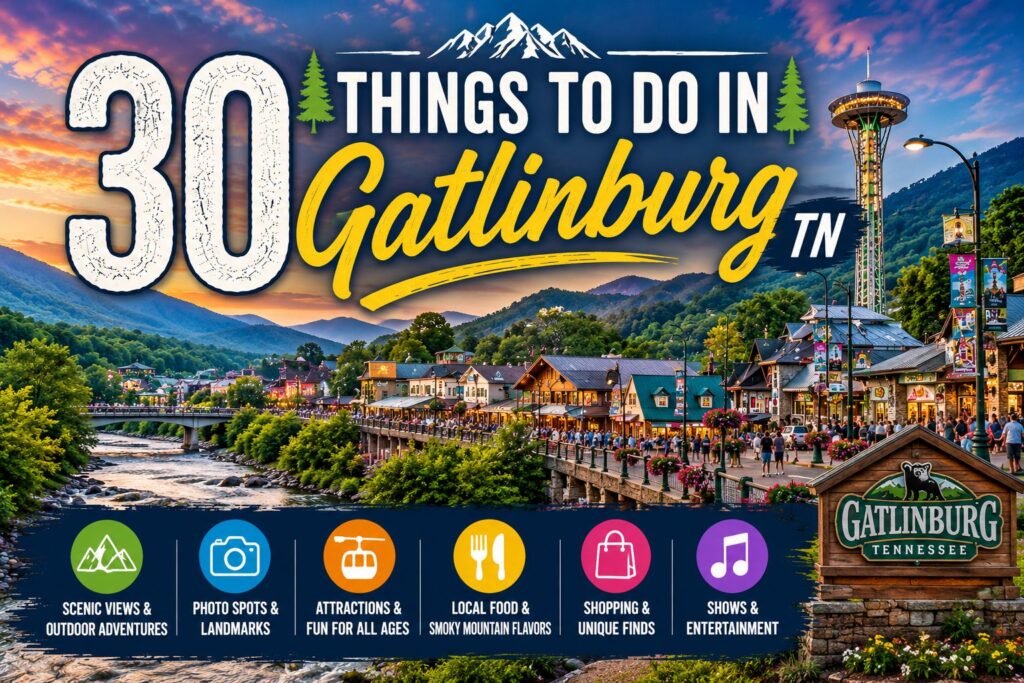
Gatlinburg, Tennessee has a permanent population of approximately 4,000 people. The Great Smoky Mountains National Park at the end of its main street receives 14 million visitors per year – more than Yellowstone, the Grand Canyon, and Zion National Park combined. You can walk from a pancake house on the Parkway to the entrance of the most visited national park in the United States without getting in a car. That single geographic fact explains everything about Gatlinburg: a small Appalachian mountain town sitting at the literal threshold of extraordinary wilderness, with all the tourist infrastructure that inevitably develops around such a position. I have been to Gatlinburg six times across eight years – in summer heat when the Parkway was shoulder-to-shoulder, in October when the Smoky Mountain fall color turned the surrounding hillsides orange and red, and in December when the Winter Magic light displays made the whole town look like a different world. The mountaintop attractions, the moonshine distilleries, and the dinner shows are all real and worth knowing. The national park 200 feet from the end of the main street is extraordinary. Both things are true simultaneously, and the best Gatlinburg visit is the one that takes both seriously.
In 2026, Gatlinburg is specifically worth visiting. Anakeesta launched the Crystal Express, the world’s only all-glass gondola system with 56 luxurious all-glass cabins delivering uninterrupted 360-degree views of the Great Smoky Mountains. Laurel Falls Trail reopens after extensive NPS improvements including a repaved asphalt trail, new viewing platforms, and 50 additional parking spaces. Riley Green’s Duck Blind Bar is opening a live music venue and restaurant on the Parkway. This is one of the strongest years the town has had for new experiences.
For more Tennessee travel travel destinations guides, read our things to do in Nashville and our things to do in Chattanooga.
Gatlinburg TN At a Glance: Quick Reference Table
| # | Activity | Area | Entry | Duration | Best For | Best Time |
|---|---|---|---|---|---|---|
| 1 | Great Smoky Mountains National Park | Park entrance at end of Parkway | Free | Half day to multiple days | All visitors, hikers | April to June; October for foliage |
| 2 | Ripley’s Aquarium of the Smokies | Downtown Gatlinburg | $29.99 adults, $19.99 ages 3-12 | 2 to 3 hours | Families, all visitors | Morning year-round; 25th anniversary 2026 |
| 3 | Anakeesta Adventure Park | Mountaintop above downtown | From $37 adults | Half day | All visitors, families | Year-round; Crystal Express gondola new 2026 |
| 4 | Dollywood Theme Park | Pigeon Forge, 10 min away | $99 to $129 adults (1-day) | Full day | Families, thrill seekers | Weekdays; NightFlight Expedition new 2026 |
| 5 | Gatlinburg SkyPark and SkyBridge | Crockett Mountain | From $42 adults | 1.5 to 2 hours | View seekers, families | Morning; clear weather year-round |
| 6 | Laurel Falls Trail | Great Smoky Mountains NP | Free | 1.5 to 2 hours | Families, casual hikers | Reopening Summer 2026 post-renovation |
| 7 | Alum Cave Trail | Great Smoky Mountains NP | Free | 3 to 4 hours | Moderate hikers | Spring and fall; weekdays |
| 8 | Clingmans Dome | Great Smoky Mountains NP | Free | 2 to 3 hours | All visitors, view seekers | May to October; clear days only |
| 9 | Cades Cove Loop Road | Great Smoky Mountains NP | Free | Half to full day | Wildlife watchers, cyclists | Early morning; fall |
| 10 | Ole Smoky Moonshine Distillery | Downtown Parkway | Free (tastings $5 to $12) | 1 to 1.5 hours | Adults, culture seekers | Afternoon year-round |
| 11 | Sugarlands Distilling Company | Downtown Gatlinburg | Free tours and tastings | 1 to 1.5 hours | Adults, spirits lovers | Afternoon year-round |
| 12 | Gatlinburg Arts and Crafts Community | 8-mile loop east of downtown | Free to browse | 2 to 3 hours | Artisan shoppers, locals | Saturday mornings year-round |
| 13 | Ober Gatlinburg Adventure Park | Mount Harrison above downtown | $20 to $35 per activity | Half day | Families, year-round adventurers | Winter for skiing; summer for coaster |
| 14 | Pittock Mansion View / Roaring Fork Motor Trail | West of downtown | Free | 1.5 to 2 hours | Scenic drivers, waterfall seekers | Spring through fall |
| 15 | Synchronous Firefly Viewing | Elkmont, Great Smoky Mountains NP | Free (parking lottery $8) | 2 hours evening | Nature lovers, families | Late May to mid-June only |
| 16 | White Water Rafting – Pigeon River | Hartford, 30 min from Gatlinburg | $45 to $60 per person | 2 to 3 hours | Active groups, thrill seekers | April to October |
| 17 | Gatlinburg Saturday Market | Frances Stevens Park | Free entry | 1 to 2 hours | Food lovers, local shoppers | Saturday mornings, May to October |
| 18 | Chimney Tops Trail | Great Smoky Mountains NP | Free | 2 to 3 hours | Moderate hikers | April to November |
| 19 | Gatlinburg Winter Magic | Downtown Parkway | Free | 1.5 to 2 hours | Families, winter visitors | November to February |
| 20 | CLIMB Works Zipline Tour | Mountaintop, north of Gatlinburg | $109 to $139 adults | 2 to 3 hours | Thrill seekers, active visitors | March to November |
| 21 | Voodoo Doughnut / Pancake Pantry | Downtown Parkway | $10 to $18 per person | 30 to 60 minutes | Breakfast lovers, first-time visitors | Morning; arrive early |
| 22 | Midnight July 4th Parade | Downtown Parkway | Free | 1 to 2 hours | Families, all visitors | July 4 at 12:01 AM only |
| 23 | Gatlinburg SkyTrail at SkyPark | Crockett Mountain | Included with SkyPark | 45 to 60 minutes | Walkers, photographers | Morning year-round |
| 24 | Horseback Riding – Smoky Mountain Stables | Great Smoky Mountains NP area | $40 to $80 per ride | 1 to 2 hours | Families, outdoor adventurers | March to November |
| 25 | Trout Fishing – LeConte Creek | Downtown and beyond | License $8/day; guide optional | 2 to 4 hours | Anglers, outdoor enthusiasts | April to October |
| 26 | Escape Rooms Gatlinburg | Downtown | $25 to $35 per person | 1 hour | Groups, rainy day visitors | Year-round |
| 27 | Dollywood NightFlight Expedition | Pigeon Forge | Included with Dollywood admission | 10 to 15 min ride | Thrill seekers, Dollywood visitors | Open spring 2026 |
| 28 | Riley Green’s Duck Blind Bar | Downtown Parkway | Varies by event | 1.5 to 2 hours | Music lovers, adults | Evenings year-round; opening 2026 |
| 29 | Willamette Valley equivalent – Gatlinburg Day Spa | Various downtown locations | $60 to $200 per treatment | 1 to 3 hours | Couples, relaxation seekers | Year-round |
| 30 | Pigeon Forge Day Trip – Titanic Museum and The Island | Pigeon Forge, 10 min away | Titanic $28 adults; Island free entry | Half to full day | Families, history buffs | Year-round |
1. Great Smoky Mountains National Park
Area: Park entrance at the end of the Parkway, Gatlinburg | Entry: Free – no entrance fee | Duration: Half day to multiple days | Best time: April to early June for wildflowers; September for the best weather-to-crowd balance; October for fall foliage
Great Smoky Mountains National Park is the most visited national park in the United States, receiving approximately 14 million visitors per year – a number that exceeds Yellowstone, the Grand Canyon, and Zion combined. It is also one of only a handful of national parks with no entrance fee, a condition written into the original land donation agreements in the 1930s that remains in place today. The park covers 522,427 acres across Tennessee and North Carolina, with elevations ranging from 900 feet in the river valleys to 6,643 feet at Clingmans Dome, the highest point in the Appalachian Mountains east of the Mississippi River. The biodiversity within the park is extraordinary – more tree species than in all of northern Europe, more than 1,500 flowering plant varieties, 65 mammal species including approximately 1,500 black bears, and 240 bird species. The Cherokee people called this land Shaconage, meaning “land of blue smoke,” referring to the natural mist that rises from the dense vegetation and that gives the mountains their distinctive hazy appearance.
What makes the Smokies specifically different from any other national park accessible from a major tourist corridor is the fact that the wilderness begins where the town ends. The Sugarlands Visitor Center is less than 2 miles from the Gatlinburg Parkway, and the first major trail system begins within 5 minutes of parking. This proximity is what drives 14 million visits per year, but it also means that the park absorbs enormous visitor pressure at its most accessible points. The key to a genuinely rewarding Smokies experience is understanding which experiences are worth sharing with the crowd and which require an early start or a weekday visit to get alone. The Great Smoky Mountains National Park is the reason Gatlinburg exists and the reason to visit – not as a backdrop to the town’s attractions, but as the primary destination, with the town’s infrastructure serving as a comfortable base from which to access one of the most biologically diverse temperate forests on earth.
Practical tips:
- Download the National Park Service Smokies app before you arrive and use it to check real-time parking lot capacity at the major trailheads – the app shows when Laurel Falls, Alum Cave, and Cades Cove parking areas are full, saving you the experience of driving to a trailhead and finding no space.
- The park’s wildlife is most active at dawn and dusk – arriving at the Cades Cove entrance or the Roaring Fork Motor Nature Trail parking area before 7 AM gives you the best probability of seeing black bears, white-tailed deer, and wild turkeys in the open meadows before the midday crowds push the animals back into the tree line.
- Carry at minimum 1 liter of water per person per hour of planned hiking regardless of temperature – the humidity in the Smokies causes dehydration faster than the relatively moderate temperatures suggest, and the nearest water source on most trails requires purification before drinking.
2. Ripley’s Aquarium of the Smokies
Area: Downtown Gatlinburg, 88 River Road | Entry: $29.99 adults, $19.99 ages 3-12, free under 3 | Duration: 2 to 3 hours | Best time: Morning at 9 AM opening; weekdays for lowest crowds; celebrating 25th anniversary in 2026
Ripley’s Aquarium of the Smokies is the most visited paid attraction in Gatlinburg and has been for most of the 25 years since it opened in 2000. The aquarium holds more than 10,000 sea creatures representing 350 species in 1.4 million gallons of water, with its signature experience being the 340-foot Shark Lagoon moving walkway – a conveyor belt that carries visitors through an acrylic tunnel surrounded by sand tiger sharks, a 285-pound loggerhead sea turtle named Sally, sawfish, and green moray eels. The tunnel places you directly beneath these animals, looking up through the acrylic ceiling at creatures moving overhead, which is a visual experience that photographs record but do not transmit. In 2026, the aquarium is celebrating its 25th anniversary with the Dragons exhibit – Ripley’s newest claim to fame brings real-life dragons to Gatlinburg, including the Kimberly Rock Monitor, Gila Monster, Green Crested Basilisk, Green Tree Python, and Siren, included in general admission. This is the most substantive new exhibit addition at Ripley’s in several years.
Beyond the shark tunnel and the anniversary Dragon exhibit, the aquarium has penguin colonies, stingray touch tanks where children can gently interact with the animals under staff supervision, a jellyfish gallery, and the Discovery Center with hands-on marine science activities. The penguin parade – where the colony walks a red-carpet route through the aquarium floor at 1:15 PM daily – is the most photographed single event at the attraction and requires arriving 15 minutes early to secure a position along the route. Ripley’s has been voted Best U.S. Aquarium by USA Today 10Best and named one of the Top 5 Aquariums in the World by TripAdvisor, assessments that surprise visitors who expect a mountain-town aquarium to be a lesser version of a coastal city institution.
The Ripley’s Aquarium 340-foot Shark Lagoon moving walkway, where sand tiger sharks circle overhead and a loggerhead sea turtle the weight of a grown man cruises past at eye level, is the most immediately dramatic single experience in downtown Gatlinburg for visitors of any age – the underwater tunnel creates a spatial relationship with large marine predators that no photograph adequately captures.
Practical tips:
- Purchase tickets online at ripleys.com/gatlinburg in advance to save approximately $3 per person versus gate pricing and to eliminate the possibility of sold-out entry on peak days including summer weekends, spring break, and fall foliage weekends when the aquarium reaches capacity.
- The Glass Bottom Boat Adventure ($8 to $12 additional, separate from general admission) allows visitors to ride a glass-floored boat above the Shark Lagoon and view the same sharks from overhead rather than below – a completely different visual perspective from the tunnel and worth the additional cost for anyone who wants both angles on the same visit.
- Arrive at 9 AM on the aquarium’s opening time to have the shark tunnel to yourself for the first 20 to 30 minutes before the main visitor wave arrives – the moving walkway in an empty tunnel is a significantly different experience from the same tunnel with 40 other people on the conveyor beside you.
3. Anakeesta Adventure Park
Area: Mountaintop above downtown Gatlinburg | Entry: From $37 adults, $28 children (varies by season and package) | Duration: Half day | Best time: Year-round; Crystal Express gondola and expanded Treetop Skywalk new in 2026
Anakeesta is a mountaintop outdoor adventure and nature park above downtown Gatlinburg, accessed from the Parkway by gondola, with the Treetop Skywalk, a mountain coaster, zipline, wildlife habitat, ice skating, and panoramic views of the Smoky Mountains and the town below. In 2026, Anakeesta launched the most significant expansion in its history – a $100 million multi-year project whose first phase has already transformed the park. The Crystal Express is the only all-glass gondola system in the world, featuring 56 luxurious all-glass cabins delivering uninterrupted 360-degree views of the Great Smoky Mountains and the Gatlinburg skyline. The four-minute ascent in a glass cabin gives you a bird’s-eye view of the town below and the mountain ridgelines extending in every direction that the old tram system did not approach. The expanded Treetop Skywalk features additional bridges, towers, and pathways high in the forest canopy, offering visitors more expansive views. The reimagined Firefly Village, with new water features and a gathering overlook, and a new nighttime Firefly Experience round out the 2026 additions.
The nighttime Firefly Experience is worth understanding separately from the Great Smoky Mountains NPS synchronous firefly event (covered at activity 15). Anakeesta’s version is a designed experience available throughout the spring season without requiring the NPS parking lottery, making it accessible to visitors who are in Gatlinburg outside the narrow late-May to mid-June window when the wild fireflies are active. The park’s mountain coaster descends 3,400 feet of mountain track in a self-controlled two-person cart, and the combination of the gondola ride up and the coaster down creates a complete mountaintop circuit that works for the full age range from young children through adults.
Anakeesta in 2026 is meaningfully better than any previous version of the park – the Crystal Express gondola ride in an all-glass cabin with 360-degree Smoky Mountain views is an experience in its own right rather than merely a method of reaching the summit, and the expanded Treetop Skywalk now covers enough ground that it is genuinely immersive forest canopy walking rather than a brief crossing.
Practical tips:
- Purchase Anakeesta tickets online at anakeesta.com in advance to save $4 to $6 per person versus gate pricing and to guarantee entry during peak periods including summer weekends and fall foliage season (October) when the park manages daily capacity.
- The Anakeesta nighttime Firefly Experience, available throughout spring and summer, is the practical alternative for visitors who cannot secure NPS parking lottery spots for the actual synchronous firefly viewing at Elkmont – check the Anakeesta event calendar before your visit for specific nighttime experience dates and times.
- Allow at least 3.5 to 4 hours for a full Anakeesta visit that includes the Crystal Express gondola, the Treetop Skywalk, and a meal at the TreeHouse Village restaurant with mountain views – visitors who allocate only 2 hours consistently feel they did not finish the experience.
4. Dollywood Theme Park
Area: Pigeon Forge, 10 miles from Gatlinburg | Entry: $99 to $129 adults (1-day, varies by date tier) | Duration: Full day | Best time: Weekdays; spring and fall for smaller crowds; NightFlight Expedition new spring 2026
Dollywood is a 160-acre theme park in Pigeon Forge named for and co-owned by Dolly Parton, who was born in nearby Sevierville and has been the park’s creative ambassador since it opened in 1986. The park has been named the Best Theme Park in the United States by the Golden Ticket Awards multiple times and ranks among the most reviewed and most positively reviewed theme parks in the world – an assessment that consistently surprises visitors who arrive expecting a country-music novelty attraction and find instead a meticulously maintained, authentically Appalachian-themed park with world-class roller coasters, genuine craft demonstrations by working artisans, and food that outperforms anything at the larger Disney and Universal parks. The Grist Mill cinnamon bread is a specific institution that regulars plan their park days around. In 2026, Dollywood opened its newest ride, a one-of-a-kind hybrid of whitewater rafting ride and roller coaster called NightFlight Expedition in the Wildwood Grove area – the most significant new addition to the park in several years and the specific reason returning visitors have a compelling new reason to come back.
Dollywood earns its reputation not primarily through its rides but through the totality of its identity – the park is genuinely about something specific, namely the Appalachian culture, the Smoky Mountains landscape, and the biography of one of America’s most interesting cultural figures, rather than being a generic theme park landscape with a celebrity name attached. The DreamMore Resort adjacent to the park allows guests to enter Dollywood an hour before the general public, which is the single most valuable logistics upgrade available for a Dollywood visit – a one-hour head start on Lightning Rod, Wild Eagle, and the Tennessee Tornado covers three major coasters before the queues build.
Dollywood earns its reputation as one of the best theme parks in America not primarily through its rides but through the cumulative experience of being inside a park that is genuinely and specifically about something – the Appalachian culture, the Smoky Mountains, and the story of one of Tennessee’s most remarkable figures – rather than a generic theme park with a famous name attached to it.
Practical tips:
- Dollywood ticket prices are date-tiered – the lowest-price days are Tuesday through Thursday in early spring (March) and late fall (November), while summer Saturdays and holiday periods reach the highest tier; the Dollywood website shows the exact price for each specific calendar date before purchase, and choosing a cheaper date can save $25 to $35 per person.
- The TimeSaver Pass ($40 to $60 per person per day depending on season) provides single-use skip-the-line access for each major ride – on busy summer Saturdays when Lightning Rod and Wild Eagle have 60 to 90-minute queues, the TimeSaver converts an overwhelming single-ride day into a complete park circuit.
- The Dollywood Harvest Festival in September and October and the Smoky Mountain Christmas from November through January are the two special seasonal events that consistently produce visitor satisfaction above the standard park experience – the Christmas event specifically has transformed November and December in the Gatlinburg area into a genuine seasonal tourism draw.
5. Gatlinburg SkyPark and SkyBridge
Area: Crockett Mountain above downtown | Entry: From $42 adults (includes SkyLift, SkyBridge, SkyDeck, and SkyTrail) | Duration: 1.5 to 2 hours | Best time: Morning for clearest mountain views; clear weather year-round
The Gatlinburg SkyPark encompasses four connected experiences on the summit of Crockett Mountain above downtown: the SkyLift chairlift ascending from the Parkway, the SkyBridge spanning the gap between two ridgelines, the SkyDeck observation platform, and the SkyTrail woodland path. The SkyBridge, opened in 2019, is North America’s longest pedestrian suspension bridge at 680 feet with a glass-floored center section that reveals the valley 140 feet below through the bridge decking. The experience of crossing a 680-foot suspension bridge at 140 feet elevation with a glass floor section visible to the valley below and the Great Smoky Mountains ridgeline visible in three directions is the most specifically dramatic single paid experience in downtown Gatlinburg – it appears on more Gatlinburg social media posts than any other attraction in the city and consistently draws visitors who came to Gatlinburg for the national park and end up spending two hours on the mountain above the Parkway.
The chairlift ascent from the Parkway is a single-seat lift that operates one rider at a time per chair, which means the queue during summer and fall peak periods can reach 45 to 90 minutes on busy afternoons. Purchasing timed-entry tickets through the SkyPark website eliminates this queue entirely for a $2 to $3 premium over walk-up pricing – one of the most efficient logistics improvements available for any Gatlinburg attraction. The SkyDeck at the summit, with the unobstructed 360-degree view that includes downtown Gatlinburg directly below, the national park ridgelines extending south and east, and the Pigeon Forge commercial corridor visible to the north, is in many ways the better viewpoint than the SkyBridge itself.
The SkyBridge crossing – 680 feet of suspension bridge at 140 feet elevation with a glass floor section revealing the valley below, the town of Gatlinburg visible at the base of the mountain, and the Great Smoky Mountains ridgeline in three directions – is the single most photographed experience in downtown Gatlinburg and the one that most quickly communicates the specific geographic drama of this mountain town’s location.
Practical tips:
- Morning visits between 8 AM and 10 AM have the most consistent visibility of the Smoky Mountains ridgeline from the SkyDeck and SkyBridge – afternoon haze and cloud buildup on the mountains begins from 1 PM onward in summer, and arriving late in the day frequently means reduced mountain views even on days that started clear.
- The glass floor section at the center of the SkyBridge is approximately 30 feet long and can be walked around using the solid-deck edge sections on either side – visitors with fear of heights who want to cross the bridge can do so on the solid edge without stepping on the glass panels, which is worth knowing before deciding whether to attempt the crossing.
- The SkyTrail woodland path, included in the SkyPark admission, is consistently the least-used component of the experience and consistently the one that produces the most pleasant 30 minutes – a quiet forested walk at summit elevation with mountain views between the trees, occupied by a fraction of the SkyBridge crowd.
6. Laurel Falls Trail
Area: Little River Road, Great Smoky Mountains NP, 3.5 miles from Sugarlands Visitor Center | Entry: Free | Duration: 1.5 to 2 hours | Best time: Reopening Summer 2026 after renovation; spring for maximum water volume; weekday mornings
Laurel Falls is the most visited waterfall in Great Smoky Mountains National Park and the most visited waterfall in the eastern United States – an 80-foot cascade reached by a 1.3-mile paved trail from the Little River Road trailhead. The trail climbs through hardwood and pine forest, passing through a rhododendron tunnel section that is at its most spectacular in late May and early June when the blooms reach peak. The falls themselves split around a central rock formation in a two-tiered drop that makes the 80-foot total height feel like two distinct waterfalls viewed from the lower pool. The National Park Service is repaving the asphalt trail, installing new viewing platforms at the waterfalls, and upgrading the parking area to add 50 more spaces, with the trail expected to reopen midyear 2026. The new viewing platforms bring visitors closer to the falls with safer footing than the previous configuration, and the 50 additional parking spaces directly address the most consistent logistical complaint about the Laurel Falls experience – arriving on a weekend morning to find no parking within a mile of the trailhead.
The renovation and reopening makes summer and fall 2026 a specifically good time to hike Laurel Falls for the first time – the trail is in better physical condition than it has been in years, the new platforms provide viewing angles that did not previously exist, and the additional parking reduces the early-morning scramble that has defined the Laurel Falls experience for the past decade. The trail is fully paved and accessible for strollers and most mobility limitations, making it the most family-inclusive trail in the park and the natural first Smokies hike for visitors with young children or adults who are not experienced hikers.
Laurel Falls Trail after its Summer 2026 renovation reopening – with new NPS-designed viewing platforms that position visitors closer to the falls than ever before and 50 additional parking spaces that reduce the logistical pressure that has historically defined early-morning Laurel Falls visits – is the best version of this trail in its history and the specific hike to prioritize for first-time Smokies visitors in 2026.
Practical tips:
- Confirm the Laurel Falls Trail reopening date before planning your visit by checking nps.gov/grsm – construction timelines occasionally shift, and verifying current trail status saves you the experience of driving to a closed trailhead.
- The Laurel Falls parking area fills completely by 9 AM on summer and fall weekends even with the 50 additional spaces added in the renovation – arrive before 8:30 AM for a parking spot, or use the Gatlinburg Trolley Pink Route which provides service to the Little River Road area.
- The rhododendron tunnel section of the Laurel Falls trail, approximately 0.4 miles from the trailhead, is at peak bloom in late May and early June when the purple-pink flowers arch over the paved path – timing a Laurel Falls visit to coincide with rhododendron bloom produces a trail experience fundamentally different from the same hike at any other time of year.
7. Alum Cave Trail
Area: Newfound Gap Road, Great Smoky Mountains NP, 9 miles from Gatlinburg | Entry: Free | Duration: 3 to 4 hours to the Bluffs; 5 to 6 hours to the LeConte summit | Best time: Weekday mornings April through June; September and October
The Alum Cave Trail is the most dramatically scenic moderate hike in Great Smoky Mountains National Park accessible from the Gatlinburg side, running 2.3 miles one way from the Alum Cave parking area on Newfound Gap Road to the Alum Cave Bluffs – a series of massive overhanging rock formations above treeline. The trail begins along the rushing Alum Cave Creek, which it crosses on log bridges multiple times in the lower section, then climbs through a rhododendron and mountain laurel tunnel before breaking out onto exposed ridge walking with increasingly open views of the surrounding mountains. The Alum Cave Bluffs themselves are a geological surprise: a concave rock formation curving overhead like the underside of a shallow dome, with Epsom salt deposits on the cave ceiling that give the trail its name and that the Confederate Army actually mined during the Civil War for gunpowder production.
Extended beyond the Bluffs for another 3.5 miles, the trail reaches the summit of Mount LeConte at 6,593 feet – the highest peak in Tennessee and the highest point accessible by trail in the eastern United States. LeConte Lodge at the summit, accessible only by trail and requiring reservations made 10 to 11 months in advance, offers one of the most coveted overnight hiking experiences in the national park system. For day hikers, the Alum Cave Bluffs at 4,400 feet represents the natural turnaround point – enough elevation gain (1,160 feet over 2.3 miles) and enough visual reward (the overhang, the ridgeline views, and on clear days the full arc of the Smokies visible from the exposed sections) to constitute a complete hiking morning without the full LeConte commitment.
The Alum Cave Bluffs overhang at 4,400 feet – a massive concave rock formation that miners extracted Epsom salts from during the Civil War, now arching above hikers who emerge from the rhododendron tunnel to find themselves standing beneath a natural amphitheater of ancient sandstone with the Smoky Mountain ridgeline visible in every direction – is the most specifically dramatic trail reward available to a moderate hiker in the entire national park.
Practical tips:
- The Alum Cave Trailhead parking area fills completely by 9 AM on summer and fall weekends – arrive before 8 AM for guaranteed parking, or plan a weekday visit in late April or early October when the trail delivers its best conditions with significantly lower crowd pressure.
- The log bridges over Alum Cave Creek in the lower section of the trail are slippery when wet regardless of recent rainfall – trail shoes with grip are necessary for the creek crossing sections, and sandals or flip-flops on this trail are a reliable source of injury.
- LeConte Lodge reservations open in October for the following season and fill within hours of release – if an overnight LeConte stay interests you, set a calendar reminder for the October release date and have your party size and preferred dates ready before the reservation system opens.
8. Clingmans Dome
Area: Clingmans Dome Road, Great Smoky Mountains NP, 22 miles from Gatlinburg | Entry: Free | Duration: 2 to 3 hours | Best time: May to October on clear days; road closes November through March
Clingmans Dome at 6,643 feet is the highest point in Great Smoky Mountains National Park and the highest point in the Appalachian Mountains east of the Mississippi River. The summit is reached by a 0.5-mile paved but steep ramp trail from the Clingmans Dome parking area, which itself sits at 6,311 feet – making the access road the highest paved road in the eastern United States. The observation tower at the summit provides 360-degree views across the Appalachian ridgeline system in good conditions, and on the clearest days the view extends 100 miles in multiple directions, encompassing seven states simultaneously: Tennessee, North Carolina, South Carolina, Georgia, Alabama, Virginia, and Kentucky. The specific visual impression from the top is of endless forest ridge after ridge extending to every horizon without a break, which is the clearest single view of why the Appalachian ecosystem is so biologically important – it is genuinely continuous, covering millions of acres without fragmentation.
Clingmans Dome Road is closed from December 1 through March 31 annually due to ice and snow, making the May through October window the only access period by car. The summit clouds in frequently even in summer, and the quality of the view varies enormously by hour and by day – checking the NPS webcam at the summit before making the 22-mile drive from Gatlinburg is the most practical way to avoid arriving in complete cloud. The 0.5-mile ramp gains 311 feet of elevation at a continuous steep grade that is demanding for visitors who do not regularly hike – the paved surface makes it technically accessible but not easy, and the altitude adds to the cardiovascular effort compared to the same climb at lower elevation.
Clingmans Dome on a clear October morning, when the hardwood foliage on the slopes below the summit is turning and the seven-state view extends to every horizon and the specific blue-gray haze that gives the Smoky Mountains their name sits in the valleys while the ridgeline above it is sharp and clear, is one of the most geographically complete views available from any publicly accessible point in the eastern United States.
Practical tips:
- Drive Clingmans Dome Road only on a clear day – the 7-mile access road can be entirely inside cloud cover even when the valleys below are sunny, and arriving at the summit to find zero visibility after a 22-mile drive is the most common Clingmans Dome disappointment; check the NPS webcam at the summit (available at nps.gov/grsm) before leaving Gatlinburg.
- Arrive at the Clingmans Dome parking area before 8 AM on summer and fall weekends – the lot fills by 9 to 10 AM and the roadside overflow parking adds 0.5 to 1 mile of road walking in each direction to the already-demanding summit ramp.
- Bring layers regardless of the temperature in Gatlinburg that morning – the summit sits above 6,600 feet and temperatures can run 15 to 25 degrees Fahrenheit cooler than the valley, with wind chill adding further cooling at the exposed observation tower level.
9. Cades Cove Loop Road
Area: Cades Cove, Great Smoky Mountains NP, 25 miles from Gatlinburg | Entry: Free | Duration: Half to full day | Best time: Early morning for wildlife; Wednesday and Saturday mornings for car-free cycling (sunrise to 10 AM)
Cades Cove is an 11-mile one-way loop road through a historic valley in the western portion of Great Smoky Mountains National Park, surrounded by the Smokies mountain ridgeline on all sides and containing preserved 19th-century homesteads, grist mills, churches, and one of the best wildlife-viewing environments in the eastern national park system. White-tailed deer, black bears, coyotes, wild turkeys, and red foxes are regularly seen in the open valley meadows throughout the year. The loop contains three historic churches – the Methodist Church (1902), the Primitive Baptist Church (1887), and the Missionary Baptist Church (1915) – two grist mills including the working Cable Mill that grinds corn on demonstration days, and multiple original 19th-century log cabins and barns maintained by the NPS.
The 11-mile one-way circuit takes 2 to 4 hours by car depending on how long you stop at each structure and pull-off, and can back up to a complete standstill on summer weekend afternoons when traffic volume makes the loop feel like a parking lot rather than a scenic drive. The solution to this is simple: the loop is closed to vehicles every Wednesday and Saturday morning from sunrise to 10 AM specifically for pedestrians and cyclists. Renting a bicycle at the Cades Cove campground store ($9 to $12 per hour) and cycling the 11-mile loop in this car-free window – with the meadows open, the wildlife active in the early morning light, and no queue of cars between you and each historic structure – is a qualitatively different experience from the car-based version and one of the best half-mornings available anywhere in the Smokies.
Cades Cove at 7 AM on a Wednesday morning in October, when the early mist is sitting in the valley meadows and the deer are grazing in the open grass and the hardwood foliage on the surrounding ridgelines is at peak color and the loop road has cyclists rather than car queues – this is the version of the Great Smoky Mountains National Park that the park’s reputation is built on, and it is available twice a week for the cost of a bicycle rental.
Practical tips:
- The Cades Cove cycling window (Wednesday and Saturday, sunrise to 10 AM) requires arriving at the Cades Cove entrance gate before it opens to ensure you start with the full 10-mile cycling window rather than cutting into it with the drive from Gatlinburg – the 25-mile drive from downtown Gatlinburg takes approximately 45 minutes.
- The Abrams Falls trailhead is accessed from the Cades Cove loop at Stop 10 and offers a 5-mile round-trip hike to a 20-foot waterfall with a deep plunge pool – the most rewarding waterfall hike accessible from Cades Cove and consistently less crowded than Laurel Falls.
- The Cable Mill at Stop 6 on the loop operates corn-grinding demonstrations on specific days posted at the mill entrance – these demonstrations show the original function of the mill in a way that the static historic structures around the loop do not, and are worth timing a stop around when the schedule aligns with your circuit.
10. Ole Smoky Moonshine Distillery
Area: Downtown Parkway, 903 Parkway | Entry: Free (tastings $5 to $12 per sample flight) | Duration: 1 to 1.5 hours | Best time: Afternoon year-round; live music evenings are most atmospheric
Ole Smoky is the first legal moonshine distillery in Tennessee history, operating from its Holler location on the Gatlinburg Parkway since 2010 when the state first permitted commercial moonshine production. The distillery produces dozens of varieties in a working production facility visible through glass walls from the tasting room – the traditional 100-proof corn whiskey that Appalachian families distilled illegally for generations, now available in flavors ranging from straight white lightening to apple pie, peach, blue flame, and seasonal varieties. Live music plays most evenings in the Holler’s outdoor performance area, and the combination of the working distillery, the tasting room, and the outdoor live music venue makes Ole Smoky one of the few Gatlinburg attractions that functions as both a daytime experience and an evening one. The distillery has become the most visited distillery in America by annual visitor count.
The Appalachian moonshine tradition is not a tourist invention – it predates the United States and was sustained through Prohibition and long after in the Tennessee mountains by families for whom distilling was both an economic activity and a cultural practice. What Ole Smoky does is make that tradition visible, legal, and tasted by 1.5 million people per year who arrive expecting a novelty and leave understanding something specific about Appalachian culture and about what corn whiskey actually tastes like at various proof levels and flavor profiles. The apple pie moonshine – corn whiskey blended with apple juice and cinnamon – is the entry point that hooks most first-time visitors. The 100-proof white lightening is the education.
Ole Smoky Moonshine is not a manufactured tourist attraction inserted into the Gatlinburg Parkway to capture visitor dollars – it is the direct commercial expression of a genuine Appalachian cultural practice that the families of the surrounding mountains sustained through Prohibition, the Depression, and long after, now legal, taxed, and served in mason jars to 1.5 million visitors per year.
Practical tips:
- The tasting flight of 3 to 4 varieties costs $5 to $12 depending on selections – the staff-guided tasting typically starts with the sweetest flavored varieties and works toward the higher-proof traditional versions, which is the correct sequence for understanding the product range without losing your palate on the first pour.
- The Ole Smoky Barrelhouse at 131 The Island Drive in Pigeon Forge is a second, larger location with a more extensive whiskey and barrel-aged moonshine selection than the downtown Gatlinburg Holler – worth visiting if aged spirits rather than standard moonshine are your primary interest.
- The live music at the Holler most evenings starting around 5 PM is free to enjoy from the outdoor seating area without purchasing tastings – local and regional musicians playing the Appalachian folk, bluegrass, and country tradition make the outdoor venue one of the better free evening options in downtown Gatlinburg.
11. Sugarlands Distilling Company
Area: Downtown Gatlinburg, 805 Parkway | Entry: Free tours and tastings | Duration: 1 to 1.5 hours | Best time: Afternoon year-round; weekdays for more attentive guide interaction
Sugarlands Distilling Company is the second major distillery on the Gatlinburg Parkway and differentiates itself from Ole Smoky through a stronger emphasis on craft production education, a barn-style tasting room with more visible still equipment, and a spirits range that extends beyond standard moonshine into craft whiskey, rum, and vodka. The distillery takes its name from Sugarlands Valley, the historic Smoky Mountain valley now within the national park boundaries, where the original Appalachian moonshine tradition had its most concentrated production during the Prohibition era. Sugarlands maintains a visitor experience that is more transparently educational than the Ole Smoky Holler – the guides spend more time explaining the corn mash recipes, the fermentation process, the still design, and what specifically produces the differences between the various spirit categories, rather than organizing the experience primarily around flavor sampling.
The collaboration spirits at Sugarlands make it a destination beyond the standard moonshine tasting. The Dolly Parton Sincerely Yours Tennessee Whiskey collection, produced in partnership with the Gatlinburg area’s most famous resident, is available exclusively at the distillery and at select Tennessee retailers – and these are not celebrity-license products but genuinely crafted spirits whose production the Sugarlands distillers designed with the collaboration in mind. For visitors interested in the full Gatlinburg distillery culture, combining Ole Smoky (activity 10) and Sugarlands on the same afternoon walk is the natural approach – both are on the Parkway within a 5-minute walk of each other, and the comparison of two different approaches to the same regional tradition produces more understanding than either distillery alone.
The Sugarlands Distilling tour is the more education-forward of the two major Gatlinburg distillery experiences – the guides spend meaningful time on fermentation science, corn mash composition, and the specific production choices that distinguish each spirit category, making Sugarlands the correct first stop for visitors who want to understand what they’re drinking rather than just enjoy tasting it.
Practical tips:
- Sugarlands tours run continuously throughout the day and do not require advance reservations – walk-in availability is reliable on weekday afternoons, while weekend afternoons in summer may have 15 to 20 minute waits between tour group departures.
- The Dolly Parton Sincerely Yours Tennessee Whiskey collection available exclusively at Sugarlands is the most specifically Gatlinburg-area souvenir available at any spirits retailer – the collaboration bottles are produced in limited quantities and sell out periodically, so purchasing on your first visit rather than planning to return is the practical approach.
- Combining Ole Smoky and Sugarlands on the same afternoon creates a natural 3-hour Gatlinburg distillery circuit – walk north on the Parkway from Ole Smoky to Sugarlands, complete both tastings, and finish with dinner at one of the Parkway restaurants between them; the two distilleries together provide a complete picture of Gatlinburg’s moonshine culture that neither alone fully delivers.
12. Gatlinburg Arts and Crafts Community
Area: 8-mile loop east of downtown Gatlinburg via Glades Road, Buckhorn Road, and Bird Creek Road | Entry: Free to browse | Duration: 2 to 3 hours | Best time: Saturday mornings when the most studios are simultaneously open; year-round
The Gatlinburg Arts and Crafts Community is an 8-mile self-guided loop through the residential foothills east of downtown, containing more than 100 independent artisans in studios and galleries producing handmade work in pottery, woodcarving, leatherwork, stained glass, quilts, dulcimers, paintings, and weaving. It is the largest organization of independent artisans in the United States under a single community designation, and it has been operating continuously since 1937 – meaning that several of the studios on the loop represent second and third-generation family craft operations that have been in the same buildings for 50 or more years. This is not a craft mall or a curated artisan market organized around what a mountain craft community is supposed to look like – it is an organic concentration of working artists who happen to occupy the same 8-mile road system and have organized themselves for visitor access.
What the Arts and Crafts Community delivers that no other Gatlinburg attraction can is the specific experience of watching the object you are about to buy being made in the same room where you buy it. The pottery studio where you watch a bowl being thrown and glazed before you choose which one to take home, the dulcimer maker who will explain the Appalachian musical tradition of the instrument before handing you one to try, and the woodcarver who has spent 30 years making the same style of Smoky Mountain wildlife figure in the same workshop are experiences that exist in this community and nowhere else in the Gatlinburg area. Most visitors to Gatlinburg spend their entire time on the Parkway and never drive the 2 miles east to the community entrance on Glades Road.
The Gatlinburg Arts and Crafts Community is the shopping experience in Gatlinburg that cannot be replicated online or at any other retail venue – the 100-plus independent studios where you can watch your purchase being made in real time by the person who made everything in the room represent a specific American craft tradition that the Parkway souvenir shops reference but do not embody.
Practical tips:
- Pick up the free Arts and Crafts Community map at the Gatlinburg Welcome Center before driving the loop – the 8-mile circuit is not well-signed and the map identifies each studio by number with a short description of medium and specialty that helps prioritize stops based on specific interests rather than driving past 60 studios without a navigation system.
- Most studios on the loop are closed Monday and Tuesday – Saturday is the most reliable day to find the maximum number of studios simultaneously open, and arriving before 10 AM on a Saturday morning gives you the first hour with most studios open and the fewest other visitors.
- The community is accessible by the Gatlinburg Trolley (Craftsmen Village Route, $0.50 per ride) from downtown – the trolley stops at intervals along the loop and provides car-free access that is the practical option for visitors who are staying downtown and do not want to drive and park multiple times along the circuit.
13. Ober Gatlinburg Adventure Park
Area: Mount Harrison above downtown, accessible by aerial tramway from 1001 Parkway | Entry: Tramway $8 to $12 round trip; activities $20 to $35 each | Duration: Half day | Best time: Winter for skiing; summer for mountain coaster and wildlife habitat; new mountain bike trails and tubing open 2026
Ober Mountain reverted to its original, iconic name, Ober Gatlinburg, in May 2026 after briefly operating under the name “Ober Mountain” since 2022. The park sits on Mount Harrison above downtown Gatlinburg and is accessible by aerial tramway from the Parkway in 8 minutes – the tram ride itself provides the best elevated view of Gatlinburg’s streetscape and the surrounding mountains from directly above the town. The park operates year-round with different activity offerings by season: skiing and snowboarding on 10 trails in winter (Tennessee’s only ski resort), and in summer a wildlife habitat with black bears and red wolves, a mountain coaster, ice skating, ice bumper cars, a climbing wall, and the outdoor water park. In 2026, Tennessee’s only lift-served downhill mountain biking is now open at Ober Gatlinburg, a brand-new tubing experience is available, and a new archery course has opened at the top of the mountain.
The wildlife habitat at Ober Gatlinburg is one of the more specifically interesting elements of the park – the resident black bears and red wolves are animals that cannot be released into the wild, and their visibility from the surrounding paths provides one of the closest observable bear encounters available outside the national park. The archery course added in 2026 and the new mountain bike trails give the park meaningful depth for visitors who want more than a coaster and a tram ride, and the combination of the tram, the wildlife habitat, the new biking, and the mountain coaster makes a genuine half-day even for visitors who are not primarily theme park oriented.
Ober Gatlinburg in 2026 – with the return of its original name, Tennessee’s only lift-served downhill mountain biking, a new tubing experience, and a new archery course added to the existing wildlife habitat and mountain coaster – is the most complete version of the mountaintop adventure park in its history and offers more genuine activity variety than at any point since it opened.
Practical tips:
- The aerial tramway departs from the Ober Gatlinburg base station on the Parkway at the northern end of downtown Gatlinburg – the tram runs daily year-round with 20-minute frequency, and the round-trip fee ($8 to $12 depending on season) is credited toward any activity purchase at the mountain.
- The black bear habitat at Ober Gatlinburg is most active in the morning hours before midday – bears that are most visible between 9 AM and 11 AM move to shaded areas by early afternoon, making morning the correct time to arrive for the best wildlife viewing.
- The new lift-served mountain biking at Ober Gatlinburg is Tennessee’s only facility of its kind – riders with their own bikes can load them on the chairlift, while rentals are available at the mountain; check current trail difficulty ratings and rental availability at obergatlinburg.com before visiting, as the program launched in 2026 and operating details continue to evolve.
14. Roaring Fork Motor Nature Trail
Area: West of downtown Gatlinburg, accessed via Cherokee Orchard Road | Entry: Free | Duration: 1.5 to 2 hours | Best time: Spring through fall; closed in winter; spring for wildflowers and highest water volume
The Roaring Fork Motor Nature Trail is a 5.5-mile one-way scenic drive through the Roaring Fork watershed area of Great Smoky Mountains National Park, entering via Cherokee Orchard Road from the traffic light at Historic Nature Trail Road in downtown Gatlinburg and winding through old-growth forest, past historic Appalachian homesteads, and along rushing mountain streams before exiting back near the park boundary. The drive passes Place of a Thousand Drips – a multi-tiered cascade visible directly from the car – the Alfred Reagan Tub Mill, the Jim Bales Place homestead with original log cabins and farm buildings, and multiple pull-offs above Roaring Fork Creek where the water is swift and clear over mossy rocks.
The Roaring Fork Motor Nature Trail is one of the most overlooked significant experiences in the Gatlinburg area, partly because it requires knowing its location and partly because it does not appear prominently in Parkway advertising. What it offers is the historical Appalachian farming landscape of the Smokies viewed from the seat of a car in a 5.5-mile circuit that takes 60 to 90 minutes with stops – the preserved homesteads show what mountain life looked like before the park was established in the 1930s and families were relocated, and the old-growth forest sections along the creek are as impressive as any in the park’s more famous hiking corridors. Several short trailheads depart from Roaring Fork motor stops, including the Trillium Gap Trail to Grotto Falls (2.6 miles round trip, the only trail in the Smokies that passes behind a waterfall).
The Roaring Fork Motor Nature Trail is the most overlooked significant experience accessible from downtown Gatlinburg – a 5.5-mile scenic drive through old-growth Smokies forest past preserved Appalachian homesteads and mountain cascades that begins 2 minutes from the Parkway and requires no hiking, no reservation, and no admission, yet is visited by a fraction of the number of people who wait 45 minutes to cross the SkyBridge.
Practical tips:
- The Grotto Falls trailhead at the Roaring Fork Motor Trail allows visitors to hike 1.3 miles to the only waterfall in Great Smoky Mountains National Park where the trail passes behind the falls – the experience of walking behind a 25-foot waterfall rather than viewing it from in front is worth the additional 2.6-mile round-trip investment if you have the time.
- The Roaring Fork Motor Nature Trail is a one-way road that cannot be reversed – read the directional signs at the Cherokee Orchard Road entrance before entering, as missing a stop and needing to backtrack requires exiting and re-entering from the other direction.
- The trail closes in winter (typically November through March) due to ice on the road surface – confirm current status at nps.gov/grsm before planning a fall or early spring visit, as the closure dates vary by year depending on weather.
15. Synchronous Firefly Viewing
Area: Elkmont Campground, Great Smoky Mountains NP, 5 miles from Gatlinburg | Entry: Free viewing; parking lottery permit $8 per vehicle per night | Duration: 2 hours (evening viewing window) | Best time: Late May to mid-June only – exact dates vary annually by temperature
The synchronous firefly (Photinus carolinus) is one of only a handful of species of firefly in the world capable of synchronizing its bioluminescent flashes with other individuals – creating a coordinated light display across the forest floor where hundreds of fireflies flash in unison, pause for several seconds, and flash again in repeating waves. Great Smoky Mountains National Park contains one of the largest and most accessible synchronous firefly populations in the world, concentrated in the Elkmont Campground area of the park, and the peak viewing window lasts approximately two weeks each year in late May or early June. The NPS manages access through a parking lottery that opens in April at recreation.gov, with winning spots granting vehicle access to the Elkmont area during the evening viewing hours. Visitors who do not win parking spots can take the NPS shuttle from Gatlinburg without a lottery ticket.
The synchronous firefly display is not a wildlife observation in the conventional sense – you do not spot a firefly the way you spot a bear or a deer. Instead, you stand in the forest at dusk and wait for the light to shift, and when the display begins it covers the full visible forest in coordinated pulses that move through the trees in waves, the individual insects invisible in the dark while their collected light show fills the canopy above and the undergrowth below. I have brought people here who had been skeptical that it could be worth the planning it requires, and watched them go quiet when it started. The synchronous firefly display at Elkmont is one of the most genuinely extraordinary free natural events accessible to visitors anywhere in the eastern United States, available for approximately 14 days per year within 5 miles of Gatlinburg’s Pancake Pantry, and attended by a fraction of the number of visitors who cross the SkyBridge on any given summer Saturday.
Practical tips:
- The NPS posts the confirmed lottery dates and peak viewing period in late April at nps.gov/grsm/learn/nature/fireflies.htm – check this page in mid-April to confirm exact dates before planning travel, as the peak window varies by 1 to 3 weeks depending on spring temperatures.
- All visitors must use red-filtered flashlights or red-filter phone covers during firefly viewing – white flashlights disrupt the synchronization behavior and genuinely ruin the experience for everyone in the area; red filters are sold at the park visitor center and at hardware stores in Gatlinburg before the event.
- Anakeesta’s nighttime Firefly Experience (covered at activity 3) is a designed alternative available throughout spring that does not require the lottery – it is a different and less wild experience but is accessible to visitors who are in Gatlinburg outside the 14-day synchronous firefly window.
16. White Water Rafting on the Pigeon River
Area: Hartford, Tennessee, 30 minutes from Gatlinburg on I-40 | Entry: $45 to $60 per person | Duration: 2 to 3 hours | Best time: April to October; May and June for highest water volume and most intense rapids
The Pigeon River runs through Hartford, Tennessee on the Tennessee-North Carolina border, 30 miles from Gatlinburg on I-40 East, with a section of Class III and IV rapids that has supported commercial whitewater rafting since the 1970s. The Upper Pigeon, at 5 miles of consistent Class III and IV water, is the standard guided raft trip section – appropriate for first-time rafters from age 8 and producing the most reliably exciting 2-hour river experience accessible from Gatlinburg. The river drops through a series of named rapids including Nantahala Falls, Lost Guide, Double Trouble, and the Roostertail, each with its own hydraulic character and each requiring the guide’s direction to navigate correctly. The drive from Gatlinburg on I-40 through the Pigeon River Gorge is itself worth noting – the interstate runs along a narrow mountain gorge for several miles where the river is visible below the highway and the gorge walls rise above, and the transition from Gatlinburg’s tourist corridor to raw Appalachian geography happens within 15 minutes of leaving the Parkway.
The Pigeon River at peak spring flow from April through June, when snowmelt from the surrounding Appalachians fills the river to maximum volume and the Class IV drops run harder and faster than their summer configuration, delivers the most physical and adrenaline-forward experience of anything available within an hour of Gatlinburg. This is the specific answer to the question of what to do in Gatlinburg for active adult travelers and groups who want something with more physical commitment than a gondola ride or a distillery tasting. Every group I have heard describe a Gatlinburg weekend consistently identifies the Pigeon River as the thing they were still talking about a month later.
White water rafting on the Pigeon River at peak spring flow is the most physically engaging single experience accessible from Gatlinburg – the Class III and IV rapids on the Upper Pigeon section require genuine effort, produce genuine adrenaline, and deliver a river canyon experience that is completely different from anything on the Parkway and from anything else within an hour’s drive.
Practical tips:
- Nantahala Outdoor Center and Rafting in the Smokies are the two most established Pigeon River operators with the strongest safety records and most experienced guides – both operate from Hartford with all equipment included, and either is preferable to lesser-known operators for first-time rafters.
- Wear clothes you are completely comfortable getting soaked in and bring a full change of clothes for the drive back to Gatlinburg – the Pigeon River is cold even in summer (water temperature from higher elevation springs), and wet clothes in a car for 30 minutes is uncomfortable in a way that is easily avoided with a dry bag in the trunk.
- The drive on I-40 East from Gatlinburg to Hartford passes through the Pigeon River Gorge where the highway runs directly above the river for several miles – pull into the designated overlook pullouts on the right side of the highway to see the gorge and the river from above before descending to raft it from below.
17. Gatlinburg Farmers Market
Area: Saturday Market at Light 3 area near downtown | Entry: Free | Duration: 1 to 1.5 hours | Best time: Saturday mornings from May through October; arrive before 10 AM
The Gatlinburg Farmers Market runs Saturday mornings from May through October and is the most locally oriented public gathering in the town – a weekly market where the surrounding mountain communities bring produce, preserves, honey, baked goods, handmade crafts, and prepared food to a covered vendor area that draws a mix of Gatlinburg residents, cabin renters, and visitors who discovered it by walking away from the Parkway and following the signs. The market is small by urban farmers market standards – typically 20 to 35 vendors depending on the week – but its specificity is the point. The Tennessee honey vendors, the Appalachian jam and preserve makers, the mountain-grown herbs and heirloom tomatoes, and the home bakers selling stack cakes and apple bread represent the agricultural and food culture of the surrounding counties in a way that the Parkway candy shops and souvenir fudge operations do not.
The Saturday market is the version of Gatlinburg where the 4,000 permanent residents of the town are more visible than the tourists – locals who know every vendor by name shopping for their weekly groceries alongside visitors who discovered the market by accident and now understand something about Gatlinburg’s food culture that the Parkway alone cannot teach. Tennessee stack cake, a traditional Appalachian layer cake made with dried apple filling and thin gingerbread layers stacked 6 to 8 high, appears at the baked goods vendors and is a specific regional food worth buying whether or not you know what it is before you arrive. Ask the baker who makes it to explain the tradition – most have been making it their entire lives and the explanation is as good as the cake.
The Gatlinburg Saturday Farmers Market is the one weekly event in the town where the ratio of locals to tourists tips toward locals – where Gatlinburg’s permanent community of 4,000 people is visible buying groceries and having conversations with vendors they know, and where the Tennessee honey, Appalachian preserves, and stack cake represent a regional food culture that exists independently of the town’s tourism identity.
Practical tips:
- Arrive before 10 AM to access the full vendor selection – the best produce, the fresh-baked goods, and the small-batch preserves sell out at the most popular stalls before midday, and arriving at 11 AM means choosing from what remains rather than what is best.
- The Tennessee stack cake at the baked goods stalls is the single most regionally specific food purchase available in Gatlinburg – ask the vendor about the tradition before buying, as the explanation of the communal cake-layer potluck tradition from which it evolved is part of what you are taking home with you.
- The market is within easy walking distance of the Gatlinburg Trolley system – visitors staying anywhere on the main Trolley routes can reach the market without a car on Saturday mornings, which is the most practical approach during summer when downtown parking is at full capacity by 9 AM.
18. Chimney Tops Trail
Area: Newfound Gap Road, Great Smoky Mountains NP, 7 miles from Gatlinburg | Entry: Free | Duration: 2 to 3 hours | Best time: April to November; weekdays only recommended due to parking pressure
Chimney Tops Trail is a 4-mile round-trip hike on Newfound Gap Road in Great Smoky Mountains National Park that gains 1,350 feet of elevation in 2 miles – one of the steeper maintained trails in the park – ending at twin rocky summits called the Chimney Tops that rise above the surrounding forest with exposed views of the surrounding mountain ridgelines. The trail follows Road Prong Creek for the first mile, crossing it multiple times on log bridges before turning sharply uphill through a dense forest of yellow birch, Fraser fir, and red spruce. The final 0.5 miles involves hand-over-foot scrambling on exposed rock that requires comfort with heights and careful footing on uneven surfaces. The summit views from the Chimney Tops are among the most dramatic accessible by a non-technical day hike in the entire national park – the twin rock spires rise above the treeline and the panorama extends across the Smokies ridgelines in three directions.
The Chimney Tops have a specific recent history worth understanding before you visit. A wildfire started near the Chimney Tops in November 2016 and spread to Gatlinburg under extreme wind conditions, killing 14 people and destroying more than 2,400 structures in the worst Smoky Mountain wildfire in modern history. The trail and the summit area show some evidence of the fire’s passage, particularly in the changed character of the upper forest, but the trail has been fully rehabilitated and the ecosystem recovery in the decade since is itself a form of witness to what fire and regrowth look like in an Appalachian hardwood forest.
The Chimney Tops Trail is the steepest and most physically demanding of the standard day hikes accessible from the Gatlinburg entrance to the national park, ending at twin exposed rock summits with views that reward every foot of the 1,350-foot elevation gain – and the knowledge that these specific summits were the origin point of the 2016 wildfire that burned into Gatlinburg adds a layer of historical weight to a hike that is visually spectacular on its own terms.
Practical tips:
- The Chimney Tops trailhead parking area on Newfound Gap Road fills completely by 9 AM on summer and fall weekends, and the road shoulder parking adds 0.5 to 1 mile of walking each way to an already-demanding hike – arrive before 8 AM on weekends or plan a weekday visit in April or October when the trail delivers its best conditions with manageable crowd levels.
- The final 0.5 miles of scrambling on exposed rock to the Chimney Tops summits requires using hands as well as feet and has significant exposure on both sides – it is not technically difficult but it is not suitable for visitors with significant fear of heights or for young children under approximately age 10.
- Carry trekking poles for the descent portion of Chimney Tops – the steep grade that makes the ascent demanding makes the descent harder on the knees, and the log bridge crossings on Road Prong Creek are slippery when wet regardless of recent rainfall.
19. Gatlinburg Winter Magic
Area: Downtown Parkway and surrounding streets | Entry: Free | Duration: 1.5 to 2 hours | Best time: November through February; evenings for the full lighting effect; December for maximum programming
Gatlinburg Winter Magic is a multi-month lighting event covering the entire Parkway and downtown streets with more than 3 million LED lights, illuminated sculptures, and themed light installations from early November through late February. The event started as a seasonal holiday display and has grown into an anchor winter tourism driver for the Gatlinburg area, transforming the typically slow winter months into a significant tourism period. The specific effect of 3 million lights on the mountain-town streetscape is not easily captured in photographs – the density of the installation, combined with the surrounding mountain darkness and the steam rising from the warm air hitting the cold nights, produces a specific Appalachian winter atmosphere that has no direct equivalent anywhere else in Tennessee.
Dollywood’s Smoky Mountain Christmas event (November through January) runs simultaneously in Pigeon Forge, creating a combined winter experience that draws visitors specifically for the two events together. The Gatlinburg Fantasy of Lights Christmas Parade in early December is a separate event from the standing light displays – a traditional parade down the Parkway with floats, marching bands, and characters that requires positioning along the route at least 45 minutes before the start time. The Winter Magic season represents the best value hotel pricing in the Gatlinburg area, with rates in January and February at 40 to 60 percent below the summer and fall peaks, and the combination of the light displays, the Dollywood Christmas programming, and the national park in its quietest and most uncrowded configuration makes winter one of the genuinely underrated Gatlinburg seasons.
Gatlinburg’s Parkway in early December at 7 PM, when the 3 million Winter Magic lights are running against the surrounding mountain darkness and the downtown shops are open and the temperature is in the low 40s Fahrenheit and the mountain community is dressed for Appalachian winter – this is the most specifically mountain-Christmas atmosphere available in Tennessee, not a generic retail holiday decoration but a mountain town that has covered every vertical surface including the hillsides above the street.
Practical tips:
- The Winter Magic lights turn on at dusk (approximately 5 to 6 PM depending on month) and are most dramatic in the first 2 hours after dark before the Parkway traffic reaches evening peak – arriving at 5:30 PM catches the lights at their most impressive with lower crowd density than the 7 PM to 9 PM window.
- January and February are the best months for budget Gatlinburg visitors – hotel rates drop 40 to 60 percent from peak, the national park is at its quietest, the Winter Magic lights are still running through late February, and the ski runs at Ober Gatlinburg are operating if the season has been cooperative.
- The Gatlinburg Fantasy of Lights Christmas Parade date varies each year – confirm the specific date and Parkway closure times at gatlinburg.com before planning a December visit around it, as the parade requires finding a position along the route before the street closure takes effect.
20. CLIMB Works Zipline Tour
Area: Mountaintop north of Gatlinburg, 1400 Glades Road | Entry: $109 to $139 adults, varies by tour package | Duration: 2 to 3 hours | Best time: March to November; morning departures for clearest mountain views
CLIMB Works is a mountaintop zipline operation north of Gatlinburg offering guided tours across 9 to 11 ziplines through the forest canopy and across mountain ridgelines, with cable runs ranging from 200 feet to 3,200 feet in length. The most dramatic single element of the CLIMB Works experience is the panoramic view from the upper platform sections – at the highest point of the tour, the full Great Smoky Mountains ridgeline is visible to the south with Gatlinburg visible in the valley below, and the combination of the altitude, the forested ridgelines, and the scale of the Smokies makes the view from the zipline platforms among the best available in the Gatlinburg area from any paid experience. The guides run the tour in small groups (typically 8 to 10 people) with a certified guide at each platform, and the pace allows for genuine engagement with the landscape rather than the production-line character of some larger zipline operations.
CLIMB Works is not the only zipline operation in the Gatlinburg corridor, but it is consistently the most reviewed and most specifically recommended by visitors who have done multiple zipline tours – the combination of cable length (the longest runs exceed 3,000 feet), platform height, and mountain views distinguishes it from the shorter and less dramatic alternatives. The physical requirements are accessible to most healthy adults – participants must weigh between 70 and 275 pounds and be able to manage short trail walks between platforms – and the upper age limit is more flexible than most zipline operations as long as participants meet the weight and mobility requirements.
CLIMB Works delivers the most complete aerial perspective of the Great Smoky Mountains available from a guided outdoor experience in the Gatlinburg area – the view from the highest platform section, with the Smokies ridgeline extending south and Gatlinburg visible in the valley below, is the specific combination of altitude and mountain panorama that makes the $109 to $139 admission the best per-hour aerial experience value in the corridor.
Practical tips:
- Book CLIMB Works tours online at climbworks.com at least 3 to 5 days in advance during summer and fall – the small group size (8 to 10 per tour) means individual departure times sell out quickly, and attempting to book the day before on popular dates frequently results in no available times.
- Morning departures (8 AM to 10 AM) have the clearest mountain views and the coolest temperature on the open platforms – afternoon tours on summer days can be hot on the exposed upper platform sections and more likely to encounter the afternoon haze that reduces the Smokies ridgeline visibility.
- Wear closed-toe shoes and form-fitting clothing without loose elements that could catch on equipment – the CLIMB Works safety briefing covers this, but arriving already appropriately dressed saves time at the gear-fitting stage and reduces the small but real possibility of being turned away for clothing that doesn’t meet safety standards.
21. Pancake Pantry and Gatlinburg Breakfast Culture
Area: Downtown Parkway, 628 Parkway | Entry: $10 to $18 per plate | Duration: 45 to 60 minutes | Best time: Open daily at 7 AM; arrive before 8:30 AM to avoid waiting in line
Pancake Pantry has been operating on the Gatlinburg Parkway since 1960 and is the most visited breakfast restaurant in the region – the single food institution most closely identified with Gatlinburg by returning visitors who have been coming for decades. The menu is built around specialty pancakes: the Austrian apple walnut pancakes (thin crepes rolled and stuffed with fresh apple filling and walnuts), the sweet potato pancakes, the buckwheat pancakes, the whole wheat pancakes with homemade syrup varieties, and the signature Tennessee honey pancakes made with local sourwood honey. The restaurant does not take reservations, operates on a first-come seating model, and has a line visible from the Parkway most mornings from 8 AM through noon. The line moves faster than it appears – tables turn quickly, and a 20-minute wait is usually the realistic outcome rather than the 40-minute visual estimate the sidewalk queue suggests.
Gatlinburg’s breakfast culture extends beyond the Pancake Pantry to a broader tradition of specialty pancake houses along the Parkway – the Old Mill Square Pancake House uses stone-ground grits and heritage grain flours, and the Log Cabin Pancake House has been operating since 1966 with the specific mountain atmosphere that newer breakfast establishments try to reference. The Gatlinburg breakfast institution exists because the tourist corridor has always organized itself around the early morning arrival of visitors who want to fuel up before a national park day, and the competition between the pancake houses for that morning traffic has produced a genuine concentration of quality breakfast food that most American small-town tourist corridors do not approach.
Pancake Pantry’s Austrian apple walnut pancakes – thin crepes rolled and stuffed with fresh apple filling, dusted with powdered sugar, and served with the sourwood honey syrup made from local Tennessee bees – are the single most regionally specific breakfast item available in Gatlinburg and the specific reason that visitors who have been coming for 20 years still list the Pancake Pantry as the non-negotiable first morning stop.
Practical tips:
- Arrive at the Pancake Pantry at 7 AM on weekdays when the restaurant opens and the line has not yet formed – the first 45 minutes of any Pancake Pantry morning are the most relaxed, the service is fastest, and the kitchen is freshest; on summer and fall weekends, a 7 AM arrival is the only way to avoid a wait.
- The Austrian apple walnut pancakes and the sweet potato pancakes are the two menu items that regulars order without consulting the menu – both represent what the Pancake Pantry does that no chain breakfast restaurant attempts, and ordering either on a first visit produces a better introduction to the restaurant than the standard buttermilk stack.
- Gatlinburg Pancake House at 1209 Parkway and Log Cabin Pancake House at 327 Historic Nature Trail are the two best alternatives if the Pancake Pantry line is prohibitive – both have been operating for more than 50 years and maintain the quality standard that the Gatlinburg breakfast tradition requires.
22. Midnight July 4th Parade
Area: Downtown Parkway | Entry: Free | Duration: 1 to 2 hours | Best time: July 4 at 12:01 AM only – this specific event exists at no other time
Gatlinburg hosts the first Independence Day Parade in the United States each year – the parade steps off at exactly 12:01 AM on July 4, making it the first Fourth of July parade in the nation by a margin of several hours over any competitor. The parade runs the full length of the Parkway with floats, marching bands, fire trucks, patriotic displays, and local organizations in a procession that typically lasts 45 to 60 minutes. A full fireworks show follows in the evening of July 4 itself, viewed from the Parkway or from the surrounding hillsides that give elevated viewing angles with the mountain backdrop behind the display. In 2026, the Midnight Parade takes on additional significance as part of America’s 250th birthday celebrations – the Sesquicentennial programming throughout the Gatlinburg corridor in summer 2026 makes the Fourth of July the most symbolically loaded single event of the year.
The midnight timing is not an accident – it was established specifically to ensure Gatlinburg holds the title of first Independence Day parade in America, and the tradition has been maintained continuously since 1912. Attending the Midnight Parade requires either planning your accommodation for the July 3-4 night in Gatlinburg or staying awake until after midnight at a downtown Parkway location. The atmosphere in the hour leading up to the midnight start is the specific energy of a crowd that has gathered knowing it is about to do something specific and slightly absurd – watching a parade at midnight – and the combination of the mountain setting, the patriotic tradition, and the midnight hour makes it genuinely unlike any other July 4th experience in the United States.
The Gatlinburg Midnight July 4th Parade is the only parade in the United States that begins at 12:01 AM – a tradition maintained since 1912 that guarantees Gatlinburg is always first in the nation to celebrate Independence Day, and the specific combination of mountain setting, midnight timing, and genuine patriotic programming makes it unlike any other July 4th experience available anywhere in Tennessee.
Practical tips:
- Accommodations in and around Gatlinburg for the July 3-4 night book out months in advance – cabin rentals within driving distance of the Parkway for the midnight viewing need to be secured by March or April for July 4, and downtown Parkway hotels are fully committed even earlier.
- Arrive at the Parkway by 10:30 PM to secure a position with a clear sightline to the parade route – the street fills completely on both sides of the Parkway from Traffic Light 1 to Traffic Light 10 well before the midnight start, and late arrivals find themselves multiple rows back from the curb.
- The July 4 evening fireworks show is separate from the midnight parade and viewable from multiple locations in and around downtown Gatlinburg without a specific ticketed position – the elevated hillsides above the Parkway on both sides provide angles with the mountain backdrop that the street-level view does not.
23. Gatlinburg SkyTrail at SkyPark
Area: Crockett Mountain, accessible via SkyLift from the Parkway | Entry: Included with SkyPark admission (from $42 adults) | Duration: 45 to 60 minutes | Best time: Morning for clearest views; fall for foliage color in the surrounding forest
The SkyTrail is the woodland path component of the Gatlinburg SkyPark experience on Crockett Mountain, separate from the SkyBridge crossing and the SkyDeck platform. The trail winds through the forest at summit elevation, with mountain views appearing between the trees at intervals, connecting the various SkyPark platform and deck structures in a loop that covers the full ridgeline terrain accessible from the mountaintop. Most SkyPark visitors focus on the SkyBridge crossing and the SkyDeck platform and treat the SkyTrail as the walkway between them rather than as a destination in itself – this is a genuine error. The SkyTrail in October when the hardwood trees on the Crockett Mountain ridgeline are at peak fall color, with the Great Smoky Mountains visible through the turning foliage and the Gatlinburg valley below, is qualitatively different from the same path in summer, and the forest-walking character of the trail provides a 45-minute experience unlike anything else included in the SkyPark admission.
The SkyTrail is also the quietest component of the SkyPark experience at almost any time of year – the SkyBridge attracts the most visitors and the SkyDeck attracts the photographers, while the forest path between them is used primarily by visitors who have already crossed the bridge and are walking between platforms. This makes the SkyTrail the most reliably peaceful component of the SkyPark admission and the best option for visitors who want to spend time on the mountain without the social pressure of a 680-foot suspension bridge crossing or a crowded observation deck.
The SkyTrail is the most consistently overlooked component of the Gatlinburg SkyPark experience – a summit-elevation woodland path through fall color, mountain views, and genuine forest quiet that most visitors walk past on their way between the SkyBridge and the parking lot, and that is included in the same admission covering the bridge crossing and the SkyDeck.
Practical tips:
- Walk the SkyTrail after crossing the SkyBridge rather than before – the bridge crossing is the most physically and emotionally demanding component of the SkyPark visit, and doing the woodland trail walk in the more relaxed post-bridge state allows better engagement with the forest and views than arriving at the bridge already tired from the trail.
- The SkyTrail in October when the surrounding hardwood forest is at peak fall color is the specific Gatlinburg SkyPark experience that photographs best and that produces the most consistent visitor responses about the value of the SkyPark admission – if your Gatlinburg visit falls in mid-October, the SkyPark is worth prioritizing specifically for the trail component.
- Wear comfortable walking shoes with grip for the SkyTrail regardless of the weather conditions – the path has natural surface sections and root systems underfoot in addition to the improved walkway sections, and smooth-soled footwear is slippery on the wooden bridge decking that connects the trail segments.
24. Horseback Riding at Smoky Mountain Stables
Area: Gatlinburg, 1720 East Parkway (US 321 North) | Entry: $40 to $80 per person depending on ride length | Duration: 1 to 2 hours | Best time: March to November; morning rides in summer for cooler temperatures
Smoky Mountain Stables in Gatlinburg operates guided horseback rides into the national park corridor on trail systems that skirt the park boundary and access forested terrain above the town, giving riders a perspective on the Smokies landscape that neither hiking nor driving provides. The rides depart from the stables on US 321 North – the road that runs east from the Gatlinburg Parkway toward Cosby – and climb into the forest on guided single-file trail routes where the guide at the front of the line manages pace and trail choice. The horses are seasoned trail horses accustomed to the terrain and to riders of varying experience levels, making the experience accessible to first-time riders as well as people who ride regularly.
Horseback riding in the Smoky Mountains is one of the genuinely historical ways to experience this landscape – before roads and automobiles, horses were the primary means of moving through the mountain terrain, and the trails used by Smoky Mountain Stables follow alignments that predate the national park. The forest on these routes has the specific character of the mid-elevation Smokies – dense hardwood canopy, rhododendron understory, and the mountain streams audible from the trail without always being visible through the vegetation. For visitors who want a physically engaging outdoor experience without the sustained aerobic effort of hiking, horseback riding covers terrain and provides views that the average visitor would not reach on foot within the time available for a single activity.
Horseback riding at Smoky Mountain Stables provides the most historically authentic perspective on the Smoky Mountain landscape available as a guided activity in Gatlinburg – following trail alignments that predate the national park through mid-elevation forest that the mountain families of the 19th century moved through in exactly this way.
Practical tips:
- Reservations for Smoky Mountain Stables are strongly recommended during summer and fall peak season – call the stables directly at their listed number or visit their website to book a specific departure time, as walk-up availability on busy weekends is limited and the most popular morning time slots fill days in advance.
- Wear long pants for the ride regardless of the temperature – the saddle leather and the trail vegetation both create friction against bare legs that becomes uncomfortable within 20 minutes, and long pants make the ride significantly more pleasant regardless of skill level.
- The 1-hour ride is appropriate for first-time riders and families with children from age 5 who meet the minimum weight requirement – the 2-hour ride adds a second section of trail that reaches higher elevation with better mountain views, making it the better choice for riders with any previous experience who want a more complete perspective on the terrain.
25. Trout Fishing on Gatlinburg’s Licensed Waters
Area: LeConte Creek and park boundary streams in and around Gatlinburg | Entry: Tennessee fishing license $8/day for non-residents; guide optional ($200 to $350 for half-day) | Duration: 2 to 4 hours | Best time: April to October; early morning for best activity
Gatlinburg sits at the confluence of the West Prong of the Little Pigeon River and LeConte Creek, both of which run through the town and into the national park system, and both of which hold wild rainbow trout, brown trout, and brook trout in the cold mountain water fed by the surrounding Smokies elevation. Tennessee designates specific sections of these waterways as licensed fishing areas accessible to visitors with a Tennessee fishing license – the one-day non-resident license at $8 is one of the most accessible fishing access points for visitors in the eastern mountain corridor. The streams are stocked periodically by the Tennessee Wildlife Resources Agency in the non-park sections, supplementing the wild fish populations with catchable trout, and the combination of stocked and wild fish makes the accessible sections productive for anglers of every skill level.
Fly fishing guides operating in the Gatlinburg area offer half-day guided experiences on both the accessible streams near town and on the native brook trout streams within the national park where the fishing is catch-and-release only and the target species is the Southern Appalachian brook trout – a genetically distinct strain of brook trout that has inhabited these streams since before the last Ice Age and that can only be caught within the national park. The guided fly fishing experience in the Smokies is a legitimate outdoor adventure in its own right – the native brook trout streams are remote enough that reaching them requires hiking in from a trailhead, and catching a wild Southern Appalachian brook trout in the creek where it has lived since the Ice Age is a specific and irreplaceable experience for anyone who fishes.
Wild trout fishing on the native brook trout streams within Great Smoky Mountains National Park – where the Southern Appalachian brook trout strain has lived in continuous isolation since before the last Ice Age, where the fish are caught and released into the same stream system where their ancestors have lived for thousands of years – is the most historically and ecologically specific outdoor experience available from Gatlinburg.
Practical tips:
- Tennessee one-day non-resident fishing licenses are available online at tn.gov/twra before you arrive, at the Walmart in Sevierville, or at sporting goods retailers in the Gatlinburg area – purchasing before you reach the stream saves the time of finding a retail outlet while your fishing window is open.
- Fishing within Great Smoky Mountains National Park is free with a valid Tennessee or North Carolina license but is restricted to artificial lures only (no live bait) and is catch-and-release for the native brook trout streams – read the current NPS fishing regulations at nps.gov/grsm before fishing in the park to understand the specific rules that apply to each stream section.
- A local fly fishing guide ($200 to $350 for a half-day, available through multiple Gatlinburg-area outfitters) is the most efficient introduction to native trout fishing in the Smokies – guides know which streams are producing, which hatches are current, and how to access the remote brook trout water that first-time visitors cannot find independently.
26. Escape Rooms Gatlinburg
Area: Multiple locations in downtown Gatlinburg | Entry: $25 to $35 per person | Duration: 1 hour (the escape room experience itself) | Best time: Year-round; ideal rainy day option; book in advance for specific time slots
Escape rooms have become a significant part of the Gatlinburg entertainment landscape, with multiple operators offering themed puzzle experiences in downtown locations within walking distance of the Parkway. The format – groups of 2 to 8 people locked in a themed room and required to solve a series of interconnected puzzles to “escape” within 60 minutes – translates well to the Gatlinburg tourism context because it provides a one-hour fully engaged experience that works equally well on a rainy day, fills a gap between larger activities, and works for group dynamics ranging from young families to adult friend groups. Gatlinburg’s escape room operators have invested in high-production themes: haunted Appalachian legends, moonshine heist scenarios, Civil War history settings, and Smoky Mountain wilderness survival narratives that reference the local culture rather than generic escape room concepts.
The quality of escape rooms varies significantly between operators, and the best experiences in Gatlinburg come from the operators who have invested in custom puzzle design rather than purchased standardized room packages. Breakout Games and Escapology Gatlinburg are the two most consistently reviewed operators in the city by guests who have experienced multiple escape room venues. The experience works best for groups of 4 to 6 – small enough to communicate efficiently but large enough to divide and conquer multiple puzzle tracks simultaneously. For first-timers, choosing a room rated at medium difficulty rather than the hardest available produces a better experience – the 60-minute time pressure is real, and arriving in the hardest room without escape room experience typically results in not finishing rather than a satisfying near-miss.
Escape rooms in Gatlinburg with Appalachian and Smoky Mountain themes – the moonshine heist, the haunted mountain legend, the Civil War cipher room – provide the most locally referenced version of a format that most cities offer in generic settings, and the hour-long fully engaged group puzzle experience is the most efficient entertainment value per dollar for groups in the Gatlinburg corridor on a rainy afternoon.
Practical tips:
- Book a specific time slot at your chosen operator at least 2 to 3 days in advance during summer and fall peak season – Gatlinburg’s escape rooms have a limited number of rooms operating simultaneously, and popular evening slots fill quickly, particularly on weekends.
- Groups of 4 to 6 produce the best escape room experience in the Gatlinburg format – groups of 2 miss the parallel problem-solving dynamic, and groups of 8 frequently have members who cannot actively contribute in smaller room configurations.
- Arrive 15 minutes before your booked time for the briefing and rules orientation – escape room briefings cover the specific mechanics and rules of each room and directly affect performance in the first 10 minutes, which are the most disorienting part of any first escape room experience.
27. Dollywood NightFlight Expedition
Area: Dollywood Theme Park, Wildwood Grove area, Pigeon Forge | Entry: Included with Dollywood general admission ($99 to $129 adults, 1-day) | Duration: 10 to 15 minutes per ride; allow 1 to 2 hours including queue | Best time: Open spring 2026; weekdays for shortest queues; first and last hours of park operation
NightFlight Expedition is Dollywood’s newest ride, opened in the Wildwood Grove area in spring 2026, and is described by Dollywood as a one-of-a-kind hybrid experience that combines storytelling, immersive theming, high-definition projection technology, and thrill elements in a format that has no direct equivalent at any other theme park. The ride takes guests on an adventure through the Smokies wilderness in an experience designed to feel like an immersive nighttime journey through the mountain ecosystem, with the projection technology and the physical ride elements working together to create the sensation of moving through the landscape rather than watching it. Dollywood has been deliberately limited in advance descriptions of the specific ride mechanics, positioning NightFlight Expedition as an experience to be discovered rather than anticipated – which is either a genuine creative decision about preserving the revelation moment or a marketing approach, and either way produces a first-ride experience that is genuinely fresh.
NightFlight Expedition in its opening year 2026 will have the longest queues of any ride in the park – new major Dollywood attractions typically draw 60 to 90-minute waits in their first season, and the Wildwood Grove area of the park will be the highest-traffic zone through at least the summer. The TimeSaver Pass (covered in the Dollywood main entry at activity 4) applies to NightFlight Expedition and is the practical solution for visitors who want to ride within the first hour of visiting rather than spending a significant portion of the day in a single queue. Visiting the Wildwood Grove area and NightFlight Expedition in the first 30 minutes after park opening – before the main crowd has moved from the parking lot to the ride entrance – is the other reliable strategy for minimizing the queue experience.
Dollywood’s NightFlight Expedition, opening spring 2026 in the Wildwood Grove area, is the most significant new addition to Tennessee’s most celebrated theme park in several years – a genuinely novel ride format with storytelling, projection technology, and physical thrill elements that Dollywood has deliberately kept partially mysterious to preserve the first-ride discovery experience.
Practical tips:
- Arrive at Dollywood at park opening (typically 9 AM, check current hours at dollywood.com) and go directly to the Wildwood Grove area and NightFlight Expedition as the first ride of the day – the opening 30 minutes of any Dollywood day have the shortest queues of the entire operating period for every major ride, and NightFlight Expedition as a new 2026 attraction will be at peak queue length from 11 AM through park close.
- The TimeSaver Pass ($40 to $60 per person per day) provides a single-use skip-the-line access for NightFlight Expedition – on busy days this converts what could be a 90-minute queue into a 10-minute boarding experience and is specifically worth purchasing if NightFlight Expedition is your primary reason for visiting Dollywood in 2026.
- NightFlight Expedition’s specific thrill level and height requirements were not fully confirmed before this guide’s publication date – verify current requirements at dollywood.com before bringing children or visitors with physical limitations, as Dollywood updates ride requirements as the attraction enters its operating phase.
28. Riley Green’s Duck Blind Bar and Music Venue
Area: Downtown Gatlinburg Parkway | Entry: Varies by event; cover charges for live music performances | Duration: 1.5 to 2 hours | Best time: Evening year-round; opening in 2026
Riley Green’s Duck Blind Bar is a new live music venue and restaurant opening on the Gatlinburg Parkway in 2026, created in partnership with country music artist Riley Green – a current chart presence in country music known for his Alabama-rooted traditional country sound. The venue is positioned as a genuine live music destination in the Gatlinburg corridor rather than a celebrity-licensed restaurant with music as a secondary feature – the Duck Blind concept references Green’s actual outdoor hunting and fishing background, and the programming includes both live performance nights with touring and local acts and the restaurant-bar operation that runs between events.
Live music venues with genuine programming are a specific gap in the Gatlinburg entertainment landscape – the town has dinner theater shows, the Ole Smoky outdoor performances, and the Parkway background music of various establishments, but a dedicated venue programming multiple acts per week at a concert-quality level has not been strongly represented on the Parkway. Riley Green’s Duck Blind fills this gap specifically. For visitors who are in Gatlinburg for more than two days and want an evening that is specifically about music rather than dinner theater or theme park programming, the Duck Blind provides what the Gatlinburg corridor has not previously had in a concentrated form. Check the venue’s calendar at whatever online presence it establishes before your visit, as opening-year programming schedules evolve through the first months of operation.
Riley Green’s Duck Blind Bar fills the specific gap in Gatlinburg’s entertainment landscape for a dedicated live music venue with genuine programming – a concert-quality room on the Parkway where the music is the primary offering rather than the background element, representing the most significant new nighttime entertainment addition to the Gatlinburg Parkway in several years.
Practical tips:
- Check the Duck Blind’s current performance schedule and cover charge information online before planning an evening visit – opening-year venues adjust their programming schedules through the first months of operation, and confirming what is happening on your specific night prevents the experience of arriving at a dark room on an off night.
- The restaurant and bar operation at the Duck Blind runs between performances and during non-concert evenings – visitors who want the atmosphere without the cover charge of a ticketed performance can experience the space in its restaurant mode, which reflects the same design and concept as the full music venue.
- For visitors who are serious about the live music component, arriving at the Duck Blind an hour before a headlining performance is scheduled gives access to the space before it fills to capacity – new Gatlinburg venues with genuine music programming develop loyal local followings quickly, and the capacity on a strong booking night fills faster than visitors from outside the area typically expect.
29. Gatlinburg Spa and Wellness Day
Area: Various downtown locations including The Spa at Westgate, Serenity Spa, and day spa options throughout the corridor | Entry: $60 to $200 per treatment depending on service | Duration: 1 to 3 hours | Best time: Year-round; midweek for most available appointment slots
Spa and wellness services in the Gatlinburg corridor have developed into a meaningful part of the tourism infrastructure over the past decade, with day spa options ranging from the full-service spa at the Westgate Resort to independent day spa operators on the Parkway and surrounding roads. The mountain setting provides a specific context for spa and wellness services that is directly relevant to the activities the rest of this guide covers – after a full day on the Alum Cave Trail or a morning of white water rafting on the Pigeon River, a massage or soaking treatment is not an indulgence so much as a practical recovery investment that makes the following day’s activities accessible. The Gatlinburg corridor spa options are primarily oriented toward couples and group bookings, and the availability of treatment packages designed for two people makes spa days a natural couples trip activity in a destination that otherwise centers on outdoor adventure and family attractions.
The Spa at Westgate Resort is the largest and most comprehensive facility in the Gatlinburg area, with a full menu of massage, body treatment, facial, and hydrotherapy services in a purpose-built facility connected to a major resort property. Independent day spas on the Parkway and surrounding roads tend toward smaller operations with more personalized service and more accessible price points. Serenity Spa at 708 East Parkway and several similar operations in the Pigeon Forge corridor offer the full range of massage and body treatment services at prices 20 to 30 percent below the resort facility rates for equivalent service lengths.
A full-day Gatlinburg itinerary that combines a morning national park hike with an afternoon massage or soaking treatment is the specific combination that makes a 3-night Gatlinburg stay feel like genuine recovery rather than continuous activity – the mountain context and the cold-water streams of the Smokies provide the outdoor component, and the spa treatments in the afternoon provide the restoration component that lets you repeat the outdoor activity the following morning.
Practical tips:
- Book spa treatments at least 3 to 5 days in advance during summer and fall peak season – the most popular treatment times (Friday afternoon, Saturday midday, Sunday morning) fill at the better facilities weeks in advance, and same-day availability is common only on weekday mornings.
- The Westgate Spa offers resort spa pricing at resort spa quality, while independent day spas in the corridor offer equivalent treatment quality at 20 to 30 percent lower price points – if the spa experience is important to your trip but the premium pricing is a constraint, the independent operators are the correct choice.
- Drinking significant amounts of water before and after any massage or body treatment is especially important in the Gatlinburg mountain context where hiking dehydration is common – arriving at a spa treatment dehydrated from a morning hike reduces both the effectiveness of the treatment and the recovery it is intended to provide.
30. Pigeon Forge Day Trip – Titanic Museum and The Island
Area: Pigeon Forge, 10 minutes from Gatlinburg on US-441 | Entry: Titanic Museum $28.99 adults, $15.99 ages 5-12; The Island free entry (rides and attractions separate) | Duration: Half to full day | Best time: Year-round; weekdays for lower crowds at Titanic; summer evenings for The Island atmosphere
Pigeon Forge, 10 minutes north of Gatlinburg on US-441, functions as the commercial partner city to Gatlinburg’s mountain town character – a denser, louder, more overtly entertainment-oriented corridor with Dollywood as its anchor and a full supporting cast of dinner theaters, factory outlet stores, go-kart tracks, and themed attractions. Two of these deserve specific attention from Gatlinburg visitors who have more than 2 days in the corridor. The Titanic Museum Attraction at 2134 Parkway is a full-scale replica of the ship’s bow built as an interactive museum, with more than 400 authentic Titanic artifacts including passenger items, ship equipment, and personal effects recovered from the wreck, all presented in recreated period environments from the original ship. Every visitor receives a boarding pass with the name of an actual Titanic passenger, and at the end of the museum they discover whether their passenger survived. This is genuinely affecting rather than kitsch – the artifact quality and the presentation design make the Titanic Museum one of the more substantive museum experiences available in the Smoky Mountain corridor.
The Island in Pigeon Forge is a 23-acre entertainment complex anchored by a 200-foot Great Smoky Mountain Wheel Ferris wheel, with restaurants, retail, a ropes course, a mirror maze, laser tag, and seasonal events organized around the central plaza. The Island in the evening – when the Ferris wheel is lit and the fountain show is running and the mix of families, couples, and groups has the energy of a pedestrian plaza that has figured out how to be entertaining without a single organizing theme – is the specific Pigeon Forge experience that rewards spending an evening there rather than rushing through.
The Pigeon Forge Titanic Museum is the most substantive museum experience in the Smoky Mountains corridor and the most consistently underestimated attraction in the entire Gatlinburg-Pigeon Forge tourism zone – more than 400 authentic artifacts from the actual wreck, presented in a recreated ship environment with a genuine emotional arc from boarding to disaster to survival, represents museum design and content that would anchor a permanent collection in any major American city.
Practical tips:
- Purchase Titanic Museum tickets online at titanicpigeonforge.com in advance to save approximately $3 per person versus gate pricing and to select a specific entry time – timed entry reduces the crowding at the most popular exhibit sections and makes the boarding pass narrative more effective when you can move through at your own pace.
- The Island is most worth visiting in the evening from 6 PM onward when the Ferris wheel and the fountain shows are both running and the plaza energy is at its peak – daytime visits to The Island feel significantly less animated than the evening version, and the free entry means there is no cost to doing a brief reconnaissance visit before committing to a dinner there.
- The combination of a morning Titanic Museum visit and an evening Island experience makes a complete Pigeon Forge day that covers both the substantive cultural component and the entertainment-district character that defines the Pigeon Forge corridor – the two experiences together provide a more complete picture of what Pigeon Forge is than either alone.
Gatlinburg TN Practical Guide
Getting Around Gatlinburg TN
Downtown Gatlinburg is walkable for visitors staying on or near the Parkway. The full Parkway runs approximately 2 miles from the national park entrance at the south end to the northern gateway at Traffic Light 1, and most attractions, restaurants, distilleries, and shops are within a 15-minute walk of any Parkway hotel. The Gatlinburg Trolley is the practical solution for extending the walkable range and for accessing attractions beyond the immediate Parkway corridor.
The Gatlinburg Trolley operates multiple color-coded routes covering downtown, the Arts and Crafts Community, Ober Gatlinburg, and connections toward Pigeon Forge, running continuously from 8 AM to midnight for $0.50 per ride or $2 for an all-day pass. The trolley is the most underused logistics tool in Gatlinburg – most visitors rent cars and pay Parkway parking rates when the trolley covers the same routes for essentially nothing.
A car is necessary for Cades Cove, Clingmans Dome, Alum Cave Trail, the Pigeon River rafting in Hartford, the Pigeon Forge attractions (Dollywood, Titanic Museum, The Island), and CLIMB Works. Rideshare (Uber and Lyft) operates in Gatlinburg with 8 to 15-minute average wait times and is practical for individual trips to destinations within 20 minutes of the Parkway.
Parking in downtown Gatlinburg during summer and fall peak season requires arriving before 9 AM or after 5 PM for the best availability at the city parking garages and lots (typically $5 to $10 per day). Attempting to park on the Parkway itself on a summer Saturday afternoon is the most reliably frustrating decision available in Gatlinburg.
Where to Stay in Gatlinburg TN
Downtown Parkway Hotels ($120 to $280 per night): Walking distance to Ripley’s Aquarium, Ole Smoky, Sugarlands, the Anakeesta gondola, the SkyPark chairlift, and every Parkway restaurant. The Margaritaville Resort Gatlinburg, the Westgate Smoky Mountain Resort, and the Courtyard by Marriott Gatlinburg are the current standout options. Best for visitors without a car or who want to minimize driving between activities.
Cabin Rentals in the Surrounding Mountains ($100 to $400 per night): The dominant accommodation category in the Gatlinburg area, with thousands of privately managed cabin rentals on the mountain roads north, east, and south of downtown. Hot tubs, mountain views, and multiple bedrooms make cabins the preferred choice for families and couples. Properties managed through Vacasa, Cabin USA, American Patriot Getaways, and local operators range from romantic 1-bedroom hideaways to 10-bedroom group properties. A car is required. Best for visitors who want a mountain retreat base.
Pigeon Forge Hotels ($80 to $180 per night): 10 miles from downtown Gatlinburg on US-441, Pigeon Forge has the highest concentration of chain hotels in the Smoky Mountains corridor at the most competitive prices. The Dollywood DreamMore Resort provides on-property access to early park entry. Best for Dollywood-focused visits or budget-conscious travelers who are comfortable with the 10-minute drive to Gatlinburg.
Sevierville and Wears Valley ($70 to $150 per night): The wider Sevierville corridor and the Wears Valley Road south of Townsend offer cabin rentals and small hotels at the lowest price points accessible to the national park and Gatlinburg, with drives of 20 to 45 minutes to the main attractions. Best for budget travelers with reliable transportation.
Gatlinburg Budget Guide
Budget traveler (Pigeon Forge chain hotel or off-Parkway cabin rental, national park hiking as the primary activity, distillery tastings and Parkway casual food): Expect $110 to $170 per day. The national park is free. The distillery tastings at Ole Smoky and Sugarlands are free. The Arts and Crafts Community is free to browse. The Roaring Fork Motor Nature Trail is free. The Midnight July 4th Parade is free. The Winter Magic light displays are free. A Pancake Pantry breakfast runs $12 to $18. The Gatlinburg Trolley covers the Parkway corridor for $0.50 per ride. The primary paid activity costs at the budget level are Ripley’s Aquarium ($29.99 per adult) and Anakeesta (from $37) – both worth spending on for a first visit.
Mid-range traveler (Parkway hotel or mid-range cabin rental, Ripley’s Aquarium, Anakeesta, SkyPark, Dollywood day, national park day, CLIMB Works or white water rafting): Budget $220 to $350 per day. A mid-range Parkway hotel runs $150 to $220 per night in peak season. Dollywood at $99 to $129 plus the TimeSaver Pass is the highest single-day activity cost. Combining Ripley’s ($29.99) and SkyPark ($42) on one day is a natural pairing. Dinner at the Park Grill (consistently Gatlinburg’s most recommended upscale restaurant) runs $35 to $55 per person. At this level, Gatlinburg delivers a complete vacation experience that most visitors describe as significantly better value than comparable beach or resort trips.
Luxury traveler (mountain view cabin rental with hot tub, LeConte Lodge overnight, private guided fly fishing, dinner at upscale Gatlinburg restaurants): Plan $350 to $600 per day. A premium mountain cabin with hot tub and multiple bedroom occupies the $200 to $400 per night range depending on season and size. LeConte Lodge (accessible only by hiking 5 to 8 miles) costs $150 to $165 per person per night including dinner and breakfast and requires booking 10 to 11 months in advance. A private guide for fly fishing on native brook trout streams within the national park runs $200 to $350 for a half-day. At this level, Gatlinburg’s cabin rental luxury and national park access combine into a genuinely distinctive high-end outdoor destination.
Best Time to Visit Gatlinburg TN
April through early June is the period I recommend consistently for first-time visitors. The wildflowers peak in late April – the Smokies have the most diverse wildflower display in the eastern United States, with more than 1,500 species represented. The waterfalls run at maximum volume from spring snowmelt. Temperatures are comfortable for hiking (55 to 75°F). The summer crowds have not yet arrived. Accommodation prices are below the summer peak.
October is the second peak season and the month most frequently cited by returning visitors as their favorite. Fall foliage in the Smoky Mountains peaks between mid-October and early November, turning the hillsides above the Parkway orange, yellow, and red. October drives the highest single-month visitor numbers of any month except July. Cabin rentals for mid-October weekends book 3 to 4 months in advance.
Summer (June through August) is the most crowded and most expensive period, with average daily highs of 85 to 90°F in Gatlinburg and peak visitor numbers throughout July. Early morning activity before 9 AM on the national park trails and after 5 PM at the downtown attractions is the practical summer strategy.
Winter (November through March) is when Gatlinburg’s Winter Magic and Dollywood’s Smoky Mountain Christmas drive tourism against the otherwise slower season. January and February offer the lowest accommodation prices of the year. The synchronous firefly viewing window in late May and early June is the single most specific seasonal event worth planning a trip specifically around.
Frequently Asked Questions About Gatlinburg TN
How many days do you need in Gatlinburg TN? Four days is the ideal baseline. Day one for the Great Smoky Mountains National Park – Laurel Falls (reopening Summer 2026) and the Roaring Fork Motor Nature Trail. Day two for Dollywood including the new NightFlight Expedition. Day three for Ripley’s Aquarium, Anakeesta with the new Crystal Express gondola, and the downtown distilleries (Ole Smoky and Sugarlands). Day four for Alum Cave Trail or Clingmans Dome and the Cades Cove Loop. A fifth day adds white water rafting on the Pigeon River or a full Arts and Crafts Community loop. Two days is possible for a quick first visit hitting the aquarium, Anakeesta, and the park entrance area, but leaves the deeper park experiences and most of the specific Gatlinburg culture unexperienced.
What is Gatlinburg Tennessee most famous for? Gatlinburg is most famous as the gateway to Great Smoky Mountains National Park (the most visited national park in the United States), Ripley’s Aquarium of the Smokies, Dollywood in adjacent Pigeon Forge, moonshine distilleries on the Parkway, and the Gatlinburg SkyPark and SkyBridge. It is also known for its cabin rental culture, the Arts and Crafts Community, the Winter Magic holiday light display, and the Midnight July 4th Parade.
What are the best things to do in Gatlinburg TN with kids? Ripley’s Aquarium of the Smokies is the standout family attraction with the shark tunnel, stingray touch tanks, and penguin parade – and the 25th anniversary Dragons exhibit in 2026. Dollywood in Pigeon Forge is the most complete family day for children from ages 5 to adult. Anakeesta’s Crystal Express gondola and Treetop Skywalk work for children from age 5. The Laurel Falls Trail (reopening Summer 2026) is the most accessible national park hike for young children. The Gatlinburg SkyBridge is appropriate for children comfortable with heights. The Ober Gatlinburg wildlife habitat with the black bears is a reliable children’s activity in the mountain setting.
When is the best time to visit Gatlinburg TN? Late April to early June for wildflowers, waterfalls at peak volume, and comfortable hiking temperatures. October for the Smoky Mountain fall foliage that draws the highest visitor numbers after July. November through February for the Winter Magic lights, the quietest crowds of the year, and the lowest accommodation prices. Avoid the week of July 4 and Columbus Day weekend if crowds are a concern – both are the highest-attendance periods of the year.
Is the Great Smoky Mountains National Park free? Yes. Great Smoky Mountains National Park is one of only a handful of US national parks that charges no entrance fee – a condition of the original land donation agreements from the 1930s that remains in effect. There is no vehicle fee, no per-person fee, and no season pass required for standard park access. Some specific activities within the park (horseback riding concessions, overnight lodging at LeConte Lodge) charge for their services, but hiking, driving the scenic roads, and visiting the visitor centers costs nothing.
What is new in Gatlinburg in 2026? Several significant 2026 additions: Anakeesta launched the Crystal Express, the world’s only all-glass gondola system with 56 glass cabins for 360-degree mountain views, plus an expanded Treetop Skywalk and a new nighttime Firefly Experience. Dollywood opened NightFlight Expedition, a one-of-a-kind hybrid storytelling and thrill experience in Wildwood Grove. Ripley’s Aquarium is celebrating its 25th anniversary with the new Dragons exhibit. Laurel Falls Trail is expected to reopen in Summer 2026 after the most comprehensive NPS renovation in its history. Riley Green’s Duck Blind Bar is opening as a new live music venue and restaurant on the Parkway. Tennessee’s only lift-served downhill mountain biking and a new tubing experience opened at Ober Gatlinburg. Ober Gatlinburg reverted to its original iconic name in May 2026.
Final Word: Where the Pancakes End and the Wilderness Begins
The main street of Gatlinburg ends at a national park. Not near one. At one. You walk from the last pancake house past the last souvenir shop and step into forest where 14 million people per year follow you, and the mountain takes over. That is the specific geography of this town and it does not get less interesting the more you think about it.
The aquarium is genuinely excellent. The new Crystal Express gondola at Anakeesta is genuinely worth riding. Dollywood is genuinely one of the best theme parks in America. The moonshine at Ole Smoky is the real thing. All of it exists at the edge of the most biologically diverse temperate forest in the western hemisphere, which is free to enter and which most visitors spend less time in than they spend in any single paid attraction on the Parkway. The balance worth finding is different for every traveler. This guide tries to make both sides of that threshold equally visible.
What did Gatlinburg show you that you weren’t expecting – the town or the mountain? Drop it in the comments.