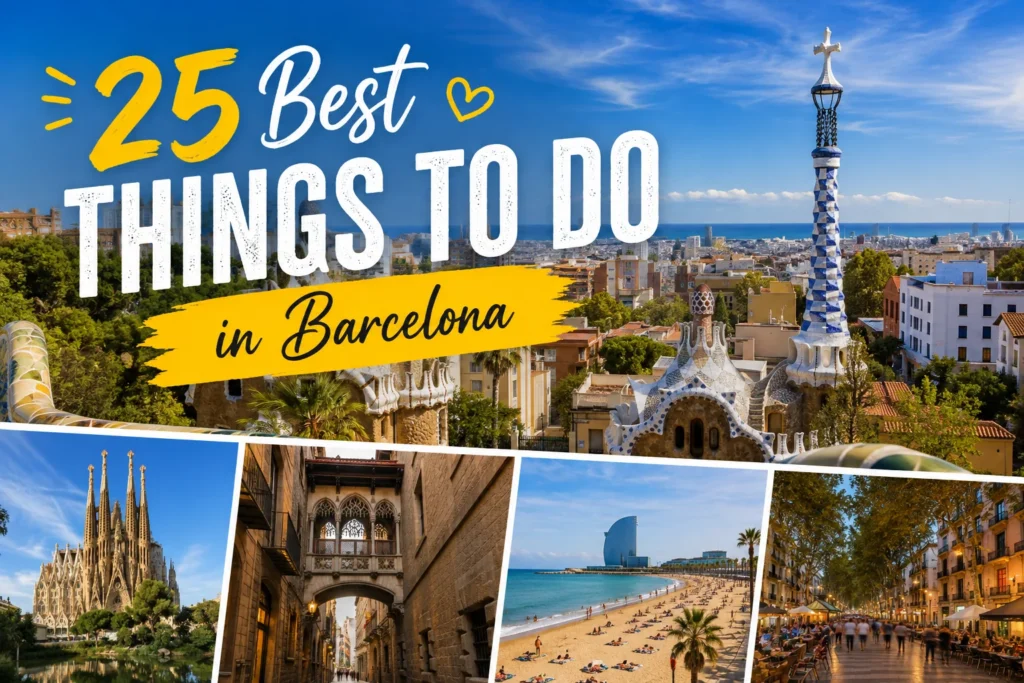
25 Best Things to Do in Barcelona in 2026 (Complete City Guide)
By Sarah Mitchell | Travel Expert and Founder
I have planned Barcelona trips for years, and in 2026 I tell everyone the same thing first: this is the Gaudí year, and it changes how you plan. June 10, 2026 marks 100 years since Antoni Gaudí’s death, the whole city is running centenary programming, and his masterpiece the Sagrada Família is targeting completion this year after 144 years of construction. That means bigger crowds and higher demand than usual, but also a genuinely historic moment to witness. The other thing I tell people: book your Gaudí tickets before you book anything else, because there is no walk-up option for the big sights in peak season, full stop.
This guide covers the 25 best things to do in Barcelona in 2026, ordered the way I would actually work through a trip, with current prices, honest time estimates, and the one thing nobody tells first-timers: Barcelona is a city to be walked and eaten slowly, not sprinted through, and the pickpockets on La Rambla are very real, so keep your wits about you. I have flagged what to book weeks ahead, what is free, and where the tourist traps hide. For more of the region, see my things to do in Madrid and things to do in Spain guides on Travel Destinations Plan.
Barcelona At a Glance: Quick Reference Table
| # | Activity | Area | Entry | Duration | Best For | Best Time |
|---|---|---|---|---|---|---|
| 1 | Sagrada Família | Eixample | From €26; tower extra | 1.5 to 2 hours | All visitors; first-timers | Book weeks ahead; early morning |
| 2 | Park Güell | Gràcia | ~€10 to €18 | 1.5 to 2 hours | Gaudí fans; families | Book ahead; first slot |
| 3 | Gothic Quarter | Ciutat Vella | Free to walk | 2 to 3 hours | History and atmosphere lovers | Morning or evening |
| 4 | Casa Batlló | Passeig de Gràcia | ~€35+ | 1 to 1.5 hours | Architecture lovers | Book ahead; morning |
| 5 | La Boqueria Market | La Rambla | Free to enter | 1 hour | Foodies | Weekday mornings |
| 6 | Montjuïc & Magic Fountain | Montjuïc | Free (fountain); attractions vary | Half day | Views; families | Evening for the fountain show |
| 7 | Casa Milà (La Pedrera) | Passeig de Gràcia | ~€28+ | 1 to 1.5 hours | Architecture lovers | Book ahead; rooftop at sunset |
| 8 | Picasso Museum | El Born | ~€15 | 1.5 to 2 hours | Art lovers | Book ahead; weekday |
| 9 | Barceloneta Beach | Barceloneta | Free | Half day | Beach lovers; summer visitors | Morning; weekdays |
| 10 | El Born neighborhood | Ciutat Vella | Free to walk | 2 to 3 hours | Foodies; nightlife; culture | Evening |
| 11 | Palau de la Música Catalana | Sant Pere | ~€22 guided tour | 1 hour | Architecture and music lovers | Book the guided tour |
| 12 | Montserrat (day trip) | ~1 hour northwest | Train/cable car varies | Full day | Nature and spirituality seekers | Early start; clear days |
| 13 | Tibidabo & Amusement Park | Collserola hills | Park entry varies | Half day | Families; view seekers | Clear days; afternoon |
| 14 | Tapas & Catalan food crawl | Citywide | Meals vary | 2 to 3 hours | Foodies | Evening |
| 15 | La Rambla | Ciutat Vella | Free to walk | 1 hour | First-timers; people-watching | Morning (fewer crowds) |
| 16 | Santa Maria del Mar | El Born | Free (some hours) | 45 mins | Architecture lovers | Morning |
| 17 | Casa Vicens | Gràcia | ~€18 | 1 hour | Gaudí completists | Anytime; quieter than others |
| 18 | Ciutadella Park | El Born edge | Free | 1 to 2 hours | Families; relaxation | Morning; weekends for atmosphere |
| 19 | Camp Nou / FC Barcelona | Les Corts | Tour/match varies | 2 to 3 hours | Football fans | Check match and tour schedule |
| 20 | Bunkers del Carmel | El Carmel | Free | 1 to 2 hours | Photographers; couples | Sunset |
| 21 | Poble Espanyol | Montjuïc | ~€15 | 1.5 to 2 hours | Families; craft lovers | Afternoon |
| 22 | Barcelona rooftop bars | Citywide | Drinks vary | 1 to 2 hours | Couples; nightlife | Sunset |
| 23 | Gràcia neighborhood | Gràcia | Free to walk | 2 hours | Locals’ Barcelona | Evening; festival in August |
| 24 | Sitges (day trip) | ~40 mins south | Train ~€8 | Half to full day | Beach lovers; a coastal break | Summer; weekdays |
| 25 | Cava country / Penedès (day trip) | ~45 mins west | Tour varies | Full day | Wine lovers | Book a winery tour |
1. Sagrada Família
Area: Eixample | Entry: From €26; tower access extra; centenary surcharge of €2 to €5 from June 2026 | Duration: 1.5 to 2 hours | Best time: Book weeks ahead; early morning for softer light
The Sagrada Família is Gaudí’s unfinished masterpiece and Spain’s most visited monument: a basilica begun in 1882, taken over by Gaudí in 1883, and worked on until his death in 1926. Its forest of tree-like columns, kaleidoscopic stained glass, and three symbolic facades are unlike any other building on earth. 2026, the Gaudí centenary, is the target completion year after 144 years, making this the most historic possible moment to see it.
The Sagrada Família is Gaudí’s lifework and Spain’s most visited monument, targeting completion in 2026 after 144 years of construction. It is the single essential sight in Barcelona and the centerpiece of the Gaudí centenary year.
Practical tips:
- There is no walk-up option in peak season. Book online 2 to 4 weeks ahead in summer, longer around the June 10 centenary events. A €2 to €5 centenary surcharge applies from June through December 2026.
- Tower access is a separate add-on that must be selected during booking, and slots sell out first. Add it when you buy or miss out.
- What I tell everyone: go early morning when the eastern Nativity facade glows and the crowds are thinnest. Give the interior real time; the light through the stained glass is the whole point.
2. Park Güell
Area: Gràcia district, on Carmel Hill | Entry: ~€10 to €18 for the Monumental Zone | Duration: 1.5 to 2 hours | Best time: Book ahead; the first entry slot of the day
Park Güell is Gaudí’s whimsical hilltop park: undulating mosaic benches, the famous tiled lizard “El Drac,” fairytale gatehouses, and sweeping views over the city to the sea. Originally conceived as a housing development, it became one of the most joyful public spaces in Europe and a UNESCO World Heritage Site. The Monumental Zone (the famous mosaic areas) is ticketed; the surrounding parkland is free.
Park Güell is Gaudí’s fairytale hilltop park, famous for its mosaic lizard and serpentine tiled benches with panoramic city views. It is the most playful and photogenic of all Gaudí’s works.
Practical tips:
- The Monumental Zone sells out days ahead in peak season. Book online and choose the first slot of the day for the best light and fewest people.
- Getting up the hill is a genuine climb. The metro plus outdoor escalators, or a bus, saves your legs versus walking up from the base.
- One honest tip: the free parkland surrounding the paid zone has some of the best city viewpoints anyway, so budget time to wander beyond the mosaic area.
3. Gothic Quarter (Barri Gòtic)
Area: Ciutat Vella | Entry: Free to walk | Duration: 2 to 3 hours | Best time: Early morning or evening
The Gothic Quarter is the medieval heart of Barcelona: a labyrinth of narrow stone lanes, hidden squares, Roman ruins, and the soaring Barcelona Cathedral, all packed into the old city. Getting deliberately lost here, stumbling on a quiet plaça with a fountain and a guitarist, is one of the great free pleasures of the city. It is atmospheric, historic, and endlessly photogenic.
The Gothic Quarter is Barcelona’s medieval core, a labyrinth of narrow stone lanes, hidden squares, and Roman ruins around the grand Cathedral. Getting lost in it is the best free experience in the city.
Practical tips:
- Go early morning or evening. Midday brings tour-group gridlock in the narrowest lanes, and the atmosphere is far better when it is quiet.
- The Barcelona Cathedral and its peaceful cloister (with resident geese) are worth stepping into; the rooftop offers a great view for a small fee.
- Keep your bag zipped and in front. The Gothic Quarter and adjacent La Rambla are the city’s pickpocketing hotspots, especially in crowds.
4. Casa Batlló
Area: Passeig de Gràcia 43 | Entry: ~€35+ | Duration: 1 to 1.5 hours | Best time: Book ahead; morning
Casa Batlló is Gaudí’s most dramatic residential building: a shimmering facade of broken ceramic and glass in blues and greens, a scaled roof evoking a dragon’s back, and an interior with barely a straight line in it, all curves, light wells, and organic forms. The immersive audiovisual tour brings Gaudí’s vision to life. It is the most visually captivating of his houses at first glance.
Casa Batlló is Gaudí’s most visually striking house, with a dragon-scale roof and a flowing, organic interior with almost no straight lines. It is the most captivating Gaudí building at first sight.
Practical tips:
- Book online in advance; it sells out 2 to 4 weeks ahead in summer like the Sagrada Família.
- The included immersive tech tour is genuinely good and sets it apart from just walking through; allow time to enjoy it.
- It sits on Passeig de Gràcia, a 6-minute walk from Casa Milà (entry 7), so pair the two Gaudí houses in one outing.
5. La Boqueria Market
Area: Off La Rambla | Entry: Free to enter | Duration: 1 hour | Best time: Weekday mornings
La Boqueria is Barcelona’s legendary public market: a riot of color and aroma under a wrought-iron roof, with stalls of jamón, seafood, fruit, cheeses, and juices, plus small counters serving some of the best cheap eats in the city. It is touristy and busy, but for good reason, and grabbing a stool at a market bar for fresh seafood is a genuine Barcelona pleasure.
La Boqueria is Barcelona’s famous public market, packed with jamón, seafood, and produce stalls plus excellent market-bar counters. It is the best place to eat cheaply and vibrantly in the city center.
Practical tips:
- Go on a weekday morning. Weekends and midday are shoulder-to-shoulder, and many stalls sell out of the best produce early.
- Eat at the small tapas bars deep inside the market (like the famous Pinotxo counter) rather than the marked-up stalls at the front entrance.
- One honest tip: the pre-cut fruit cups at the entrance are overpriced tourist bait. Walk further in for better prices and better food.
6. Montjuïc & the Magic Fountain
Area: Montjuïc hill | Entry: Free (fountain and hill); individual attractions vary | Duration: Half day | Best time: Evening for the fountain light show
Montjuïc is the green hill overlooking the harbor, packed with attractions: the National Art Museum (MNAC) in its palatial building, the Joan Miró Foundation, Olympic sites from 1992, gardens, a castle with harbor views, and, at its foot, the Magic Fountain, which puts on a free choreographed light-and-music show on select evenings. A cable car glides up for panoramic views.
Montjuïc is a hilltop of museums, gardens, and Olympic sites crowned by harbor views, with the free Magic Fountain light show at its base. It is the best half-day for views and culture combined.
Practical tips:
- Check the Magic Fountain schedule before you go; it runs only on select evenings and seasons, and times shift through the year.
- The MNAC’s collection and its terrace view over the city are both superb; combine the museum with the fountain show below afterward.
- Take the funicular and cable car up rather than climbing; it saves energy and the ride itself is scenic.
7. Casa Milà (La Pedrera)
Area: Passeig de Gràcia | Entry: ~€28+ | Duration: 1 to 1.5 hours | Best time: Book ahead; rooftop at sunset
Casa Milà, nicknamed La Pedrera (“the stone quarry”) for its rippling limestone facade, is Gaudí’s last civil work: a wave-like apartment building whose surreal rooftop, bristling with sculptural chimneys, is one of the most photographed spaces in Barcelona. The interior museum and a restored period apartment show how radical Gaudí’s ideas were for 1912.
Casa Milà, known as La Pedrera, features a wave-like stone facade and a surreal rooftop of sculptural chimneys. Its rooftop is one of the most photogenic spaces in all of Barcelona.
Practical tips:
- Book ahead, and if a sunset or evening rooftop session is offered, take it; the chimneys against a golden or lit sky are unforgettable.
- It is a 6-minute walk from Casa Batlló along Passeig de Gràcia, so do both Gaudí houses in one visit.
- The rooftop is the star, but the attic with its parabolic arches and the period apartment are worth the full walk-through.
8. Picasso Museum
Area: El Born | Entry: ~€15 | Duration: 1.5 to 2 hours | Best time: Book ahead; weekday
The Museu Picasso holds one of the world’s most extensive collections of the artist’s work, focused on his formative early years in Barcelona, housed across five adjoining medieval palaces in El Born. It is less about his famous later Cubism and more a fascinating window into how a prodigy became Picasso, including his complete “Las Meninas” series.
The Picasso Museum holds the world’s most extensive collection of the artist’s early work, set in five medieval palaces in El Born. It is the best place to understand how Picasso became Picasso.
Practical tips:
- Book timed tickets online to skip the notorious queue, and go on a weekday when it is calmer.
- It is free on certain times (often Thursday evenings and the first Sunday of the month); check the current schedule, though these slots are crowded.
- The setting, five linked Gothic palaces, is half the experience; appreciate the architecture as you move through.
9. Barceloneta Beach
Area: Barceloneta | Entry: Free | Duration: Half day | Best time: Morning; weekdays
Barceloneta is the city beach, a broad stretch of sand a short walk or metro ride from the Gothic Quarter, backed by a lively boardwalk of seafood restaurants (chiringuitos) and buzzing with swimmers, sunbathers, and beach volleyball in summer. It is not the most pristine beach in Catalonia, but its sheer convenience and energy make it a Barcelona institution.
Barceloneta is Barcelona’s lively city beach, a short walk from the old town with a boardwalk of seafood restaurants. It is the most convenient place to swim and soak up the Mediterranean.
Practical tips:
- Go in the morning, especially on summer weekends, when the sand fills up completely by midday.
- Watch your belongings closely; the beach is a known spot for opportunistic theft while people swim.
- For a better, cleaner beach, locals head a bit further to Bogatell or Nova Icària, both an easy walk northeast along the coast.
10. El Born Neighborhood
Area: Ciutat Vella | Entry: Free to walk | Duration: 2 to 3 hours | Best time: Evening
El Born is the coolest of the old-town neighborhoods: medieval lanes lined with boutiques, wine bars, tapas spots, and the Picasso Museum, anchored by the stunning Santa Maria del Mar church and the old Born market. It is where locals and in-the-know visitors go for an evening of eating and drinking, more atmospheric and less touristy than the Gothic Quarter next door.
El Born is the most stylish old-town neighborhood, with medieval lanes full of wine bars, boutiques, and tapas around the beautiful Santa Maria del Mar. It is the best area for an evening of eating and drinking.
Practical tips:
- This is the neighborhood for a tapas-and-wine crawl. Wander Passeig del Born and the side streets and duck into whatever looks good.
- Santa Maria del Mar (entry 16) is the anchor; time your walk to step inside during its free open hours.
- Evenings are when El Born comes alive, but it is genuinely lovely and quiet in the morning too if you want the lanes to yourself.
11. Palau de la Música Catalana
Area: Sant Pere | Entry: ~€22 guided tour; concert tickets vary | Duration: 1 hour | Best time: Book the guided tour, or better, a concert
The Palau de la Música is a jaw-dropping Catalan Modernisme concert hall, a UNESCO site by architect Lluís Domènech i Montaner, all stained glass, mosaic, and sculpture, crowned by an inverted stained-glass skylight dome that floods the auditorium with natural light. Even among Barcelona’s architectural riches, its interior is a genuine showstopper.
The Palau de la Música Catalana is a UNESCO-listed Modernisme concert hall with a breathtaking stained-glass skylight dome. Its interior is one of the most beautiful concert spaces in the world.
Practical tips:
- The guided daytime tour is worth it, but attending an actual concert (from classical to guitar to flamenco) is the magical way to experience the hall.
- Book ahead either way; both tours and concerts sell out, especially in high season.
- It is a short walk from El Born and the Gothic Quarter, easy to combine with an old-town day.
12. Montserrat (Day Trip)
Area: About 1 hour northwest | Entry: Train and cable car/rack railway fares vary | Duration: Full day | Best time: Early start; clear days
Montserrat is a dramatic serrated mountain topped by a Benedictine monastery, home to the revered “Black Madonna” statue and a famous boys’ choir, reached by a scenic train and then a cable car or rack railway. Beyond the monastery, hiking trails wind among the surreal rock formations with staggering views over Catalonia. It is the most popular and rewarding day trip from Barcelona.
Montserrat is a dramatic mountain monastery home to the Black Madonna and a renowned boys’ choir, reached by cable car with panoramic trails. It is the best day trip from Barcelona.
Practical tips:
- Start early to beat the crowds and give yourself time for both the monastery and a hike among the rock formations.
- Time your visit to hear the Escolania boys’ choir (they sing at set times most days, but check the schedule and closures).
- Buy a combined train-plus-cable-car ticket to simplify the journey; decide between the cable car (dramatic) and the rack railway (gentler) for the final ascent.
13. Tibidabo & Amusement Park
Area: Collserola hills, above the city | Entry: Park entry and ride passes vary | Duration: Half day | Best time: Clear days; afternoon into evening
Tibidabo is the mountain overlooking Barcelona, crowned by a striking church (the Temple del Sagrat Cor) and a charming vintage amusement park with some rides dating back over a century, all offering the highest panoramic views in the city. Reached by a historic tram and funicular, it is a nostalgic, family-friendly outing with an unbeatable outlook.
Tibidabo crowns the city with a hilltop church and a century-old amusement park offering the highest views in Barcelona. It is the best family outing for panoramas and old-fashioned fun.
Practical tips:
- Go on a clear day; the whole point is the view, which vanishes in haze or cloud.
- The vintage rides, especially the old airplane ride and the Ferris wheel, are charming for all ages; you can enter for the views without riding much.
- Getting there is part of the fun via the historic Tramvia Blau and funicular; check current operating status as schedules vary seasonally.
14. Tapas & Catalan Food Crawl
Area: Citywide, concentrated in El Born, Gràcia, and Gothic Quarter | Entry: Meals vary | Duration: 2 to 3 hours | Best time: Evening
Barcelona’s food is a destination in itself, and the best way to experience it is a tapas crawl: hopping between small bars for patatas bravas, pan con tomate, jamón, seafood, and Catalan specialties like esqueixada or botifarra, washed down with vermut or cava. Catalan cuisine is distinct from generic “Spanish” food, and eating your way through it is essential.
Barcelona’s Catalan cuisine is distinct and superb, best experienced as an evening tapas crawl through small neighborhood bars. Eating your way through the city is as essential as any monument.
Practical tips:
- Eat where locals do and on local time; dinner starts late, often 9 pm or later, and the best tapas bars fill up after tourists have gone.
- Try vermut (vermouth on tap) as an aperitif and cava (Catalan sparkling wine); both are local traditions done brilliantly here.
- One honest tip: avoid the restaurants with photo menus and hawkers on La Rambla. The real food is a few streets away in El Born, Gràcia, and the Gothic back lanes.
15. La Rambla
Area: Ciutat Vella | Entry: Free to walk | Duration: 1 hour | Best time: Early morning, before the crowds
La Rambla is Barcelona’s famous tree-lined pedestrian boulevard, running from Plaça de Catalunya down to the harbor, alive with flower stalls, street performers, cafes, and a constant flow of humanity. It is the city’s most famous promenade and worth a stroll for the spectacle, though it is also its most touristy and pickpocket-prone stretch.
La Rambla is Barcelona’s iconic tree-lined boulevard of flower stalls and street performers running down to the harbor. It is the city’s most famous walk, best enjoyed early before the crowds.
Practical tips:
- Walk it early morning for the atmosphere without the crush, and to actually see it rather than a wall of people.
- Guard your belongings vigilantly; this is the single most notorious pickpocketing spot in Barcelona.
- One honest tip: do not eat or drink at the restaurants directly on La Rambla; prices are high and quality low. Use it as a walkway to La Boqueria and the Gothic Quarter, then eat elsewhere.
16. Santa Maria del Mar
Area: El Born | Entry: Free during general hours; paid for tower/guided visits | Duration: 45 minutes | Best time: Morning
Santa Maria del Mar is a masterpiece of Catalan Gothic architecture: a 14th-century church built remarkably fast for its era, with soaring, slender columns and a sense of luminous, uncluttered space that many find more moving than the grander cathedral. Immortalized in the novel “Cathedral of the Sea,” it is the beloved heart of El Born.
Santa Maria del Mar is a sublime 14th-century Catalan Gothic church, prized for its luminous, spacious interior. Many visitors find it more beautiful than Barcelona’s main cathedral.
Practical tips:
- It is free to enter during general visiting hours; a paid guided visit adds rooftop and tower access with lovely views.
- Go in the morning when light streams through the stained glass and the space is quiet.
- Read up on its history (or the novel) beforehand; knowing it was built by the local parish and porters makes the space more moving.
17. Casa Vicens
Area: Gràcia | Entry: ~€18 | Duration: 1 hour | Best time: Anytime; it is quieter than the other Gaudí houses
Casa Vicens was Gaudí’s first major commission, a colorful early house that shows his genius already emerging, richly decorated with ceramic tiles, Moorish and oriental influences, and intricate ironwork. A UNESCO site opened to the public relatively recently, it is the least crowded of Gaudí’s buildings and a treat for anyone wanting to see where his style began.
Casa Vicens is Gaudí’s first major work, a vivid tile-covered house showing his early genius, and the least crowded of his buildings. It is the best Gaudí visit for avoiding the crowds.
Practical tips:
- Because it is off the main tourist trail in Gràcia, you can often get in with less advance booking than the other Gaudí sites.
- It is a manageable one-hour visit, good to pair with exploring the Gràcia neighborhood (entry 23) around it.
- For Gaudí completists, seeing his first work after his last (Casa Milà) and his masterpiece (Sagrada Família) completes the arc beautifully.
18. Ciutadella Park
Area: Edge of El Born | Entry: Free | Duration: 1 to 2 hours | Best time: Morning, or weekends for the local atmosphere
Parc de la Ciutadella is Barcelona’s central green lung: a lovely park with a grand ornamental fountain (which a young Gaudí contributed to), a boating lake, the Catalan parliament, a zoo, and wide lawns where locals picnic, play music, and relax on weekends. It is the best spot to slow down and see how Barcelonans actually spend their leisure time.
Ciutadella Park is Barcelona’s central green space, with an ornamental fountain, a boating lake, and lawns full of relaxing locals. It is the best place to slow down and rest between sights.
Practical tips:
- Rent a rowboat on the lake for a cheap, charming break, or just bring a picnic and sprawl on the grass like the locals.
- The monumental cascade fountain, which Gaudí worked on as a student, is the visual centerpiece; go see it up close.
- Weekends bring drum circles, slackliners, and a wonderful communal atmosphere; it is a great free window into local life.
19. Camp Nou / FC Barcelona
Area: Les Corts | Entry: Stadium tour and match tickets vary | Duration: 2 to 3 hours | Best time: Check the match and tour schedule
Camp Nou is the legendary home of FC Barcelona, one of the biggest football stadiums in the world, undergoing major renovation in recent years. Whether you catch a match (an electric, unforgettable experience) or take the museum-and-stadium tour, it is a pilgrimage for football fans. Check current status, as the stadium and its tours have been affected by the ongoing rebuild.
Camp Nou is the iconic home of FC Barcelona and one of the world’s great football stadiums. Catching a match here is an unforgettable experience for any sports fan.
Practical tips:
- Check the current status of the stadium and tours before planning; the major renovation has affected access and schedules, with the club sometimes playing elsewhere.
- If a match is on during your visit and tickets are available, that beats any tour; the atmosphere is extraordinary.
- Book match or tour tickets through official channels to avoid inflated resale prices and scams.
20. Bunkers del Carmel
Area: El Carmel hill | Entry: Free | Duration: 1 to 2 hours | Best time: Sunset
The Bunkers del Carmel are old Spanish Civil War anti-aircraft gun platforms on a hilltop, now the best free 360-degree viewpoint in Barcelona. Locals and travelers climb up at sunset with drinks and snacks to watch the whole city, the Sagrada Família, Montjuïc, and the sea, glow in the evening light. It is the ultimate free sunset spot.
The Bunkers del Carmel are hilltop Civil War platforms offering the best free 360-degree view in Barcelona. Watching sunset over the whole city from here is the ultimate free experience.
Practical tips:
- It is a real climb up from the nearest transit; wear comfortable shoes and allow time to get up before sunset.
- Bring your own drinks and snacks for a picnic sunset like the locals do, but take all your rubbish with you; residents have pushed back against crowds and litter.
- Go for sunset specifically; the light on the city and the Sagrada Família in the distance is the whole reward.
21. Poble Espanyol
Area: Montjuïc | Entry: ~€15 | Duration: 1.5 to 2 hours | Best time: Afternoon
Poble Espanyol (“Spanish Village”) is an open-air architectural museum built for the 1929 World’s Fair, recreating streets, squares, and buildings from all over Spain in one walkable village. It is part museum, part craft-workshop hub, part event space, letting you sample the architecture of the whole country, from Andalusian whitewash to Aragonese stone, without leaving Barcelona.
Poble Espanyol is an open-air village recreating architecture from all across Spain in one place, with artisan workshops throughout. It is the best way to sample the whole country’s building styles in an afternoon.
Practical tips:
- It is on Montjuïc, so combine it with the MNAC and the Magic Fountain for a full hill day.
- The artisan workshops (glassblowers, ceramicists, and more) are the highlight; watching makers at work is better than the souvenir shops.
- It can feel touristy, but it is genuinely useful and fun for families and anyone who will not travel to the actual regions it recreates.
22. Barcelona Rooftop Bars
Area: Citywide | Entry: Free to enter; drinks vary | Duration: 1 to 2 hours | Best time: Sunset
Barcelona does rooftop bars exceptionally well, with hotel terraces and sky bars across the city offering cocktails alongside views of the Gothic rooftops, the Sagrada Família, or the Mediterranean. A sunset drink up high is one of the loveliest ways to bookend a day of sightseeing, whether it is a glamorous hotel terrace or a laid-back neighborhood roof.
Barcelona’s rooftop bars offer cocktails with sweeping views of the city’s spires and the sea. A sunset drink from a terrace is one of the most romantic ways to end a day.
Practical tips:
- Many of the best are atop hotels; you usually do not need to be a guest, but some require a reservation or have a minimum spend at peak times.
- Go for sunset and arrive a little early to get a good spot at the railing before the evening crowd.
- Drinks are priced for the view, so treat it as a special-occasion splurge rather than a cheap night out.
23. Gràcia Neighborhood
Area: Gràcia | Entry: Free to walk | Duration: 2 hours | Best time: Evening; the Festa Major in August
Gràcia is Barcelona’s bohemian village-within-a-city: a former independent town of narrow streets, leafy plazas full of cafe tables, independent shops, and a young, local, creative energy. It is where Barcelonans go to feel like they are in a small town, and its lively squares at aperitivo hour are one of the most genuine local experiences in the city.
Gràcia is Barcelona’s bohemian former village, full of leafy plazas, independent shops, and local cafe life. It is the best neighborhood to experience the authentic, non-touristy side of the city.
Practical tips:
- Plant yourself at a table in one of the plaças (like Plaça del Sol or Plaça de la Virreina) at aperitivo hour and soak up local life.
- If you visit in mid-August, the Festa Major de Gràcia is spectacular, with streets elaborately decorated by residents in a friendly competition.
- Casa Vicens (entry 17) sits here, so combine a Gràcia wander with Gaudí’s first house.
24. Sitges (Day Trip)
Area: About 40 minutes south by train | Entry: Train ~€8 round trip; beaches free | Duration: Half to full day | Best time: Summer; weekdays
Sitges is a beautiful, chic seaside town a short train ride south of Barcelona, with golden beaches, a pretty whitewashed old town, a landmark hilltop church over the sea, and a famously vibrant, welcoming atmosphere. It is the easiest beach-town escape from the city and a lovely change of pace, whether for sunbathing, seafood, or simply strolling the promenade.
Sitges is a chic seaside town just 40 minutes from Barcelona, with golden beaches and a charming whitewashed old town. It is the easiest and prettiest beach escape from the city.
Practical tips:
- The train from Passeig de Gràcia or Sants is cheap and easy; go on a weekday in summer to avoid the biggest crowds.
- The beaches right in town are lovely, but walk a little further along the coast for quieter stretches of sand.
- It is also a famous LGBTQ+ destination with a lively, inclusive scene and great nightlife if you stay into the evening.
25. Cava Country / Penedès (Day Trip)
Area: About 45 minutes west | Entry: Winery tours vary | Duration: Full day | Best time: Book a winery tour in advance
The Penedès region west of Barcelona is the home of cava, Spain’s celebrated sparkling wine, and its rolling vineyards and historic wineries (in towns like Sant Sadurní d’Anoia and Vilafranca del Penedès) make a superb day trip for wine lovers. Tour the cellars of famous producers, learn how cava is made, and taste your way through a genuinely beautiful wine country close to the city.
The Penedès region is the home of Spanish cava, with historic wineries an easy trip from Barcelona. It is the best day trip for wine lovers wanting to taste and tour vineyards.
Practical tips:
- Book a winery tour in advance; the big cava houses like those in Sant Sadurní d’Anoia offer cellar tours with tastings.
- Consider an organized tour with transport so you can taste freely without worrying about driving.
- Combine a couple of wineries with lunch in Vilafranca del Penedès for a full, relaxed day in the vineyards.
Barcelona Practical Guide
Getting Around Barcelona
Barcelona is one of the most walkable big cities in Europe, and the Eixample grid makes the Gaudí sights unusually easy to walk between, Sagrada Família to Casa Batlló is about 15 minutes on foot. For longer hops, the metro is clean, cheap, and efficient, reaching nearly everything, and a T-casual multi-trip ticket or the Hola Barcelona travel card saves money. You do not need a car in the city; it is a hindrance. Taxis and rideshares are readily available for late nights.
One thing I always tell first-timers: pickpocketing is the real and only significant risk here, concentrated on La Rambla, the metro, Barceloneta beach, and crowded tourist spots. It is not dangerous, just opportunistic, so keep your phone and wallet secure, wear your bag in front in crowds, and you will be completely fine.
Where to Stay in Barcelona
Eixample: Central, elegant, and home to the Gaudí houses, with wide avenues and great restaurants. Best for first-timers wanting to walk to the main sights.
Gothic Quarter / El Born: Atmospheric old-town streets full of history, tapas, and nightlife. Best for those wanting character and to be in the heart of the action (though it can be noisy).
Gràcia: A local, bohemian neighborhood slightly removed from the tourist crush, with village charm. Best for repeat visitors and travelers wanting an authentic base.
Barcelona Budget Guide
Budget traveler (hostel or budget hotel, free sights like the Gothic Quarter, beaches, and Bunkers, market meals and tapas, metro): roughly €70 to €120 per day. Many of Barcelona’s joys, its neighborhoods, beaches, and viewpoints, are free.
Mid-range traveler (comfortable hotel, paid Gaudí sights, sit-down dining, a day trip): roughly €150 to €280 per day, with the Gaudí tickets being the main attraction cost.
Higher-spend traveler (boutique or luxury hotel, all the Gaudí sites with tower access, fine dining, rooftop bars, private tours): €350 or more per day, driven by lodging, dining, and premium experiences.
Frequently Asked Questions About Barcelona
Why is 2026 a special year to visit Barcelona? 2026 is the Gaudí centenary: June 10 marks 100 years since Antoni Gaudí’s death, and the city is running special exhibitions and commemorative programming all year. It is also the target completion year for the Sagrada Família after 144 years of construction. Expect higher crowds but a genuinely historic moment, especially around the June events.
How many days do you need in Barcelona? Three to four days covers the essential Gaudí sights (Sagrada Família, Park Güell, one or two houses), the Gothic Quarter and El Born, Montjuïc, and the beach. Five days lets you add day trips like Montserrat or Sitges, more neighborhoods, and a slower pace for the city’s incredible food.
What is Barcelona most famous for? Antoni Gaudí’s architecture (the Sagrada Família, Park Güell, Casa Batlló), the Gothic Quarter, its beaches, FC Barcelona football, Catalan cuisine and tapas, the La Boqueria market, and its vibrant, walkable neighborhoods.
Do I need to book Barcelona attractions in advance? Yes, absolutely, for the Gaudí sights. The Sagrada Família and Casa Batlló sell out 2 to 4 weeks ahead in summer, and Park Güell sells out days ahead, with no walk-up option in peak season. Book these first. Free sights like the Gothic Quarter, beaches, and Bunkers del Carmel need no booking.
When is the best time to visit Barcelona? Late spring (May, early June) and fall (September, October) offer warm weather, swimmable sea, and thinner crowds than peak summer. July and August are hot and very crowded. Note that 2026’s Gaudí centenary means higher-than-usual demand year-round, so book early whenever you go.
Is Barcelona safe for tourists? Yes, Barcelona is very safe in terms of violent crime. The main concern is pickpocketing, which is common on La Rambla, the metro, and at crowded attractions and the beach. Stay alert, keep valuables secure and bags in front in crowds, and you will have no trouble.
The Final Word
If you take one thing from this guide, take this: 2026 is a landmark year to see Barcelona, but only if you plan ahead. The Gaudí centenary and the Sagrada Família’s target completion make this a genuinely historic moment, and the crowds will reflect that. The single biggest mistake I watch people make is showing up expecting to walk into the Sagrada Família or Park Güell same-day and finding them completely sold out. Book your Gaudí tickets the moment your dates are set, before flights if you have to.
Where I would spend the money: the Sagrada Família with tower access, and at least one Gaudí house (Casa Batlló for drama, Casa Milà for that rooftop). Where the magic is free: getting lost in the Gothic Quarter, sunset from the Bunkers del Carmel, an afternoon on the beach, and a long tapas-and-vermut evening in El Born or Gràcia. The other mistake I see is people never leaving the tourist core; the real Barcelona is in the neighborhoods, on local time, over small plates and a glass of cava. Give the city days, not hours, and eat late like a local.
Have a Barcelona tip I missed, or a favorite tapas bar, or a Gaudí building you love most? Tell me in the comments. I update this guide as prices, tickets, and the Sagrada Família itself keep changing.
For more Spain and Europe travel guides, visit Travel Destinations Plan.