
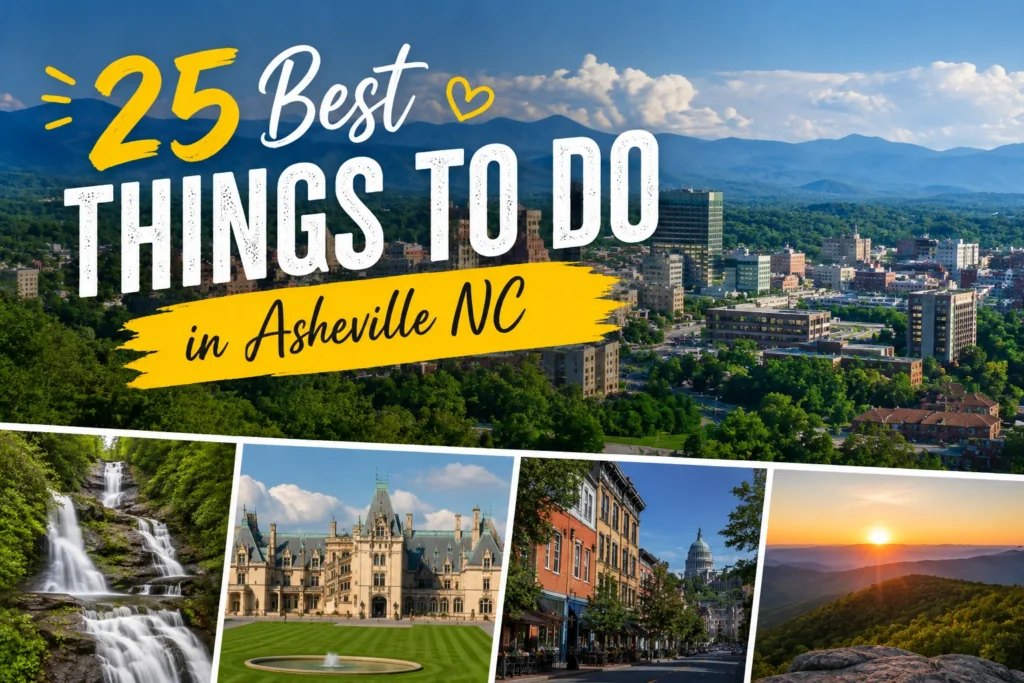
25 Best Things to Do in Asheville NC in 2026 (Complete City Guide)
By Sarah Mitchell | Travel Expert and Founder
I have sent travelers to Asheville for years, and in 2026 I tell every one of them the same thing first: go now, because this city needs you and it is better than ever. Hurricane Helene hit hard in September 2024, but Asheville has rebuilt with the kind of stubborn mountain grit that defines the place. Downtown, Biltmore, and the breweries are running normally, the Blue Ridge Parkway has reopened in long continuous stretches, and the River Arts District came back so strong it was ranked the number one arts district in America in 2026. Your visit puts money straight into the pockets of families still recovering, and you get one of the best small-city trips in the country in return.
This guide covers the 25 best things to do in Asheville in 2026, ordered the way I would actually work through a trip, with current prices, honest time estimates, and the one thing nobody tells first-timers: this is a city where the free mountain views and the paid grandeur of Biltmore matter equally, and you need both to get it. I have flagged what is new for 2026, what needs booking, and where a couple of Helene-related closures still linger. For more of the region, see my things to do in North Carolina and things to do in Charlotte guides on Travel Destinations Plan.
Asheville At a Glance: Quick Reference Table
| # | Activity | Area | Entry | Duration | Best For | Best Time |
|---|---|---|---|---|---|---|
| 1 | Biltmore Estate | South Asheville | ~$79+ adults, date-based | Full day | History and architecture lovers | Book online; spring for Luminere |
| 2 | Blue Ridge Parkway | Runs through Asheville | Free | Half to full day | All visitors; leaf-peepers | October for fall color; sunrise |
| 3 | Downtown Asheville | Downtown | Free to walk | 2 to 4 hours | Foodies; architecture; shopping | Afternoon into evening |
| 4 | River Arts District (RAD) | West of downtown | Free to browse | 2 to 3 hours | Art lovers | Weekend afternoons |
| 5 | Asheville brewery scene | South Slope & citywide | Tastings vary | 2 to 4 hours | Craft beer lovers | Thursday to Saturday evenings |
| 6 | Blue Ridge Parkway waterfalls | South of Asheville | Free | Half day | Hikers; photographers | Spring for flow; morning |
| 7 | Grove Park Inn | North Asheville | Free to visit lobby | 1 to 2 hours | Architecture; relaxation | Sunset from the terrace |
| 8 | North Carolina Arboretum | South Asheville | ~$20 per vehicle | 2 to 3 hours | Nature lovers; families | Spring and fall |
| 9 | Chimney Rock State Park | ~40 mins southeast | ~$25 adults; timed entry | Half day | Hikers; view seekers | Morning; book ahead |
| 10 | Mount Mitchell (day trip) | ~1 hour northeast | Free | Half day | Hikers; view seekers | Clear days; summer for cool air |
| 11 | Grovewood Village | North Asheville | Free | 1 to 2 hours | Craft lovers; history | Anytime |
| 12 | Asheville food scene | Citywide | Meals vary | 2 to 3 hours | Foodies | Dinner; book ahead |
| 13 | Western NC Nature Center | East Asheville | ~$17 adults | 2 hours | Families | Morning |
| 14 | Pisgah National Forest | Southwest of Asheville | Free | Half to full day | Hikers; swimmers | Summer for swimming holes |
| 15 | Downtown Asheville Historic Walk | Downtown | Free | 1.5 to 2 hours | Architecture; history | Morning |
| 16 | Biltmore Village | South Asheville | Free to walk | 1.5 to 2 hours | Shopping; dining | Afternoon |
| 17 | Sunset from Craggy Gardens | Blue Ridge Parkway north | Free | 2 to 3 hours | Photographers; couples | June for rhododendron; sunset |
| 18 | Asheville Pinball Museum | Downtown | ~$15 all-day play | 1.5 to 2 hours | Families; nostalgia | Anytime; rainy-day plan |
| 19 | Montford neighborhood | North of downtown | Free to walk | 1 to 1.5 hours | Architecture; quiet strolls | Morning |
| 20 | Lake Lure & Beach (day trip) | ~45 mins southeast | Beach fee varies | Half day | Families; swimmers | Summer; reopening 2026 |
| 21 | LEAF & Asheville festivals | Citywide | Varies | Varies | Music and culture lovers | Check festival calendar |
| 22 | French Broad River float | West Asheville | Tube rental ~$20 | Half day | Groups; summer visitors | Summer afternoons |
| 23 | Antique & vintage shopping | Downtown & Biltmore Village | Free to browse | 1.5 to 2 hours | Collectors; browsers | Afternoons |
| 24 | Historic Johnson Farm (day trip) | Hendersonville, ~30 mins | ~$10 | 1.5 to 2 hours | History lovers; families | Morning |
| 25 | Sierra Nevada Brewery (day trip) | Mills River, ~20 mins | Free to visit; tours vary | 2 to 3 hours | Beer lovers; families | Afternoon |
1. Biltmore Estate
Area: South Asheville | Entry: ~$79+ adults, date-based, cheaper online | Duration: Full day | Best time: Book online ahead; spring 2026 for the new Luminere show
Biltmore is America’s largest home: George Vanderbilt’s 250-room French Renaissance chateau, completed in 1895, set on 8,000 acres of gardens, forest, farmland, and a working winery. The self-guided house tour, the Frederick Law Olmsted-designed gardens, the estate winery with complimentary tastings, and the sheer scale of the place make it a genuine full-day experience and the anchor of any Asheville trip.
Biltmore is the largest privately owned home in America, with 250 rooms on an 8,000-acre estate including a winery and Olmsted-designed gardens. It is the essential Asheville experience and worth a full day.
Practical tips:
- New for 2026: Luminere, a large-scale outdoor light and art installation that transforms the house and gardens into a nighttime spectacle set to a custom score, runs select evenings from late March through October 18. It is the biggest new thing at Biltmore in years.
- Buy tickets online in advance for the lowest date-based prices, and arrive early to beat the crowds through the house.
- What I tell people: the estate reopened just five weeks after Helene and the Vanderbilt family pledged millions to local relief. Visiting here directly supports the region’s recovery. Christmas at Biltmore returns for its 130th anniversary if you come in the holidays.
2. Blue Ridge Parkway
Area: Runs directly through Asheville | Entry: Free | Duration: Half to full day | Best time: October for peak fall color; sunrise for the best light
The Blue Ridge Parkway is America’s Favorite Drive, a 469-mile scenic road through the Appalachian highlands, and Asheville sits right on it. In 2026 the Parkway celebrates 90 years since construction began, and more than 114 contiguous miles are fully reopened after Helene repairs, giving seamless access to Mount Mitchell, the Folk Art Center, the North Carolina Arboretum, Craggy Gardens, and the Smokies. The overlooks, the tunnels, and the layered blue ridgelines are the reason people fall for these mountains.
The Blue Ridge Parkway runs directly through Asheville and offers some of the most beautiful mountain driving in America, with 114 contiguous miles reopened for its 90th anniversary in 2026. It is the best free thing to do in the region.
Practical tips:
- A few sections between Linville Falls and Mount Mitchell remain closed for Helene repairs, with reopening expected between summer and December 2026. Check the National Park Service Parkway status page before driving specific stretches.
- October is peak leaf season and the single most popular time; expect crowds at the overlooks but unforgettable color. Go at sunrise to have them to yourself.
- What I always do: drive a stretch at sunrise or sunset when the light rakes across the ridges. Midday is fine, but the golden hours are what people remember.
3. Downtown Asheville
Area: Downtown | Entry: Free to walk | Duration: 2 to 4 hours | Best time: Afternoon into evening
Downtown Asheville is one of the most walkable, characterful small-city cores in America: Art Deco architecture, independent bookshops and boutiques, buskers on every corner, a genuinely world-class food scene, and more breweries per capita than almost anywhere in the country. It is compact, creative, and completely its own thing, the beating heart of the city and running fully normally in 2026.
Downtown Asheville packs Art Deco architecture, independent shops, street music, and one of the best food-and-beer scenes in the South into a walkable core. It is the vibrant heart of the city.
Practical tips:
- Start at Pack Square and wander outward. The whole downtown is walkable, and getting lost in it is the point.
- The Friday-night drum circle in Pritchard Park (warm months) is a beloved local tradition and completely free.
- Where I send people first: just walk. Downtown Asheville rewards aimless wandering more than a checklist, with a gallery, a brewery, or a busker around every corner.
4. River Arts District (RAD)
Area: West of downtown, along the French Broad River | Entry: Free to browse | Duration: 2 to 3 hours | Best time: Weekend afternoons
The River Arts District is a stretch of former industrial buildings along the French Broad River, filled with the working studios of hundreds of artists, potters, painters, glassblowers, and makers, where you can watch them work and buy directly. Hit hard by Helene’s flooding, the RAD has come back so powerfully it was ranked the number one arts district in America in 2026, with more than 340 artists exhibiting again.
The River Arts District houses hundreds of working artist studios in riverside industrial buildings and was ranked the number one arts district in America in 2026 after rebuilding from Helene. It is the best place to see and buy local art.
Practical tips:
- Many studios let you watch artists actually working, not just browse finished pieces. Weekends have the most studios open.
- The district is actively rebuilding in real time, now around 20 percent reopened and climbing, so buying here directly funds the recovery.
- What I love: this is the most authentic art experience in the region, no gift-shop gloss, just artists in their spaces. Talk to them; they have stories.
5. Asheville Brewery Scene
Area: South Slope and citywide | Entry: Tastings and pints vary | Duration: 2 to 4 hours | Best time: Thursday to Saturday evenings
Asheville has one of the highest concentrations of breweries per capita in the United States, and it earned the nickname Beer City USA the honest way. The South Slope district downtown is the walkable epicenter, packed with taprooms within blocks of each other, while bigger operations like Highland, Wicked Weed, and Burial anchor the scene. It is the best small-city beer crawl in the country.
Asheville has one of the highest numbers of breweries per capita in the US, earning it the nickname Beer City USA. The walkable South Slope district is the best beer crawl in the region.
Practical tips:
- The South Slope is compact enough to walk between a dozen taprooms in an evening. No car needed, which is the point.
- Highland Brewing (the city’s original) and Burial Beer are local favorites; Wicked Weed’s sour-focused Funkatorium is a standout for adventurous drinkers.
- Straight talk: you cannot do them all. Pick four or five in the South Slope, order flights, and pace yourself. Quality over quantity.
6. Blue Ridge Parkway Waterfalls
Area: South of Asheville along the Parkway and into Pisgah | Entry: Free | Duration: Half day | Best time: Spring for the strongest flow; morning light
Western North Carolina has one of the highest concentrations of waterfalls in the eastern US, and many are a short drive south of Asheville. Looking Glass Falls (roadside, no hike required), Sliding Rock (a natural waterslide), and the falls around Graveyard Fields off the Parkway are the accessible headliners. Spring snowmelt and rain give the biggest flows, but they run year-round.
Western North Carolina holds one of the highest concentrations of waterfalls in the eastern US, many just a short drive south of Asheville. Looking Glass Falls and Sliding Rock are the best easily accessible ones.
Practical tips:
- Looking Glass Falls requires no hike, just a roadside pull-off and a short walk to the base, making it the easiest big waterfall in the area.
- Sliding Rock is a genuine natural waterslide with a lifeguard in summer; bring old shorts and nerve.
- Go in the morning for the best light and the fewest people, especially on summer weekends when these spots get busy.
7. Grove Park Inn
Area: North Asheville | Entry: Free to visit the lobby and grounds | Duration: 1 to 2 hours | Best time: Sunset from the terrace
The Omni Grove Park Inn is a grand 1913 stone resort built into the side of Sunset Mountain, its Great Hall anchored by two enormous fireplaces you can practically walk into, and its terrace offering one of the best mountain-and-city views in Asheville. You do not have to stay here to enjoy it: the lobby, the terrace, and a drink at sunset are open to everyone.
The Grove Park Inn is a historic 1913 mountain resort with a massive stone Great Hall and a terrace boasting the best sunset view in Asheville. You can enjoy it all without staying overnight.
Practical tips:
- Order a drink and grab a spot on the Sunset Terrace in the late afternoon. The view over Asheville and the mountains at sunset is the whole point.
- The two-story stone fireplaces in the Great Hall are a sight in themselves, especially cozy in cooler months.
- The famous subterranean spa is for guests and paying spa-goers, but the historic hotel itself is free to wander and admire.
8. North Carolina Arboretum
Area: South Asheville, near the Parkway | Entry: ~$20 per vehicle | Duration: 2 to 3 hours | Best time: Spring and fall
The North Carolina Arboretum is 434 acres of cultivated gardens and natural forest at the edge of Pisgah, with manicured plant collections, a nationally recognized bonsai exhibit, and miles of hiking and biking trails threading into the mountains. It reopened and bloomed back beautifully after Helene, and it is the most peaceful, family-friendly nature stop close to the city.
The North Carolina Arboretum spans 434 acres of gardens and forest trails, with a nationally acclaimed bonsai collection. It is the most peaceful, family-friendly nature experience near Asheville.
Practical tips:
- The entry fee is per vehicle, not per person, making it good value for families and groups.
- The Bonsai Exhibition Garden is genuinely world-class and the highlight; give it proper time.
- The trails here connect into the broader Pisgah system, so you can do a gentle garden stroll or a real hike from the same parking lot.
9. Chimney Rock State Park
Area: About 40 minutes southeast | Entry: ~$25 adults; timed-entry reservations required | Duration: Half day | Best time: Morning; book ahead
Chimney Rock is the dramatic 315-foot granite monolith towering over Hickory Nut Gorge, with a summit view stretching 75 miles across Lake Lure and the mountains. An elevator inside the rock (when operating) and a network of trails, including one to the 404-foot Hickory Nut Falls, make it one of the most scenic state parks in the state. It reopened after Helene with timed-entry reservations now required.
Chimney Rock State Park features a 315-foot granite monolith with a 75-mile summit view over Lake Lure and Hickory Nut Gorge. It is the most dramatic viewpoint within an hour of Asheville.
Practical tips:
- Timed-entry reservations are now required following the post-Helene reopening. Book online before you drive out, as walk-up entry is not guaranteed.
- The drive out via the Chimney Rock corridor takes a bit longer than before Helene, so allow extra time and check current road routes.
- Chimney Rock Village at the base has reopened businesses that need visitors; grab lunch there and support the recovery.
10. Mount Mitchell (Day Trip)
Area: About 1 hour northeast via the Parkway | Entry: Free | Duration: Half day | Best time: Clear days; summer for cool air
Mount Mitchell is the highest peak east of the Mississippi at 6,684 feet, reached by a spur road off the Blue Ridge Parkway with a short paved walk to a summit observation platform. On a clear day the view spans a hundred miles of layered ridgelines, and the summit is often 20 degrees cooler than Asheville, a genuine escape on a hot summer day.
Mount Mitchell is the highest peak east of the Mississippi at 6,684 feet, with a summit observation deck reachable by a short walk. It is the best high-elevation view in the eastern US.
Practical tips:
- Check that the Parkway sections leading to the Mount Mitchell spur are open, as some nearby stretches have lingering Helene closures into late 2026.
- The summit is dramatically cooler and often windier than Asheville; bring a layer even in summer.
- Time your drive for a clear day. On a hazy or cloudy day the famous view disappears entirely, so watch the forecast.
11. Grovewood Village
Area: North Asheville, next to the Grove Park Inn | Entry: Free | Duration: 1 to 2 hours | Best time: Anytime
Grovewood Village is a historic craft complex on the grounds of the former Biltmore Industries weaving operation, now home to a craft gallery of Southern makers, working artist studios, a free antique car museum, and the sculpture-dotted grounds. It is a quiet, free, and often overlooked stop right next to the Grove Park Inn.
Grovewood Village is a historic craft complex with a Southern makers gallery, artist studios, and a free antique car museum, next to the Grove Park Inn. It is a charming, free stop most visitors miss.
Practical tips:
- The antique car museum is free and a fun quick stop, especially with kids or car enthusiasts.
- The craft gallery showcases high-quality Southern Appalachian work; a good place for a meaningful souvenir.
- Combine it with a Grove Park Inn sunset (entry 7) since they are right next to each other in north Asheville.
12. Asheville Food Scene
Area: Citywide, concentrated downtown | Entry: Meals vary | Duration: 2 to 3 hours | Best time: Dinner; book popular spots ahead
Asheville punches absurdly above its weight on food, a genuine culinary destination with James Beard-recognized chefs, a farm-to-table ethic rooted in the surrounding mountain farms, Appalachian traditions reinvented, and everything from fine dining to killer food trucks. The scene, branded locally as Foodtopia, is one of the real reasons to visit and is fully back in 2026.
Asheville is a nationally recognized food destination with James Beard-honored chefs and a deep farm-to-table culture rooted in the surrounding mountains. Its dining scene rivals cities many times its size.
Practical tips:
- Book the marquee restaurants ahead, especially on weekends; the best tables in this small city fill fast.
- Do not sleep on the food trucks and casual spots; some of the best eating in Asheville is inexpensive and unfussy.
- Where I send foodies: pair one splurge dinner with a lot of casual grazing, breweries, biscuits, barbecue, and a farm-to-table brunch. That is the real Asheville table.
13. Western NC Nature Center
Area: East Asheville | Entry: ~$17 adults | Duration: 2 hours | Best time: Morning
The Western North Carolina Nature Center is a wildlife park focused on the animals native to the Southern Appalachians: black bears, red wolves, cougars, otters, and more, in naturalistic habitats. It is compact, genuinely educational, and ideal for families, giving kids a close look at the region’s real wildlife without a big theme-park scale.
The Western NC Nature Center showcases native Appalachian animals like black bears, red wolves, and cougars in naturalistic habitats. It is the best family wildlife experience in Asheville.
Practical tips:
- Go in the morning when the animals are most active, especially in warmer months.
- It is compact and walkable in about two hours, making it a manageable outing with young children.
- The red wolf exhibit is a highlight; these are among the most endangered wild canines in the world and rarely seen elsewhere.
14. Pisgah National Forest
Area: Southwest of Asheville | Entry: Free | Duration: Half to full day | Best time: Summer for swimming holes; fall for color
Pisgah National Forest surrounds Asheville with half a million acres of Appalachian wilderness: waterfalls, swimming holes, mountain-biking trails, and iconic hikes like the exposed granite dome of Looking Glass Rock. It is the wild backyard that makes Asheville what it is, and most of it is free and fully open for 2026.
Pisgah National Forest surrounds Asheville with half a million acres of waterfalls, trails, and swimming holes, including the famous Looking Glass Rock. It is the region’s wild backyard and largely free.
Practical tips:
- Sliding Rock and the various swimming holes are the summer draw; the waterfalls run year-round.
- Check trail conditions before heading out, as Helene affected some trails and a few remain under repair.
- The Cradle of Forestry historic site within Pisgah is a good rainy-day or family option, telling the story of American forestry that began here on Vanderbilt’s land.
15. Downtown Asheville Historic Walk
Area: Downtown | Entry: Free (self-guided) | Duration: 1.5 to 2 hours | Best time: Morning
Asheville has one of the finest collections of Art Deco architecture in the Southeast, preserved because the city was too broke to tear anything down after the Depression. A self-guided Urban Trail walk connects the highlights: the S&W Cafeteria building, the Jackson Building, the Basilica of Saint Lawrence with its self-supporting tile dome, and dozens of plaques and sculptures telling the city’s story.
Downtown Asheville holds one of the best collections of Art Deco architecture in the Southeast, preserved by Depression-era poverty. A self-guided Urban Trail walk is the best way to see it, and it is free.
Practical tips:
- The self-guided Urban Trail is marked and free; pick up a map at the visitor center or follow it on your phone.
- The Basilica of Saint Lawrence has a massive self-supporting tile dome with no internal steel supports, an architectural marvel worth stepping inside for.
- Go in the morning light when the Art Deco facades photograph best and the streets are quiet.
16. Biltmore Village
Area: South Asheville, at the estate entrance | Entry: Free to walk | Duration: 1.5 to 2 hours | Best time: Afternoon
Biltmore Village is the charming, English-style hamlet George Vanderbilt built at the gates of his estate to house workers, now a walkable district of boutiques, galleries, restaurants, and craft shops in the original Tudor-style cottages. It is a pleasant, free stroll and a natural pairing with a Biltmore visit, sitting right outside the estate entrance.
Biltmore Village is a walkable district of shops and restaurants in the original English-style cottages Vanderbilt built at his estate gates. It is a charming, free complement to a Biltmore visit.
Practical tips:
- It sits right at the Biltmore entrance, so combine it with your estate day, before or after.
- The independent shops and galleries here are higher-end and worth browsing for quality craft and gifts.
- The Cathedral of All Souls, Vanderbilt’s parish church in the village, is a beautiful and free quick stop.
17. Sunset from Craggy Gardens
Area: Blue Ridge Parkway, about 30 minutes north | Entry: Free | Duration: 2 to 3 hours | Best time: June for rhododendron bloom; sunset
Craggy Gardens is a high-elevation stretch of the Blue Ridge Parkway famous for its natural rhododendron gardens that explode into purple bloom in June, and for panoramic sunset views from its balds and overlooks. A short trail leads to a summit view that is one of the best accessible sunset spots on the entire Parkway near Asheville.
Craggy Gardens on the Blue Ridge Parkway bursts with purple rhododendron blooms in June and offers some of the best sunset views near Asheville. It is the best accessible Parkway sunset spot.
Practical tips:
- Mid-June is peak rhododendron bloom, when the balds turn brilliant purple. It is spectacular and popular, so arrive early for sunset.
- The Craggy Gardens trail to the summit is short but rewarding; wear real shoes as it can be rocky and damp.
- Confirm this Parkway section is open before driving, as closures shift during ongoing 2026 Helene repairs north of the city.
18. Asheville Pinball Museum
Area: Downtown | Entry: ~$15 for all-day play | Duration: 1.5 to 2 hours | Best time: Anytime; a great rainy-day plan
The Asheville Pinball Museum is a downtown institution where one admission price gets you unlimited play on dozens of vintage and modern pinball machines and classic arcade games. It is pure fun, genuinely all-ages, and the single best rainy-day or hot-afternoon plan downtown, with a small bar for the grown-ups.
The Asheville Pinball Museum offers unlimited all-day play on dozens of vintage pinball and arcade machines for one admission price. It is the best rainy-day family fun in downtown Asheville.
Practical tips:
- The flat admission covers unlimited play all day, so you can leave and come back; great value on a rainy day.
- It gets busy on weekends and rainy afternoons; go on a weekday or at opening for shorter waits on the popular machines.
- There is a small bar, so parents can grab a local beer while the kids play. Genuinely all-ages.
19. Montford Neighborhood
Area: Just north of downtown | Entry: Free to walk | Duration: 1 to 1.5 hours | Best time: Morning
Montford is Asheville’s most beautiful historic neighborhood, a walkable district of grand Victorian and Arts and Crafts homes from the early 1900s, many now bed-and-breakfasts, on tree-lined streets just north of downtown. It is a quiet, lovely stroll, and home to the Riverside Cemetery where Thomas Wolfe and O. Henry are buried.
Montford is Asheville’s most beautiful historic neighborhood, with grand Victorian and Arts and Crafts homes on tree-lined streets. It is the best quiet architectural stroll in the city.
Practical tips:
- It is an easy walk or short drive from downtown, and the architecture is best appreciated slowly on foot.
- Riverside Cemetery, within Montford, is the resting place of authors Thomas Wolfe and O. Henry, a peaceful and historic detour.
- Many of the grand homes are now B&Bs, making this a lovely and central area to stay if you want quiet with walkability.
20. Lake Lure & Beach (Day Trip)
Area: About 45 minutes southeast | Entry: Beach access fee varies | Duration: Half day | Best time: Summer; full recreational reopening 2026
Lake Lure is the scenic mountain lake made famous as the filming location for Dirty Dancing, ringed by peaks and offering a public beach, boat tours, and swimming. Hit by Helene, the lake is on track for full recreational reopening by Memorial Day weekend 2026, making it a top summer destination as the region rebounds, with the dramatic Hickory Nut Gorge scenery all around.
Lake Lure is a scenic mountain lake, famous from Dirty Dancing, with a public beach and boat tours, reopening fully for recreation by Memorial Day 2026. It is the best summer lake day near Asheville.
Practical tips:
- Access is currently via NC-9 with slightly altered routes post-Helene; check current directions before you go.
- Full recreational reopening is targeted for Memorial Day weekend 2026, so confirm beach and boat status if visiting early in the season.
- Combine it with Chimney Rock (entry 9) right next door for a full day in Hickory Nut Gorge.
21. LEAF & Asheville Festivals
Area: Citywide and nearby | Entry: Varies by event | Duration: Varies | Best time: Check the festival calendar
Asheville’s festival calendar is packed year-round: LEAF (Lake Eden Arts Festival) twice a year for music and arts, the Asheville Fringe Festival, Oktoberfest, the Christmas Jam, and countless smaller music and craft gatherings. The city’s creative, communal spirit is best experienced through one of these events, and 2026’s calendar is a full-throated celebration of the region’s comeback.
Asheville hosts a packed year-round festival calendar, from the twice-yearly LEAF music and arts festival to Oktoberfest and the Christmas Jam. Timing a visit to one captures the city’s creative spirit best.
Practical tips:
- Check the Explore Asheville events calendar when planning your dates; there is almost always something on.
- LEAF, held at nearby Lake Eden in spring and fall, is the signature music-and-arts festival and books accommodation out early.
- Festival weekends mean higher hotel prices and fuller restaurants, so book well ahead if you are timing a trip to one.
22. French Broad River Float
Area: West Asheville | Entry: Tube or kayak rental ~$20 | Duration: Half day | Best time: Summer afternoons
The French Broad is one of the oldest rivers in the world, and floating a lazy stretch of it on a hot summer afternoon, tube in hand, beer in the cooler, is a beloved Asheville tradition. Outfitters in west Asheville rent tubes, kayaks, and paddleboards and shuttle you upstream for a gentle drift back through the greenery and past the River Arts District.
Floating the ancient French Broad River by tube on a summer afternoon is a classic Asheville tradition. It is the best way to cool off and see the city from the water.
Practical tips:
- Outfitters handle the shuttle, dropping you upstream to float back down, so you do not need two cars.
- Bring a waterproof bag, sunscreen, and water; the gentle float takes a couple of hours in the sun.
- Some sections were affected by Helene; go with a local outfitter who knows the current safe and open stretches.
23. Antique & Vintage Shopping
Area: Downtown and Biltmore Village | Entry: Free to browse | Duration: 1.5 to 2 hours | Best time: Afternoons
Asheville is a genuinely great antiquing and vintage town, with multi-dealer antique malls, curated vintage clothing shops, and record stores scattered downtown and through Biltmore Village. The mountain region’s history and the city’s creative, thrifty streak fill these shops with real finds, making browsing them a low-cost, high-reward way to spend an afternoon.
Asheville is a great antiquing and vintage town, with multi-dealer antique malls, vintage clothing, and record stores downtown and in Biltmore Village. It is the best low-cost browsing in the city.
Practical tips:
- The Antique Tobacco Barn is one of the largest antique malls in the region, a treasure hunt worth an hour or two.
- Downtown’s vintage clothing and record shops suit browsers looking for something more curated and portable.
- Shopping local here matters more than ever in 2026; these independent shops are part of the recovering economy.
24. Historic Johnson Farm (Day Trip)
Area: Hendersonville, about 30 minutes south | Entry: ~$10 | Duration: 1.5 to 2 hours | Best time: Morning
The Historic Johnson Farm near Hendersonville is a preserved 1880s tobacco farm turned heritage education site, with the original farmhouse, barns, farm animals, and walking trails across its acreage. It is a gentle, affordable, genuinely educational stop that gives kids and history-minded visitors a real look at mountain farm life, a quiet counterpoint to Biltmore’s grandeur.
The Historic Johnson Farm is a preserved 1880s mountain farm near Hendersonville with original buildings, animals, and trails. It is the best affordable glimpse of everyday Appalachian farm history.
Practical tips:
- It is inexpensive and low-key, a good option for families with younger kids or anyone wanting history without crowds.
- Guided tours of the farmhouse run on a schedule; check ahead for tour times before driving out.
- Combine it with a wander around downtown Hendersonville, a charming smaller mountain town, for a full half day.
25. Sierra Nevada Brewery (Day Trip)
Area: Mills River, about 20 minutes south | Entry: Free to visit; tours vary | Duration: 2 to 3 hours | Best time: Afternoon
Sierra Nevada’s East Coast brewery in Mills River is a destination in itself: a massive, beautiful facility with a full restaurant, a taproom, a gift shop, live music, outdoor grounds with trails, and free and paid brewery tours. It is family- and dog-friendly, genuinely impressive in scale, and an easy, rewarding half-day trip just south of Asheville.
Sierra Nevada’s East Coast brewery in Mills River offers tours, a full restaurant, live music, and beautiful grounds, all just 20 minutes from Asheville. It is the best brewery day trip in the region.
Practical tips:
- The grounds, restaurant, and taproom are free to enjoy; the guided brewery tours range from free basic walk-throughs to paid in-depth experiences.
- The food is genuinely good, not an afterthought, making this a lunch-plus-beer destination rather than just a tasting stop.
- It is family- and dog-friendly with outdoor space, so it works for groups who are not all beer enthusiasts.
Asheville Practical Guide
Getting Around Asheville
Downtown Asheville is walkable and the South Slope breweries are easily covered on foot, but a car is genuinely necessary for almost everything else: Biltmore, the Blue Ridge Parkway, the waterfalls, Chimney Rock, Mount Mitchell, and the day trips all require driving. Asheville has a small bus system and rideshares work downtown, but this is a mountain region where the best experiences are spread across winding scenic roads. Rent a car unless you plan to stay strictly downtown.
One thing I always tell 2026 visitors: check current road and trail status before heading to the Blue Ridge Parkway, Chimney Rock, or Lake Lure, because Helene recovery means a few sections and routes are still shifting. Downtown, Biltmore, and the breweries are completely normal, but the outlying natural attractions occasionally have detours or lingering closures. A quick check of the National Park Service and Explore Asheville sites saves surprises.
Where to Stay in Asheville
Downtown: Walkable to restaurants, breweries, shops, and nightlife, right in the heart of the action. Best for first-timers and anyone prioritizing food and beer without driving.
Biltmore Village / South Asheville: Close to the Biltmore Estate and quieter, with easy highway access. Best for those centering their trip on Biltmore or wanting a calmer base.
Montford / historic B&Bs: Beautiful historic bed-and-breakfasts a short walk or drive from downtown. Best for couples and travelers wanting charm and quiet with walkability.
Asheville Budget Guide
Budget traveler (modest hotel or B&B, free attractions like the Parkway, downtown, RAD, and waterfalls, brewery visits, casual eats): roughly $100 to $180 per day. Asheville’s best assets, the mountains and the city’s creative energy, are largely free.
Mid-range traveler (comfortable hotel, a Biltmore day, sit-down dining, a day trip or two): roughly $250 to $400 per day, with the Biltmore ticket being the single biggest attraction cost.
Higher-spend traveler (Grove Park Inn or luxury B&B, Biltmore with add-ons, fine dining, guided outdoor experiences): $450 or more per day, driven mostly by premium lodging and Biltmore extras.
Frequently Asked Questions About Asheville
Is Asheville open for tourism in 2026 after Hurricane Helene? Yes, absolutely. Downtown Asheville, the Biltmore Estate, the breweries, and most attractions are open and running normally. The Blue Ridge Parkway has 114 contiguous miles reopened, with a few sections still under repair through late 2026. Visiting actively supports the region’s recovery, and locals strongly encourage it.
How many days do you need in Asheville? Three to four days covers Biltmore (a full day), the Blue Ridge Parkway and waterfalls, downtown and the breweries, and the River Arts District. Five days lets you add day trips like Chimney Rock, Mount Mitchell, or Sierra Nevada, plus more time in the food scene and the mountains.
What is Asheville most famous for? The Biltmore Estate (America’s largest home), the Blue Ridge Parkway and surrounding mountains, one of the highest concentrations of breweries per capita in the US (Beer City USA), a nationally recognized farm-to-table food scene, and the creative River Arts District.
What is new in Asheville for 2026? Biltmore debuts Luminere, a large-scale outdoor light and art experience running select evenings from late March through October 18, and Christmas at Biltmore returns for its 130th anniversary. The Blue Ridge Parkway reopened 114 contiguous miles for its 90th anniversary, and the River Arts District was ranked the number one arts district in America.
When is the best time to visit Asheville? Fall (October) for spectacular Blue Ridge Parkway leaf color is the marquee season, though it is the busiest. Spring brings waterfalls at full flow and blooming gardens, summer offers swimming holes and cool mountain escapes, and the holidays bring Christmas at Biltmore. Every season has a strong case.
Do I need a car in Asheville? Yes, for most of the trip. Downtown and the South Slope breweries are walkable, but Biltmore, the Blue Ridge Parkway, waterfalls, Chimney Rock, and the day trips all require driving on mountain roads. Rent a car unless you are staying strictly downtown the whole time.
The Final Word
If you take one thing from this guide, take this: 2026 is the year to visit Asheville, and not out of pity. The city has rebuilt into something genuinely thriving, the fall color on a reopened Blue Ridge Parkway is as spectacular as ever, Biltmore has a dazzling new light show, and the River Arts District came back ranked the best in the country. Your tourism dollars matter more here right now than almost anywhere, because while the doors are open, the customers have not fully returned. Visiting is not disrespectful. Locals will tell you it is essential.
Where I would spend the money: a full Biltmore day is worth every dollar, especially with the new Luminere show in spring, and one great farm-to-table dinner. Where the magic is free: the Blue Ridge Parkway at sunrise, the drum circle downtown on a Friday night, the artists in the River Arts District, and a sunset from the Grove Park Inn terrace. The mistake I watch people make is treating Asheville as just a Biltmore day trip. Give it three or four days, get up on the Parkway, and let the mountains and the city’s creative soul work on you.
Have an Asheville tip I missed, or a favorite Parkway overlook, or a brewery I should try? Tell me in the comments. I update this guide as the region rebuilds and reopens through 2026.
For more North Carolina and US travel guides, visit Travel Destinations Plan.