
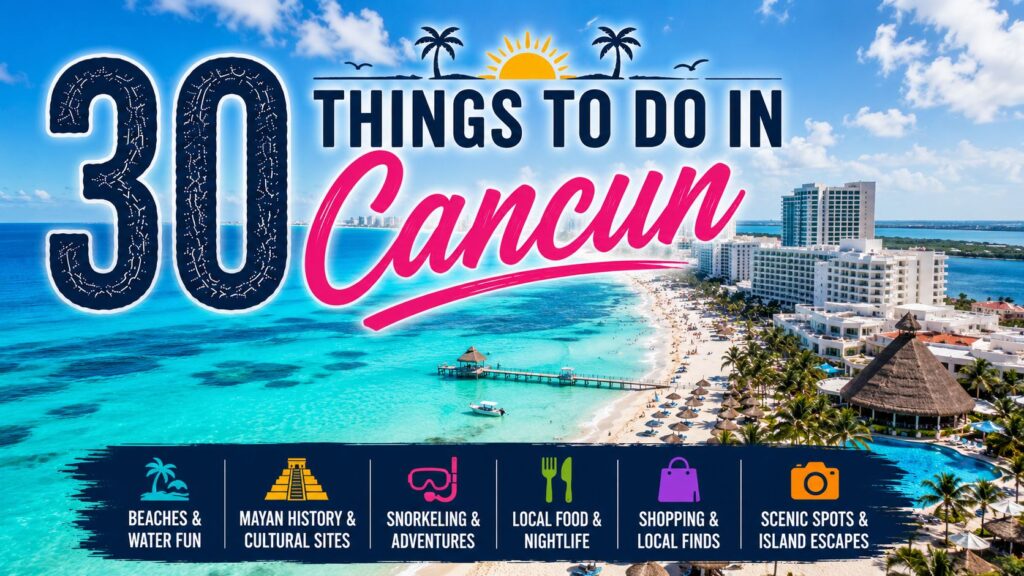
The Cancun Hotel Zone is a 22-kilometer sandbar. That is the geographic fact the all-inclusive resort industry was built around – a narrow strip of Caribbean coastline so perfectly positioned between the turquoise sea and the calm Nichupte Lagoon that developers in the 1970s recognized it as the most buildable beach real estate in the Western Hemisphere and built accordingly. Today the Hotel Zone has more than 150 resorts, a Costco, a Walmart, and a Señor Frog’s. It also has some of the most consistently beautiful Caribbean water on the continent, a barrier reef 600 meters offshore that is part of the second longest coral reef system in the world, and Mayan ruins inside the Hotel Zone itself that most guests of the surrounding five-star resorts walk past on their way to the pool bar. What the Hotel Zone does not have is the Yucatan Peninsula – the jungle, the cenotes, the pyramid cities, the underground rivers, and the specific Mexican culture that exists 20 minutes south of the resort strip and that most Cancun visitors return home never having touched. I have been to Cancun seven times across twelve years. The sandbar is beautiful. The peninsula behind it is extraordinary. This guide covers both – all 30 things worth doing, written in strict numerical order from 1 through 30, with current 2026 pricing and honest practical advice for every single one.
For more warm-weather travel destination guides, read our things to do in Hawaii and our things to do in Honolulu.
Cancun At a Glance: Quick Reference Table
| # | Activity | Area | Entry | Duration | Best For | Best Time |
|---|---|---|---|---|---|---|
| 1 | Playa Delfines | Hotel Zone, km 17.5 | Free | 2 to 4 hours | All visitors, locals beach | Morning before 10 AM |
| 2 | Isla Mujeres Day Trip | Ferry from Hotel Zone | $28 USD round trip adults | Full day | Families, beach lovers | Weekdays year-round |
| 3 | Chichen Itza Day Trip | 2.5 hrs from Cancun | 646 MXN (~$33 USD) total entry | Full day | History lovers, all visitors | Depart by 7 AM |
| 4 | Cenote Swimming | Riviera Maya, 30-90 min away | $15 to $35 per person | 2 to 4 hours | Swimmers, nature lovers, families | Morning year-round |
| 5 | MUSA Underwater Museum | Hotel Zone / Isla Mujeres waters | $50 to $120 (snorkel or dive tour) | 3 to 4 hours | Snorkelers, divers, art lovers | Year-round morning tours |
| 6 | Nichupte Lagoon Jungle Boat Tour | Hotel Zone, lagoon side | $45 to $65 per person | 2 hours | Active visitors, families | Morning year-round |
| 7 | Mercado 28 | Downtown Cancun | Free entry | 1.5 to 2 hours | Local shoppers, food lovers | Morning year-round |
| 8 | Museo Maya de Cancun | Hotel Zone, km 16.5 | ~$4 USD (70 MXN) | 1.5 to 2 hours | History and culture lovers | Weekday mornings |
| 9 | Playa Gaviota Azul | Hotel Zone, km 9 | Free | 2 to 3 hours | Calm water swimmers, families | Morning year-round |
| 10 | Coco Bongo Nightclub | Hotel Zone | $50 to $80 (includes open bar) | 3 to 4 hours | Nightlife seekers, first-timers | Thursday to Sunday evenings |
| 11 | Xcaret Eco-Archaeological Park | Riviera Maya, 75km south | $119 to $159 adults | Full day | Families, culture lovers | Year-round; book in advance |
| 12 | El Rey Archaeological Zone | Hotel Zone, km 18 | ~$4 USD (70 MXN) | 1 to 1.5 hours | History buffs, iguana spotters | Early morning year-round |
| 13 | Xel-Ha All-Inclusive Snorkel Park | Riviera Maya, 120km south | $99 to $130 adults | Full day | Families, swimmers, snorkelers | Year-round |
| 14 | Catamaran Tour to Isla Mujeres | Hotel Zone marina | $65 to $95 per person | Full day | Groups, families | Year-round |
| 15 | Tulum Archaeological Zone | Tulum, 130km south | ~$5 USD (90 MXN) | 2 to 3 hours | History lovers, coastal photography | Early morning; opens 8 AM |
| 16 | Whale Shark Tour | Offshore Cancun and Holbox | $150 to $200 per person | Full day | Wildlife lovers | June to September only |
| 17 | Playa Norte – Isla Mujeres | Isla Mujeres | Free (ferry extra) | 2 to 4 hours | Beach connoisseurs | Morning year-round |
| 18 | La Isla Shopping Village | Hotel Zone, km 12.5 | Free entry | 1.5 to 2 hours | Shoppers, evening strollers | Evening year-round |
| 19 | Coba Archaeological Zone | Coba, 165km southwest | ~$5 USD (90 MXN) | 3 to 4 hours | Hikers, serious ruin lovers | Opens 8 AM; morning arrival |
| 20 | Captain Hook Pirate Dinner Cruise | Hotel Zone marina | $55 to $85 adults | 3 hours | Families, couples | Tuesday to Sunday evenings |
| 21 | Cancun Downtown Food Tour | El Centro, downtown | $35 to $55 per person | 2.5 to 3 hours | Food lovers, culture seekers | Evening year-round |
| 22 | Xoximilco Cancun | Near Cancun airport | $90 to $115 adults | 3 hours | Groups, culture lovers | Thursday to Sunday evenings |
| 23 | San Miguelito Archaeological Zone | Hotel Zone, km 16.5 | Included with Museo Maya | 45 to 60 minutes | History and archaeology fans | Morning year-round |
| 24 | Isla Holbox Day Trip | 2.5 hrs from Cancun | $25 to $40 ferry | Full day | Off-the-beaten-path seekers | Year-round; whale sharks June-Sept |
| 25 | Chankanaab Beach Adventure Park | Cozumel, ferry from Playa del Carmen | $43 adults | Full day | Snorkelers, families | Year-round morning |
| 26 | Valladolid Day Trip | 160km west of Cancun | Free to explore | Half to full day | Colonial town lovers, foodies | Year-round |
| 27 | Laguna Nichupte Kayaking | Hotel Zone | $20 to $35 rental per hour | 1.5 to 2 hours | Active visitors, sunset seekers | Late afternoon |
| 28 | Cancun Downtown Street Food Walk | El Centro, downtown | Free (food $10 to $20) | 2 to 3 hours | Budget travelers, local food seekers | Evening year-round |
| 29 | Swim with Dolphins | Hotel Zone / Isla Mujeres | $79 to $150 per person | 1.5 to 2 hours | Families, children | Year-round |
| 30 | Cirque du Soleil JOYA | Riviera Maya, Xcaret complex | $99 to $199 per person | 2 hours | Adults, couples, culture lovers | Thursday to Sunday evenings |
1. Playa Delfines
Area: Hotel Zone, km 17.5, Boulevard Kukulcan | Entry: Free | Duration: 2 to 4 hours | Best time: Morning before 10 AM; Sunday mornings for the most local atmosphere; sunset for photography
Playa Delfines is Cancun’s largest free public beach and the one that most accurately represents what the Caribbean looks like without the resort infrastructure built directly beside it. At kilometer 17.5 at the southern end of the Hotel Zone, Delfines sits beyond the densest cluster of all-inclusive resorts and has a long stretch of open shoreline with the Hotel Zone skyline visible to the north and an unobstructed horizon to the east. The beach has palapas, a parking lot, public restrooms, and the “Cancun” letter sign installation that is the most photographed non-archaeological landmark in the city. The waves here are stronger than at the northern Hotel Zone beaches because Delfines faces northeast and catches direct Caribbean swell without the protection of the barrier reef – the red-yellow-green flag warning system enforced by lifeguards is reliable and worth reading before entering the water.
This is the beach where Cancun’s 900,000 permanent residents actually spend their weekends. On Sunday mornings, the palapas are occupied by local families with coolers and grills, the parking lot has the cars of people who drove from El Centro rather than the Hotel Zone, and the social atmosphere is the most genuinely Mexican of any beach accessible in the Hotel Zone corridor. The iguanas that live in the scrub vegetation behind the palapas, the brown pelicans working the shore break, and the specific turquoise color of the Caribbean at this latitude unmediated by a swim-up bar are the version of Cancun that the resort brochures are trying to photograph. Playa Delfines is the beach that Cancun’s own residents come to on their days off, where the Caribbean is as beautiful as anything in the Hotel Zone and the experience costs nothing and the only infrastructure is a palapa and the flag system – and it is the correct first morning in Cancun because it establishes what is actually here before the resort programming tells you what to see.
Practical tips:
- Arrive before 8 AM on summer weekends to claim a palapa with shade – the free palapa structures fill completely by 10 AM on Saturday and Sunday, and arriving after that means shade-free sand in Caribbean summer heat, which is a genuinely uncomfortable experience without preparation.
- The R-2 and R-15 public buses run the full 22-kilometer length of the Hotel Zone on Kukulcan Boulevard for 10 MXN per ride (approximately $0.60 USD) and stop directly at Playa Delfines – using the public bus eliminates taxi negotiation entirely and is how Cancun’s service workers and local families actually travel the Hotel Zone.
- The “Cancun” letter installation photo is best taken at 7 AM when there is no queue and the morning Caribbean light comes from the east directly behind the letters – arriving at midday puts the sun behind you and the photo into flat overhead light, while the morning shot has the Caribbean’s best color behind the installation.
2. Isla Mujeres Day Trip
Area: 13km off the Cancun Hotel Zone coast; ferry from Hotel Zone pier or Puerto Juárez | Entry: $28 USD round trip adults, $21 USD children (Xcaret Xailing ferry from Hotel Zone) | Duration: Full day | Best time: Weekdays to avoid weekend crowds; year-round
Isla Mujeres is a 7-kilometer-long, half-kilometer-wide island 13 kilometers off the Cancun Hotel Zone coast, accessible by ferry in approximately 20 minutes. The island was the first point of land in Mexico encountered by Spanish explorers in 1517 and takes its name from the clay female figurines they found at a Mayan shrine on the southern point. Today it is a car-free community with a year-round population of approximately 13,000 people, Playa Norte (one of the most consistently cited beaches in the Caribbean), excellent snorkeling directly from shore, multiple beach clubs over the water with hammocks, fresh seafood at street-side operations, and a social pace that is categorically different from the Hotel Zone resort strip 13 kilometers away. A golf cart rental ($40 to $60 for 3 to 4 hours) from the ferry landing gives you the island’s full circuit from El Centro to Punta Sur in a morning.
The ferry to Isla Mujeres operates from two Hotel Zone departure points and from Puerto Juárez downtown. The Hotel Zone pier at km 4 (Xcaret Xailing) runs the most convenient service for resort guests at $28 USD round trip for adults. The Puerto Juárez ferry from downtown runs more frequent service at lower prices (approximately 200 MXN round trip) and is the option locals use. Both cross the same channel in the same 20 minutes. The island has three genuinely distinct experiences worth building a day around: the town of El Centro with its food operations, the northern Playa Norte beach, and the southern Punta Sur cliff section with the small Maya temple and lighthouse. All three require the golf cart or a willingness to walk further than Caribbean heat makes comfortable.
Isla Mujeres is the specific answer to the question of what Cancun looks like when you strip away the all-inclusive model – a small Mexican Caribbean island with genuine community character, colorful buildings, street-side ceviche operations, hammocks over the water, and a pace of life that the Hotel Zone does not attempt to replicate, accessible in 20 minutes by ferry from the resort strip.
Practical tips:
- Rent a golf cart immediately after stepping off the ferry at the landing in El Centro – the rental operations on Hidalgo Street directly beside the ferry dock charge $40 to $60 for 3 to 4 hours and the cart is the correct way to see Punta Sur, the turtle farm, and the sculpture garden at the southern end that the 7-kilometer length makes impractical to walk in heat.
- The last ferry from Isla Mujeres back to the Hotel Zone departs in the early evening – confirm the final departure time from the ferry staff when you arrive on the island, as missing the last boat means either a longer route back or an unplanned overnight on Isla Mujeres.
- Eating at the street-side ceviche and taco operations on Hidalgo Street in El Centro costs a fraction of the beach club menus – a full plate of fresh ceviche with tostadas runs 80 to 120 MXN ($4 to $6 USD) at the market operations, versus $18 to $25 for comparable seafood at the Hotel Zone restaurants.
3. Chichen Itza Day Trip
Area: Yucatan State, 200km from Cancun; approximately 2.5 hours by car or tour bus | Entry: 646 MXN total (~$33 USD) – two separate fees at entrance | Duration: Full day | Best time: Arrive at 8 AM opening; avoid 10 AM to 2 PM peak crowd hours
Chichen Itza is a UNESCO World Heritage Site and one of the New Seven Wonders of the World – a late Classic and early Postclassic Maya city that was the dominant political and ceremonial center of the northern Yucatan from roughly 600 AD to 1100 AD and reached a population estimated at 50,000 at its height. The site covers 4 square kilometers and includes El Castillo (the 30-meter stepped pyramid whose shadow creates a serpent effect on the spring and autumn equinoxes), the Great Ball Court (the largest in Mesoamerica, with acoustic properties that amplify a handclap at the center into a sound resembling a quetzal bird), El Caracol (an astronomical observatory designed to track Venus), and the Sacred Cenote where jade, gold, and human remains were offered to the rain deity Chaac over centuries of ceremonial use.
The 2026 entry fee structure has changed from previous years. The total admission is 646 MXN (approximately $33 USD), split into two mandatory payments collected separately at the entrance gate: 571 MXN for the Yucatan state CULTUR fee and 75 MXN for the federal INAH archaeological zone fee. Both must be paid. Tour packages from the Hotel Zone frequently list only one of these fees, which is the most common source of “the tour didn’t include the full entry” complaints. Confirm both fees are covered before paying for any tour desk package. The most important single logistics decision for Chichen Itza is arrival time – departing Cancun by 7 AM means arriving at the 8 AM site opening with 2 hours before the tour buses from Hotel Zone hotels begin arriving at 10 to 11 AM.
Chichen Itza visited at 8 AM opening, before the tour buses arrive at 10 AM and before the temperature climbs into full afternoon heat, is a genuinely different archaeological experience from the same site at midday – El Castillo with 30 other people in the surrounding plaza is one of the more specifically powerful historic encounters available from Cancun; El Castillo surrounded by 2,000 people at noon is a crowd management exercise.
Practical tips:
- You must pay both the INAH federal fee (75 MXN) and the CULTUR state fee (571 MXN) separately at the entrance – if purchasing a tour package from a Hotel Zone tour desk, confirm explicitly in writing that both fees are included, as the typical source of “entry not included” complaints is the tour desk selling only one of the two required payments.
- The archaeological site provides almost no shade on the main ceremonial plazas – Chichen Itza’s open limestone areas in full sun from 10 AM onward reach temperatures that feel 15 to 20 degrees hotter than the air temperature; a wide-brim hat, minimum 2 liters of water per person, and reef-safe sunscreen are non-negotiable rather than optional.
- Cenote Ik Kil, located 3 kilometers from the Chichen Itza entrance on the same access road, is typically included in organized day tour packages and is the most photographically dramatic cenote accessible as part of the Chichen Itza day – the circular open-air sinkhole with hanging roots and a 26-meter drop to the water is a genuine addition to the itinerary rather than a bolted-on stop.
4. Cenote Swimming
Area: Riviera Maya corridor, 30 to 90 minutes from Cancun Hotel Zone | Entry: $15 to $35 per person depending on cenote | Duration: 2 to 4 hours | Best time: Morning arrivals for the best light in open-air cenotes; biodegradable sunscreen required
Cenotes are freshwater sinkholes formed by the collapse of the limestone ceiling above the Yucatan’s underground river system – the world’s largest network of subterranean rivers, stretching approximately 400 kilometers through the Yucatan Peninsula below the jungle floor. More than 6,000 cenotes have been documented in the Yucatan, ranging from open circular pools with jungle canopy overhead to fully enclosed cavern systems accessible only by diving through underwater passages. The water in all of them is the same: crystalline, 24 to 25 degrees Celsius year-round, fed by rainfall filtered through limestone for decades before reaching the pool, and clear to depths that the eye cannot fully credit on first view. The most accessible cenotes from Cancun are the Ruta de los Cenotes near Puerto Morelos (30 to 40 minutes from the Hotel Zone), Gran Cenote near Tulum (90 minutes), and Cenote Dos Ojos near Tulum (90 minutes).
The specific experience of swimming in a Yucatan cenote – dropping into water so clear that a 20-meter-deep floor is visible in full detail, with roots descending from the jungle above and shafts of light entering through the natural skylight opening, in water that stays the same temperature whether it is July or January because it has never seen the surface – is the most uniquely Yucatecan thing you can do from a Cancun hotel. The organized cenote day-trip packages sold by Hotel Zone tour desks charge $80 to $120 per person. The independent approach – a taxi to the Ruta de los Cenotes outside Puerto Morelos and direct entry at the cenote – costs $15 to $25 in admission plus $20 to $30 in transportation, making it the better economic choice for any group of two or more.
Swimming in a Yucatan cenote for the first time produces a specific perceptual recalibration about water clarity that no pool or ocean experience prepares you for – the combination of 25-degree water, 20-meter visibility, and the specific underground-river geology of the Yucatan creates a swimming environment that exists nowhere else on earth and is available 30 minutes from any Hotel Zone hotel.
Practical tips:
- Apply only biodegradable sunscreen before entering any cenote – the Yucatan’s cenote system connects underground to the coastal reef, and standard chemical sunscreens (containing oxybenzone and octinoxate) have been linked to coral bleaching and aquatic ecosystem damage; biodegradable alternatives are sold at every cenote entrance for $5 to $8 if you do not bring your own.
- Cenote Dos Ojos near Tulum has 61 kilometers of mapped underwater passage and accessible snorkel routes through the first cavern chamber that are suitable for non-divers with a guide – the bioluminescent sections of the cavern visible by flashlight and the cathedral-like scale of the underwater chambers make it the most dramatically impressive cenote accessible from Cancun.
- The Ruta de los Cenotes (Puerto Morelos exit on Highway 307, 30 to 40 minutes from the Hotel Zone) is a 12-kilometer road passing more than a dozen cenotes at individual admission prices of $10 to $20 – significantly less expensive than the organized tour packages and accessible by taxi from the Hotel Zone without needing a rental car.
5. MUSA Underwater Museum of Art
Area: Waters between Cancun Hotel Zone and Isla Mujeres | Entry: $50 to $120 per person depending on snorkel vs. dive tour | Duration: 3 to 4 hours | Best time: Year-round morning tours; best visibility April through June
MUSA (Museo Subacuático de Arte) is an ongoing underwater art installation in the waters between the Cancun Hotel Zone and Isla Mujeres, containing more than 500 life-size sculptures submerged at depths ranging from 4 meters (accessible to snorkelers) to 9 meters (dive access only). The project was conceived simultaneously as an art museum and a coral reef conservation initiative – the sculptures were made from pH-neutral marine-grade concrete specifically designed to encourage coral growth, and after more than a decade in the water, the most established pieces are now fully covered in living coral, sea fans, and tropical fish. The collection includes Jason deCaires Taylor’s most famous Yucatan work, including the Recuerdos installation of 450 life-size human figures arranged in a circular field on the ocean floor – an installation that has appeared in National Geographic and that creates a specific spatial experience of moving through a crowd of statues 9 meters underwater.
Tours to MUSA depart from the Hotel Zone marina and from Isla Mujeres operators, running as snorkel-surface tours for the Manchones Reef shallow gallery (4 meters, $50 to $70 per person) and as guided dives for the deeper Jason deCaires Taylor collection ($90 to $120 per person with equipment). Both versions include time at the reef sections where the coral-encrusted sculptures are most established. The morning light angle – sun coming from the east in the first hours after 8 AM – produces the best underwater visibility and the most photogenic light conditions for the sculptures; afternoon visits have flatter light and occasionally more suspended particles in the water from boat traffic.
MUSA is the only underwater art museum in the world where the sculptures have been in place long enough to become genuine coral reef habitat – pieces that were bare concrete in 2009 are now living reefs hosting fish and coral in 2026, which means the art installation and the reef conservation project have become inseparable, and what you are swimming through is simultaneously contemporary art and functioning marine ecosystem.
Practical tips:
- The snorkel tour ($50 to $70) accesses the shallower Manchones section of MUSA at 4 meters depth and is suitable for non-divers who can swim and use a snorkel – the most photographed individual sculpture, the Recuerdos circular field, is in the deeper dive-access section, so confirm which specific sculptures are included in your tour before booking.
- Book MUSA tours through Hotel Zone marina operators or through Isla Mujeres tour operators rather than through the Hotel Zone tour desks – the marina and island operators typically have smaller group sizes and more experienced guides than the mass-market Hotel Zone desk packages, and the MUSA experience is significantly better with 8 to 12 swimmers than with 30.
- Underwater photography at MUSA requires either a waterproof camera or a waterproof phone case – rental underwater cameras are available from some operators but the quality is inconsistent; bringing your own waterproof setup produces reliably better results than relying on rental equipment.
6. Nichupte Lagoon Jungle Boat Tour
Area: Hotel Zone lagoon side, Kukulcan Boulevard | Entry: $45 to $65 per person | Duration: 2 hours | Best time: Morning for wildlife; afternoon for mangrove light
The Nichupte Lagoon is the body of calm, green-tinted water on the western side of the Hotel Zone sandbar, separated from the Caribbean by the 22-kilometer strip of resort hotels. While the Caribbean side of the sandbar draws the beach and resort attention, the lagoon side holds a functioning mangrove ecosystem with crocodiles, herons, roseate spoonbills, frigatebirds, and the specific wildlife character of a protected tropical estuary that the resort infrastructure on the eastern side does not attempt to preserve. The Nichupte Lagoon jungle boat tours depart from multiple Hotel Zone launch points in shallow-draft motorboats that navigate the mangrove channels, entering sections of the lagoon where the mangrove canopy closes overhead and the only sounds are birds and the low-horsepower motor.
The crocodile population in the Nichupte Lagoon is real and regularly encountered on morning tours – American crocodiles up to 2 meters resting on mangrove banks in the early morning sun are the tour’s wildlife centerpiece, and the guides know which channels have the most reliable sightings. The birdlife in the mangroves includes species that Hotel Zone resort guests never see from their beach chairs: roseate spoonbills with their distinctive pink plumage, great blue herons, black-crowned night herons, and the occasional frigate bird soaring above the tree line. The 2-hour circuit typically covers the main mangrove channels, a wide section of open lagoon with the Hotel Zone skyline visible across the water, and a return through the narrower interior passages where the vegetation density is highest.
The Nichupte Lagoon boat tour is the experience that most effectively reframes the Hotel Zone’s geography for visitors who have been looking at the Caribbean all week – the same sandbar that holds the resort strip has an entirely different ecosystem on its western face, and spending 2 hours in the mangroves with crocodiles and tropical birds changes the mental map of what Cancun actually is.
Practical tips:
- Morning departures (8 AM to 10 AM) have the highest crocodile activity – the reptiles are cold-blooded and spend the early morning hours basking on exposed roots and banks before retreating to the water as temperatures rise; afternoon tours see fewer animals in their most visible positions.
- Tours are run by multiple operators from Hotel Zone launch points at km 4, km 8, and km 14 – the smaller operators with boats carrying 8 to 12 people provide a more wildlife-focused experience than the larger catamaran operations that combine the lagoon tour with open bar service, which prioritizes the party experience over the natural history component.
- Bring insect repellent for the mangrove channel sections – the interior passages with the densest wildlife are also the most sheltered from wind, and the mosquito pressure in the mangroves during calm morning hours is significant without protection.
7. Mercado 28
Area: Downtown Cancun (El Centro), SM 28 near Avenida Yaxchilan | Entry: Free | Duration: 1.5 to 2 hours | Best time: Morning year-round; avoid Sunday when some vendors close early
Mercado 28 is an outdoor and covered market in downtown Cancun organized around a central plaza, with approximately 200 permanent vendor stalls selling handicrafts, textiles, jewelry, hammocks, ceramics, vanilla, spices, and food from across Mexico. It operates as a functioning community market for the 900,000 residents of Cancun’s downtown – the people who work in the Hotel Zone’s resorts and restaurants, the families who have lived here since before the resort strip was built, and the local economy that exists independently of the all-inclusive model. The restaurant section around the market’s central plaza serves some of the most affordable and authentically Mexican food accessible from Cancun – cochinita pibil (slow-roasted pork in achiote and citrus, the Yucatan’s signature dish), seafood tostadas, fresh agua fresca, and antojitos at prices a fraction of what equivalent food costs in the Hotel Zone.
The standard Mercado 28 cochinita pibil at the taqueria stalls in the central plaza costs 60 to 80 MXN ($3.50 to $4.50) per plate versus $18 to $25 for a comparable Yucatecan plate at a Hotel Zone restaurant. The quality at the market stalls is equal or superior because the kitchen feeds local regulars rather than resort guests, and the tortillas are made fresh throughout the day. Bargaining at the handicraft stalls is expected and appropriate – the opening price is typically 40 to 60 percent above the seller’s acceptable price, and politely counter-offering at 60 to 70 percent of the asking price is the conventional starting point for negotiation. The taxi from the Hotel Zone to Mercado 28 costs 80 to 120 MXN ($5 to $7 USD), or Uber operates reliably in Cancun at slightly lower rates.
Mercado 28 is the 20-minute taxi ride that most Cancun visitors never take and that those who have been multiple times universally say they wish someone had told them about on the first trip – the Hotel Zone has better pool bars and the market has better food, lower prices, and the only version of Cancun shopping that reflects what the city actually produces rather than what the resort gift shops curate.
Practical tips:
- The cochinita pibil at the central plaza taqueria stalls is the single best food purchase in the Mercado 28 experience – order it with the habanero salsa on the side rather than on the meat, as the Yucatan habanero is genuinely hot and controlling the amount preserves the flavor of the achiote-roasted pork rather than masking it.
- Most Mercado 28 handicraft vendors accept USD as well as MXN, but the exchange rate they apply is typically 10 to 15 percent less favorable than the official rate – paying in MXN at the market gives you full value, and ATMs in downtown Cancun dispense pesos at bank rates significantly better than the Hotel Zone exchange booths.
- Mercado 23, a smaller and less tourist-facing market approximately 500 meters from Mercado 28 on Avenida Tulum, has a produce section and food stalls that are almost entirely used by Cancun residents rather than visitors – worth a 10-minute walk from Mercado 28 to see the difference between a market organized for tourism and one organized for daily local use.
8. Museo Maya de Cancun
Area: Hotel Zone, km 16.5, Boulevard Kukulcan | Entry: 70 MXN (~$4 USD) | Duration: 1.5 to 2 hours | Best time: Weekday mornings; combine with San Miguelito Archaeological Zone next door
The Museo Maya de Cancun is the most comprehensive Maya museum in the Cancun region, holding more than 350 pieces of jade, ceramics, obsidian tools, and burial remains from Maya sites across Quintana Roo and the Yucatan Peninsula. The museum opened in 2012 and occupies a purpose-built structure at kilometer 16.5 of the Hotel Zone, directly adjacent to the San Miguelito Archaeological Zone (covered at activity 23), with three exhibition halls covering the pre-Classic period, the Classic period, and a rotating exhibition hall for temporary collections. The permanent collection includes significant jade pieces recovered from the Sacred Cenote at Chichen Itza, ceramic burial vessels from multiple Quintana Roo sites, and skeletal remains with stucco dental modifications that show the specific body modification practices of Classic-period Maya aristocracy.
At 70 MXN ($4 USD), the Museo Maya de Cancun is the single best-value paid experience in the Hotel Zone – a museum with genuine national-significance collections occupying the same boulevard as the five-star resorts, priced at less than the cost of a single cocktail at any of those resorts. The museum is air-conditioned, well-lit, and bilingual (Spanish and English) throughout, making it a practical choice on hot afternoons when beach activity is uncomfortable, and one of the most substantive cultural experiences available without leaving the Hotel Zone. The combined ticket covering both the museum and the adjacent San Miguelito Archaeological Zone is included in the single 70 MXN admission price.
The Museo Maya de Cancun holds a national-significance collection of Maya artifacts at a price point lower than the Hotel Zone’s cheapest beach cocktail – 350-plus pieces of jade, obsidian, ceramic burial vessels, and human remains that contextualize the Chichen Itza and Tulum sites you may be visiting during your trip, making it the single best-value paid experience in the Hotel Zone and the one most consistently skipped by visitors who walk past it on the way to the beach.
Practical tips:
- Visit the Museo Maya de Cancun before rather than after visiting Chichen Itza or Tulum – the museum’s chronological exhibition halls provide cultural and historical context for the archaeological sites that significantly deepens the experience of being at those sites rather than serving as a follow-up summary.
- The museum is fully air-conditioned and operates year-round on a consistent schedule from 9 AM to 7 PM Tuesday through Sunday (closed Mondays) – it is the most practical Hotel Zone activity for the hottest midday hours of summer when beach conditions are uncomfortable and outdoor activities are impractical.
- The rotating third exhibition hall changes approximately every 3 to 4 months with new collections from national Mexican museums – check the current exhibition at the entrance before your visit, as a temporary collection from the Anthropology Museum in Mexico City or the Merida regional museum is occasionally on display and substantially expands what the permanent collection alone provides.
9. Playa Gaviota Azul
Area: Hotel Zone, km 9, Forum by the Sea area | Entry: Free | Duration: 2 to 3 hours | Best time: Morning year-round; calmer water than southern beaches
Playa Gaviota Azul is at the northern curve of the Hotel Zone’s J-shaped layout, where the sandbar bends and the water calms due to the protection offered by the curving shoreline and the reef system to the east. The beach is adjacent to the Forum by the Sea shopping complex and the Señor Frog’s entertainment complex, which makes the surrounding commercial infrastructure louder than Playa Delfines, but the water itself – warm, the specific turquoise of the shallow Caribbean over white limestone sand, and calm enough for non-swimmers to stand in – is the most consistently swimmable section of the Hotel Zone for families with young children who cannot safely enter the stronger surf at the southern beaches. The beach chairs and umbrellas from the adjacent hotel beach clubs are rentable to non-guests at $15 to $25 per person with a minimum food and drink spend.
The specific visual quality of Playa Gaviota Azul in the morning before 9 AM – when the hotel beach chair operations have not yet set up and the natural beach is visible in its uncluttered state, and the Caribbean light comes from the east across the flat water in the bay – is the version of the Hotel Zone beach that appears in the resort marketing materials, and it is genuinely that good in those first hours. The parasail operators who run from this beach charge $45 to $65 per person for a 10 to 15-minute ride above the Hotel Zone, and the aerial view of the 22-kilometer sandbar with the Caribbean on one side and the green-blue Nichupte Lagoon on the other is the fastest way to understand the geography that defines everything about Cancun’s tourism identity.
Playa Gaviota Azul in the morning before 9 AM, when the calm protected Caribbean water is flat and the specific turquoise color comes from the white limestone seafloor reflecting the early light, is the Hotel Zone beach that the resort photographs are attempting to represent – and it is actually that color, that calm, and that specific, which is not always true of the places that become tourist clichés.
Practical tips:
- The hotel beach clubs adjacent to Gaviota Azul (Mandala Beach Club, Taboo Beach Club) rent loungers and umbrellas to non-resort guests at $15 to $25 per person with a minimum food and drink spend – this is significantly less expensive than the all-inclusive model for a half-day beach access and provides table service on the same physical beach.
- The water color at Gaviota Azul and the northern Hotel Zone beaches is the direct result of the white limestone seafloor reflecting Caribbean light at shallow depths – the color is most saturated on clear mornings from November through April when the sun angle is lower and more directional, and least saturated in the cloudy periods of September and October hurricane season.
- The R-1 Hotel Zone bus stops directly at the Forum by the Sea entrance adjacent to Playa Gaviota Azul for 10 MXN per ride – the bus covers the full Hotel Zone length and makes the beach accessible from any Hotel Zone hotel without requiring a taxi.
10. Coco Bongo Nightclub
Area: Hotel Zone, Forum by the Sea, km 9.5, Boulevard Kukulcan | Entry: $50 to $80 USD including open bar | Duration: 3 to 4 hours | Best time: Thursday to Sunday; arrive no earlier than 11 PM; peak energy 1 to 3 AM
Coco Bongo is not a nightclub in any standard sense of the word. It is a 3,000-capacity theatrical venue on three levels where, from 11 PM onward, the music alternates between DJ sets and live performance segments featuring aerial acrobats performing 20 meters above the crowd, Broadway-style dancers, musical impersonators covering Michael Jackson, Shakira, ABBA, and whoever else the current production schedule includes, while confetti and foam cannons run continuously and the open bar operates until 4 AM. The venue has been operating continuously since 1995 and is the single most visited paid entertainment experience in the Hotel Zone by total annual throughput. The two reviews that coexist about Coco Bongo are both accurate: it is the best night of some people’s vacation, and it is an overwhelming tourist production for others. The difference is calibration – if you arrive understanding you are going to a 3,000-person theatrical party rather than a club experience, it is genuinely impressive.
The admission of $50 to $80 USD includes the open bar for the full evening, which is the economic reality that makes it functional as a night out compared to separately purchasing cover and drinks at any Hotel Zone bar that approaches the same production level. The admission price fluctuates by night – Friday is peak pricing, Thursday and Sunday are lower – and the tickets purchased directly at the Coco Bongo box office on Kukulcan Boulevard are typically the same price or cheaper than the same tickets bought through Hotel Zone tour desks. The box office opens at 9 PM and the official opening time is 10:30 PM, but the energy does not reach its characteristic intensity until after midnight.
Coco Bongo is the specific Cancun experience that requires correct expectation calibration before arrival – if you expect a 3,000-person theatrical party with aerial acrobats, confetti cannons, an open bar, and rotating celebrity impersonators at levels of production that a 29-year-old venue in a Mexican resort city has had three decades to refine, you will have an excellent time; if you expect a club with good music, you are in the wrong building.
Practical tips:
- Arrive no earlier than 11 PM regardless of what time the box office sells you a ticket – the venue officially opens at 10:30 PM but the crowd, the energy, and the performance programming all build through midnight, and arriving at 10:30 PM means 90 minutes in a filling venue before the experience the admission price is actually paying for begins.
- The dress code is casual by nightlife standards – shorts and sandals are generally acceptable, the Hotel Zone dress code for most venues reflects the beach resort context and is significantly more relaxed than comparable venues in Miami or Mexico City, and the practical concern is footwear that can handle a sticky venue floor after foam cannons.
- Coco Bongo has a second location in Playa del Carmen that operates on the same format with a smaller capacity and a different crowd mix – worth knowing if the Cancun Hotel Zone location is sold out on your specific night, as the Playa del Carmen version is 65 kilometers south on Highway 307.
11. Xcaret Eco-Archaeological Park
Area: Riviera Maya, 75km south of Cancun Hotel Zone | Entry: $119 to $159 adults (Plus package recommended) | Duration: Full day | Best time: Year-round; book tickets online in advance; underground river before 11 AM**
Xcaret is a 50-hectare eco-archaeological park on the Riviera Maya operated by the Experiencias Xcaret group, with a mix of natural attractions – underground river snorkel, cenotes, coral reef snorkeling, flamingo lagoon, butterfly pavilion, wildlife sanctuaries with jaguars and spider monkeys – and cultural programming including traditional Mexican performances, Mayan archaeological sites reconstructed within the park, and regional food from multiple Mexican states. The park’s most popular single attraction is the underground river float – a 600-meter swim through a limestone cavern on a life vest with natural rock formations overhead and the specific underground-light quality of a cave river that has sunlight reaching it from multiple sinkholes above. The evening show “Mexico Espectacular” runs at sunset and covers 3,000 years of Mexican history in a 2-hour theatrical production that uses the park’s outdoor amphitheater as the stage.
The “Plus” package ($139 to $159) that adds unlimited food and beverages throughout the day converts the park into an all-in cost that is competitive with a comparable Hotel Zone beach day with meals and activities. The base admission ($119) covers most attractions but not food. For families planning a full day, the Plus package is the better economic choice – a single restaurant meal at Xcaret runs $20 to $35 per person, and multiple visits to the food stations through a 10-hour day make the Plus package’s additional cost recover within the first two meals. The free shuttle from Hotel Zone hotels is included with advance online bookings at xcaret.com, departing at 7:30 AM and returning at park close.
Xcaret’s underground river float – a 600-meter swim through a limestone cavern on a life vest, with natural rock formations overhead and shafts of light entering from sinkholes above, in the clear warm water of the Yucatan underground river system – is the single attraction that consistently produces the highest visitor satisfaction rating in the entire Riviera Maya park system, and arriving at the river entrance at park opening before the queue builds is the most important logistics decision of the Xcaret day.
Practical tips:
- Book tickets online at xcaret.com at least 3 to 5 days in advance for weekend and holiday period visits – the park manages daily capacity and peak-season days reach capacity with walk-up entry limited or unavailable; Saturday during Mexican school holidays and spring break are the highest-demand dates.
- Enter the underground river at park opening (8:30 AM) to float the 600-meter passage with minimal traffic – the river fills with visitors after 11 AM and the flow through the cavern later in the day produces a slower, more crowded experience with less opportunity to stop and observe the formations.
- The jaguar island section of Xcaret, where resident jaguars are visible from the surrounding walkway in a naturalistic habitat, is the most wildlife-specific component of the park and is most active in the morning before 11 AM – combining the underground river and jaguar island as the first two stops of the day uses the optimal wildlife activity window before the crowds peak.
12. El Rey Archaeological Zone
Area: Hotel Zone, km 18, Boulevard Kukulcan | Entry: 70 MXN (~$4 USD) | Duration: 1 to 1.5 hours | Best time: Early morning year-round; best iguana activity before 10 AM
El Rey is a small Postclassic Maya ceremonial site (900 to 1500 AD) inside the Hotel Zone at kilometer 18, containing 47 structures including temples, platforms, and a royal tomb – and it is also home to the largest urban iguana colony in Cancun. Hundreds of green iguanas use the ancient stone platforms as their personal sun terraces, and these animals are completely habituated to human visitors after decades of coexistence on an archaeological site surrounded by resort hotels. Adult male iguanas reach 1.5 meters in length and perform territorial displays from the top of the platform structures; juvenile iguanas are visible in the ground vegetation between the ruins. The combination of a genuine Postclassic Maya site with consistent, close-range iguana encounters makes El Rey the most reliably entertaining Hotel Zone experience for families with children, at an admission price lower than a single Hotel Zone ice cream cone.
At 70 MXN ($4 USD), El Rey is the same admission price as the Museo Maya de Cancun next door on the Kukulcan Boulevard, and the combined visit to both (the museum at km 16.5 and El Rey at km 18) makes a complete morning of Hotel Zone history and culture that costs $8 USD total. Most guests of the surrounding five-star resorts walk past the El Rey entrance sign on their way to the beach without knowing what it is. The iguanas are present year-round and are most active in the morning before 10 AM when they are basking to raise their body temperature – arriving after noon means seeing the animals in sheltered, shaded positions rather than the full territorial display behavior of the morning sun.
El Rey Archaeological Zone is the most consistently underused attraction in the Cancun Hotel Zone – a genuine Postclassic Maya archaeological site with 47 structures and hundreds of free-ranging iguanas, priced at $4 USD, located on the same boulevard as the Hotel Zone’s five-star resorts, and attended by a fraction of the number of visitors who pay $50 to stand at the roped-off viewing area of any comparable site.
Practical tips:
- Arrive at El Rey at 8 AM when the site opens to catch the iguana colony at peak basking activity – the large adult males performing territorial displays from the tops of the platform structures are a specific wildlife spectacle that most Hotel Zone visitors never see because they are unaware the site exists.
- Admission to El Rey at 70 MXN is typically combined with the adjacent Museo Maya de Cancun on the same ticket – confirm this at the entrance gate, as the combined museum and ruins visit makes the most complete 3-hour morning available within the Hotel Zone without leaving the sandbar.
- The R-2 and R-15 Hotel Zone buses stop at km 18 on Kukulcan Boulevard directly outside the El Rey entrance – no taxi required for Hotel Zone guests, and the bus fare of 10 MXN each direction makes the total transportation cost for an El Rey visit approximately $1.20 USD round trip.
13. Xel-Ha All-Inclusive Snorkel Park
Area: Riviera Maya, 120km south of Cancun Hotel Zone | Entry: $99 to $130 adults, $50 to $65 ages 5-11 | Duration: Full day | Best time: Year-round; arrive at opening for best snorkel conditions
Xel-Ha is a natural aquatic park built around a large coastal lagoon where freshwater cenote systems meet the Caribbean Sea, creating a brackish water environment with exceptionally high marine life density – the confluence of fresh and salt water produces nutrient mixing that supports significantly higher fish populations than either environment alone. The park is fully all-inclusive with food, beverages, snorkel equipment, life vests, tube floats, and hammock spaces included in the admission price. The main attraction is the floating snorkel circuit through the lagoon channels, where visibility is consistently 8 to 15 meters and the fish concentration – including parrotfish, sergeant majors, snapper, and the occasional spotted eagle ray in the deeper sections – is higher than most reef snorkeling available from Cancun.
Unlike Xcaret with its constructed attractions, Xel-Ha’s experience is essentially the natural lagoon and its marine life, supplemented by the all-inclusive food and beverage operation. This makes it a better choice for visitors who are primarily interested in water time and marine life, while Xcaret is the better choice for visitors who want cultural programming, the underground river, and terrestrial wildlife alongside the water activities. The cliff jump platform in the interior of the lagoon (a 7-meter jump into a fresh cenote pool) and the zipline above the lagoon entrance channel are the two non-snorkel attractions that get the most use. The free shuttle from Hotel Zone hotels is included with online booking at xelha.com.
Xel-Ha’s brackish lagoon where freshwater cenote systems meet the Caribbean creates a marine life density that consistently exceeds what standard reef snorkeling from Cancun delivers – the fish concentration in the main snorkel channel, all-inclusive and accessible from the Hotel Zone by included shuttle, makes it the best pure snorkeling-and-swimming day available from Cancun for visitors who do not dive.
Practical tips:
- Arrive at Xel-Ha at park opening (8:30 AM) to start the snorkel circuit before the main visitor wave arrives at 10 AM – the difference in marine life behavior and water clarity between a 9 AM snorkel in the inner channels and a noon snorkel in the same channels with 500 people in the water is substantial.
- The inner lagoon channels accessible by snorkel 20 to 30 minutes from the main entrance have higher fish density and better visibility than the entrance-area sections where the crowd concentrates – follow the floating guide arrows through the lagoon to reach the quieter interior sections that most visitors do not venture to.
- Xel-Ha is the more practical all-inclusive water park choice for families with children under 8 whose primary interest is calm water and fish rather than cultural programming – the lagoon’s consistent calm conditions and the included child-size snorkel equipment make it more manageable for young children than the open Caribbean at Playa Delfines or the crowded reef sections at other snorkel sites.
14. Catamaran Tour to Isla Mujeres
Area: Hotel Zone marina, multiple departure points | Entry: $65 to $95 per person (includes snorkeling, open bar, lunch, and beach time) | Duration: Full day (approximately 8 to 10 hours) | Best time: Year-round; book in advance for specific departure time
The catamaran tour to Isla Mujeres is the most popular organized day activity sold by Hotel Zone tour desks, running large sailing catamarans from the Hotel Zone marina to the waters between Cancun and Isla Mujeres for snorkeling on the reef section, then continuing to the island for 2 to 3 hours of free beach time at Playa Norte or a beach club, then returning with open bar service on the sailing leg back to the Hotel Zone. The tours typically include snorkel equipment, life vests, food (lunch on the boat or at the island), and unlimited beverages from departure to return. The catamaran boats run from 40 to 80 feet in length and carry between 30 and 80 passengers depending on the operator.
The catamaran tour occupies the middle ground between the independent Isla Mujeres ferry day trip (covered at activity 2) and the organized group activity – it provides reef snorkeling that the ferry does not include, but it trades the independent exploration of the island for a structured group itinerary. For first-time visitors who want a social, organized experience that covers snorkeling and island beach time without independent navigation, the catamaran tour is the logical choice. For visitors who want to explore Isla Mujeres at their own pace, rent a golf cart, and eat at their chosen restaurants, the independent ferry day trip is the better option. The return sailing leg with open bar and the Caribbean wind in your face is specifically enjoyable – the catamaran in open water between Cancun and Isla Mujeres is a genuinely pleasant sailing experience that the Hotel Zone’s artificial environment does not provide.
The catamaran tour to Isla Mujeres provides the best social group day experience available from the Hotel Zone – organized reef snorkeling with equipment, Playa Norte beach time, open bar sailing on the return leg, and the social dynamic of a large boat on Caribbean water that makes it the activity most frequently cited by groups and couples as the highlight of a Cancun week.
Practical tips:
- Book catamaran tours through Hotel Zone marina operators or directly through the boat captain rather than through the tour desks inside resort lobbies – the desk packages frequently add a 15 to 25 percent markup over the marina price for the same tour, and arriving at the marina in the morning gives you direct booking access to the day’s available departures.
- Smaller catamaran operations with 20 to 30 passengers provide a significantly better experience than the larger party boats with 60 to 80 passengers – the snorkeling site is less crowded, the island time is more independent, and the open bar service is less chaotic; ask the operator specifically how many passengers their boat carries before booking.
- The snorkeling section of the catamaran tour typically stops at the MUSA shallow reef section or at the Manchones Reef – confirm which snorkel site the operator visits before booking, as the MUSA sculptures (covered at activity 5) add a specific visual component to the reef snorkel that the standard Manchones section does not provide.
15. Tulum Archaeological Zone
Area: Tulum, 130km south of Cancun Hotel Zone | Entry: 90 MXN (~$5 USD) | Duration: 2 to 3 hours | Best time: Arrive at 8 AM opening; depart before 11 AM before cruise ship crowds; October to April for comfortable temperatures
Tulum is a walled Maya port city perched on 12-meter-high cliffs above the Caribbean Sea, operating as an active trading port from approximately 1200 to 1500 AD before European contact. The site is smaller and architecturally less impressive than Chichen Itza, but it has something no other major Maya site in the Yucatan possesses: a direct and unobstructed view of the Caribbean from the top of the cliff, with the ruins in the foreground and the turquoise water below. El Castillo, the main temple structure at Tulum, sits at the cliff edge with the sea visible directly behind it in a composition that appears on more Mexico travel photographs than almost any other single image in the country. The site’s coastal location means that sea turtles nest on the beach below the ruins from June through October, and the beach itself is accessible from a staircase inside the site during visiting hours.
The crowds at Tulum Archaeological Zone are the most significant practical challenge of the site – multiple cruise ships dock at Playa del Carmen and bus passengers to Tulum simultaneously on busy days, and the main platform area around El Castillo can have 2,000 or more visitors from 10 AM onward on high-traffic days. The site’s photogenic quality combined with its accessibility from both Cancun and Coba make it one of the most crowded archaeological sites in Mexico. Arriving at the 8 AM opening and departing before 11 AM is the practical solution that the crowd data consistently supports – the 2-hour window before the cruise ship buses arrive is a qualitatively different site experience.
The view from El Castillo temple at Tulum looking east over the cliff edge to the Caribbean – ruins in the foreground, turquoise sea below, jungle on either side, and the knowledge that the Maya who lived here watched the same view for 300 years before Spanish ships appeared on that horizon – is the most visually specific ancient site experience accessible from Cancun, and the $5 admission makes it the best dollar-for-dollar historical experience on the Yucatan Peninsula.
Practical tips:
- The ADO bus from Cancun’s downtown terminal to Tulum runs multiple times daily for 150 to 170 MXN ($9 to $10 USD) one way and takes approximately 2 hours – significantly less expensive than the Hotel Zone tour packages ($45 to $80) and practical for independent travelers comfortable with Mexican bus infrastructure; the Tulum bus terminal is a short taxi ride from the archaeological zone entrance.
- Tulum Archaeological Zone does not currently permit swimming at the beach below the cliff within the site boundaries – the beach staircase allows viewing from the top, but entering the water during site visiting hours is restricted; confirm current access rules at the entrance as the policy has been adjusted periodically.
- Combining the Tulum ruins with Gran Cenote (3km from the ruins on the road toward Coba) as a south-of-Cancun day covers the cliff ruins, the Caribbean view, and one of the most photogenic cenotes in the Riviera Maya in a single day trip requiring 7 to 8 hours from the Hotel Zone by organized tour or rental car.
16. Whale Shark Tour
Area: Offshore waters between Cancun, Isla Mujeres, and Isla Holbox | Entry: $150 to $200 per person | Duration: Full day (depart 7 AM, return by 3 to 4 PM) | Best time: June through September only – the aggregation is not present outside these months
From June through September, the waters between Cancun, Isla Mujeres, and Isla Holbox host the largest annual aggregation of whale sharks in the world – sometimes more than 400 individual animals feeding simultaneously on fish spawn near the surface of the Yucatan Channel. Whale sharks are the world’s largest fish, reaching 12 meters (40 feet) in length, filter feeders that consume plankton and fish eggs at the surface with their mouths open in a slow, predictable swimming pattern that allows snorkelers to enter the water and swim alongside them at close range. The Yucatan summer aggregation specifically produces feeding behavior at the surface – the animals’ dorsal fins and tails visible above the water, their mouths opening at the surface level – that makes the interaction different from typical whale shark diving at other global sites where animals are encountered in the water column rather than at the surface.
The CONANP (Mexico’s national parks commission) manages the whale shark interaction zone as a protected marine area with strict protocols: maximum 2 snorkelers per shark at a time, no touching, no flash photography, eco-compliant vessels only, certified guide in the water at all times. These protocols protect the animals and maintain the quality of the interaction – an uncrowded, properly managed whale shark encounter with 2 people per animal is a fundamentally different experience from the unregulated interactions that have degraded similar sites elsewhere in the world. July and August are the peak months for both animal numbers and for booking competition.
Swimming alongside a whale shark in the Yucatan Channel from June through September – at arm’s length from a 10-meter fish that ignores your presence with the indifference of an animal that has no natural predator, its spots visible through clear Caribbean water and its tail sweeping past you in slow motion – is one of the most significant wildlife encounters available to recreational travelers anywhere on earth, and it is accessible within 90 minutes of any Cancun Hotel Zone hotel.
Practical tips:
- Book whale shark tours 2 to 4 weeks in advance for July and August departures – the certified operator slots fill quickly in peak season, and last-minute bookings frequently land with uncertified operators who do not follow the CONANP protocols, producing both a lower-quality experience and potential harm to the animals.
- The boat ride to the whale shark aggregation area takes 30 to 90 minutes each way depending on current animal location, on open Caribbean water that can be rough in summer swell conditions – take motion sickness medication the night before if you are susceptible, and eat a light breakfast rather than a full meal before the morning departure.
- The whale shark season is exclusively June through September – the aggregation follows the fish spawn that occurs in these specific months and is entirely absent from the Yucatan Channel at other times of year; any operator claiming whale shark encounters outside this window is either misrepresenting the experience or has confused whale sharks with whale shark sharks at other global sites.
17. Playa Norte – Isla Mujeres
Area: Northwest tip of Isla Mujeres; 20 minutes by ferry from Cancun Hotel Zone | Entry: Free (ferry extra at $28 USD round trip from Hotel Zone) | Duration: 2 to 4 hours | Best time: Morning for clearest water; full day for the complete experience
Playa Norte is a 300-meter crescent of white sand on the northwestern tip of Isla Mujeres with water so shallow and calm it reads as a natural infinity pool rather than an ocean beach. The sand is the specific powder-white Caribbean limestone variety that stays cool underfoot even in full sun. The water is warm, clear to 6 meters depth in places, populated with small tropical fish visible to the naked eye from shore, and almost entirely without wave energy due to the bay’s protected position. Beach clubs line the back of the beach with hammocks extended directly over the water, and the combination of that infrastructure with the complete absence of resort-scale development makes Playa Norte the most immediately satisfying single beach experience accessible from the Cancun corridor.
Playa Norte has ranked on multiple “best beaches in the Caribbean” lists for more than a decade, and the consistency of that recognition is itself the most useful signal about the quality of the experience – the Caribbean has thousands of beaches, and a beach that continues to appear on best-of lists across different publications and years is making those lists on the basis of consistent, independently observed experience rather than a single good photograph. The Soggy Peso, El Patio, and Faro Beach clubs on the back of the beach rent hammocks and loungers at $10 to $20 per person with a minimum drink order. The snorkeling from the southern end of the beach near the fishing pier accesses a shallow reef section with tropical fish within 50 meters of shore.
Playa Norte is the beach that Cancun visitors describe when they come home and try to explain the Caribbean to people who have not been – the specific color of the water, the temperature, the visibility to the seafloor, the complete absence of wave energy, and the hammocks over the water at the beach clubs create a combination that photographs document incompletely and that you have to stand in to fully understand.
Practical tips:
- Settle into a beach club hammock over the water before 11 AM – arrive on the first ferry from the Hotel Zone (departures start at 6:30 AM), walk 10 minutes to Playa Norte, and have the beach at its quietest and most photogenic in the morning light before the day-tripper ferries from the 9 AM and 10 AM departures arrive with the midday crowd.
- The snorkeling from the southern end of Playa Norte near the fishing pier reveals parrotfish, sergeant majors, and the occasional nurse shark resting on the reef section within 50 meters of shore – rent a mask and fins at one of the El Centro shops on Hidalgo Street for 100 to 150 MXN before heading to the beach, as the reef section is the most accessible free snorkeling from any beach in the Cancun area.
- Eat lunch at the El Centro restaurants on Hidalgo Street rather than at the beach clubs – the street tacos at the taqueria stands and the fresh ceviche at the small seafood restaurants in El Centro are both significantly less expensive than beach club food (beach club tacos run $4 to $6 each versus $1.50 to $2 at the street stands) and significantly more authentic.
18. La Isla Shopping Village
Area: Hotel Zone, km 12.5, Boulevard Kukulcan | Entry: Free | Duration: 1.5 to 2 hours | Best time: Evening year-round; afternoon for the Sky Wheel Ferris wheel
La Isla Shopping Village is an open-air shopping and entertainment complex at km 12.5 of the Hotel Zone, built on a series of canals and lagoon channels with gondola rides between sections and the iconic Sky Wheel – a nearly 200-foot (60-meter) Ferris wheel that is one of the most recognizable Hotel Zone landmarks and the highest elevated viewpoint available within the Hotel Zone itself. The shopping component of La Isla includes international retail brands (Zara, H&M, Swarovski), Mexican artisan shops, a full food court, multiple sit-down restaurants, a cinema, and an interactive aquarium with shark tunnel and touch pools. In the evening, when the canal lights and the Sky Wheel are illuminated and the outdoor restaurant patios are full, La Isla has the character of a genuinely pleasant outdoor evening destination rather than simply a shopping mall with a water feature.
The Sky Wheel ride ($8 to $12 USD per person) provides a 15-minute Ferris wheel circuit at 60 meters elevation with 360-degree views of the Hotel Zone, the Nichupte Lagoon, and the Caribbean – the most accessible elevated view available inside the Hotel Zone, and the one that most clearly shows the sandbar geography of the 22-kilometer strip from above. The interactive aquarium inside La Isla ($12 to $18 adults) is a smaller facility than the Cancun Aquarium in the downtown area but is convenient for Hotel Zone visitors who want a marine life encounter without leaving the corridor. La Isla’s canal section, accessible by foot on the walkways surrounding the shopping areas, is pleasant in the evening regardless of whether you purchase anything inside.
La Isla Shopping Village in the evening, when the Sky Wheel is lit and the canal walkways are occupied and the open-air restaurant patios have the warm Hotel Zone air and the specific quality of a commercial complex that has been built for people who want to be outside rather than inside a mall, is the most pleasant evening stroll available in the Hotel Zone for visitors who have had enough of the beach and are not interested in nightclub programming.
Practical tips:
- The Sky Wheel runs continuously from approximately 10 AM to 11 PM daily and has minimal queuing except on peak evening hours from 7 PM to 9 PM on weekends – a midday or early afternoon ride (before 5 PM) typically has no wait and provides the best viewing conditions when the sky is clear.
- The Interactive Aquarium at La Isla ($12 to $18 adults) has a shark feeding experience ($25 additional) where visitors can watch sharks being fed from inside a cage submerged in the main tank – a more participatory experience than the standard aquarium walk-through and the most unusual single activity available within La Isla.
- La Isla is the most convenient Hotel Zone location for international bank ATMs with no transaction fees for international cards – the HSBC and Banamex ATM machines in the complex dispense pesos at official bank exchange rates significantly better than the exchange booths operating on the Parkway boulevard.
19. Coba Archaeological Zone
Area: Coba, 165km southwest of Cancun Hotel Zone | Entry: 90 MXN (~$5 USD) | Duration: 3 to 4 hours | Best time: Arrive at 8 AM opening; May to November for fewer visitors
Coba is a Classic period Maya city in the jungle between two freshwater lakes, 165 kilometers from Cancun, that reached an estimated population of 50,000 at its height and controlled a network of sacbe (white limestone raised roads) extending across the northern Yucatan. The site covers 70 square kilometers of jungle with more than 6,000 structures documented, most of which remain unexcavated beneath the forest. The Nohoch Mul pyramid at Coba stands 42 meters tall – the tallest accessible Maya structure in the Yucatan – and unlike El Castillo at Chichen Itza where climbing has been prohibited since 2006, visitors are currently still permitted to climb Nohoch Mul to the summit platform. The view from 42 meters extends across the flat Yucatan jungle canopy to every horizon with no other human structure visible in any direction – endless forest, the two Coba lakes visible below the pyramid base, and the specific sensation of being at the highest point for 50 kilometers in every direction.
The bicycle rental at the site entrance ($5) is the correct approach for Coba – the distances between major structures (Nohoch Mul is 2 kilometers from the entrance, the Paintings Group is another 500 meters) are manageable by bicycle in the heat in a way that they are not on foot, and the limestone sacbe paths between structures are flat and well-surfaced for cycling. The combination of climbable pyramid, jungle circuit, and bicycle transport makes Coba the most physically rewarding Maya site accessible from Cancun and the one most frequently described by visitors as the highlight of their Yucatan peninsula experience.
The Nohoch Mul pyramid at Coba – 42 meters of climbable limestone with a near-vertical staircase, a rope assist for descent, and a summit view extending across the flat Yucatan jungle canopy to every horizon with no other human structure visible – is the specific reason to choose Coba over a second visit to Chichen Itza, and the fact that Nohoch Mul remains climbable when El Castillo does not makes it the most physically engaging Maya site experience accessible from Cancun.
Practical tips:
- Rent a bicycle at the Coba site entrance ($5) to navigate between major structures – the Nohoch Mul pyramid is 2 kilometers from the entrance on the main sacbe path, the Paintings Group and Ball Courts are additional distances, and walking the full site circuit in Caribbean heat is significantly more exhausting than the same circuit by bicycle.
- The climb to Nohoch Mul’s summit involves a near-vertical stone staircase with a rope assist for descent – allow 10 to 15 minutes for the ascent, limit summit time to 20 minutes per group as the platform has limited capacity, and begin the descent before the next large climbing group reaches the top to avoid the congestion that develops on the stairs when multiple groups arrive simultaneously.
- Coba works best combined with the town of Valladolid (60km west, covered at activity 26) as a single south-of-Cancun day – the ruins in the morning, lunch and the Cenote Zaci in Valladolid in the early afternoon, and the return to Cancun by late afternoon makes a complete 9 to 10 hour day that covers both the most physically engaging Maya site and the most accessible colonial town in the Yucatan.
20. Captain Hook Pirate Dinner Cruise
Area: Hotel Zone marina, Royal Yacht Club pier | Entry: $55 to $85 adults, $35 to $55 ages 3-12 | Duration: 3 hours | Best time: Tuesday to Sunday evenings; sunset departure timing
The Captain Hook Pirate Dinner Cruise is a 3-hour evening dinner theater experience on a full-size replica 17th-century Spanish galleon, departing from the Hotel Zone marina at sunset and cruising Bahia de Mujeres between Cancun and Isla Mujeres while a live pirate show runs on deck. The performance involves the Captain Hook character and crew in period costume staging a pirate battle against a rival ship (a second Captain Hook vessel that appears on the water during the show), with cannon effects, acrobatics, a sword fight, a narrative storyline, and entertainment that is calibrated for the full age range from young children through adults. The dinner service runs simultaneously with the show and includes a set menu of soup, main course, dessert, and beverage service. The open bar option (at an additional cost) is available on some departure formats.
The specific quality that separates the Captain Hook cruise from comparable dinner shows is the actual sailing component – the galleon is on open water in the bay, the sunset occurs over the Hotel Zone skyline and the Cancun lagoon during the first act, and the nighttime return crosses the same water with the lights of Isla Mujeres visible on the horizon. This creates a genuine maritime experience alongside the dinner theater format, rather than a land-based theater set designed to look like a ship. For families with children between 4 and 14 specifically, the pirate show on an actual ship on actual Caribbean water is a different category of experience from any land-based entertainment option in the Hotel Zone.
The Captain Hook Pirate Dinner Cruise is the most consistently well-executed family evening entertainment in the Hotel Zone – a genuine 17th-century replica galleon on actual Caribbean water with a live pirate battle, acrobatics, a full dinner service, and the specific quality that comes from doing the show on water rather than on a stage designed to look like water.
Practical tips:
- Book Captain Hook tickets at captainhook.com.mx in advance rather than through Hotel Zone tour desks – the official website typically offers the same experience at 10 to 15 percent lower cost than the desk packages, and online booking guarantees specific departure time and seating section.
- Request seating near the upper deck railings when booking if your group prioritizes the view and the show visibility over table service convenience – the upper deck positions have better sightlines to the performance area and the sunset over the Hotel Zone skyline than the lower deck table configurations.
- The Captain Hook cruise operates in most weather conditions due to the protected bay route, but cancellations occur during significant weather events – the operator provides same-day notification by phone or email when cancellations happen, and refund policies are clearly documented at booking.
21. Cancun Downtown Food Tour
Area: El Centro (downtown Cancun), departing from various meeting points near Mercado 23 | Entry: $35 to $55 per person (guided tour) | Duration: 2.5 to 3 hours | Best time: Evening year-round; weekday evenings have the most authentic local crowd
Downtown Cancun – El Centro – is the city where 900,000 Mexicans live, work, and eat, and it is 20 minutes by taxi from the Hotel Zone. The food tour operators running evening downtown walks cover 5 to 7 food stops: cochinita pibil tacos at the taqueria stands on Avenida Yaxchilan, fresh ceviche at the market operations near Mercado 28, street elote (roasted corn with mayo, cheese, and chile), freshly made churros with chocolate dipping sauce, Yucatecan specialties like sikil pak (pumpkin seed dip) and panuchos (black bean-stuffed tortillas), and agua fresca in regional flavors. The combination of the food stops with street art context, local neighborhood history, and the guide’s explanation of Mexican regional food culture produces an orientation to the real Cancun that 3 days in the Hotel Zone does not provide.
The downtown food tour is the experience that most reorganizes first-time visitors’ understanding of what Cancun actually is – the guided walk makes visible the city that exists behind the resort infrastructure, introduces food that the Hotel Zone restaurants reference but rarely replicate authentically, and provides an evening of social engagement with a local guide that the all-inclusive model is specifically designed to make unnecessary. Operators who consistently receive strong reviews on GetYourGuide and Viator for the Cancun downtown food tour use local guides who are Cancun residents rather than contracted hotel employees, and this distinction is visible in the quality of the neighborhood explanation and the food stop selection.
The downtown Cancun evening food tour is the experience that most consistently reframes first-time visitors’ understanding of what Cancun is – the city of 900,000 people that supports the Hotel Zone’s entire tourism economy lives in El Centro, eats at taco stands on Avenida Tulum, and has a cultural and social life that the resort sandbar reflects none of, and 2.5 hours with a local guide produces a reframe that no amount of Hotel Zone pool time provides.
Practical tips:
- Book through operators with demonstrably local guides rather than contracted tour company staff – the best downtown food tour in Cancun is led by someone who eats at the stops regularly, knows the vendors by name, and can answer questions about the specific Yucatecan food traditions being demonstrated rather than reciting information from a tour script.
- Arrive with an appetite but not starving – the tour covers 5 to 7 food stops with small tastings at each, and the cumulative amount of food over 2.5 hours is genuinely filling; arriving hungry enough to fully engage with each stop but not so hungry that the first taco satisfies the appetite before the more interesting stops are reached is the correct calibration.
- The evening downtown food tour is safe for international visitors on the routes used by established operators – the neighborhoods covered are the Parque de las Palapas area, Avenida Yaxchilan, and the Mercado 23 and 28 corridors, all of which are active with local foot traffic in the evening and appropriate for guided visitor groups.
22. Xoximilco Cancun
Area: Near Cancun airport, approximately 20 minutes from the Hotel Zone | Entry: $90 to $115 adults (includes food and open bar) | Duration: 3 hours | Best time: Thursday to Sunday evenings; transport from Hotel Zone included with advance booking
Xoximilco is a floating party experience on the lagoon near the Cancun airport, inspired by the xochimilco trajinera boat parties in Mexico City’s canal system. Flat-bottomed boats decorated with bright flowers and lights carry groups of 20 to 30 people each through the canal while mariachi, marimba, and norteño musicians from Mexico’s distinct regional traditions perform on boats moving alongside yours, food from multiple Mexican regional cuisines is served throughout the evening, and the open bar runs for the full 3 hours. It is operated by the Experiencias Xcaret group. The regional music progression through the evening covers traditions from Veracruz, Oaxaca, Jalisco, and the Yucatan in sequence, giving the experience a genuine cultural education component that the open bar atmosphere makes accessible rather than academic.
Xoximilco is the most specifically Mexican cultural experience available in the Cancun area outside of a day trip to a colonial city. The trajinera format, the regional food, and the regional music are all directly referencing Mexican cultural traditions rather than a generalized resort entertainment product. The inter-boat social interaction that develops when mariachi musicians move between vessels and different boat groups sing back at each other across the water has a spontaneous quality that land-based venues do not replicate. Transport from Hotel Zone hotels is included in the package when booked through xcaret.com, departing at approximately 6 PM with return by 11 PM.
Xoximilco is the most specifically Mexican cultural evening available in the Cancun area – the floating trajinera party format, the regional food from multiple Mexican states, and the live mariachi and norteño musicians performing across boats in a moving canal produce a social atmosphere with a genuine Mexico City cultural reference that the Hotel Zone’s entertainment options do not approach.
Practical tips:
- Transportation from Hotel Zone hotels to the Xoximilco dock is included in the package when booked through xcaret.com – confirm this when booking, as the dock is not accessible by standard taxi without knowing the specific location, and the included transport eliminates the logistics problem of reaching a canal-side facility near the airport without a rental car.
- The open bar includes unlimited Mexican beer, margaritas, micheladas, and non-alcoholic options throughout the evening – the food service covers tlayudas, pozole, tamales, enchiladas, and dishes from multiple Mexican regional traditions at a quality level that represents genuine regional cooking rather than the buffet-hotel version.
- Xoximilco is appropriate for adults and older teenagers but less suitable for children under 10 due to the late evening timing (typically departing at 6:30 PM with return at 10:30 PM) and the pace of the program, which does not have dedicated children’s programming.
23. San Miguelito Archaeological Zone
Area: Hotel Zone, km 16.5, adjacent to Museo Maya de Cancun | Entry: Included with Museo Maya de Cancun admission (70 MXN / ~$4 USD) | Duration: 45 to 60 minutes | Best time: Morning year-round; combine with Museo Maya next door
San Miguelito is a genuine Maya archaeological site with 16 restored structures inside the Hotel Zone at km 16.5 of Boulevard Kukulcan, including the Pyramid of El Rey (different from the El Rey ruins at km 18 covered at activity 12), a grand platform, and a series of residential complexes from the late Postclassic period. It is attached to the Museo Maya de Cancun on a combined ticket, meaning that the 70 MXN museum admission also covers the outdoor archaeological site, making the combined museum-plus-ruins visit the highest-value cultural experience in the Hotel Zone per dollar spent. The site is consistently described as the most underrated attraction in the Hotel Zone by visitors who stumble upon it and by travel writers familiar with the region – an actual Maya archaeological site with a pyramid and restored platforms, located in the Hotel Zone, priced at $4 USD, attended by a fraction of the visitors at El Rey or the beach.
The specific character of San Miguelito that distinguishes it from El Rey (activity 12) is the Museo Maya de Cancun immediately adjacent, which provides cultural context for the structures you are walking through. Visiting the museum first, then the archaeological site, produces a layered experience where the ceramic vessels and jade pieces from the museum’s collection are legible as objects from the same civilization whose residential and ceremonial architecture you are then walking through. The site also has resident iguanas, though in lower density than El Rey, and the combination of ruins, museum, and lizards in a single 3-hour morning costs 70 MXN total.
San Miguelito is the most overlooked cultural attraction in the Cancun Hotel Zone – a 16-structure Maya archaeological site with a pyramid, residential complexes, and a grand platform, directly adjacent to the region’s best Maya museum, both included on a single 70 MXN ticket, located on the same boulevard as the Hotel Zone’s five-star resorts, and visited by a fraction of the tourists who walk past the entrance sign every day on the way to the beach.
Practical tips:
- Visit the Museo Maya de Cancun before San Miguelito rather than after – the museum’s chronological exhibition provides context for the Postclassic period structures at San Miguelito that significantly deepens the archaeological site experience; entering the site without the museum context produces a less informative walk than the reverse order.
- The combined Museo Maya and San Miguelito visit takes approximately 2.5 to 3 hours total – allocate sufficient time for both rather than treating either as a brief stop, as the museum’s 350-plus-piece collection requires at least 1.5 hours to engage with properly and the outdoor site benefits from unhurried exploration.
- San Miguelito and El Rey (km 18) together make a complete Hotel Zone archaeological morning – both sites are on the same Kukulcan Boulevard bus line, 2 kilometers apart, and the combined admission for both is 140 MXN ($8 USD) for 3 to 4 hours of archaeological exploration without leaving the Hotel Zone sandbar.
24. Isla Holbox Day Trip
Area: 150km northwest of Cancun; 2.5 hours by car and ferry | Entry: Ferry approximately $25 to $40 USD round trip | Duration: Full day | Best time: Year-round for the island itself; June to September for whale shark encounters from Holbox
Isla Holbox is a 26-kilometer-long island at the northern tip of the Yucatan Peninsula, accessible from Cancun by 2 hours of highway driving to the town of Chiquila and then a 25-minute ferry crossing. The island has no paved roads, no cars (golf carts and bicycles only), bioluminescent plankton in the water that makes nighttime swimming glow, flamingo colonies visible from the beach at the western end, and a pace of life that is deliberately slower than Isla Mujeres by a significant margin. The beaches on Holbox are wide, flat, and backed by pelican colonies and frigatebird nesting trees rather than by resort hotels. The water is shallower and warmer than the Hotel Zone Caribbean, with a milkier color from the freshwater cenote systems that empty into the Gulf here rather than the crystal Caribbean blue of the Cancun coast.
Isla Holbox is the correct alternative to Isla Mujeres for visitors who want genuine off-the-beaten-path Caribbean island character rather than a polished day-trip destination. The food on Holbox – particularly the langosta pizza at the beachfront restaurants and the fresh lobster available from June through February at prices that reflect local supply rather than tourist demand – is the most specifically island-sourced restaurant food accessible from Cancun. The bioluminescence at night, when the water around swimmers glows blue-green from disturbed plankton, is not predictable on every visit but is one of the most genuinely extraordinary free natural experiences in the Caribbean when the conditions are right.
Isla Holbox is the specific answer for visitors who find Isla Mujeres too polished and the Hotel Zone too organized – a 26-kilometer island with no paved roads, no resort hotels, flamingo colonies at the western beach, bioluminescent water at night, and a pace of life that reflects the actual character of a small Yucatan fishing community rather than a day-trip destination optimized for visitor throughput.
Practical tips:
- The drive from Cancun to Chiquila (the ferry departure point for Holbox) takes approximately 2 hours on Highway 180 West then the Holbox road north from Kantunilkin – depart Cancun by 7 AM to reach the first morning ferry and have the full island day before the afternoon return, and confirm the last ferry back from Holbox (typically 7 PM to 8 PM) before committing to a sunset dinner on the island.
- Golf cart rental on Holbox costs approximately $40 to $60 for 4 hours and is the correct way to reach Punta Mosquito at the western end of the island where the flamingo colony is viewable at low tide in the shallow lagoon – the 8-kilometer distance from the ferry landing makes walking impractical in Caribbean heat.
- The bioluminescent plankton experience on Holbox is most reliable from June through September when plankton concentrations are highest, and requires a moonless night to be fully visible – check the moon phase calendar before planning a Holbox visit specifically for the bioluminescence, as a full moon completely obscures the effect.
25. Chankanaab Beach Adventure Park – Cozumel
Area: Cozumel island; ferry from Playa del Carmen (65km south of Cancun) | Entry: $43 adults, $22 ages 3-11 | Duration: Full day | Best time: Year-round morning; Tuesday to Thursday for lowest crowds
Chankanaab National Park on Cozumel island, 65 kilometers south of Cancun on the Riviera Maya coast, is a marine park and beach adventure complex built around a natural coastal lagoon with direct access to the Palancar and Columbia reefs – sections of the Mesoamerican Barrier Reef that are consistently ranked among the top 10 dive and snorkel sites in the world. The park’s lagoon functions as a protected swimming and snorkeling area where the reef’s fish population concentrates in calm, clear water accessible from shore, and the outer reef sections are accessible by the park’s snorkel boat to deeper water where the coral formations and fish diversity increase substantially. Dolphin interaction programs, sea lion shows, a botanical garden with Mayan ruins within the park grounds, a beach club, and restaurant facilities complete a full-day package that justifies the 90-minute travel time from Cancun.
The logistics for Chankanaab from Cancun require either a rental car for the Highway 307 drive to Playa del Carmen and then the Ultramar ferry to Cozumel, or an organized tour package that handles the transport. The ferry from Playa del Carmen to Cozumel runs approximately every 2 hours and takes 45 minutes. Total travel time from the Cancun Hotel Zone to Chankanaab is approximately 2.5 to 3 hours each way, making it a genuine commitment that is best treated as a full-day excursion rather than a half-day activity. The snorkeling quality at Chankanaab – specifically the outer reef accessed by the park’s boat – is the highest-quality coral reef snorkeling accessible from the Cancun tourism corridor.
Chankanaab National Park on Cozumel provides access to the Mesoamerican Barrier Reef sections that consistently rank among the world’s top dive and snorkel sites – the fish diversity, coral health, and water clarity at the Palancar and Columbia reefs accessible from Cozumel are the best reef snorkeling experiences available from the Cancun corridor and justify the 2.5-hour travel time each way.
Practical tips:
- Purchase Chankanaab tickets online in advance at chankanaab.com.mx to guarantee entry and save approximately $5 per adult versus gate pricing – the park manages capacity on busy days (particularly during Cozumel cruise ship port days when multiple ships are in harbor simultaneously) and walk-up entry can be limited.
- Check the Cozumel cruise ship schedule before planning your visit – when 3 or more cruise ships are in port simultaneously, the reefs and the beach park have significantly higher visitor density; visiting on Tuesday, Wednesday, or Thursday typically coincides with lower cruise ship traffic than weekend and Friday arrivals.
- The Cozumel ferry from Playa del Carmen to the Cozumel ferry terminal deposits you approximately 3 kilometers north of Chankanaab, requiring a taxi to the park entrance – taxis at the Cozumel ferry terminal charge fixed rates (approximately 100 to 120 MXN to Chankanaab) and the fare is not negotiable at the designated taxi stand.
26. Valladolid Day Trip
Area: 160km west of Cancun on Highway 180 | Entry: Free to explore; Cenote Zaci 50 MXN | Duration: Half to full day | Best time: Year-round; works best combined with Coba or Chichen Itza
Valladolid is a 16th-century colonial city of 80,000 people in the center of the Yucatan Peninsula, 40 minutes west of Chichen Itza on Highway 180 and 2 hours from Cancun. The city’s Zócalo (central plaza) is surrounded by the 1552 Cathedral of San Servacio, built on the foundation of a demolished Maya temple using stones from the same structure, and the colonnaded municipal buildings that define the Spanish colonial town layout across the Yucatan. Cenote Zaci, a natural open-air cenote in the center of the city accessible for 50 MXN, sits within walking distance of the Zócalo in a park setting that makes it the most accessible cenote for visitors who have not done a dedicated cenote day trip. The city’s restaurant culture – specifically the restaurants on the streets surrounding the Zócalo that serve Yucatecan food to local regulars rather than to tourists – is the best accessible example of the regional cuisine available between Cancun and Merida.
Valladolid occupies the specific category of Mexican colonial cities that have not yet fully oriented themselves around international tourism – the Zócalo at noon is occupied by Valladolid residents eating lunch rather than by tour groups looking for photo opportunities, and the restaurant prices reflect local demand rather than visitor willingness to pay. A full plate of cochinita pibil with black beans, rice, and handmade tortillas at the market lunch counters on the streets south of the Zócalo costs 60 to 90 MXN ($3.50 to $5 USD). The specific combination of Cenote Zaci, the cathedral, the market lunch, and the 30 minutes of simply sitting in the Zócalo watching a provincial Mexican city operate at its own pace is the most accessible version of the real Yucatan available from a Cancun hotel.
Valladolid is the Yucatan colonial city that shows what the peninsula looks like when it is operating for its own residents rather than for tourism – the Zócalo at noon, the market lunch counter with cochinita pibil at $4 a plate, Cenote Zaci in the middle of the city, and the 16th-century cathedral built on the foundation of a Maya temple are all within a 10-minute walk of each other, 2 hours from Cancun.
Practical tips:
- Valladolid works perfectly as the lunch stop on a Chichen Itza day trip – depart Cancun at 6:30 AM, arrive at Chichen Itza for the 8 AM opening, spend 2.5 to 3 hours at the site, drive 40 minutes to Valladolid for lunch and the Cenote Zaci, and return to Cancun by 5 to 6 PM for a complete 10-hour day covering both the archaeological site and the colonial city.
- The best restaurants in Valladolid for visitors are the market lunch counters on Calles 39 and 41 south of the Zócalo rather than the tourist-facing restaurants on the Zócalo itself – the market counters serve the local midday meal to office workers and families at prices 60 to 70 percent below the Zócalo restaurants for equivalent or superior food quality.
- The Ek Balam Maya site (30 minutes north of Valladolid) has a still-climbable pyramid with a stucco facade depicting the entrance to the Maya underworld, receives 5 percent of Chichen Itza’s visitor numbers, and can be combined with a Valladolid visit as an alternative to Chichen Itza for visitors who have already been there.
27. Laguna Nichupte Kayaking
Area: Hotel Zone, multiple launch points on Kukulcan Boulevard lagoon side | Entry: $20 to $35 rental per hour | Duration: 1.5 to 2 hours | Best time: Late afternoon for sunset; morning for wildlife
Kayaking on the Nichupte Lagoon from Hotel Zone launch points provides the most independent and physically engaging way to experience the lagoon ecosystem that the motorized jungle boat tour (activity 6) covers in a guided format. Several hotel beach clubs and dedicated water sports operators on the lagoon side of the Hotel Zone rent single and double kayaks by the hour, and the mangrove channels immediately adjacent to the rental points are navigable in a standard recreational kayak without guide accompaniment. The inner mangrove channels accessible by kayak within 15 minutes of the Hotel Zone rental points have crocodile activity, heron colonies, and the specific enclosed-waterway ecology of a protected tropical estuary that cannot be experienced from a beach or a resort pool deck.
The late afternoon timing, specifically the hour before sunset, produces the best combination of cooling temperature, wildlife activity, and photographic light quality on the Nichupte Lagoon. The mangrove trees catch the low western light and the reflections on the still lagoon water in the final hour before sunset are the most photographically specific element of the Cancun Hotel Zone that requires neither an organized tour nor any admission price. Kayaking independently also allows stopping in the mangrove channels for as long as the wildlife in a specific location merits, rather than being moved along a motorized boat tour’s predetermined circuit, and this freedom to pause produces better wildlife encounters than the boat tour format when the paddler has enough patience to wait for the herons to resume their activity after the initial disturbance.
Kayaking the Nichupte Lagoon mangrove channels in the hour before sunset – when the low western light turns the mangrove trees gold-orange and the crocodiles are active on the exposed banks and the herons are making their final feeding runs and the water reflects everything in perfect stillness – is the most specifically beautiful hour available in the Cancun Hotel Zone and one that costs $20 in kayak rental and requires no tour desk involvement.
Practical tips:
- The mangrove channels navigable without a guide are approximately 15 to 20 minutes of paddling from the main Hotel Zone lagoon-side launch points – stay within the protected lagoon water rather than attempting to cross the main lagoon body, which has motorboat traffic and wind chop that is inappropriate for recreational kayak navigation.
- Bring water, sunscreen, and a hat for the kayak rental – the lagoon-side has no shade coverage and the afternoon sun before sunset is still at full intensity; the wildlife activity that makes late afternoon the best kayaking window also coincides with the period of maximum heat exposure.
- The crocodile population in the Nichupte Lagoon is active but non-aggressive toward kayakers who maintain respectful distance – crocodiles resting on mangrove banks will slide into the water when approached within approximately 10 meters, and maintaining that distance preserves both the wildlife encounter and the appropriate safety margin.
28. Cancun Downtown Street Food Walk
Area: El Centro, downtown Cancun, Parque de las Palapas area | Entry: Free (food $10 to $20 for a full evening) | Duration: 2 to 3 hours | Best time: Evening from 6 PM year-round; weekend evenings for maximum activity
Downtown Cancun’s street food scene is centered on the Parque de las Palapas – a large park in El Centro where the evening brings out food vendors, juice stands, elote carts, antojito operations, and the specific informal outdoor dining culture of a Mexican city that has never organized its nighttime food operations for international tourism. The park is occupied from about 5 PM onward by Cancun families, teenagers, couples, and workers from the Hotel Zone service industry who use the Parque de las Palapas as the social center that the Hotel Zone corridor specifically does not provide for its workers. The food available covers the range of Mexican street food with specific Yucatecan emphasis: panuchos (black bean-stuffed tortillas topped with turkey or chicken), salbutes (puffed tortillas), marquesitas (crispy rolled crepes filled with Edam cheese and dulce de leche), fresh-squeezed orange juice, roasted elote, and cochinita pibil tacos at the taqueria operations surrounding the park.
The self-guided street food walk differs from the organized food tour (activity 21) in that it requires no booking, no guide, and no group – it is simply arriving at the Parque de las Palapas area after 6 PM and eating what you find at the prices the local vendors charge local customers. A complete evening of street food in downtown Cancun – taco al pastor, a cup of elote, fresh juice, a marquesita for dessert – costs $10 to $15 USD total. The taxi from the Hotel Zone to the Parque de las Palapas costs 80 to 100 MXN ($5 to $6 USD), and the neighborhood is appropriate for evening visitor exploration on foot within the park and surrounding streets.
The Parque de las Palapas street food scene on a Saturday evening is where the 900,000 people who actually live in Cancun come to eat dinner and spend time together – the panuchos, marquesitas, elote, and fresh juice available from the park vendors at local prices provide the most authentic and most affordable eating experience accessible from the Hotel Zone, and the social atmosphere of a functioning Mexican public park is the most honest version of Cancun culture available.
Practical tips:
- The marquesita – a crispy rolled crepe made on a hot circular iron and filled with Edam cheese and your choice of additional filling (Nutella, cajeta, strawberry jam) – is Yucatan’s most specific street dessert and is the single food item in the Parque de las Palapas that is impossible to find in equivalent form in the Hotel Zone; order one from the first marquesita cart you see and eat it immediately while the crepe is still crispy.
- Avenida Yaxchilan, the main commercial street of El Centro running north-south through downtown Cancun, has the highest concentration of taqueria operations and the best-quality street taco selection outside the market area – the al pastor tacos cut from the rotating spit at the Yaxchilan taqueria operations are the best tacos available in the Cancun area at any price point.
- The Parque de las Palapas neighborhood is safe for evening visitors who use standard urban awareness – stay on the main park and Yaxchilan corridor, use Uber for the return journey to the Hotel Zone rather than flagging street taxis at night, and keep your phone in your pocket rather than on the table while eating.
29. Swim with Dolphins
Area: Hotel Zone interactive programs (Dolphinaris, Ventura Park) or Isla Mujeres open-water encounters | Entry: $79 to $150 per person depending on program level | Duration: 1.5 to 2 hours total experience | Best time: Year-round; morning sessions for the most alert animals
Swim with dolphins programs in the Cancun area operate from two types of facilities: the in-lagoon programs at Hotel Zone dolphinaria (Dolphinaris Cancun, Ventura Park) where the interaction happens in a protected enclosure with supervised programs of varying intensity levels, and the open-water encounter programs at Isla Mujeres facilities where dolphins live in a sea pen in the natural bay water and the interaction occurs in the open Caribbean. The program levels range from the brief “Swim Adventure” (dorsal fin ride, foot push, direct water contact) at $79 to the more involved “Signature Swim” programs with longer water time and additional interactions at $120 to $150. All programs include a safety briefing, limited time in the water with a dolphin under trainer supervision, and a photography package that can be purchased separately.
The ethical dimensions of dolphin swim programs are widely discussed and genuinely contested – some animal welfare organizations oppose all captive dolphin interaction programs regardless of facility quality, while others distinguish between facilities with adequate space, enrichment, and welfare standards and those without. The Cancun area dolphin programs operate in facilities that have been inspected and certified by Mexican environmental authorities, and the animals at the best-rated Hotel Zone facilities have significantly more space and more complex environments than the smallest-pool dolphin programs in other global tourism markets. This guide includes the activity because it is one of the most booked experiences in the Cancun corridor; the ethical considerations are worth researching before booking.
Swim with dolphins programs in the Cancun area provide the most direct wildlife encounter available as a structured Hotel Zone activity, and the combination of the dorsal fin ride and direct water contact at the Signature Swim level produces the specific physical thrill that makes it one of the most consistently booked activities in the corridor – alongside the ethical questions around captive dolphin interaction that are worth understanding before making a booking decision.
Practical tips:
- Book swim with dolphins programs through the facility directly (Dolphinaris at dolphinaris.com, Ventura Park at venturapark.com) rather than through Hotel Zone tour desks – direct booking typically saves $10 to $20 per person and guarantees the specific program level, session time, and facility you are choosing rather than a package that may substitute alternatives.
- The photography packages sold at the end of dolphin swim programs are typically $30 to $60 for a set of digital images – decide before the session whether you will purchase the photos, as the quality of the official photography is reliably better than what a poolside observer can capture with a personal camera through the viewing windows.
- Morning sessions (8 AM to 10 AM) have the most alert and active dolphins as the animals are fed at the start of their day and are at their highest interaction energy level – afternoon sessions after 2 PM have animals that are often less engaged after a full day of programming.
30. Cirque du Soleil JOYA
Area: Riviera Maya, Xcaret complex, 75km south of Cancun Hotel Zone | Entry: $99 to $199 per person; dinner included in premium packages | Duration: 2 hours (show); 3 hours with dinner | Best time: Thursday to Sunday evenings; dinner package for the complete experience**
Cirque du Soleil JOYA is a permanent resident show at the Xcaret complex in the Riviera Maya, specifically designed for the Mexican Caribbean context with a storyline drawing on Mayan myth and natural symbolism, performed in a purpose-built 600-seat theater with a central water stage that floods and drains during the show for specific acts. The show has been running since 2014 as Cirque du Soleil’s first-ever permanent resident production outside North American venues, and the theater design – the organic architecture of the performance space, the canopy integration into the structure, and the water stage capability – is purpose-built for JOYA rather than adapted from an existing Cirque touring production.
The cast includes aerialists, acrobats, contortionists, and underwater performers in acts that specifically use the water stage in ways that touring Cirque productions cannot – extended underwater sequences where performers move through the stage pool are part of multiple JOYA acts and are unique to this production. The dinner packages integrate a 3-course contemporary Mexican dinner into the experience, served at tables surrounding the stage during the pre-show period, making JOYA the most complete single evening experience accessible from Cancun for adult travelers and couples. Transport from Hotel Zone hotels is available through organized transfers from the Xcaret group at approximately $25 per person round trip.
Cirque du Soleil JOYA is the most sophisticated evening entertainment experience accessible from the Cancun Hotel Zone – a purpose-built permanent Cirque production with a water stage, Mayan narrative, and acts designed specifically for this theater, representing the only permanent Cirque du Soleil show outside North America and the most consistently cited special-occasion experience in the Riviera Maya corridor.
Practical tips:
- Book JOYA tickets at cirquedusoleil.com/joya in advance, selecting the dinner package if budget allows – the $199 dinner package includes the 3-course contemporary Mexican dinner in the pre-show period, guaranteed seating in the best sight-line sections, and the complete JOYA experience; the $99 show-only ticket provides access to any available seat category with dinner not included.
- Arrange Hotel Zone hotel transport to the Xcaret complex through the Xcaret group transfer service or through your hotel concierge rather than relying on standard taxi – the Xcaret complex is located off Highway 307 at kilometer 282 and requires knowing the specific access road, which makes standard taxi navigation less reliable than organized transport.
- JOYA is appropriate for adults and children from approximately age 8 who can engage with a 2-hour performance without narration – the show is performed without dialogue and the storyline is conveyed entirely through movement and music, making it accessible across languages but requiring the sustained attention that younger children may not maintain for the full duration.
Cancun Practical Guide
Getting Around Cancun
The Hotel Zone is served by the R-1 and R-2 buses running the full 22-kilometer length of Kukulcan Boulevard at 10 MXN ($0.60 USD) per ride – the most inexpensive and practical way to move between hotel properties, beaches, and restaurants within the Zone without paying taxi rates. Taxis in the Hotel Zone operate at fixed rates posted at taxi stands: Hotel Zone to downtown Cancun runs 150 to 200 MXN, and within-Hotel Zone fares run 80 to 150 MXN depending on distance. Uber operates reliably in Cancun and is generally 20 to 30 percent less expensive than the Hotel Zone taxi stands for the same routes.
For day trips to Chichen Itza, Tulum, Coba, Valladolid, Isla Holbox, and the cenotes, organized tour buses from Hotel Zone tour desks are the most convenient option. Independent travelers can use ADO buses from the downtown Cancun terminal (Tulum 150 MXN, Chichen Itza 180 MXN one way) or rent a car from Hotel Zone rental offices (from $35 to $55 USD per day with insurance). The ferry to Isla Mujeres operates from the Hotel Zone pier at km 4 (Xcaret Xailing) and from Puerto Juárez downtown.
Where to Stay in Cancun
Hotel Zone All-Inclusive ($150 to $500+ per night): The dominant model, with 150-plus all-inclusive resorts ranging from budget properties on the lagoon side to ultra-luxury oceanfront properties. Hyatt Zilara, Moon Palace, and Hard Rock Hotel Cancun represent the premium end. Dreams Riviera Cancun and Club Med Cancun Yucatan sit in the mid-range. All-inclusive pricing typically covers all food, drinks, most on-site activities, and entertainment. Best for visitors whose primary goal is beach and pool time without managing individual expenses.
Hotel Zone Non-All-Inclusive ($120 to $280 per night): Several Hotel Zone properties operate on a room-only basis – the Krystal Grand Cancun, Marriott CasaMagna, and Westin Resort and Spa. Better suited for visitors who plan significant time off-property on day trips and don’t want to pay for all-inclusive amenities they won’t use.
Downtown Cancun ($40 to $120 per night): Budget hotels, guesthouses, and mid-range properties in El Centro offer the most affordable accommodation and genuine access to downtown Cancun’s food, market, and neighborhood life. A 20-minute taxi to the Hotel Zone is consistently available. Best for budget-conscious travelers and those primarily interested in the Yucatan Peninsula day trips rather than Hotel Zone beach time.
Isla Mujeres ($80 to $250 per night): Staying overnight on Isla Mujeres rather than in Cancun is the single accommodation decision that most changes the character of a Cancun area trip – the island pace, golf cart mobility, and Playa Norte at dawn without day-tripper crowd are a completely distinct experience from anything in the Hotel Zone.
Cancun Budget Guide
Budget traveler (downtown Cancun hotel or lagoon-side Hotel Zone budget property, public buses for Hotel Zone transport, Mercado 28 and street food for most meals, self-organized cenote visits and free beaches): Expect $60 to $100 per day. Playa Delfines is free. The Hotel Zone buses are $0.60 per ride. Mercado 28 meals run $3.50 to $6. El Rey and Museo Maya de Cancun combined admission is $8 total. A self-organized taxi to the Ruta de los Cenotes costs $20 to $25 per person round trip with $15 to $20 cenote admission. Chichen Itza by ADO bus from downtown costs $10 each way plus $33 entry – a complete day for under $56.
Mid-range traveler (Hotel Zone non-all-inclusive or mid-range all-inclusive, one organized day trip, one nightlife evening, mix of day trips and restaurant meals): Budget $180 to $320 per day. A mid-range Hotel Zone hotel runs $150 to $200 per night. One Chichen Itza organized day trip runs $75 to $100 per person from Hotel Zone tour desks including transport, guide, and often cenote and lunch. One evening at Coco Bongo costs $50 to $80. Hotel Zone casual restaurant dinner runs $25 to $40 per person. At this level, Cancun delivers the full range of its experiences at prices lower than comparable Caribbean destinations.
Luxury traveler (top-tier Hotel Zone all-inclusive, private Chichen Itza tour, whale shark trip, Xcaret Plus, Cirque du Soleil JOYA): Plan $350 to $600 per day. Hyatt Zilara or Moon Palace all-inclusive starts at $250 to $350 per person per night including all food and drinks. A private Chichen Itza day trip with a certified archaeologist guide runs $200 to $350 per couple. The whale shark tour is $150 to $200 per person. Xcaret Plus is $159 per adult. JOYA is $99 to $199 per person. At this level, Cancun offers a complete luxury destination with the cultural depth of the Yucatan Peninsula unavailable at comparable Caribbean resort locations.
Best Time to Visit Cancun
December through April is the peak season and the right time for most visitors. Temperatures are warm but comfortable (26 to 30°C), humidity is low, rainfall is minimal, and the Caribbean water reaches its best visibility. Hotel prices peak in December-January and again during spring break. This period has the highest Hotel Zone crowd levels.
June through August is whale shark season – the specific reason to visit during Mexico’s summer heat and humidity. Temperatures reach 33 to 35°C with high humidity and brief afternoon storms that clear quickly. Hotel prices are lower than peak season. July and August are the peak months for whale shark numbers.
September and October are hurricane season. The statistical peak of Atlantic hurricane activity falls in September. Weather risk is genuine but direct hits on Cancun are historically infrequent. Budget pricing reflects the weather uncertainty.
May and November are shoulder months – good weather, lower prices than peak, and fewer visitors than December through April. November is one of the most underrated Cancun months: post-hurricane season weather is reliably excellent, Hotel Zone crowds thin, and hotel prices drop.
Frequently Asked Questions About Cancun
How many days do you need in Cancun? Five to seven days is the right amount for a complete Cancun experience. Two days for the Hotel Zone beaches (Playa Delfines, Playa Gaviota Azul) and Isla Mujeres. One full day for Chichen Itza. One afternoon for downtown Cancun, Mercado 28, and dinner in El Centro. One day for cenotes or the Tulum and Coba ruins circuit. A sixth day for Xcaret or the whale shark tour (June through September). A seventh day for Isla Holbox for visitors who want the off-the-beaten-path island experience. Three days is possible for a beach-focused trip that includes Isla Mujeres but sacrifices the archaeological sites.
What is Cancun most famous for? Cancun is most famous for its Hotel Zone resort strip, Caribbean white-sand beaches, spring break culture, all-inclusive resorts, and nightlife at venues like Coco Bongo. It is also the primary gateway to the Yucatan Peninsula’s Mayan archaeological sites (Chichen Itza, Tulum, Coba), the world’s largest accessible cenote system, Isla Mujeres, the MUSA underwater museum, and the annual whale shark aggregation from June through September.
What are the best things to do in Cancun with kids? Isla Mujeres for the calm beach, golf cart island tour, and snorkeling from Playa Norte. El Rey Archaeological Zone for the iguana colony within the Hotel Zone – accessible and free for children. Xcaret’s underground river and wildlife exhibits work well for families. The cenotes near Puerto Morelos (30 minutes from the Hotel Zone) are appropriate for children 6 and up who are comfortable swimming. The Captain Hook Pirate Dinner Cruise is a reliable family evening that combines entertainment and a meal. Playa Gaviota Azul’s calm water suits young children for Hotel Zone beach time.
When is the best time to visit Cancun Mexico? November through April for the combination of comfortable temperatures, low humidity, minimal rain, and the clearest Caribbean water. December and January are peak season with premium pricing. February and March offer excellent weather with slightly lower prices. June through September for whale shark encounters if wildlife is the priority. Avoid September and October for weather risk unless the pricing is the primary driver.
Is Cancun safe for US tourists? The Hotel Zone is one of the safer tourist environments in Mexico – a self-contained resort strip with a strong security presence and tourism infrastructure designed for international visitors. Downtown Cancun requires standard urban awareness similar to any large Mexican city. Day trips to Chichen Itza, Tulum, Coba, Isla Mujeres, and the cenotes on organized tours or on the major highway corridors are consistently safe for American and international tourists. The US State Department’s Mexico travel advisory covers specific regions – Quintana Roo, the state containing Cancun, has historically received different assessments than states like Tamaulipas. Standard travel precautions apply: use registered taxis or Uber, avoid displaying valuables, be aware of surroundings at night.
Do I need to leave the Hotel Zone in Cancun? You do not need to. Many visitors spend 7 days in the Hotel Zone and have a satisfying vacation. But the specific experiences that make the Yucatan Peninsula worth the flight – the cenotes, the Maya sites, Isla Mujeres, the colonial towns, the Yucatecan food culture – are not in the Hotel Zone. Visiting Cancun without leaving the sandbar is the equivalent of visiting Palm Springs and never going to Joshua Tree – you have been to the place without experiencing what makes it specific. The peninsula is available 20 minutes south. Every day trip in this guide is worth the departure.
Final Word: Both Sides of the Sandbar
The Hotel Zone is real. The Caribbean at Playa Delfines at 7 AM is genuinely one of the most beautiful things I have seen from a beach anywhere. The Isla Mujeres ferry crossing with the Hotel Zone skyline behind you and the island ahead is a specific pleasure. Coco Bongo is a lot, and people love it.
The peninsula behind the sandbar is where the trip becomes irreplaceable. Standing at the top of Nohoch Mul in Coba looking over the flat jungle canopy. Dropping into the crystalline water of a cenote for the first time and understanding why the Maya built their civilization around these sinkholes. Arriving at Chichen Itza at 8 AM before the crowd and having El Castillo largely to yourself for one hour. Swimming alongside a whale shark in June and genuinely not believing the scale of what is next to you. These experiences are not in the Hotel Zone. They are 30 to 150 minutes away from it, and they are the difference between a beach vacation and a Yucatan vacation.
What surprised you most about Cancun – the sandbar or what was behind it? Drop it in the comments.