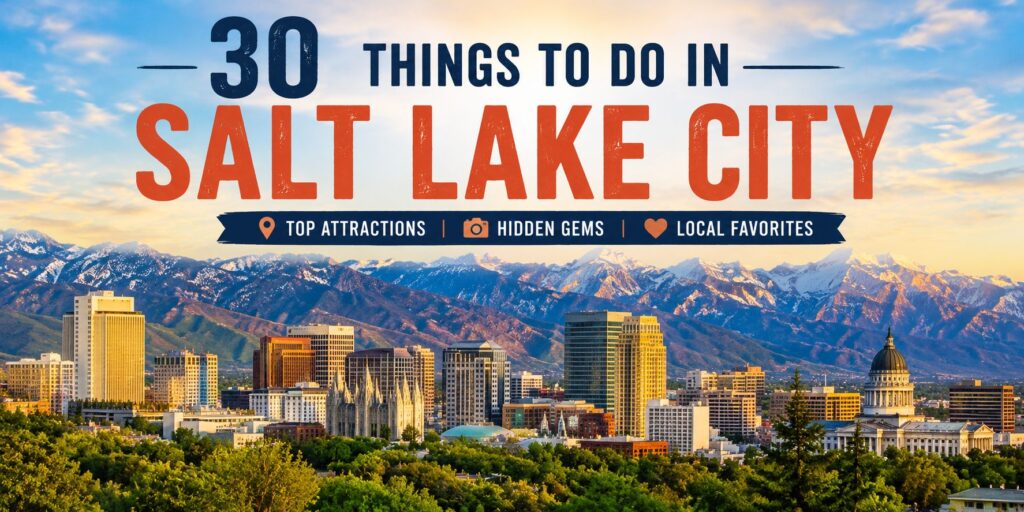
Salt Lake City is the American city that most consistently surprises visitors who arrive with modest expectations. They expect a conservative, religiously homogeneous city in the desert and find something considerably more interesting: a genuinely cosmopolitan mountain city of 200,000 people ringed by one of the finest ski resort concentrations in the world, possessing a food and craft beer scene that overachieves for its size, and sitting at the base of the Wasatch Mountains in a landscape of extraordinary physical drama.
I visited Salt Lake City utah in late October, which is an ideal time. The Wasatch Mountains above the city had their first snow and the cottonwood trees in Big Cottonwood Canyon were still gold against the white peaks. The Natural History Museum of Utah, the finest natural history museum utah has produced, sits on the hill above the University of Utah and was the finest natural history museum I had visited in the American West. The Temple Square reconstruction, ongoing since 2019, was more interesting to walk through as a working project than many fully completed religious sites.
This guide covers the 30 best things to do in salt lake city utah organized by neighborhood and activity type. It covers the essential salt lake city attractions and the most fun things to do in salt lake city honestly and goes considerably further into the food scene, the mountain canyons, and the full range of SLC things to do that make Salt Lake City one of the most rewarding and underrated city destinations in the Western United States.
Salt Lake City At a Glance: Quick Reference Table
| Activity | Area | Entry | Duration | Best For | Best Time |
|---|---|---|---|---|---|
| Temple Square | Downtown | Free | 1 to 2 hours | History, architecture, LDS heritage | Year-round |
| Utah State Capitol | Capitol Hill | Free | 45 mins to 1 hour | Architecture, city views | Year-round |
| Natural History Museum of Utah | University | $15 to $21 | 2 to 3 hours | Dinosaurs, geology, families | Any time |
| Clark Planetarium | Downtown | Free to enter | 1 to 2 hours | Space, IMAX, families | Any time |
| The Leonardo Museum | Downtown | $14 to $20 | 2 hours | Science, art, creativity | Any time |
| Pioneer Park Farmers Market | Downtown | Free | 1 to 2 hours | Local food, produce, crafts | Sat June to Oct |
| Rio Grande Historic District | Downtown | Free | 1 hour | History, architecture | Any time |
| Utah Museum of Fine Arts | University | $12 to $18 | 1.5 to 2 hours | Art, free Sundays | Year-round |
| 9th and 9th Neighborhood | East Side | Free | 2 to 3 hours | Coffee, food, local shops | Morning to evening |
| Sugar House Neighborhood | Sugar House | Free | 2 to 3 hours | Cafes, parks, local life | Weekend afternoon |
| Gilgal Sculpture Garden | Sugar House | Free | 45 mins | Quirky art, historic curiosity | Any time |
| Liberty Park | Central | Free | 1 to 3 hours | Walking, nature, families | Spring and summer |
| Red Butte Garden | East Foothills | $8 to $12 | 1.5 to 2 hours | Botanic garden, concerts | May to October |
| Tracy Aviary | Liberty Park | $9 to $15 | 1 to 2 hours | Birds, families, kids | Year-round |
| Memory Grove and City Creek Canyon | North Capitol | Free | 1 to 2 hours | Hiking, memorial, quiet | Morning |
| Antelope Island State Park | Great Salt Lake | $15 per vehicle | Half to full day | Wildlife, lake, hiking | Year-round |
| Great Salt Lake Shoreline | Northwest | Free | 1 to 2 hours | Natural wonder, sunset | Late afternoon |
| Jordan River Parkway | West Side | Free | 1 to 3 hours | Cycling, walking, nature | Morning |
| Wheeler Historic Farm | Murray | $5 to $12 | 1 to 2 hours | Families, farm animals, history | Year-round |
| Big Cottonwood Canyon | 30 mins east | Free to enter | Half to full day | Hiking, fall color, skiing | Year-round |
| Little Cottonwood Canyon | 30 mins east | Free to enter | Half to full day | Hiking, Snowbird, Alta | Year-round |
| Snowbird and Alta Skiing | Little Cottonwood | $120 to $180 lift | Full day | World-class skiing | Nov to May |
| Wasatch Mountain Hiking | Multiple trailheads | Free | 2 to 8 hours | Hiking, trail running | June to October |
| Bonneville Salt Flats | 1.5 hrs west | Free | 2 to 3 hours | Natural wonder, photography | Year-round |
| Park City Utah | 30 mins east | Free (activities vary) | Half to full day | Ski town, Main St, art | Year-round |
| Sundance Mountain Resort | 1 hr south | Free (ski extra) | Half to full day | Skiing, film festival, nature | Year-round |
| Salt Lake City Food Scene | Various | $12 to $60 | Meal time | Utah fry sauce, craft dining | Dinner |
| Craft Beer Scene | Various | $6 to $15 per pint | Evening | Utah craft beer, local bars | Evening |
| Ken Sanders Rare Books | Downtown | Free | 45 mins to 1 hour | Books, SLC history, browsing | Any time |
| Pioneer Memorial Museum | Capitol Hill | Free | 1 hour | Pioneer history, Utah heritage | Any time |
Downtown Salt Lake City and Temple Square
1. Temple Square
Area: Downtown | Entry: Free | Duration: 1 to 2 hours | Best time: Year-round
Temple Square is the headquarters and spiritual center of The Church of Jesus Christ of Latter-day Saints and the single most visited tourist attraction in Utah, drawing over five million visitors annually. The 35-acre block contains the Salt Lake Temple, the Tabernacle with its remarkable domed roof and organ, the Assembly Hall, and a series of visitor centers presenting the history and theology of the LDS church.
The Salt Lake Temple, under significant renovation since 2019 that is expected to complete in 2026, is not open to non-members. The Tabernacle, home to the world-famous Mormon Tabernacle Choir, is open for self-guided tours and for the choir’s free Thursday rehearsals and Sunday broadcasts. The acoustics of the tabernacle dome, where a pin dropped at the podium is audible at the back of the 6,500-seat hall, are genuinely extraordinary and worth experiencing independently of any religious interest.
The visitor centers present LDS history with professional production quality. Whether you share the theology or not, understanding the pioneer Mormon settlement of the Salt Lake Valley, the wagon trains from Missouri, and the transformation of an arid basin into one of the American West’s most organized cities is one of the most specifically local history experiences available in the city.
Daily cost breakdown: Entry entirely free · Choir rehearsal Thursday 7:30 PM free · Sunday Choir broadcast 9:30 AM free · Visitor centers free.
Practical tips:
- The Mormon Tabernacle Choir Thursday evening rehearsal and Sunday morning broadcast are both free and open to all visitors, no religious affiliation required
- The Conference Center opposite Temple Square, seating 21,000, is the largest religious meeting hall in the world and offers free tours daily
- The Family History Library adjacent to Temple Square is the world’s largest genealogy library and is free to use
2. Utah State Capitol and Capitol Hill
Area: Capitol Hill | Entry: Free | Duration: 45 minutes to 1 hour | Best time: Year-round
The Utah State Capitol, a Renaissance Revival building completed in 1916 on a hill north of downtown, is among the finest state capitol buildings in the Western United States. The granite dome visible from most of downtown Salt Lake City rises 285 feet and was modeled after the United States Capitol in Washington. The interior rotunda, with its murals depicting Utah history from the Fremont people through Mormon pioneer settlement to statehood, is the finest single room in the building.
The grounds of Capitol Hill, with unobstructed views south over downtown and the Wasatch Mountains rising behind it to the east, deliver the finest panoramic city view available from any publicly accessible elevated point in Salt Lake City utah.
Daily cost breakdown: Entry completely free · Self-guided tour maps available at the main entrance · Guided tours run weekdays at set times, free.
Practical tips:
- Walk up from downtown via the Capitol Hill walking paths rather than driving, the approach from below delivers the building’s scale in proper perspective
- The statue of Massasoit above the south entrance, a cast of the original in Plymouth Massachusetts, is one of the finest pieces of public sculpture in the city
- Memory Grove Park begins immediately below the east side of the Capitol, combine as a 2-hour Capitol Hill morning walk
3. Clark Planetarium
Area: Downtown | Entry: Free to enter, IMAX and shows $8 to $15 | Duration: 1 to 2 hours | Best time: Any time
The Clark Planetarium on West North Temple is one of the finest planetariums in the Mountain West, featuring a 160-seat domed digital theater, rotating science exhibitions, and the finest publicly accessible telescope viewing events in Salt Lake City. The free ground-floor exhibitions covering space exploration, geology, and physics are engaging for visitors of all ages without requiring paid show entry.
The IMAX Dome Theater shows rotate seasonally. The weekly telescope viewing events on the rooftop of the Gateway shopping center adjacent to the planetarium are free and among the finest urban astronomy experiences in Utah given the relative darkness of the western Salt Lake Valley sky.
Daily cost breakdown: Ground floor exhibitions free · Digital dome shows $8 to $10 · IMAX $13 to $15 · Telescope viewing Fridays free (weather permitting).
Practical tips:
- The Friday evening telescope viewing events on the Gateway rooftop are among the most underrated free experiences in downtown SLC
- Book IMAX shows online in advance for weekend afternoon sessions which sell out
- The Clark Planetarium store has the finest selection of astronomy and science books in downtown Salt Lake City
4. Pioneer Park Farmers Market
Area: Downtown | Entry: Free | Duration: 1 to 2 hours | Best time: Saturday morning, June to October
The Pioneer Park Farmers Market, operating every Saturday from 8 AM to 2 PM in Pioneer Park on 300 South from June through October, is the finest outdoor farmers market in Salt Lake City and one of the best in Utah. The market draws over 150 vendors selling fresh produce from the northern Utah growing regions, Wasatch Mountain honey, Utah cheese, local pastries, prepared food from the city’s immigrant communities, and craft goods.
The market’s position in Pioneer Park, one of the oldest parks in Salt Lake City utah at the site of the original settlement, gives it both physical character and historical depth that the newer suburban farmers markets lack.
Daily cost breakdown: Entry free · Fresh produce $2 to $8 per item · Prepared breakfast items $6 to $14 · Craft goods $10 to $60.
Practical tips:
- Arrive before 9 AM for the finest produce selection before the most popular vendors sell out
- The breakfast burrito and green chile stalls are consistently the longest-queued food vendors, worth the wait
- The park itself is worth 20 minutes after the market for its shaded lawns and central fountain in summer
5. Rio Grande Historic District
Area: Downtown West | Entry: Free | Duration: 1 hour | Best time: Any time
The Rio Grande Historic District, centered on 300 South between 400 West and the Jordan River, contains the finest concentration of early 20th-century brick warehouse and industrial architecture in Salt Lake City. The Rio Grande Depot, an Italian Renaissance Revival train station built in 1910 and now housing the Utah State Historical Society and their excellent Utah history museum, is the finest single building in the district.
The natural history collections and rotating historical exhibitions in the Rio Grande Depot are free and among the most informative introductions to Utah’s geological and human history available in the city. The district’s ongoing transformation into an arts and restaurant neighborhood has added quality dining options within a few blocks of the Depot.
Daily cost breakdown: Utah State Historical Society and museum free · Adjacent restaurant lunches $12 to $22.
Practical tips:
- The Utah State Historical Society museum in the Rio Grande Depot is one of the most undervisited and most informative free museums in Salt Lake City
- The district is the most rapidly changing neighborhood in downtown SLC with new restaurants and bars opening regularly
- The TRAX light rail Rio Grande station provides direct access from downtown with no parking needed
Museums and Cultural Salt Lake City Attractions
6. Natural History Museum of Utah
Area: University | Entry: $15 to $21 | Duration: 2 to 3 hours | Best time: Any time
The Natural History Museum of Utah, opened in 2011 in a building of striking copper and glass on the hill above the University of Utah, is the finest natural history museum in the Mountain West and one of the finest in the United States. Utah’s geological position within the Colorado Plateau, where erosion has exposed sedimentary formations across hundreds of millions of years, makes the state the most productive paleontological region in North America. The museum’s collection reflects this directly.
The Past Worlds level presents seventeen complete dinosaur skeletons including Utah’s own Utahraptor, multiple sauropods, and a fully mounted allosaurus, displayed in reconstructed environments rather than on pedestals. These are not casts. The collections are among the finest in any natural history museum in the world. The World of Change geology galleries present the 3.8-billion-year formation of Utah’s landscape with the clearest scientific narrative of any geology exhibition I have encountered in American museum travel.
The Living Utah level covers the state’s extraordinary ecosystem diversity, from the Great Salt Lake brine ecology to the Wasatch Mountain alpine zones, with specimen quality consistently above most comparable natural history museum collections.
Daily cost breakdown: Adults $21 · Children (3 to 12) $15 · Children under 3 free · Annual membership $65 to $80 (good value for 2+ visits).
Practical tips:
- The rooftop terrace delivers one of the finest views of Salt Lake City and the Wasatch Range available from any museum in the state
- Weekday morning visits are significantly less crowded than weekend afternoons
- The TRAX light rail Red Line runs directly to the University of Utah Medical Center station adjacent to the museum
7. The Leonardo Museum
Area: Downtown | Entry: $14 to $20 | Duration: 2 hours | Best time: Any time
The Leonardo, in the historic Salt Lake City Public Library building on 500 South, presents the intersection of science, technology, and art through rotating large-scale exhibitions and a permanent collection of interactive science installations. The museum skews toward a genuinely curious adult audience rather than exclusively family programming, making it one of the more intellectually engaging rainy-day options in the city.
Recent exhibitions have included traveling shows on robotics, climate science visualization, and Leonardo da Vinci’s engineering drawings. The permanent exhibition spaces covering optics, sound physics, and mathematical visualization are engaging for visitors with and without scientific backgrounds.
Daily cost breakdown: Adults $20 · Youth $14 · Members free · Special exhibitions sometimes have additional charges.
Practical tips:
- Check the current exhibition schedule before visiting as the Leonardo’s programming quality varies significantly between shows
- The café in the building serves good coffee and lunch items at reasonable prices by downtown SLC standards
- The building’s original Carnegie Library architecture is worth examining in its own right
8. Utah Museum of Fine Arts
Area: University | Entry: $12 to $18, free Sundays | Duration: 1.5 to 2 hours | Best time: Sunday for free entry
The Utah Museum of Fine Arts on the University of Utah campus houses a permanent collection of over 19,000 objects spanning ancient Egyptian artifacts through contemporary American painting. The collection’s particular strength is in pre-Columbian American art, indigenous Utah and Southwest artifacts, and American landscape painting from the 19th and early 20th centuries, the last category directly relevant to understanding how the landscapes visible from Salt Lake City utah have been interpreted by artists who visited them.
Daily cost breakdown: Adults $18 · Students $12 · Sundays free for all visitors · University parking $3 to $5.
Practical tips:
- Sunday free entry makes this the finest value museum afternoon in Salt Lake City
- The Albert Fisher Gallery within the museum houses the collection’s finest works and is consistently the most rewarding single room
- Combine with the Natural History Museum of Utah on the same University of Utah campus for a full culture day
Salt Lake City Neighborhoods
9. 9th and 9th Neighborhood
Area: East Side | Entry: Free | Duration: 2 to 3 hours | Best time: Morning to evening
The 9th and 9th neighborhood, centered on the intersection of 900 South and 900 East, is Salt Lake City’s most characterful independent commercial district. The grid of Victorian bungalows and small apartment buildings surrounding the main commercial corner houses the finest concentration of independent coffee shops, bookstores, wine bars, and boutique restaurants in the city.
The coffee at Publik Coffee Roasters on 900 South is the finest independent coffee in Salt Lake City by a significant margin, operating in a converted mid-century commercial building with the most considered espresso program in the city. The Proper Brewing Company nearby is one of the most welcoming and consistent craft beer experiences on the east side. The neighborhood’s food options on 9th and 9th itself and on nearby streets represent the most specifically local dining identity in Salt Lake City.
Daily cost breakdown: Coffee $4 to $8 · Casual restaurant lunch $12 to $20 · Wine bar by the glass $10 to $16 · Boutique shopping varies.
Practical tips:
- Publik Coffee Roasters at 975 S West Temple is the finest espresso in Salt Lake City, worth the detour from anywhere in the city
- The 15th and 15th neighborhood, a few blocks south with the same character, is the overflow neighborhood when 9th and 9th feels crowded
- The neighborhood bookstore, The King’s English Bookshop at 1511 S 1500 East, is one of the finest independent bookstores in Utah
10. Sugar House Neighborhood
Area: Sugar House | Entry: Free | Duration: 2 to 3 hours | Best time: Weekend afternoon
Sugar House, Salt Lake City’s most diverse and historically significant neighborhood, developed around the original territorial sugar beet factory in the 1850s and has evolved into the city’s most walkable and most socially inclusive commercial neighborhood. The main commercial corridor on 2100 South contains the greatest range of independent restaurant, bar, and retail options in any Salt Lake City neighborhood outside the 9th and 9th district.
Sugar House Park, a 110-acre city park at the southern end of the neighborhood with a 60-acre reservoir, is the finest urban park in Salt Lake City for afternoon walking. The park’s eastern edge provides unobstructed views west over the city and north to the Wasatch peaks above downtown.
Daily cost breakdown: Everything outdoors free · Restaurant lunch $12 to $22 · Coffee $4 to $7 · Sugar House Park free.
Practical tips:
- The Gilgal Sculpture Garden, a few blocks from the Sugar House commercial strip, is the most extraordinary free 45-minute detour in the neighborhood
- The Sugar House Saturday morning Farmers Market at Fairmont Park runs from May through October and is smaller but more local than the Pioneer Park market
- The TRAX light rail Sugar House station provides direct access from downtown
11. Gilgal Sculpture Garden
Area: Sugar House | Entry: Free | Duration: 45 minutes | Best time: Any time
Gilgal Sculpture Garden, a half-acre private garden donated to Salt Lake City in 2000, contains twelve large stone sculptures created by LDS bishop Thomas Child between 1945 and 1963. The sculptures are singular and strange: a sphinx with the face of Joseph Smith, massive scriptural quote stones, and the self-portrait stone of the artist himself. The garden occupies the most peculiar aesthetic territory of any public space in Salt Lake City utah.
Whether you engage with the religious symbolism or simply experience the sculpture quality and the general strangeness of the place, Gilgal is entirely specific to Salt Lake City and unavailable anywhere else. The adjacent picnic area under mature trees is one of the more pleasant quiet spaces in the Sugar House neighborhood.
Daily cost breakdown: Completely free · Open daily dawn to dusk.
Practical tips:
- The garden is tucked between residential buildings at 749 East 500 South, easy to miss without the address
- The self-portrait stone of Thomas Child at the center of the garden is the most directly personal and most affecting sculpture in the collection
- Combine with the Sugar House commercial strip as the 15-minute walk between them passes through the finest residential architecture in the neighborhood
Parks and Urban Nature
12. Liberty Park
Area: Central | Entry: Free | Duration: 1 to 3 hours | Best time: Spring and summer
Liberty Park, a 110-acre city park at the center of Salt Lake City, is the largest municipal park in Utah and the primary green space for central SLC residents. The park’s mature trees, ponds, tennis courts, volleyball nets, and the central Seven Canyons Fountain make it the finest urban park day destination in the city. The Tracy Aviary within the park adds a dedicated bird and wildlife experience to what is already the most complete free park offering in Salt Lake City utah.
The Chase Mill, an 1852 stone grist mill preserved within the park, is the oldest surviving flour mill in Utah and an easily overlooked piece of genuinely significant pioneer heritage.
Daily cost breakdown: Park entry completely free · Tracy Aviary entry $9 to $15 additional.
Practical tips:
- The Chariot Racing track on the eastern side of the park is used by local cycling groups on weekend mornings
- Liberty Park is the primary outdoor concert venue in central SLC in summer with free events most weekends
- The Chase Mill at the north end of the park is open for self-guided visits and is one of the finest surviving pioneer-era structures in the city
13. Red Butte Garden and Arboretum
Area: East Foothills | Entry: $8 to $12 | Duration: 1.5 to 2 hours | Best time: May to October
Red Butte Garden, on the hillside above the University of Utah with direct views west over Salt Lake City and the Great Salt Lake in the distance, is the finest botanic garden in Utah. The 100-acre garden contains a formal garden complex, a water garden, a wildflower meadow, and the Red Butte Canyon Research Natural Area beyond the garden fence providing access to lower Wasatch Mountain ecosystems.
The summer outdoor concert series at Red Butte, operating from June through September in the natural hillside amphitheater, is the finest music venue in Salt Lake City. Artists ranging from indie rock to jazz to classical play against a backdrop of the garden and the city lights below.
Daily cost breakdown: Adults $12 · Children $8 · Members free · Concert tickets $25 to $65 depending on artist.
Practical tips:
- Book summer concert tickets well in advance as the most popular shows sell out months ahead
- The garden’s highest viewpoint delivers the finest panoramic view of Salt Lake City and the Great Salt Lake basin of any easily accessible location in the city
- Combine with the Natural History Museum of Utah on the adjacent University campus for a full east-side day
14. Tracy Aviary
Area: Liberty Park | Entry: $9 to $15 | Duration: 1 to 2 hours | Best time: Year-round
Tracy Aviary in Liberty Park, the oldest free-flight aviary in the United States in continuous operation since 1938, houses over 400 birds representing 135 species in one of the most thoughtfully designed urban bird gardens in North America. The Condor Canyon exhibit housing Andean and California condors, the African penguin colony, and the free-flight eagle demonstration program are the finest experiences in the collection.
For families with younger children visiting Salt Lake City, Tracy Aviary represents the finest combination of genuine education quality and age-appropriate entertainment available in the city.
Daily cost breakdown: Adults $15 · Children (3 to 12) $9 · Under 3 free · Annual family membership $65.
Practical tips:
- The eagle free-flight demonstrations run at set times posted at the aviary entrance, check the schedule on arrival
- The aviary’s central wetland garden hosts wild migratory waterfowl in addition to the resident collection during spring and fall migrations
- Combine with Liberty Park for a full morning without additional transport
15. Memory Grove and City Creek Canyon
Area: North Capitol | Entry: Free | Duration: 1 to 2 hours | Best time: Morning
Memory Grove Park, a narrow valley immediately below the north side of the State Capitol, is the most atmospheric and most overlooked green space in downtown Salt Lake City. The grove of mature trees, war memorials, stone bridges over City Creek, and the general quality of quiet within a 5-minute walk of the Capitol make it the finest pocket park in the city.
City Creek Canyon above Memory Grove is the closest mountain hiking accessible from downtown SLC on foot. The canyon is closed to bicycles and motor vehicles on alternating days, and the 3-mile round trip hike along the creek to the first junction delivers genuine mountain canyon scenery within 30 minutes of walking from Temple Square.
Daily cost breakdown: Completely free · No entry fee for park or lower canyon.
Practical tips:
- Memory Grove is the finest 20-minute quiet walk in downtown Salt Lake City, the contrast with the city immediately above is remarkable
- City Creek Canyon is closed to motor vehicles at all times and to bicycles on odd-numbered days
- The Canyon Road trailhead begins at the park’s upper end and is signed from the Capitol grounds
The Great Salt Lake and West Salt Lake City
16. Antelope Island State Park
Area: Great Salt Lake, 35 mins west | Entry: $15 per vehicle | Duration: Half to full day | Best time: Year-round
Antelope Island, the largest island in the Great Salt Lake and accessible by a 7.5-mile causeway from Syracuse, is the most extraordinary natural destination within day-trip distance of Salt Lake City. The island supports the largest free-roaming American bison herd in the United States at approximately 700 animals, pronghorn antelope for which the island is named, mule deer, bighorn sheep, and coyotes in a landscape of salt flats, sagebrush hills, and the alkaline lake surrounding them.
The Fielding Garr Ranch at the island’s southern end, a working cattle operation from 1848 until 1981 and now a historic site, is the oldest continuously operated ranch in Utah. The hiking trails on Buffalo Point and the Elephant Head trail deliver the finest elevated views of the Great Salt Lake and the Wasatch Mountains across the water.
The salt content of the Great Salt Lake, 7 to 9 times saltier than ocean water, means that the human body floats without effort in the lake’s shallow bays. Swimming from Bridger Bay Beach, one of the island’s primary visitor beaches, is a specifically Great Salt Lake experience unavailable anywhere else in the American West.
Daily cost breakdown: $15 per vehicle entry · Camping $25 to $35/night · Fielding Garr Ranch tours $5 to $8.
Practical tips:
- Bison viewing is most reliable from the main causeway road in early morning when the herd grazes near the road
- The brine flies at Bridger Bay Beach from June through August are numerous but do not bite, they are a key food source for migratory birds
- The island’s highest point at Frary Peak (6,596 ft) is a 6-mile round trip hike delivering the finest aerial view of the Great Salt Lake and both mountain ranges flanking it
17. Great Salt Lake Shoreline
Area: Northwest SLC | Entry: Free at public access points | Duration: 1 to 2 hours | Best time: Late afternoon
The Great Salt Lake, the largest saltwater lake in the Western Hemisphere and the remnant of the ancient Lake Bonneville that once covered most of the Great Basin, is one of the most significant and most visually dramatic natural features in the American West. The lake’s pink and orange coloration, produced by the Dunaliella salina algae and Halobacterium in the south arm, is most visible and most vividly colored in late summer and early autumn.
The Great Salt Lake State Marina, 15 miles west of downtown on I-80, provides the most accessible public shoreline access for visitors without a vehicle suited to Antelope Island’s unpaved roads. The sunset views from the marina across the lake toward the Oquirrh Mountains on the west shore are among the finest natural light displays available anywhere near Salt Lake City.
Daily cost breakdown: State Marina parking $5 · Shoreline walking and viewing free.
Practical tips:
- The lake’s salinity makes the air near the shoreline smell distinctly of brine, this is normal and not a sign of pollution
- The 2022 and 2023 drought concerns about the lake’s shrinking have improved somewhat following above-average snowpack years, the current state is variable
- Great Salt Lake sunsets from the west-facing marina are the finest accessible sunset viewpoint near downtown SLC
18. Jordan River Parkway
Area: West Side | Entry: Free | Duration: 1 to 3 hours | Best time: Morning
The Jordan River Parkway, a 40-mile paved trail following the Jordan River from Utah Lake to the Great Salt Lake through the western urban areas of Salt Lake City, is the finest urban cycling and walking trail in the region. The section from Jordan River State Park south to about 2100 South is the most accessible, most scenic, and most effectively used by residents of the city’s west side neighborhoods.
The Jordan River Natural Area, a restored riparian zone within the parkway, hosts over 200 species of migratory birds during spring and fall migration making it the finest urban birdwatching location in Salt Lake City utah.
Daily cost breakdown: Completely free · Bike rental from downtown shops $25 to $40/half day.
Practical tips:
- The Jordan River Parkway connects to the Legacy Parkway Trail north of SLC and to the Provo River Parkway south, together forming the longest continuous river trail corridor in Utah
- The riparian bird habitat is most active from late April through May and again from August through October
- The segment from 2100 South north to the TRAX North Temple station is the most urban and most easily accessed from downtown
Mountain Canyons, Skiing and Wasatch Hiking
The Wasatch Mountains immediately east of Salt Lake City provide the most accessible combination of urban and wilderness in any American mountain city. Big and Little Cottonwood Canyons begin less than 45 minutes from downtown and deliver genuine alpine terrain, world-class skiing, and summer hiking trails within a city day trip.
19. Big Cottonwood Canyon
Area: 30 mins east | Entry: Free to enter canyon | Duration: Half to full day | Best time: Year-round
Big Cottonwood Canyon, ascending 5,500 feet from the canyon mouth near the Salt Lake Valley floor to the Solitude and Brighton ski resorts at its head, is the most visually dramatic of the Wasatch canyon drives accessible from Salt Lake City. The 15-mile drive up the canyon along Big Cottonwood Creek passes through successively more dramatic terrain: narrow canyon walls giving way to open mountain parks, then to the sub-alpine basins housing the ski resorts.
The fall color in Big Cottonwood Canyon from late September through mid-October, when the canyon’s extensive groves of bigtooth aspen turn gold against the evergreen slopes, is the finest autumn color display accessible as a day trip from Salt Lake City utah.
Lake Blanche, a 7-mile round trip hike from the Mill B South Fork trailhead, is the finest single day hike in Big Cottonwood Canyon with consistent lake and cirque views throughout.
Daily cost breakdown: Canyon entry free · Lake Blanche parking $6 · Brighton ski day pass $100 to $140 · Solitude ski day pass $110 to $150.
Practical tips:
- Big Cottonwood Canyon Road is a watershed protection area, no dogs, no swimming in the creek, no camping outside designated sites
- The fall color peaks approximately 2 weeks after the aspens in Little Cottonwood Canyon due to slightly lower elevation
- The Brighton ski resort day lodge serves the best affordable mountain lunch in either Cottonwood Canyon
20. Little Cottonwood Canyon and Snowbird
Area: 30 mins east | Entry: Free to enter canyon | Duration: Half to full day | Best time: Year-round
Little Cottonwood Canyon, narrower and more dramatically vertical than Big Cottonwood, is home to Snowbird and Alta, two of the finest ski resorts in North America. The canyon’s granite walls rise 2,000 feet from the road on both sides, making the 10-mile drive up to the resort area one of the most scenic canyon approaches of any ski resort on the continent.
Snowbird received 500+ inches of annual snowfall in its highest-yield seasons. The spring skiing conditions, with deep powder surviving into May and sometimes June on the upper mountain, make Snowbird the longest ski season resort in Utah. The tram to Hidden Peak at 11,000 feet operates in summer for hiking access to the high ridgeline and aerial views of the Salt Lake Valley below.
Daily cost breakdown: Canyon entry free · Snowbird ski day pass $120 to $180 · Snowbird summer tram $30 · Alta ski day pass $120 to $170.
Practical tips:
- Book ski day passes online at least 5 to 7 days in advance for weekends as both Snowbird and Alta sell out peak days
- The UDOT canyon shuttle from the park-and-ride at the mouth of Little Cottonwood Canyon runs on weekends and powder days, significantly better than driving in canyon traffic
- The Snowbird summer Oktoberfest from late August through October is the finest outdoor festival accessible as a day trip from Salt Lake City
21. Snowbird and Alta World-Class Skiing
Area: Little Cottonwood Canyon | Entry: $120 to $180 lift ticket | Duration: Full day | Best time: November to May
Snowbird and Alta together form the most concentrated collection of serious ski terrain in Utah. Alta, accessible only to skiers (snowboards have been banned since the resort’s founding), is widely considered the finest powder skiing destination in North America. The mountain’s complex terrain, deep persistent snowpack, and the culture of the skier-only policy create a specific skiing atmosphere unlike any other Utah resort.
Snowbird’s aerial tram, the longest-running in North America at its category, delivers 3,000 vertical feet of descent in conditions that routinely grade as “epic.” The combination of the two resorts on a single lift pass is available and represents the finest skiing day trip from any American city.
Daily cost breakdown: Snowbird full-day lift $120 to $180 · Alta full-day lift $120 to $170 · Interconnect pass (both + other Utah resorts) $220 to $260 · Ski rental downtown SLC $45 to $70/day.
Practical tips:
- The Alta Lodge is the finest ski lodge accommodation in the Wasatch and the most historically significant ski resort hotel in Utah
- Storm cycles in the Wasatch arrive from the northwest and deposit snow most heavily at the top of Little Cottonwood Canyon, check powder alerts on the Snowbird and Alta apps
- Skiing in salt lake city is a legitimate claim, the resort base at Snowbird is 29 miles from downtown SLC
22. Wasatch Mountain Hiking
Area: Multiple trailheads east of SLC | Entry: Free | Duration: 2 to 8 hours | Best time: June to October
The Wasatch Mountains immediately east of Salt Lake City contain over 200 miles of maintained hiking trail accessible within 45 minutes of downtown. The trail network is the finest single feature of Salt Lake City’s outdoor recreation offer and the primary reason for the city’s outsized quality of life relative to its size.
The three finest accessible hikes within a 45-minute drive:
Donut Falls in Big Cottonwood Canyon: 3.4 miles round trip, accessible to most fitness levels, ending at a waterfall flowing through a hole in a boulder. Best June through October.
Lake Blanche in Big Cottonwood Canyon: 7 miles round trip, 2,764 feet elevation gain to a glacially carved lake at 10,000 feet. The finest full-day hike accessible from Salt Lake City.
Mount Olympus above the east bench neighborhoods: 9 miles round trip, 4,000 feet gain to the craggy summit visible from everywhere in the Salt Lake Valley. The most technically demanding major trail within city day-trip reach.
Daily cost breakdown: Hiking free · Parking at most trailheads free to $6 Northwest Forest Pass equivalent · Gear rental (poles, packs) $15 to $30/day from REI or local shops.
Practical tips:
- The REI flagship store at 3285 East 3300 South is the finest outdoor retail and gear rental resource in Salt Lake City utah
- All Wasatch trails above 8,000 feet retain snow until at least mid-June in average years, check current conditions on the Wasatch Backcountry Alliance website
- The Millcreek Canyon road (no permit required, $3 fee) is the most underused and most pleasant canyon drive for walking and casual hiking
Day Trips from Salt Lake City
23. Bonneville Salt Flats
Area: 1.5 hours west on I-80 | Entry: Free | Duration: 2 to 3 hours | Best time: Summer and autumn
The Bonneville Salt Flats, a 30,000-acre expanse of flat salt crust at the base of the Great Basin west of Salt Lake City utah, is one of the most visually extraordinary and most disorienting landscapes in North America. The salt surface is smooth enough and flat enough at 4,218 feet elevation to serve as a natural motorsport venue, and it has hosted land speed record attempts since 1914.
The experience of standing at the center of the salt flats with the white surface extending uniformly to the horizon in every direction and the Pilot Peak mountains rising in the distance creates a visual context that neither photographs nor descriptions convey adequately. The specific quality of light reflecting from the salt crust in the late afternoon, when the surface picks up every color from the sky above, is one of the finest natural light experiences in the American West.
Daily cost breakdown: Access completely free · No facilities at the main flat area, bring water and food · Speed Week spectator access free.
Practical tips:
- The best surface conditions are from late summer through autumn after any standing water has evaporated
- Bonneville Speed Week in late August draws land speed record competitors and is the finest time to visit for atmosphere
- The salt crust is thin in wet years, check current conditions on the BLM website before driving a vehicle onto the flats
24. Park City Utah
Area: 30 minutes east via I-80 | Entry: Free (ski passes extra) | Duration: Half to full day | Best time: Year-round
Park City, the silver mining town turned ski resort town 30 miles east of Salt Lake City, is the most refined small city in Utah and one of the finest ski towns in the United States. The Main Street Historic District, four blocks of 19th-century commercial buildings converted into galleries, restaurants, and independent shops, is the finest preserved mining town main street in the Mountain West.
The Utah Olympic Park, built for the 2002 Winter Olympics, offers summer bobsled rides and a world-class extreme sports training facility visible from the road. The Park City ski resorts, Deer Valley and Park City Mountain Resort, together form one of the largest ski resort complexes in the United States.
The Sundance Film Festival uses Park City as its primary venue every January, filling the town with the largest concentration of independent film industry professionals available anywhere outside Los Angeles during that period.
Daily cost breakdown: Park City Main Street walking free · Olympic Park bobsled experience $30 to $60 · Deer Valley ski day pass $140 to $220 · PCMR ski day pass $130 to $200.
Practical tips:
- Park City Main Street is walkable from the free shuttle bus stops at both ends, no parking needed
- The Utah Olympic Park aerial skills practice sessions are free to watch from the viewing areas throughout summer and autumn
- Deer Valley Resort is ski-only (no snowboards) and is consistently rated the finest ski resort service in North America
25. Sundance Mountain Resort
Area: 50 minutes south via US-189 | Entry: Free (ski and activities extra) | Duration: Half to full day | Best time: Year-round
Sundance Mountain Resort, Robert Redford’s artistic community and ski resort in Provo Canyon south of Salt Lake City, is the most characterful mountain resort accessible from SLC. The small resort with 450 skiable acres consistently delivers quality far above what its size suggests, and the arts programming including the Sundance Film Festival satellite screenings, the outdoor amphitheater summer concert series, and the Sundance Artist Studios make it the most culturally complete mountain resort in Utah.
The Stewart Falls hike, a 4-mile round trip from the Sundance trailhead to a 200-foot waterfall on the north face of Mount Timpanogos, is the finest accessible hike on the Sundance property.
Daily cost breakdown: Sundance ski day pass $80 to $120 · Art Studio visits free · Stewart Falls hiking free · Sundance restaurant dinner $40 to $80.
Practical tips:
- The Sundance General Store is worth a stop for the finest selection of artisan Utah food products available outside Salt Lake City
- The outdoor amphitheater summer concert series runs June through August with tickets $20 to $50
- Provo Canyon Drive (US-189) from Orem to Sundance through the canyon is the finest canyon drive accessible from Salt Lake City south of the Wasatch canyons
26. Wheeler Historic Farm
Area: Murray, 15 mins south | Entry: $5 to $12 | Duration: 1 to 2 hours | Best time: Year-round
Wheeler Historic Farm, a working Victorian-era farm in Murray preserved as a city park, is the finest family-oriented historical attraction within the Salt Lake Valley and the most specifically Utah agricultural heritage site accessible as a quick half-day from downtown. The heritage breed animals including Jersey cows, heritage pigs, draft horses, and heritage chickens are maintained as working farm residents rather than display animals.
The evening wagon rides in autumn, the milking demonstrations, and the seasonal farm events are the finest specifically rural Utah experiences accessible to urban visitors without a longer road trip.
Daily cost breakdown: Entry $5 to $12 depending on activities chosen · Wagon rides $6 · TRAX light rail accessible from downtown.
Practical tips:
- Wheeler Farm is one of the few urban farms in the Mountain West where visitors can participate in actual farm tasks alongside staff
- The autumn harvest festival events in October are the finest seasonal programming and draw significant local community attendance
- TRAX Red Line runs to the Murray Central station 15 minutes walk from the farm
Salt Lake City Food and Craft Beer
27. Salt Lake City Food Scene
Where: Multiple neighborhoods | Cost: $12 to $60 per person | Best time: Dinner service
Salt Lake City’s restaurant scene overachieves for its population size, driven by a combination of the university community, a significant immigrant population from Mexico, Central America, Southeast Asia, and the Pacific Islands, and a food culture that has moved decisively beyond the conservative culinary reputation that preceded it.
The finest dining options in SLC cluster in the 9th and 9th neighborhood, the Broadway (300 South) corridor, and the Sugarhouse commercial strip. Handle Restaurant on 300 South is the finest farm-to-table restaurant in Salt Lake City, with a seasonal menu built on Utah agricultural products and the Intermountain West’s extraordinary ranching heritage. Copper Common on 111 East 300 South is the finest cocktail and small plates bar in the city.
The Utah fry sauce tradition, a pink condiment of mayonnaise and ketchup (or sometimes tomatoes and vinegar) served with fries at virtually every casual restaurant in the state, is the most specifically Utahn food culture element and the one that most surprises visitors unfamiliar with the state’s food traditions.
Daily cost breakdown: Casual restaurant lunch $12 to $18 · Mid-range dinner $25 to $45 · Fine dining $60 to $100 · Street food and food truck $6 to $12.
Practical tips:
- Handle Restaurant at 438 W Broadway: reservations required for dinner, open Tuesday to Saturday
- The 9th and 9th neighborhood has the highest concentration of independently owned restaurants in Salt Lake City
- The Pioneer Park Farmers Market on Saturdays provides the finest quick-service breakfast in downtown SLC at market vendor prices
28. Salt Lake City Craft Beer Scene
Where: Various locations | Cost: $6 to $15 per pint | Best time: Evening
Utah’s alcohol laws, revised significantly in 2019 and since relaxed from the historical 3.2% ABV maximum, now permit full-strength craft beer at grocery stores and direct brewery sales. After a morning of skiing salt lake city canyons, the craft beer scene in Salt Lake City utah has grown rapidly into one of the finest per-capita in the Mountain West.
Squatters Pub Brewery on 147 West Broadway, operating since 1989, is the oldest craft brewery in Utah and still produces some of the most consistent craft beer in the state, the Provo Girl Pilsner and the Emigration Amber are the best entry-point beers. Epic Brewing on 825 South State Street is the largest and most innovative brewery in the state, with a rotating selection of 50+ beers on tap at the taproom. Toasted Barrel Brewery in Sugar House is the finest neighborhood taproom in the city for atmosphere.
Daily cost breakdown: Pint at Squatters $6 to $9 · Epic Brewing pint $7 to $12 · Toasted Barrel pint $7 to $10 · Craft cocktail at Copper Common $14 to $18.
Practical tips:
- Utah alcohol regulations: beer above 5% ABV must be purchased by food-ordering customers at most on-premise establishments, ask the server for the current house rules
- Epic Brewing’s taproom on State Street is the finest single brewery visit in SLC for range and quality
- The Beer Bar at 161 E 200 South has the finest craft beer selection in a non-brewery bar in downtown Salt Lake City
29. Ken Sanders Rare Books
Area: Downtown | Entry: Free | Duration: 45 minutes to 1 hour | Best time: Any time
Ken Sanders Rare Books, one of the finest independent antiquarian bookshops in the American West, occupies a building on 268 South 200 East in downtown Salt Lake City. The inventory of over 100,000 books covers Utah and Western Americana, natural history, exploration literature, Mormon pioneer documents, maps, and the general antiquarian trade with the authority that comes from decades of specialization.
Ken Sanders himself, a fixture of the Salt Lake City literary community and a passionate advocate for the independent bookshop, is frequently present and worth a conversation. The shop is the finest single room for browsing in Salt Lake City and one of the finest rare bookshops in the entire Mountain West.
Daily cost breakdown: Browsing free · Books from $5 to $5,000+ depending on rarity.
Practical tips:
- The Utah and Mormon pioneer history section is the finest specialist collection of its kind available in any bookshop in the state
- Ken Sanders was instrumental in exposing the forged Mormon documents case in the 1980s, the story is worth asking him about if he is in the shop
- Open Tuesday to Saturday, hours vary, call ahead or check the website before a special visit
Salt Lake City Practical Guide
Getting Around Salt Lake City
TRAX Light Rail: TRAX connects Salt Lake Central Station (adjacent to the Rio Grande Depot) to the University of Utah, South Jordan, Sandy, and the airport. A single ride costs $2.50. A day pass is $6.25. TRAX is the most practical transport option for downtown, the University district, and Sugar House.
Bus (UTA): The Utah Transit Authority bus network covers the full Salt Lake Valley. The free circulator route connecting Temple Square, the Gateway, and Gallivan Center operates on weekdays.
Bike Share: GREENbike operates 600 bikes at 55 stations across downtown and the University area. A day pass costs $8.
Car: Essential for the Cottonwood Canyons, Antelope Island, Bonneville Salt Flats, and Park City. Rideshare services operate extensively throughout the valley for canyon day trips.
Where to Stay in Salt Lake City
Downtown: Best for first-time visitors wanting walking access to Temple Square, the Gallivan Center, and the farmers market.
9th and 9th / East Bench: Best for visitors who want the finest restaurant and coffee access in the city with residential neighborhood character.
Sugar House: Best for visitors wanting the finest neighborhood feel, direct TRAX access to downtown, and proximity to Millcreek and Big Cottonwood Canyon trailheads.
University of Utah area: Best for visiting the Natural History Museum and Red Butte Garden with proximity to the Cottonwood Canyon entrances.
Salt Lake City Budget Guide
Budget traveler (hostel or budget hotel, farmers market food, free attractions): $70 to $120 per day.
Mid-range traveler (hotel, restaurant meals, paid museums and activities): $160 to $260 per day.
Luxury traveler (boutique hotel, fine dining, ski resort accommodation, private tours): $400 and above per day.
Salt Lake City has an exceptional list of the best things to do salt lake city has to offer, many of them free or low-cost. Temple Square, the Utah State Capitol, Memory Grove, Liberty Park, Gilgal Sculpture Garden, Bonneville Salt Flats, the Jordan River Parkway, and the Pioneer Park Farmers Market together constitute a genuinely rich SLC day at very low cost.
Best Time to Visit Salt Lake City
July to September: The finest weather for outdoor activities. Temperatures average 90 to 95 degrees Fahrenheit in July (hot but dry). The Wasatch hiking season peaks in August and September. Red Butte Garden concerts are at their best. Book accommodation 2 to 3 months in advance.
March to May: Ideal for spring skiing in the Cottonwood Canyons. Snow often persists at Snowbird and Alta into May. Downtown temperatures rise through the 60s and 70s from mid-April onward.
October to November: The finest fall color season in the Cottonwood Canyons, peaking in early to mid-October. Temperatures are comfortable for hiking. Crowds significantly lower than summer.
December to February: Peak ski season in the Cottonwood Canyons. Temple Square Christmas lights are among the finest in the American West. The Sundance Film Festival in January transforms Park City 30 miles east.
faq
Final Word: Salt Lake City Rewards the Curious Visitor
Salt Lake City is the American city that most rewards visitors who arrive without fixed expectations. The combination of a landscape of extraordinary physical drama, a historical narrative of pioneer settlement and faith that is entirely specific to this place, a food and culture scene that overachieves for its size, and mountain access within 45 minutes of downtown creates a city of genuine and varied depth.
The best version of Salt Lake City is the one where you are at the trailhead of Donut Falls before the summer heat builds, where you spend two hours in the Natural History Museum of Utah and leave understanding the Colorado Plateau better than when you arrived, where you eat at the Handle and drink a pint at Epic Brewing and walk the 9th and 9th neighborhood at dusk and understand that this is a city worth returning to.
For our complete collection of US city guides, read our guides to things to do in Nashville, things to do in Chicago, things to do in Seattle, things to do in San Francisco, and things to do in Washington DC. Our full USA planning guide is at best places to visit in the USA.