
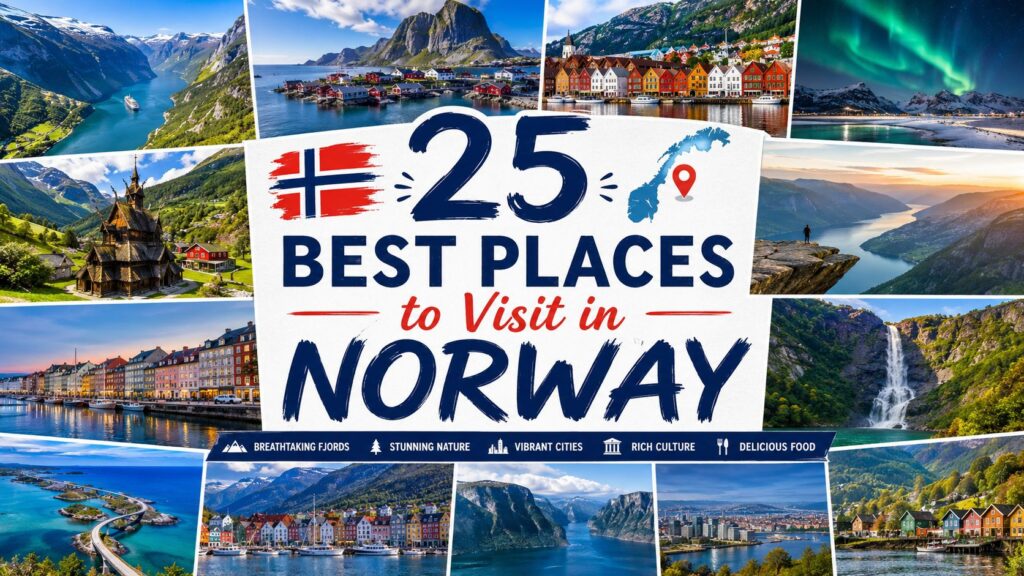
Norway is the country that makes you question whether what you are seeing is real. The Geirangerfjord at dawn, when the water is pewter and the waterfalls fall in white threads from the plateau above and the cliff walls rise so steeply that you cannot see where they end. The Northern Lights above Tromsø, the aurora borealis moving and silent across the sky. The Lofoten Islands in autumn, when the light on the red fishing cabins and the black mountain peaks and the still harbor catches everything at once.
I have visited Norway four times across different seasons. February in Tromsø for the Northern Lights, which appeared on the third night and were everything the photographs suggested and more. May in Bergen and the norway fjords, when the fruit trees along the Hardangerfjord were in blossom and the ferry from Flåm was still uncrowded. October in the Lofoten Islands, when the light was low and gold and the islands had shed their summer character and returned to what they actually are.
This guide covers the 25 best places to visit in Norway organized by region with a full quick-reference table, actual daily budget estimates, practical tips for every destination, and honest seasonal advice.
Norway at a Glance: Quick Planning Table
| Destination | Region | Days | Best For | Daily Cost | Best Season |
|---|---|---|---|---|---|
| Oslo | Southeast | 3 to 4 | Museums, waterfront, culture | $200–$350 | Year-round |
| Fredrikstad | Southeast | 1 | Oldest fortress town | $100–$160 | May to Sept |
| Bergen | West | 2 to 3 | Fjord gateway, Bryggen, fish market | $180–$300 | May to Sept |
| Sognefjord and Nærøyfjord | West | 2 to 3 | Longest fjord, UNESCO | $150–$280 | May to Sept |
| Flåm | West | 1 to 2 | Scenic railway, Aurlandsfjord | $180–$300 | Year-round |
| Hardangerfjord | West | 2 to 3 | Apple blossoms, waterfalls | $150–$260 | April to Oct |
| Geiranger | West | 1 to 2 | UNESCO, Seven Sisters waterfall | $180–$320 | May to Sept |
| Ålesund | West | 1 to 2 | Art Nouveau, Atlantic Road | $170–$290 | May to Sept |
| Voss | West | 2 to 3 | Adventure sports, skiing | $150–$260 | Year-round |
| Nordfjord and Briksdal | West | 1 to 2 | Glacier walking | $160–$280 | May to Sept |
| Borgund Stave Church | West | Half day | Medieval wooden architecture | $80–$120 | May to Sept |
| Stavanger | Southwest | 2 to 3 | Oil museum, old town, Preikestolen base | $180–$300 | May to Sept |
| Preikestolen | Southwest | Day hike | 604m cliff above Lysefjord | $120–$180 | May to Oct |
| Trolltunga | Southwest | Day hike | Rock ledge, bucket list hike | $120–$200 | June to Sept |
| Besseggen Ridge | Central | Day hike | Two-colored lake ridge | $130–$200 | July to Sept |
| Kristiansand | South | 1 to 2 | South coast, beaches, families | $120–$200 | June to Aug |
| Røros | Central | 1 to 2 | UNESCO mining town | $130–$220 | Year-round |
| Lillehammer | Central | 1 | Winter Olympics, museum | $140–$230 | Year-round |
| Jotunheimen | Central | 2 to 3 | Norway’s highest peaks, hiking | $130–$220 | July to Sept |
| Hardangervidda | Central | 1 to 3 | Largest plateau, reindeer | $120–$200 | June to Sept |
| Tromsø | North | 3 to 5 | Northern Lights, aurora borealis, Arctic | $200–$360 | Sept to March |
| Lofoten Islands | North | 4 to 7 | Most dramatic scenery in Norway | $140–$280 | June to Oct |
| Bodø and Saltstraumen | North | 1 to 2 | World’s strongest tidal current | $150–$240 | Year-round |
| Alta | North | 2 to 3 | Aurora borealis, UNESCO rock art | $170–$300 | Sept to March |
| Svalbard | Arctic | 4 to 7 | Polar bears, Arctic wilderness | $350–$600 | Feb to April |
Oslo and Southeast Norway
1. Oslo
Region: Southeast | Days: 3 to 4 | Daily cost: $200–$350 | Best season: Year-round
Oslo is the Scandinavian capital that surprises visitors who arrive expecting a conventional Nordic city and find something considerably more interesting. The concentration of world-class museums on the Bygdøy peninsula, the transformed waterfront at Aker Brygge and Tjuvholmen, the extraordinary Vigeland Sculpture Park, and a food scene that has moved from generic Scandinavian to genuinely compelling make Oslo a city that rewards three full days of exploration.
The Viking Ship Museum at Bygdøy houses three Viking longships excavated from burial mounds dated to the 9th century. These are not reconstructions. They are the original ships, the actual vessels in which actual human beings sailed across Northern Europe twelve centuries ago. The Oseberg ship at 21.5 meters is the finest surviving example of Viking Age shipbuilding in the world.
The Munch Museum, relocated to a new building at Bjørvika waterfront in 2021, houses the world’s largest collection of Edvard Munch’s work including both versions of The Scream. The Norwegian Museum of Cultural History presents 160 historic buildings relocated from across Norway, the most comprehensive single introduction to Norwegian architecture available in one place.
Daily cost breakdown: Budget hotel $120–$160/night · Mid-range hotel $180–$280/night · Restaurant lunch $20–$35 · Dinner $40–$70 · Oslo Pass (covers transport and 30+ attractions) $70–$110 for 24 to 48 hours.
Practical tips:
- The Oslo Pass covers public transport and free entry to Bygdøy museums, Vigeland Park, and the Munch Museum
- The ferry to Bygdøy takes 8 minutes from Aker Brygge and is included in the Oslo Pass
- The Holmenkollen Ski Jump above the city is open year-round for views across the city and fjord
2. Fredrikstad
Region: Southeast | Days: 1 | Daily cost: $100–$160 | Best season: May to September
Fredrikstad, 90 kilometers south of Oslo, houses the finest preserved fortified town in Scandinavia. The Old Town enclosed within its original 17th-century star-shaped fortifications, complete with moats, drawbridges, and bastions, is the most completely intact example of baroque military architecture in the region. The streets inside the walls, lined with wooden houses in the original 18th-century color palette, now function as artist studios and galleries.
The ferry across the Glomma river from modern Fredrikstad to the Old Town costs a few kroner and is one of the finest value half-day excursions from Oslo, and one of the most completely overlooked by international visitors.
Daily cost breakdown: Day trip from Oslo, no overnight needed · Lunch in the old town $15–$25 · Ferry to Old Town $2–$4.
Practical tips:
- Combine with a day trip from Oslo, 1.5 hours by train and entirely manageable as a one-day excursion
- The Fredrikstad Museum inside the fortress presents the town’s military history clearly and concisely
- Saturday morning is the finest time to visit when the market sets up inside the fortress walls
Western Norway: The Norway Fjords
The norway fjords of the western coast are the landscape most associated with Norway worldwide and the primary reason most international visitors come. The combination of fjord length and verticality available here is not matched anywhere else on Earth.
3. Bergen
Region: West | Days: 2 to 3 | Daily cost: $180–$300 | Best season: May to September
Bergen is Norway’s second city and the gateway to the western fjords, a city of extraordinary atmospheric quality produced partly by its physical setting between seven mountains and the fjord, and partly by the 200 or more days of annual rainfall that keep the vegetation startlingly green and create the low-cloud conditions that give the Bryggen waterfront its most photographed appearance.
The Bryggen Wharf, the UNESCO World Heritage row of medieval wooden buildings along the harbor, is Bergen’s most famous image. These 14th-century Hanseatic trading buildings lean and settle constantly in the soft ground and have survived seven major fires since the 12th century, rebuilt each time in the same forms. Workshops, galleries, and restaurants now occupy the spaces where German merchants traded dried fish for grain six centuries ago.
The Fløibanen funicular rises 320 meters from the city center to the Fløyen plateau in 8 minutes, delivering views across the Bergen peninsula and the surrounding fjords. The fish market at Torget has operated since the 18th century, the fresh salmon, shrimp, and seafood available at the outdoor stalls are among the finest accessible in Norway.
Daily cost breakdown: Budget hotel $120–$160/night · Mid-range hotel $180–$250/night · Fish market lunch $15–$30 · Bergen Card $40–$60 (covers Fløibanen and most attractions).
Practical tips:
- Bergen is the wettest city in Norway, pack full waterproof gear regardless of season
- The Bergen Card covers Fløibanen, the fish market tram, and most city attractions
- The Norway in a Nutshell tour begins and ends in Bergen and is the most efficient fjord day circuit available
4. Sognefjord and Nærøyfjord
Region: West | Days: 2 to 3 | Daily cost: $150–$280 | Best season: May to September
The Sognefjord is the longest fjord in Norway at 204 kilometers and the deepest in the world at 1,308 meters. The main fjord narrows dramatically into the Nærøyfjord at its southeastern end, where the walls close to within 250 meters and rise 1,700 meters above the water. The Nærøyfjord, a UNESCO World Heritage Site, is the narrowest and most vertically dramatic norway fjord.
The boat journey from Flåm through the Nærøyfjord to Gudvangen, 2 hours on the regular passenger boat, is the finest fjord boat experience in Norway and the centerpiece of the Norway in a Nutshell circuit. The vertical walls on both sides, farms clinging to ledges hundreds of meters above the water, and waterfalls falling in long threads from the plateau above create an unmatched fjord experience from any single journey.
Daily cost breakdown: Nærøyfjord boat ticket $30–$50 · Accommodation in fjord villages $130–$200/night · Norway in a Nutshell full circuit $150–$200.
Practical tips:
- The Nærøyfjord boat from Flåm is the finest single fjord experience in Norway
- Book Norway in a Nutshell tickets at least 2 to 3 weeks in advance in summer
- The villages along Sognefjord, particularly Balestrand, provide the most authentic overnight fjord experience
5. Flåm and the Flåmsbana Railway
Region: West | Days: 1 to 2 | Daily cost: $180–$300 | Best season: Year-round
Flåm sits at the end of the Aurlandsfjord and the Flåmsbana railway connecting Flåm to the Myrdal mountain plateau is one of the most spectacular railway journeys in the world. The 20-kilometer line descends 863 meters on a gradient of 1 in 18, one of the steepest standard-gauge railways in the world, through 20 tunnels and past the Kjosfossen waterfall, where the train stops at a 93-meter curtain of water.
The specific combination of the Flåmsbana railway journey, the Nærøyfjord boat trip, and overnight accommodation in Flåm before the day-trippers arrive creates the most rewarding 2-day fjord itinerary available.
Daily cost breakdown: Flåmsbana train ticket $35–$55 · Hotel in Flåm $150–$240/night · Dinner in Flåm $40–$65.
Practical tips:
- Book the Flåmsbana in advance in summer, it runs at capacity from July through August
- The Stegastein viewpoint, 30 minutes drive above Flåm, delivers the finest aerial view of the Aurlandsfjord available from any road
- Stay overnight in Flåm to experience the fjord before and after the day-tripper boats arrive and depart
6. Hardangerfjord
Region: West | Days: 2 to 3 | Daily cost: $150–$260 | Best season: Late April to October
The Hardangerfjord, at 179 kilometers Norway’s second longest fjord, is the least internationally famous and the most seasonally dramatic. The orchards of apple, pear, and cherry trees along the fjord’s southern shore bloom in late April and early May in a display that is the finest seasonal landscape event in Norway, pink and white blossom reflected in fjord water with snow still on the peaks above.
The Vøringsfossen waterfall in the Mabodalen valley above the fjord drops 182 meters in a single free fall and is among the highest in Norway. The Hardangervidda plateau rises from the fjord’s eastern end and is the most accessible alpine plateau in Norway for day hiking.
Daily cost breakdown: Guesthouse $100–$160/night · Mid-range accommodation $150–$220/night · Local restaurant dinner $35–$55.
Practical tips:
- Late April and early May is the finest time to visit for the cherry blossom season along the fjord
- The Hardanger Fartøyvernsenter boat heritage museum at Norheimsund is free and the most accessible cultural site on the southern shore
- The E134 mountain road crossing Hardangervidda above the fjord delivers the finest elevated views of the fjord system accessible by car
7. Geiranger and the Geirangerfjord
Region: West | Days: 1 to 2 | Daily cost: $180–$320 | Best season: May to September
The Geirangerfjord, a UNESCO World Heritage Site, is the most photographed fjord in Norway and the most vertically dramatic. The fjord runs 15 kilometers inland with walls rising over 1,400 meters. The Seven Sisters waterfall on the northern wall, seven simultaneous cascades that fall from the plateau, is the most recognizable natural feature of the norwegian fjords worldwide.
The Ørnesvingen Eagle Road, 11 hairpin bends climbing 620 meters above the fjord on the approach from Åndalsnes, delivers the aerial perspective that has made Geiranger the defining image of Norwegian travel. The Dalsnibba mountain plateau at 1,476 meters, accessible by toll road, provides the highest viewpoint over the fjord system with views extending to the Atlantic on clear days.
Daily cost breakdown: Hotel in Geiranger $160–$260/night · Ferry Hellesylt to Geiranger $25–$40 · Dalsnibba toll road $20 per vehicle.
Practical tips:
- The ferry from Hellesylt to Geiranger takes 65 minutes and crosses the full fjord length, the finest way to arrive
- Check cruise ship schedules before booking, on heavy cruise days the village is extremely crowded
- The Flydalsjuvet viewpoint above the village is free and delivers the most classic Geiranger photograph
8. Ålesund
Region: West | Days: 1 to 2 | Daily cost: $170–$290 | Best season: May to September
Ålesund is the most architecturally distinctive city in Norway. After the 1904 fire destroyed virtually the entire city, it was rebuilt in Jugendstil Art Nouveau style, the result is a coastal city of turrets, ornamental facades, and decorative details that looks unlike anything else in Scandinavia. The Jugendstilsenteret Art Nouveau museum presents the rebuilding story with excellent context.
The Aksla viewpoint, reached by 418 steps from the city center, delivers a panorama of the Sunnmøre archipelago and the surrounding norway fjords from any publicly accessible elevated point in the city. The Atlantic Ocean Road south of Ålesund, connecting islands by bridges and causeways through open sea, is one of the most dramatic coastal drives in Europe.
Daily cost breakdown: Hotel $130–$200/night · Restaurant lunch $18–$28 · Aksla viewpoint free · Atlantic Ocean Road free (no toll).
Practical tips:
- The Aksla viewpoint is most atmospheric at sunset when the islands and waterways light up below
- The Atlantic Ocean Road is best driven in autumn or winter when wave action over the causeways is most dramatic
- The Art Nouveau buildings along Kongens gate and Kirkegata are the finest concentration of the architectural style
9. Voss
Region: West | Days: 2 to 3 | Daily cost: $150–$260 | Best season: Year-round
Voss is Norway’s adventure sports capital, a town on the banks of Lake Vangsvatnet surrounded by mountains offering paragliding, skydiving, kayaking, white-water rafting, and bungee jumping. The Voss Vind cable car ascending Hangurstoppen mountain above the town is the most accessible aerial view in the western fjords region.
The Voss Extreme Sports Week in June is the world’s largest extreme sports festival, drawing professional athletes and spectators from across Europe. In winter, the Voss ski resort on Hangurstoppen provides the most accessible downhill skiing from Bergen, connected to the city by a 1-hour direct train.
Daily cost breakdown: Hostel $80–$110/night · Mid-range hotel $140–$200/night · Cable car return $30–$40 · Rafting tour $80–$120 · Ski day pass $60–$80.
Practical tips:
- The Voss Extreme Sports Week in June books accommodation in the town months in advance
- The cable car runs year-round and gives the finest accessible mountain panorama between Bergen and Flåm
- The direct Bergen to Voss train runs hourly and costs $15–$25, no car needed
10. Nordfjord and Briksdal Glacier
Region: West | Days: 1 to 2 | Daily cost: $160–$280 | Best season: May to September
The Nordfjord region north of Bergen contains the Jostedalsbreen, the largest glacier in continental Europe at 487 square kilometers, whose glacier arms descend into surrounding valleys. The Briksdalsbreen glacier arm in the Oldedalen valley is the most accessible glacier walk in Norway, a 1-hour return hike from the valley car park to the glacier face where blue ice is close enough to touch.
The Olden valley, the most beautiful of the valleys leading from Nordfjord to the glacier, passes through fjord water, farmland, and forest in a 30-kilometer drive that is itself one of the finest scenic drives in western Norway.
Daily cost breakdown: Accommodation in Stryn or Olden $130–$200/night · Glacier walk guide (optional) $40–$60 · Local restaurant $25–$45.
Practical tips:
- The Briksdalsbreen glacier has retreated significantly in recent decades, the walk to the current face is longer than historical photographs suggest
- The Glacier Experience Centre at Fjærland on the Sognefjord arm presents the best context for understanding the Jostedalsbreen system
- Combine with the Geirangerfjord for a 2 to 3 day western Norway circuit
11. Borgund Stave Church
Region: West | Days: Half day | Daily cost: $80–$120 | Best season: May to September
The Borgund Stave Church, built around 1180 AD in the Lærdal valley above the Sognefjord, is the best preserved of Norway’s 28 surviving stave churches and the finest example of the specifically Norwegian wooden building tradition. The dragon-headed roof line, the carved portals blending Viking and Christian imagery, and the construction using only wood without metal fasteners represent the highest achievement of Norwegian medieval timber architecture.
The church is 90 minutes from Bergen by road over the Filefjell mountain pass, a drive of considerable beauty through the most dramatic mountain pass scenery accessible from the city.
Daily cost breakdown: Church entry $15–$20 · Combine with Sognefjord day without additional accommodation needed.
Practical tips:
- The Borgund Stave Church visitor center adjacent to the church presents the full stave church tradition with excellent models and context
- The Lærdal tunnel nearby is the world’s longest road tunnel at 24.5 kilometers and passes through mountain chambers with blue lighting
- Best visited as a detour on the drive between Bergen and the Sognefjord area
Southwest Norway: Hiking Icons
12. Stavanger and the Lysefjord
Region: Southwest | Days: 2 to 3 | Daily cost: $180–$300 | Best season: May to September
Stavanger, Norway’s oil capital, combines a beautifully preserved Old Town with the Norwegian Petroleum Museum and proximity to Preikestolen and the Lysefjord. Gamle Stavanger, over 150 white wooden houses from the 18th and 19th century above the harbor, is one of the best preserved wooden townscapes in Norway.
The Lysefjord, the fjord southeast of Stavanger famous for Preikestolen and Kjeragbolten, is accessible by boat from the city in summer. The boat tour from Stavanger to the Preikestolen base and back is the most complete single-day fjord and hiking combination available from any Norwegian city.
Daily cost breakdown: Hotel $140–$220/night · Lysefjord boat tour $60–$90 · Petroleum Museum entry $20 · Old Stavanger walking, free.
Practical tips:
- The ferry from Stavanger to Tau across the Lysefjord takes 40 minutes and connects by bus to the Preikestolen trailhead
- The Swords in Rock sculpture at Hafrsfjord, a national monument 10 minutes from the city center, is free and often missed by visitors
- Stavanger’s restaurant scene is the finest in southwest Norway, the Øvre Holmegate street has the highest concentration of quality restaurants
13. Preikestolen (Pulpit Rock)
Region: Southwest | Difficulty: Moderate | Duration: 4 to 5 hours return | Daily cost: $120–$180 | Best season: May to October
Preikestolen is a flat-topped rock platform rising 604 meters above the Lysefjord with no fence or railing at its edge. The trail from the Preikestolen Mountain Lodge is 3.8 kilometers each way and gains 334 meters in elevation, genuinely achievable for visitors with moderate fitness and proper footwear.
The experience of standing at the edge of Preikestolen, looking directly down 604 meters to the fjord and across at the vertical walls of the opposite shore, is one of those specific experiences that Norway delivers and that no amount of photography prepares you for.
Daily cost breakdown: Ferry from Stavanger $15–$25 · Bus to trailhead $15 · Lodge accommodation (optional) $130–$200/night.
Practical tips:
- Start before 8 AM in summer to beat the significant crowds at the summit
- The hike is muddy in wet conditions, waterproof boots are more important than hiking boots specifically
- The view from the trail 30 minutes below the summit, looking up at the cliff, is almost as dramatic as the summit itself and rarely photographed
14. Trolltunga
Region: Southwest | Difficulty: Strenuous | Duration: 8 to 12 hours return | Daily cost: $120–$200 | Best season: Late June to September
Trolltunga, the Troll’s Tongue, is a horizontal rock shelf projecting 700 meters above Lake Ringedalsvatnet. The 27-kilometer return trail with 800 meters of elevation gain is the most demanding of Norway’s iconic hikes and requires full mountain equipment, proper footwear, and genuine physical fitness. The summit view of the rock ledge above the lake below, with the Hardangerfjord in the distance, is the most celebrated bucket-list hiking photograph in Norway.
Daily cost breakdown: Guided tour from Odda $80–$130 · Accommodation in Odda $100–$160/night · Shuttle bus from Odda $20–$30.
Practical tips:
- Guided tours from Odda are strongly recommended for first-time visitors unfamiliar with Norwegian mountain terrain
- The trail is only reliably snow-free from late June through September
- Start the hike before 7 AM to reach the summit before the busiest midday period
15. Besseggen Ridge
Region: Central | Difficulty: Moderate-Strenuous | Duration: 7 to 8 hours | Daily cost: $130–$200 | Best season: July to September
The Besseggen Ridge walk in Jotunheimen National Park traverses a narrow rocky ridge between the emerald green Gjende lake and the deep blue Bessvatnet lake, the color contrast visible simultaneously from the ridge path. The 14-kilometer hike from the Memurubu mountain lodge to the Gjendesheim visitor center, with a boat crossing as the final section, is consistently rated Norway’s finest day hike.
Daily cost breakdown: Boat across Gjende lake $30–$40 · Mountain lodge accommodation $100–$160/night · Packed lunch from lodge $15–$20.
Practical tips:
- The early morning boat from Gjendesheim to Memurubu at 8 AM allows you to start the ridge walk before the main hiking traffic
- The ridge path is narrow in places and requires good balance, not suitable for those with significant fear of heights
- Jotunheimen National Park requires a day or more of travel to access from Oslo, plan an overnight at the lodge
16. Kristiansand
Region: South | Days: 1 to 2 | Daily cost: $120–$200 | Best season: June to August
Kristiansand, the gateway to the Norwegian south coast, is Norway’s summer capital in the south with the finest beaches on the mainland coast and the Dyreparken zoo and amusement park, the most visited attraction in Norway. The beaches at Hamresanden and Bystranda are genuine sandy Atlantic beaches reaching 20 degrees Celsius water temperature in July. The south coast wooden town architecture creates the most specifically Norwegian beach resort atmosphere on the mainland.
Daily cost breakdown: Hotel $120–$180/night · Dyreparken entry $45–$55 · Beach access free · Restaurant dinner $30–$50.
Practical tips:
- Dyreparken is genuinely excellent for families and includes a water park section in summer
- The car ferry connections from Kristiansand to Denmark make it the practical southern entry point for visitors driving from Europe
- The Posebyen old town neighborhood west of the city center has the finest concentration of 19th-century wooden architecture in Kristiansand
Central Norway
17. Røros
Region: Central | Days: 1 to 2 | Daily cost: $130–$220 | Best season: Year-round
Røros is a UNESCO World Heritage copper mining town in central Norway, established in 1644 and preserved in a state of extraordinary completeness. The wooden mining town, the slag heaps, the smelting works, and the octagonal 18th-century church are all intact. The town has never been destroyed by fire, exceptional for a Norwegian wooden settlement of its age.
Walking Bergmannsgata in winter when snow covers the black timber facades and the temperature drops below minus 20 Celsius creates the most atmospheric historical Norwegian experience available in any season. The Røros Museum in the old smelting works is one of Norway’s finest industrial heritage museums.
Daily cost breakdown: Guesthouse $100–$160/night · Røros Museum entry $18 · Local restaurant $25–$40.
Practical tips:
- The Røros winter market in February, held since 1854, fills the town with reindeer sleds and traditional market stalls
- The 2.5-hour train from Oslo runs directly to Røros through the Østerdalen valley, no car needed
- Winter visits produce the finest atmosphere but summer visits allow access to the surrounding mining landscape trails
18. Lillehammer
Region: Central | Days: 1 | Daily cost: $140–$230 | Best season: Year-round
Lillehammer, host of the 1994 Winter Olympics, retains the finest concentration of Olympic legacy infrastructure in Norway at the Lysgårdsbakkene ski jump complex, the Hafjell alpine ski area, and the Norwegian Olympic Museum. The ski jump complex towers above the town on the hillside and delivers the finest view of the Mjøsa lake from any publicly accessible elevated point in the region.
The Maihaugen open-air museum, one of the largest in Norway with 185 historic buildings on the hillside above the town, is the finest folk museum in the Gudbrandsdalen valley.
Daily cost breakdown: Hotel $130–$200/night · Olympic Museum entry $20 · Maihaugen entry $25 · Ski day pass in season $60–$80.
Practical tips:
- Lillehammer is 2 hours north of Oslo by train, easily combined with the Gudbrandsdalen valley drive
- The ski jump viewing platform is open year-round and the view of the town below is worth the visit outside ski season
- The Bjørnstjerne Bjørnson museum at Aulestad, 15 kilometers west of Lillehammer, is the finest literary house museum in central Norway
19. Besseggen and Jotunheimen National Park
Region: Central | Days: 2 to 3 | Daily cost: $130–$220 | Best season: July to September
Jotunheimen National Park, the mountain massif of central Norway containing Norway’s two highest peaks, Galdhøpiggen at 2,469 meters and Glittertind at 2,465 meters, is the most concentrated mountain landscape in Norway. The park’s network of mountain lodges operated by the Norwegian Trekking Association allows multi-day hiking routes that connect peak to peak through an alpine landscape of glaciers, lakes, and ridgelines.
Galdhøpiggen is accessible on a guided glacier tour from the Juvvasshytta mountain lodge for non-technical hikers, making Norway’s highest summit achievable for visitors with moderate fitness and no mountaineering experience.
Daily cost breakdown: Mountain lodge $100–$160/night including meals · Galdhøpiggen guided glacier tour $80–$120 · National park entry free.
Practical tips:
- Book mountain lodges well in advance for July and August
- The guided Galdhøpiggen glacier walk takes approximately 6 hours round trip from Juvvasshytta
- The Lom stave church on the valley road to Jotunheimen is one of Norway’s finest and easily combined with a park visit
20. Hardangervidda National Park
Region: Central/West | Days: 1 to 3 | Daily cost: $120–$200 | Best season: June to September
The Hardangervidda, Norway’s largest national park at 3,422 square kilometers, is Europe’s largest mountain plateau at an average elevation of 1,100 meters. The plateau’s combination of high mountain lake scenery, the largest wild reindeer population in Europe at approximately 10,000 animals, and the network of trails accessible from Finse on the Bergen Railway line creates the most accessible extended plateau hiking in Norway.
The Finse 1222 mountain hotel, accessible only by train at 1,222 meters elevation, is the finest mountain lodge base for Hardangervidda hiking and the most dramatically isolated hotel in southern Norway.
Daily cost breakdown: Finse 1222 lodge $150–$220/night including breakfast · Bergen Railway ticket to Finse $40–$60 · Hiking gear rental at Finse station $20–$40/day.
Practical tips:
- Finse is accessible only by train, no road reaches the village
- The cycling route from Finse to Flåm follows the original railway construction road and is the finest long-distance cycling route in Norway
- The Hardangervidda plateau in late September produces the most dramatic light conditions of any season
Northern Norway and the Arctic
21. Tromsø
Region: Northern Norway | Days: 3 to 5 | Daily cost: $200–$360 | Best season: September to March
Tromsø is the world’s finest city from which to observe the Northern Lights and the aurora borealis. At 69 degrees north latitude and inside the Northern Lights oval, the city provides the most infrastructure-supported and most consistently accessible aurora experience available from any major urban center. From late September to late March, the Northern Lights and aurora borealis are potentially visible on any clear night. 2026 falls within a solar maximum period making auroral activity significantly higher than average.
Beyond the aurora borealis, Tromsø offers the Polar Museum covering the Norwegian polar explorer tradition, the Arctic Cathedral with its triangular facade of glass mosaic tiles, and the Fjellheisen cable car operating until midnight in summer for the midnight sun panorama.
The midnight sun period from early May to late July, when the sun remains above the horizon continuously, produces a quality of light at 2 AM that is unlike any other light in the world.
Daily cost breakdown: Hotel $160–$260/night · Northern Lights tour $100–$160/person · Arctic Cathedral entry $10 · Cable car return $25 · Restaurant dinner $50–$80.
Practical tips:
- Book Northern Lights tours 4 to 6 weeks in advance for September to March
- Direct flights from Oslo take 2 hours on Norwegian or SAS
- Reindeer sledding, dog sledding, and snowmobile tours book out weeks in advance in January and February
22. Lofoten Islands
Region: Northern Norway | Days: 4 to 7 | Daily cost: $140–$280 | Best season: June to August, February to March
The Lofoten Islands are Norway’s most photographed landscape and one of the most visually extraordinary places in Europe. The 160-kilometer archipelago has mountains rising directly from the water in sharp peaks, the fishing villages of red and yellow rorbuer cabins reflected in still harbors, and a light quality in both summer and winter with no equivalent in any other accessible location in Norway.
The fishing culture of Lofoten has maintained continuous connection to the sea since the Viking Age. The seasonal cod fishing tradition, still practiced from February to April, produces the stockfish racks that line the harbors in tens of thousands. The hiking on Lofoten climbs from sea level to 1,000-meter peaks in very short distances, providing aerial views of the archipelago that are among the finest short mountain hikes in Europe. Reine village, consistently voted the most beautiful village in Norway, sits on a spit of land between mountain peaks and the still water of the Reine fjord.
Daily cost breakdown: Rorbu fishing cabin $100–$180/night · Hotel in Svolvær $140–$220/night · Fish dinner at harbor restaurant $30–$50 · Northern Lights tour (winter) $100–$150.
Practical tips:
- Fly to Harstad/Narvik or Bodø and drive or take the ferry into the islands, the scenery between destinations is the point
- Rent a car as the E10 highway connecting the islands provides some of the finest driving scenery in Norway
- Book accommodation at least 2 months in advance for July
23. Bodø and Saltstraumen
Region: Northern Norway | Days: 1 to 2 | Daily cost: $150–$240 | Best season: Year-round
Bodø, the main transport hub for the Lofoten Islands, is also the gateway to Saltstraumen, the world’s strongest tidal current. The Saltstraumen strait, 30 kilometers east of Bodø, exchanges 400 million cubic meters of water four times daily through a 150-meter-wide channel, producing a permanent maelstrom of standing waves, whirlpools, and eddy systems. The maelstrom is at its most powerful approximately 1 hour before and after the tidal peak.
The Kjerringøy Trading Post, 40 kilometers north of Bodø, is the finest surviving example of a northern Norwegian coastal merchant station.
Daily cost breakdown: Hotel in Bodø $130–$200/night · Saltstraumen viewing free · Kjerringøy entry $15–$20 · Local restaurant $25–$40.
Practical tips:
- Check the tide table before driving to Saltstraumen, visiting at peak tidal exchange makes the difference between a dramatic natural spectacle and still water
- Bodø has direct flights from Oslo making it the most practical northern Norway hub for visitors not covering Tromsø
- The Bodø Cathedral and its wartime history make the city center worth an hour even in transit
24. Alta and the Rock Art of Alta
Region: Northern Norway | Days: 2 to 3 | Daily cost: $170–$300 | Best season: September to March
Alta, in the Finnmark region at the top of the Norwegian mainland, is the finest Northern Lights and aurora borealis destination in Norway after Tromsø for visitors who want the full Arctic experience without Tromsø’s tourist infrastructure. The aurora borealis season extends from September through March with the longest darkness hours of any accessible Norwegian city.
The Rock Art of Alta, a UNESCO World Heritage Site containing over 5,000 individual carvings at Hjemmeluft on the Alta Fjord, represents the most significant concentration of prehistoric art in Norway. The carvings, created between 4,200 and 500 BC, depict reindeer, bears, boats, and human figures across 4,000 years of Arctic life.
The Sami cultural traditions of the Finnmark region, most directly accessible through reindeer herding experiences available from local Sami guides, are the most authentic expression of indigenous Arctic culture accessible in mainland Norway.
Daily cost breakdown: Hotel $150–$240/night · Northern Lights tour $80–$120 · Rock art site entry $15 · Sami reindeer experience $80–$140.
Practical tips:
- The Alta Museum adjacent to the rock art site provides essential context for understanding the carvings
- Dog sledding and reindeer experiences from Alta are less commercially developed than Tromsø equivalents, and significantly cheaper
- The Northern Lights from Alta are equally spectacular to Tromsø but infrastructure for viewing is less organized, hire a guide
25. Svalbard
Region: Arctic | Days: 4 to 7 | Daily cost: $350–$600 | Best season: February to April, June to August
Svalbard is a Norwegian archipelago at 78 degrees north in the Arctic Ocean, 1,300 kilometers from the Norwegian mainland and the most accessible High Arctic destination on Earth. Approximately 3,000 polar bears inhabit the archipelago, outnumbering the 2,400 year-round human residents.
Longyearbyen, the main settlement, is the world’s northernmost city with a population over 1,000. It has a global seed vault containing seeds from every crop plant on Earth, a university research station, and regulations requiring anyone leaving the settlement to carry a rifle against polar bears.
Guided snowmobile tours in winter cross the open tundra to glaciers and frozen bays where polar bears are regularly spotted. Summer boat tours navigate among calving glaciers and walrus colonies. The blue hour in winter, when the sun stays below the horizon for four months and the sky maintains an indigo twilight for three hours each day, produces light of a quality with no equivalent anywhere else on Earth.
Daily cost breakdown: Longyearbyen hotel $200–$360/night · Snowmobile tour $200–$300/person · Boat tour $150–$250/person · All meals and activities significantly higher than mainland Norway.
Practical tips:
- Fly from Oslo or Tromsø to Longyearbyen, 3 hours from Oslo
- All wilderness tours require licensed guides, independent travel outside the settlement is prohibited by safety regulations
- Polar bear encounter rates are highest from February to April when bears are on sea ice near the settlement
Planning Your Norway Trip
Norway Itineraries by Length
7 days, Classic Western Norway Days 1 to 2: Oslo. Day 3: Train to Bergen. Day 4: Bergen and fjord day trip. Day 5: Flåm via Norway in a Nutshell. Day 6: Geiranger by ferry. Day 7: Ålesund and fly home.
10 days, Fjords Plus Hiking Days 1 to 2: Oslo. Day 3: Bergen. Day 4: Hardangerfjord. Day 5: Flåm and Nærøyfjord. Day 6: Geiranger. Day 7: Ålesund. Day 8: Drive south to Stavanger. Day 9: Preikestolen hike. Day 10: Fly home from Stavanger.
14 days, Complete Norway Follow the 10-day plan then add: Day 11: Fly to Tromsø. Days 12 to 14: Lofoten Islands or Tromsø Northern Lights.
Getting Around Norway
Train: NSB connects Oslo to Bergen (7 hours), Oslo to Stavanger (8 hours), and Oslo to Myrdal for the Flåmsbana branch. The Bergen Line is one of Europe’s finest mountain railway journeys.
Ferry: The Hurtigruten coastal voyage runs from Bergen to Kirkenes along the full Norwegian coast, stopping at 34 ports over 12 days. Norway in a Nutshell ferry connections operate throughout the fjord region.
Car: The fjord region and northern Norway are best explored by car. The scenic byways including the Atlantic Ocean Road and the Trollstigen mountain pass are among Europe’s finest drives.
Plane: Oslo to Tromsø takes 2 hours by plane. Domestic routes connect all major Norwegian cities efficiently.
Norway Budget Guide
Budget traveler (hostel, self-catering, hiking, free sights): 100 to 150 euros per day.
Mid-range traveler (hotel, restaurant meals, tours): 200 to 350 euros per day.
Luxury traveler (design hotels, fine dining, private tours): 500 euros and above per day.
Norway is among Europe’s most expensive countries. Primary cost-saving strategies: self-catering from Kiwi or Rema 1000 supermarkets, booking accommodation well in advance, and visiting in shoulder season from May to June and September to October when prices are 20 to 30 percent lower than peak summer.
Best Time to Visit Norway
June to August: Peak season. Maximum daylight, all attractions open, optimal hiking. Midnight sun in the north. Book 3 to 6 months in advance.
September to October: Excellent shoulder season. Hiking still possible in September. Northern Lights and aurora borealis begin in late September. Significantly fewer tourists and lower prices.
November to January: Northern Lights and aurora borealis season at peak. Polar nights in the north. Christmas atmosphere in Bergen and Oslo.
February to April: Best combination of Northern Lights, polar bear viewing in Svalbard, and improving daylight. The Lofoten cod season adds cultural interest.
Frequently Asked Questions About Norway
-
Seven days is the minimum for a first visit covering Oslo and the western Norway fjords. Ten days allows you to add Preikestolen and the Stavanger region. Two weeks allows you to add northern Norway including Tromsø for the Northern Lights or the Lofoten Islands. Norway rewards slower travel — the in-between landscapes, the ferry crossings, and the long approaches are as rewarding as the headline destinations.
-
Norway is genuinely expensive and the question deserves a direct answer. The landscape, infrastructure, quality of food and accommodation, and consistency of the experience are all at the highest level available in Europe. For travelers who have the budget, the experience per euro spent is high. Self-catering and shoulder-season travel bring costs to manageable levels for budget travelers.
-
The Norway in a Nutshell tour from Bergen or Oslo is the most efficient single-day introduction combining the Flåmsbana railway, Aurlandsfjord boat crossing, and Nærøyfjord. For a deeper experience, a self-drive itinerary covering Bergen, Flåm, Geiranger, and Ålesund over 5 to 7 days is the most rewarding approach to the Norwegian fjords.
-
From late September to late March when Norway has sufficient darkness. Peak period is December to February when nights are longest. Tromsø and the Lofoten Islands are the most accessible viewing locations. 2026 falls within a solar maximum period making auroral activity significantly higher than average.
-
Norway is among the safest countries in the world for solo travelers. Crime is extremely rare. The primary safety consideration is mountain weather, which changes rapidly and requires proper preparation for any hiking above the treeline.
-
Norwegian cuisine is defined by extraordinary seafood quality from some of the cleanest waters in the world, combined with a preservation tradition of smoking, curing, and fermenting. Fresh grilled salmon and brunost brown cheese are the most accessible Norwegian food experiences. The New Nordic cuisine movement has significantly influenced Oslo’s restaurant scene.
Final Word: Norway Rewards Those Who Move Slowly
The best version of Norway is the one where you take the slow ferry across the Hardangerfjord on a grey morning when the mist sits in the valley above the orchards. Where you are at Preikestolen before 7 AM and have the cliff largely to yourself. Where you sit on the dock at Reine in the Lofoten Islands at 11 PM watching the light on the water and the mountains reflected in the harbor.
For more of the world’s finest destinations, explore our guides to the best places to visit in Japan, the best places to visit in Croatia, and all our destination guides at Travel Destinations Plan.
Which Norway destination is your favourite? Tell us in the comments below.