
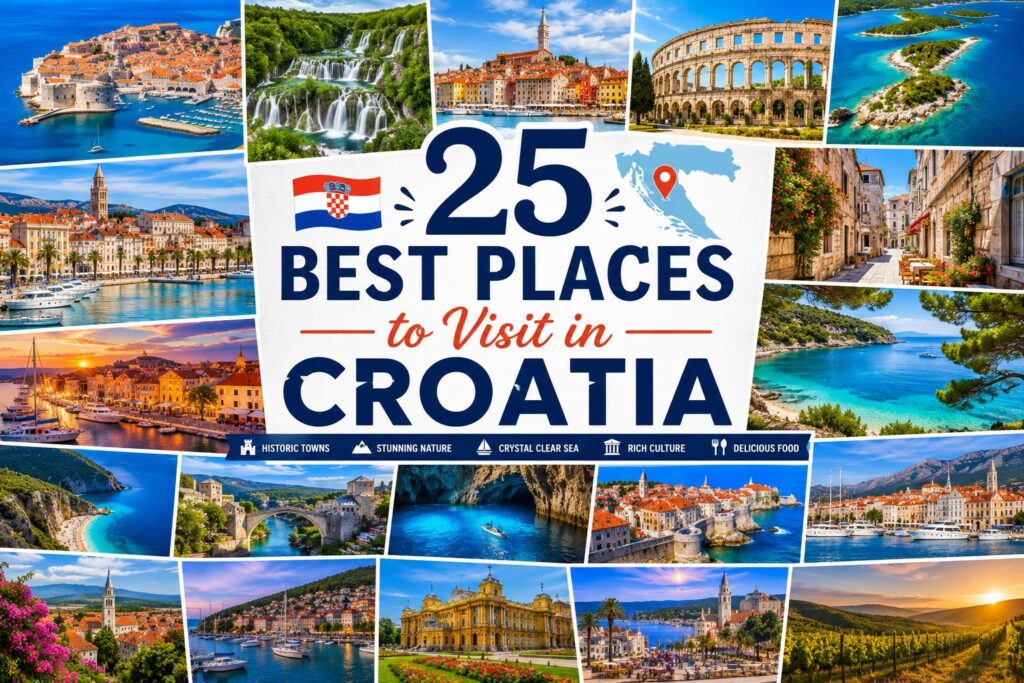
Croatia is the European destination that most reliably exceeds expectations. The combination of a Dalmatian coastline of extraordinary beauty, a sequence of medieval walled cities in outstanding condition, islands ranging from mass-tourism resorts to places so quiet that the loudest sound at noon is the cicadas, and an inland landscape of national park waterfalls and Istrian hill towns that most visitors never reach, all of this makes Croatia one of the most rewarding countries in Europe for visitors who go beyond the obvious.
I have visited Croatia three times across different seasons. October in Dubrovnik, when the crowds have thinned and the stone of the Old City glows amber in the afternoon light and you can walk the city walls without pressing against strangers. June in Istria, when the lavender on Hvar had already passed but the truffle season was beginning in the forests around Motovun. July on Vis, the remotest of the major islands, where the fishing village of Komiža feels entirely unaffected by the tourist infrastructure that has transformed the rest of the Dalmatian coast.
This guide covers the 25 best places to visit in Croatia organized by region to help you build an itinerary across the country’s full range.
Croatia at a Glance: Quick Planning Guide
| Destination | Region | Days to Stay | Best For | Budget Level | Best Season |
|---|---|---|---|---|---|
| Dubrovnik | Dalmatia | 2 to 3 | Old City walls, Game of Thrones | Luxury | May, Sept to Oct |
| Split | Dalmatia | 2 to 3 | Diocletian’s Palace, ferry hub | Mid-range | May to June, Sept |
| Hvar Town | Dalmatia | 2 to 3 | Nightlife, lavender, fortress | Mid to Luxury | June to Sept |
| Korčula | Dalmatia | 1 to 2 | Medieval old town, wine | Mid-range | May to Oct |
| Trogir | Dalmatia | 1 | UNESCO old town, day trip | Budget | May to Oct |
| Šibenik | Dalmatia | 1 to 2 | UNESCO cathedral, gateway | Mid-range | May to Oct |
| Makarska | Dalmatia | 2 to 3 | Biokovo mountain, beaches | Budget | June to Aug |
| Brač Island | Dalmatia | 2 to 3 | Zlatni Rat beach, stone carving | Mid-range | June to Aug |
| Vis Island | Dalmatia | 3 to 5 | Remote beauty, Blue Cave | Mid to Luxury | June to Sept |
| Lastovo | Dalmatia | 2 to 3 | Dark sky, total remoteness | Budget | June to Sept |
| Mljet Island | Dalmatia | 2 | National park lakes, cycling | Mid-range | May to Oct |
| Pelješac Peninsula | Dalmatia | 1 to 2 | Wine, oysters, Ston Walls | Mid-range | May to Oct |
| Zadar | Northern Dalmatia | 1 to 2 | Sea Organ, sunsets, price | Budget | May to Oct |
| Plitvice Lakes | Central | 1 to 2 | UNESCO waterfalls | Mid-range | April to Oct |
| Krka National Park | Dalmatia | 1 | Waterfalls, monastery | Budget | April to Sept |
| Rovinj | Istria | 2 to 3 | Most beautiful Istrian town | Mid to Luxury | May to Oct |
| Pula | Istria | 1 to 2 | Roman amphitheater | Mid-range | May to Oct |
| Poreč | Istria | 1 to 2 | UNESCO Byzantine basilica | Budget | June to Aug |
| Motovun | Istria | 1 | Hilltop truffle village | Mid-range | Year-round |
| Grožnjan | Istria | Half day | Artists’ town, views | Budget | May to Oct |
| Opatija | Kvarner | 1 to 2 | Belle Époque architecture | Mid-range | Year-round |
| Rijeka | Kvarner | 1 | Carnival, city culture | Budget | Year-round |
| Krk Island | Kvarner | 2 to 3 | Largest island, all seasons | Budget | Year-round |
| Lošinj Island | Kvarner | 2 to 3 | Wellness, nature, dolphins | Mid to Luxury | May to Oct |
| Zagreb | Inland | 2 to 3 | Capital, museums, café culture | Budget | Year-round |
The Dalmatian Coast: Croatia’s Most Famous Shoreline
1. Dubrovnik
Region: Southern Dalmatia | Days: 2 to 3 | Budget: Luxury | Best season: May, September to October
Dubrovnik is the most perfectly preserved medieval walled city in Europe and the most visited single destination in Croatia. The Old City, a UNESCO World Heritage Site enclosed within 2-kilometer stone walls that have protected it since the 13th century, is one of those places where the gap between the photographs and the reality is entirely in the reality’s favor. Walking the city walls in the early morning when the Adriatic is still and the terra cotta rooftops are catching the first direct light and you have the walkway largely to yourself is one of the finest experiences available in European travel.
The specific quality of Dubrovnik is the completeness of the preserved environment. Within the walls, the marble-paved Stradun, the main street connecting the Pile Gate to the Ploče Gate, and the warren of streets and staircases that rise from it on both sides create a medieval city that functions as a living neighborhood rather than a preserved ruin. Restaurants, apartments, and local businesses occupy the buildings. Residents live within the walls. The city has been continuously inhabited since the 7th century and looks exactly like a city that has been continuously inhabited for that long.
What makes Dubrovnik unmissable: The city walls walk, 2 kilometers taking approximately 90 minutes, with views down into the terracotta rooftops on one side and the Adriatic on the other. Fort Lovrijenac outside the Pile Gate. The view from the cable car to Mount Srđ above the city. Kayaking around the city walls from the sea-level perspective. The Game of Thrones filming locations, which are extensive and genuinely recognizable.
Honest assessment of Dubrovnik: Dubrovnik in July and August is the most crowded destination in Croatia. The cruise ships discharge thousands of passengers daily. The Stradun at 10 AM in summer is a mass of people. The prices reflect the location absolutely. Visiting in May, September, or October delivers the same city at a fraction of the peak-season intensity and at lower accommodation prices.
Practical tips:
- The city walls require a ticket and are most rewarding before 8 AM or after 5 PM
- Accommodation inside the Old City walls is the most atmospheric but the most expensive option
- The bus from Dubrovnik airport to the Pile Gate costs 40 kuna and is far cheaper than the taxi
2. Split
Region: Central Dalmatia | Days: 2 to 3 | Budget: Mid-range | Best season: May to June, September
Split, Croatia’s second-largest city and the main ferry hub for the Dalmatian islands, is built into and around the ruins of the palace that Roman Emperor Diocletian built for his retirement in 305 AD. The Diocletian’s Palace complex, a UNESCO World Heritage Site covering 30,000 square meters and containing within its original Roman walls an entire working neighborhood of apartments, restaurants, bars, and shops, is the most extraordinary example of a living Roman monument in Europe.
The people of Split have been living inside Diocletian’s retirement palace for 1,700 years. The original Roman cellars below the palace floor are used as market space, exhibition space, and film locations. The Peristyle, the central colonnaded courtyard, has outdoor café tables set among the columns where Romans gathered for ceremonies. The cathedral of Saint Domnius occupies the original mausoleum built for the Emperor. This specific accumulation of layers makes Split the most historically complex accessible city in Croatia.
What makes Split unmissable: Walking the Diocletian’s Palace cellars, the underground spaces used as film sets for Game of Thrones. The Peristyle at dusk when the stone is warm and the cafés are filling. The Meštrović Gallery, the finest collection of works by Croatia’s greatest sculptor Ivan Meštrović in his former studio. The Bačvice Beach, the only urban sandy beach in Dalmatia and the home of picigin, the traditional Split beach ball game.
Practical tips:
- Split is the ferry hub for Brač, Hvar, Vis, and Korčula, it is the most practical base for island-hopping
- The Riva promenade along the harbor is the finest people-watching location in Dalmatia on a warm evening
- The Green Market and the Fish Market adjacent to the palace are the best morning food experiences in the city
3. Hvar
Region: Dalmatia | Days: 2 to 3 | Budget: Mid to Luxury | Best season: June to September
Hvar, the long narrow island off the Split coast, is simultaneously Croatia’s most fashionable island resort and home to some of its finest agricultural landscapes. The lavender fields of the island’s central plateau, visible from the road between Hvar Town and Stari Grad in late June and early July, cover the stone-walled terraced fields in purple at a quality that rivals the Provence lavender season. The lavender honey and essential oils produced from these fields are the finest souvenir available in Dalmatia.
Hvar Town is the fashionable version of the island, with its Venetian-era loggia, its 13th-century cathedral, its fortress above the harbor, and its concentration of bars and restaurants that make it the liveliest island nightlife destination in Croatia. The Fortica fortress above the town, reached by a 15-minute climb from the harbor, delivers the finest view of the Pakleni Islands archipelago scattered across the channel below.
Stari Grad, 20 kilometers east of Hvar Town, is the oldest town in Croatia and far quieter than its more famous neighbor. The Stari Grad Plain behind it, a UNESCO World Heritage Site representing an unchanged ancient Greek agricultural landscape of plots divided by stone walls since 384 BC, is one of the most historically significant rural landscapes in Europe.
Practical tips:
- Hvar is accessible by catamaran from Split in 1 hour or slower car ferry in 2 hours
- The water taxi from Hvar Town harbor to the Pakleni Islands takes 5 to 15 minutes depending on the island
4. Korčula
Region: Dalmatia | Days: 1 to 2 | Budget: Mid-range | Best season: May to October
Korčula’s old town, a compact fortified peninsula projecting into the Pelješac Channel, is the finest small medieval town in Dalmatia and the one most frequently compared to Dubrovnik by visitors who discover it. The similarity is real, the same honey-colored stone, the same narrow herringbone-patterned streets designed to channel the wind, the same cathedral dominating the skyline, but Korčula has none of Dubrovnik’s mass tourism and retains the functioning neighborhood character that the more famous city has largely lost to commercial pressure.
The birthplace of Marco Polo, a claim disputed by Venice but maintained locally with considerable conviction, is marked on a house in the old town that can be entered for a small admission. The Moreška sword dance, performed weekly in summer outside the Land Gate, is the most specific cultural tradition maintained in active performance in Dalmatia.
The Korčula winery trail, covering the Grk and Pošip white wine grape varieties unique to the island and produced by a handful of family wineries accessible by bicycle from the town, is the finest island wine trail in Croatia.
5. Trogir
Region: Central Dalmatia | Days: 1 | Budget: Budget | Best season: May to October
Trogir, 30 kilometers west of Split and connected to the mainland and to Čiovo Island by two bridges, is a UNESCO World Heritage City and the most accessible of the Dalmatian medieval towns for visitors based in Split. The old town, on an island barely 300 meters across, contains a Romanesque cathedral whose portal carved by Radovan in 1240 is the finest example of Romanesque sculpture in Dalmatia, a Venetian loggia, a Renaissance palace, and several medieval towers compressed into an area no larger than a city block.
The Cathedral of St Lawrence, whose campanile provides the finest elevated view of the channel between the mainland and the island, takes 20 minutes to climb and delivers a panorama of the surrounding islets and the Trogir rooftops that justifies every step.
6. Šibenik
Region: Northern Dalmatia | Days: 1 to 2 | Budget: Mid-range | Best season: May to October
Šibenik, the most Croatian of the Dalmatian cities in the sense that it was founded by Croatians rather than Greeks or Romans, houses the Cathedral of St James, a UNESCO World Heritage building that is the only major cathedral in Europe built entirely from stone without any brick or mortar. The interlocking stone blocks, cut from the islands of Brač and Korčula, have held each other in tension for 600 years without any adhesive material.
The 71 sculpted stone heads of ordinary citizens of 15th-century Šibenik carved into the cathedral’s exterior frieze, a portrait gallery of medieval Šibenik carved by Juraj Dalmatinac between 1441 and 1475, is the most specific and most unusual decorative program on any cathedral exterior in Croatia.
The St Michael’s Fortress above the old town, restored and converted to an outdoor performance venue, hosts summer concerts and delivers the finest view of the Šibenik channel from any publicly accessible elevated point in the city.
7. Makarska and the Makarska Riviera
Region: Central Dalmatia | Days: 2 to 3 | Budget: Budget | Best season: June to August
The Makarska Riviera, the 60-kilometer stretch of coast between Brela and Gradac at the foot of the Biokovo mountain range, is the finest combination of beach and dramatic mountain scenery in Croatia. The limestone peaks of Biokovo rise directly from the coast to 1,762 meters, the second highest mountain in Croatia, and the Biokovo Nature Park summit road and hiking trails deliver aerial views of the Dalmatian coast and the offshore islands from above that no other accessible vantage point in Croatia provides.
Makarska town at the center of the riviera is the most relaxed of the Dalmatian coast towns, with a harbor and a Franciscan monastery and beaches extending in both directions from the town center. The Brela beach north of the town, where the stone-pine forest reaches the pebble beach and the water is the most transparent on the mainland coast, is consistently cited as the finest mainland beach in Dalmatia.
8. Brač Island
Region: Dalmatia | Days: 2 to 3 | Budget: Mid-range | Best season: June to August
Brač, the closest large island to Split and the most accessible for visitors basing themselves there, is known internationally for Zlatni Rat, the shifting pebble spit that extends 530 meters from the Bol headland and changes shape with the currents and winds. The beach’s triangular form, photographed aerially from above, appears on every Croatia travel photograph collection. The experience at ground level is more modest, it is a pebble beach, not sand, but the turquoise water on both sides of the spit and the pine forest above it create a beach setting of genuine beauty.
Bol village, beneath the Dominican monastery that overlooks Zlatni Rat from the headland, is the most charming and most visited settlement on the island. Supetar on the north coast, the island’s main town connected to Split by frequent ferry, is more everyday and more local in character.
Brač stone, the white limestone quarried on the island since Roman times and used in the construction of Diocletian’s Palace and reportedly in the construction of the White House in Washington, is carved into decorative objects and architectural elements at the Brač Stone Stonemason School in Pučišća that can be visited.
9. Vis Island
Region: Dalmatia | Days: 3 to 5 | Budget: Mid to Luxury | Best season: June to September
Vis is the most remote of the large Dalmatian islands and the one that most rewards visitors who make the additional effort to reach it. The island was a closed Yugoslav military base until 1989 and was consequently preserved from the tourist development that transformed the other major islands in the 1970s and 1980s. The absence of that development legacy means Vis retains a specific authenticity and tranquility that the more accessible islands have largely lost.
The fishing village of Komiža on the island’s west coast, its seafront flanked by Venetian-era towers and small fishing boats, is the most beautiful village in Dalmatia. The local small-batch wines, made from the Vugava white grape variety found almost nowhere else in the world, are some of the finest produced on any Croatian island.
The Blue Cave at Biševo, accessible by small boat from Komiža, is a sea cave where refracted light creates the interior illumination that turns the water an iridescent electric blue for approximately two hours around midday. The experience inside the cave, when the water and the walls are simultaneously glowing blue, is entirely unlike anything available anywhere else on the Dalmatian coast.
Practical tips:
- The catamaran from Split to Vis takes 2.5 hours, book tickets in advance in summer
- The Blue Cave boat tours from Komiža sell out by mid-morning on summer days, book the previous evening
10. Lastovo Island
Region: Dalmatia | Days: 2 to 3 | Budget: Budget | Best season: June to September
Lastovo, the most remote inhabited island in Croatia and also the darkest island in Europe for stargazing purposes, it holds the UNESCO Dark Sky Park designation and produces the least light pollution of any inhabited island in the Adriatic, rewards visitors who want absolute tranquility and some of the finest night sky visibility accessible anywhere in Europe.
The small stone village of Lastovo Town, built up a hillside away from the harbor to confuse pirates, and the baroque chimneys called fumari that are specific to Lastovo architecture and found nowhere else in Croatia, create a village character entirely different from any other Dalmatian destination.
11. Mljet Island
Region: Dalmatia | Days: 2 | Budget: Mid-range | Best season: May to October
Mljet, the greenest and most forested of the large Dalmatian islands, is two-thirds covered by the Mljet National Park. The park’s two saltwater lakes, Malo Jezero and Veliko Jezero, connected to the sea by a narrow channel and to each other, create the most unusual swimming environment in Croatia, enclosed, calm, and a degree or two warmer than the open sea. The Benedictine monastery island in the middle of Veliko Jezero, accessible by small boat, has been continuously occupied since the 12th century.
The cycling route around the national park, covering both lakes and the coast above them, is the finest cycling experience on any Croatian island and can be completed in 3 to 4 hours.
12. Pelješac Peninsula
Region: Dalmatia | Days: 1 to 2 | Budget: Mid-range | Best season: May to October
The Pelješac Peninsula, the long finger of land extending northwest from the mainland between Dubrovnik and the Makarska Riviera, is Croatia’s finest wine region and the location of the Ston defensive walls, the longest fortress walls in Europe after the Great Wall of China.
The Dingač and Postup wines made from the Plavac Mali grape on the steep southern slopes of Pelješac produce some of the finest red wines in the Balkans. The Mali Ston oysters, farmed in the bay below the walls of Ston in conditions of exceptional water clarity, are the finest oysters in Croatia and served raw at the waterfront restaurants directly below the oyster farms.
Northern Dalmatia
13. Zadar
Region: Northern Dalmatia | Days: 1 to 2 | Budget: Budget | Best season: May to October
Zadar is Croatia’s best-value major coastal city, offering the combination of a well-preserved old town, the finest sunsets on the Dalmatian coast, and significantly lower accommodation prices than Split or Dubrovnik. Alfred Hitchcock called the sunset at Zadar the finest in the world, and the specific atmospheric conditions of the northern Dalmatian coast that produce the light quality at the Zadar waterfront are genuine enough to sustain the claim.
The Sea Organ on the Zadar waterfront, the permanent art installation designed by Nikola Bašić consisting of 35 whistle pipes built into the stone steps of the harbor promenade through which the sea wind and wave action produces an ever-changing organ tone, is the most original public art installation in Croatia. The adjacent Greeting to the Sun, a 22-meter solar-powered light installation that absorbs solar energy through the day and produces a color light show after dark, extends the waterfront art experience through the evening.
The old town of Zadar, surrounded by complete Roman and medieval walls, contains the Church of St Donatus, the finest pre-Romanesque building in Croatia, built in the 9th century on the foundations of the Roman Forum whose columns still stand in the church courtyard.
14. Krka National Park
Region: Northern Dalmatia | Days: 1 | Budget: Budget | Best season: April to September
Krka National Park, a series of seven waterfalls descending the Krka River gorge 15 kilometers north of Šibenik, is Croatia’s most visited national park and the most accessible of the country’s major natural attractions. The Skradinski Buk waterfall, the largest and most accessible of the seven, creates a series of tufa-formed stepped cascades falling 17 meters across a 400-meter width that can be explored on a walkway crossing between the pools.
The Visovac island monastery in the middle of the canyon lake above Skradinski Buk, accessible by boat, is a 15th-century Franciscan monastery in one of the most atmospherically isolated religious sites in Dalmatia.
Practical tips:
- Arrive at the park entrance before 9 AM in summer to avoid the significant peak-hour queues
- The NP boat from Skradin village to the falls includes the park entrance in the ticket price
Central Croatia: National Parks
15. Plitvice Lakes National Park
Region: Central Croatia (Lika) | Days: 1 to 2 | Budget: Mid-range | Best season: April to October
Plitvice Lakes, a UNESCO World Heritage Site and Croatia’s oldest national park, contains 16 terraced lakes connected by waterfalls falling through dolomite and limestone formations that have been growing at the rate of 1 centimeter per year for thousands of years. The specific combination of turquoise and emerald water coloration produced by the mineral content of the Korana River source water and the constant formation of new travertine terraces creates a landscape that is entirely specific to this geology and has no equivalent elsewhere in Europe.
The walking routes through the park cover both the Lower Lakes and Upper Lakes sections and include boardwalk crossings directly above and between the falls at water level. The view from the highest point of the upper lakes looking south across the full descending sequence of lakes and waterfalls to the valley below is the finest single landscape view in Croatia.
The honest crowd assessment: Plitvice is the most visited attraction in Croatia with over 1.5 million annual visitors. In July and August the main routes are significantly crowded and the experience is diminished. The park at dawn in May or early October, when mist sits on the lower lakes and the boardwalks are nearly empty, is one of the most beautiful natural experiences in Central Europe.
Practical tips:
- Book tickets online weeks in advance, the park has daily visitor caps that sell out in peak season
- Route B covers the finest Upper Lakes terrain in a 3 to 4 hour loop
- The park shuttle boats cross the Lower Lakes and are included in admission
<a name=”istria”></a>
Istria: Croatia’s Most Underrated Region
Istria, the heart-shaped peninsula in northwest Croatia that shares its western coast with Italy and its culture with Venice across the water, is the region of Croatia that most rewards visitors who come a second time. The first visit is typically Rovinj and Pula. The subsequent visits go to the hilltop towns, the truffle farms, the olive oil estates, and the Malvazija wine cellars that make Istria one of the finest food and wine regions in the Adriatic.
16. Rovinj
Region: Istria | Days: 2 to 3 | Budget: Mid to Luxury | Best season: May to October
Rovinj is the most beautiful town in Istria and one of the most photographed urban landscapes in Croatia, its colorful Venetian-era houses rising directly from the sea on the Rovinj peninsula and the Cathedral of Saint Euphemia campanile visible from every approach to the town. The specific combination of Italian-influenced architecture, the painter-crowded cobblestone lanes of the old town, and the Adriatic light on the harbor front makes Rovinj the most aesthetically compelling small city in Croatia.
The old town, built on a small island connected to the mainland in the 18th century, contains over 20 working artists’ studios, a history museum in the Baroque City Hall, and the narrow Grisia Street where painters display works from their studio windows on a specific Sunday in August that is the finest art festival in Istria.
The coast south of Rovinj, the Lim Fjord stretching inland for 12 kilometers through a protected nature area, produces the finest oysters in Istria and the boat trip through the fjord is the most atmospheric short excursion from the town.
17. Pula
Region: Istria | Days: 1 to 2 | Budget: Mid-range | Best season: May to October
Pula houses the finest Roman amphitheater outside Rome, the Arena of Pula built between 27 BC and 68 AD and one of the six largest Roman arenas ever constructed. The amphitheater, in extraordinary condition with three of its four original external towers surviving, is used for summer concerts and film festivals that allow the interior to be experienced in use rather than purely as a ruin. Attending any event in the Pula Arena, the Croatia Film Festival runs in July, is the finest single experience of functioning Roman architecture available in Croatia.
The rest of Pula’s Roman heritage, including the Arch of the Sergii, the Temple of Augustus, and the city wall fragments, are distributed through the old town in a concentration that makes Pula the finest Roman city outside Italy accessible in the Adriatic region.
18. Poreč
Region: Istria | Days: 1 to 2 | Budget: Budget | Best season: June to August
Poreč houses the Euphrasian Basilica, a UNESCO World Heritage 6th-century Byzantine mosaic complex that is the finest surviving early Christian building in Croatia and among the finest in Europe. The gold-background apse mosaic, depicting the Virgin and Child flanked by saints and Bishop Euphrasius who commissioned the church, has been compared favorably to the contemporary mosaics at Ravenna. The basilica is entirely free to visit and takes 30 minutes to experience properly.
Poreč town is the most family-oriented resort on the Istrian coast and the largest tourist infrastructure in the region, making it the best base for families wanting both cultural content and resort facilities.
19. Motovun
Region: Istria | Days: 1 | Budget: Mid-range | Best season: Year-round
Motovun is the finest hilltop town in Istria, its medieval walls visible from the Mirna Valley below as a stone crown on a 277-meter hill. The village within the walls, 70 permanent residents in a medieval street plan that has not changed since the 15th century, is the most perfectly preserved example of the Venetian hill town tradition in Istrian Croatia.
The Motovun Forest around the base of the hill, in the alluvial valley of the Mirna River, produces the finest white truffles in Croatia, the largest white truffle ever found weighed 1.31 kilograms and was discovered near Motovun in 1999. The truffle hunting season from September through January is the most specific culinary experience available in inland Istria, and the Zigante Restaurant below the hill serves the most consistently excellent truffle-based cuisine in the region.
20. Grožnjan
Region: Istria | Days: Half day | Budget: Budget | Best season: May to October
Grožnjan, a nearly abandoned hilltop village on the ridge above the Mirna Valley, was repopulated in the 1960s by artists and musicians who were given empty houses in exchange for restoring them. The result is the most specifically artistic small town in Croatia, galleries occupy almost every building, studios are open to the public, and the International Youth Music Festival in July fills the village with musicians rehearsing in the courtyards and narrow streets.
The view from the village walls across the Mirna Valley to the Učka Mountains on the Kvarner coast on a clear morning is the finest landscape panorama in inland Istria.
Kvarner Gulf
21. Opatija
Region: Kvarner | Days: 1 to 2 | Budget: Mid-range | Best season: Year-round
Opatija, the Austro-Hungarian Riviera resort on the Kvarner coast 15 kilometers west of Rijeka, preserves the finest collection of 19th and early 20th-century resort architecture in Croatia. The grand hotels, villas, and the Lungomare seafront promenade stretching 12 kilometers along the Kvarner coast were built when Opatija served as the preferred seaside resort of the Austro-Hungarian court, and the architecture has the specific quality of Viennese Secessionist and Art Nouveau building applied to the Adriatic waterfront.
The Lungomare promenade, built in 1885 and maintained continuously since, is the finest coastal walking path in the Kvarner region and the most direct expression of the resort tradition that made Opatija the Monte Carlo of the Austro-Hungarian Empire.
22. Rijeka
Region: Kvarner | Days: 1 | Budget: Budget | Best season: Year-round
Rijeka, Croatia’s third-largest city and its busiest port, is the most undervisited major city in Croatia and the most authentic. The Rijeka Carnival, held annually in February, is the largest carnival in Croatia and one of the largest in Europe, with the specific tradition of the zvončari bell-wearers, masked figures wearing bells and sheepskin costumes who walk in procession, representing a pre-Christian ritual of unusual antiquity. The carnival’s final Sunday parade through the city center is the most culturally specific public event in the Kvarner region.
23. Krk Island
Region: Kvarner | Days: 2 to 3 | Budget: Budget | Best season: Year-round
Krk, the largest island in the Adriatic at 405 square kilometers, is the most accessible Croatian island for visitors arriving overland, the Krk Bridge connects it to the mainland, and the most visited year-round of the Kvarner islands. The accessibility makes it Croatia’s most developed major island resort outside the Dalmatian islands, but the island’s size means that the tourist facilities and the quieter parts of the interior and the less-visited southern coast coexist without conflict.
The town of Krk, with its medieval city walls intact and the narrow stone streets of its old town, is the finest historic settlement on the island. Baška village on the southern coast, with its 2-kilometer pebble beach and the surrounding landscape of abandoned agricultural terraces, is the most picturesque coastal settlement.
24. Lošinj Island
Region: Kvarner | Days: 2 to 3 | Budget: Mid to Luxury | Best season: May to October
Lošinj, reached by ferry from Brestova on the mainland, is the finest wellness and nature destination in the Kvarner region. The island has been a designated health resort since the 1890s, when the specific combination of aromatic plant oils from the Mediterranean vegetation, the exceptionally clean air, and the sea air were medically recommended for respiratory conditions. The tradition has been updated and the island now operates Croatia’s most extensive network of wellness hotels and spas.
The Blue World Institute of Marine Research and Conservation at Veli Lošinj studies the Mediterranean dolphin population in the Cres-Lošinj waters, the most stable and best-studied dolphin community in the Adriatic, and offers dolphin spotting boat excursions from Mali Lošinj harbor.
Zagreb: Croatia’s Capital
25. Zagreb
Region: Inland Croatia | Days: 2 to 3 | Budget: Budget | Best season: Year-round
Zagreb, Croatia’s capital and its largest city, is the most culturally complete and most year-round viable destination in Croatia and the one most frequently skipped by visitors who fly to Dubrovnik and head directly to the coast. This is a mistake that becomes obvious the moment you spend an evening in the Upper Town and understand that Zagreb has a quality of life and a café and restaurant culture that the coastal resorts cannot replicate.
Gornji Grad, the Upper Town, contains St Mark’s Church with its remarkable tiled roof of the Croatian coat of arms, the Croatian Parliament, the Croatian Museum of Naïve Art, and a network of stone streets that retain the Austro-Hungarian civic architecture of the 19th-century kingdom of Croatia-Slavonia. The Funicular connecting the Upper Town to the Lower Town is the shortest public funicular in the world at 66 meters.
The Museum of Broken Relationships, which has won the Kenneth Hudson Award for the most innovative museum in Europe, displays donated objects from ended relationships worldwide alongside the anonymous personal stories of what they meant. It is the most original museum in Croatia and one of the most moving in Europe.
The Dolac Market, the covered and outdoor market immediately below the Upper Town, is the finest fresh food market in Croatia and the one that most clearly shows Zagreb’s central European rather than Mediterranean character. The hand-embroidered tablecloths and the red heart-shaped licitar gingerbread that are Zagreb’s most specific craft traditions are available here alongside produce from the surrounding Zagorje farmland.
Practical tips:
- Zagreb is the main entry point for budget flights to Croatia from London and other European hubs
- The Zagreb Card covers all tram and bus transport for 24 or 72 hours and entrance to most museums
- The Christmas market in Advent Zagreb on Ban Jelačić Square is the most awarded Christmas market in Europe
Planning Your Croatia Trip
Croatia Itineraries by Trip Length
7 days: Classic Dalmatian Coast Day 1 to 2: Split. Day 3: Trogir and ferry to Hvar. Day 4 to 5: Hvar. Day 6: Ferry to Korčula. Day 7: Ferry back to Split, fly home.
10 days: Dalmatia Plus Dubrovnik Day 1 to 2: Split. Day 3: Trogir. Day 4 to 5: Hvar. Day 6: Korčula. Day 7: Drive or ferry south via Pelješac. Day 8 to 10: Dubrovnik.
14 days: Complete Southern Croatia Follow the 10-day plan and add: Day 11: Šibenik and Krka National Park. Day 12: Zadar. Day 13 to 14: Plitvice Lakes and Zagreb.
14 days: Istria and Dalmatia Day 1 to 2: Zagreb. Day 3 to 4: Rovinj. Day 5: Pula. Day 6: Poreč. Day 7: Motovun and Grožnjan. Day 8: Plitvice Lakes. Day 9 to 10: Split. Day 11 to 12: Hvar. Day 13 to 14: Dubrovnik.
Getting Around Croatia
Ferry system: The Jadrolinija ferry network connects all major islands to Split and other mainland ports. Car ferries require advance booking from June through August. Passenger catamarans carry no cars but are significantly faster.
Car rental: The most flexible way to explore Istria, the Pelješac Peninsula, and the inland national parks. Not necessary for island-hopping.
Bus: Fast and affordable connections between all major cities. Split to Dubrovnik takes 4.5 hours. Zagreb to Split takes 6 hours.
Plane: Croatia Airlines connects Zagreb to Dubrovnik, Split, and Zadar. Budget airlines connect Zagreb and Split to major European hubs.
Croatia Budget Guide
Budget traveler (guesthouse, local restaurants, public transport): 600 to 900 kuna (80 to 120 EUR) per day.
Mid-range traveler (hotel, restaurant meals, activities): 1,500 to 2,500 kuna (200 to 330 EUR) per day.
Luxury traveler (boutique hotel, fine dining, private boat): 4,000 kuna and above (530 EUR and above) per day.
Croatia is more expensive in peak season (July to August) and significantly more affordable in May, June, September, and October when the same destinations operate at 30 to 50 percent lower prices with dramatically smaller crowds.
Best Time to Visit Croatia
May and June: The finest month for the Dalmatian coast. Warm enough for swimming, no peak-season crowds, wildflowers on the islands, and accommodation at 30 to 40 percent below July prices. The lavender on Hvar blooms in late June.
September and October: The second finest period. September is warmest for swimming. October delivers the finest light quality for photography and the truffle season begins in Istria. Dubrovnik in October is at its most atmospheric.
July and August: Peak season with the highest prices, the largest crowds, and the hottest temperatures. The experience is complete and the energy is high but Dubrovnik and Hvar in August can feel overwhelmed by visitor numbers.
November to April: The shoulder and off-season. Many island facilities close entirely. Zagreb and the Istrian interior remain interesting year-round.
Frequently Asked Questions About Croatia
-
Ten days is the practical minimum for a meaningful first visit combining Split, Hvar, Korčula, and Dubrovnik. Fourteen days allows you to add Plitvice Lakes, Šibenik, and Zadar. Three weeks covers Croatia comprehensively including Istria and Zagreb. Croatia rewards slower travel because the best island experiences require several days to access the remoter beaches and the more authentic restaurants that the day-trippers never reach.
-
September and October are arguably the finest months to visit Croatia. The Adriatic is still warm enough for swimming through September. The crowds at Dubrovnik and Hvar are dramatically smaller. Accommodation prices fall 30 to 40 percent from August peaks. The Istrian truffle season begins. The light quality for photography is exceptional. The consensus among experienced Croatia travelers is that shoulder season delivers a substantially better experience for a substantially lower price.
-
Croatia adopted the Euro in January 2023, replacing the Kuna. All prices are now in Euros throughout the country.
-
Croatia is among the safest tourist destinations in Europe. Violent crime against tourists is extremely rare. The main practical concerns are petty theft in crowded areas like Dubrovnik Old City, and the significant cost increase that targeted tourist-facing businesses apply relative to local prices. Eating and drinking where locals eat and drink consistently delivers better value and better quality.
-
Dubrovnik’s walled Old City and its role as the filming location for King’s Landing in Game of Thrones. The Plitvice Lakes. The Dalmatian island coast. Diocletian’s Palace in Split. Internationally, the country’s profile was transformed by Game of Thrones tourism and continues to grow as travelers discover its combination of historical depth, natural beauty, and relative affordability compared to western Mediterranean alternatives.
-
Brač for its accessibility from Split and the specific visual appeal of Zlatni Rat for children. Krk for its accessibility from the mainland. Hvar for the combination of activities and facilities. For our complete worldwide family travel guide, read our guide to the best places to travel with kids.
Final Word: Croatia Rewards the Visitors Who Go Beyond the Obvious
The visitors who leave Croatia most satisfied are the ones who went to Vis as well as Hvar. Who spent a morning in the Plitvice Lakes before the crowds arrived. Who found the Motovun truffle restaurant below the hilltop walls. Who ate oysters at Ston from the farm visible across the bay and understood exactly where the food came from.
Croatia is a country that offers the obvious and the extraordinary in close proximity. The obvious is genuinely excellent, Dubrovnik and the walled cities deserve every photograph and every article written about them. The extraordinary is what makes Croatia something you return to rather than simply visit once.
Explore more of Europe’s finest destinations in our complete collection at Travel Destinations Plan, including our guides to things to do in Paris and the best places to visit in Norway.
Which Croatian destination is your favourite? Tell us in the comments below.