

The best places to travel with kids in 2026 include Japan, Costa Rica, Iceland, Italy, Greece, Orlando, San Diego, New Zealand, Portugal, and Kenya. Each destination offers unique kid-friendly activities, safe environments, and memorable family experiences across different budgets and age groups.
Why This Guide Is Different
I have traveled to over 60 countries with children of different ages, from a 2-year-old on a flight to Iceland to a teenager reluctantly dragged through the temples of Kyoto who later called it the best trip of his life. I know what actually works for families on the road. Not what looks good in a brochure.
This is not a copy-paste list of “go to Disney World.” This is a real, experience-tested guide to the best family travel destinations in 2026, organized by what your family actually needs: the right age, the right budget, and the right type of experience.
Every destination in this guide has been chosen based on three things:
- Kid-friendliness: activities, safety, pacing, and engagement for children
- Parent sanity: ease of travel, infrastructure, food options, and accommodation quality
- Memory value: experiences that children actually remember and talk about for years
Let us get into it.
How to Use This Guide
Jump to the section that fits your family:
- By Age: Toddlers, young kids, tweens, and teens
- By Budget: Budget, mid-range, and luxury
- By Experience: Beach, adventure, culture, wildlife, and theme parks
- Full Destination List: All 25 destinations with full details
- Planning Tips: How to actually plan a family trip
The 25 Best Places to Travel With Kids in 2026
1. Japan
Best for: Ages 5 and up | Budget: Mid-range to luxury | Experience: Culture and Adventure
Japan consistently ranks as one of the safest, cleanest, and most child-friendly countries on the planet. In 2026, it is also the most visited country in the world. With record-breaking tourism of over 42 million visitors in 2025, Japan has become the world’s number one family travel destination for very good reason.

Why kids love it: Children are treated like royalty in Japan. The culture genuinely values and welcomes families. From the moment you arrive, you notice it. Bullet trains, known as Shinkansen, feel like a futuristic amusement ride. Vending machines sell everything imaginable. Capsule toy shops called Gashapon appear on every corner. And the food culture somehow manages to delight even the pickiest eaters in the family.
Tokyo alone could keep a family busy for two full weeks. TeamLab Planets and TeamLab Borderless offer interactive digital art experiences that feel like stepping inside a dream, where children and adults alike stand completely speechless. The Ghibli Museum in Mitaka brings the world of Studio Ghibli to life in ways that no screen ever could. Akihabara satisfies tech-obsessed tweens. Shibuya Crossing gives even the most jaded teenagers a genuine moment of wonder.
Outside Tokyo, Kyoto offers age-appropriate history that does not feel like a school lesson. Walking through thousands of red torii gates at Fushimi Inari with a 9-year-old and watching their eyes go wide is a memory that does not fade. Osaka delivers pure sensory overload in the best possible way, with incredible street food, Universal Studios Japan home to the best Harry Potter experience in the world, and the most enthusiastic locals you will meet anywhere.
Practical family travel tips for Japan:
- The Japan Rail Pass covers unlimited Shinkansen travel and is essential for family trips covering multiple cities
- Most restaurants have picture menus or plastic food displays outside, so there is no language barrier when ordering
- Children under 6 ride trains and buses for free, and ages 6 to 11 pay half price
- Convenience stores including 7-Eleven, FamilyMart, and Lawson are genuinely excellent for quick family meals at low cost
- Book accommodation with tatami rooms and futons because children find sleeping on the floor incredibly exciting
Best time to visit with kids: March to May for cherry blossom season or October to November for autumn colors. Avoid August as it is extremely hot and humid.
Suggested family itinerary: 14 days total. Spend 5 days in Tokyo, 3 days in Kyoto, 2 days in Osaka, 2 days in Hiroshima and Miyajima, and 2 days in Hakone for Mount Fuji views and onsen.
Top kid-friendly attractions: TeamLab, Ghibli Museum, Universal Studios Japan, Hiroshima Peace Memorial for ages 10 and above, deer park in Nara, and Disneyland Tokyo.
2. Costa Rica
Best for: Ages 4 and up | Budget: Mid-range | Experience: Wildlife, Adventure, and Nature
If you want your children to understand why protecting the planet matters, take them to Costa Rica. This small Central American country packs more biodiversity per square kilometer than almost anywhere on Earth, and it manages to make wildlife encounters feel completely natural rather than staged.
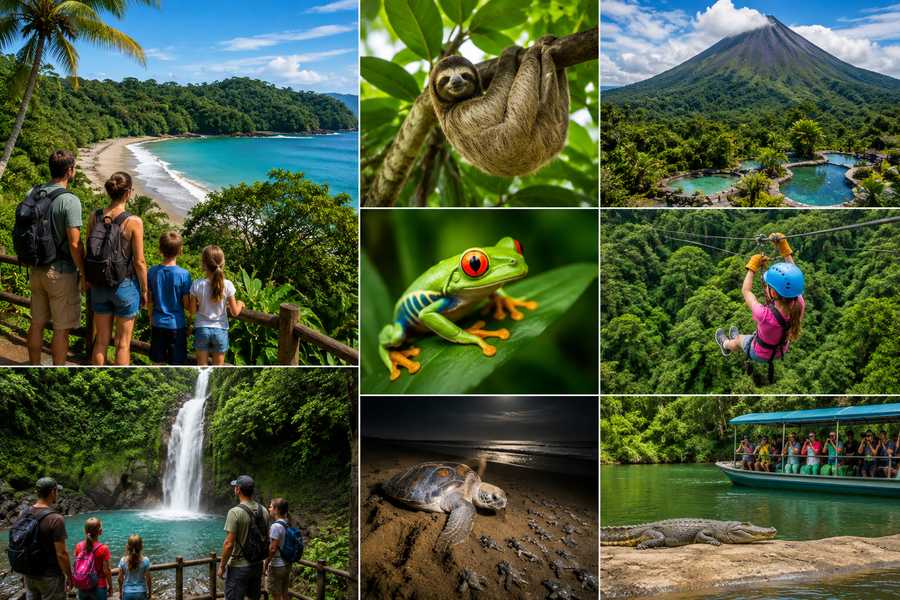
Why kids love it: Spotting a sloth hanging lazily from a tree branch is one of those childhood moments that sticks forever. So is watching a sea turtle lay eggs on a dark beach at midnight, or seeing a red-eyed tree frog no bigger than a thumb perched on a leaf inches from your face. Costa Rica delivers these moments again and again throughout the trip.
The adventure infrastructure is perfectly built for families. Zip-lining through the cloud forest canopy in Monteverde is genuinely accessible for children as young as 6. White-water rafting on the Pacuare River has family-friendly grade options. Hanging bridges through the jungle are safe, well-maintained, and feel like something straight out of an Indiana Jones film.
The country has also made sustainability central to its identity. A remarkable 99% of electricity comes from renewable sources, and over 25% of the land is protected national park. Traveling here teaches children environmental values in the most powerful way possible by showing them what a healthy planet actually looks like.
Practical family travel tips for Costa Rica:
- Rent a 4×4 vehicle because roads between destinations can be rough and unpredictable
- Pack waterproof everything because even in dry season, rain appears suddenly
- Book accommodation in Arenal, Manuel Antonio, or Tortuguero for the best wildlife density
- Carry cash because many smaller restaurants and shops do not accept cards
- Book a reputable local guide for wildlife tours as trained eyes spot animals that tourists walk right past
Best time to visit with kids: December to April covers the dry season on the Pacific coast. June to August also works well on the Caribbean coast.
Top kid-friendly experiences: Manuel Antonio National Park wildlife tour, Arenal Volcano hot springs, zip-lining in Monteverde, sea turtle nesting tour in Tortuguero, and crocodile river boat tour.
3. Iceland
Best for: Ages 6 and up | Budget: Luxury | Experience: Nature, Adventure, and Science
Iceland is one of those rare destinations that makes children feel like they have landed on another planet, because in many ways they have. Geysers erupt every 10 minutes. Waterfalls crash into black sand beaches. Glaciers are wide enough to walk across. The Northern Lights dance overhead in winter. The entire country is a living science lesson.
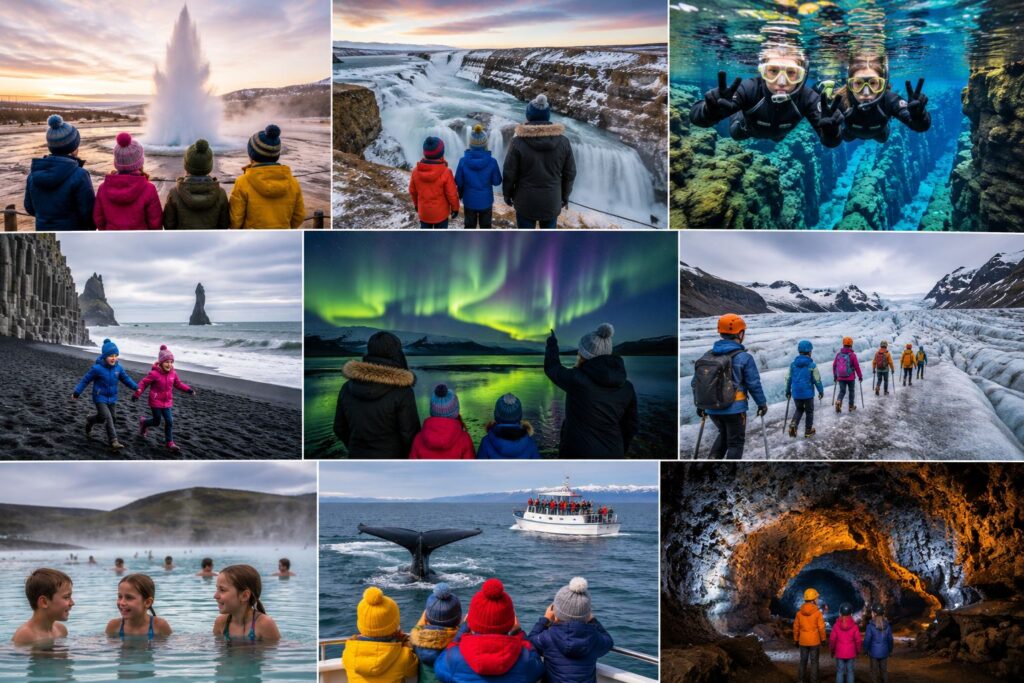
Why kids love it: The Golden Circle route alone gives children a visceral understanding of geology that no classroom can replicate. It covers the geysers at Geysir, the dramatic Gullfoss waterfall, and the meeting point of two tectonic plates at Þingvellir National Park. Snorkeling or diving between tectonic plates in crystal-clear water at Silfra is available for children aged 12 and above.
In summer from June to August, Iceland offers the extraordinary phenomenon of the midnight sun, where children can play outside at midnight in full daylight. They find this genuinely mind-bending. In winter from September to March, the Northern Lights create moments of collective family awe that parents consistently describe as among the most powerful experiences of their lives.
Iceland is also exceptionally safe and consistently ranks as one of the safest countries on Earth. The infrastructure is excellent, English is spoken universally, and the food scene has improved dramatically. Reykjavik now has genuine world-class restaurants alongside family-friendly burger spots and excellent fish and chips.
Practical family travel tips for Iceland:
- Rent a campervan for ultimate family flexibility as camping is well-organized and beautiful throughout the country
- Download the Vedur app for weather because conditions change dramatically and fast
- Blue Lagoon requires advance booking so book 3 to 4 months ahead in peak season
- Pack full waterproof gear for everyone as the weather is genuinely unpredictable
- Whale watching from Reykjavik harbor is one of the most accessible and reliable in the world
Best time to visit with kids: June to August for the midnight sun and best weather. November to February for the Northern Lights.
Top kid-friendly experiences: Golden Circle, whale watching, Northern Lights in season, glacier hiking, Reykjavik geothermal swimming pools at Laugardalslaug, and lava tube caves.
4. Italy
Best for: All ages | Budget: Mid-range to luxury | Experience: Culture, History, and Food
Italy is the country that teaches children that history is not boring. It is everywhere, it is enormous, and it is beautiful. And then there is the food. If there is a child anywhere who does not like pizza, pasta, or gelato, they simply have not been to Italy yet.
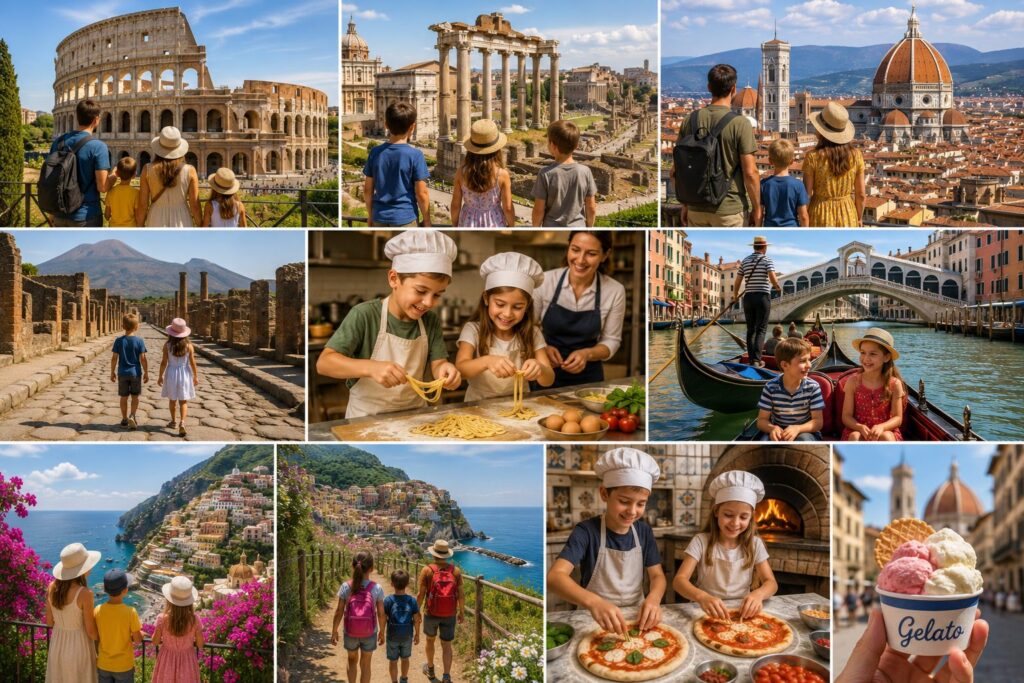
Why kids love it: Standing in the Colosseum and understanding that 50,000 Romans once sat in those exact seats watching gladiator battles is the kind of history lesson that makes children lean forward with genuine interest. Walking across the perfectly preserved Roman Forum, seeing Pompeii frozen in time by volcanic ash, or climbing to the top of a medieval tower in San Gimignano gives history a physical reality that textbooks simply cannot deliver.
Rome is extraordinarily family-friendly. The Vatican Museums are genuinely awe-inspiring. Build in the Sistine Chapel as your finishing destination after other galleries and time it right to avoid the worst crowds. Florence offers the Uffizi Gallery but also excellent hands-on cooking classes where children make their own pasta from scratch, which is one of the most universally beloved family travel experiences in all of Europe.
The Amalfi Coast is visually overwhelming in the best possible way. Lake Como offers gentler beauty and a slower pace. Sicily combines excellent beaches with Greek temples and some of the best food in the entire country. Venice with children is theatrical and strange and utterly unlike anywhere else on Earth.
Practical family travel tips for Italy:
- Book major attractions including the Colosseum, Vatican, Uffizi, and Last Supper in Milan months in advance because queues without booking are brutal
- Lunch is the main meal of the day so eat your big meal at midday and save significantly on cost
- Regional trains are affordable and connect major cities efficiently
- Many museums offer free or reduced entry for children under 18, so always ask at the door
- Learn 10 Italian phrases because locals respond with genuine warmth to any attempt at the language
Best time to visit with kids: April to June or September to October for warm weather, manageable crowds, and excellent light.
Top kid-friendly experiences: Colosseum in Rome, Pompeii, pasta-making class in Florence, gondola ride in Venice, Cinque Terre coastal walks, and pizza-making class in Naples.
5. Greece
Best for: Ages 4 and up | Budget: Mid-range | Experience: Beach, History, and Food
Greece is the Mediterranean at its most welcoming. It is warm, safe, spectacularly beautiful, affordable by Western European standards, and deeply generous toward families with children. Greeks have a saying that children are a gift, and you feel that sentiment everywhere you go.
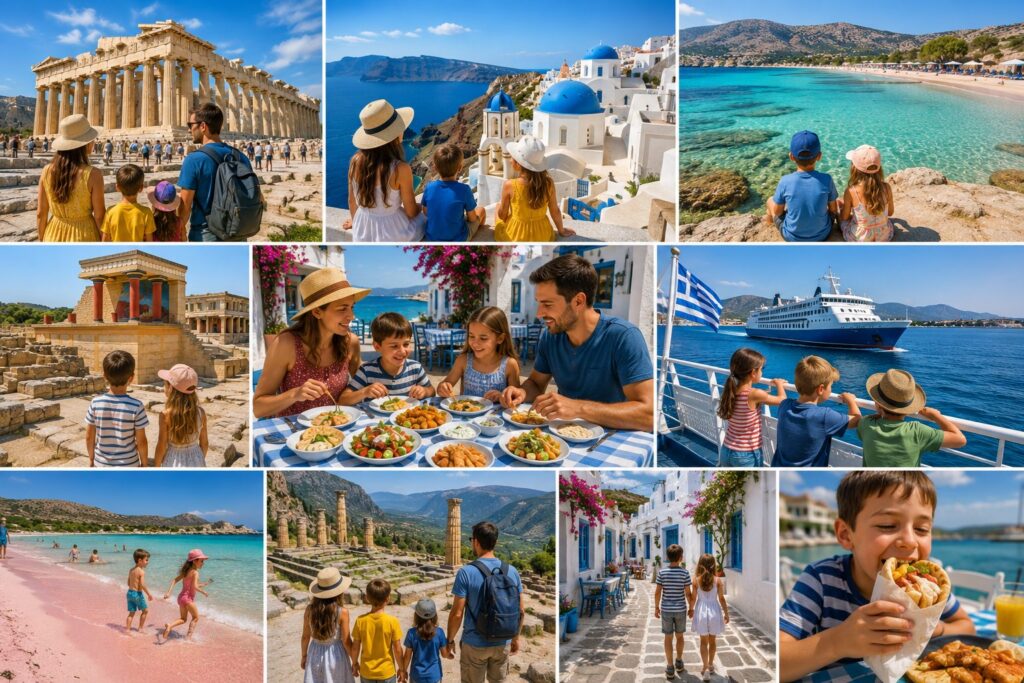
Why kids love it: The Greek islands are some of the most beautiful places on Earth. Santorini’s iconic blue-domed churches and cliffside villages are genuinely as stunning in person as in every photograph. Crete is Greece’s largest island and arguably its most family-friendly destination, with long sandy beaches at Elafonissi that glow pink, the Samaria Gorge for older kids and teens, and ancient Minoan palaces at Knossos that bring Europe’s oldest civilization alive.
Mykonos is better suited to adults, but Corfu, Rhodes, and Kefalonia offer excellent family infrastructure with clean beaches, safe shallow water for small children, reliable medical facilities, and a relaxed pace that allows genuine decompression.
Athens is far more than just the Acropolis, though the Acropolis alone is worth the entire trip. The National Archaeological Museum is one of the world’s great collections. The Acropolis Museum directly below the ancient site uses technology brilliantly to help children understand ancient Greek life in ways they genuinely engage with.
Practical family travel tips for Greece:
- Fly into Athens and island-hop by ferry, which is genuinely fun for children who love boats
- Book ferry tickets in advance in summer because popular routes sell out quickly
- Avoid Santorini in July and August with small children as it becomes extremely crowded and hot
- Greek food culture is excellent for families because portions are enormous and sharing is completely normal
- Most beaches are public and free, so you only need to rent sunbeds if you specifically want them
Best time to visit with kids: May, June, or September for warmth, far fewer crowds, and better prices.
Top kid-friendly experiences: Acropolis in Athens, Elafonissi Beach in Crete, Knossos Palace, Santorini sunset, Delphi day trip, and island ferry hopping.
6. Orlando, Florida
Best for: Ages 3 to 14 | Budget: Mid-range to luxury | Experience: Theme Parks and Entertainment
No destination list for families with young children is complete without Orlando. Love it or not, and many travel writers are too cool to admit they love it, Walt Disney World, Universal Studios, and the entirely new Epic Universe which opened in 2025 represent the highest level of engineered childhood magic on the planet.

Why kids love it: Disney World needs no introduction. What parents often underestimate is how genuinely emotional the experience is for young children. Seeing a 4-year-old meet their favorite character in person, or watching a child experience their first roller coaster, or standing together watching the Cinderella Castle fireworks at night creates experiences that parents remember as vividly as the children themselves.
Universal’s Epic Universe opened in May 2025 and added five entirely new worlds to Orlando’s theme park landscape: Super Nintendo World, the Wizarding World of Harry Potter Ministry of Magic, How to Train Your Dragon, Monster-Verse, and Classic Universal Monsters. This essentially doubled Orlando’s already impressive Universal offering and makes 2026 a particularly exceptional year to visit.
Beyond the parks, and many families never venture beyond them which is entirely valid, Orlando has excellent water parks, LEGOLAND Florida 45 minutes away, Kennedy Space Center an hour east, and some genuinely beautiful natural areas including Everglades day trips.
Practical family travel tips for Orlando:
- Visit in September to November or January to February for shorter queues, lower prices, and better weather
- Book Disney’s Genie+ or Universal’s Express Pass because it saves enormous amounts of queuing time
- Arrive at parks 30 minutes before official opening as the first two hours are significantly less crowded
- Stay on-site at Disney or Universal for early park access, which is worth the extra cost for families with young children
- Pack snacks because food inside parks is expensive and not always great quality
Best time to visit with kids: September to November or January to February.
Top kid-friendly experiences: Magic Kingdom, Hollywood Studios Galaxy’s Edge, Epic Universe, SeaWorld, Kennedy Space Center, and LEGOLAND Florida.
7. New Zealand
Best for: Ages 6 and up | Budget: Luxury | Experience: Adventure, Nature, and Outdoor
New Zealand is the adventure capital of the world combined with the infrastructure and safety of a fully developed nation. For families who want genuine outdoor adventure rather than a sanitized version of it, this is your destination.
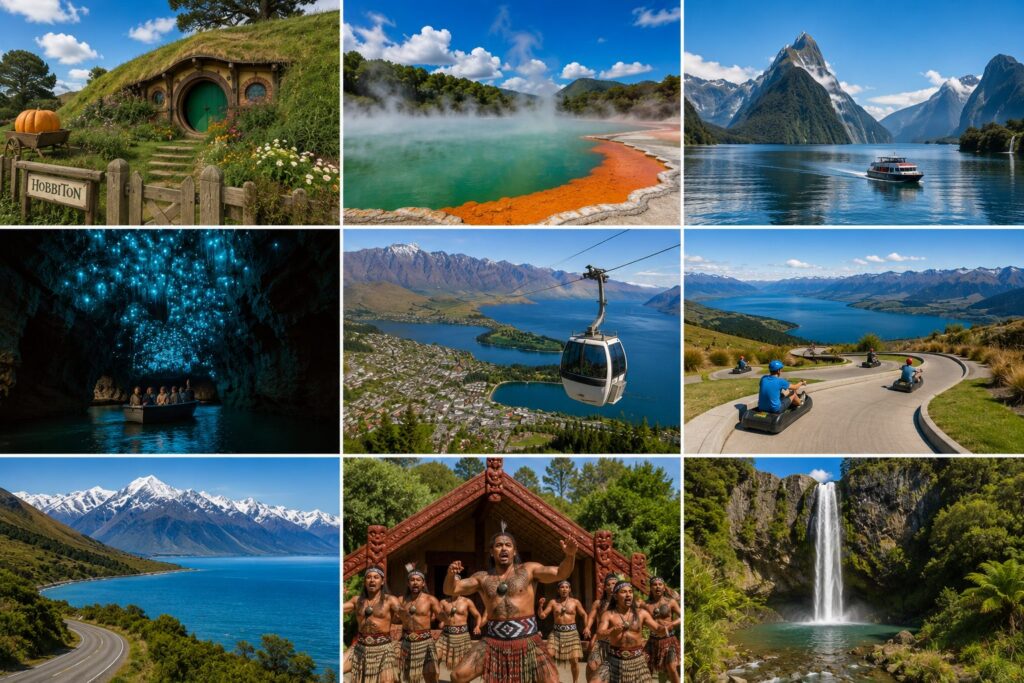
Why kids love it: The North Island offers geothermal landscapes that feel genuinely otherworldly. Rotorua’s bubbling mud pools, shooting geysers, and sulfur-scented air are like nothing else on Earth. The Hobbiton movie set in Matamata is a mandatory pilgrimage for any family with Lord of the Rings or Hobbit fans, and it is genuinely impressive even for those who have never seen the films.
The South Island is one of the most dramatically beautiful places I have ever taken children. Fjordland National Park, specifically Milford Sound, delivers moments of pure silence and grandeur that even teenagers put down their phones for. The Queenstown region offers gondolas, luge riding for all ages, and arguably the best views in the Southern Hemisphere.
New Zealand’s Maori culture offers families one of the most respectful and accessible indigenous cultural experiences in the world. A traditional haka performance is powerful for children because it demonstrates cultural identity, pride, and expression in a way that stays with them long after the trip is over.
Practical family travel tips for New Zealand:
- Rent a campervan as it is the best way to experience both islands with maximum flexibility
- Book the Interislander ferry between the North and South Island for a scenic 3-hour crossing
- Freedom camping requires a self-contained certified vehicle, so check before you stop anywhere
- New Zealand has excellent playgrounds in almost every town, which are great for breaking up long drives
- Hire a local Maori guide for cultural experiences because it is far more meaningful than tourist shows
Best time to visit with kids: December to February for New Zealand summer and school holidays. March to May for autumn with fewer crowds.
Top kid-friendly experiences: Hobbiton, Waitomo Glowworm Caves, Milford Sound cruise, Queenstown luge, Rotorua geothermal parks, and Maori cultural experience.
8. Portugal
Best for: All ages | Budget: Mid-range | Experience: Beach, Culture, and History
Portugal has quietly become one of Europe’s most popular family travel destinations, and for very good reason. It combines excellent beaches, rich history, outstanding food, genuine safety, warm people, and a price point significantly lower than France, Italy, or Spain.
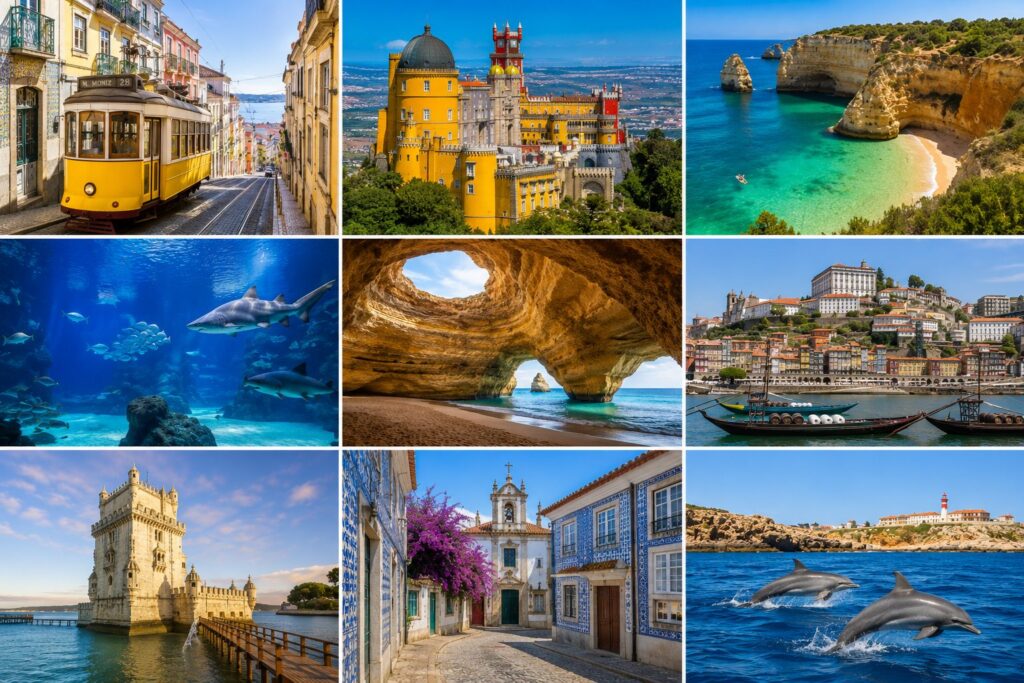
Why kids love it: Lisbon is one of Europe’s most approachable capital cities for families. The historic trams, particularly Tram 28, delight young children. The Oceanarium in Lisbon is genuinely world-class and one of the best aquariums in Europe. Sintra, just 40 minutes from Lisbon by train, offers fairy-tale palaces perched on forested hilltops. The Pena Palace with its candy-colored towers is the kind of place that makes children genuinely believe in fairy tales.
The Algarve in southern Portugal offers some of Europe’s finest beaches with dramatic golden cliffs, clear calm water, and a coastline that changes shape around every headland. Praia da Marinha, Praia de Benagil, and Lagos beaches are among the most photogenic in Europe and perfectly safe for families who swim.
Porto is a compact, walkable city built on dramatic hillsides above the Douro River. Children love the tiled azulejo buildings, the enormous historic bookshop Livraria Lello which inspired J.K. Rowling’s Hogwarts library, and the river boat cruises through the Douro wine valley.
Practical family travel tips for Portugal:
- Lisbon hills require comfortable shoes, so buy children good walking shoes before arriving
- Sintra day trip from Lisbon is essential but book Pena Palace tickets in advance
- The Algarve is a 3-hour drive or short flight from Lisbon, making it worth splitting your trip between both regions
- Portuguese food is exceptionally family-friendly with bacalhau salt cod, fresh seafood, and pasteis de nata
- Uber works reliably in Lisbon and Porto and is more affordable than taxis
Best time to visit with kids: May to June or September to October for warmth without overwhelming heat and far fewer tourists.
Top kid-friendly experiences: Lisbon Oceanarium, Sintra palaces, Algarve beach caves by kayak, Porto river cruise, Pena Palace, and dolphin watching in Lagos.
9. Kenya
Best for: Ages 6 and up | Budget: Luxury | Experience: Wildlife Safari and Culture
A Kenya safari is not just a family holiday. It is a life event. Parents who bring their children on safari consistently describe it as the most impactful travel experience of their lives, more meaningful than any beach, theme park, or city trip. Nothing changes a child’s relationship with the natural world like seeing it in its rawest form.
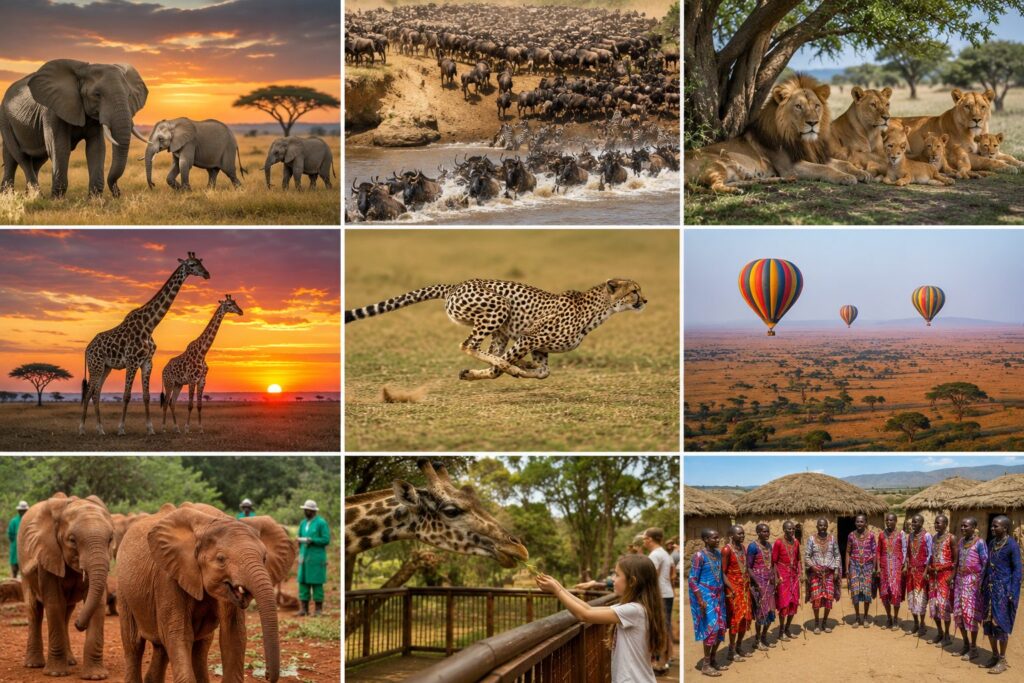
Why kids love it: The Maasai Mara in southern Kenya is one of the greatest wildlife spectacles on the planet. The Great Migration sees over 1.5 million wildebeest, zebras, and gazelles cross the Mara River between Tanzania and Kenya. It is the most dramatic wildlife event on Earth. Watching predator and prey interactions in real time under an enormous African sky changes how children understand nature, food chains, ecosystems, and their own place in the world.
Beyond the migration, daily game drives deliver elephant families moving slowly through the savanna, lion prides sleeping under acacia trees, giraffes silhouetted against orange sunsets, and cheetahs demonstrating the pure mathematics of speed. Children do not need to be told to pay attention. They simply cannot look away.
Family-friendly safari lodges have evolved significantly in recent years. Camps like Angama Mara, Mahali Mzuri, and Governors’ Camp offer dedicated children’s programs, specialist junior ranger activities, and accommodation that manages to be both genuinely luxurious and authentically wild at the same time.
Practical family travel tips for Kenya:
- Most quality family safari lodges accept children aged 6 and older, though some have no minimum age restriction
- Pack khaki or neutral colors because bright colors can disturb wildlife during game drives
- Consult your doctor about malaria prophylaxis well in advance as it is essential for this destination
- Combine your safari with a visit to Nairobi’s Elephant Orphanage at the David Sheldrick Wildlife Trust, which is profoundly moving for children of all ages
- Flying between parks saves enormous amounts of time and is worth the additional cost for families
Best time to visit with kids: July to October for the Great Migration. January to February for calving season when predator activity peaks.
Top kid-friendly experiences: Maasai Mara game drives, Great Migration river crossing, David Sheldrick Elephant Orphanage, Giraffe Centre Nairobi, Maasai village cultural visit, and hot air balloon safari.
10. San Diego, California
Best for: All ages | Budget: Mid-range | Experience: Beach, Wildlife, and Theme Parks
San Diego is one of America’s most consistently excellent family destinations. It manages to combine world-class zoo and wildlife experiences, excellent beaches, theme parks, and a relaxed California lifestyle into one very accessible package that works for families with children of any age.
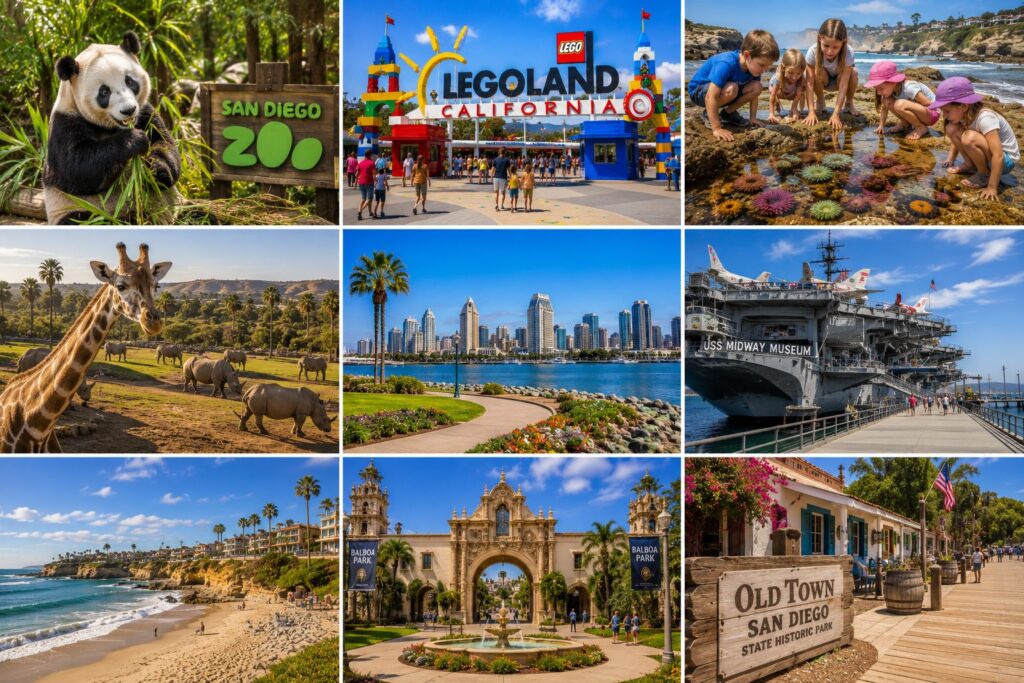
Why kids love it: The San Diego Zoo is universally considered one of the world’s greatest. Over 12,000 animals representing more than 650 species live across beautifully landscaped habitats. The Giant Panda program alone draws families from across the world. The zoo’s sister park, the San Diego Zoo Safari Park in Escondido, offers a more expansive experience with genuine savanna environments and exceptional giraffe, rhino, and cheetah programs.
LEGOLAND California in Carlsbad, 30 minutes north of the city, is perfectly calibrated for children aged 3 to 12. The rides are exciting without being terrifying, the building zones are genuinely engaging, and the Lego-themed accommodation is something children talk about for years afterward. La Jolla Cove and Windansea Beach offer tide pools full of sea anemones, hermit crabs, and starfish that pre-schoolers can explore safely with adult supervision.
For families with older teens, the USS Midway Museum is one of America’s finest military history museums aboard a decommissioned aircraft carrier. Balboa Park, which contains 17 museums, the zoo, and beautiful gardens, could occupy a family for an entire day without spending a dollar on attractions beyond the entrance fee.
Practical family travel tips for San Diego:
- San Diego Zoo membership pays for itself in one and a half visits, making it excellent value for multi-day trips
- Beaches north of Mission Bay including La Jolla and Del Mar have calmer water, which is better for young children
- Old Town San Diego State Historic Park is free and gives excellent context to California history
- The Gaslamp Quarter is more adult-focused, so families are better served staying near Mission Bay or La Jolla
- Parking can be challenging downtown, so use the park-and-ride trolley system instead
Best time to visit with kids: May to October for minimal rain, warm temperatures, and full beach season.
Top kid-friendly experiences: San Diego Zoo, LEGOLAND California, La Jolla tide pools, Balboa Park, USS Midway Museum, and San Diego Safari Park.
11. Thailand
Best for: Ages 5 and up | Budget: Budget to mid-range | Experience: Beach, Culture, and Food
Thailand remains one of the world’s great family travel destinations in 2026, not despite its exoticism but because of it. This is a country where children encounter a genuinely different world: elaborate Buddhist temples, floating markets, elephants in natural sanctuaries, and some of the most extraordinary food on the planet.
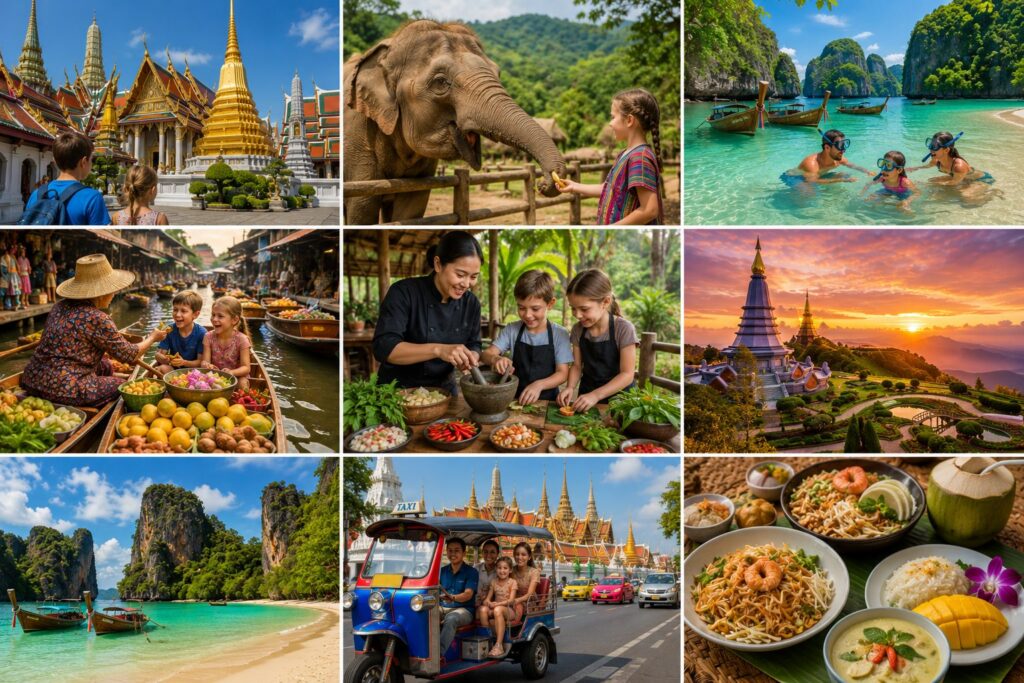
Why kids love it: Thai people have an extraordinary natural affinity with children. Small children are treated with almost reverential warmth everywhere you go throughout the country. This creates a relaxed environment for parents that is genuinely different from traveling in Western countries.
The beaches of southern Thailand including Koh Samui, Koh Lanta, Krabi, and the Phi Phi Islands offer crystalline water, white sand, and coral reefs that make snorkeling accessible to children as young as 5. Chiang Mai in the north offers ethical elephant sanctuaries, and it is worth noting here that you should avoid any sanctuary that offers elephant riding and instead choose organizations that rescue rather than exploit. Chiang Mai also has excellent cooking classes for families and a night bazaar culture that children find completely captivating.
Bangkok is genuinely overwhelming on first arrival but reveals itself quickly as a city built for exploration. The Grand Palace is an architectural spectacle. Floating markets like Damnoen Saduak are theatrical and fun. Thai street food including pad thai, mango sticky rice, and fresh coconut water converts even the most resistant child eaters.
Practical family travel tips for Thailand:
- Stay in Chiang Mai rather than Bangkok as your northern base because it is more relaxed and better for families
- Choose ethical elephant experiences and note that Elephant Nature Park in Chiang Mai is the gold standard
- Travel with sunscreen, mosquito repellent, and electrolyte packets because heat and hydration are real concerns
- Tuk-tuk rides are perfectly safe for families and are absolutely loved by children
- Budget Thailand carefully because entrance fees to temples and attractions are low but they accumulate quickly
Best time to visit with kids: November to February for cool and dry conditions, which are perfect for traveling across the country.
Top kid-friendly experiences: Elephant Nature Park in Chiang Mai, Phi Phi Islands snorkeling, Thai cooking class, Grand Palace Bangkok, floating markets, and Krabi rock climbing for teens.
12. Australia
Best for: All ages | Budget: Luxury | Experience: Wildlife, Beach, and Nature
Australia has the world’s most unique wildlife, and seeing a kangaroo, koala, wombat, or platypus in the wild is a childhood experience that belongs in an entirely different category from any zoo visit. Australia is also blessed with some of the world’s finest beaches and extraordinary natural landscapes that genuinely humble you.
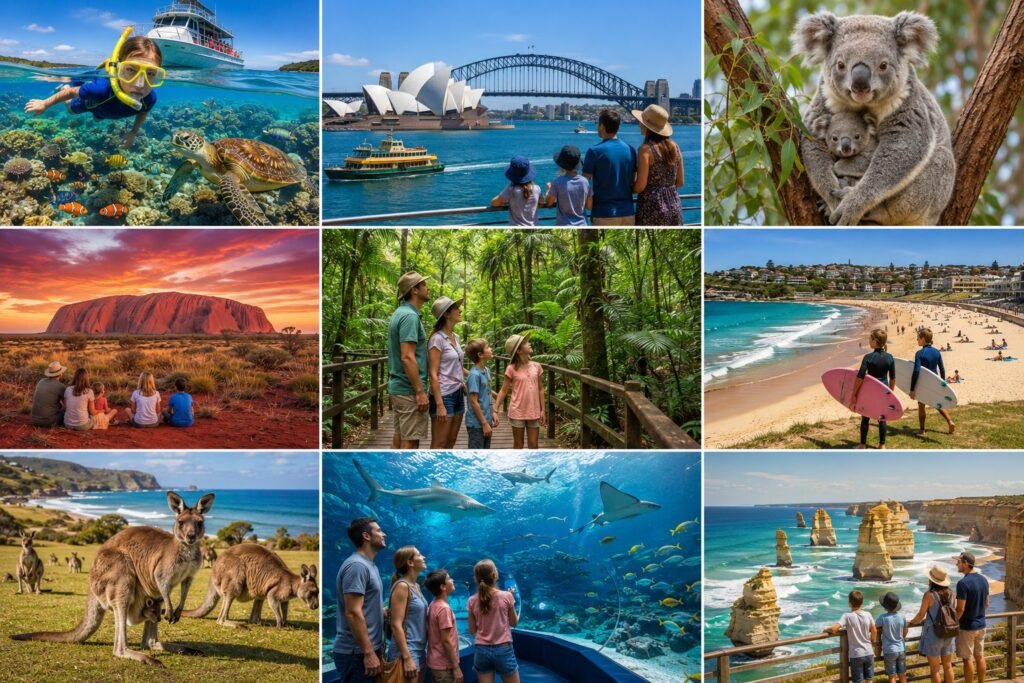
Why kids love it: The Great Barrier Reef is one of the world’s natural wonders. Snorkeling or glass-bottom boat cruising above it with children creates a lasting understanding of marine ecosystems that no documentary can ever replicate. Queensland’s Daintree Rainforest is the world’s oldest tropical rainforest at 135 million years old and is genuinely prehistoric in its atmosphere and scale.
Sydney provides one of the world’s most livable family city experiences with Taronga Zoo and its harbor views, the interactive exhibits of the Australian Museum, Bondi Beach, and ferry rides across the harbor. Melbourne offers excellent family cultural infrastructure including the Melbourne Museum, the aquarium, the Royal Botanic Gardens, and perhaps the finest coffee culture in the world, which is very relevant for parents.
The Red Centre, covering Uluru, Kata Tjuta, and the MacDonnell Ranges, offers children a landscape of almost surreal beauty and an introduction to Indigenous Australian culture of extraordinary depth and significance that cannot be found anywhere else.
Practical family travel tips for Australia:
- Fly into Sydney or Melbourne as your base and plan a domestic flight to Queensland or the Red Centre
- Australia is large, so domestic flights are expensive but unavoidable for covering serious distances
- Sun protection is critical because Australian UV radiation is significantly stronger than in Europe or North America
- Stinger season on the Queensland coast runs November to May, so swim in stinger-netted areas only during this period
- Wildlife parks like Lone Pine Koala Sanctuary in Brisbane offer guaranteed close encounters for families with young children
Best time to visit with kids: April to September for Australian autumn and winter, offering cooler temperatures, no wet season, and no stinger season in Queensland.
Top kid-friendly experiences: Great Barrier Reef snorkeling, Taronga Zoo in Sydney, Uluru sunrise, Lone Pine Koala Sanctuary, Daintree Rainforest, and Sydney Harbour Ferry.
13. Canada
Best for: All ages | Budget: Mid-range to luxury | Experience: Nature, Adventure, and Cities
Canada is criminally underrated as a family travel destination. It offers the safety, infrastructure, and English-language accessibility of a developed Western nation combined with natural landscapes of staggering scale and beauty, including the Rocky Mountains, Niagara Falls, the Bay of Fundy, and ancient boreal forests that genuinely humble even experienced travelers.
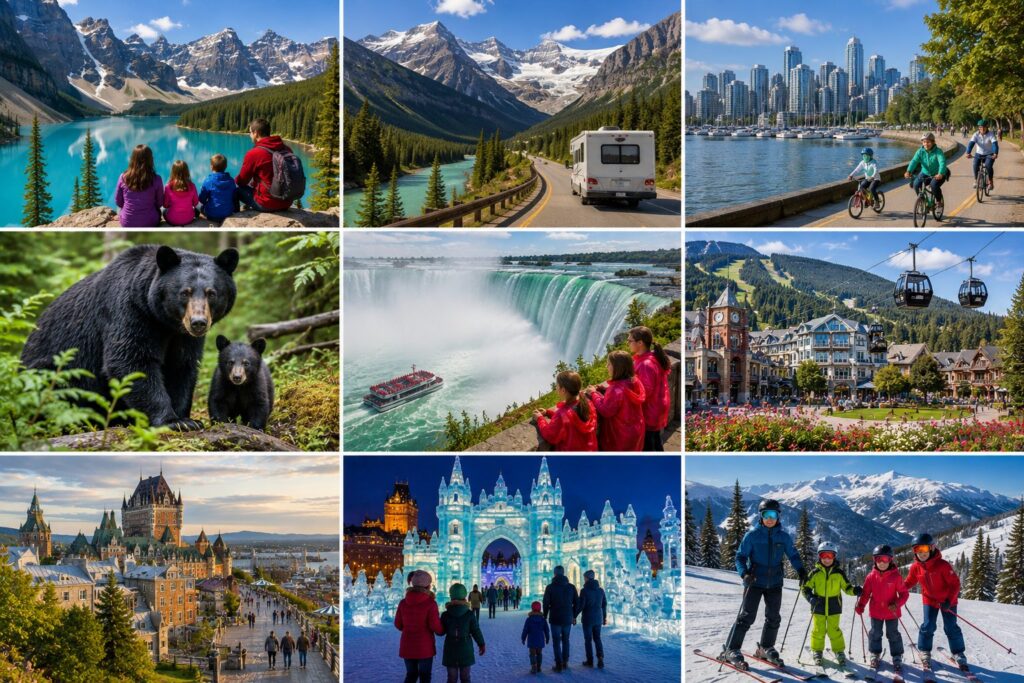
Why kids love it: Banff and Jasper National Parks in the Canadian Rockies represent nature at its most cinematic. Turquoise glacial lakes like Lake Louise and Peyto Lake look digitally enhanced even in person. The hike to the Plain of Six Glaciers above Lake Louise is achievable for children as young as 7 with good footwear. Wildlife encounters including elk grazing roadside, black bears in forests, and mountain goats navigating cliff faces are reliable and genuinely thrilling.
Vancouver is consistently ranked one of the world’s most livable cities and makes an exceptional family base. Stanley Park is larger than New York’s Central Park and is free to explore. It offers a seawall that families can cycle together. The Vancouver Aquarium is excellent. The short drive to Whistler offers year-round outdoor activities with ski season extending from November to May, and summer bringing mountain biking, hiking, and an excellent adventure park.
Quebec City satisfies cultural curiosity in ways that children genuinely appreciate. It is a walled city with authentic French character, horse-drawn carriages, and ice sculpture festivals in winter that create a fairy-tale atmosphere unlike anything in North America.
Practical family travel tips for Canada:
- Parks Canada’s Family and Youth Pass provides free admission for children under 18 to all national parks
- Book accommodation in Banff town well in advance because it fills months ahead in summer
- Rent a vehicle for the Icefields Parkway as it is one of the world’s great scenic drives
- Bear spray is recommended for backcountry hiking, so learn how to use it before setting out
- Canada’s restaurant culture is excellent and dietary requirements are routinely accommodated without issue
Best time to visit with kids: June to August for summer. December to March for ski season and a genuine winter wonderland atmosphere.
Top kid-friendly experiences: Banff and Lake Louise, Niagara Falls, Vancouver Stanley Park, Quebec City Winter Carnival, whale watching in Quebec, and Whistler ski season.
14. Spain
Best for: All ages | Budget: Mid-range | Experience: Beach, Culture, and Food
Spain is one of Europe’s most family-friendly countries. It is a culture that genuinely embraces children in restaurants, public spaces, and social situations in ways that Northern European countries sometimes do not manage. Dinner at 10 PM with a 7-year-old is completely normal. Children are welcome absolutely everywhere.
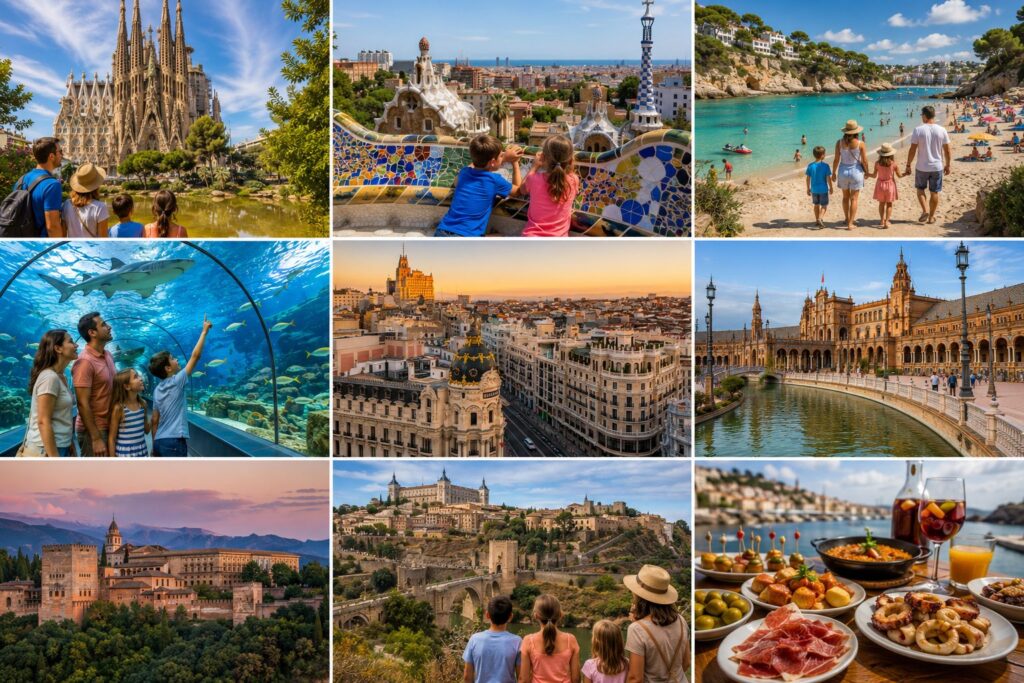
Why kids love it: Barcelona is a city that rewards walking and looking up. Gaudi’s architecture is genuinely unlike anything else in the world. The Sagrada Familia, even still technically under construction, is the most extraordinary building most children will ever see in their lives. Park Guell is an interactive art environment that children run through with pure delight. The Barcelona aquarium in Port Vell is world-class.
The Balearic Islands including Mallorca, the family side of Ibiza, and Menorca offer excellent beach infrastructure specifically designed for families, with shallow coves, good water sports rental, and reliable summer sunshine. The Canary Islands including Tenerife and Gran Canaria provide year-round warmth within a 4-hour flight from Northern Europe, which is a major advantage for families limited to school holiday windows.
Madrid offers the Prado Museum for older children and art-inclined families, but also the Retiro Park, the Natural Science Museum, and some of the finest street food in Europe. Seville’s Alcazar palace, parts of which served as Game of Thrones filming locations, is spectacular for families with older children and teenagers.
Practical family travel tips for Spain:
- Spanish lunch from 2 PM to 4 PM is the main meal of the day and restaurants are empty and welcoming during this window
- Avoid Madrid and Seville in July and August because temperatures regularly exceed 40 degrees Celsius
- Barcelona is walkable but the metro is excellent for covering distance quickly
- Book Sagrada Familia tickets months in advance because it sells out consistently
- Spanish people are extraordinarily helpful to families so do not hesitate to ask for assistance
Best time to visit with kids: April to June or September to October for mainland Spain. The Canary Islands work year-round.
Top kid-friendly experiences: Sagrada Familia in Barcelona, Park Guell, Mallorca beaches, Alhambra in Granada which requires booking months ahead, Toledo day trip from Madrid, and San Sebastian food tour.
15. Maldives
Best for: Ages 4 and up | Budget: Luxury | Experience: Beach, Ocean, and Relaxation
The Maldives is not a destination for every family because the cost is significant and it requires genuine commitment. But for families who make the journey, it delivers an experience of such pure, unhurried beauty that parents describe it as the most relaxing family holiday of their lives. The ocean is so clear, warm, and full of life that children who have never snorkeled before become instantly and completely obsessed.
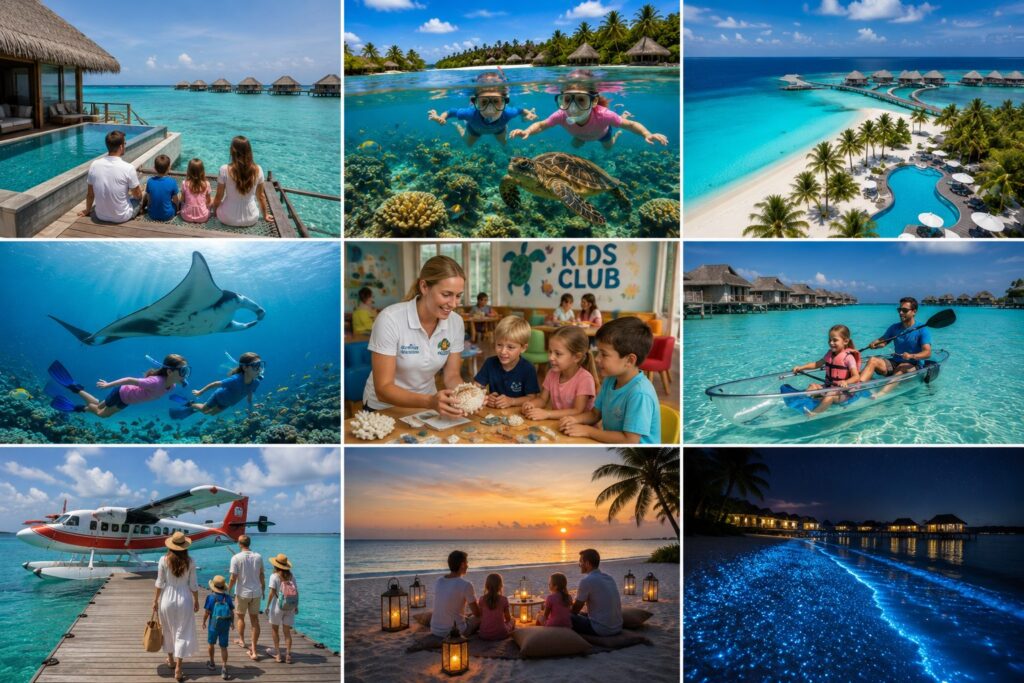
Why kids love it: Waking up in an overwater villa and walking directly from your room into warm, waist-deep turquoise water is an experience children describe with pure, uncomplicated joy. The house reef at most atolls is accessible directly from the beach with no boat required. It delivers snorkeling encounters with manta rays, sea turtles, tropical fish, and occasional reef sharks that are entirely harmless and that children treat like local celebrities.
Many Maldives resorts have invested seriously in children’s programming, offering dedicated kids clubs with marine biology sessions, glass-bottom kayaking, treasure hunts, and junior snorkeling lessons run by patient and qualified staff. Soneva Fushi, Six Senses Laamu, and Anantara Veli are among the best specifically for families.
The Maldives also offers something increasingly rare in family travel: genuine disconnection. Many resorts deliberately limit Wi-Fi access in public areas. Children who arrive attached to screens often forget about them within 24 hours of arrival. For many parents, this is the single most valuable thing the Maldives actually delivers.
Practical family travel tips for the Maldives:
- Seaplane transfers to remote atolls are expensive but provide an extraordinary experience for children
- Choose resorts on North Male Atoll for shorter and cheaper speedboat transfers
- Many resorts charge significant supplements for children, so calculate the total family cost carefully before booking
- Travel insurance covering water sports and medical evacuation is essential for this destination
- Book 6 to 12 months in advance for peak season from December to April
Best time to visit with kids: November to April for the dry season, clearest water, and calmest seas.
Top kid-friendly experiences: Snorkeling the house reef, manta ray encounters, glass-bottom kayaking, marine biology sessions, overwater villa experience, and bioluminescent beach nights.
16. Peru
Best for: Ages 8 and up | Budget: Mid-range | Experience: History, Culture, and Adventure
Peru is one of those destinations that genuinely changes the way children see the world. Standing at Machu Picchu and understanding that an entire civilization built this impossibly perfect stone city on a mountain ridge without modern tools, without wheels, and without written plans is the kind of moment that rewires young minds permanently.
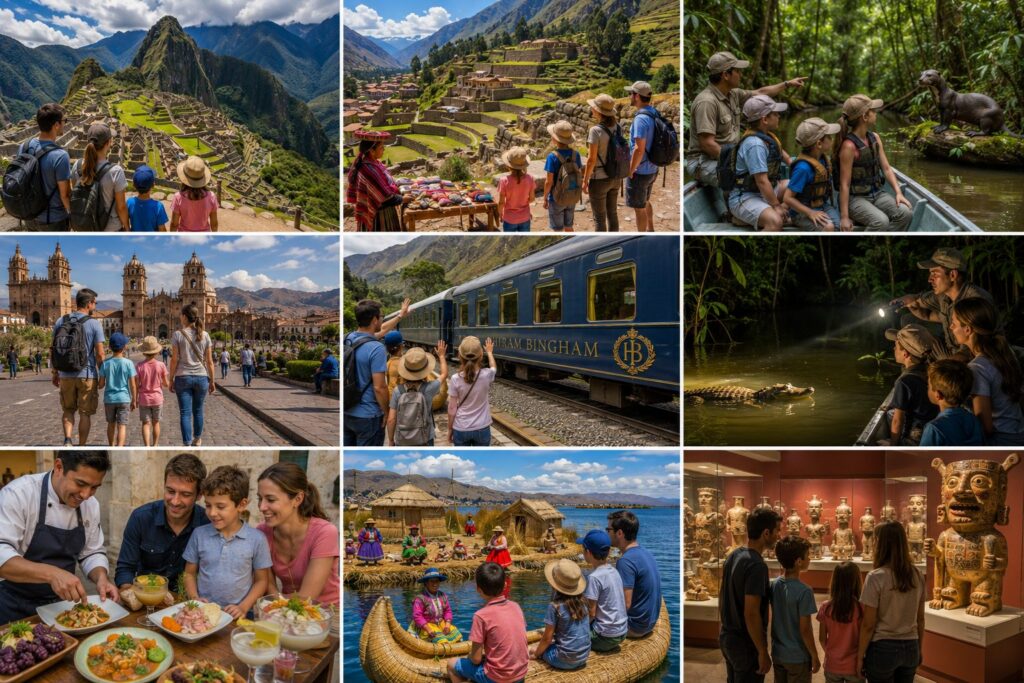
Why kids love it: Machu Picchu is the obvious draw, and it absolutely delivers. But Peru is far more than one ancient site. The Sacred Valley offers a string of Incan ruins, traditional markets, and farming terraces that give children a complete picture of how the Incan Empire actually functioned at its peak. Cusco, the former Incan capital now layered with Spanish colonial architecture, is one of the most visually striking cities in the Americas.
The Amazon rainforest in the Madre de Dios region offers families an entirely different Peru. Guided jungle lodges run excellent programs for children covering wildlife tracking, medicinal plant identification, and nocturnal animal spotting. Seeing a giant river otter, a family of capybara, or a caiman by torchlight from a dugout canoe is a childhood experience with no equivalent anywhere in Europe or North America.
The Peruvian people are extraordinarily warm toward families with children. The country’s food scene, centered on Lima which many chefs now consider the gastronomic capital of South America, is spectacular. Even children who claim not to like new foods consistently discover things they love in Peru.
Practical family travel tips for Peru:
- Spend 2 to 3 days in Cusco before heading to Machu Picchu to allow proper acclimatization to altitude
- Book Machu Picchu tickets at least 3 months in advance as daily visitor numbers are strictly capped
- Children under 8 can visit Machu Picchu but the altitude and walking distance make 8 and above more practical
- The Hiram Bingham train from Cusco to Aguas Calientes is the most comfortable family option for the journey
- Lima is an excellent 2-day city stop at the start or end of the trip with excellent food, museums, and coastal parks
Best time to visit with kids: May to October for dry season and clear skies at Machu Picchu. Avoid November to March when the Inca Trail closes due to heavy rain.
Top kid-friendly experiences: Machu Picchu, Sacred Valley markets, Amazon jungle lodge, Cusco food tour, Lake Titicaca floating islands, Lima Larco Museum.
17. Bali, Indonesia
Best for: Ages 4 and up | Budget: Budget to mid-range | Experience: Culture, Beach, and Nature
Bali has earned its reputation as one of the most family-friendly destinations in Asia, and not simply because it is beautiful, though it genuinely is. What makes Bali exceptional for families is the combination of extraordinary natural scenery, deeply welcoming local culture, world-class family resorts at prices that are genuinely affordable, and a pace of life that forces everyone to slow down and breathe properly.
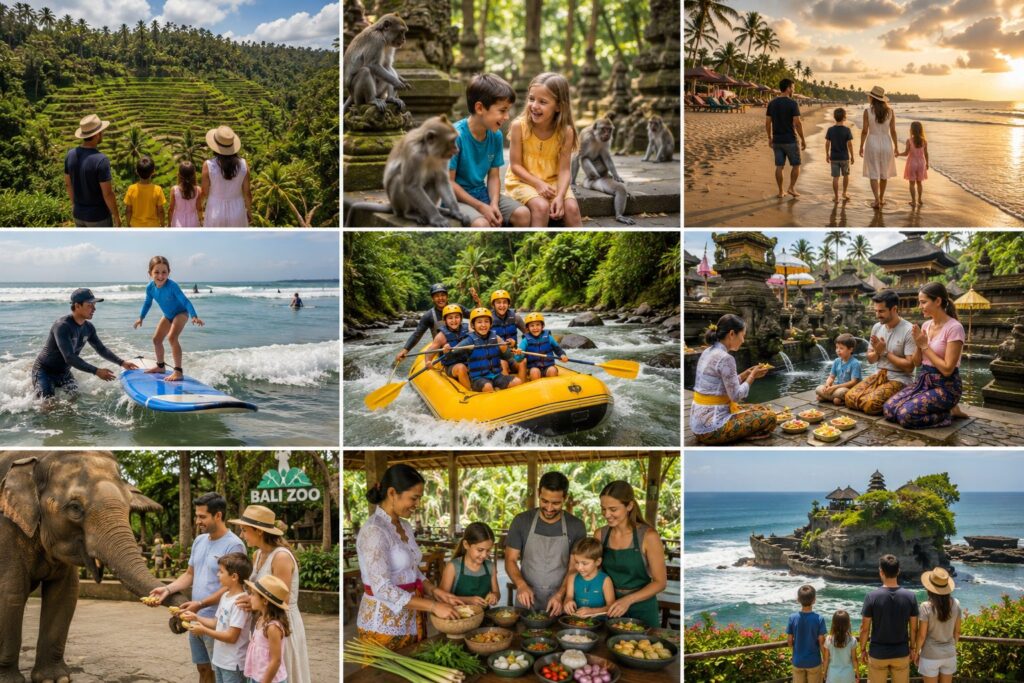
Why kids love it: The rice terraces of Ubud are among the most photographed landscapes on Earth and they are even more impressive in person. Walking through working rice paddies with a knowledgeable local guide who explains the subak water system that has sustained Balinese agriculture for a thousand years turns a walk into a genuine living history lesson. Children remember it.
Bali’s monkey forests are a genuine hit with children of all ages. The Sacred Monkey Forest in Ubud is home to over 700 Balinese long-tailed macaques living freely among ancient temple ruins. Children find this equal parts thrilling and slightly terrifying, which is exactly the right combination for making lasting memories.
The beaches of Seminyak, Nusa Dua, and the Bukit Peninsula deliver everything families expect from an Asian tropical beach destination. The surfing culture in Bali is perfectly suited to children, with dozens of schools offering half-day lessons for children as young as 6 in sheltered, calm conditions. And white water rafting on the Ayung River near Ubud is accessible for children aged 7 and above.
Practical family travel tips for Bali:
- Base yourself in Seminyak or Nusa Dua for beach focus, or Ubud for culture and nature focus so split your trip between both for the best experience
- Water temple ceremonies happen regularly and families are genuinely welcome to observe respectfully
- Hire a private driver for the day rather than renting a scooter which is safer and far more practical for families with children
- Balinese food is excellent but some dishes are genuinely spicy so always ask before ordering for young children
- Most villa accommodation includes a private pool which is far more practical for families than hotel pools
Best time to visit with kids: April to October for dry season with the best beach conditions. July and August are peak season and more expensive but the weather is most reliable.
Top kid-friendly experiences: Sacred Monkey Forest Ubud, rice terrace walk Tegalalang, surf lesson Seminyak, white water rafting Ayung River, Bali Zoo, cooking class with local family.
18. Vietnam
Best for: Ages 7 and up | Budget: Budget | Experience: History, Food, Culture, and Nature
Vietnam is one of the world’s most underrated family travel destinations and one of its best value ones. For the money, it is almost impossible to find a country that delivers as much diversity of experience: ancient cities, dramatic natural landscapes, extraordinary food, living history, and a local culture that has genuine warmth and curiosity toward foreign families.
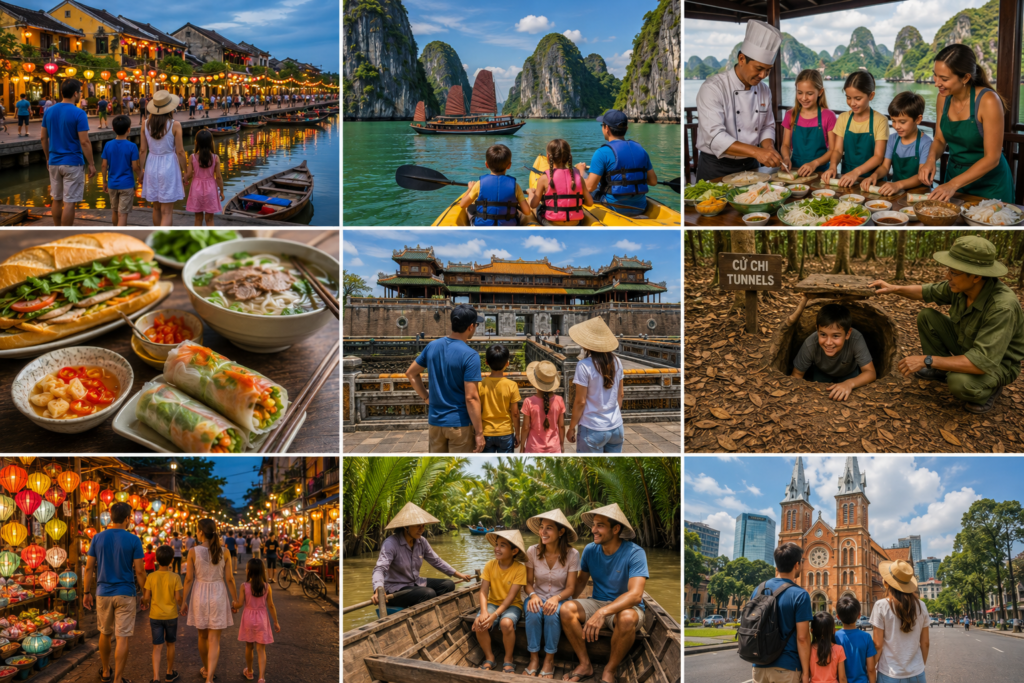
Why kids love it: Hoi An is one of the most beautiful towns in Southeast Asia, a UNESCO World Heritage-listed trading port whose Chinese merchant houses, Japanese covered bridge, and tailoring workshops have remained essentially unchanged for four centuries. Children find the lantern-lit streets magical at night, and the experience of having clothes or shoes custom-made by a local tailor in 24 hours is something they genuinely treasure.
Halong Bay is a UNESCO World Heritage landscape of nearly 2,000 limestone karst islands rising dramatically from green water. An overnight cruise on a traditional wooden junk is one of Asia’s great family travel experiences. Children kayak through sea caves, swim in secluded bays, and cook spring rolls with the ship’s chef. It is everything a family adventure should be.
Ha Long’s food scene is extraordinary and genuinely accessible to children. Banh mi sandwiches from street stalls cost less than a dollar and taste extraordinary. Fresh spring rolls, pho noodle soup, and grilled corn are universally popular with children. Vietnam manages the rare trick of having street food that is both genuinely interesting and genuinely approachable.
Practical family travel tips for Vietnam:
- Fly into Hanoi for north Vietnam and Ho Chi Minh City for south Vietnam because the country is long and planning your direction carefully saves significant time
- Book an overnight Halong Bay cruise on a reputable boat as quality varies enormously so read recent family reviews before booking
- Hoi An is the single best base for families as it is safe, beautiful, walkable, and has excellent food on every street
- Vietnamese traffic is heavy and chaotic in cities so use taxis or ride-hailing apps rather than walking busy roads with young children
- Motorbike tours of rural areas are popular but use a reputable company with proper safety equipment for older children
Best time to visit with kids: February to April for central Vietnam including Hoi An. November to April for south Vietnam. Halong Bay is best March to May and September to November.
Top kid-friendly experiences: Halong Bay overnight cruise, Hoi An lantern-lit old town, Vietnamese cooking class, Cu Chi Tunnels for ages 10 and above, Hue Imperial Citadel, Mekong Delta boat tour.
19. Morocco
Best for: Ages 8 and up | Budget: Budget to mid-range | Experience: Culture, Adventure, and History
Morocco is the family travel destination that genuinely surprises. Most parents arrive expecting heat and culture shock and leave describing it as one of the most visually extraordinary, personally welcoming, and genuinely educational trips they have ever taken with their children. The country delivers sensory richness that no amount of preparation quite captures.

Why kids love it: The medinas of Fes and Marrakech are genuine labyrinths. Walking through winding alleyways where leather tanners, spice merchants, metalworkers, and weavers all practice centuries-old crafts within meters of each other is unlike any experience in the developed world. Children who would scroll through their phones at a museum stand completely absorbed in the organised chaos of a working medina.
Sleeping in the Sahara Desert is a bucket list experience for any age. A camel trek from Merzouga into the Erg Chebbi dunes at sunset followed by a night in a luxury desert camp under an absolutely undiluted Milky Way sky is the kind of experience that parents describe as their child’s most treasured travel memory. The silence of the desert at night is itself something children carry with them.
Chefchaouen, the blue city tucked into the Rif Mountains in northern Morocco, is perhaps the most photogenic city in Africa. Its narrow streets painted entirely in different shades of blue create a dreamlike atmosphere that children find genuinely magical. It is also one of Morocco’s most relaxed and genuinely safe cities for families.
Practical family travel tips for Morocco:
- Book a reputable local guide for medina visits in Fes and Marrakech because it is both safer and far more interesting than navigating alone
- Negotiate prices calmly and with good humor in souks as children find the haggling process genuinely fascinating once they understand how it works
- Arrange Sahara desert camps through established operators as standards vary considerably so always read recent family reviews before committing
- Moroccan food is excellent for children with tagines, couscous, fresh bread, and sweet mint tea all universally popular
- Riad accommodation in the medinas is exceptional value and provides a beautiful private courtyard environment perfect for families
Best time to visit with kids: March to May or September to November for the most comfortable temperatures. Avoid July and August in inland cities as temperatures regularly exceed 40 degrees Celsius.
Top kid-friendly experiences: Sahara desert camel trek and overnight camp, Fes medina guided tour, Chefchaouen blue city, Marrakech Djemaa el-Fna evening market, Atlas Mountains day hike, traditional hammam experience.
20. Hawaii, USA
Best for: All ages | Budget: Mid-range to luxury | Experience: Beach, Nature, and Outdoor Adventure
Hawaii occupies a unique position in family travel. It offers the full experience of a genuinely exotic tropical destination including volcanoes, rainforests, whale watching, and world-class surfing beaches while remaining entirely within the United States. No passport, no currency exchange, no language barrier, and no jet lag for mainland American families. It is the most accessible extraordinary destination in the world.
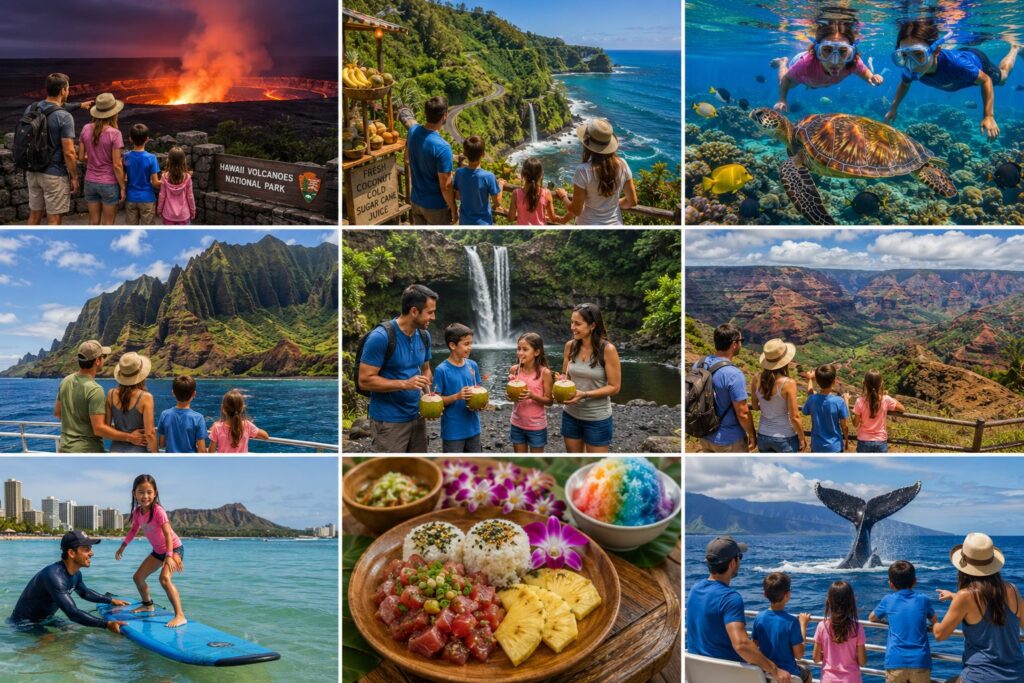
Why kids love it: The Big Island of Hawaii offers something found almost nowhere else on Earth: the chance to see an active volcano up close in complete safety. Hawaii Volcanoes National Park lets families walk across cooled lava fields, peer into steam vents, and understand that the island they are standing on is still being created by geological forces beneath their feet. The Jaggar Museum overlook at night, where molten lava glows orange in the dark, is genuinely one of the most dramatic sights in the natural world.
Maui delivers the quintessential Hawaiian family experience. The Road to Hana combines bamboo forests, waterfalls cascading directly onto black sand beaches, and roadside fruit stands selling fresh coconut and sugarcane juice into one of America’s great drives. Snorkeling at Molokini Crater, a partially submerged volcanic caldera, puts families inside a protected marine sanctuary teeming with Hawaiian green sea turtles, spotted eagle rays, and hundreds of tropical fish species.
Kauai, the oldest and most dramatically beautiful of the main islands, offers the Na Pali Coast by boat or helicopter for an aerial perspective that children genuinely cannot believe. The Waimea Canyon, sometimes called the Grand Canyon of the Pacific, delivers red rock landscapes of extraordinary scale accessible by car and short hiking trails.
Practical family travel tips for Hawaii:
- Each island has a distinct character so choose based on your family’s priorities rather than visiting multiple islands in one trip
- Maui and Kauai are the best all-round choices for families with children of mixed ages
- Book whale watching tours from December to March for humpback whale season which is extraordinary for children
- Sunscreen in Hawaii must be reef-safe because standard chemical sunscreens are banned to protect coral reefs and this law is actively enforced
- Early morning beach visits avoid the strongest midday sun and deliver the calmest ocean conditions for young swimmers
Best time to visit with kids: April to June and September to November for the best combination of good weather, lighter crowds, and lower prices. December to March for whale watching season.
Top kid-friendly experiences: Hawaii Volcanoes National Park, Road to Hana Maui, Molokini Crater snorkeling, Na Pali Coast boat tour, Waimea Canyon Kauai, surf lessons Waikiki Beach.
21. Switzerland
Best for: All ages | Budget: Luxury | Experience: Nature, Adventure, and Alpine Scenery
Switzerland is expensive. There is no way around this fact and families should budget carefully. But for those who can manage it, Switzerland delivers a standard of natural scenery, safety, infrastructure, and sheer Alpine beauty that has no equal in Europe. Children who visit Switzerland come home describing it as looking like something from a cartoon or a dream, because the mountains are simply that dramatic.
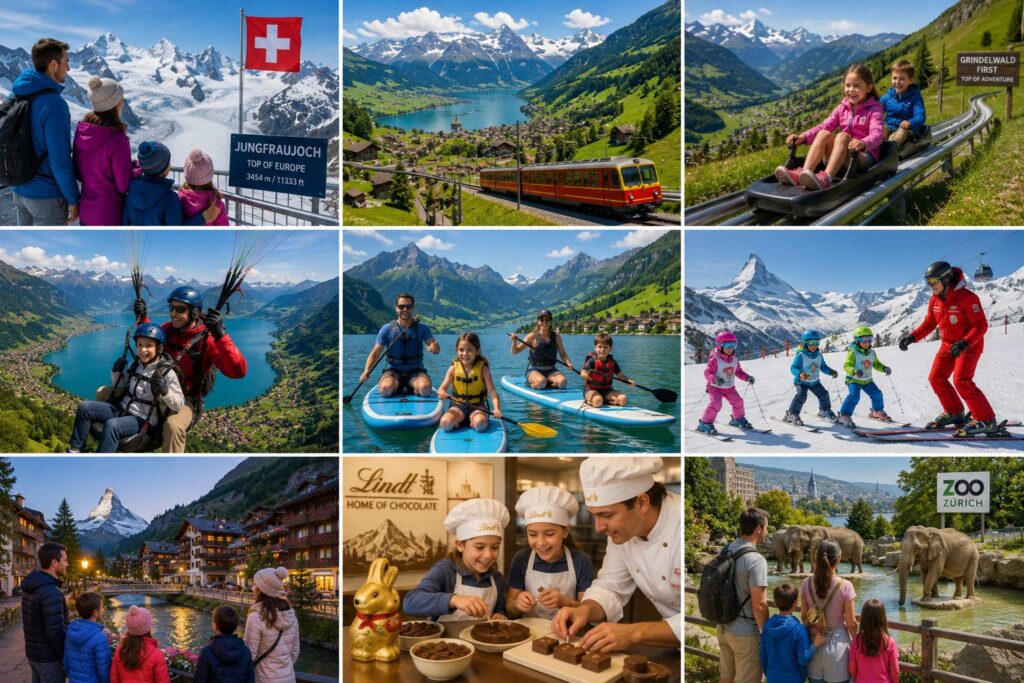
Why kids love it: The Swiss mountain railways are an experience in themselves. The Jungfraujoch railway climbs to 3,454 meters above sea level, the highest railway station in Europe, arriving at a landscape of permanent snow, glaciers, and views across four countries. Children who have never seen a glacier in their lives stand completely silent the first time they step out into that white world above the clouds.
Interlaken sits between two pristine mountain lakes and directly below the Eiger, Monch, and Jungfrau peaks. It is the adventure capital of Europe and surprisingly accessible for families. The summer luge runs at Grindelwald are suitable for children aged 5 and above. Paragliding tandem flights are available for children aged 8 and above. Paddle boarding on Lake Thun or Lake Brienz is calm, safe, and set against scenery that makes every photograph look professionally composed.
In winter, Switzerland becomes one of Europe’s finest family skiing destinations. Verbier, Zermatt, and Davos all have excellent ski schools for children from age 3 upwards. The sight of the Matterhorn rising above Zermatt at dawn, perfectly pyramidal and utterly still, is one of those travel moments that adults describe years later as having made them feel very small in the best possible way.
Practical family travel tips for Switzerland:
- The Swiss Travel Pass covers trains, buses, and most mountain railways and is essential for family travel and children under 16 travel completely free when accompanying a parent pass holder
- Supermarkets including Migros and Coop are excellent for affordable family meals and reduce costs significantly
- Book ski school at least one month in advance during peak winter season as popular resorts fill quickly
- Mountain weather changes rapidly so always carry an extra warm layer even during summer months
- Swiss public transport runs with extraordinary reliability so plan connections confidently without needing buffer time
Best time to visit with kids: June to September for hiking, mountain railways, and summer activities. December to March for skiing and snow.
Top kid-friendly experiences: Jungfraujoch railway, Grindelwald summer luge, Zermatt Matterhorn views, Lake Lucerne paddle boarding, Zurich zoo, Swiss chocolate factory tour.
22. South Africa
Best for: Ages 6 and up | Budget: Mid-range to luxury | Experience: Wildlife, Culture, and Coastal
South Africa is one of the world’s most diverse family travel destinations. In a single trip a family can experience world-class wildlife safaris, some of the most dramatic coastal scenery on Earth, a deeply layered and important cultural history, excellent cuisine, world-class wines for the parents, and a country that makes international visitors feel genuinely welcome. All of this at a price point that is significantly more accessible than Kenya or Tanzania.
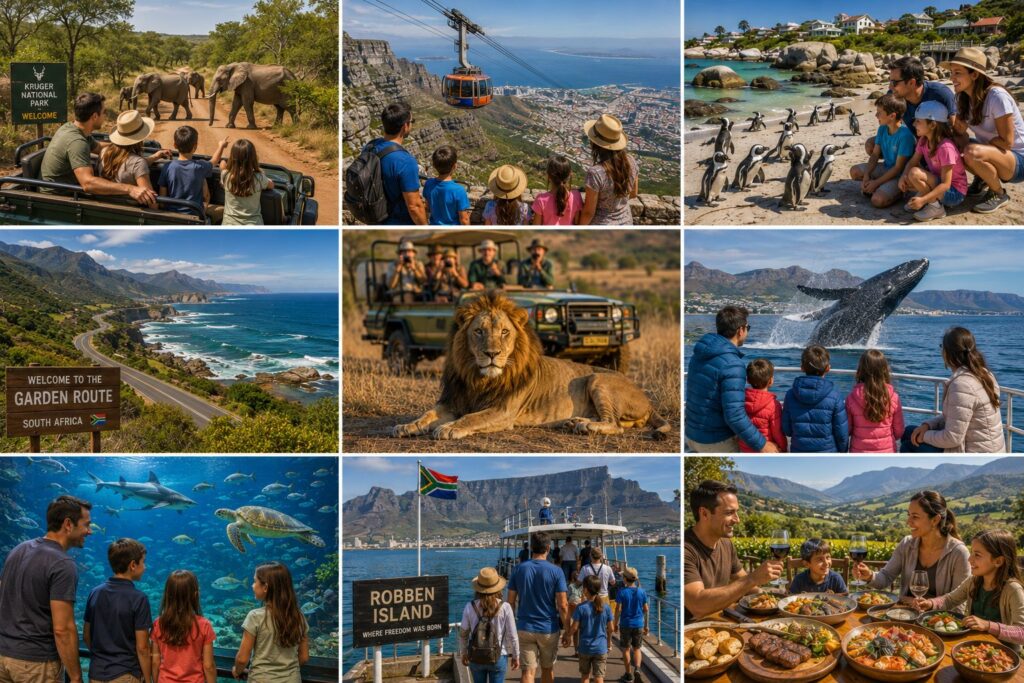
Why kids love it: The Kruger National Park is one of Africa’s greatest wildlife destinations and an ideal introduction to safari for families new to the experience. Self-drive safaris in Kruger are genuinely accessible and affordable, allowing families to drive their own vehicle through the park at their own pace while spotting lions, elephants, rhinos, leopards, and buffalo. The famous Big Five can realistically all be seen within a 3-day visit.
Cape Town is one of the world’s great cities for families. Table Mountain by cable car delivers views that genuinely stun children into silence. The Boulders Beach penguin colony near Simon’s Town, where African penguins waddle through the car park and nest between private houses, is one of the most joyful wildlife encounters in Africa. The Waterfront development offers excellent restaurants, the Two Oceans Aquarium, and a ferry to Robben Island for families with older children and teenagers.
The Garden Route connecting Cape Town to Port Elizabeth through George and Knysna offers waterfalls, forest walks, bungee jumping for teenagers from Bloukrans Bridge which is the world’s highest commercial bungee jump, and outstanding whale watching from Hermanus between July and November.
Practical family travel tips for South Africa:
- Self-drive Kruger is excellent for families and book rest camps inside the park well in advance as they fill quickly
- Cape Town is very safe in tourist areas but be aware of surroundings in less visited parts of the city
- Car rental is good value and essential for exploring the Garden Route and Cape Winelands
- South African cuisine is exceptional value with braai culture, fresh seafood, and Cape Malay food all being excellent choices for families
- The Boulders Beach penguin colony requires advance booking in peak season as visitor numbers are managed carefully
Best time to visit with kids: October to April for Cape Town and coastal areas. May to September for Kruger wildlife viewing when animals gather at waterholes.
Top kid-friendly experiences: Kruger National Park self-drive safari, Table Mountain cable car, Boulders Beach penguin colony, Two Oceans Aquarium Cape Town, Hermanus whale watching, Robben Island for ages 10 and above.
23. Mexico
Best for: All ages | Budget: Budget to mid-range | Experience: Beach, Culture, History, and Food
Mexico is North America’s most underrated family travel destination. For families in the United States and Canada it offers extraordinary value, short flight times, no jet lag, and a richness of culture, cuisine, history, and natural beauty that genuinely rivals destinations requiring a transatlantic flight. The tequila is for the parents. Everything else is for the whole family.
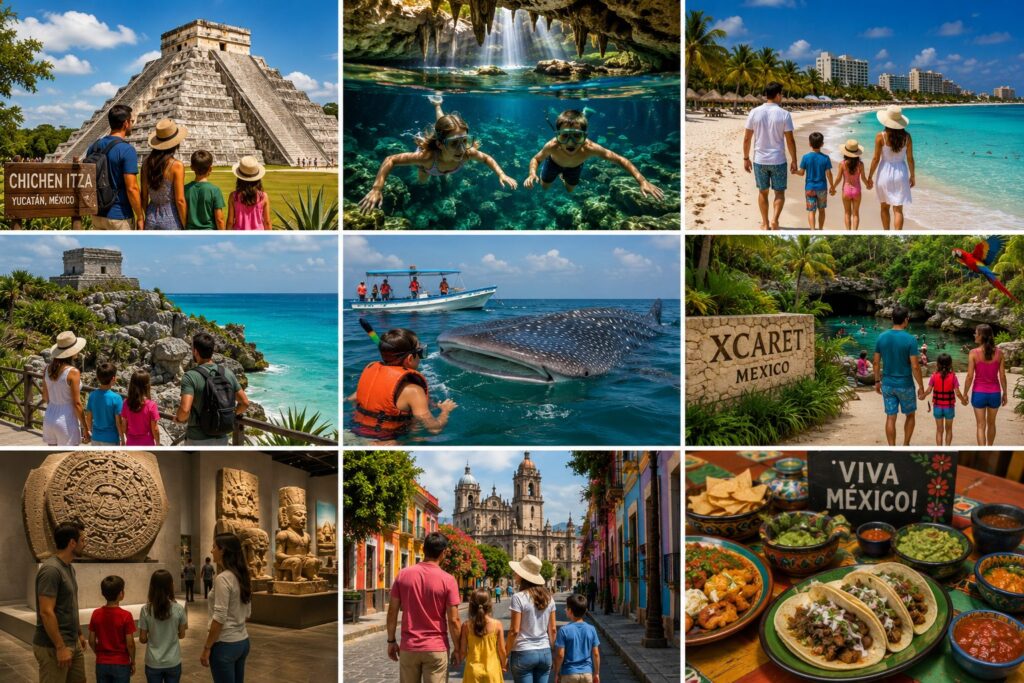
Why kids love it: The Yucatan Peninsula is the richest region for family travel in Mexico. The ancient Maya ruins of Chichen Itza, one of the New Seven Wonders of the World, give children a direct connection to a civilization of genuine mathematical, astronomical, and architectural genius. Watching the shadow of the feathered serpent deity Kukulkan descend the main pyramid steps during the spring equinox is one of the most extraordinary calendar-aligned architectural experiences in the world.
The cenotes of the Yucatan are freshwater limestone sinkholes formed by the collapse of cave ceilings over underground rivers. Swimming and snorkeling in these crystal clear underground pools surrounded by stalactites and tropical fish is completely unlike any swimming experience in the world. Children find them equal parts beautiful and slightly mysterious, which is exactly right.
Cancun and the Riviera Maya offer world-class all-inclusive resort options for families who want a simpler beach holiday, while Tulum offers a more boutique experience with a quieter beach scene and extraordinary cenote access directly from town. Mexico City itself, often overlooked by families, has outstanding museums including the National Anthropology Museum which houses the world’s greatest collection of pre-Columbian artifacts.
Practical family travel tips for Mexico:
- Drink only bottled or filtered water throughout Mexico and this rule applies to ice in drinks as well
- Apply reef-safe sunscreen at all times when swimming near coral in the Riviera Maya
- Book cenote visits through reputable operators as some cenotes have serious depth and strong currents that require proper guidance
- The Cancun hotel zone is very safe for families but explore Playa del Carmen and Tulum for a more authentic Mexican experience
- Mexican cuisine is genuinely extraordinary and encourage children to try authentic local food well beyond the hotel buffet
Best time to visit with kids: November to April for dry season on the Yucatan Peninsula with the most reliable weather and calmest seas.
Top kid-friendly experiences: Chichen Itza ruins, cenote swimming Yucatan, Tulum ruins above the Caribbean, Xcaret eco-park, whale shark snorkeling Holbox from June to September, Mexico City National Anthropology Museum.
24. France
Best for: All ages | Budget: Mid-range to luxury | Experience: Culture, History, Food, and Nature
France is the world’s most visited country for a reason. It has managed to combine extraordinary cultural depth, genuine gastronomic excellence, diverse natural landscapes, and world-class family tourism infrastructure into one country that delivers something remarkable for every member of the family regardless of age or interest.
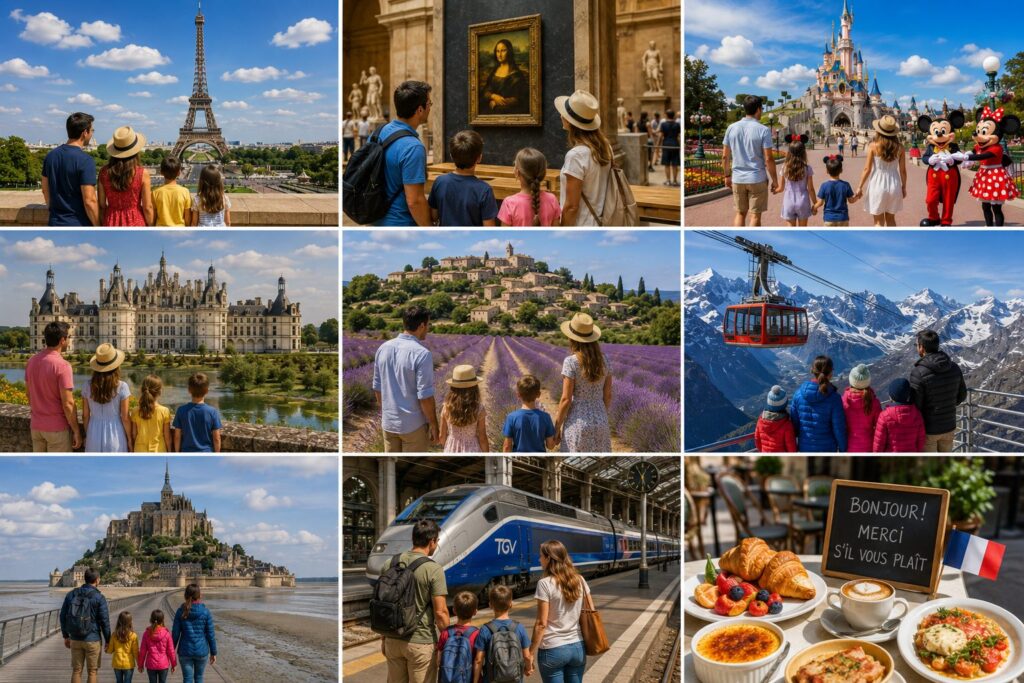
Why kids love it: Paris with children is not the hardship that nervous parents sometimes imagine. The Eiffel Tower is every bit as impressive as photographs suggest, and the ascent by lift to the summit with a city laid out beneath you is universally described by children as one of the best things they have ever done. The Louvre is vast but its Egyptian antiquities wing, the Greek and Roman sculptures, and of course the Mona Lisa corridor give families with limited concentration spans a genuine circuit they can complete in two satisfying hours.
Disneyland Paris, 35 minutes from central Paris by RER train, is the best-run Disney park in Europe and a genuinely magical experience for children aged 3 to 12. Unlike Florida’s Disney World, the European park is compact enough to cover meaningfully in two days, the queues are manageable outside peak periods, and the surrounding hotel environment is beautifully themed.
The French countryside offers families something entirely different. The Loire Valley with its fairy-tale chateaux rising above the river is a living history of Renaissance France. Provence in summer with its lavender fields and hilltop villages delivers some of the most beautiful scenery in Europe. The French Alps offer world-class skiing at Chamonix, Les Deux Alpes, and Megeve with excellent ski schools for children from age 3 upwards.
Practical family travel tips for France:
- Paris is very walkable but the Metro is excellent and children under 10 travel free
- Book Eiffel Tower summit tickets at least 2 months in advance as the summit sells out far ahead of time
- French lunch culture means restaurants stop serving around 2:30 PM so eat on French time rather than fighting the system
- French people respond warmly to any attempt at the language and teach children to say bonjour, merci, and s’il vous plait before arriving
- The TGV high-speed train network connects Paris to Marseille, Lyon, Bordeaux, and other major cities in 2 to 3 hours
Best time to visit with kids: April to June and September to October for Paris and the countryside. December to March for Alps skiing.
Top kid-friendly experiences: Eiffel Tower Paris, Louvre Museum, Disneyland Paris, Loire Valley chateaux, Mont Saint-Michel at high tide, Chamonix cable car and glacier.
25. USA National Parks
Best for: All ages | Budget: Budget to mid-range | Experience: Nature, Adventure, Science, and American Heritage
The United States National Park System is one of the greatest gifts any government has ever given its citizens and its visitors. Covering over 84 million acres across 63 official national parks, the system preserves landscapes of such extraordinary diversity and scale that a family could spend decades exploring it without exhausting its possibilities. It is also, by international standards, remarkably affordable.
Why kids love it: The Grand Canyon is simply incomprehensible from the rim. Standing at the South Rim with a child and watching them try to process a chasm 277 miles long, 18 miles wide, and over a mile deep is one of the most humbling experiences available to a family on Earth. The first sight of it stops conversation. Every child who has ever stood at that rim has described it in almost identical terms: they had no idea something could be that big.
Yellowstone National Park is the world’s first national park and remains its most extraordinary geological theater. Old Faithful erupts on a predictable schedule that children find satisfying. The Grand Prismatic Spring, a hot spring over 300 feet in diameter with rainbow-colored bacterial mats creating concentric rings of orange, yellow, and green around its deep blue center, looks digitally enhanced even in photographs. In person it looks genuinely impossible. Bison, elk, wolves, and bears are routinely visible from park roads.
Yosemite Valley in California delivers vertical granite walls, thundering waterfalls, and ancient giant sequoia trees so large that tunnels have been carved through their bases large enough to drive a car through. Zion National Park in Utah offers the Narrows slot canyon hike where families wade through a river between canyon walls 2,000 feet high. Acadia in Maine delivers tidal pools, carriage roads for cycling, and the only mountain on the US Atlantic coast.
Practical family travel tips for USA National Parks:
- The America the Beautiful Annual Pass covers entrance to all national parks for one year and pays for itself in two to three park visits
- Book accommodation inside parks 6 months in advance as campsites and lodges fill extremely quickly
- Download the NPS app before each visit for offline maps, junior ranger program information, and ranger-led program schedules
- Junior Ranger programs at every national park are free and give children a structured way to engage with and earn an official badge from each park they visit
- Visit in shoulder seasons of April to May and September to October for significantly fewer crowds and better wildlife viewing
Best time to visit with kids: Varies by park. Grand Canyon and Zion are best April to May and September to October. Yellowstone is best June to September. Acadia peaks in September and October for fall foliage.
Top kid-friendly experiences: Grand Canyon South Rim, Yellowstone Old Faithful and Grand Prismatic Spring, Yosemite Valley and giant sequoias, Zion Narrows hike, Acadia carriage road cycling, Junior Ranger badge program at every park.
Best Destinations by Age Group
Best Places to Travel With Toddlers (Ages 1 to 3)
Traveling with toddlers requires prioritizing safety, routine, and minimal transit time. The best destinations for this age group are predictable, warm, and short-haul from your home.
Top picks for toddlers:
- Portugal Algarve: Shallow, calm beaches; short flights from Europe; relaxed culture; excellent accommodation infrastructure
- Hawaii: No jet lag from the US mainland; calm lagoon beaches; highly accessible; familiar language
- Italy: Culture-rich but highly family-accepting; excellent food; well-connected by train
- Spain Balearic Islands: Protected coves with flat water; reliable sunshine; short flights from Europe
- Canada Vancouver and Victoria: Safe, walkable cities; outstanding parks; no language barrier
Toddler travel tips: Pack your own child car seat for international trips. Carry all medications in your carry-on luggage. Book accommodation with kitchen facilities for preparing familiar food. Accept that sightseeing will be slower and plan your daily schedule accordingly with realistic expectations.
Best Places to Travel With Young Kids (Ages 4 to 8)
This is the golden window for family travel. Children this age are old enough to have vivid memories of experiences, young enough to be utterly captivated by new environments, and still at an age where parents have genuine influence over their interests and attention.
Top picks for young kids:
- Japan: Completely safe; children treated beautifully; Disneyland Tokyo; bullet trains; highly interactive culture
- Costa Rica: Wildlife encounters; accessible adventure; ecological education; enthusiastic nature guides
- Orlando: Designed specifically for this age group; maximum magic; excellent accommodation options for all budgets
- Iceland: Geysers, waterfalls, and Northern Lights; natural science made visceral; safe and accessible infrastructure
- New Zealand North Island: Hobbiton; Waitomo caves; geothermal parks; genuine adventure without serious risk
Best Places to Travel With Tweens (Ages 9 to 12)
Tweens are old enough for genuinely adventurous experiences and young enough to still be fully engaged by family travel. This age group responds particularly well to destinations that combine physical activity, interesting history, and culturally different environments.
Top picks for tweens:
- Kenya safari: Wildlife encounters; junior ranger programs; genuine adventure; real-world environmental education
- Greece: Ancient history brought alive; island sailing; accessible water sports; excellent food culture
- Australia: Great Barrier Reef; unique wildlife; diverse landscapes; high physical activity options
- Spain: Rich history; excellent food culture; accessible adventure in mountains and on coasts
- Peru: Machu Picchu; Incan civilization; Amazon rainforest; transformative cultural experience
Best Places to Travel With Teenagers (Ages 13 to 17)
Teenagers need destinations that give them some autonomy and that engage their emerging intellectual and social interests. The worst thing you can do with a teenager is take them somewhere they consider childish. The best thing you can do is take them somewhere genuinely extraordinary.
Top picks for teenagers:
- Japan: Tech culture; anime; incredible food variety; youth culture in Tokyo; complete safety for semi-independent exploration in cities
- Iceland: Extreme adventure activities; photography opportunities; genuinely impressive natural phenomena
- New York City: Urban culture; music; art; food; genuine diversity; world-class museums
- Vietnam: History including Cu Chi Tunnels and Hoi An; extraordinary food; motorbike culture; affordability; genuinely different world
- Morocco: Medina culture; Sahara camping; Atlas Mountains hiking; profound cultural difference; exceptional value for money
Best Family Travel Destinations by Budget
Budget Family Destinations (Under $150 per day for a family of 4)
- Thailand: Exceptional value; outstanding food; beautiful beaches; rich culture
- Vietnam: Among the world’s best value destinations; extraordinary history; incredible food
- Portugal: The most affordable Western European family destination by some distance
- Mexico: Excellent all-inclusive options in Cancun and Tulum; colonial cities; no long-haul flight from North America
- Eastern Europe including Croatia, Czech Republic, and Poland: World-class history and culture at a fraction of Western Europe prices
Mid-Range Family Destinations ($150 to $400 per day for a family of 4)
- Spain: Excellent value by Western European standards; world-class food; beaches and cities combined
- Greece: Island hopping costs less than most people expect; excellent accommodation variety
- Canada: National parks are almost free; cities are more expensive but manageable
- Costa Rica: Mid-range lodges offer genuine wildlife access; all-inclusive options exist
- New Zealand: Campervanning dramatically reduces costs and adds enormous flexibility
Luxury Family Destinations (Over $400 per day for a family of 4)
- Maldives: The premium family beach experience and worth every penny if budget allows
- Kenya safari: Premium camps deliver once-in-a-lifetime wildlife experiences
- Australia: High base costs but genuinely exceptional experiences that justify them
- Iceland: Accommodation and dining are expensive but the country consistently delivers
- Galapagos Islands: The most extraordinary wildlife destination on Earth with significant cost but a truly transformative experience for children
How to Plan the Perfect Family Trip: Expert Tips
1. Involve Children in the Planning Process
Children who help choose a destination are more engaged when they arrive. Show them photos, maps, and documentary clips. Let them identify one activity they most want to do. Give them ownership of the trip and their excitement becomes genuinely self-sustaining throughout the journey.
2. Always Build in Slower Days
The biggest mistake families make in travel planning is over-scheduling. Every ambitious itinerary looks achievable on paper and brutal in execution with tired children. For every two days of active sightseeing, build in one recovery day with no fixed agenda and no pressure to be anywhere.
3. Prioritize the Right Accommodation
With young children especially, accommodation is not just where you sleep. It is your operational base, your safety net, and your refuge when things go wrong. Prioritize accommodation with kitchen access, laundry facilities, outdoor space, and proximity to a grocery store over proximity to tourist sites.
4. Travel During Off-Peak Periods When Possible
If your school schedule allows any flexibility at all, even a week earlier or later than official holidays, take it. Tourist sites are less crowded, accommodation is less expensive, locals are less tired of tourists, and restaurants are less overwhelmed. The experience is objectively better in almost every measurable way.
5. Pack Half of What You Think You Need
Every experienced family traveler will tell you this without hesitation. The temptation to prepare for every possible situation produces luggage that becomes its own serious problem. Pack light, do laundry on the road, and buy what you actually need locally.
6. Purchase Comprehensive Travel Insurance
This is non-negotiable for family travel. Medical emergencies with children in unfamiliar countries are both stressful and expensive without appropriate coverage. Ensure your policy includes medical evacuation, trip cancellation, and coverage for any pre-existing conditions.
7. Download Offline Maps Before You Travel
Google Maps allows offline map download for specific regions. Download your destination before you arrive. This is critical for those moments when you have no data signal, a tired and crying child, and no idea which direction your accommodation is in.
Frequently Asked Questions
-
There is no wrong age to begin. Many experienced family travelers take children as young as 3 months on international trips. The practical sweet spot for genuinely memorable experiences is around 5 to 6 years old because children retain vivid memories and are physically capable of meaningful participation. The earlier you normalize travel as a family activity, the more naturally it integrates into everyday family life.
-
Japan, Iceland, New Zealand, Portugal, Canada, and the Scandinavian countries of Norway, Denmark, and Sweden consistently rank among the world’s safest countries for family travel. Safety ratings combine low crime rates, excellent healthcare infrastructure, political stability, and quality of transport infrastructure.
-
Download all entertainment before you board. Bring noise-canceling headphones sized for children. Pack a small activity bag with new items the child has not seen before — novelty sustains attention far better than familiar toys. Schedule flights during nighttime hours when possible. Accept that some flights will be difficult and plan accordingly rather than hoping for perfection.
-
Requirements vary significantly by destination. Consult a travel health clinic or your pediatrician at least 6 to 8 weeks before departure. Standard travel vaccines for many destinations include Hepatitis A and Typhoid, plus any destination-specific requirements. Yellow fever vaccination is required for entry to certain African and South American countries, so check requirements carefully.
-
Both approaches work well depending on destination and family travel style. For first-time visits to complex destinations like Japan, Kenya, Peru, or Morocco, a specialist family travel agent or guided tour removes enormous logistical pressure and often delivers access that independent travelers cannot arrange. For well-worn destinations like Italy, Spain, Portugal, and Canada, independent travel gives families maximum flexibility and often a richer experience.
Final Word: The Philosophy of Family Travel
The most important thing I can tell you, after years of traveling with children across six continents, is this: the destination matters less than you think, and the act of going matters more than you realize.
Children who grow up traveling develop specific qualities that are difficult to cultivate any other way. They develop genuine comfort with difference, the ability to navigate unfamiliar situations with confidence, curiosity about cultures and perspectives unlike their own, and a fundamental understanding that the world is larger and more interesting than any single community within it.
Every destination on this list will deliver those qualities in abundance. The question is not which destination is best in the abstract. The question is which destination is right for your family right now, based on your children’s ages, your budget, your available time, and the kind of experience you want to share together.
Pick one. Book it. Go.
Found this guide helpful? Share it with a family who needs a travel push. And let us know in the comments where the best place your family has ever traveled was and what made it truly unforgettable.