
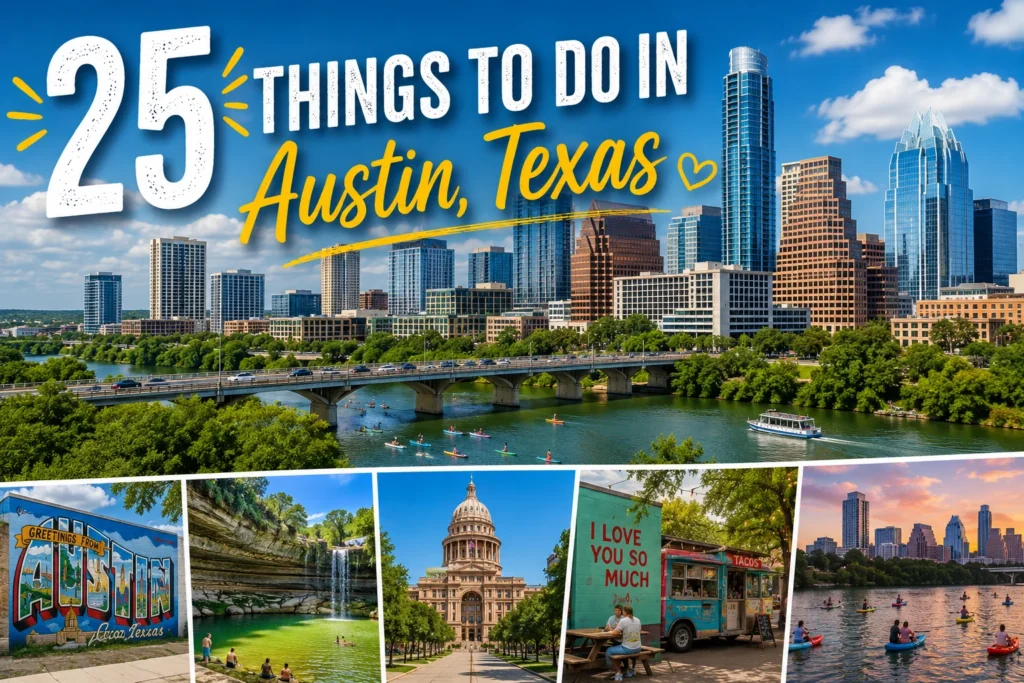
25 Best Things to Do in Austin Texas in 2026 (Complete City Guide)
By Sarah Mitchell | Travel Expert and Founder
I have planned Austin trips for years, and the thing I tell everyone first is the one that reframes the whole city: Austin is not about any single headline attraction. There is no Statue of Liberty, no Golden Gate Bridge, no one thing you came to see. Austin is a mood, and the mood is built from a specific combination of live music on every block, spring-fed swimming in the middle of the city, breakfast tacos from a trailer at 7 AM, 1.5 million bats spiraling off a bridge at sunset, and a barbecue culture that people fly across the country to stand in line for. The best days here are not a checklist; they are a rhythm of eating, swimming, walking, and listening to music that no other American city replicates.
This guide covers the 25 best things to do in Austin in 2026, ordered the way I would actually work through a trip, with current prices, honest time estimates, and the one thing nobody warns first-timers about: the heat. Austin summers are genuinely brutal, regularly over 100°F from June through September, and they change how you plan everything. Do outdoor activities early morning or after dark, and build midday around water, air conditioning, or both. For more of the region, see my things to do in San Antonio and things to do in Dallas guides on Travel Destinations Plan.
Austin At a Glance: Quick Reference Table
| # | Activity | Area | Entry | Duration | Best For | Best Time |
|---|---|---|---|---|---|---|
| 1 | Congress Avenue Bridge bat colony | Downtown | Free | 1 hour | All visitors; wildlife lovers | Sunset, March through November |
| 2 | Barton Springs Pool | Zilker Park | ~$5 adults; free before 9 AM | 1.5 to 3 hours | Swimmers; all visitors | Morning; year-round |
| 3 | South Congress Avenue (SoCo) | South Austin | Free to walk | 2 to 3 hours | Shoppers; foodies; culture seekers | Afternoon into evening |
| 4 | Live music on 6th Street & Red River | Downtown | Free to walk; cover varies | 2 to 4 hours | Music lovers; nightlife | Thursday to Saturday evenings |
| 5 | Texas State Capitol | Downtown | Free | 1 to 1.5 hours | History and architecture lovers | Weekday mornings for guided tour |
| 6 | Lady Bird Lake | Downtown | Free; kayak rental ~$20-40 | 1.5 to 3 hours | Outdoor lovers; families | Morning; spring and fall |
| 7 | Franklin Barbecue | East Austin | ~$25-30 per person | 4+ hours with queue | BBQ lovers; the dedicated | Arrive by 8 AM; weekdays |
| 8 | Zilker Park | South Austin | Free | 2 to 4 hours | Families; outdoor lovers | Morning; spring and fall |
| 9 | East Austin food and murals | East Austin | Free to walk; food varies | 2 to 3 hours | Foodies; art lovers | Afternoon into evening |
| 10 | LBJ Presidential Library | UT campus | Free | 1.5 to 2 hours | History lovers | Anytime |
| 11 | Mount Bonnell | West Austin | Free | 30 to 45 mins | View seekers; couples | Sunset |
| 12 | Rainey Street | Downtown | Free to walk; drinks vary | 2 to 3 hours | Nightlife; groups | Evenings |
| 13 | Hamilton Pool Preserve (day trip) | ~45 mins west | ~$12 reservation required | Half day | Swimmers; photographers | Book ahead; morning |
| 14 | Austin BBQ and taco crawl | Citywide | Meals vary | 2 to 4 hours | Foodies | Breakfast for tacos; lunch for BBQ |
| 15 | Broken Spoke | South Austin | Cover varies | 2 to 3 hours | Country music and dance lovers | Tuesday and Saturday for dancing |
| 16 | Blanton Museum of Art | UT campus | ~$10 adults | 1.5 to 2 hours | Art lovers | Weekdays |
| 17 | South Congress murals & photo spots | South Congress | Free | 1 hour | Photographers; first-timers | Morning light |
| 18 | Zilker Botanical Garden | Zilker Park | ~$14 adults | 1 to 1.5 hours | Nature lovers; families | Morning; spring |
| 19 | Umlauf Sculpture Garden | Zilker area | ~$7 adults | 1 hour | Art lovers; a quiet break | Morning |
| 20 | Hill Country wineries (day trip) | 30 to 45 mins west | Tastings ~$15-25 | Full day | Wine lovers; couples | Spring and fall |
| 21 | Paddleboarding Lady Bird Lake | Downtown | ~$20-30/hour rental | 1.5 to 2 hours | Active visitors; views | Morning for calm water |
| 22 | Texas food trailers | Citywide | Meals ~$8-15 | 1 hour | Foodies; budget travelers | Lunch |
| 23 | Continental Club | South Congress | Cover varies, often free | 2 to 3 hours | Music lovers | Any night |
| 24 | Cathedral of Junk | South Austin | Free; by appointment | 30 to 45 mins | The curious; the quirky | By appointment only |
| 25 | Fredericksburg (day trip) | ~1.5 hours west | Free to walk | Full day | History; wine; German heritage | Spring and fall |
1. Congress Avenue Bridge Bat Colony
Area: Downtown, Congress Avenue Bridge over Lady Bird Lake | Entry: Free | Duration: 1 hour (arrive 30 to 45 minutes before sunset) | Best time: Sunset, March through November; peak colony July through August
The Congress Avenue Bridge houses the largest urban bat colony in North America: approximately 1.5 million Mexican free-tailed bats living in the bridge’s expansion joints. Every evening from March through early November, they emerge at dusk in a massive, swirling cloud that streams east over Lady Bird Lake to feed, creating one of the most extraordinary free wildlife spectacles in any American city.
The Congress Avenue Bridge shelters 1.5 million Mexican free-tailed bats that emerge at sunset in a massive cloud, the largest urban bat colony in North America. It is the most unique free wildlife spectacle in Austin.
Practical tips:
- Arrive 30 to 45 minutes before sunset and stake a spot on the bridge’s pedestrian walkway or the hike-and-bike trail below. Summer weekends fill fast.
- Peak season is July through August, when the colony is largest and the emergence most dramatic. March, April, and October have smaller but still impressive flights.
- What I actually recommend: rent a kayak and watch from the water below the bridge. The bats streaming directly overhead at water level is the most dramatic angle, and several outfitters run sunset bat-watching kayak tours (~$40-60).
2. Barton Springs Pool
Area: Zilker Park | Entry: ~$5 adults; free before 9 AM during free-swim hours | Duration: 1.5 to 3 hours | Best time: Morning; year-round (68°F constant)
Barton Springs Pool is a 3-acre, spring-fed swimming pool in the heart of Zilker Park, fed by underground springs that keep the water at a constant 68°F year-round. It has been Austin’s communal swimming hole since 1917, and on a 100°F summer afternoon, it is the most essential experience in the city. Swimming in cold spring water with the downtown skyline visible through the trees is as specifically Austin as anything gets.
Barton Springs Pool is a 3-acre, spring-fed swimming hole that stays 68°F year-round, open since 1917 in the heart of Zilker Park. It is Austin’s single most essential experience.
Practical tips:
- The free-swim hours before 9 AM are the locals’ secret: the pool is open, lifeguards are not yet on duty, and admission is free. The 5 AM swim, alone in 68-degree water as the sun comes up, is the best free experience in Austin.
- The water is genuinely cold. On a hot day it is heaven; on a cool morning it takes nerve. Go in fast.
- What I tell everyone: do not skip this. Barton Springs is not a pool; it is the soul of the city. Every Austin trip should start or end here.
3. South Congress Avenue (SoCo)
Area: South Austin, from the bridge to roughly Oltorf Street | Entry: Free to walk | Duration: 2 to 3 hours | Best time: Afternoon into evening
South Congress is Austin’s most walkable, most characterful commercial strip: a mile of independent boutiques, vintage shops, boot stores, food trailers, ice cream shops, and the Continental Club (entry 23), all under the “Keep Austin Weird” ethos that started here. The “I Love You So Much” mural, the giant cowboy boots at Allens Boots, and the view north toward the Capitol dome are the visual signatures.
South Congress is Austin’s most iconic commercial strip, a mile of independent shops, food trailers, and the Continental Club under the “Keep Austin Weird” banner. It is the most walkable, most specifically Austin neighborhood in the city.
Practical tips:
- Walk it in the late afternoon into evening, when the shops are open, the food trailers are firing, and the Continental Club is warming up for the night.
- The “I Love You So Much” mural on the side of Jo’s Coffee is the most photographed wall in Austin. Get there early morning for a photo without a queue.
- Where I send people for the most Austin afternoon: start at the bridge end, walk south through the shops, eat at a food trailer, and end at the Continental Club for live music.
4. Live Music on 6th Street & Red River
Area: Downtown | Entry: Free to walk; individual venue covers vary (many are free) | Duration: 2 to 4 hours | Best time: Thursday through Saturday evenings
Austin calls itself the Live Music Capital of the World, and the claim is backed by the density: on any given night, hundreds of venues across the city host live performances, from dive bars to concert halls, across country, blues, rock, indie, jazz, and Latin genres. Dirty 6th (the party strip between Congress and I-35) is the tourist-facing version; the Red River Cultural District (Red River Street between 6th and 10th) is where the serious music lives.
Austin hosts live music at hundreds of venues every night, earning its title as the Live Music Capital of the World. The Red River Cultural District is where the best, most authentic live music happens.
Practical tips:
- Skip the tourist end of Dirty 6th (the crowded party bars east of Congress) and go to Red River instead. Mohawk, Cheer Up Charlies, and Stubb’s are the anchors, and the music is consistently better.
- Many venues have no cover charge, especially on weeknights. You can hear genuinely great live music for the price of a beer.
- What I tell music lovers: do not plan too carefully. Walk Red River, listen from the sidewalk, and follow your ears into whatever sounds best. That is how Austin works.
5. Texas State Capitol
Area: Downtown, Congress Avenue | Entry: Free; free guided tours available | Duration: 1 to 1.5 hours | Best time: Weekday mornings for the guided tour
The Texas State Capitol is the largest state capitol building in America, taller than the US Capitol in Washington, built from sunset-red Texas granite with a dome visible from miles down Congress Avenue. Free self-guided and guided tours cover the legislative chambers, the rotunda, the portraits of every Texas governor, and the grounds, including monuments and the Great Walk leading south toward the University of Texas.
The Texas State Capitol is the largest state capitol in America, taller than the US Capitol, built from distinctive sunset-red Texas granite. It is the best free architectural experience in Austin.
Practical tips:
- Free guided tours run throughout the day on weekdays and are worth doing for the history and the building details you would miss on your own.
- The view down Congress Avenue from the Capitol steps, with the avenue leading to the bridge and Lady Bird Lake, is the defining Austin vista.
- The Capitol grounds are open for walking and are a pleasant, shaded green space in the middle of downtown.
6. Lady Bird Lake
Area: Downtown, runs through the city center | Entry: Free; kayak/SUP rental ~$20-40/hour | Duration: 1.5 to 3 hours | Best time: Morning; spring and fall for comfortable temperatures
Lady Bird Lake is a reservoir on the Colorado River running through the center of Austin, bordered by the Ann and Roy Butler Hike-and-Bike Trail, a 10-plus-mile loop of crushed granite and pavement that is the city’s communal outdoor living room. Kayaking, paddleboarding, canoeing, and rowing share the water with turtles and herons, and the trail draws runners, cyclists, and walkers at every hour.
Lady Bird Lake is a downtown reservoir bordered by 10-plus miles of hike-and-bike trail, with kayaking, paddleboarding, and the city’s best outdoor recreation. It is Austin’s communal backyard.
Practical tips:
- The trail is free and runs the full lake loop; it is the single best way to see Austin’s relationship with its outdoor spaces.
- Rent a kayak or SUP in the morning when the water is calm and the heat has not yet built.
- The boardwalk section on the south shore gives the best skyline views and connects directly to the Barton Springs area.
7. Franklin Barbecue
Area: East 11th Street, East Austin | Entry: ~$25-30 per person for brisket, ribs, and sides | Duration: 4-plus hours including the queue | Best time: Arrive by 8 AM on a weekday; avoid weekends if possible
Franklin Barbecue is the most famous barbecue restaurant in America: a small cinder-block building on East 11th Street where Aaron Franklin smokes brisket that has been called the best in Texas (and therefore the world) by nearly every food publication that has tried it. The queue starts before dawn, the meat sells out by early afternoon, and the wait is the price of admission as much as the money.
Franklin Barbecue is widely considered the best barbecue in America, with brisket smoked to a standard that draws hours-long queues daily. The wait is the ritual; the brisket is the reward.
Practical tips:
- The queue is real: 3 to 4 hours on weekdays, longer on weekends. Arrive by 8 AM, bring chairs, a cooler with drinks, and friends to hold your spot. The line itself is a social experience and part of the Franklin mythology.
- Order the brisket. That is what you came for. Add pulled pork, a link of sausage, and the sides if you want, but the brisket is the point.
- If the queue is not for you, Austin has a dozen other world-class barbecue joints with shorter or no waits. la Barbecue, Micklethwait, and Interstellar BBQ are all excellent and more accessible. I send most people to those first, honestly.
8. Zilker Park
Area: South Austin, along Barton Creek and Lady Bird Lake | Entry: Free | Duration: 2 to 4 hours | Best time: Morning; spring and fall
Zilker Park is Austin’s 351-acre central park, holding Barton Springs Pool (entry 2), the Zilker Botanical Garden (entry 18), the Umlauf Sculpture Garden (entry 19), the Zilker Zephyr miniature train, and wide open lawns where Austin plays frisbee, has picnics, and hosts ACL Fest every October. It is the physical center of Austin’s outdoor culture and the park that defines the city’s relationship with nature.
Zilker Park is Austin’s 351-acre central park, home to Barton Springs Pool, botanical gardens, and the ACL Festival grounds. It is the green heart of Austin’s outdoor culture.
Practical tips:
- Barton Springs is inside Zilker, so a park morning naturally flows into a swim.
- ACL Fest (Austin City Limits Music Festival, two weekends in October) takes over Zilker annually. If your dates overlap, book early; if they do not, the park is at its most accessible.
- Great for families: the Zilker Zephyr train, the botanical garden, and the broad lawns with creek access cover a full morning for all ages.
9. East Austin Food & Murals
Area: East Cesar Chavez, East 6th Street, East 7th Street | Entry: Free to walk; food varies | Duration: 2 to 3 hours | Best time: Afternoon into evening
East Austin is where the city’s food and cultural evolution is happening fastest: food trailers serving everything from Thai to barbecue to vegan tacos, murals covering entire building facades, craft cocktail bars, breweries, and the specific creative energy of a neighborhood that is still evolving rather than already finished. It is the most dynamic side of Austin in 2026.
East Austin is the most creatively dynamic neighborhood in the city, with food trailers, world-class murals, and craft cocktail bars on every block. It is where Austin’s food and culture scene is evolving fastest.
Practical tips:
- Walk East Cesar Chavez and East 6th Street for the densest concentration of murals, trailers, and bars.
- The food trailers here are not consolation prizes; some of the best eating in Austin happens from a window at a trailer park. Go hungry.
- What I tell people who have done SoCo: East Austin is the next chapter. South Congress is the Austin everyone knows; East Austin is the Austin that is being built right now.
10. LBJ Presidential Library
Area: University of Texas campus | Entry: Free | Duration: 1.5 to 2 hours | Best time: Anytime
The Lyndon Baines Johnson Presidential Library sits on the University of Texas campus and covers the life, presidency, and legacy of the 36th president, with a particular focus on the Civil Rights Act, the Great Society, and the Vietnam War. The full-scale Oval Office replica, the cabinet room, and the vast archive make it one of the best presidential libraries in the country, and it is free.
The LBJ Presidential Library covers the Civil Rights Act, the Great Society, and Vietnam through a full Oval Office replica and vast archives. It is the best free museum in Austin.
Practical tips:
- It is free and rarely crowded, making it the best rainy-day or hot-afternoon plan on the UT campus.
- The civil rights exhibits are the emotional core; give them proper time.
- Combine with the Blanton Museum of Art (entry 16) on the same campus for a full cultural morning.
11. Mount Bonnell
Area: West Austin, above Lake Austin | Entry: Free | Duration: 30 to 45 minutes | Best time: Sunset
Mount Bonnell is the highest point within Austin city limits, reached by climbing 102 stone steps to a limestone overlook with views over Lake Austin, the Hill Country, and the western city. It is the classic Austin sunset spot: short, free, and dramatically rewarding for a climb that takes less than five minutes.
Mount Bonnell is Austin’s highest point, reached by 102 steps, with sweeping views over Lake Austin and the Hill Country. It is the best free sunset viewpoint in the city.
Practical tips:
- Go at sunset. The view over Lake Austin as the light goes gold is the whole reason to climb.
- The parking area is small and fills fast at sunset; arrive 30 minutes early or rideshare.
- It is a quick stop, not a hike. You can combine it with a Lake Austin drive or a Hill Country outing without losing much time.
12. Rainey Street
Area: Downtown, south of the Convention Center | Entry: Free to walk; drinks vary | Duration: 2 to 3 hours | Best time: Evenings, especially weekends
Rainey Street is a block of historic bungalows converted into bars, each with a yard, a porch, and its own personality, creating a walkable bar district that feels more like a neighborhood party than a nightlife strip. It is the most relaxed, most social, and most distinctly Austin version of going out that the city offers, somewhere between 6th Street’s party chaos and a house party.
Rainey Street is a block of bungalows converted into bars with yards and porches, creating the most relaxed, most social bar district in Austin. It is the best night out for groups who want fun without chaos.
Practical tips:
- The yards and porches are the whole appeal; grab a drink and move between the houses on foot.
- It is far calmer and more pleasant than Dirty 6th, with a mixed crowd rather than a pure party-strip clientele.
- Food trailers line the street, so you can eat well between bars without leaving the block.
13. Hamilton Pool Preserve (Day Trip)
Area: About 45 minutes west, in the Hill Country | Entry: ~$12 per vehicle; advance reservation required | Duration: Half day | Best time: Book ahead at parks.traviscountytx.gov; morning
Hamilton Pool is a natural swimming hole formed by the collapse of a cave dome, creating a turquoise pool beneath a 50-foot waterfall surrounded by a limestone grotto draped in ferns and moss. It is one of the most visually stunning natural swimming spots in Texas and requires an advance reservation to visit, as access is limited to protect the fragile site.
Hamilton Pool is a turquoise swimming hole beneath a 50-foot waterfall inside a collapsed limestone grotto. It is the most visually stunning natural swim near Austin and requires advance reservation.
Practical tips:
- Reservations are required and book out, especially in summer. Reserve online at parks.traviscountytx.gov the moment your dates are set.
- Swimming is not always allowed; water quality and conditions determine whether the pool is open for swimming on any given day. Check before making the drive specifically to swim.
- The trail down to the pool is short but steep and rocky. Wear proper shoes, not flip-flops.
14. Austin BBQ & Taco Crawl
Area: Citywide | Entry: Meals vary; breakfast tacos ~$3-5 each; BBQ plates ~$15-30 | Duration: 2 to 4 hours | Best time: Breakfast for tacos; lunch for BBQ
Austin’s food identity rests on two pillars: barbecue and breakfast tacos. The barbecue culture here is the most competitive in Texas (which means the world), and the breakfast taco, a flour tortilla filled with eggs, cheese, bacon, potato, and salsa, is the city’s universal morning meal, available from trailers, taquerias, and gas stations at prices that make sit-down breakfast feel like a scam.
Austin’s barbecue and breakfast tacos are the two foods that define the city, with world-class BBQ joints and $3 breakfast tacos from trailers on every block. Eating through both is the most essential Austin food experience.
Practical tips:
- Breakfast tacos: Veracruz All Natural, Tamale House East, and Valentina’s Tex Mex BBQ (which also does barbecue) are three very different and excellent options.
- BBQ beyond Franklin: la Barbecue (shorter line, excellent brisket), Micklethwait Craft Meats (small-batch, often sells out early), and Interstellar BBQ (north Austin, no wait) are all world-class without the 4-hour queue.
- What I tell first-timers: eat a breakfast taco from a trailer before 8 AM, then barbecue for lunch. That one-two is the Austin food experience in its purest form.
15. The Broken Spoke
Area: South Lamar, South Austin | Entry: Cover varies; often free before the band starts | Duration: 2 to 3 hours | Best time: Tuesday and Saturday for two-step dancing
The Broken Spoke is the last true Texas honky-tonk in Austin: a 1964 dance hall with a sawdust floor, live country and western swing bands, and genuine two-step dancing by real Texans who have been coming here for decades. In a city that has changed enormously, the Spoke has not, and that is the entire point.
The Broken Spoke is Austin’s last authentic 1964 honky-tonk, with live country bands and real two-step dancing on a sawdust floor. It is the most genuinely Texan experience in the city.
Practical tips:
- Tuesday and Saturday nights are the main dance nights. You do not need to know how to two-step; watching is half the fun, and the regulars are friendly if you want to learn.
- It is small, it is old, and it is perfect. Do not expect polish. Expect authenticity.
- Who I send here: everyone. Country music fan or not, the Broken Spoke is the one Austin experience that cannot exist anywhere else.
16. Blanton Museum of Art
Area: University of Texas campus | Entry: ~$10 adults | Duration: 1.5 to 2 hours | Best time: Weekdays
The Blanton is the largest university art museum in the country, with a permanent collection spanning Renaissance and Baroque European art, Latin American art (one of the strongest holdings in the US), and contemporary work. The Ellsworth Kelly “Austin” chapel, a freestanding building of colored glass and white stone designed as the artist’s final work, is alone worth the visit.
The Blanton Museum holds one of the strongest Latin American art collections in the US, plus the Ellsworth Kelly “Austin” chapel, his final masterwork. It is the best art museum in Austin.
Practical tips:
- The Ellsworth Kelly “Austin” building is free to enter and separate from the main museum. Even if you skip the museum, see this.
- The Latin American collection is the Blanton’s specific strength and the reason art historians treat it seriously; give it more time than the European galleries if your time is limited.
- Combine with the LBJ Library (entry 10) on the same campus for a full UT morning.
17. South Congress Murals & Photo Spots
Area: South Congress Avenue | Entry: Free | Duration: 1 hour | Best time: Morning light
Austin is a mural city, and South Congress has the most iconic collection: the “I Love You So Much” scrawl on Jo’s Coffee, the “Greetings from Austin” postcard mural, the “You’re My Butter Half” mural, and half a dozen others that have become the city’s visual identity on Instagram and beyond. Walking SoCo in the morning light, before the crowds arrive, is the best time to photograph them.
South Congress holds Austin’s most iconic murals, including “I Love You So Much” and “Greetings from Austin.” They are the most photographed spots in the city.
Practical tips:
- The “I Love You So Much” mural has a queue by mid-morning on weekends. Go at 7 or 8 AM for a clean shot.
- The murals are spread along the full SoCo strip, so combine them with the shops and food trailers (entry 3) as you walk.
- East Austin (entry 9) has more murals and more variety, with less of a queue. Go to SoCo for the famous ones; go east for the deeper street art.
18. Zilker Botanical Garden
Area: Zilker Park | Entry: ~$14 adults | Duration: 1 to 1.5 hours | Best time: Morning; spring for peak bloom
Zilker Botanical Garden covers 26 acres within Zilker Park, with themed gardens including a Japanese garden, a prehistoric garden with dinosaur-track fossils, a butterfly garden, and a xeriscape demonstration garden showing the native Texas plants that thrive in the heat. It is a peaceful, shaded escape and one of the best family-friendly stops near Barton Springs.
Zilker Botanical Garden covers 26 acres of themed gardens including a Japanese garden and a prehistoric garden with dinosaur tracks. It is the most peaceful green space in Austin.
Practical tips:
- The dinosaur-track fossils embedded in the limestone are the most specifically unusual element; kids love them.
- Pair it with Barton Springs (a short walk within Zilker Park) for a garden-then-swim morning.
- Spring is peak bloom, but the xeriscape garden is interesting year-round as a window into how Texas plants survive the heat.
19. Umlauf Sculpture Garden
Area: Zilker Park area, near Barton Springs Road | Entry: ~$7 adults | Duration: 1 hour | Best time: Morning
The Umlauf Sculpture Garden is a small, shaded outdoor museum displaying the bronze and stone sculptures of Charles Umlauf, a UT art professor, in a garden setting along Barton Creek. It is one of the quietest, most overlooked cultural spots in Austin, and at $7 it is one of the best-value art experiences in the city.
The Umlauf Sculpture Garden displays bronze and stone sculptures in a shaded creekside setting near Barton Springs. It is the most peaceful, most overlooked art stop in Austin.
Practical tips:
- It is small and can be seen in under an hour, making it an easy add-on to a Zilker Park or Barton Springs morning.
- The shaded garden is a genuine relief from the heat, making it a good midday stop in summer.
- Great for couples and anyone wanting a quiet cultural moment away from the music-and-BBQ intensity.
20. Hill Country Wineries (Day Trip)
Area: 30 to 45 minutes west, centered on Dripping Springs and Fredericksburg | Entry: Tastings ~$15-25 per winery | Duration: Full day | Best time: Spring and fall; weekdays for fewer crowds
The Texas Hill Country west of Austin has become one of the most productive wine regions in the state, with dozens of wineries and tasting rooms scattered across rolling limestone hills, wildflower meadows (in spring), and the specific beauty of the Hill Country landscape. Dripping Springs is the closest cluster; Fredericksburg (entry 25) is the anchor town for a full wine-country day.
The Texas Hill Country west of Austin has dozens of wineries across rolling limestone hills. It is the best wine day trip in Texas and one of the most scenic drives near the city.
Practical tips:
- Hire a driver or book a shuttle if you plan to taste at multiple wineries; the roads are rural and enforcement is real.
- Dripping Springs wineries are the closest to Austin (30 minutes); Fredericksburg (1.5 hours) has the most concentrated wine scene but requires more of a commitment.
- Spring (March through May) brings the famous Texas wildflower bloom, especially bluebonnets, making the drive as scenic as the destination.
21. Paddleboarding on Lady Bird Lake
Area: Downtown, multiple launch points | Entry: ~$20-30/hour rental | Duration: 1.5 to 2 hours | Best time: Morning for calm water and cooler temperatures
Stand-up paddleboarding on Lady Bird Lake is one of the most popular outdoor activities in Austin: gliding past the downtown skyline, the Congress Avenue Bridge, and the tree-lined banks with turtles surfacing nearby. Multiple rental outfitters operate along the south shore, and no experience is needed for the flat, calm lake water.
Paddleboarding on Lady Bird Lake gives you downtown skyline views from the water on flat, calm water. It is the most popular active outdoor experience in Austin.
Practical tips:
- Morning is best: calmer water, cooler temperatures, and the chance to be on the lake before the afternoon heat and wind.
- The lake is flat and calm, making it genuinely beginner-friendly. No experience needed.
- Paddle toward the Congress Avenue Bridge for the best skyline views and the closest look at the bat colony’s roost (from the water, looking up).
22. Texas Food Trailers
Area: Citywide; concentrated in East Austin, South Congress, and Rainey Street | Entry: Meals ~$8-15 | Duration: 1 hour | Best time: Lunch
Austin’s food-trailer culture is not a gimmick; it is the city’s actual restaurant ecosystem. Hundreds of trailers serve everything from barbecue to Thai to vegan to Korean-Mexican fusion at prices that make sit-down restaurants feel like a luxury. Trailer parks (groups of trailers sharing a lot with picnic tables) are where Austin eats, and the quality at the best ones rivals any brick-and-mortar restaurant in the city.
Austin’s food trailers serve world-class cuisine from every tradition at prices of $8-15, and the best ones rival any brick-and-mortar restaurant. They are the most essential budget-friendly food experience in the city.
Practical tips:
- Veracruz All Natural (multiple locations) for breakfast tacos, Loro (East Austin, a joint venture from Franklin and Uchi’s teams) for Asian-smoked meats, and Valentina’s Tex Mex BBQ for the combination of barbecue and Tex-Mex are three can’t-miss trailers.
- Trailer parks with multiple trailers and picnic seating are the easiest way to eat: everyone in the group picks a different trailer and meets at the tables.
- What I tell budget travelers: you can eat brilliantly in Austin for $30 a day if you eat at trailers and taquerias. This is not compromise eating; it is the best eating in the city.
23. Continental Club
Area: South Congress, 1315 South Congress Avenue | Entry: Cover varies; often free early or on weeknights | Duration: 2 to 3 hours | Best time: Any night; the music starts early
The Continental Club is Austin’s most iconic live music venue: a small, dark, 1955 cocktail lounge on South Congress that has hosted everyone from Stevie Ray Vaughan to Dale Watson, and where you can still hear genuinely great live music, country, blues, rockabilly, and roots, most nights for free or a small cover. It is the specific venue that best represents what “Live Music Capital” actually means.
The Continental Club is Austin’s most iconic music venue, a 1955 cocktail lounge on South Congress with nightly live music. It is the single best place to hear what makes Austin the Live Music Capital.
Practical tips:
- The music starts early here (often 6 or 7 PM for the happy-hour sets), which makes it an easy stop on a SoCo evening without a late night.
- The upstairs Continental Gallery hosts a second, smaller stage with different artists. Check both.
- What I tell everyone: if you see one show in Austin, see it here. The room, the sound, and the crowd are the distilled essence of what Austin music is.
24. Cathedral of Junk
Area: South Austin, residential neighborhood | Entry: Free; by appointment only | Duration: 30 to 45 minutes | Best time: Contact the owner to schedule; weekends usually
The Cathedral of Junk is a massive, climbable sculpture built in a residential backyard from decades of collected junk, bicycle wheels, circuit boards, signs, toys, and thousands of other objects welded and wired into a towering, cave-like structure. It is the most “Keep Austin Weird” thing in Austin, created by one person over 30 years, and visiting it requires calling or texting the owner to schedule.
The Cathedral of Junk is a towering backyard sculpture made from decades of collected objects, climbable and free by appointment. It is the most literally “Keep Austin Weird” experience in the city.
Practical tips:
- You must contact the owner (Vince Hannemann) to schedule a visit; the address is residential and unannounced visits are not welcome. His contact information is available online.
- It is free, though a donation is appreciated and deserved. The man has been building this for 30 years.
- Not for everyone, but for the people who love it, and they are many, it is the most memorable half hour in Austin.
25. Fredericksburg (Day Trip)
Area: About 1.5 hours west in the Hill Country | Entry: Free to walk; attractions and tastings vary | Duration: Full day | Best time: Spring for wildflowers; fall for comfortable weather
Fredericksburg is a small Hill Country town founded by German settlers in 1846, now the hub of the Texas wine country and a destination in its own right: a walkable Main Street of shops, restaurants, wine-tasting rooms, and German bakeries, plus the National Museum of the Pacific War (the only museum in the US dedicated exclusively to the Pacific Theater of WWII, centered on Fredericksburg native Chester Nimitz).
Fredericksburg is a German-heritage Hill Country town with a walkable Main Street, wine-tasting rooms, and the only US museum dedicated to the Pacific Theater of WWII. It is the best full-day trip from Austin.
Practical tips:
- The National Museum of the Pacific War (~$18 adults) is genuinely world-class and far more extensive than visitors expect; budget 2 to 3 hours if WWII history interests you.
- Main Street’s tasting rooms make wine tasting possible without driving between wineries, which is the most practical approach if you are not hiring a driver.
- Spring (March through May) is the best time for the drive: the Hill Country wildflowers, especially bluebonnets, line the roadsides and are a Texas institution.
Austin Practical Guide
Getting Around Austin
Downtown Austin, South Congress, Rainey Street, and East Austin are all walkable or a short rideshare apart. Lady Bird Lake’s hike-and-bike trail connects many of the central attractions on foot or by bike. A car is needed for the Hill Country day trips (Hamilton Pool, Fredericksburg, wineries), Mount Bonnell, and some of the BBQ joints and food trailers in outer neighborhoods. The city has a bus system (Cap Metro) and a light rail line (the Red Line), but for most visitors, a combination of walking, rideshares, and a rental car for day trips covers everything.
One thing I always tell first-timers: the heat is the real constraint from June through September. Highs above 100°F are routine, and outdoor activities in the midday sun are genuinely unpleasant and potentially dangerous. Plan outdoor activities (hiking, the lake, Barton Springs, Mount Bonnell) for early morning or after sunset, and fill midday with indoor attractions, food, or the pool.
Where to Stay in Austin
Downtown / 2nd Street District: Walkable to 6th Street, Lady Bird Lake, the Capitol, and Rainey Street. Best for first-timers who want everything central.
South Congress (SoCo): On the iconic strip, close to Zilker Park and Barton Springs, with the best food-trailer and boutique access. Best for the most specifically Austin experience.
East Austin: The most creative, fastest-evolving neighborhood, with the best food trailers, murals, and cocktail bars. Best for repeat visitors and foodies.
Austin Budget Guide
Budget traveler (budget hotel or hostel, free attractions like the bats, Barton Springs free swim, Lady Bird Lake trail, Capitol tour, food trailers and breakfast tacos): roughly $80 to $130 per day. Austin’s best experiences, the bats, the music, the pool, the tacos, are cheap or free.
Mid-range traveler (downtown or SoCo hotel, Hamilton Pool day trip, a couple of BBQ meals, live music, kayaking): roughly $200 to $350 per day.
Higher-spend traveler (boutique hotel, Hill Country wine day, Franklin Barbecue, fine dining, VIP music experiences): $400 or more per day, driven by lodging and dining.
Frequently Asked Questions About Austin Texas
How many days do you need in Austin? Three to four days covers Barton Springs, South Congress, the bats, the live music scene, the Capitol, the BBQ and taco crawl, and Lady Bird Lake comfortably. Five days lets you add a Hill Country day trip (Hamilton Pool or Fredericksburg), more music, and deeper neighborhood exploration.
Is Austin expensive? It is mid-range by major US city standards. The best experiences, the bats, Barton Springs, the music, the Capitol, the trails, and the murals, are free or very cheap. Food trailers and breakfast tacos keep eating affordable. Hotels and sit-down dining in the downtown and SoCo corridor are the main costs.
What is Austin Texas most famous for? Live music (the Live Music Capital of the World), barbecue (Franklin Barbecue and a dozen rivals), Barton Springs Pool, the Congress Avenue Bridge bat colony, South Congress Avenue, breakfast tacos, SXSW and ACL Fest, the Texas State Capitol, and the “Keep Austin Weird” culture.
When is the best time to visit Austin? March through May (spring) for wildflowers, comfortable weather, and SXSW. October for ACL Fest, peak bat season’s tail end, and ideal temperatures. Avoid July and August unless you love extreme heat; highs regularly exceed 100°F and outdoor activities are miserable midday.
Do I need to book Austin attractions in advance? Book Hamilton Pool (reservation required, sells out). Book Franklin Barbecue only if they offer pre-orders (otherwise, arrive early and queue). Book SXSW and ACL Fest badges/tickets months ahead. Free attractions like the bats, Barton Springs, the Capitol, Lady Bird Lake, and South Congress need no booking.
Do I need a car in Austin? Not for downtown, SoCo, East Austin, Rainey Street, or Lady Bird Lake, all of which are walkable or a short rideshare apart. A car is needed for Hamilton Pool, the Hill Country wineries, Fredericksburg, Mount Bonnell, and some of the outer-neighborhood BBQ joints.
The Final Word
If you take one thing from this guide, take this: Austin is not a checklist city. The best Austin days are the ones where you swim at Barton Springs at dawn, eat a breakfast taco from a trailer, walk South Congress in the afternoon, watch 1.5 million bats spiral off the bridge at sunset, and end up at the Continental Club listening to a band you have never heard of that turns out to be the highlight of the trip. That sequence, free or nearly free, is what makes Austin unlike any other city in the country.
Where I would spend the money: one great barbecue lunch (Franklin if you have the patience, la Barbecue if you do not), a Hamilton Pool morning, and a Broken Spoke honky-tonk night. Where the magic is free: the 5 AM swim at Barton Springs, the bats at sunset, the Capitol at midday, and whatever live music spills out of the first open door you pass on Red River Street at 10 PM. The mistake I watch people make is over-planning. Austin rewards the wanderer. Walk, listen, eat, swim, repeat.
Have an Austin tip I missed, or a favorite taco trailer, or a BBQ joint you think beats Franklin? Tell me in the comments. I update this guide as trailers open, venues change, and the heat keeps being the heat.
For more Texas and US travel guides, visit Travel Destinations Plan.
Pingback: 25 Best Things to Do in Dallas 2026 (Local Guide)
Pingback: 25 Best Things to Do in San Antonio 2026 (Guide)
Pingback: 25 Best Things to Do in Houston 2026 (Local Guide)