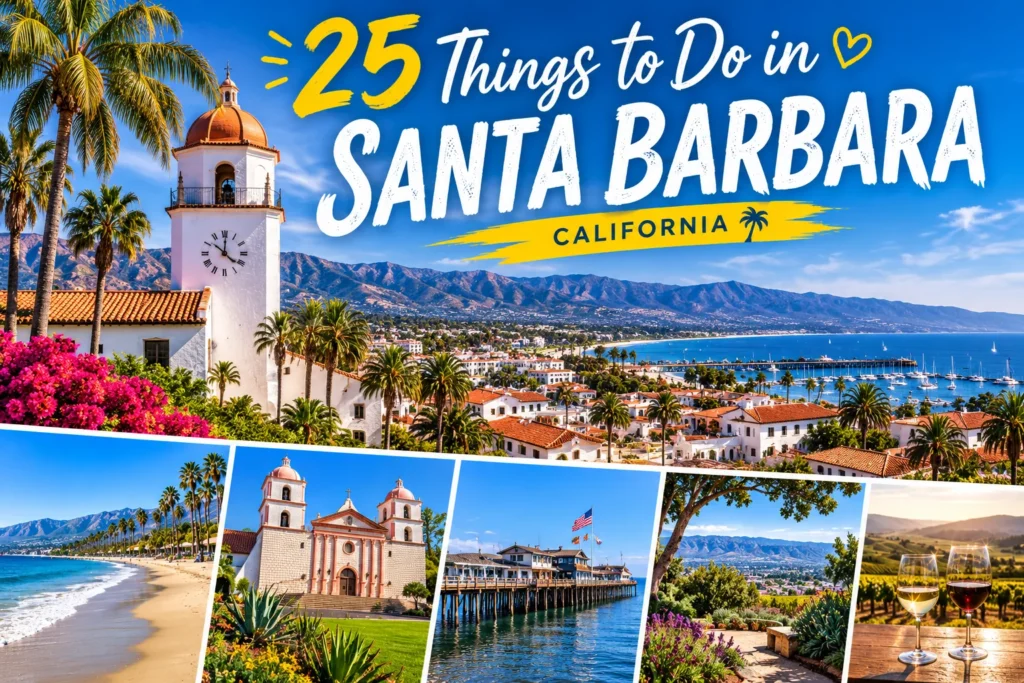
25 Best Things to Do in Santa Barbara in 2026 (Complete City Guide)
By Sarah Mitchell | Travel Expert and Founder
I have planned Santa Barbara trips for years, and the thing I tell everyone first is the one that reframes the whole visit: this is not a beach town. Santa Barbara is a small city that happens to sit between the Santa Ynez Mountains and the Pacific Ocean, with 200 years of Spanish colonial architecture, a world-class wine region 30 minutes inland, a free courthouse that is one of the most beautiful public buildings in the country, and a food-and-wine scene that quietly rivals cities ten times its size. The beaches are gorgeous, yes, but the people who come only for the sand miss the architecture, the wine, the gardens, and the mountains that make this place genuinely special.
This guide covers the 25 best things to do in Santa Barbara in 2026, ordered the way I would actually work through a trip, with current prices, honest time estimates, and the one thing nobody warns first-timers about: Lotusland, one of the most extraordinary private gardens in America, requires advance reservations weeks to months ahead and turns away everyone who shows up without one. Book it first. For more of the coast, see my things to do in California and things to do in San Diego guides on Travel Destinations Plan.
Santa Barbara At a Glance: Quick Reference Table
| # | Activity | Area | Entry | Duration | Best For | Best Time |
|---|---|---|---|---|---|---|
| 1 | Santa Barbara County Courthouse | Downtown | Free | 45 mins to 1 hour | All visitors; architecture fans | Morning; clock tower at sunset |
| 2 | Old Mission Santa Barbara | Upper State Street | ~$17 adults | 1 to 1.5 hours | History and architecture lovers | Morning |
| 3 | Stearns Wharf | Waterfront | Free to walk | 1 to 1.5 hours | All visitors; families | Sunset |
| 4 | Funk Zone | Waterfront / downtown edge | Free to walk; tastings ~$15-20 | 2 to 3 hours | Wine and food lovers; art fans | Afternoon into evening |
| 5 | Lotusland | Montecito | ~$60 adults | 2 hours | Garden lovers; the dedicated | Book weeks to months ahead |
| 6 | Santa Ynez Valley wine country (day trip) | 30 to 40 mins north | Tastings ~$20-30 each | Full day | Wine lovers; couples | Spring and fall |
| 7 | Butterfly Beach | Montecito | Free | 1 to 3 hours | Beach lovers; sunset watchers | Late afternoon |
| 8 | State Street & downtown walk | Downtown | Free | 1.5 to 2 hours | Shoppers; architecture fans | Morning |
| 9 | Santa Barbara Botanic Garden | Mission Canyon | ~$20 adults | 1.5 to 2 hours | Nature lovers; families | Morning; spring |
| 10 | Whale watching | Santa Barbara Harbor | ~$55 to $100 | 2.5 to 4 hours | Wildlife lovers | Jul-Aug blue whales; winter gray whales |
| 11 | Shoreline Park & beach path | Waterfront | Free | 1 to 2 hours | Walkers; families; views | Morning or sunset |
| 12 | Santa Barbara Zoo | East of downtown | ~$25 adults | 2 to 3 hours | Families | Morning |
| 13 | Kayaking the coast | Harbor / Goleta | ~$35 to $60 | 2 hours | Adventure seekers | Morning for calm water |
| 14 | Urban Wine Trail | Downtown / Funk Zone | Tastings ~$15-20 each | 2 to 4 hours | Wine lovers | Afternoon |
| 15 | Rattlesnake Canyon hike | Foothills | Free | 1.5 to 2.5 hours | Hikers; nature lovers | Morning |
| 16 | Montecito | East of downtown | Free to walk | 1 to 2 hours | Upscale dining; celebrity spotting | Lunch; afternoon |
| 17 | MOXI (Wolf Museum of Exploration) | Downtown waterfront | ~$20 adults | 1.5 to 2 hours | Families; science fans | Anytime; rainy day plan |
| 18 | Santa Barbara Harbor | Waterfront | Free to walk | 1 hour | All visitors; seafood lovers | Late afternoon |
| 19 | El Presidio State Historic Park | Downtown | Free | 45 mins | History lovers | Morning |
| 20 | Solvang (day trip) | 35 mins northwest | Free to walk | Half to full day | Families; Danish culture fans | Anytime |
| 21 | Cold Spring Tavern | San Marcos Pass | Meals vary | 1 to 2 hours | Foodies; history lovers | Weekend for live music |
| 22 | Inspiration Point hike | Foothills | Free | 2 to 3 hours | Hikers; view seekers | Morning |
| 23 | Douglas Family Preserve | Mesa area | Free | 1 to 1.5 hours | Dog walkers; quiet nature | Morning |
| 24 | Channel Islands National Park (day trip) | Boat from Ventura, ~1 hr south | Boat ~$60-90 round trip | Full day | Hikers; wildlife seekers | Spring and summer |
| 25 | Santa Barbara farmers market | Downtown | Free to browse | 1 hour | Foodies; locals’ Santa Barbara | Tuesday evening; Saturday morning |
1. Santa Barbara County Courthouse
Area: Downtown, 1100 Anacapa Street | Entry: Free | Duration: 45 minutes to 1 hour | Best time: Morning for the interior; climb the clock tower at sunset
The Santa Barbara County Courthouse is one of the most beautiful public buildings in America: a 1929 Spanish-Moorish masterpiece with hand-painted murals covering entire rooms, Tunisian tile staircases, sunken gardens, and an 85-foot clock tower with a free observation deck offering the single best 360-degree view of the city, the mountains, and the sea. It is free to enter, free to climb, and a functioning courthouse to this day.
The Santa Barbara County Courthouse is a 1929 Spanish-Moorish landmark with hand-painted murals, sunken gardens, and a free 85-foot clock tower with the best panoramic view in the city. It is the most beautiful free attraction in Santa Barbara.
Practical tips:
- Climb the clock tower. The 360-degree view from the top, mountains behind the city, red-tile roofs, and ocean stretching to the islands, is the defining Santa Barbara panorama, and it is free.
- The Mural Room on the second floor, painted with scenes from Santa Barbara’s history, is the most beautiful single room in the building. Do not rush past it.
- What I tell everyone: this is the first thing to see in Santa Barbara, before the beaches, before the Mission. It orients you to the entire city and costs nothing.
2. Old Mission Santa Barbara
Area: Upper State Street, 2201 Laguna Street | Entry: ~$17 adults, ~$12 youth 5-17, ~$15 seniors | Duration: 1 to 1.5 hours | Best time: Morning
The Old Mission, founded in 1786, is the “Queen of the Missions” and the most architecturally beautiful of California’s 21 Spanish missions: a twin-towered stone facade, a rose garden planted with the species of the original 1786 garden, a museum of mission-era artifacts, and the cemetery holding more than 4,000 Chumash people and early colonists. It remains an active Franciscan parish.
The Old Mission Santa Barbara, founded in 1786, is the most architecturally beautiful of California’s 21 Spanish missions. Its twin-towered facade and rose garden make it the city’s most iconic historical landmark.
Practical tips:
- The rose garden behind the church is the most peaceful part of the visit and the most photographed; give it real time rather than rushing through the museum.
- The cemetery is historically significant and sobering: more than 4,000 people are buried here, most of them Chumash.
- One honest tip: the Mission is beautiful but compact. Budget an hour, not a half day, and pair it with the Botanic Garden (entry 9) up the road in Mission Canyon.
3. Stearns Wharf
Area: Waterfront, foot of State Street | Entry: Free to walk | Duration: 1 to 1.5 hours | Best time: Late afternoon and sunset
Stearns Wharf has been standing since 1872, making it the oldest working wooden wharf in California. It extends from the foot of State Street into the harbor with restaurants, shops, the Sea Center (a small marine museum), and views back toward the city with the mountains rising behind the red-tile roofs. It is the classic Santa Barbara postcard and a genuinely pleasant walk, especially at sunset.
Stearns Wharf, built in 1872, is the oldest working wooden wharf in California, with restaurants, a marine museum, and sunset views back toward the mountains. It is the classic Santa Barbara walk.
Practical tips:
- Walk to the end for the best view back toward the city, especially as the light goes golden before sunset.
- The Sea Center on the wharf (small admission) is a nice quick stop for families, with touch tanks and a gray whale skeleton.
- Where I send people for seafood: the harbor restaurants at the base of the wharf or along the waterfront rather than the tourist-facing spots on the wharf itself, which tend to charge more for less.
4. The Funk Zone
Area: Waterfront district, between State Street and the beach | Entry: Free to walk; wine tastings ~$15-20 | Duration: 2 to 3 hours | Best time: Afternoon into evening
The Funk Zone is a few-block district of converted warehouses between downtown and the beach, packed with wine tasting rooms (many tied to the Urban Wine Trail), craft breweries, galleries, street murals, and restaurants. It is the most creatively energetic part of Santa Barbara, the place where the wine scene, the art scene, and the food scene converge on foot.
The Funk Zone is a converted-warehouse district of wine tasting rooms, galleries, breweries, and murals between downtown and the beach. It is the most vibrant, walkable creative district in Santa Barbara.
Practical tips:
- The Urban Wine Trail (entry 14) runs through here, so you can taste at multiple rooms without driving.
- The murals on the warehouse walls are the most photographed street art in the city and change regularly.
- What I tell people: this is the best afternoon in Santa Barbara. Start with a couple of tastings, grab lunch at one of the small restaurants, browse the galleries, and walk to the beach. Everything is on foot.
5. Lotusland
Area: Montecito, east of downtown | Entry: ~$60 adults, ~$25 children 3-17; docent-led tour add-on ~$15 | Duration: 2 hours | Best time: Book weeks to months ahead; summer for the lotus bloom
Lotusland is one of the most extraordinary private gardens in the world: 37 acres of themed gardens created over decades by the eccentric opera singer Madame Ganna Walska, including a water garden of sacred lotus, a cycad collection among the world’s most significant, a topiary garden, a Japanese garden, and the famous blue garden planted entirely in blue-foliaged plants. It is magical, meticulously maintained, and strictly reservation-only with a cap of roughly 15,000 visitors per year.
Lotusland is a 37-acre private garden estate created by an eccentric opera singer, with one of the world’s most significant botanical collections. Limited to roughly 15,000 visitors per year, it is the most exclusive garden experience in California.
Practical tips:
- There are no walk-ins, ever. Reservations must be made in advance through lotusland.org, and popular summer dates (especially lotus bloom in July and August) book out months ahead. This is not a suggestion; it is a rule.
- The self-guided tour is $60 adults; the docent-led tour ($15 add-on) is worth it for the stories of Madame Walska, who was as extraordinary as her garden.
- What I tell garden lovers: this is the single most memorable garden experience I have ever recommended. Book it before anything else in Santa Barbara.
6. Santa Ynez Valley Wine Country (Day Trip)
Area: 30 to 40 minutes north over San Marcos Pass or via Highway 101 | Entry: Tastings ~$20-30 per winery | Duration: Full day | Best time: Spring for mustard bloom; fall for harvest; weekdays for fewer crowds
The Santa Ynez Valley is one of California’s most acclaimed wine regions, producing Pinot Noir and Chardonnay that wine critics compare favorably to Burgundy, alongside Rhône varieties and the bold reds that put Santa Barbara County on the wine map after the movie Sideways was filmed here. The towns of Los Olivos, Solvang (entry 20), and Buellton anchor a day of tasting, eating, and rolling-vineyard scenery.
The Santa Ynez Valley produces world-class Pinot Noir and Chardonnay just 30 minutes from Santa Barbara, in the wine country made famous by Sideways. It is the best wine day trip on the Central Coast.
Practical tips:
- Hire a driver or take a guided tour if wine tasting at multiple wineries is the plan. The roads are narrow and local enforcement is strict.
- Los Olivos’ tasting rooms are walkable from a single main street, making it the easiest one-stop wine town if you do not want to drive between wineries.
- The Santa Rita Hills sub-appellation produces the most acclaimed Pinot Noir in the region; if you only visit one area, make it that one.
7. Butterfly Beach
Area: Montecito, east of downtown | Entry: Free | Duration: 1 to 3 hours | Best time: Late afternoon into sunset
Butterfly Beach is the most photogenic and least crowded of Santa Barbara’s main beaches: a long, east-facing stretch of sand in Montecito that catches the afternoon light beautifully and looks directly at the harbor, the wharf, and the mountains. Because it is slightly removed from the downtown beaches, it draws fewer crowds and more locals.
Butterfly Beach in Montecito is the most scenic and least crowded of Santa Barbara’s main beaches, with afternoon light on the mountains and harbor. It is the best sunset beach in the city.
Practical tips:
- It faces east, which means the mountains behind the city glow at sunset rather than the ocean. That is actually the better view.
- Parking is along the road (Channel Drive) and limited; arrive by mid-afternoon on summer weekends for a spot.
- What I tell couples: this is the romantic beach in Santa Barbara. Fewer kids, fewer crowds, better light.
8. State Street & Downtown Walk
Area: Downtown | Entry: Free | Duration: 1.5 to 2 hours | Best time: Morning
State Street is Santa Barbara’s main street, a promenade of Spanish Colonial Revival architecture, independent shops, restaurants, and galleries running from the courthouse area down to the wharf. The red-tile roofs, white stucco walls, and iron balconies are mandated by city building codes, giving the entire downtown a cohesive Mediterranean character that most American cities can only envy.
State Street is Santa Barbara’s Spanish Colonial promenade, where building codes mandate red-tile roofs and white stucco, giving the entire downtown a cohesive Mediterranean character. It is the most walkable main street in California.
Practical tips:
- Walk it in the morning when the shops are opening and the light on the white facades is at its best.
- The lower blocks near the waterfront tend to be more tourist-facing; the upper blocks near the courthouse and the art museum have more independent character.
- The Spanish Colonial consistency is not an accident; after the 1925 earthquake, the city deliberately rebuilt in a unified architectural style. Knowing that makes the walk more interesting.
9. Santa Barbara Botanic Garden
Area: Mission Canyon, above the Mission | Entry: ~$20 adults; advance reservations required | Duration: 1.5 to 2 hours | Best time: Morning; spring for peak wildflower bloom
The Santa Barbara Botanic Garden covers 78 acres of native California plants on a hillside above the Mission, with meadow trails, a redwood grove, a historic dam and aqueduct, and an emphasis on the specific plants of the California chaparral and coastal-sage ecosystems. It is quieter, wilder, and more specifically Californian than most botanical gardens.
The Santa Barbara Botanic Garden covers 78 acres of native California plants on a hillside above the Mission. It is the most specifically Californian garden experience and a peaceful escape above the city.
Practical tips:
- Advance reservations are required; book at sbbg.org before visiting.
- It is a budget-friendly alternative to Lotusland ($20 versus $60) and does not require the same months-ahead booking, though reservations are still needed.
- Pair it with the Old Mission (entry 2) just down the road in Mission Canyon for a complete morning.
10. Whale Watching
Area: Departing from Santa Barbara Harbor | Entry: ~$55 to $100 per person depending on tour | Duration: 2.5 to 4 hours | Best time: July through August for blue whales; December through April for gray whales
Santa Barbara sits on the edge of the Santa Barbara Channel, one of the richest marine environments on the West Coast, and the whale watching here is genuinely world-class. Blue whales, the largest animals ever to live on earth, feed in the channel from July through August. Humpbacks visit spring through fall. Gray whales migrate through in winter. Condor Express is the most established operator.
Santa Barbara’s whale watching includes blue whales, the largest animals on earth, feeding in the channel from July through August. It is some of the best whale watching on the entire West Coast.
Practical tips:
- Blue whale season (July through August) is the headliner: these are animals the length of a basketball court, lunging through krill at the surface. It is staggering when you see it.
- Gray whale migration (December through April) is more reliable and the standard winter tour; humpbacks fill the spring-through-fall shoulder seasons.
- Condor Express runs the most established tours out of the harbor; book ahead in summer when blue whale trips sell out.
11. Shoreline Park & Beach Path
Area: Waterfront, west of Stearns Wharf | Entry: Free | Duration: 1 to 2 hours | Best time: Morning or sunset
Shoreline Park is a bluff-top strip of grass and palm trees overlooking the Pacific, with benches, picnic tables, and the most accessible free ocean views in the city. A paved path runs along the waterfront below, connecting the harbor, East Beach, and the Funk Zone in a flat, scenic walk or bike ride that covers the best of the Santa Barbara coast on foot.
Shoreline Park is a free bluff-top green space with Pacific views, connecting to a paved waterfront path along the beaches and harbor. It is the best free coastal walk in Santa Barbara.
Practical tips:
- The bluff-top benches at sunset, looking out over the channel toward the Channel Islands, are the most peaceful free sunset spot in the city.
- The path below connects the harbor to East Beach to the Funk Zone, making it the easiest way to cover the waterfront on foot or by bike.
- Great for families: the playground at the park’s eastern end is well maintained, and the grass is perfect for a picnic.
12. Santa Barbara Zoo
Area: East of downtown, 500 Niños Drive | Entry: ~$25 adults | Duration: 2 to 3 hours | Best time: Morning; weekdays
The Santa Barbara Zoo is a small, beautiful zoo set on a bluff overlooking the ocean, with giraffes, gorillas, elephants, penguins, and California condors in a garden setting that takes full advantage of the coastal views. It is compact enough to cover in two to three hours, making it the best family half-day in the city.
The Santa Barbara Zoo sits on an ocean-view bluff with giraffes, gorillas, and California condors in a garden setting. It is the most scenically located small zoo in California.
Practical tips:
- The giraffe feeding experience is the highlight for kids and genuinely fun for adults.
- It is small compared to the San Diego or LA zoos, which is actually a strength: manageable, uncrowded, and lovely.
- The train ride around the zoo’s perimeter gives the best ocean views from within the grounds.
13. Kayaking the Coast
Area: Santa Barbara Harbor or Goleta coast | Entry: ~$35 to $60 per person for a guided tour | Duration: 2 hours | Best time: Morning for calmest water
Kayaking the Santa Barbara coast gives you the kelp forests, sea lions, harbor seals, and occasionally dolphins and whales from the water rather than from shore. Guided tours launch from the harbor or the Goleta coast and require no experience. It is one of the most accessible ocean kayaking experiences on the California coast.
Kayaking from Santa Barbara Harbor puts you in the kelp forests alongside sea lions and harbor seals. It is the most accessible ocean kayak experience on the Central Coast.
Practical tips:
- Morning departures have the calmest water and the best wildlife visibility.
- No experience needed for the guided tours; guides provide instruction and tandem kayaks are available.
- The kelp forests just offshore are the star: paddling through them with sea otters and harbor seals nearby is unforgettable.
14. Urban Wine Trail
Area: Downtown and the Funk Zone | Entry: Tastings ~$15-20 per room | Duration: 2 to 4 hours | Best time: Afternoon; weekdays for a quieter experience
The Urban Wine Trail connects more than 30 tasting rooms in downtown Santa Barbara and the Funk Zone, all walkable, all pouring wines from Santa Barbara County’s acclaimed vineyards. You can taste world-class Pinot Noir, Chardonnay, and Syrah without ever getting in a car, which makes it the most convenient wine-tasting experience in any California city.
The Urban Wine Trail connects 30-plus walkable tasting rooms in downtown Santa Barbara, pouring world-class Santa Barbara County wines. It is the most convenient wine-tasting walk in California.
Practical tips:
- Joining the trail is free and gets you a free tasting at each winery on your first visit, plus 10% off purchases. Sign up at urbanwinetrailsb.com.
- Pace yourself: three or four tasting rooms in an afternoon is the sweet spot. Quality over quantity.
- The Funk Zone concentration makes it easy to combine tastings with lunch and gallery browsing in the same afternoon.
15. Rattlesnake Canyon Hike
Area: Foothills, north of the Mission | Entry: Free | Duration: 1.5 to 2.5 hours | Best time: Morning, before the heat
Rattlesnake Canyon is the most popular foothill hike near downtown Santa Barbara: a 3.5-mile round-trip trail through oak woodland and chaparral, crossing a creek multiple times, climbing to a meadow viewpoint overlooking the city, the coast, and the Channel Islands. It is the hike the locals do before work, which tells you everything about both the trail and the city.
Rattlesnake Canyon is the most popular local hike in Santa Barbara, climbing through oak woodland to a meadow with city and ocean views. It is the best morning hike near downtown.
Practical tips:
- Go early morning for cooler temperatures and the best light on the ocean views from the meadow.
- The trail crosses the creek several times; in winter and spring it can be wet, so wear shoes that can handle mud.
- The parking area at the trailhead fills early on weekends; arrive before 8 AM or take a rideshare.
16. Montecito
Area: East of downtown, along Coast Village Road | Entry: Free to walk | Duration: 1 to 2 hours | Best time: Lunch; afternoon
Montecito is Santa Barbara’s wealthy enclave, where celebrity estates hide behind hedges and the shopping and dining along Coast Village Road and the Upper Village cater to a quietly affluent crowd. It is beautiful, manicured, and the source of most of the “American Riviera” comparisons that Santa Barbara’s tourism uses. A stroll and a lunch here show you the polished, luxurious side of the area.
Montecito is Santa Barbara’s celebrity-studded enclave, with luxury shopping and dining along Coast Village Road. It is the most upscale side of the American Riviera.
Practical tips:
- Coast Village Road is the main strip: boutiques, cafes, and restaurants in a walkable, shaded setting.
- Butterfly Beach (entry 7) is in Montecito and pairs naturally with a Montecito lunch.
- One honest tip: Montecito is lovely and expensive. Window-shop and lunch here; save your serious spending for the wine trail.
17. MOXI (Wolf Museum of Exploration + Innovation)
Area: Downtown waterfront, 125 State Street | Entry: ~$20 adults | Duration: 1.5 to 2 hours | Best time: Anytime; great rainy-day or hot-afternoon plan
MOXI is a hands-on science and creativity museum with interactive exhibits across multiple floors covering light, speed, sound, and technology, capped by a rooftop Sky Garden with views of the harbor, the mountains, and the Channel Islands. It is the best family indoor attraction in Santa Barbara and a surprisingly fun stop for adults without children.
MOXI is a hands-on science museum with interactive exhibits and a rooftop Sky Garden overlooking the harbor and mountains. It is the best family indoor attraction in Santa Barbara.
Practical tips:
- The rooftop Sky Garden alone is worth the admission for the views, even if you are not interested in the exhibits below.
- It is the most reliable rainy-day or hot-afternoon plan in the city, fully indoor and air-conditioned.
- Great for families with children roughly 4 and up; younger kids may not engage with the more complex exhibits.
18. Santa Barbara Harbor
Area: Waterfront, west of Stearns Wharf | Entry: Free to walk | Duration: 1 hour | Best time: Late afternoon; weekdays for a quieter vibe
Santa Barbara Harbor is a working marina with fishing boats, sailboats, and the whale-watching fleet, plus a handful of seafood restaurants, a bait shop, and the specific character of a harbor that is still genuinely functional rather than purely decorative. Walking the breakwater to the lighthouse at the harbor’s end gives a different, less touristy perspective on the waterfront than the wharf.
Santa Barbara Harbor is a working marina with seafood restaurants and a breakwater walk to a lighthouse. It is the most authentic, least touristy waterfront experience in the city.
Practical tips:
- Walk the breakwater to the lighthouse at the end for a quieter waterfront experience than Stearns Wharf.
- The seafood restaurants here, particularly Brophy Bros., are where locals actually eat on the water rather than on the wharf.
- Late afternoon, with the light going golden on the boats and the mountains behind, is the best time for photographs.
19. El Presidio de Santa Barbara State Historic Park
Area: Downtown, 123 East Canon Perdido Street | Entry: Free | Duration: 45 minutes | Best time: Morning
El Presidio is the site of the original Spanish military fortification established in 1782, one of four presidios built by Spain in Alta California. Reconstructed adobe buildings and original foundations show how the colonial outpost functioned, and the small museum covers the specific Spanish, Mexican, and Chumash history of the site. It is free, quick, and the oldest European-built structure in the city.
El Presidio is the site of the original 1782 Spanish military fort, with reconstructed adobes and original foundations. It is the oldest European-built site in Santa Barbara and completely free.
Practical tips:
- It is small and can be seen in 45 minutes, making it an easy add-on to a downtown walk.
- The Chapel, reconstructed on its original foundation, is the most atmospheric part of the site.
- Combine with the Courthouse (entry 1) two blocks away for a free morning of Santa Barbara history and architecture.
20. Solvang (Day Trip)
Area: 35 minutes northwest via Highway 154 or Highway 101 | Entry: Free to walk | Duration: Half to full day | Best time: Anytime; weekdays for fewer crowds
Solvang is a small town founded in 1911 by Danish immigrants, built to resemble a Danish village with half-timbered buildings, windmills, and bakeries serving aebleskiver (Danish pancake balls). It is kitschy, charming, and a genuinely pleasant half-day, surrounded by the Santa Ynez Valley wine country (entry 6) that makes a wine-tasting day trip through Solvang the most efficient way to combine both.
Solvang is a Danish-themed village with windmills, bakeries, and half-timbered buildings, surrounded by Santa Ynez wine country. It is the most charming day trip from Santa Barbara.
Practical tips:
- Try the aebleskiver at any of the Danish bakeries; they are the town’s signature food and genuinely good with jam and powdered sugar.
- Combine Solvang with a winery visit or two in the surrounding Santa Ynez Valley for a full day trip.
- Weekdays are significantly calmer than weekends, when the small streets can feel congested.
21. Cold Spring Tavern
Area: San Marcos Pass, about 20 minutes north | Entry: Meals vary | Duration: 1 to 2 hours | Best time: Weekends for live music
Cold Spring Tavern has been serving food on the San Marcos Pass stagecoach road since 1865, and today it operates as a restaurant and bar in the original rustic log buildings, surrounded by oak forest and reached by a winding mountain road. The tri-tip sandwiches, the outdoor barbecue on weekends, and the live music on Saturday and Sunday afternoons make it one of the most specifically atmospheric places to eat near Santa Barbara.
Cold Spring Tavern has served travelers on the San Marcos Pass since 1865, with live music and barbecue in original log buildings. It is the most atmospheric restaurant near Santa Barbara.
Practical tips:
- The weekend barbecue (tri-tip, ribs, and burgers on an outdoor grill) and the live music in the outdoor area are the draw; weekdays are calmer but have less atmosphere.
- It is on the road to the Santa Ynez Valley, so combine it with a wine trip for lunch on the way there or back.
- The mountain setting, the log buildings, and the 160 years of continuous operation are genuinely special. This is not a themed restaurant; it is the real thing.
22. Inspiration Point Hike
Area: Foothills, east of the Mission | Entry: Free | Duration: 2 to 3 hours | Best time: Morning
Inspiration Point is the other essential Santa Barbara foothill hike: a 3.5-mile round-trip trail (slightly more challenging than Rattlesnake Canyon) that climbs to a rocky overlook with a sweeping view of the coast, the Channel Islands, and the city below. The name is earned; the view from the top on a clear day is one of the best in the region.
Inspiration Point is a foothill hike to a sweeping overlook of the coast, the Channel Islands, and the city. Its view is the best earned by a moderate hike near Santa Barbara.
Practical tips:
- The trail is moderately steep and exposed in sections; bring water and go in the morning before the heat builds.
- Clear winter and spring mornings give the best visibility to the Channel Islands from the summit.
- The trailhead parking (at the Tunnel Trail/Jesusita Trail junction) fills early on weekends; get there before 8 AM.
23. Douglas Family Preserve
Area: Mesa area, above Arroyo Burro Beach | Entry: Free | Duration: 1 to 1.5 hours | Best time: Morning
The Douglas Family Preserve (named for actor Michael Douglas, who helped fund its purchase) is a 70-acre coastal bluff open space with walking trails through coastal sage and grassland, ocean views, and one of the most popular off-leash dog areas in Santa Barbara. It is peaceful, undeveloped, and the kind of quiet natural space that most visitors never find.
The Douglas Family Preserve is a 70-acre coastal bluff with ocean views and walking trails, rarely visited by tourists. It is the most peaceful, least-known free outdoor spot in Santa Barbara.
Practical tips:
- The trails are flat and easy, making this accessible for all fitness levels.
- It connects by trail to Arroyo Burro Beach (Hendry’s), a local-favorite beach with a beachfront restaurant, for a combined walk and lunch.
- What I tell people who want quiet nature near the city: come here instead of the more crowded parks. You will likely have the trails nearly to yourself.
24. Channel Islands National Park (Day Trip)
Area: Boat from Ventura Harbor, about 1 hour south of Santa Barbara | Entry: Park free; boat round trip ~$60-90 via Island Packers | Duration: Full day | Best time: Spring and summer; calm seas
The Channel Islands are five offshore islands that constitute one of America’s most remote and biodiverse national parks, with endemic species, sea caves, kelp forests, and some of the best snorkeling and kayaking on the West Coast. The most accessible islands (Anacapa and Santa Cruz) are reached by boat from Ventura, about an hour south of Santa Barbara, and make a spectacular full-day trip.
The Channel Islands are among America’s most remote national parks, with endemic wildlife, sea caves, and world-class kayaking, accessible by boat from nearby Ventura. They are the most spectacular nature day trip from the Santa Barbara area.
Practical tips:
- Book with Island Packers (the authorized concessionaire) well ahead; boats to Santa Cruz and Anacapa fill, especially in summer.
- Bring everything you need: water, food, layers, and sun protection. There are no services on the islands.
- The Painted Cave on Santa Cruz Island, one of the world’s largest sea caves, is accessible by kayak and genuinely awe-inspiring.
25. Santa Barbara Farmers Market
Area: Downtown, State Street and Cota Street | Entry: Free to browse | Duration: 1 hour | Best time: Tuesday evening (most popular); Saturday morning
The Santa Barbara farmers market is one of the best in California, with local growers selling the produce, flowers, avocados, strawberries, and citrus that the region’s year-round growing season makes possible. The Tuesday evening market on State Street is the flagship, when the street fills with locals, chefs shopping for their kitchens, and the specific community atmosphere of a city that takes its food seriously.
The Santa Barbara farmers market, especially the Tuesday evening edition on State Street, is one of the best in California. It is the most authentic taste of local Santa Barbara food culture.
Practical tips:
- The Tuesday evening market (roughly 3:30 to 7:30 PM on lower State Street) is the main event: the largest, most vibrant, and most local.
- The Saturday morning market at Santa Barbara and Cota Streets is the cooking market, where local chefs buy their produce. Both are excellent.
- Buy the avocados. Santa Barbara County grows some of the best in the state, and market prices are a fraction of what you pay at a grocery store.
Santa Barbara Practical Guide
Getting Around Santa Barbara
Downtown Santa Barbara is highly walkable: the Courthouse, State Street, the Funk Zone, Stearns Wharf, the harbor, and most downtown attractions are all within comfortable walking distance of each other. For the Mission, the Botanic Garden, and the zoo, a short drive or rideshare covers it. A car is essential for the Santa Ynez Valley wine country, Solvang, Cold Spring Tavern, and the Channel Islands boat departure from Ventura. The downtown electric shuttle runs a loop through the main attractions and the waterfront.
One thing I always tell first-timers: the weather here is extraordinary, averaging around 300 sunny days a year, but “June Gloom” (coastal fog that keeps mornings grey in May and June) is real and can surprise visitors expecting nonstop sun. It typically burns off by noon, but plan morning activities inland (the Mission, the Botanic Garden, wine country) and save the beach for the afternoon.
Where to Stay in Santa Barbara
Downtown / State Street: Walkable to the Courthouse, the Funk Zone, Stearns Wharf, and the waterfront. Best for first-timers who want everything on foot.
Montecito: Upscale, quiet, and close to Butterfly Beach, Lotusland, and the luxury dining scene. Best for couples and travelers wanting a more refined, less tourist-dense base.
Goleta / University area: More affordable, slightly further from downtown, with a local vibe and proximity to the UCSB campus and the northern beach breaks. Best for budget-conscious visitors and surfers.
Santa Barbara Budget Guide
Budget traveler (budget hotel or hostel, free attractions like the Courthouse, Shoreline Park, the beaches, and hiking, farmers market grazing, one wine tasting): roughly $100 to $160 per day. Many of Santa Barbara’s best experiences, the architecture, the beaches, the hiking, and the harbor, are free.
Mid-range traveler (comfortable hotel, Mission, Botanic Garden or zoo, wine tasting afternoon, sit-down dining): roughly $250 to $400 per day, with wine-country tastings and dining as the main costs.
Higher-spend traveler (boutique hotel in Montecito, Lotusland, full wine-country day, whale watching, fine dining): $500 or more per day, driven by premium lodging, Lotusland, and the wine-country experience.
Frequently Asked Questions About Santa Barbara
How many days do you need in Santa Barbara? Three days covers the Courthouse, the Mission, the Funk Zone and Urban Wine Trail, Stearns Wharf, a beach day, and one hike comfortably. Four to five days lets you add Lotusland, a full Santa Ynez Valley wine-country day, a whale-watching trip, and the Channel Islands. A weekend works for the downtown highlights alone.
Is Santa Barbara expensive? Accommodation and dining are on the pricier side for California, but the best free attractions, the Courthouse, the beaches, Shoreline Park, the hiking, the harbor, and the farmers market, are genuinely world-class and cost nothing. The wine-country tastings and Lotusland are the main paid splurges.
What is Santa Barbara most famous for? Its red-tile-roofed Spanish Colonial architecture, the Old Mission, the Santa Ynez Valley wine country (the Sideways connection), the beaches, the year-round mild climate, and its reputation as the “American Riviera” for its Mediterranean character.
When is the best time to visit Santa Barbara? September and October for the warmest weather, clearest skies, and wine-harvest season. July and August for blue whale watching. Spring for wildflowers and mustard bloom in the wine country. Avoid May and early June if consistent sunshine matters, as “June Gloom” fog can keep mornings grey.
Do I need to book Santa Barbara attractions in advance? Book Lotusland weeks to months ahead (no walk-ins ever). Book whale-watching tours ahead in summer. Book Santa Barbara Botanic Garden reservations. The Courthouse, beaches, hiking, Funk Zone, and most downtown attractions need no booking.
Do I need a car in Santa Barbara? Not for downtown, the Funk Zone, the waterfront, or Stearns Wharf, all of which are walkable. A car is needed for the Santa Ynez Valley wine country, Solvang, Lotusland, the foothill hikes (short drive), the Channel Islands boat from Ventura, and Cold Spring Tavern.
The Final Word
If you take one thing from this guide, take this: Santa Barbara is not a beach town with a pretty main street. It is a small city with 200 years of architectural heritage, a wine region that rivals Napa in quality at a fraction of the pretension, one of the most extraordinary private gardens in America, and a food-and-wine scene operating at a level its size does not predict. The people who come for a beach day and leave the same afternoon are the ones who miss what makes this place genuinely special.
Where I would spend the money: Lotusland (book it first, $60, worth every cent), one afternoon on the Urban Wine Trail in the Funk Zone, and a blue whale watching trip in July or August. Where the magic is free: the Courthouse clock tower at sunset, Butterfly Beach in the late afternoon light, the Tuesday evening farmers market, and the Rattlesnake Canyon hike at dawn. The mistake I watch people make is treating Santa Barbara as a quick stop on a drive between LA and San Francisco. Give it three days. You will understand why people move here and never leave.
Have a Santa Barbara tip I missed, or a favorite Funk Zone tasting room, or an opinion on Lotusland versus the Botanic Garden? Tell me in the comments. I update this guide as prices and seasons change.
For more California and West Coast guides, visit Travel Destinations Plan.