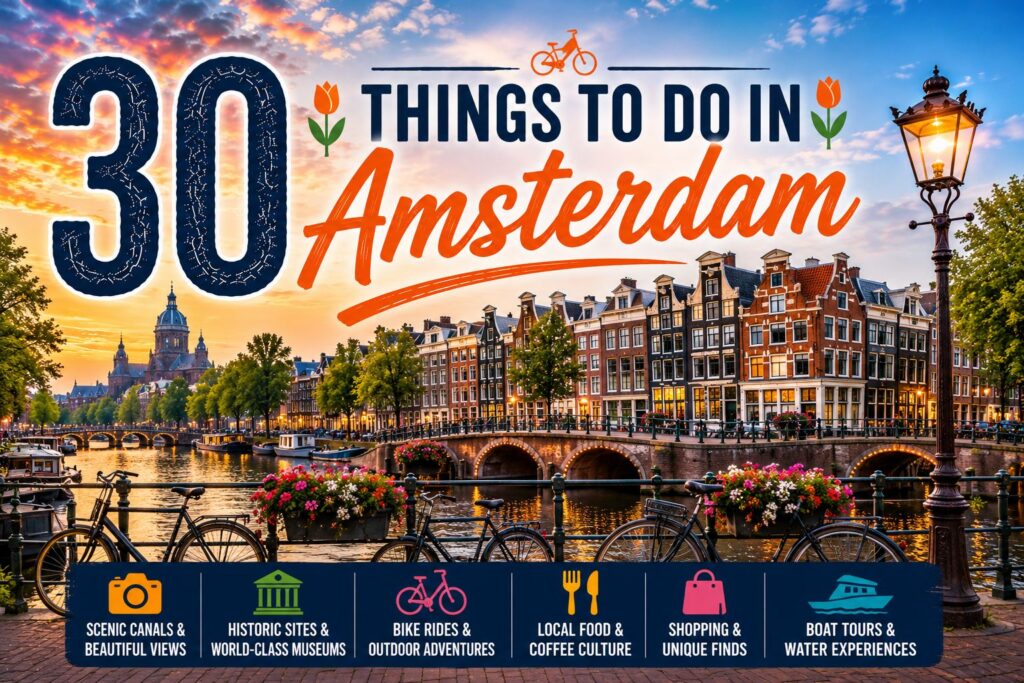
Amsterdam has 900,000 bicycles for a population of 900,000 people. The city has more bikes than residents. On any given morning, the number of cyclists crossing the Magere Brug on their way to work exceeds the number of cars on the same bridge by a ratio that would be considered impossible in any other major European city. This is the fact that most accurately describes Amsterdam: a city that made a specific and deliberate choice about how it wanted to organize itself, and then built the infrastructure to make that choice permanent. The choice also produced the canal ring, a UNESCO World Heritage Site where 17th-century merchant houses lean slightly over the water on wooden foundations that have been standing since 1600. It produced the Anne Frank House, the Rijksmuseum’s Night Watch, the Van Gogh Museum’s 200-plus original works, and the Jordaan neighbourhood’s specific combination of independent shops and brown cafés that has attracted creative people from across Europe for 50 years. In 2026, Amsterdam is also hosting WorldPride – the largest Pride celebration in the world – with the Canal Parade on August 1. I have been to Amsterdam nine times across fifteen years, in tulip season and in winter fog and in summer when the Vondelpark fills with people who have decided collectively that a city can be a living room. This guide covers all 30 things worth doing, in strict numerical order from 1 through 30, with current 2026 data throughout.
For more European city guides and travel destination inspiration, visit Travel Destinations Plan. For other city guides, read our things to do in Portland Oregon and our things to do in Vancouver.
Amsterdam At a Glance: Quick Reference Table
| # | Activity | Area | Entry | Duration | Best For | Best Time |
|---|---|---|---|---|---|---|
| 1 | Rijksmuseum | Museumplein | €25 adults | 2 to 4 hours | Art lovers, all visitors | Weekday mornings; book in advance |
| 2 | Anne Frank House | Canal Ring, Prinsengracht | €16.50 adults | 1 to 1.5 hours | History lovers, all visitors | Book 6-8 weeks ahead; first Tuesday monthly release |
| 3 | Van Gogh Museum | Museumplein | €25 adults | 2 to 3 hours | Art lovers, families | Weekday mornings; book in advance |
| 4 | Canal Ring Walk and Cruise | Canal Belt | Free walk; €16 to €25 cruise | 2 to 4 hours | All visitors | Year-round; spring and summer evenings |
| 5 | Jordaan Neighbourhood | West Amsterdam | Free | 2 to 3 hours | Local culture seekers, shoppers | Saturday mornings year-round |
| 6 | Vondelpark | Oud-Zuid | Free | 1 to 3 hours | Locals, families, cyclists | May to September |
| 7 | Albert Cuyp Market | De Pijp | Free entry | 1 to 1.5 hours | Food lovers, shoppers | Monday to Saturday mornings |
| 8 | Stedelijk Museum | Museumplein | €22.50 adults | 2 to 3 hours | Modern art lovers | Weekday afternoons |
| 9 | Heineken Experience | De Pijp / Stadhouderskade | €26 adults | 1.5 to 2 hours | Beer lovers, all visitors | Year-round; book in advance |
| 10 | Amsterdam Canal Bike | Various rental points | €14 to €16 per person/hour | 1 to 2 hours | Active visitors, families | April to October |
| 11 | STRAAT Museum | NDSM Wharf, Amsterdam Noord | €17.50 adults | 1.5 to 2 hours | Street art lovers, culture seekers | Year-round |
| 12 | Rembrandthuis | Canal Ring, Jodenbreestraat | €17.50 adults | 1 to 1.5 hours | Art and history lovers | Weekday mornings |
| 13 | De Pijp Neighbourhood | South Amsterdam | Free | 2 to 3 hours | Food lovers, locals, market shoppers | Saturday for Albert Cuyp |
| 14 | Amsterdam Noord by Ferry | Amsterdam Noord | Free ferry; activities extra | Half day | Alternative seekers, culture lovers | Year-round |
| 15 | Bloemenmarkt (Flower Market) | Singel Canal | Free to browse | 30 to 45 minutes | Shoppers, photographers | Year-round; spring for bulb season |
| 16 | MOCO Museum | Museumplein | €24 adults | 1.5 to 2 hours | Contemporary and street art lovers | Year-round |
| 17 | Artis Royal Zoo | Plantage | €26.50 adults | 3 to 4 hours | Families, nature lovers | Year-round mornings |
| 18 | Keukenhof Gardens | Lisse (35 min from Amsterdam) | €22 adults | 3 to 4 hours | Garden lovers, tulip seekers | Late March to mid-May only |
| 19 | Hortus Botanicus Amsterdam | Plantage | €11 adults | 1 to 1.5 hours | Garden lovers, families | Year-round |
| 20 | EYE Film Museum | Amsterdam Noord | €12 adults | 1.5 to 2 hours | Cinema lovers, architecture admirers | Year-round |
| 21 | Brouwerij ‘t IJ | De Pijp / Funenkade | €5 tasting | 1 hour | Beer lovers, local culture seekers | Year-round; busy weekends |
| 22 | King’s Day Celebrations | Citywide | Free | Full day | All visitors | April 27 annually |
| 23 | WorldPride / Canal Parade 2026 | Canal Ring | Free (street viewing) | 2 to 4 hours | All visitors | August 1, 2026 |
| 24 | Amsterdam Light Festival | Canal Ring | €25 boat tour; free walking | 1.5 to 3 hours | Families, winter visitors | November to January |
| 25 | Waterlooplein Flea Market | Waterlooplein | Free entry | 1 to 1.5 hours | Bargain hunters, vintage lovers | Monday to Saturday |
| 26 | Foam Photography Museum | Canal Ring | €16 adults | 1 to 1.5 hours | Photography and art lovers | Year-round |
| 27 | Day Trip to Haarlem | 20 min by train | Free to explore | Half to full day | Architecture lovers, Frans Hals fans | Year-round |
| 28 | Westergas / Westergasfabriek | West Amsterdam | Free to wander | 2 to 3 hours | Alternative culture, food and market seekers | Weekends for markets |
| 29 | Amsterdam City Cycling | Citywide | €12 to €18 per day bike rental | Half to full day | Active visitors | Year-round; spring and summer best |
| 30 | Dutch Food and Brown Café Culture | Citywide – especially Jordaan | €3 to €12 per item | 2 to 3 hours | Food lovers, local culture seekers | Year-round evenings |
1. Rijksmuseum
Area: Museumplein, Museumstraat 1 | Entry: €25 adults, free under 18; Museumkaart accepted | Duration: 2 to 4 hours | Best time: Weekday mornings; book timed entry in advance at rijksmuseum.nl
The Rijksmuseum is the national museum of the Netherlands and the most important collection of Dutch Golden Age art in the world, holding 8,000 works on display from a collection of more than 1 million objects spanning 800 years of Dutch and European history, decorative arts, and Asian art. The building itself – a vast red-brick Gothic-Renaissance palace designed by Pierre Cuypers and opened in 1885 – is one of the most magnificent museum buildings in Europe, with a central hall (the Eregalerij, or Gallery of Honour) running the full length of the building and leading to the Night Watch room where Rembrandt’s largest and most famous painting hangs on its own dedicated wall at the far end. The Night Watch (1642) is a 3.63-by-4.37-meter painting of Amsterdam’s civic guard company in action, and no reproduction has yet been made that conveys its scale, its specific warm-dark-light contrast, or the specific quality of the paint surface.
The collection’s other masterpieces – Vermeer’s The Milkmaid (1657-1658), Hals’ The Merry Drinker, the Delftware collection, the Dutch Golden Age doll houses that are as historically specific as any painting in the museum, the models of 17th-century East India Company ships – form a collection that requires at minimum 2.5 hours to cover properly and rewards 4. In 2026, the Rijksmuseum Garden reopens for summer (June through September) with the Carel Visser sculpture exhibition (free entry, 5 June to 25 October 2026), and the Ed van der Elsken photography exhibition runs inside from June 19 to September 13, 2026.
The Rijksmuseum’s Gallery of Honour culminating in the Night Watch room is the most specifically Dutch cultural experience available in the world – walking toward Rembrandt’s 380-year-old masterpiece through a hallway lined with the Vermeer, the Hals, and the Van Ruysdael works that defined European painting for two centuries, in a room whose specific architectural scale was designed specifically to hold this specific painting, is the experience that justifies the Amsterdam trip.
Practical tips:
- All visitors must book a timed entry slot in advance at rijksmuseum.nl – the Museumkaart is accepted but still requires an advance booking; walk-up entry is available in limited quantities and should not be relied upon for summer or holiday visits when the museum reaches capacity by mid-morning.
- The Night Watch is best viewed from the bench positioned directly in front of it at the far end of the Gallery of Honour – arriving at the museum at opening (9 AM) and walking directly to the Night Watch room before turning back to the rest of the collection gives you the painting with fewer than 20 other people around it before the 10 AM wave of timed-entry visitors fills the room.
- The Rijksmuseum Garden (open June through September, free entry without museum admission) provides the best view of the museum’s Gothic-Renaissance exterior and access to the summer sculpture exhibition – worth visiting separately for visitors who have already been inside the museum.
2. Anne Frank House
Area: Canal Ring, Prinsengracht 263-267 (entrance at Westermarkt 20) | Entry: €16.50 adults, €7 ages 10-17, €1 under 10 | Duration: 1 to 1.5 hours | Best time: Book immediately when tickets release – first Tuesday of each month for the following 6 weeks via annefrank.org only
The Anne Frank House is the canal house on Amsterdam’s Prinsengracht where Otto Frank ran a spice and pectin business on the lower floors and where his family, along with four other Jewish individuals, hid in the concealed rear annex from July 1942 until their arrest in August 1944. Anne Frank was 13 when the family went into hiding and 15 when they were discovered. She died in Bergen-Belsen concentration camp in February 1945, three months before liberation. Her diary, recovered by Miep Gies after the arrest and returned to Otto Frank after the war, was published in 1947 and has since been translated into 70 languages. The museum is the actual building where this happened – the actual steep staircases, the actual hidden bookcase concealing the entrance to the annex, the actual rooms where eight people lived in complete secrecy for 25 months – and the experience of moving through these spaces is fundamentally different from reading about them.
Tickets are sold exclusively online at annefrank.org and are never available at the door. The release schedule is the most critical logistics fact about visiting the Anne Frank House: tickets release on the first Tuesday of each month for the following 6 weeks. In peak season (April through September), the entire available inventory sells out within hours of the Tuesday release. For visits from April through September, you must book at least 6 to 8 weeks in advance and be at your computer when the Tuesday release opens. Evening time slots (6 PM to 10 PM) sell more slowly than morning and afternoon and are the most reliable fallback option.
The Anne Frank House is not a typical museum – it is the actual building, the actual annex, the actual bookcase, the actual rooms where a family hid for 25 months – and seeing Anne Frank’s original diary displayed in the same building where she wrote it produces a specific and lasting understanding of what happened in Amsterdam between 1940 and 1945 that no amount of reading about it replicates.
Practical tips:
- Tickets release on the first Tuesday of each month for the following 6 weeks at annefrank.org exactly at 10 AM Amsterdam time – set a calendar reminder, be at the booking page before 10 AM, and have your payment details ready; the most popular morning and afternoon slots sell out within minutes of release.
- Evening time slots (6 PM to 10 PM, the museum is open until 10 PM most days) sell more slowly than daytime and are the most reliable option for visitors who cannot secure peak-demand daytime slots – the museum experience in the evening, when the visitor numbers are lower and the building has a different quality of quiet, is arguably better than the busier afternoon version.
- If the Anne Frank House is completely sold out for your travel dates, the Anne Frank’s Last Walk and Secret Annex VR tour (bookable through Amsterdam Experiences) follows the route Anne walked on her last day of freedom and ends with a virtual reality experience inside the Secret Annex showing every room as it appeared when the families lived there – a genuinely affecting alternative that does not require securing the sold-out museum tickets.
3. Van Gogh Museum
Area: Museumplein, Museumplein 6 | Entry: €25 adults, free under 18 | Duration: 2 to 3 hours | Best time: Weekday mornings; book at vangoghmuseum.nl at least 3 to 4 weeks in advance
The Van Gogh Museum holds the world’s largest collection of works by Vincent van Gogh – 200 paintings, 500 drawings, and 800 letters – covering his entire career from the dark potato-farmer paintings of the Dutch period (1880-1885) through the Japanese-influenced works of the Paris period (1886-1888) to the Provençal sun-saturated paintings of Arles and Saint-Rémy (1888-1890) to the final works made at Auvers-sur-Oise in the last 70 days of his life. The collection is organized chronologically, and moving through it period by period – watching the palette shift from brown-black to pure Japanese color as Van Gogh encountered the Impressionists in Paris, then to the yellow and blue intensity of Arles as he developed his mature style – is the clearest available single-building demonstration of an artist’s technical development across a career.
The museum’s most significant single work is The Bedroom (1888), painted at the Yellow House in Arles and representing the specific room Van Gogh described in letters to his brother Theo as a painting of absolute rest and calm. The Sunflowers (one of five surviving versions, the museum’s version painted in 1889) and the Self-Portrait (1889, one of more than 35 self-portraits in the collection) are the works with the highest public recognition, but the most affecting room in the museum is usually the final gallery showing the Wheatfield with Crows and related works from the last weeks of Van Gogh’s life at Auvers-sur-Oise.
The Van Gogh Museum’s chronological organization – moving from the dark Dutch period paintings through the Paris Impressionist works to the Arles sun-color intensity to the final Auvers works – is the clearest single-building demonstration of an artist’s technical and emotional development available in any European museum, and the specific quality of seeing 200 original Van Gogh paintings rather than reproductions changes the understanding of why this painter matters.
Practical tips:
- Book at vangoghmuseum.nl at least 3 to 4 weeks in advance for spring and summer visits and at least 1 to 2 weeks in advance for fall and winter – the museum is one of the most visited in Europe and same-day tickets are essentially unavailable from April through September.
- The Van Gogh Museum is not covered by the Museumkaart (unlike the Rijksmuseum) and is not included in the I Amsterdam City Card as of 2022 – budget €25 per adult separately regardless of which city pass you purchase.
- The museum café on the ground level and the sculpture garden (accessible from the museum) are both accessible without a museum ticket during the final hour of the day – worth knowing for visitors who want to experience the building’s atmosphere without the admission cost.
4. Canal Ring Walk and Cruise
Area: Canal Belt (Grachtengordel) – UNESCO World Heritage Site | Entry: Free to walk; canal cruise €16 to €25 adults | Duration: 2 to 4 hours walking; 1 hour for standard canal cruise | Best time: Year-round; spring and summer evenings most atmospheric; winter fog most photogenic
The Amsterdam Canal Ring is a UNESCO World Heritage Site – a semi-circular system of four concentric canals (Singel, Herengracht, Keizersgracht, and Prinsengracht) dug between 1613 and 1663 during Amsterdam’s Golden Age, lined on both sides by 17th-century merchant houses leaning slightly outward over the water on wooden foundations sunk into the Amsterdam clay. The canal belt contains approximately 1,500 historic buildings and is the most complete preserved example of a planned early modern city center in the world. Walking the main canals – particularly the Herengracht (Lords’ Canal) and the Keizersgracht (Emperor’s Canal) in the late afternoon when the light comes from the west and reflects on the water between the bridges – produces the specific Amsterdam image that has appeared in more European city travel photography than any other Dutch urban landscape.
A canal cruise adds the water-level perspective that walking cannot provide: the view of the leaning canal houses from below the bridge arches, the sense of the city organized around water rather than around roads, and the specific Amsterdam geography visible only from a boat – the way the city opens and closes as you move through different canal sections. Multiple operators run 1-hour canal cruises from central departure points near Central Station, Rembrandtplein, and the Anne Frank House, ranging from basic audio-guide boats to open glass-roofed boats to private dinner cruises. The basic 1-hour cruise is sufficient for the orientation experience; longer evening cruises with wine service are the couples and celebration option.
Walking the Herengracht and Keizersgracht in the late afternoon on a clear spring day, when the light comes from the west and reflects in the canal between the 17th-century merchant house facades leaning toward the water on both sides, is the experience that Amsterdam’s tourist photography has been trying to reproduce since the invention of photography – and it is available for free, every day, to anyone who walks west from Dam Square.
Practical tips:
- The most photogenic single stretch of the canal ring is the Golden Bend (Gouden Bocht) on the Herengracht between Vijzelstraat and Leidsestraat – the widest section of the Herengracht where the most affluent Golden Age merchants built double-wide houses, producing the grandest canal house facades in Amsterdam.
- The Magere Brug (Skinny Bridge) on the Amstel River is the most photographed bridge in Amsterdam and the best evening walk destination – the bridge is illuminated by hundreds of small white lights from late afternoon through midnight, and the view from the bridge looking north toward the Stopera opera house and south toward the River IJ is the most complete single urban view in Amsterdam.
- Book canal cruises online in advance during peak season (April through September) to avoid the queues at the departure points near Central Station – the best independent operators (Blue Boat Company, Lovers Canal Cruises) have website booking that is both faster and typically the same price or cheaper than the pier touts.
5. Jordaan Neighbourhood
Area: West Amsterdam, between Prinsengracht and Lijnbaansgracht | Entry: Free | Duration: 2 to 3 hours | Best time: Saturday mornings for the Noordermarkt; weekday afternoons for the quietest café experience
The Jordaan is a neighbourhood in the western canal ring that was built in the early 17th century as a working-class district outside the main canal belt, and that has become over the past 30 years the most-visited and most-desired residential neighbourhood in Amsterdam. The street grid of the Jordaan does not follow the canal ring’s concentric pattern but instead follows the pre-existing irrigation ditch system of the farmland that preceded it – producing a denser, more organic network of smaller canals and narrower streets than the formal canal belt to its east. The neighbourhood contains Amsterdam’s best concentration of independent shops, brown cafés (traditional Dutch bars with tobacco-stained ceilings, dark wood, and beer at reasonable prices), galleries, vintage clothing stores, and the specific type of Amsterdam life that has attracted artists, writers, and creative people to the neighbourhood for decades.
The Noordermarkt on Saturday mornings (a farmers and organic market from 9 AM to 4 PM, and a flea market from 9 AM to 1 PM) is the most locally-attended market in Amsterdam – not a tourist market but a Saturday morning institution for the Jordaan and western canal ring residents who buy their week’s cheese, bread, flowers, and produce here. The neighbourhood’s brown cafés – Café ‘t Smalle at Egelantiersgracht 12 (open since 1786, on a canal, the most photogenic brown café in Amsterdam), Café Papeneiland at Prinsengracht 2 (founded 1642, has a secret tunnel to the church across the canal from the Catholic suppression period) – are the best single expression of Dutch café culture in the city.
The Jordaan on a Saturday morning, when the Noordermarkt is running and the canal streets are quiet enough to walk without obstruction and the smell of coffee and fresh bread from the bakeries on Haarlemmerdijk is drifting through the neighbourhood and the specific Amsterdam of daily life rather than tourist infrastructure is fully visible – this is the neighbourhood version of Amsterdam that makes visitors understand why people choose to live here.
Practical tips:
- Café ‘t Smalle at Egelantiersgracht 12 is the single most specifically Amsterdam café interior in the city – open since 1786, on a small canal with outdoor seating directly over the water on the canal bridge, and serving Dutch jenever (gin) from the original distillery barrels displayed on the bar; arrive before noon on weekdays to have the waterside seating available.
- The Jordaan’s small galleries are clustered on the Elandsgracht and Hazenstraat streets and are open Wednesday through Saturday in most cases – the neighbourhood gallery circuit is one of the best free art experiences in Amsterdam and the most direct connection to the contemporary Amsterdam art scene that operates below the Stedelijk Museum’s curatorial radar.
- Haarlemmerdijk and Haarlemmerstraat, running east from the Jordaan through the Haarlemmerbuurt neighbourhood toward Central Station, is the best single shopping street in Amsterdam for independent food shops, lifestyle stores, and cafés – the 15-minute walk from the Noordermarkt to Central Station along these streets is the best food shopping circuit in the city.
6. Vondelpark
Area: Oud-Zuid, adjacent to Museumplein | Entry: Free | Duration: 1 to 3 hours | Best time: May to September; summer evenings for the Open Air Theatre; weekday mornings for quiet walks
Vondelpark is Amsterdam’s most famous park – 47 hectares of English landscape garden in the Oud-Zuid neighbourhood, adjacent to Museumplein, with ponds, rose gardens, a bandstand, and the Open Air Theatre (Openluchttheater) that runs free performances of music, comedy, and theatre on weekend evenings from June through August. The park was created between 1864 and 1877 and donated to the city of Amsterdam, which accepted it on the condition that it remain free and publicly accessible in perpetuity – a condition that has never been challenged. On a warm Sunday afternoon in July, the park population reaches 100,000 people: families on picnic blankets, cyclists on the main paths, rollerbladers on the skating circuit, students reading on the lawns, and the specific Amsterdam quality of outdoor public space being used by every demographic simultaneously.
The Vondelpark Openluchttheater runs free outdoor performances from June through August on Wednesday, Thursday, Friday, and Saturday evenings and Sunday afternoons. The programme covers classical music, pop, cabaret, children’s theatre, and comedy in a format that attracts both tourists and local residents, and the specific combination of free outdoor theatre in a 19th-century park with 100-year-old oak trees and a pond behind the stage is the most Dutch public space experience available in Amsterdam outside the canal ring itself.
Vondelpark on a warm Sunday afternoon in July, when the park population reaches 100,000 people who have collectively decided that a 47-hectare English landscape garden in the middle of a European capital can function as the city’s living room – cyclists, families, musicians, sunbathers, and picnickers coexisting on the same patch of grass in a way that would require a permit in most cities and requires nothing here except showing up.
Practical tips:
- The Vondelpark Openluchttheater (Open Air Theatre) runs free performances on Wednesday through Saturday evenings and Sunday afternoons from June through August – the weekly programme is posted at openluchttheater.nl and covers classical, pop, children’s, and comedy formats; arriving 30 minutes before the advertised start secures a good position on the sloped grass amphitheatre in front of the stage.
- The Vondelpark rose garden in the southeastern section of the park peaks in June and is the best free garden experience in Amsterdam during tulip-free months – the combination of the rose garden, the adjacent Vondelkirk (a converted church now used as an event space), and the skating circuit makes the southeastern section the most varied in the park.
- The Van Gogh Museum, Rijksmuseum, and Stedelijk Museum are all a 5 to 10-minute walk from the Vondelpark’s eastern entrance on Stadhouderskade – combining a Vondelpark walk with a Museumplein museum visit and a café stop on Overtoom or Cornelis Schuytstraat makes the most productive Amsterdam half-day.
7. Albert Cuyp Market
Area: De Pijp, Albert Cuypstraat | Entry: Free | Duration: 1 to 1.5 hours | Best time: Monday to Saturday 9 AM to 5 PM; Saturday morning for maximum vendor activity
The Albert Cuyp Market is the largest outdoor market in the Netherlands and one of the most visited in Europe – a 900-meter street market running the full length of Albert Cuypstraat in the De Pijp neighbourhood from Monday through Saturday, with more than 260 stalls selling fresh fish (raw herring, smoked eel, pickled herring with raw onion), Dutch cheese at lower prices than any Amsterdam shop, stroopwafels made fresh on the iron in front of you, fresh cut flowers, fabrics, clothing, street food from the surrounding immigrant communities, and the specific mix of daily-use and tourist-adjacent goods that a neighbourhood market serving both purposes provides. The Albert Cuyp is not organized for tourists – it is the market where De Pijp and the surrounding South Amsterdam neighbourhoods buy food, and the vendors’ pricing reflects local competition rather than tourist willingness to pay.
The specific Albert Cuyp food experiences worth seeking specifically: the raw herring (haring) served with raw onion and gherkin from the fish stalls (the traditional Dutch way to eat herring is to tilt your head back and lower the fish in by the tail, though sliced versions are available), the fresh stroopwafels made on the market iron, the wheel-of-cheese Dutch Gouda from the cheese vendors priced at market rates rather than retail, and the Indonesian street food from the stalls reflecting De Pijp’s historic Indonesian community. The neighbourhood of De Pijp surrounding the market is covered in detail at activity 13.
The Albert Cuyp Market raw herring (haring) experience – herring with raw onion and gherkin, eaten standing at the fish stall in the middle of a 900-meter outdoor market – is the most specifically Dutch food experience accessible in Amsterdam, the traditional preparation unchanged since the 16th century, available at the market for less than €3, and eaten correctly by tilting your head back and lowering the fish in by the tail.
Practical tips:
- The fish stalls at the Albert Cuyp are the market’s best single stop – the raw herring (nieuwe haring when available from May through July, the year’s freshest catch) is the most specifically Dutch food available at the market and costs €2.50 to €3.50 at the stall versus €6 to €8 at any Amsterdam restaurant.
- Saturday mornings from 9 AM to noon are the Albert Cuyp at its fullest – the maximum number of stalls, the freshest produce and fish, and the most active market atmosphere, but also the highest crowd density; arriving at 9 AM rather than 10:30 AM provides the best stall access before the peak midday volume.
- The stroopwafel stalls making fresh waffles on the iron (as opposed to the pre-packaged stroopwafels available everywhere in Amsterdam) are identifiable by the waffle iron and the queue of people waiting – a fresh stroopwafel warm from the iron is categorically different from the packaged version and costs €1 to €1.50.
8. Stedelijk Museum
Area: Museumplein, Museumplein 10 | Entry: €22.50 adults, free under 18; Museumkaart accepted | Duration: 2 to 3 hours | Best time: Weekday afternoons; less crowded than Rijksmuseum and Van Gogh**
The Stedelijk Museum is Amsterdam’s museum of modern and contemporary art and design, holding one of the most important collections of 20th-century art in Europe – significant holdings of De Stijl (Mondrian, Van Doesburg), Russian Constructivism, CoBrA, Abstract Expressionism (Pollock, de Kooning), and contemporary international art from the 1960s to the present. The museum building combines a 19th-century brick structure with a 2012 addition nicknamed “the bathtub” (a cantilevered white fiberglass and aluminum extension that projects over the entrance plaza) that has become one of Amsterdam’s more distinctive architectural statements. The Stedelijk’s permanent collection is displayed across thematic rather than chronological galleries, creating juxtapositions between artists and periods that the strictly chronological Rijksmuseum does not attempt.
The Stedelijk is the most undervisited of the three Museumplein museums despite holding the collection that most surprises visitors who arrive expecting something less significant than the Rijksmuseum’s Golden Age. The Mondrian holdings, the Karel Appel paintings from the CoBrA period, the Francis Bacon works, and the design collection including original Rietveld furniture and Droog Design objects give the Stedelijk a range that its relatively low profile in Amsterdam’s tourist infrastructure does not suggest. The Museumkaart is accepted, making it the most economical of the three Museumplein museums for Museumkaart holders.
The Stedelijk Museum is the most undervisited major museum in Amsterdam relative to its collection quality – significant holdings of Mondrian, Malevich, CoBrA, Abstract Expressionism, and contemporary international art in the same building as an important design collection, covered by the Museumkaart, and consistently less crowded than the Rijksmuseum and Van Gogh Museum across the square.
Practical tips:
- The Stedelijk is covered by the Museumkaart (unlike the Van Gogh Museum and Anne Frank House) – for visitors with the Museumkaart, the Stedelijk is the most cost-effective of the three Museumplein museums and the one that provides the most significant collection depth relative to the time investment.
- The museum’s shop and café are accessible without a museum ticket from approximately 5 PM onward – the shop has the best art and design book selection of any Amsterdam museum, and browsing it is a productive 30 minutes for visitors who have finished their visit or who are waiting for a dinner reservation nearby.
- Combine the Stedelijk with the Rijksmuseum and/or Van Gogh Museum on the same Museumplein day only if you have 6 or more hours available – attempting all three in a single day produces cultural fatigue that reduces the quality of engagement with each collection.
9. Heineken Experience
Area: Stadhouderskade 78, near De Pijp | Entry: €26 adults, €22.50 ages 12-17 | Duration: 1.5 to 2 hours | Best time: Year-round; book in advance; weekday afternoons for lowest queues
The Heineken Experience is a self-guided tour through the historic Heineken brewery on Stadhouderskade – the original 1867 building where Heineken produced beer until 1988 before production moved to larger facilities outside the city. The tour covers the history of the Heineken brand, the brewing process, interactive experiences including a simulation of what it feels like to be a bottle of beer on the production line, and two free beers included in the admission price. The brewery building itself is historically significant and architecturally interesting – a 19th-century industrial building with the specific character of Amsterdam’s canal-adjacent industrial heritage that has been converted into an attraction without losing the building’s essential material honesty.
The Heineken Experience is the most-visited paid attraction in Amsterdam after the Rijksmuseum, Van Gogh Museum, and Anne Frank House, with approximately 1 million visitors per year. It works best understood as an entertainment experience rather than a serious brewing education – the interactive elements, the history of Heineken’s global marketing, and the two included beers in the final bar section are what visitors come for, and the tour delivers those elements consistently. For visitors interested in genuinely artisanal Dutch beer, Brouwerij ‘t IJ (activity 21) provides a more authentic small-brewery experience at lower cost.
The Heineken Experience is the most honest version of a beer brand museum available in Europe – the 1867 brewery building, the archived advertising campaign history, the interactive production simulation, and the two included beers in the final bar section combine to make it the most visited non-museum paid attraction in Amsterdam, and understanding what it is (a brand entertainment experience in a historic building) rather than what it is not (a serious brewing education) produces the most satisfying visit.
Practical tips:
- Book tickets online at heinekenexperience.com in advance – the experience sells out on summer weekends and at peak times, and online booking is typically 10 to 15 percent cheaper than the door price for the same experience.
- The two included beers are poured in the final section of the tour at a bar that looks directly onto the Stadhouderskade canal – this is the most specifically Amsterdam beer experience in the building, and allocating 30 to 45 minutes in the final bar section rather than rushing to the exit makes the best use of the included beverage allowance.
- The Heineken Experience is adjacent to De Pijp and the Albert Cuyp Market – combining the market (activity 7) in the morning with the Heineken Experience in the afternoon makes a natural De Pijp day that covers food culture and beer culture in the same neighbourhood without requiring additional transit.
10. Amsterdam Canal Bike
Area: Pedal boat rental points at Leidseplein, Rijksmuseum, and Anne Frank House | Entry: €14 to €16 per person per hour | Duration: 1 to 2 hours | Best time: April to October; weekday afternoons for the quietest canal experience
Pedal boats (canal bikes) on the Amsterdam canals provide the most independent water experience available in the city – 2 or 4-person pedal boats available for rental at multiple points on the central canals, allowing self-guided navigation through the canal ring without a guide, schedule, or predetermined route. The pedal boats are slow, stable, and low enough to the water to pass under the narrower bridges that the larger tour boats cannot access. The experience of navigating the canal ring under your own power – choosing which turns to take, stopping under bridges to watch cyclists cross overhead, pulling alongside canal house gardens visible only from water level – is fundamentally different from the passive cruise experience and the most direct engagement with the canal ring’s specific geography available to visitors.
The pedal boat rental points at the Rijksmuseum and the Leidseplein location are the most practical starting points – the Rijksmuseum point provides immediate access to the Keizersgracht and Prinsengracht network, while the Leidseplein point puts you at the junction of multiple canals with the most routing options. The canal bike rental includes a map of the canal system and the bridges accessible by pedal boat. The combination of the low waterline perspective, the specific canal house gardens visible from the water, and the passing pleasure boats, rowing shells, and sailing dinghies that share the canal space produces the specific experience of understanding Amsterdam as a water city rather than a land city with canals added.
Canal biking on the Amsterdam canal ring – navigating a 2-person pedal boat through the Keizersgracht and Prinsengracht network at water level, passing under the bridge arches that give you a view upward through the bridge stonework to the cyclist crossing above, looking into the canal house gardens visible only from the water – is the most independent and most specifically water-oriented Amsterdam experience available for €14 to €16 per person.
Practical tips:
- The Rijksmuseum canal bike rental point on the Singelgracht puts you at the junction of the Singel, Keizersgracht, and Prinsengracht network immediately – start by heading north on the Keizersgracht toward the Brouwersgracht (the most beautiful single canal in Amsterdam) for the most photogenic pedal boat route in the city.
- Canal bikes can be returned to any of the rental company’s multiple docking points rather than needing to return to the departure point – useful for planning a one-way route through the canal ring to a different neighbourhood without backtracking.
- Check the weather forecast before a canal bike session – pedal boats operate in light rain but are less enjoyable in heavy rain or strong wind, and the canal surface in wind chop is harder to navigate for inexperienced pedal boaters; the rental companies can advise on current canal conditions.
11. STRAAT Museum
Area: NDSM Wharf, Amsterdam Noord, accessible by free ferry from Central Station | Entry: €17.50 adults, €9 ages 6-12 | Duration: 1.5 to 2 hours | Best time: Year-round; weekday afternoons quietest; The Essence exhibition through December 30, 2026
STRAAT is the world’s largest street art and graffiti museum, housed in an 8,000 square meter former shipyard warehouse at the NDSM Wharf in Amsterdam Noord. The museum contains approximately 180 large-scale artworks all created on-site by artists from around the world, working directly on the warehouse walls, floors, and structural elements – making the collection site-specific in a way that most gallery-based street art exhibitions cannot replicate. In 2026, the museum is running The Essence – a major exhibition exploring the cultural meaning and foundations of graffiti and street art running from April 10 to December 30, 2026, which adds curatorial context to the permanent collection of murals in a way the warehouse format previously lacked.
The NDSM Wharf surrounding the STRAAT Museum is itself worth exploring – the former shipbuilding facility has been converted into a creative hub with artist studios, restaurants, event spaces, and the open-air sculpture park on the waterfront. The area represents a version of Amsterdam that the canal ring tourist infrastructure does not show: a post-industrial creative neighbourhood built on the edge of the IJ river, accessed by a free ferry from Central Station, with the best view of the Amsterdam skyline visible from across the water as the ferry approaches the NDSM quay. The free ferry from Central Station (Pontsteiger and NDSM Werf destinations) runs every 15 to 30 minutes and is itself a component of the Amsterdam Noord experience.
STRAAT Museum is the world’s largest street art museum, and the specific quality that distinguishes it from every other street art exhibition in Europe is that all 180 works were created directly on the warehouse walls and surfaces – site-specific, impossible to remove, painted by artists who came to this building and made their work here – which is the fundamental difference between a street art museum and a gallery that shows framed street art.
Practical tips:
- Take the free NDSM ferry from behind Amsterdam Central Station (Buiksloterweg or NDSM Werf destination – STRAAT requires the NDSM Werf ferry, not the closer Buiksloterweg) – the ferry runs every 15 to 30 minutes, is completely free, and the 15-minute IJ crossing provides the best view of the Amsterdam skyline available from the water.
- The Essence exhibition (April 10 to December 30, 2026) is the most substantive curatorial addition to the STRAAT Museum since it opened – it adds historical context and theoretical framework to the warehouse murals that makes the visit more informative than the standard mural-only experience; allow an additional 30 to 45 minutes beyond the standard warehouse walk for the exhibition content.
- The NDSM Wharf has multiple restaurants and street food operations directly adjacent to the STRAAT Museum – IJ-Kantine (classic Dutch food in a former canteen), Pllek (beach bar and restaurant on the waterfront), and the food trucks that operate during peak seasons provide the most specifically Amsterdam Noord food experience available after the museum visit.
12. Rembrandthuis
Area: Canal Ring, Jodenbreestraat 4 | Entry: €17.50 adults, free under 6; Museumkaart accepted | Duration: 1 to 1.5 hours | Best time: Weekday mornings; advance booking recommended
The Rembrandthuis is the canal house on Jodenbreestraat where Rembrandt van Rijn lived and worked from 1639 to 1658 – the most successful period of his career, during which he painted The Night Watch (1642) now in the Rijksmuseum – and which the city of Amsterdam repossessed in 1658 when Rembrandt was declared bankrupt due to his expensive collecting habits and lavish lifestyle. The house has been restored to its 1658 configuration using the inventory list compiled by the bankruptcy commissioners, allowing the recreation of the specific rooms, the specific furniture, and the specific art and curiosity collection that Rembrandt actually owned. The studio on the upper floor – the room where Rembrandt painted – has been reconstructed with the grinding stones, the mixing bowls, the dried pigments, and the working materials of a 17th-century Dutch master’s studio.
The museum is smaller and less crowded than the Rijksmuseum and provides the specific complement that the Rijksmuseum’s Night Watch cannot: context for how and where Rembrandt actually lived and worked, the conditions of a successful Amsterdam artist’s house in the Golden Age, and the collection of prints (approximately 250 original Rembrandt etchings are displayed in rotation) that represents the best accessible concentration of original Rembrandt graphic work in the world. The etching demonstrations that take place several times daily in the ground floor print room show the actual etching process on the original presses.
The Rembrandthuis is the physical context for the Night Watch – the house where Rembrandt actually lived when he painted it, restored to its 1658 bankruptcy inventory configuration, with the original studio on the upper floor reconstructed with the actual materials of a 17th-century Dutch master’s working practice, and the largest accessible collection of original Rembrandt etchings available anywhere in the world displayed in rotation in the print gallery.
Practical tips:
- The etching demonstrations in the ground floor print room run several times daily and show the actual etching and printing process on period presses – ask at the entrance desk for the current demonstration schedule and time your visit to include one, as the 20-minute demonstration transforms the print collection from static display to active practice.
- The Rembrandthuis is covered by the Museumkaart and is significantly less crowded than the Rijksmuseum – for Museumkaart holders, the combination of Rembrandthuis and the Rijksmuseum on the same day is the most complete Rembrandt day available in Amsterdam, covering his working life and his masterwork in the same city visit.
- The neighbourhood surrounding the Rembrandthuis – the former Jewish Quarter (Jodenbuurt) – has specific historical significance related to Amsterdam’s WWII history, and the Hollandsche Schouwburg (Dutch Theatre, now a Holocaust memorial) and the Jewish Historical Museum are both within 5 minutes walk of the Rembrandthuis.
13. De Pijp Neighbourhood
Area: South Amsterdam, bounded by Stadhouderskade, Ferdinand Bolstraat, and Ceintuurbaan | Entry: Free | Duration: 2 to 3 hours | Best time: Saturday mornings for the Albert Cuyp Market; weekend afternoons for café and restaurant culture
De Pijp is the most densely inhabited neighbourhood in Amsterdam and the one with the most diverse demographic character – a historically working-class district that has been transformed since the 1990s by gentrification while retaining more of its diverse community character than similar neighbourhoods in comparable European cities. The neighbourhood name (The Pipe) comes from the long, narrow streets resembling clay pipes as seen from above. It contains the Albert Cuyp Market (activity 7), the Heineken Experience (activity 9), the best concentration of international restaurants in Amsterdam (particularly Indonesian, Moroccan, and Surinamese), and the specific café and brunch culture that has made Ferdinand Bolstraat and Ceintuurbaan two of the most socially active streets in the city.
The neighbourhood’s Indonesian restaurants represent Amsterdam’s most historically significant food culture – the Netherlands’ 350-year colonial relationship with Indonesia produced a Dutch-Indonesian food culture (Indisch cuisine) that is specific to the Netherlands and that is best experienced in the rijsttafel (rice table) format: a meal of 15 to 25 small dishes representing different Indonesian regional traditions, served simultaneously with rice, eaten communally. De Pijp has the highest concentration of rijsttafel restaurants in Amsterdam, from the budget versions serving 15 dishes to the premium versions at Blauw and Sama Sebo serving 25 to 30 dishes from specialist regional traditions.
De Pijp is the Amsterdam neighbourhood where the city’s historical relationship with Indonesia is most visible in the food culture – the rijsttafel (rice table) format, a Dutch-Indonesian invention of 15 to 25 small dishes from different regional traditions eaten simultaneously, is the most specifically Dutch-colonial food experience available in Amsterdam and De Pijp is where the best versions are found.
Practical tips:
- The rijsttafel at Blauw on Amstelveenseweg is consistently the most recommended restaurant in Amsterdam for a full Indonesian rice table experience – reservations are required and should be booked at least 1 week in advance for dinner, with the 22-dish table for two at approximately €70 per person representing the most immersive Dutch-Indonesian food experience available in the city.
- The Sarphatipark, a small park at the center of De Pijp, is the neighbourhood’s living room on warm evenings and weekend afternoons – the combination of the park, the surrounding café terraces on Ceintuurbaan and Van Woustraat, and the neighbourhood’s specific multicultural street character makes the Sarphatipark area the best single place in De Pijp for extended afternoon sitting.
- Combine De Pijp with the Albert Cuyp Market (activity 7) and the Heineken Experience (activity 9) as a full southern Amsterdam day – the three are within 10 minutes walk of each other and together cover food culture, beer culture, and neighbourhood character in the same geographic area.
14. Amsterdam Noord by Free Ferry
Area: Amsterdam Noord, across the IJ from Central Station | Entry: Free ferry; individual attractions extra | Duration: Half day | Best time: Year-round; summer for the beach bars; weekends for the creative market atmosphere at NDSM
Amsterdam Noord is the neighbourhood across the IJ river from Central Station, accessible by free GVB ferries that depart from behind the station every 15 minutes (multiple destinations: Buiksloterweg, NDSM Werf, and IJplein). Noord was historically a separate municipality and shipbuilding industrial area, and the NDSM Wharf section specifically (see STRAAT Museum, activity 11) has been converted into the most significant creative hub in the Netherlands. The EYE Film Museum (activity 20) is in Amsterdam Noord, visible from the ferry as a striking white deconstructed angular building directly on the IJ waterfront. Pllek, a beach bar and restaurant built on a man-made beach at the NDSM waterfront, operates as one of Amsterdam’s best summer outdoor venues.
The overall Amsterdam Noord experience is best described as what Amsterdam looks like when it stops performing for visitors – the NDSM Wharf’s working artist studios, the food trucks, the skate park visible from the STRAAT Museum entrance, and the wide IJ river views with the Amsterdam skyline behind you all constitute a version of the city that is not organized around the canal ring tourist infrastructure. The Buiksloterweg ferry destination (a shorter crossing, running every 5 to 7 minutes) delivers you to the EYE Film Museum, the A’DAM Lookout observation tower (€16 adults, with Europe’s highest swing Over the Edge), and the Adam Toren hotel and entertainment complex.
Amsterdam Noord seen from the free IJ ferry from Central Station – the white deconstructed angular EYE Film Museum visible on the waterfront, the IJ river wide and silver ahead, and the Amsterdam canal ring skyline receding behind the ferry – is the clearest single moment for understanding Amsterdam’s geography as a water city, and Noord itself is the version of Amsterdam that exists for the city’s residents rather than for its visitors.
Practical tips:
- Take the Buiksloterweg ferry (the closer and more frequent crossing, running every 5 to 7 minutes from behind Central Station) for the EYE Film Museum and A’DAM Lookout – and the NDSM Werf ferry (running every 15 to 30 minutes) for the STRAAT Museum; both are free and the ferry landing points are clearly marked at the station rear.
- The A’DAM Lookout observation tower (€16 adults) has Europe’s highest outdoor swing (Over the Edge) extending from the roof at 100 meters elevation over the IJ – separately ticketed from the observation deck, the swing requires a minimum height of 130 cm, and advance booking at adamlookout.com is strongly recommended for weekends.
- Pllek on the NDSM waterfront (open year-round, free entry, food and drinks at normal Amsterdam prices) is the best single free destination in Amsterdam Noord for visitors who want the waterfront atmosphere, the creative market character, and the view of the Amsterdam skyline from across the IJ without paying any additional entrance fees.
15. Bloemenmarkt (Flower Market)
Area: Singel Canal, between Muntplein and Koningsplein | Entry: Free to browse | Duration: 30 to 45 minutes | Best time: Year-round; spring for the widest bulb selection; mornings for freshest stock
The Bloemenmarkt is the world’s only floating flower market – a row of permanently moored barges on the Singel Canal, each converted into a flower shop, selling fresh cut flowers, potted plants, tulip bulbs, seeds, and Dutch garden souvenirs. The market has operated continuously since 1862 and currently has 15 stalls open Monday through Saturday. The “floating” character is visible only from the side canal or from boats – from the street, the Bloemenmarkt looks like a normal commercial street with glass shop fronts. It is the street surface of the stalls that floats, not the merchandise or the experience, and this reality is the most common Amsterdam visitor discovery.
The Bloemenmarkt’s primary practical value for visitors is tulip bulbs – if you visit Amsterdam in a non-tulip season and want to bring bulbs home for planting, the Bloemenmarkt carries the widest selection of Dutch cultivars available in the city, including varieties not available outside the Netherlands. The fresh cut flower prices are not lower than equivalent Amsterdam florists, and the tourist-facing gifts and merchandise (wooden shoes, windmill magnets, Delftware trinkets) are priced at tourist premium rates. The most specific Bloemenmarkt purchase is a bag of mixed tulip bulbs for planting in autumn – the bulbs travel well in checked luggage and produce Dutch-variety tulips in any temperate garden the following spring.
The Bloemenmarkt is the world’s only floating flower market and the most specific place in Amsterdam to buy tulip bulbs to plant at home – the widest selection of Dutch cultivars available in the city, sold on permanently moored barges that have been here since 1862, and the experience is worth the 30 minutes it takes regardless of whether you purchase anything.
Practical tips:
- Tulip bulbs from the Bloemenmarkt travel well in checked luggage with no phytosanitary issues for visitors returning to the US, EU, UK, or Australia (confirm current import regulations for your specific country before purchasing) – a bag of 10 mixed tulip bulbs costs €5 to €8 and produces Dutch-variety tulips in any temperate garden when planted in autumn.
- The Bloemenmarkt is located on the Singel Canal between Muntplein and Koningsplein – a 5-minute walk from the Rijksmuseum through the Spiegelstraat antique dealer corridor, making it a natural final stop on a Museumplein morning before heading toward the Leidseplein area.
- The fresh cut flower prices at the Bloemenmarkt are comparable to street florists elsewhere in Amsterdam – if buying a bouquet, the prices are fair rather than tourist-premium, and the selection of Dutch narcissus, hyacinth, and tulips in season is the best available in the central city.
16. MOCO Museum
Area: Museumplein, Honthorststraat 20 | Entry: €24 adults, €17 ages 13-18 | Duration: 1.5 to 2 hours | Best time: Year-round; book at mocomuseum.com in advance; Banksy: Laugh Now running 2026
The MOCO Museum (Modern Contemporary Museum) is a privately operated museum of modern and contemporary art in a 1904 villa on the edge of Museumplein, best known internationally for holding one of the world’s most significant Banksy collections permanently alongside rotating temporary exhibitions from other contemporary artists. The Banksy holdings include large-scale works, paintings on canvas, installations, and authenticated prints that span the British street artist’s career from the early Bristol stencil work through the internationally recognized pieces including Girl with Balloon, Flower Thrower, and the Pulp Fiction variant. In 2026, the museum is running Banksy: Laugh Now, described as a diverse selection of works from the anonymous British artist including pieces from multiple periods and media.
The museum also holds works by Salvador Dalí, Yayoi Kusama, Kaws, Jeff Koons, and Roy Lichtenstein in its permanent collection, making it more diverse than its Banksy-forward marketing suggests. The building itself – a turn-of-the-century Amsterdam villa with high ceilings and the specific quality of natural light that the flat Amsterdam sky produces through original windows – provides a more intimate presentation context than the larger public museums, and the queues that develop outside the Rijksmuseum and Van Gogh Museum across the square rarely materialize at the MOCO entrance. It is the most visitor-paced of the Museumplein museums. The guided audio tour included in the ticket covers both the Banksy context and the broader collection.
The MOCO Museum’s Banksy collection – one of the largest authenticated permanent Banksy holdings in the world, displayed in a 1904 Amsterdam villa across from the Rijksmuseum – is the most specifically contemporary counterpoint to the Dutch Golden Age available on Museumplein, and for visitors whose primary interest is contemporary art rather than Old Masters, the MOCO is the correct Museumplein first choice.
Practical tips:
- Book at mocomuseum.com in advance – the museum manages daily capacity and peak season visits without advance booking can result in queuing for 30 to 60 minutes, while advance booking guarantees entry at a specific time window.
- The MOCO is not covered by the Museumkaart – budget €24 per adult separately, but the smaller scale of the museum (approximately 90 to 120 minutes for the full collection) means the per-hour cost is comparable to the larger museums despite the similar ticket price.
- Combine the MOCO with the Stedelijk Museum (activity 8) on the same Museumplein day for the most complete Amsterdam contemporary art experience – the MOCO’s commercially accessible contemporary art and the Stedelijk’s more institutionally serious modern and contemporary collection provide complementary perspectives on post-WWII art from the same geographic starting point.
17. Artis Royal Zoo
Area: Plantage, Plantage Kerklaan 38-40 | Entry: €26.50 adults, €23.50 ages 3-12 | Duration: 3 to 4 hours | Best time: Morning year-round; weekdays for lowest crowds; spring and summer for outdoor habitats
Artis Royal Zoo is the oldest zoo in the Netherlands and one of the oldest in Europe, established in 1838 in the Plantage neighbourhood. The zoo holds approximately 700 animal species across 14 hectares of Victorian-era park landscaping that has evolved continuously since the 1838 founding, with historic animal houses from multiple architectural periods standing alongside more recent naturalistic habitat designs. Artis is distinctively urban in character – the zoo is woven into the fabric of the Plantage neighbourhood rather than separated from it, and walking between exhibits involves moving through a 19th-century park environment that would be worth visiting even without the animals. The Planetarium inside the zoo runs astronomy and earth science shows throughout the day. The Micropia museum adjacent to the main zoo entrance is the world’s first museum of microbes – an unusual addition to a zoo complex that covers the organisms invisible to the naked eye that form the base of every ecosystem the zoo’s visible animals inhabit.
The zoo’s strongest exhibits are the primate facility, the African savanna section, and the aquarium housed in a 19th-century vaulted building with coral reef, Amazon River, and Dutch waterway sections. The specific Artis character – Victorian park architecture, historic animal houses, urban Amsterdam neighbourhood immediately beyond the fence, and the specific quality of a zoo that has never tried to compete with the larger purpose-built wildlife parks of recent decades – makes it a more historically interesting visit than its position in the Amsterdam tourist hierarchy suggests.
Artis Royal Zoo is one of the oldest zoos in Europe and the most historically specific in the Netherlands – a 19th-century urban park with historic animal houses from multiple architectural periods, a planetarium, and the world’s first museum of microbes, all woven into the Plantage neighbourhood in a way that makes the zoo feel like a specific Amsterdam institution rather than a generic wildlife park.
Practical tips:
- The Plantage neighbourhood surrounding Artis is one of Amsterdam’s most historically significant – established in the 19th century as a mixed residential and botanical area, it contains the Hortus Botanicus (activity 19), the Hollandsche Schouwburg Holocaust memorial, the Jewish Historical Museum, and the Portuguese Synagogue within a 10-minute walking radius of the zoo entrance.
- Micropia, the world’s only microorganism museum adjacent to the Artis entrance, is included in the combined Artis/Micropia ticket (confirm current combination pricing at artis.nl) – the 45-minute Micropia experience is the most scientifically specific attraction in the Amsterdam zoo complex and is consistently cited by visitors as unexpectedly engaging.
- Book Artis tickets online at artis.nl at least 2 to 3 days in advance during school holiday periods and summer weekends – the zoo reaches capacity on peak days and online booking eliminates the possibility of arriving at a closed gate.
18. Keukenhof Gardens
Area: Lisse, 35 minutes from Amsterdam by bus; shuttle from Schiphol airport | Entry: €22 adults, €11 ages 4-17 | Duration: 3 to 4 hours | Best time: Late March to mid-May ONLY – the gardens are closed outside this window
Keukenhof is a 32-hectare flower park near the town of Lisse in the South Holland bulb-growing region, operating for approximately 8 weeks per year from late March through mid-May when the Dutch bulb fields and the park’s 7 million planted flower bulbs are in simultaneous bloom. The park was established in 1949 as a showcase for Dutch bulb growers and has been the most visited paid garden in the world for most of its history, with approximately 1 million visitors per year in its 8-week operating window. The park holds tulips, daffodils, hyacinths, crocuses, narcissus, and alliums in combinations and color sequences that no garden of any other type attempts at this scale – entire fields of a single variety, fields of complementary colors, geometric formal beds, naturalistic woodland plantings, and the pavilion greenhouse exhibitions.
The tulip fields surrounding Keukenhof on the bus route from Schiphol are as significant as the park itself – the commercial bulb fields of the Duin and Bollenstreek region, planted in solid-color strips that stretch to the horizon in shades organized by the color wheel, are the most specifically Dutch visual landscape experience available and are visible from the dedicated Keukenhof bus route (Connexxion Bus 858 from Schiphol, Route 854 from Leiden Central) without any additional entry fee. Keukenhof is closed from mid-May through late March. Visiting at any other time of year finds a closed entrance and empty fields.
Keukenhof in the second week of April, when the 7 million planted bulbs reach simultaneous peak bloom across 32 hectares and the commercial tulip fields surrounding the park on the Connexxion bus route are in the solid-color strip pattern visible from 500 meters, is the single most Dutch visual experience available in the Netherlands and the one that makes the April timing worth planning an Amsterdam trip specifically around.
Practical tips:
- The Connexxion Bus 858 from Schiphol Airport to Keukenhof (combination bus and entrance ticket available at schiphol.nl) and Bus 854 from Leiden Central are the most practical approaches from Amsterdam – the dedicated shuttle service runs specifically for Keukenhof visitors during the garden’s operating period and eliminates the driving and parking complexity.
- The exact peak bloom window at Keukenhof varies by year depending on the winter temperature pattern – the Keukenhof website posts weekly bloom reports from the end of March onward, and the second and third weeks of April are the most reliable peak window in an average year.
- Book Keukenhof tickets online at keukenhof.nl well in advance of your visit – the 8-week season attracts 1 million visitors, and peak weekend days in mid-April sell out for timed entry slots weeks in advance; purchasing online also saves the queue at the entrance gate.
19. Hortus Botanicus Amsterdam
Area: Plantage, Plantage Middenlaan 2a | Entry: €11 adults, €5.50 ages 5-14 | Duration: 1 to 1.5 hours | Best time: Year-round; spring for the outdoor garden bloom; winter for the palm greenhouse
The Hortus Botanicus in Amsterdam is one of the oldest botanical gardens in the world, established in 1638 during the Dutch Golden Age as a medicinal herb garden for Amsterdam’s physicians and later as a receiving point for plant specimens collected by the Dutch East India Company from across the trading empire. The garden’s oldest tree – a 300-year-old Eastern Cape Cycad brought from South Africa in the early 18th century – is the oldest potted plant in the world. The Hortus holds approximately 6,000 plant species across its outdoor gardens, the three climate greenhouses (tropical, subtropical, and desert), and the butterfly greenhouse that operates year-round with live tropical butterflies in a heated flight environment.
The garden’s specific historical significance – as the arrival point for coffee plants brought from Yemen that produced the first plants to leave the Dutch East India Company’s collection and eventually establish the Brazilian coffee industry, and as the original Dutch quarantine location for newly arrived exotic species – makes it more culturally interesting than a standard botanical garden. The 300-year-old Cycad in the semicircular house is the specific Hortus specimen that most visitors come specifically to see, and its combination of extreme age and the specific angular palm-tree form of a very old cycad makes it the most visually specific botanical object in Amsterdam.
The Hortus Botanicus holds the world’s oldest potted plant – a 300-year-old Eastern Cape Cycad brought from South Africa in the early 18th century – in the same garden that received the coffee plants from Yemen that eventually established the Brazilian coffee industry, making it not just a botanical garden but a specific node in the history of global commodity production.
Practical tips:
- The butterfly greenhouse at the Hortus (included in garden admission) operates year-round with live tropical butterflies in a heated flight environment – the best version of the butterfly greenhouse is in winter when the contrast between the heated tropical interior and the Amsterdam cold outside is most extreme, and the butterflies are most active in the morning warmth.
- The Hortus is in the Plantage neighbourhood adjacent to Artis Royal Zoo (activity 17) and the Rembrandthuis (activity 12) – combining all three as a Plantage morning covers botanical, zoological, and art history in the same walkable neighbourhood without requiring additional transit.
- The Hortus café serves lunch in a glasshouse overlooking the garden – the most peaceful midday meal available in the Plantage neighbourhood, suitable for a break between the morning botanical walk and the afternoon zoo or museum visit.
20. EYE Film Museum
Area: Amsterdam Noord, IJpromenade 1, directly opposite Central Station | Entry: €12 adults, €9 ages 12-17, free under 12 | Duration: 1.5 to 2 hours | Best time: Year-round; film screenings evening and weekend; building exterior is free to photograph at any time
The EYE Film Museum is the Netherlands’ national film museum, housed in a striking white deconstructed angular building designed by Delugan Meissl Associated Architects and opened in 2012 on the north bank of the IJ river directly opposite Amsterdam Central Station. The building is the most architecturally specific structure built in Amsterdam in the 21st century and is visible from the Central Station ferry departure point – a white geometric form that appears to have crashed into the IJ riverbank at an angle, with a cantilevered white canopy over the main entrance. The museum holds the national Dutch film collection with more than 37,000 films dating from the late 19th century and provides permanent and rotating exhibitions on film history, cinema technology, and the moving image as a cultural form.
The EYE screens films from its collection in four cinema rooms with programming that covers the full range of film history – classic Dutch and international cinema, restored silents with live musical accompaniment, contemporary international film not in general release, and curated retrospectives. The building’s public ground floor (café, bar, and outdoor terrace on the IJ waterfront) is freely accessible without paying museum admission, making the EYE a practical destination for the IJ waterfront view and coffee without committing to the museum content. The view from the EYE terrace looking south across the IJ toward Central Station is the most architecturally framed view of Amsterdam’s central transport hub available from any public location.
The EYE Film Museum is the most architecturally interesting building constructed in Amsterdam in the 21st century – the white deconstructed angular form that appears to have crashed into the IJ riverbank directly opposite Central Station is the building that most clearly signals Amsterdam’s willingness to build contemporary architecture at a scale that competes visually with the 17th-century canal ring on the opposite bank.
Practical tips:
- The EYE’s ground floor café and IJ waterfront terrace are accessible without paying museum admission – the terrace provides the best water-level view of Central Station and the Amsterdam skyline looking south from the north bank of the IJ, which is the most complete single panoramic view of central Amsterdam available from any publicly accessible location.
- The EYE film screening programme (available at eyefilm.nl) runs films from the Dutch national collection in a format that is more adventurous than any standard Amsterdam cinema – checking the current programme before visiting Noord and building a Noorderlight screening or a classic Dutch cinema evening into an Amsterdam Noord day makes the most of the IJ ferry crossing.
- The Buiksloterweg free ferry from behind Central Station delivers you to the EYE waterfront in 5 minutes and runs every 5 to 7 minutes around the clock – the ferry crossing is the most practical approach, more frequent and closer to the EYE entrance than the NDSM Werf ferry used for STRAAT Museum.
21. Brouwerij ‘t IJ
Area: Funenkade 7, East Amsterdam | Entry: Tasting room free entry; guided tour €5 | Duration: 1 hour | Best time: Year-round; Thursday to Sunday afternoons when the tasting room is busiest; tour on Friday, Saturday, Sunday
Brouwerij ‘t IJ is Amsterdam’s most well-known craft brewery, operating since 1985 in a 19th-century windmill on the Funenkade canal in East Amsterdam. The combination of the windmill structure, the canal location, and the brewery operating inside the windmill base creates the most specifically Amsterdam visual combination available in any drinking establishment – a working windmill housing a craft brewery on a canal, surrounded by the cycling infrastructure and the canal landscape that define the city’s character. The tasting room at the base of the windmill serves the brewery’s full range on draft including the Columbus (IPA, 9%), the Natte (dark dubbel, 6.5%), the Zatte (tripel, 8%), and seasonal and limited releases.
The brewery’s guided tour (Friday, Saturday, and Sunday, booking required) covers the brewing equipment inside the windmill base, the fermentation tanks, and the history of the 19th-century windmill and its 1985 conversion to a brewery. The tasting room requires no tour ticket and is open Thursday through Sunday from noon – making a Thursday through Sunday afternoon visit to the tasting room the most accessible version of the Brouwerij ‘t IJ experience. The canal setting and the windmill exterior make this the most photogenic single brewery in the Netherlands, and the combination of genuine craft beer quality and a location that appears to have been designed specifically to represent everything Dutch simultaneously makes Brouwerij ‘t IJ the mandatory Amsterdam beer stop for any visitor interested in Dutch craft brewing.
Brouwerij ‘t IJ is a craft brewery operating inside a 19th-century windmill on a canal in East Amsterdam, serving its full range of Dutch craft beer in a tasting room at the windmill’s base – which is the most compressed available expression of the specific things that make Amsterdam Amsterdam, and one of the more legitimately remarkable drinking environments in Europe.
Practical tips:
- The tasting room at Brouwerij ‘t IJ is open Thursday through Sunday from noon (closing times vary by season) with no booking required for the bar itself – the guided brewery tour (Friday, Saturday, Sunday) does require advance booking at brouwerijhetij.nl, and the tour is limited capacity.
- The Funenkade canal directly outside the brewery entrance has outdoor seating tables available in warm weather where the beer from the tasting room can be consumed while watching cyclists cross the Fune bridge – this is the most specifically Amsterdam beer experience available in the city, combining the craft beer quality with the canal and cycling infrastructure that the city is built around.
- Tram 14 from the city center connects to the Alexanderplein stop, from which the Funenkade is a 10-minute walk east along the canal – no car required from any Amsterdam hotel, and the tram journey passes through the Plantage neighbourhood and the Hortus Botanicus area.
22. King’s Day Celebrations
Area: Citywide – concentrated in Vondelpark, Jordaan, and canal ring | Entry: Free | Duration: Full day | Best time: April 27 annually (or April 26 if April 27 falls on a Sunday)
King’s Day (Koningsdag) on April 27 is the Dutch national holiday celebrating the birthday of King Willem-Alexander, and it is the largest single street party in Europe – the day when the entire Dutch population appears to put on orange clothing, floods the streets and canals, and operates a city-wide flea market in which anyone can sell anything from any public space without a permit. In Amsterdam, the city’s 900,000 residents are joined by approximately 700,000 visitors for a day when the canal ring fills with boats playing competing music, the Vondelpark becomes a free outdoor concert venue, and every bridge, square, and stretch of canal bank becomes a spontaneous market selling vintage clothing, used books, children’s toys, electronics, and anything else that accumulates in Dutch houses.
The flea market component of King’s Day is the most specifically Dutch element – the government’s temporary suspension of street trading regulations for one day means that Dutch families spread blankets on the bridges and canal banks and sell their excess possessions in a city-wide garage sale that covers every neighborhood simultaneously. The market is the only day of the year when the Amsterdam canal bridges are not used for cycling – they are covered in blankets and people selling second-hand goods, making them impassable to bikes and producing the most visible evidence that Dutch cycling culture has temporarily given way to something even more fundamentally Dutch.
King’s Day in Amsterdam on April 27 is the only day of the year when the city genuinely belongs to its residents before it belongs to visitors – 700,000 additional people joining 900,000 Amsterdammers in orange, the canal ring filled with music boats, the bridges covered in flea market blankets, and the Vondelpark converted to a free outdoor concert – the largest street party in Europe and the single most specifically Dutch cultural event available to any visitor fortunate enough to be in Amsterdam on this date.
Practical tips:
- Book accommodation for King’s Day at least 3 to 4 months in advance – the combination of 700,000 additional visitors and the city’s own celebrating population makes April 27 the highest-demand hotel date in Amsterdam’s calendar, and last-minute accommodation is essentially unavailable at any reasonable price.
- Store valuable items securely before entering the King’s Day crowd concentrations – the Jordaan, Rembrandtplein, and canal ring areas during peak afternoon hours (noon to 6 PM) are the most densely crowded street environments in Amsterdam’s calendar, and pickpocket activity increases proportionally with the crowd density.
- The early morning (8 AM to 10 AM) flea market on the canal bridges before the main crowd builds is the best time to find genuine bargains – Dutch families set up their blanket sales from 7 AM and the best vintage clothing, books, and vinyl records sell in the first two hours before the afternoon crowd arrives.
23. WorldPride and Canal Parade 2026
Area: Canal Ring and Prinsengracht – Canal Parade route | Entry: Free street and canal bank viewing | Duration: 2 to 4 hours for the Canal Parade; WorldPride runs throughout August | Best time: August 1, 2026 for the Canal Parade specifically; WorldPride events throughout late July and early August
In 2026, Amsterdam is hosting WorldPride – the global Pride celebration that moves between cities every two years and represents the most significant LGBTQ+ event in any host city’s calendar. Amsterdam WorldPride 2026 is particularly significant: Amsterdam has been a center of global LGBTQ+ rights history since the 1970s, the Netherlands was the first country in the world to legalize same-sex marriage (2001), and the Canal Parade on the Prinsengracht canal is the original template for the boat-based Pride parade format that has been adopted by cities globally. The 2026 Canal Parade takes place on August 1, with decorated boats carrying performers, activists, and community organizations moving through the canal ring past hundreds of thousands of spectators on the canal banks.
WorldPride 2026 programming runs throughout late July and early August with exhibitions, debates, cultural events, sports tournaments, and community gatherings across multiple Amsterdam venues. The Canal Parade itself is the visual and emotional centerpiece – decorated boats on the Prinsengracht moving from Westerdok to the Amstel River, with the canal banks and bridges packed to capacity with spectators. The Amsterdam Canal Parade has been running annually since 1996 and regularly attracts 400,000 to 500,000 spectators – in the WorldPride year, the attendance is expected to be significantly higher.
WorldPride 2026 in Amsterdam – the city where the first same-sex marriages were performed in the world, on a canal system whose boats have been doing this specific parade since 1996, in the year when the global WorldPride celebration comes to the Netherlands for the first time – is the most historically significant Pride event Amsterdam has hosted and the single most consequential 2026 calendar reason to plan a summer visit.
Practical tips:
- Book accommodation for the Canal Parade weekend (July 31 to August 2, 2026) at least 6 months in advance – WorldPride year produces the highest combined demand for Amsterdam accommodation outside of King’s Day, and late bookings face both unavailability and significant price increases.
- The best free viewing positions for the Canal Parade on August 1 are along the Prinsengracht between the Westerdok starting point and the Amstel river finish – arrive at least 2 hours before the parade start time to secure a position at the canal bank, as the crowd builds from mid-morning on parade day.
- The WorldPride event programme (published at worldpride2026.nl) covers exhibitions, debates, sports tournaments, and cultural programming across multiple Amsterdam venues throughout late July and early August – the Canal Parade is the centerpiece but the surrounding week’s programming represents the most concentrated LGBTQ+ cultural calendar Amsterdam has ever produced.
24. Amsterdam Light Festival
Area: Canal Ring and walking routes | Entry: €25 boat tour; free walking route | Duration: 1.5 to 3 hours | Best time: November through January; evening from 5 PM
The Amsterdam Light Festival runs annually from late November through mid-January, when large-scale light art installations are placed on and along the canals and in the surrounding public spaces, creating a winter light trail accessible both by boat (the official tour) and on foot (the free walking route). The festival has run since 2012 and has grown to include 25 to 30 major installations each year, commissioned from international artists specifically for the canal and urban environment. The installations range from projected light works on canal house facades to floating illuminated structures on the water to large-scale sculptures in public squares, and the festival produces a version of Amsterdam’s canal ring that looks completely different from any other time of year.
The boat tour (€25 adults, operated by multiple companies departing from Westerdok and other central points) provides the water-level perspective that puts the light installations in their most dramatic context – approaching the installations from the canal rather than from the street changes the spatial relationship significantly, and the boat tour covers more installations in less time than the walking route. The free walking route covers a selection of installations in the Centrum and Jordaan areas and takes approximately 1.5 hours at a comfortable pace. The festival runs from approximately 5 PM to 11 PM each evening, and the Tuesday through Thursday evenings have the lowest crowd levels while Friday and Saturday evenings have the highest.
The Amsterdam Light Festival from late November through January transforms the canal ring into something that does not exist at any other time of year – large-scale light art installations on and along the canals visible from boat or on foot, turning the world’s most photographed urban waterway into a gallery that uses the canal surface as part of the display, in the specific winter darkness that Amsterdam’s northern latitude produces from 4 PM onward.
Practical tips:
- The official Amsterdam Light Festival boat tour (€25, book at amsterdamlightfestival.com) covers all major installations in the Centrum and Jordaan canal ring in approximately 75 minutes from a heated boat – the most complete version of the festival in the shortest time, and the on-board commentary identifies each artist and explains the installation concept.
- The free walking route (downloadable map at amsterdamlightfestival.com) covers the canal-adjacent installations in the Centrum area in approximately 1.5 to 2 hours – the most accessible Light Festival experience for visitors who want to control their own pace and do not want to book a boat tour.
- Tuesday through Thursday evenings from 5 PM to 7 PM have the lowest crowd levels at the Light Festival installations – the weekend evenings, particularly Saturday from 7 PM to 10 PM, have the highest visitor density along the canal banks and around the most prominent installations.
25. Waterlooplein Flea Market
Area: Waterlooplein, adjacent to the Stopera opera house | Entry: Free | Duration: 1 to 1.5 hours | Best time: Monday to Saturday 9 AM to 5:30 PM; Saturday for maximum vendor activity
The Waterlooplein Flea Market has operated on the Waterlooplein square since 1886 and is the oldest and largest flea market in the Netherlands, occupying the historical site of the former Jewish quarter’s main market. The market survived the Nazi occupation, the post-war reconstruction of the Waterlooplein, and the construction of the adjacent Stopera opera house complex in the 1980s, and currently operates Monday through Saturday with approximately 300 stalls selling vintage clothing, used electronics, books, records, antiques, military surplus, bicycle parts, and the specific assortment of Amsterdam household overflow that characterizes a market where both dealers and private individuals bring their stock. The market is more genuinely second-hand than the tourist-facing markets in other Amsterdam locations and has a higher proportion of local buyers than the Noordermarkt or the Albert Cuyp.
The Waterlooplein’s historical significance as the former center of Amsterdam’s Jewish quarter adds a dimension that the market’s flea market character does not announce – the square and the surrounding streets were the center of the Jewish community destroyed by the Nazi occupation, and the memorial to Dutch Jewish victims (the Hollandsche Schouwburg, 5 minutes walk north on Plantage Middenlaan) and the Jewish Historical Museum (on the square itself) provide the historical context that makes the market’s location meaningful beyond its commercial function.
The Waterlooplein Flea Market has operated on the same square since 1886 and is the most genuinely second-hand of Amsterdam’s markets – a mix of private sellers clearing household overflow and professional dealers with vintage clothing, records, books, and Amsterdam-specific collectibles, on the historical site of the Jewish quarter’s main market before the Second World War.
Practical tips:
- The best quality vintage clothing and vinyl records at the Waterlooplein appear earliest in the morning – professional vintage dealers and knowledgeable private collectors both arrive when the market opens at 9 AM, and the most desirable items in these categories sell within the first 90 minutes of the market day.
- The Jewish Historical Museum on the Waterlooplein square (€17 adults) is one of the most important Holocaust and Jewish history museums in the Netherlands – combining a Waterlooplein flea market visit with the Jewish Historical Museum and the nearby Hollandsche Schouwburg Holocaust memorial makes the most historically complete morning available in the Plantage-Waterlooplein area.
- The Waterlooplein is accessible by tram 14 (Waterlooplein stop) and by Metro to Waterlooplein station – directly adjacent to the square, making it one of the most transit-accessible Amsterdam markets.
26. Foam Photography Museum
Area: Canal Ring, Keizersgracht 609 | Entry: €16 adults, free under 12 | Duration: 1 to 1.5 hours | Best time: Year-round; Nadav Kander exhibition from September 2026
Foam (Fotografiemuseum Amsterdam) is a photography museum housed in two 17th-century canal houses on the Keizersgracht, presenting four to six exhibitions per year covering the full range of photography from documentary and photojournalism through fine art and conceptual photography. The museum is located in one of the most atmospheric sections of the canal ring, and the combination of the 17th-century building interior (original beamed ceilings, narrow staircases, canal-facing windows) with contemporary photography exhibitions produces a presentation context that no purpose-built photography museum offers. Foam is consistently one of the best programming photography museums in Europe, with exhibitions that respond to current events in documentary photography and introduce emerging Dutch and international photographers alongside established figures.
In 2026, Foam is running Nadav Kander: The Edge of Things from September 18, 2026 through February 17, 2027 – a major solo exhibition of the internationally renowned British-born photographer spanning four decades of work. Earlier in 2026, the exhibition programme has included Hailun Ma’s Hometown (first major solo exhibition from the Chinese photographer). The museum’s bookshop is one of the best photography book sources in the Netherlands, carrying monographs and exhibition catalogues that are not available in standard Amsterdam bookshops.
Foam Photography Museum on the Keizersgracht is the most atmospherically specific major photography venue in Europe – four to six exhibitions per year of documentary, art, and conceptual photography presented in two connected 17th-century canal houses with original beamed ceilings and canal-facing windows, where the building is as much of the experience as the photographs on the walls.
Practical tips:
- Foam’s exhibition programme changes every 6 to 8 weeks – check the current exhibitions at foam.org before visiting, as the museum’s appeal depends entirely on the current programme rather than a permanent collection, and the exhibition quality varies between the museum’s own productions and travelling shows.
- The Foam bookshop on the ground level is accessible without a museum ticket during opening hours and carries the best photography book selection in Amsterdam – worth 20 minutes for any visitor interested in photography publications, regardless of whether the current exhibitions are of specific interest.
- The Keizersgracht canal stretch outside Foam (between Vijzelstraat and Leidsestraat, the Golden Bend section) is the single most architecturally impressive canal section in Amsterdam – combining a Foam visit with a Golden Bend canal walk makes the best use of the Keizersgracht location.
27. Day Trip to Haarlem
Area: Haarlem, 20 minutes from Amsterdam Central Station by direct train | Entry: Train approximately €8 round trip; Frans Hals Museum €19 adults | Duration: Half to full day | Best time: Year-round; Tuesday to Saturday for maximum museum access
Haarlem is a city of 160,000 people 25 kilometers west of Amsterdam, accessible in 20 minutes by direct train from Amsterdam Central Station (multiple departures per hour), and it is the most complete day trip from Amsterdam available in the Netherlands. The city has a medieval center built around the Grote Markt (Great Market Square) with the 15th-century St Bavo Cathedral and the Teylers Museum (the oldest museum in the Netherlands, founded 1784), the best-preserved Dutch Golden Age street fabric outside Amsterdam, and the Frans Hals Museum – one of the most important Dutch Golden Age art collections in the world, specifically the only institution outside the Rijksmuseum that holds a substantial collection of works by Frans Hals (c. 1582-1666), the Dutch Golden Age’s greatest portrait painter.
The Frans Hals Museum holds 11 of Hals’ large-scale civic guard portraits including the Banquet of the Officers of the St George Militia Company series and works including The Merry Drinker – the specific paintings that make Hals the most important Dutch Golden Age painter for the energy and psychological complexity of his portraits. The museum’s Dutch Golden Age collection more broadly includes still lifes, landscapes, and genre paintings that are significantly more accessible to visitors without advance booking than the equivalent Rijksmuseum. Haarlem’s central shopping streets (Grote Houtstraat, Barteljorisstraat) have the specific character of a prosperous Dutch provincial city organized around retail rather than tourism.
The Frans Hals Museum in Haarlem is the one Dutch Golden Age collection that most consistently surprises visitors who came to Amsterdam specifically for the Rijksmuseum – the 11 large-scale Hals militia portraits in their original display context, the walk through a preserved Dutch Golden Age city to reach them, and the absence of the Rijksmuseum crowds that compete for your attention at the Night Watch make Haarlem the most specific Dutch art alternative available by 20-minute train.
Practical tips:
- The direct train from Amsterdam Central Station to Haarlem runs every 10 minutes during peak hours and takes exactly 17 minutes – no advance booking required, tickets purchased at the station or via the NS app for approximately €4 each way.
- The Frans Hals Museum (€19 adults, advance booking at franshalsmuseum.nl recommended for weekend visits) is split across two locations: the main collection at Groot Heiligland 62 and the Hals-specific portraits at Haarlem’s Hal exhibition space – confirm current opening status and the building locations before visiting.
- The Jopenkerk in central Haarlem is a craft brewery opened in 2010 in a 19th-century church building, producing Dutch craft beer including Jacobus Haarlem ales that are not available in Amsterdam – combining a Haarlem day with a Jopenkerk beer stop in the church nave is the most specifically Haarlem combination of art, history, and beer available in the Netherlands.
28. Westergas / Westergasfabriek
Area: West Amsterdam, Haarlemmerweg 8-10 | Entry: Free to wander; individual events and venues extra | Duration: 2 to 3 hours | Best time: Weekends for the markets and food events; year-round for the park and café culture
The Westergasfabriek is a 19th-century gas works complex converted since 2003 into Amsterdam’s most successful cultural and creative venue complex – a collection of 14 historic industrial buildings on a 14-hectare park in West Amsterdam, now housing restaurants, cafés, studios, event spaces, a cinema, and the weekend markets that draw the highest proportion of Amsterdam residents relative to tourists of any comparable event in the city. The Noordermarkt is more famous, but the Westergasfabriek’s weekend Organic Farmer’s Market (Sunday, 9 AM to 4 PM) and the monthly IJhallen flea market (largest indoor flea market in Europe, held at the Westergasfabriek complex on specific dates) represent the most complete alternative culture and food market experience in Amsterdam.
The Westergas park surrounding the gas works buildings is free and always accessible – a public park with grass, water features, and the historic industrial chimneys of the former gas works as the dominant visual element. The café and restaurant concentration within the complex (including Canvas, Westerunie, and Mossel & Gin) provides the most consistently well-reviewed food and drink destination in West Amsterdam. The Westergasfabriek represents the Amsterdam that developed in the 2000s and 2010s independently of the canal ring tourist infrastructure, and visiting on a Sunday for the organic market and lunch at one of the complex’s restaurants is the single best day-off experience available for visitors who want to understand contemporary Amsterdam rather than 17th-century Amsterdam.
The Westergasfabriek on a Sunday, when the Organic Farmer’s Market is running in the courtyard between the converted gas works buildings and the park is occupied by Amsterdam residents with dogs and children and the café terraces have the morning sun – this is the version of contemporary Amsterdam that the canal ring tourist infrastructure does not generate, and it requires only knowing the address and taking tram 10.
Practical tips:
- The Sunday Organic Farmer’s Market at Westergasfabriek (9 AM to 4 PM) is the most locally-attended market event in Amsterdam’s weekly calendar – significantly more Amsterdam residents relative to tourists than the Albert Cuyp or Noordermarkt, with organic produce, artisan cheese, baked goods, and prepared food at prices that reflect local competition.
- The IJhallen flea market at the Westergasfabriek complex is the largest indoor flea market in Europe and runs on specific weekend dates (check ijhallen.nl for the current schedule) – the 750-plus stall format covering vintage clothing, antiques, electronics, books, and the full range of Dutch household overflow produces the most comprehensive single Amsterdam flea market experience available.
- Tram 10 from Leidseplein reaches the Westergas area in 5 minutes, and tram 5 from the canal ring also connects – the area is accessible from central Amsterdam without requiring a taxi or rideshare, and the tram journey through the Westerpark neighbourhood is itself worth the window seat.
29. Amsterdam City Cycling
Area: Citywide – bike rental available throughout the centrum | Entry: €12 to €18 per day bike rental | Duration: Half to full day | Best time: Year-round; spring and summer most comfortable; Amsterdam cycling operates in rain
Amsterdam cycling is not a tourist activity – it is the dominant transport mode in a city that has 900,000 bicycles for 900,000 people and has built its entire infrastructure around two wheels. Renting a bike and cycling the city is the single most effective way to understand Amsterdam’s geography, its neighbourhood character, and the specific social contract that makes the cycling infrastructure function: cyclists have priority, trams share the road but are predictable, and the GVB rental bikes are geared for the flat Amsterdam terrain in a way that makes the mechanical aspect essentially invisible. The standard touring route – Vondelpark to the Jordaan to the Albert Cuyp to the Plantage to Amsterdam Noord via the IJ ferry – covers the city’s main character zones in 3 to 4 hours of comfortable cycling.
The cycling infrastructure in Amsterdam is the most extensive and most well-maintained in any major European city – protected bike lanes cover all major routes, bike traffic signals operate at most significant intersections, and the spatial separation between cyclists, pedestrians, and vehicles is consistent enough to make navigation by bike less stressful than navigation by car. The primary learning curve for visitors is the etiquette of the bike lane: cycling at a consistent pace, signaling with hand gestures before turning, and understanding that standing stationary in a bike lane produces the same social response in Amsterdam that stopping a moving car in a highway lane produces elsewhere.
Cycling Amsterdam is not a tourist activity but the dominant transport mode of a city where 900,000 bikes serve 900,000 people – renting a bike for a day and moving through the city the way Amsterdammers move through it, on dedicated cycling infrastructure that has priority over cars at most intersections, is the most effective single way to understand the city’s geography and the social contract that its transport culture has built.
Practical tips:
- MacBike (multiple locations in the centrum) and Orange Bike (Centrum and Waterlooplein) are the two most widely recommended rental operators for first-time Amsterdam cyclists – both charge €12 to €18 per day for a standard city bike with a lock included, and both have multi-day rental discounts.
- The most common cycling error for visitors is using the pedestrian path (voetpad) instead of the bike lane (fietspad) – the red asphalt surface indicates a bike lane in Amsterdam, and walking on the red surface produces an immediate and emphatic correction from passing cyclists; always use the sidewalk (stoep) for walking and the red-surfaced lane for cycling.
- The IJ ferry crossing to Amsterdam Noord is free for cyclists and pedestrians and is included in the Amsterdam city cycling experience – cycling to Central Station, taking the ferry across with your bike, and cycling through Noord to the STRAAT Museum and back via the EYE Film Museum waterfront adds 2 to 3 hours to the standard cycling day.
30. Dutch Food and Brown Café Culture
Area: Citywide – best in Jordaan, De Pijp, and Haarlemmerbuurt | Entry: €3 to €12 per item | Duration: 2 to 3 hours | Best time: Year-round; afternoon and evening for the brown café character
The Dutch brown café (bruine kroeg) is a specifically Dutch institution: a bar with tobacco-stained wood ceilings, dark paneling, sand on the floor in the oldest examples, Dutch beer on tap (Amstel, Heineken, Grolsch, and increasingly craft alternatives), and Dutch jenever (a grain spirit that is the ancestor of English gin) served in small glasses at the bar. The brown café culture is the closest Amsterdam equivalent to the London pub – a neighborhood institution where regulars have been coming for decades, where the social atmosphere is the primary product rather than the food or the décor, and where the specific quality of an Amsterdam afternoon can be experienced at the cost of a €3 draft beer. The oldest brown cafés in Amsterdam predate the United States – Café Papeneiland on the Prinsengracht dates to 1642, In ‘t Aepjen on the Zeedijk to 1519.
Dutch food experiences worth seeking specifically: stroopwafels (fresh from the market iron at the Albert Cuyp, not packaged), Dutch apple pie (appeltaart) at Winkel 43 on the Noordermarkt (consistently described by food writers as the best appeltaart in Amsterdam), haring (raw herring with onion) at any canal-side fish stand, bitterballen (fried beef ragout balls served with mustard, the standard Dutch bar snack) at any brown café, and the stamppot (mashed potato with kale, sauerkraut, or endive and rookworst sausage) at traditional Dutch restaurants in the Jordaan.
The Amsterdam brown café at 4 PM on a weekday afternoon, when the regulars are in their usual seats and the jenever bottles are lined up behind the bar and the tobacco ceiling is the color of 200 years of Dutch social life and the canal is visible through the window and there is absolutely no reason to be anywhere else – this is the experience that Amsterdam’s tourist infrastructure exists around but does not produce, and finding it requires only walking into the right Jordaan or De Pijp street and opening the right door.
Practical tips:
- The three brown cafés that most completely represent the Amsterdam brown café tradition are Café ‘t Smalle (Egelantiersgracht 12, Jordaan, open since 1786), Café Papeneiland (Prinsengracht 2, Jordaan, founded 1642, with a secret Catholic tunnel), and In ‘t Aepjen (Zeedijk 15, Centrum, from 1519, which historically accepted sailors’ pet monkeys as payment for beer) – each represents a different era and neighbourhood.
- Bitterballen, the standard Dutch bar snack, are served everywhere in Amsterdam but the best versions are made fresh daily rather than frozen – ask the staff whether the bitterballen are house-made, and in any Jordaan brown café that has been operating for more than 20 years, assume they are.
- Winkel 43 on the Noordermarkt (open daily, queues on Saturday morning market days) serves what food writers including the New York Times have described as the best appeltaart in Amsterdam – a deep-dish warm apple pie with whipped cream served at the café tables overlooking the Noordermarkt square, at €4.50 per slice, and worth the 20-minute Saturday morning queue.
Amsterdam Practical Guide
Getting Around Amsterdam
Amsterdam’s public transport system (GVB) covers the city with trams (the most useful for central Amsterdam), metro (4 lines connecting the outer districts to the center), buses (filling gaps in tram and metro coverage), and the free IJ ferries to Amsterdam Noord. The OV-chipkaart (stored-value transit card) and the single-journey credit card tap-in/tap-out system at tram and bus stops are the two payment methods – cash is no longer accepted on Amsterdam public transport.
The I Amsterdam City Card (24 hours €65, 48 hours €85, 72 hours €100) includes unlimited GVB transport plus free entry to 70-plus museums (not including Van Gogh Museum or Anne Frank House), a canal cruise, and discounts at restaurants. The value calculation: for visitors planning 4 or more museum visits and extensive tram use, the card saves money; for visitors planning 2 to 3 museum visits primarily on foot, individual tickets are more economical.
Cycling (activity 29) is the local transport mode and the most efficient way to cover the central city. Rental bikes from MacBike or Orange Bike run €12 to €18 per day.
WorldPride 2026 transport note: GVB runs additional tram and bus services on Canal Parade day (August 1, 2026). Many central streets close to vehicle traffic for the parade; plan additional travel time for any cross-city movement on August 1.
Where to Stay in Amsterdam
Centrum and Canal Ring (€200 to €400 per night): The most central accommodation, walking distance to the Rijksmuseum, Van Gogh Museum, Anne Frank House, and Jordaan. The Pulitzer Amsterdam, the Dylan Hotel, and the Waldorf Astoria Amsterdam in a canal house complex are the most prestigious canal ring properties. Best for first-time visitors who want to walk to all major attractions.
Jordaan (€150 to €300 per night): Boutique hotels and canal house B&Bs in the most atmospheric Amsterdam neighbourhood. Walking distance to the Anne Frank House, the Noordermarkt, and the Haarlemmerbuurt. Best for visitors who want a neighbourhood experience rather than a hotel-district location.
De Pijp and Oud-Zuid (€130 to €250 per night): Close to the Museumplein, the Albert Cuyp Market, and the Vondelpark. Less tourist-facing than the Centrum. The Hotel V Nesplein and the Banks Mansion are the most frequently recommended mid-range options.
Amsterdam Noord (€100 to €200 per night): The most affordable central-adjacent accommodation. Free ferry to Central Station in 5 minutes. The Sir Adam Hotel in the A’DAM tower and the Crane Hotel Faralda (a converted harbour crane) are the most distinctive Noord options.
Amsterdam Budget Guide
Budget traveler (hostel or budget hotel in Jordaan or De Pijp, walking and cycling as primary transport, brown cafés for drinks, Albert Cuyp Market for food): Expect €80 to €130 per day. The best Amsterdam experiences are free or low cost: canal ring walking, Vondelpark, Jordaan neighbourhood exploration, Albert Cuyp Market browsing, brown café visits, and the free IJ ferry to Amsterdam Noord. A tram day pass is €8.50. A brown café beer runs €3 to €4.50. A market lunch from the Albert Cuyp runs €6 to €10. The primary budget museum costs are Rijksmuseum (€25) and Anne Frank House (€16.50).
Mid-range traveler (Jordaan or Canal Ring hotel, Rijksmuseum, Anne Frank House, Van Gogh Museum, canal cruise, Heineken Experience): Budget €180 to €280 per day. A mid-range Amsterdam canal ring hotel runs €180 to €250 per night. The Rijksmuseum (€25) + Van Gogh Museum (€25) + Anne Frank House (€16.50) + canal cruise (€20) represents the primary museum day spending. The Museumkaart at €69.95 covers the Rijksmuseum and Stedelijk Museum but not Van Gogh or Anne Frank – calculate the value based on your specific museum plan.
Luxury traveler (Pulitzer or Waldorf Astoria canal house hotel, private canal boat, tasting menu dinner, luxury museum experiences): Plan €400 to €700 per day. The Pulitzer Amsterdam starts at €350 per night. A private 2-hour canal cruise for 6 to 8 people runs €400 to €600. A tasting menu at Amsterdam’s starred restaurants (Restaurant 212, Vinkeles at the Dylan Hotel, Spectrum at W Amsterdam) runs €120 to €200 per person. At this level, Amsterdam’s canal ring hotel infrastructure is among the most specific luxury accommodation available in any European city.
Best Time to Visit Amsterdam
April to May is peak tourist season due to the tulip fields and Keukenhof – visually the most Dutch time of year, with the bulb fields in bloom and King’s Day on April 27. Accommodation prices peak in April and May alongside the visitor volume. Book everything 3 to 4 months in advance.
June to August is warm and comfortable (20 to 25°C), with Vondelpark at its most used, café terraces at their most accessible, and the city at its most socially active. In 2026, August 1 is the WorldPride Canal Parade – the single most significant event in Amsterdam’s 2026 calendar, requiring accommodation booked at least 6 months in advance. The Holland Festival (June 3-28) is the most prestigious performing arts festival in the Netherlands.
September to October is the best combination of decent weather, reduced crowds from the summer peak, and lower accommodation prices than spring and summer. October has the specific autumn light quality that makes the canal ring most photogenic in a different way from spring.
November to March is Amsterdam’s quieter season – the Amsterdam Light Festival (November through January) is the primary winter event. The canals occasionally freeze in January and February in cold years, producing an Amsterdam that most visitors never see. Accommodation prices are lowest. The museum experience is most relaxed.
Frequently Asked Questions About Amsterdam
How many days do you need in Amsterdam? Three days is the correct baseline for a first visit. Day one for the Rijksmuseum, the canal ring walk, and the Jordaan with a brown café evening. Day two for the Anne Frank House, the Van Gogh Museum, and the Vondelpark. Day three for De Pijp and the Albert Cuyp Market in the morning, Amsterdam Noord via the free ferry in the afternoon. A fourth day adds Haarlem as a day trip (activity 27) or the Westergasfabriek Sunday market. Keukenhof requires a dedicated half-day and is only possible from late March through mid-May.
What is Amsterdam most famous for? Amsterdam is most famous for the Anne Frank House, the Rijksmuseum’s Night Watch, the Van Gogh Museum, the canal ring (UNESCO World Heritage Site), the red light district (De Wallen), cycling culture, tulips, and the specific Amsterdam tolerance for personal freedoms that has defined the city’s international reputation since the 17th century. In 2026, it is also hosting WorldPride, the largest LGBTQ+ event in the world.
What are the best things to do in Amsterdam with kids? Artis Royal Zoo and Micropia for the animal collection and the world’s first microbe museum. The Hortus Botanicus butterfly greenhouse. The EYE Film Museum for the building and the family film screenings. Canal biking in 4-person pedal boats. The STRAAT Museum for the large-scale mural art. The NEMO Science Museum (not listed in this guide but specifically designed for families) on the waterfront near Central Station. Keukenhof in tulip season for the flower fields.
When is the best time to visit Amsterdam? April and May for tulips and King’s Day (April 27). August 1, 2026 specifically for the WorldPride Canal Parade. June through August for warm weather and café culture. September and October for lower crowds and the autumn canal light. November through January for the Amsterdam Light Festival and the most atmospheric canal ring.
Is Amsterdam expensive? Amsterdam is one of the more expensive European capitals for accommodation and museum admissions. Budget travelers who walk and cycle, eat at markets and brown cafés, and focus on the free attractions (canal ring, Vondelpark, Jordaan, free IJ ferry) can experience the most characterful version of Amsterdam at €80 to €130 per day. Mid-range visitors spending on the three main museums (€66.50 total for Rijksmuseum, Van Gogh, and Anne Frank House) and canal ring accommodation will spend €180 to €280 per day. The specific Dutch cost concern is that two of Amsterdam’s most visited attractions (Van Gogh Museum and Anne Frank House) are not covered by any available city pass.
Final Word: The City That Made a Choice
Amsterdam has 900,000 bicycles for 900,000 people. Every other thing about the city follows from that ratio. The decision to build cycling infrastructure instead of motorway infrastructure meant the canals were preserved rather than filled. The preserved canals meant the 17th-century canal houses were preserved rather than demolished. The preserved canal houses are a UNESCO World Heritage Site. The UNESCO World Heritage Site is the backdrop for the Anne Frank House and the Rijksmuseum and the Jordaan brown cafés and the Canal Parade. All of it follows from a specific and deliberate choice about how a city wants to organize itself.
The extraordinary thing about Amsterdam is how much of what makes it extraordinary is free: the canal ring, the Jordaan neighbourhood, the Vondelpark, the cycling itself. The museums are excellent and worth paying for. But the specific quality that makes Amsterdam irreplaceable as a city is visible from a bicycle on the Keizersgracht on a Tuesday morning when there is nothing scheduled and nowhere particular to be. That is when you understand what the choice produced.
For more destination guides across the world, explore Travel Destinations Plan.
What did Amsterdam show you that you weren’t expecting? Drop it in the comments.