Bourbon Street is the wrong place to start a New Orleans visit. I know this because I started there on my first trip, the way that most visitors start there, and spent a confused afternoon wondering what all the fuss was about. Bourbon Street is loud, alcohol-oriented, and functions primarily as a performance of New Orleans for visitors who have come to see New Orleans performing for them. The real thing is seven blocks away on Frenchmen Street, where three blocks of music venues run live jazz, blues, funk, and brass band music simultaneously from 8 PM until 4 AM, all with doors open to the street, all free if you do not buy a drink, and all occupied almost entirely by New Orleans residents doing their regular Tuesday night.
The larger mistake visitors make is treating New Orleans like every other American city and looking for the expected. New Orleans is the American city that most consistently produces the response of genuine disorientation not unpleasant disorientation, but the specific surprise of finding somewhere genuinely unlike anywhere you have been. The French Quarter is older than the United States. The above-ground cemeteries exist because the water table makes underground burial impossible. The food gumbo, jambalaya, muffuletta, po’boys, crawfish etouffee is a separate cuisine, not a variation on anything else. The second-line brass band tradition, where a hired band leads a wedding or funeral procession through the streets with the neighborhood joining the parade, still happens regularly in the Tremé. New Orleans is simultaneously the most French city, the most African city, and the most Caribbean city in the United States, and these identities coexist in the same two-mile square in a way that produces something that belongs to no single tradition.
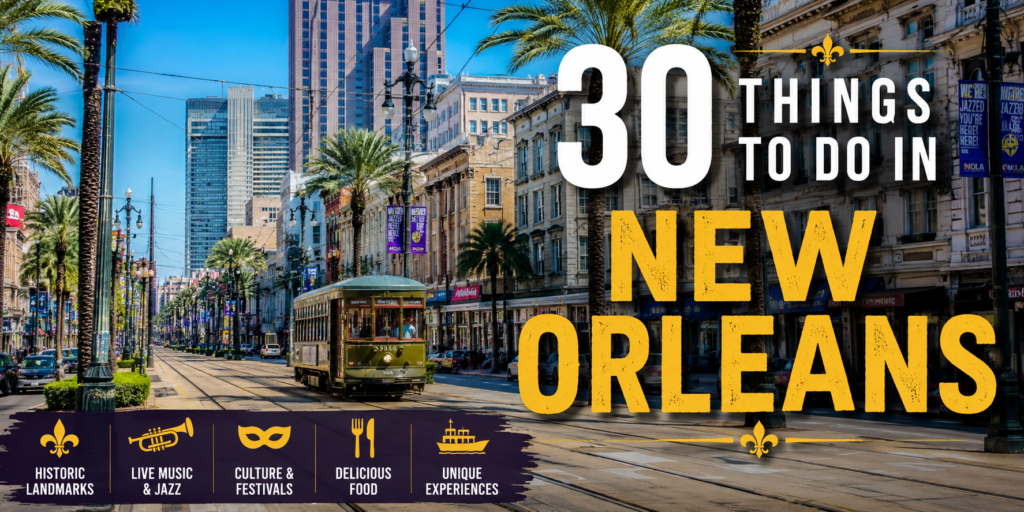
This guide covers the 30 best things to do in new orleans organized by neighborhood, from the French Quarter essentials to the genuinely overlooked. It is written for US visitors planning a New Orleans trip and covers every budget from completely free to the properly magnificent. For more Southern US city guides, read our complete articles on things to do in Nashville, things to do in Savannah GA, and things to do in Dallas.
New Orleans At a Glance: Quick Reference Table
| Activity | Neighborhood | Entry | Duration | Best For | Best Time |
|---|---|---|---|---|---|
| Frenchmen Street Live Music | Marigny | Free outdoors, $5–$15 venue cover | Evening | Real New Orleans music scene | Tuesday to Thursday night |
| French Quarter Walking | French Quarter | Free | 2 to 3 hours | Architecture, history, atmosphere | Weekday morning |
| Jackson Square and St. Louis Cathedral | French Quarter | Free exterior | 30 to 45 mins | New Orleans landmark, artists, street life | Morning |
| Café Du Monde Beignets | French Quarter | $4 to $7 | 30 to 45 mins | New Orleans food tradition, café au lait | Any time |
| Preservation Hall Jazz | French Quarter | $20 to $40 | 45 mins per set | Traditional New Orleans jazz | Evening shows |
| Bourbon Street | French Quarter | Free | 1 hour max | One honest look, then leave | Avoid Friday and Saturday nights |
| Commander’s Palace Tuesday Lunch | Garden District | $42 prix fixe | 2 hours | Finest restaurant in New Orleans at accessible price | Tuesday, reserve ahead |
| Central Grocery Muffuletta | French Quarter | $12 to $16 | Lunch | The sandwich invented here in 1906 | Weekday lunch |
| Po’boys at Domilise’s or Parkway | Various | $12 to $18 | Lunch | New Orleans sandwich tradition | Lunch weekdays |
| Dooky Chase’s Restaurant | Tremé | $25 to $45 | Dinner | Historic civil rights restaurant, finest gumbo | Dinner, reserve ahead |
| Cochon Restaurant | Warehouse District | $25 to $55 | Dinner | Finest Cajun cooking in the city | Dinner, reserve ahead |
| National WWII Museum | Warehouse District | $30 to $35 | Half to full day | Finest museum in New Orleans | Full day weekday |
| New Orleans Museum of Art (NOMA) | City Park | $15 | 1.5 to 2 hours | Art, Sydney Besthoff Sculpture Garden | Any time, Thursday free evening |
| City Park | Mid-City | Free | 1 to 3 hours | 1,300 acres, Spanish moss, New Orleans character | Morning |
| Mardi Gras World | Warehouse District | $22 to $27 | 1 to 1.5 hours | Behind-the-scenes Mardi Gras float workshop | Any time |
| St. Charles Avenue Streetcar | Garden District | $1.25 | Full route 1.5 hours | Finest $1.25 you spend in New Orleans | Morning |
| Garden District Walking | Garden District | Free | 1.5 to 2 hours | Finest antebellum mansion streetscape in the US | Morning |
| Magazine Street | Garden District | Free | 2 to 3 hours | Independent shops, restaurants, local neighborhood | Any time |
| Tremé Neighborhood | Tremé | Free | 2 hours | Oldest Black neighborhood in America, brass bands | Weekend |
| Louis Armstrong Park and Congo Square | Tremé | Free | 45 minutes | Origins of American music, New Orleans history | Day time |
| Marigny Neighborhood | Marigny | Free | 1 to 2 hours | Frenchmen Street by day, neighborhood character | Afternoon before evening |
| St. Louis Cemetery No. 1 | French Quarter | $25 guided tour | 1 hour | Above-ground tombs, New Orleans history | Guided tour only |
| LaFitte’s Blacksmith Shop | French Quarter | Free | 1 hour | Oldest bar in the United States | Evening |
| Snug Harbor Jazz Bistro | Marigny | $20 to $30 cover | Evening show | Finest jazz club in New Orleans | Evening, book ahead |
| Bayou St. John Neighborhood | Mid-City | Free | 1 to 2 hours | Most beautiful residential neighborhood | Saturday morning |
| Audubon Zoo | Uptown | $22 to $28 | 2 to 3 hours | Finest zoo in the Gulf South | Morning |
| Jean Lafitte Swamp Tour | 25 miles south | $25 to $45 | 2 hours | Louisiana bayou, alligators, cypress trees | Morning |
| Oak Alley Plantation | Vacherie, 1 hour | $30 to $40 | 2 to 3 hours | Antebellum history, enslaved people’s story | Weekday |
| Mississippi River Riverboat Tour | French Quarter waterfront | $30 to $65 | 1.5 to 2 hours | River views, New Orleans from the water | Afternoon |
| Second Line and Jazz Funeral | Various, citywide | Free (public) | 1 to 2 hours | Most specifically New Orleans experience | Sunday afternoons, schedule varies |
The French Quarter and Downtown
1. Frenchmen Street
Neighborhood: Marigny, 7 blocks from Bourbon Street | Entry: Free outdoors, $5 to $15 club covers | Duration: Evening | Best time: Tuesday to Thursday, 9 PM onward
Frenchmen Street is the finest free live music in the United States and the answer to the question every New Orleans visitor should be asking: where do the musicians actually go at night? The three-block strip of bars and music clubs in the Marigny neighborhood the Spotted Cat Music Club, The Maison, Snug Harbor, the Bamboula’s outdoor stage runs simultaneously from 8 PM until 4 AM. Every genre of New Orleans music is represented across the three blocks: traditional jazz, modern jazz, New Orleans R&B, funk, brass band, and blues, all within 300 feet of each other, all free if you stand on the sidewalk, all $5 to $15 cover if you want a seat.
The outdoor portion of Frenchmen Street is genuinely free. The street itself, on any evening from Tuesday through Sunday, has musicians and pedestrians moving between venues, sometimes a second-line brass band working its way down the center of the road, and the specific street-level energy of a music neighborhood that has not been sanitized for tourist convenience. I have been on Frenchmen Street on five New Orleans visits and it surprises me every time not with novelty but with consistency. The music is still good. The street is still primarily local. The Bourbon Street comparison is embarrassing to Bourbon Street.
Practical tips:
- The Spotted Cat Music Club at 623 Frenchmen Street is the finest venue on the strip for traditional jazz. No advance reservations, first come first served, cover $5 to $10 depending on the night
- Tuesday and Wednesday nights on Frenchmen Street have the best musician-to-tourist ratio of any night of the week. The music is the same quality but the audience is more knowledgeable
- The Frenchmen Art Market at the far end of the strip, operating nightly, is the finest outdoor arts market in New Orleans and free to walk
2. French Quarter Walking
Neighborhood: French Quarter | Entry: Free | Duration: 2 to 3 hours | Best time: Weekday morning
The French Quarter is the oldest continuously inhabited European settlement in the Mississippi River valley, covering a 78-block grid between the river and Rampart Street in lower New Orleans. The buildings are genuinely old not 19th-century American old but 18th-century colonial old, many dating from the Spanish colonial period (1762 to 1800) after the original French structures burned in the great fires of 1788 and 1794. The characteristic wrought-iron balconies, the interior courtyards visible through arched gates, the pastel plaster facades, and the narrow streets create a streetscape that is physically unlike any other American neighborhood and closer in character to Havana or Cartagena than to any US city.
The finest section of the French Quarter for walking is the area between Decatur Street and Esplanade Avenue the lower Quarter, away from Bourbon Street where the architecture is best preserved and the tourist density lowest. The Ursuline Convent at 1100 Chartres Street, built in 1752, is the oldest surviving building in the Mississippi Valley and the oldest building in the continental United States that has been in continuous use. The Old Ursuline Convent tour is the most historically significant $10 you spend in New Orleans.
Practical tips:
- Walk the full length of Chartres Street from Canal Street to Esplanade Avenue for the finest single walking experience in the French Quarter
- The French Quarter is most atmospheric before 10 AM on weekdays, before the tour groups and daytime tourists arrive. Return in the evening for the jazz bars and restaurant energy
- The Pat O’Brien’s courtyard on St. Peter Street, the birthplace of the Hurricane cocktail in 1942, is worth one drink for the history and the fountain
3. Jackson Square and St. Louis Cathedral
Neighborhood: French Quarter | Entry: Free exterior | Duration: 30 to 45 minutes | Best time: Morning
Jackson Square, the former Place d’Armes of colonial New Orleans, fronts the Mississippi River at the heart of the French Quarter with St. Louis Cathedral to the north, the Pontalba Apartment Buildings (1850, the oldest apartment buildings in the United States) on the east and west, and the Cabildo and Presbytere on either side of the cathedral. The cathedral facade, the equestrian statue of Andrew Jackson, and the open square facing the levee create the visual center of New Orleans and the most photographed view in the city.
The street artists, fortune tellers, and musicians who set up on the Jackson Square perimeter create a permanent outdoor spectacle that has operated here in some form since the colonial period. The combination of architecture, street performance, and river access makes Jackson Square the correct starting point for any French Quarter visit.
Practical tips:
- The St. Louis Cathedral interior is open for free self-guided tours during the day. The ceiling murals and the historical significance of the building (the oldest continuously operating cathedral in the United States) warrant 20 minutes inside
- The levee behind Jackson Square, reached via Moon Walk along the river, delivers the only ground-level view of the Mississippi River accessible in central New Orleans
- Café Du Monde is directly across Decatur Street from Jackson Square. Walk from one to the other
4. Café Du Monde Beignets
Neighborhood: French Quarter, Decatur Street | Entry: $4 to $7 per order | Duration: 30 to 45 minutes | Best time: Any time
Café Du Monde at 800 Decatur Street has been serving beignets and café au lait from the same location at the edge of Jackson Square since 1862. The beignet a deep-fried doughnut covered in enough powdered sugar to guarantee a clothing casualty is the single most specifically New Orleans food experience available for under $5 and the one thing that every visitor, regardless of their feelings about tourist institutions, should eat here.
The open-air café operates 24 hours a day, seven days a week, closing only for Christmas Day and occasional hurricanes. The queue at noon on a weekend takes 20 to 30 minutes. The queue at 7 AM on a Tuesday takes 5 minutes. The beignets are consistent at all hours. The café au lait, made with chicory-blended coffee and scalded milk in the New Orleans tradition, is the correct accompaniment and is equally distinctive.
Practical tips:
- Go at 7 AM on a weekday. The wait is short, the light on the square is exceptional, and the experience is genuinely the café rather than a queue management exercise
- The powdered sugar will go on your clothes. Accept this before you sit down
- The café au lait at Café Du Monde uses chicory-blended Community Coffee the specific bitterness of the chicory against the hot milk is the taste of New Orleans morning
5. Preservation Hall Jazz Band
Neighborhood: French Quarter, 726 St. Peter Street | Entry: $20 to $40 | Duration: 45-minute sets | Best time: Evening shows
Preservation Hall at 726 St. Peter Street is the physical center of the New Orleans traditional jazz revival, opened in 1961 specifically to preserve and perform the traditional New Orleans jazz style that had been declining as modern jazz styles superseded it. The Preservation Hall Jazz Band performs traditional New Orleans jazz the 1920s collective improvisation style developed in the brothels and dance halls of Storyville with a scholarly commitment to the form and a genuine musical skill that makes the tiny, bare room one of the finest live jazz experiences available anywhere.
The hall seats approximately 100 people in wooden benches and standing room, with no air conditioning and minimal lighting. The sets run 45 minutes. There is no drink service. The music is the complete point and the room exists entirely for it.
Practical tips:
- Tickets sell out for evening shows, especially on weekends. Book at preservationhall.com at least one week ahead
- The late show at 10 PM on weekdays draws a smaller and more music-focused crowd than the early shows
- General admission front-of-line tickets at $40 allow access to the door benches closest to the band. Worth the premium for the first visit
6. Bourbon Street
Neighborhood: French Quarter | Entry: Free | Duration: 1 hour maximum | Best time: Early evening, once
Bourbon Street is worth one hour and not worth more than that. The strip of bars, clubs, souvenir shops, and balcony-based drinking establishments running from Canal Street to St. Ann Street is the most famous block in New Orleans and the least representative of what makes New Orleans worth visiting. It exists. It is loud. The Hand Grenade cocktails are genuinely strong and genuinely bad. The music is mostly recorded.
What Bourbon Street does have: Galatoire’s at 209 Bourbon Street, one of the oldest and most specifically New Orleans restaurants in the city, where the Friday lunch has been a civic institution for over 100 years. The restaurant requires a jacket for the downstairs dining room on Fridays. The experience of having Friday lunch at Galatoire’s the specific combination of old-school service, seafood-focused Creole cooking, and a room full of New Orleans regulars is the finest thing on Bourbon Street and is not available at street level.
Practical tips:
- Walk the full length of Bourbon Street from Canal to St. Ann at least once. Understand what it is. Then go to Frenchmen Street
- Galatoire’s Friday lunch at 209 Bourbon Street requires a jacket and patience for the line, which starts forming at 11:30 AM. It is the finest Friday lunch in New Orleans
- LaFitte’s Blacksmith Shop at 941 Bourbon Street, at the dark end of the strip, is the oldest operating bar in the United States and worth a drink on the way to somewhere better
New Orleans Food and Drink
New Orleans has the most specific regional food culture of any American city, and this is not hyperbole. The food is not Southern food with New Orleans seasoning. It is a separate cuisine developed from the convergence of French haute cuisine technique, West African cooking traditions, Spanish colonial flavors, Acadian country cooking from the bayou parishes, and the specific agricultural products of the Louisiana delta. Gumbo, jambalaya, muffuletta, po’boys, beignets, crawfish etouffee, red beans and rice on Mondays, bananas Foster, and the New Orleans style of cooking oysters these dishes exist in their most authentic form only here.
7. Commander’s Palace Tuesday Lunch
Neighborhood: Garden District, Washington Avenue | Entry: $42 three-course prix fixe | Duration: 2 hours | Best time: Tuesday to Friday lunch, reserve one week ahead
Commander’s Palace at 1403 Washington Avenue in the Garden District is the most historically significant restaurant in New Orleans and the institution that produced Emeril Lagasse, Paul Prudhomme, and the chef generation that defined American fine dining in the 1980s. The restaurant serves a three-course prix fixe lunch Tuesday through Friday for $42 per person with a 25-cent martini and a 25-cent bread pudding souffle. This is the most important single piece of New Orleans food knowledge I can give a visitor planning a trip.
The full dinner at Commander’s Palace costs $90 to $150 per person. The Tuesday through Friday lunch costs $42 and includes dishes from the same kitchen, the same service, and the same dining room. The specific combination of Creole cooking at its most technically accomplished and a Garden District Victorian dining room with tuxedoed service staff is the finest $42 meal available in the American South.
Practical tips:
- Book online at commanderspalace.com at least one week ahead for lunch Tuesday through Friday. Weekend brunch is more crowded and the prix fixe is not available on weekends
- The dress code is business casual minimum. Jackets preferred for men but not required for lunch
- Order the turtle soup with a splash of sherry, the fish of the day, and the bread pudding souffle. These are the three dishes that most specifically represent what Commander’s Palace does
8. Central Grocery Muffuletta
Neighborhood: French Quarter, 923 Decatur Street | Cost: $12 to $16 | Duration: Lunch | Best time: Weekday 10 AM to 1 PM
The muffuletta sandwich was invented at Central Grocery at 923 Decatur Street in 1906 by Salvatore Lupo, a Sicilian immigrant who assembled the first one for dock workers who asked for their lunch ingredients together rather than separately. The Central Grocery muffuletta olive salad, salami, ham, provolone, and mortadella on a large round sesame seed loaf is the specific combination that has not changed since 1906 and exists nowhere else in its original form.
Central Grocery still operates as a deli and Italian grocery store, selling the same muffuletta in the same fashion from the same counter. A full muffuletta feeds two people comfortably. A half feeds one generously. The best place to eat it is on the steps of the levee behind Jackson Square, ten minutes’ walk away, looking at the Mississippi River.
Practical tips:
- Central Grocery is open daily but arrives late and sells out. Arrive between 10 AM and 1 PM for the freshest preparation and the full inventory
- The muffuletta is served at room temperature. It does not need to be heated. The olive salad marinates the bread on the walk to the levee and this is the correct temperature
- Napoleon House at 500 Chartres Street, a French Quarter bar, also serves an excellent baked muffuletta if Central Grocery is closed
9. Po’boys at Domilise’s or Parkway Bakery
Neighborhood: Uptown (Domilise’s), Mid-City (Parkway) | Cost: $12 to $18 | Best time: Weekday lunch
The po’boy is New Orleans’s contribution to the American sandwich tradition a long French bread roll with a specific crust developed in New Orleans bakeries, filled with roast beef debris (the shredded beef that falls into the cooking gravy), fried shrimp, fried oysters, or any combination thereof, dressed with lettuce, tomato, pickles, and mayonnaise. The two best po’boys in New Orleans are the roast beef at Domilise’s on Annunciation Street in Uptown and the roast beef at Parkway Bakery on Hagan Avenue in Mid-City. Both are served wet, meaning the bread is soaked in the beef gravy, and both are the correct standard against which the tourist French Quarter versions should be measured.
Domilise’s, open since 1918 in the same Uptown neighborhood location, is the most loyal to the original po’boy tradition. The roast beef debris po’boy, dressed, on the New Orleans French bread loaf, is $14 to $16 and is one of the finest $15 meals in American food.
Practical tips:
- Order it dressed: lettuce, tomato, pickles, mayonnaise. Order it wet if roast beef. The wet roast beef po’boy with gravy soaking into the French bread is the correct version
- Domilise’s and Parkway are both cash-friendly but accept cards. Both close in the early afternoon when they run out of bread. Arrive before 12:30 PM
- The French bread itself matters. New Orleans French bread has a specific thin, crackling crust that is unique to local bakeries and cannot be replicated outside the city’s humidity
10. Dooky Chase’s Restaurant
Neighborhood: Tremé, 2301 Orleans Avenue | Cost: $25 to $45 | Best time: Dinner, reserve ahead
Dooky Chase’s Restaurant at 2301 Orleans Avenue in the Tremé is one of the most historically significant restaurants in the American South. During the Civil Rights Movement, Dooky Chase’s was the restaurant where Black civil rights leaders Martin Luther King Jr., Thurgood Marshall, Medgar Evers could meet, eat, and organize at a time when segregated New Orleans offered nowhere else for them to gather with dignity. Chef Leah Chase, who ran the restaurant from 1946 until her death in 2019 at age 96, was awarded the Presidential Medal of Freedom in part for what the restaurant meant to American civil rights.
The food is traditional New Orleans Creole, with Leah Chase’s gumbo z’herbes served on Holy Thursday as the most specifically significant dish. The current kitchen maintains the recipes and the tradition. The dining room is largely unchanged.
Practical tips:
- Reserve at least one week ahead for dinner. The restaurant is consistently busy and the reservation is necessary
- The gumbo z’herbes a thick green herb gumbo served on Maundy Thursday before Good Friday is a once-per-year event worth specifically planning a New Orleans trip around
- The fried chicken at Dooky Chase’s is the finest fried chicken in New Orleans and requires no specific justification beyond that
11. Cochon Restaurant
Neighborhood: Warehouse District, 930 Tchoupitoulas Street | Cost: $25 to $55 | Best time: Dinner, reserve ahead
Cochon, the Donald Link restaurant at 930 Tchoupitoulas Street in the Warehouse District, is the finest Cajun cooking restaurant in New Orleans and the clearest expression of what makes Louisiana cooking different from New Orleans Creole cooking. The wood-fired oven at Cochon, the whole-animal butchery program, and the commitment to specific Louisiana pork and game traditions create a menu that is rooted in the Cajun country cooking of Acadiana in a way that few New Orleans restaurants connect.
The cochon de lait (milk-fed suckling pig), when available, is the finest single dish in the restaurant. The fried alligator and chaurice sausage appetizer is the most specifically Louisiana menu item in the city.
Practical tips:
- Reserve one week ahead at cochonrestaurant.com. Weekend dinner fills within days of the reservation window opening
- The bar at Cochon accepts walk-ins. The full menu is available at the bar and the wait time on weekdays is rarely more than 20 minutes
- Butcher, the attached sandwich shop and butchery, serves lunch Monday through Saturday. The muffuletta and the smoked meat po’boy are worth a separate visit
Museums and Cultural Institutions
12. National World War II Museum
Neighborhood: Warehouse District, Magazine Street | Entry: $30 to $35 adults | Duration: Half to full day | Best time: Weekday
The National World War II Museum at 945 Magazine Street is the finest museum in New Orleans and one of the finest history museums in the United States. The museum opened in New Orleans in 2000 because the city was the site of the Higgins boat manufacturing facility Andrew Higgins’s design of the flat-bottomed landing craft used in the D-Day invasion was built in New Orleans, and General Eisenhower called Higgins “the man who won the war.” The museum’s 400,000 square feet cover the full American experience of World War II across six pavilions.
The Beyond All Boundaries 4D cinematic experience, the submarine exhibit, and the Pacific theater pavilion are the most technically impressive presentations in the museum. The oral history recordings from veterans throughout the exhibition are the most emotionally significant part of any visit.
Practical tips:
- Allow a full day. Visitors who spend three hours see the highlights but miss the depth that makes this museum genuinely extraordinary
- Buy tickets online. The museum regularly has queues at the door that a pre-purchased ticket bypasses entirely
- The Stage Door Canteen restaurant inside the museum serves lunch in a period-appropriate WWII canteen setting and is worth including in a full-day visit
13. New Orleans Museum of Art (NOMA) and Sydney Besthoff Sculpture Garden
Neighborhood: City Park, Lelong Avenue | Entry: $15 museum, sculpture garden free | Duration: 1.5 to 2 hours | Best time: Thursday free evening, Sunday morning
The New Orleans Museum of Art in City Park houses a permanent collection of over 40,000 works covering art from ancient times through the present, with particular strength in French and European 19th-century painting, New Orleans portraiture, and the decorative arts of Louisiana. The Sydney Besthoff Sculpture Garden adjacent to the museum is one of the finest accessible outdoor sculpture collections in the American South 90 works on five acres of City Park landscape with live oaks, lagoons, and the specific humid beauty of New Orleans parkland and admission to the garden is free.
The Thursday evening free entry program runs from 4 PM to 9 PM and is the finest version of NOMA available the garden in the late afternoon light, then the museum galleries with evening crowds rather than school group density.
Practical tips:
- The sculpture garden is free and accessible during park hours regardless of museum opening. The garden in early morning, before the museum opens, is the finest version of it
- The NOMA café serves lunch and is one of the better accessible midday eating options in City Park
- The French and Impressionist painting galleries on the second floor are NOMA’s strongest collection area
14. City Park
Neighborhood: Mid-City | Entry: Free | Duration: 1 to 3 hours | Best time: Morning
City Park, the 1,300-acre park in Mid-City, is New Orleans’s equivalent of Central Park and significantly less visited by tourists. The park contains the largest collection of mature live oak trees in the world some over 600 years old, their massive limbs horizontal and draped in Spanish moss, creating the most distinctively Southern landscape accessible in New Orleans. The park also contains NOMA, the sculpture garden, the Botanical Garden, the New Orleans Carousel Gardens amusement park, the Bayou Metairie lagoon system, and the Tad Gormley Stadium.
The Botanical Garden within City Park, operating since 1936 and one of the largest Depression-era New Deal public works projects in the American South, is $8 to enter and contains the finest accessible garden collection in New Orleans outside of private estates.
Practical tips:
- City Park is accessible by the Canal Streetcar from downtown. The Esplanade Avenue entrance is a 15-minute ride from the French Quarter
- The Big Lake area of City Park, with paddleboat rentals and the lagoon system under the old oaks, is the most specifically New Orleans outdoor experience in the park
- The Storyland children’s playground inside City Park is one of the finest free children’s attractions in New Orleans
15. Mardi Gras World
Neighborhood: Warehouse District, 1380 Port of New Orleans Place | Entry: $22 to $27 | Duration: 1 to 1.5 hours | Best time: Any time
Mardi Gras World is the working studio where 75% of the Mardi Gras parade floats for the major krewes are designed, built, and stored between parade seasons. Walking through 300,000 square feet of warehouse space containing 30-foot papier-mache kings, queens, mythological creatures, and the full inventory of a Mardi Gras season in progress is the most surreal New Orleans experience available at any price point. The guided tour explains the krewe system, the float construction process, and the specific cultural traditions of New Orleans Mardi Gras with a detail that no outside observer could replicate.
Practical tips:
- The tour includes costume pieces and the ability to photograph the floats at close range. Bring a wide-angle lens if you are interested in photography
- Mardi Gras World is accessible on foot from the Warehouse District hotels and from the Aquarium waterfront
- If visiting during Carnival season (January to March), the float-building activity in the warehouse is at its most visible and most spectacular
Garden District and Uptown
16. Garden District Walking Tour
Neighborhood: Garden District | Entry: Free | Duration: 1.5 to 2 hours | Best time: Morning
The Garden District, the residential neighborhood between St. Charles Avenue and Magazine Street developed by wealthy American merchants in the mid-19th century who did not want to live in the French Quarter alongside the old Creole elite, contains the finest collection of Italianate, Greek Revival, and Queen Anne mansions in the American South. The streets between Prytania and Coliseum from Jackson Avenue to Louisiana Avenue constitute one block after another of antebellum and Victorian architecture in continuous use as private residences a preserved streetscape of 19th-century American prosperity that New York and Chicago lost to development and New Orleans kept.
The Garden District Association publishes a free walking tour map. The non-guided walking tour covers the major mansions including the Brevard-Clapp House (where Anne Rice set Interview with the Vampire), the Colonel Short’s Villa, and the Commander’s Palace complex.
Practical tips:
- Walk the Garden District in the morning before the tour groups arrive at 10 AM. The neighborhood is significantly more atmospheric at 8 AM when it belongs entirely to the people who live there
- The Lafayette Cemetery No. 1 at Washington Avenue and Prytania is free to enter and is the finest accessible above-ground cemetery in the Garden District
- Magazine Street begins at the Garden District boundary and continues seven miles uptown through neighborhood commercial strips
17. St. Charles Avenue Streetcar
Neighborhood: Canal Street to the end of the line, Uptown | Cost: $1.25 per ride | Duration: Full route 1.5 hours | Best time: Morning
The St. Charles Avenue streetcar is the oldest continuously operating streetcar line in the world, in operation on the same route since 1835, and the finest $1.25 you will spend in New Orleans. The route runs from Canal Street through the Central Business District, along the full length of St. Charles Avenue through the Garden District and Uptown, through Tulane and Loyola Universities, to the turnaround at Palmer Park. The full route takes 1.5 hours in each direction.
Riding the streetcar the full length and back is a New Orleans orientation that no bus or rideshare replicates. St. Charles Avenue passes through 180 years of New Orleans residential history, from the grand mansions of the Garden District to the Craftsman bungalows of Uptown to the university campus buildings at Tulane.
Practical tips:
- The streetcar requires exact change or a Jazzy Pass ($3 per day, available at streetcar stops and convenience stores). The $1.25 fare has not increased since 2019
- Sit on the right side of the streetcar heading uptown (away from Canal Street) for the best Garden District mansion views through the window
- The streetcar is not air-conditioned. In summer, it is hot. This is consistent with riding a 19th-century transit vehicle through a subtropical city
18. Magazine Street
Neighborhood: Garden District and Uptown | Entry: Free | Duration: 2 to 3 hours | Best time: Any time
Magazine Street, the seven-mile commercial strip running from the Central Business District through the Garden District and Uptown neighborhoods, is the finest independent retail and restaurant street in New Orleans. The combination of mid-century antique shops, independent clothing boutiques, art galleries, neighborhood coffee shops, and restaurants organized in shotgun storefronts over seven miles of Uptown New Orleans neighborhoods gives Magazine Street a specific cumulative character that no single destination produces.
The best concentration of Magazine Street activity runs from Jackson Avenue to Napoleon Avenue approximately 20 blocks with Aidan Gill for Men (the finest barbershop in New Orleans), Sucre (the finest pastry shop in New Orleans), Stein’s Market and Deli, and a rotating cast of independent shops that have occupied these storefronts for decades.
Practical tips:
- Walk Magazine Street from Jackson Avenue to Napoleon Avenue as the central Magazine Street experience. This covers 20 blocks and takes 1.5 to 2 hours with stops
- The Magazine Street Whole Foods at 5600 Magazine Street is the best accessible grocery and prepared food option in Uptown for self-catering
- The St. Charles streetcar stops at Magazine Street intersections throughout Uptown, making Magazine Street accessible from the streetcar route
Tremé, Marigny, and the Real New Orleans
19. Tremé Neighborhood
Neighborhood: Tremé | Entry: Free | Duration: 2 hours | Best time: Weekend afternoon
The Tremé, the neighborhood immediately north of the French Quarter across Rampart Street, is the oldest continuously inhabited African American neighborhood in the United States and the cultural birthplace of jazz, the second-line tradition, Mardi Gras Indians, and most of what the world means when it says “New Orleans music.” The shotgun houses, the Creole cottages, the brass band rehearsal spaces, and the specific community character of the Tremé exist alongside significant poverty and the long history of a neighborhood that has absorbed every economic and physical shock that New Orleans has experienced since 1718.
St. Augustine Church at 1210 Governor Nicholls Street, built in 1841 by free people of color, is the oldest African American Catholic church in the United States and the spiritual center of the Tremé community. The church is open for tours and services.
Practical tips:
- The Tremé is a working neighborhood, not a tourist district. Walk it with respect and spend money in the neighborhood’s businesses
- The New Orleans Jazz National Historical Park at 916 N. Peters Street provides free ranger-led programs on the history of New Orleans jazz and the Tremé community
- The weekly second-line parades, organized by social aid and pleasure clubs in the Tremé and Ninth Ward neighborhoods, are the most specifically New Orleans public event available. Schedules are at neworleans.com
20. Louis Armstrong Park and Congo Square
Neighborhood: Tremé | Entry: Free | Duration: 45 minutes | Best time: Day time
Louis Armstrong Park, the 32-acre public park immediately across Rampart Street from the French Quarter, commemorates the greatest New Orleans musician and the city’s most globally influential cultural export. Congo Square, the clearing within the park where enslaved Africans gathered on Sunday afternoons in the 18th and early 19th centuries to sing, drum, and perform the music and dance of their homelands, is widely regarded as the geographical origin of American jazz the specific place where African musical traditions that became the foundation of American popular music were preserved.
The bronze statue of Louis Armstrong at the park entrance, the Municipal Auditorium behind it, and the lagoon and natural landscape within the park make Louis Armstrong Park a New Orleans landmark that most visitors walk past on their way to Frenchmen Street without stopping.
Practical tips:
- Congo Square is marked within the park. Stand in it and read the historical marker before continuing to Frenchmen Street
- The New Orleans Jazz National Historical Park, adjacent to Louis Armstrong Park, hosts free jazz concerts by local musicians in the warm months. Check the schedule at nps.gov/jazz
- The park is safe during daylight hours. Follow standard urban park common sense after dark
21. St. Louis Cemetery No. 1
Neighborhood: French Quarter edge, Basin Street | Entry: $25 guided tour | Duration: 1 hour | Best time: Guided tour only
St. Louis Cemetery No. 1, established in 1789, is the oldest surviving cemetery in New Orleans and the reason that above-ground tomb burial became the New Orleans tradition. The water table in New Orleans sits 1 to 5 feet below ground level. In the 18th and 19th centuries, buried coffins regularly floated to the surface during heavy rains. The above-ground tomb system multi-family brick vaults where the remains of generations accumulate solved the problem and created the most distinctive funeral architecture in the United States.
Nicolas Cage owns a pyramid-shaped tomb in St. Louis Cemetery No. 1 that he purchased in advance of his death. This is a true and specifically New Orleans fact.
Practical tips:
- Guided tours only since 2015 the cemetery is not open for independent visits. Tours through the Archdiocese of New Orleans ($25) are the official option and available at nolacatholiccemeteries.org
- The ceremony of leaving red X marks on the tomb attributed to Marie Laveau, the 19th-century Voodoo Queen of New Orleans, for wishes has been officially discontinued. The Archdiocese has requested visitors stop doing it
- St. Louis Cemeteries No. 2 and No. 3 are accessible without guided tours and contain equally interesting 19th-century New Orleans family tombs
22. LaFitte’s Blacksmith Shop
Neighborhood: French Quarter, 941 Bourbon Street | Entry: Free | Duration: 1 hour | Best time: Early evening
LaFitte’s Blacksmith Shop at 941 Bourbon Street, the dark end of Bourbon away from the noise, is the oldest operating bar in the United States. The building dates to between 1722 and 1732, making it one of the few surviving structures in New Orleans predating the great fires of 1788 and 1794, and it has operated as a bar since at least the 19th century. The bar operates by candlelight after dark. The interior is stone and dark wood. It is the antithesis of the neon Bourbon Street 200 yards away.
The bar serves the Purple Drank, a lavender vodka cocktail in a styrofoam cup that is the Blacksmith Shop’s signature drink, alongside a full bar. The experience is worth the walk to the end of Bourbon Street entirely for the building.
Practical tips:
- LaFitte’s is open from noon until 5 AM. The early evening from 6 to 8 PM, before the late-night crowd arrives, is the most atmospheric version of the bar
- The candlelit interior makes photography difficult but rewards being experienced rather than documented
- The piano in the back room of LaFitte’s is played by a local musician most evenings
Mid-City and Bayou St. John
23. Bayou St. John Neighborhood
Neighborhood: Mid-City | Entry: Free | Duration: 1 to 2 hours | Best time: Saturday morning
Bayou St. John, the historic waterway running through Mid-City from City Park to Esplanade Avenue, is the most beautiful residential neighborhood in New Orleans and the one that most clearly shows the city at rest on a Saturday morning. The bayou was the original water route connecting the French Quarter to Lake Pontchartrain used by the earliest French settlers, and the bayouside residences Greek Revival and Creole cottages from the 19th century, many with dock access constitute the finest streetscape of small-scale historic residential architecture in the city.
The Saturday morning farmers market at the Bayou St. John end of Esplanade Avenue, the coffee shops on Magazine Street accessible by a 10-minute walk, and the City Park entrance immediately adjacent make Bayou St. John the correct Saturday morning neighborhood for visitors who want to see New Orleans as it actually lives.
Practical tips:
- Walk the full length of the bayou from Esplanade Avenue to City Park. The 45-minute walk passes the finest residential architecture, the bayou drawbridge, and the City Park entrance
- Nola Brewing at 3001 Tchoupitoulas Street, a 10-minute drive from Bayou St. John, has the finest brewery tap room in New Orleans
- The Saturday farmers market at the French Market in the French Quarter is larger but Bayou St. John’s market is more local and less tourist-facing
24. Snug Harbor Jazz Bistro
Neighborhood: Marigny, 626 Frenchmen Street | Entry: $20 to $30 cover | Duration: Evening show | Best time: Evening, book ahead
Snug Harbor Jazz Bistro at 626 Frenchmen Street is the finest dedicated jazz club in New Orleans a sit-down listening room where the music is the primary purpose and the dinner and drinks are secondary. Where Preservation Hall performs traditional New Orleans jazz from the 1920s, Snug Harbor presents contemporary and modern jazz from the best working New Orleans musicians, making it the complement rather than the competition to Preservation Hall’s programming.
Charmaine Neville, Ellis Marsalis Jr. before his death in 2020, and the full lineage of the New Orleans modern jazz scene have performed at Snug Harbor. The current programming includes the Charmaine Neville Band, various members of the Marsalis family, and rotating visiting jazz artists.
Practical tips:
- Tickets are available at snugjazz.com and sell out for popular acts. Reserve the week ahead of your visit
- The dinner menu at Snug Harbor is a full Creole restaurant menu, better than most French Quarter tourist restaurants at comparable prices
- Snug Harbor is at the far end of Frenchmen Street from the Spotted Cat. Begin your Frenchmen Street evening at the Spotted Cat end and work toward Snug Harbor for the late show
Day Trips from New Orleans
25. Jean Lafitte National Historical Park Swamp Tour
Location: Barataria Preserve, 25 miles south of New Orleans | Entry: $25 to $45 for guided boat tour | Duration: 2 to 3 hours | Best time: Morning
The Barataria Preserve of Jean Lafitte National Historical Park, 25 miles south of New Orleans on the West Bank of the Mississippi, contains the most accessible genuine Louisiana bayou landscape available as a day trip from the city. The cypress swamp and marshland of Barataria, traversed by flatboat on a guided two-hour tour, contains alligators, great blue herons, roseate spoonbills, river otters, and the floating prairies of Gulf Coast Louisiana in a landscape that has no equivalent in any other American state.
The flat-bottomed airboat tours from the multiple operators in Marrero and Westwego are the standard option. The National Park Service also operates free canoe trails through Barataria for self-guided visitors.
Practical tips:
- Book a morning tour. Alligators are most active in cooler temperatures and morning light produces the best wildlife photography conditions
- The NPS Barataria Preserve visitor center is free and provides context for the swamp ecosystem that improves the boat tour experience
- Tour operators run shared tours for $25 to $35 per person and private tours from $45 per person. The shared tours are adequate for wildlife viewing
26. Oak Alley Plantation
Location: Vacherie, Louisiana, 60 miles west of New Orleans | Entry: $30 to $40 | Duration: 2 to 3 hours | Best time: Weekday
Oak Alley Plantation on Louisiana Highway 18, the River Road plantation with the famous quarter-mile alley of 300-year-old live oak trees leading from the Mississippi River to the 1839 Greek Revival plantation house, is the most photographed plantation site in Louisiana. The site’s current interpretation includes the enslaved community’s history and living quarters as a central part of every tour the experience of being in the same space as the 18th-century French colonists who planted the oaks and the enslaved people who built and worked the plantation is the complete New Orleans historical experience in a single 2-hour visit.
The oak alley itself, regardless of any historical context, is one of the most extraordinary natural corridors in the American South. The 28 surviving oaks are individually wider than most rooms.
Practical tips:
- The River Road Plantation Drive from New Orleans to Oak Alley passes six other plantation sites, most of which are more focused on historical interpretation than the standard tour. The Laura Plantation tour at $22 is particularly highly regarded for enslaved people’s history
- The drive along Louisiana Highway 18 (the Great River Road) is the finest scenic drive in the greater New Orleans area
- Weekday visits at Oak Alley are significantly less crowded than weekends and the tour quality is better when guides can take more time
27. Second Line Parade
Location: Various, primarily Tremé and Ninth Ward | Entry: Free (public participation) | Duration: 1 to 2 hours | Best time: Sunday afternoons, September through June
The New Orleans second line, the weekly street parade organized by the city’s social aid and pleasure clubs, is the most specifically New Orleans public event accessible to visitors. A second line consists of a brass band hired by the organizing club, the club members themselves (the first line), and any members of the public who join the parade behind the band (the second line) which in New Orleans means hundreds of neighborhood residents dancing through the streets behind the music every Sunday afternoon.
Second lines run nearly every Sunday from September through June in the Tremé, Central City, and Ninth Ward neighborhoods. The schedule is published by community organizations and at nolasecondlines.com.
Practical tips:
- Wear comfortable shoes. The second line covers 2 to 4 miles of neighborhood streets over 1 to 2 hours
- Buy a souvenir handkerchief or fan from the club vendors at the starting point. Waving it during the second line is the correct participation
- The food vendors that set up along the second line route sell the finest accessible Creole home cooking in New Orleans at $5 to $10 per plate
28. Mississippi River Riverboat Tour
Neighborhood: French Quarter Waterfront, Toulouse Street | Cost: $30 to $65 | Duration: 1.5 to 2 hours | Best time: Afternoon
The Steamboat Natchez, the last authentic steam-powered sternwheeler operating on the Mississippi River, departs from the Toulouse Street Wharf twice daily for a 2-hour harbor cruise with jazz music, commentary on New Orleans history, and the finest views of the city skyline available from the water. The Mississippi River at New Orleans runs at 3 to 6 miles per hour and carries approximately 500,000 cubic feet of water per second past the French Quarter levee the largest river in North America, visually overwhelming at close range in a way that the city itself obscures.
Practical tips:
- The Steamboat Natchez dinner cruise at $65 to $80 per person includes Creole buffet dinner and the jazz band. Worth the premium for the combination of the river at night and the meal
- Book at steamboatnatchez.com. The afternoon jazz cruise at $32 per person is the most accessible option
- The French Market waterfront and Moon Walk along the river behind Jackson Square are free and deliver the same river proximity for visitors who prefer the levee to the boat
New Orleans Practical Guide
Getting Around New Orleans
New Orleans Regional Transit Authority (RTA): The Canal Streetcar, St. Charles Avenue Streetcar, and Riverfront Streetcar serve the major visitor corridors. A single ride costs $1.25. A Jazzy Pass day pass costs $3 and covers unlimited rides on buses and streetcars. The Jazzy Pass is sold at streetcar stops and at the RTA office on Canal Street.
Ride Share: Uber and Lyft operate throughout New Orleans and are the most practical option for the Garden District, Mid-City, the Warehouse District, and any destination more than 10 minutes’ walk from the French Quarter. Fares average $8 to $15 for cross-neighborhood trips.
Walking: The French Quarter, Frenchmen Street, the Warehouse District, and the lower Garden District are all walkable from each other within 20 to 30 minutes. The city is flat. The heat and humidity from June through September are the only meaningful walking deterrents.
Driving: Parking in the French Quarter requires a garage or a hotel with parking. Street parking in the Quarter is extremely limited and regularly ticketed. For neighborhoods outside the Quarter, street parking is generally available.
Where to Stay in New Orleans
French Quarter: Best for first-time visitors wanting walking access to Jackson Square, Café Du Monde, Preservation Hall, and Frenchmen Street. The widest range of accommodation options at all price points. $100 to $350 per night.
Warehouse District and CBD: Best for visitors attending the WWII Museum or arriving by Amtrak at Union Passenger Terminal. Modern hotel options at competitive rates. $90 to $280 per night.
Garden District: Best for visitors who want the residential New Orleans experience with the St. Charles streetcar connection and access to Magazine Street. $80 to $250 per night.
Marigny: Best for visitors focused on the Frenchmen Street music scene. Walking distance to Frenchmen Street with a 10-minute walk to the French Quarter. $70 to $200 per night.
New Orleans Budget Guide
Budget traveler (hostel or budget hotel, Café Du Monde, po’boys, Frenchmen Street free music): $80 to $130 per day. New Orleans has exceptional free experiences. Frenchmen Street free music, the French Quarter walk, Louis Armstrong Park, City Park, the sculpture garden, the streetcar ride, and a $7 beignet and café au lait at Café Du Monde together constitute a genuinely excellent New Orleans day. A Central Grocery muffuletta at $14 and a po’boy at Domilise’s at $15 keeps the food budget under $40.
Mid-range traveler (hotel, restaurant meals, paid attractions): $175 to $300 per day. Commander’s Palace Tuesday lunch ($42), National WWII Museum ($35), Preservation Hall evening show ($20 to $40), Cochon or Dooky Chase’s dinner, and the Steamboat Natchez afternoon cruise cover the essential New Orleans experience at this range.
Luxury traveler (boutique hotel, fine dining, premium experiences): $400 and above per day. Commander’s Palace dinner, private swamp tour, Steamboat Natchez dinner cruise, NOMA with a reserved dinner at Coquette or Compère Lapin, and the Preservation Hall premium set represent New Orleans at its most considered.
Best Time to Visit New Orleans
March to May: The finest season for most visitors. Temperatures average 70 to 80 degrees Fahrenheit. The spring garden season brings the finest version of City Park, the Audubon Garden, and the Japanese Magnolia trees that line the Esplanade Avenue neutral ground in bloom. Jazz Fest, the New Orleans Jazz and Heritage Festival, runs in late April to early May and is the finest outdoor music festival in the United States.
October to November: The second-best season. The summer humidity breaks in mid-October. Fall temperatures (70 to 78 degrees) are comfortable for the French Quarter walk and the Garden District. The Halloween season, including the Krewe of Boo parade in late October, is a specifically New Orleans cultural event.
Mardi Gras (February/March): Mardi Gras is the reason most visitors have heard of New Orleans and the most complicated period to navigate as a visitor. The season runs from Epiphany (January 6) through Fat Tuesday. The final five days before Fat Tuesday are the most chaotic and the most expensive, with hotel prices tripling and the French Quarter becoming difficult to navigate on foot. The best Mardi Gras experience is the Uptown parade route on St. Charles Avenue, where the major krewes (Endymion, Bacchus, Zulu, Rex) throw beads and doubloons from floats into crowds of New Orleans families. The French Quarter on Fat Tuesday is best avoided after noon.
June to September: Hot, humid, and occasionally subject to tropical weather systems. The heat is genuinely uncomfortable for midday outdoor activity from mid-June through August. Indoor cultural institutions the WWII Museum, NOMA, Preservation Hall, Commander’s Palace work well in summer. Outdoor activity is best before 10 AM or after 6 PM.
Frequently Asked Questions About New Orleans
How many days do you need in New Orleans? Three days covers the essential new orleans things to do: Frenchmen Street night one, French Quarter and Café Du Monde morning two, the National WWII Museum afternoon two, Commander’s Palace Tuesday lunch or Cochon dinner, Preservation Hall evening two, Garden District walk and St. Charles streetcar day three. Four days adds the swamp tour, City Park, and Bayou St. John. Five days allows the Oak Alley Plantation day trip and the full Tremé neighborhood walk. Two days is not enough. The first evening on Frenchmen Street alone requires three days to process.
Is New Orleans safe? New Orleans has a concentrated violent crime problem in specific neighborhoods that does not significantly affect the areas most visitors spend time in. The French Quarter, Garden District, Magazine Street, Frenchmen Street, the Warehouse District, and the St. Charles streetcar corridor are routinely safe during standard tourist hours. Exercise normal urban awareness. Do not walk alone in unfamiliar neighborhoods late at night. The specific neighborhoods to avoid at night are the same ones that New Orleans residents will tell you to avoid.
What is the best free thing to do in new orleans louisiana? Frenchmen Street live music is the finest free cultural experience in New Orleans. The French Quarter walk, Louis Armstrong Park, City Park, the Sydney Besthoff Sculpture Garden, the St. Charles streetcar ride, the Garden District walk, and the Saturday morning second-line parade when one is scheduled are all free and together constitute a full day of genuine New Orleans experience at minimal cost.
What is New Orleans most famous for? New Orleans is internationally known for Mardi Gras, jazz music, the French Quarter, Bourbon Street, the creole and cajun cuisine tradition, Louis Armstrong, Fats Domino, and the cultural legacy of the city’s African, French, Spanish, and Caribbean heritage. The city is also known for Hurricane Katrina (2005) and the recovery and resilience that followed, which remains a significant part of New Orleans’s current civic identity.
What is the best restaurant in new orleans? Commander’s Palace is the most historically significant and the most accessible at high quality through the Tuesday through Friday prix fixe lunch. Dooky Chase’s is the most historically important for American civil rights history. Cochon is the finest Cajun cooking restaurant. Galatoire’s Friday lunch is the most specifically New Orleans social institution. For first-time visitors, the Commander’s Palace Tuesday lunch at $42 per person is the single correct answer to this question.
What are fun things to do in new orleans for adults? Frenchmen Street on a Tuesday or Wednesday night is the finest adult evening in New Orleans without a significant budget. The Commander’s Palace Tuesday lunch with the 25-cent martini is the finest adult lunch in the American South. A riverboat Natchez cruise with jazz is the most specifically New Orleans afternoon. The second-line parade on any Sunday is the most participatory New Orleans cultural experience. The Preservation Hall Jazz Band late show on a weeknight is the most intimate live music experience in the city.
Final Word: New Orleans Asks You to Let It Show You What It Actually Is
The most consistent advice from New Orleans regulars to first-time visitors is the same piece of advice: ignore Bourbon Street after the first hour and go find the actual city. The actual city is not hiding. Frenchmen Street is seven blocks away. The Garden District is a $1.25 streetcar ride. Commander’s Palace is a $42 lunch reservation on a Tuesday. The second-line parade is free and runs every Sunday. None of it requires local knowledge. It just requires moving away from the neon and following the music.
New Orleans is the American city that most clearly demonstrates what happens when a place has a genuinely specific culture, developed over 300 years from a specific convergence of people and geography, that cannot be replicated anywhere else. The gumbo is the gumbo because the African cooking tradition met the French roux technique in a delta where file powder grows wild. The jazz is the jazz because Congo Square existed and the Sunday gathering continued. The cemetery is above ground because the water table demands it. The city is what it is because of what happened here, and what happened here could only have happened here.
Go to Frenchmen Street first. Let the rest of New Orleans introduce itself from there.
For more US city guides, read our complete articles on things to do in Nashville, things to do in Chicago, things to do in Seattle and things to do in Washington DC. The full USA planning guide is at best places to visit in the USA.
What surprised you most about New Orleans? Tell us in the comments below.