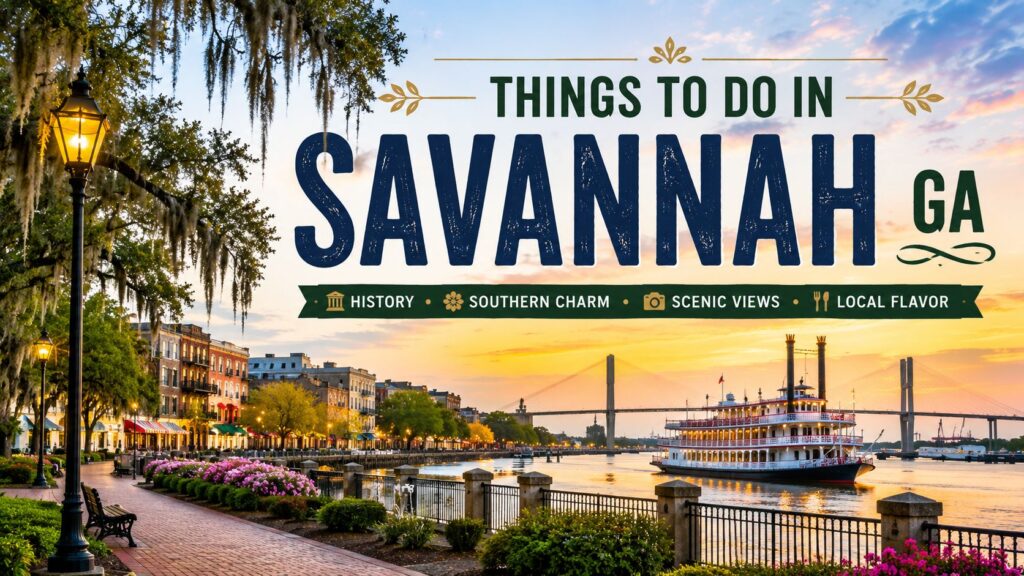
Savannah was Sherman’s Christmas gift. When Union General William Tecumseh Sherman completed his March to the Sea through Georgia in December 1864, he had burned Atlanta, torched Columbia, and destroyed most of what stood in his path across the South. When he reached Savannah, he sent President Lincoln a telegram: “I beg to present you as a Christmas gift the city of Savannah.” He did not burn it. The 1,100 architecturally significant buildings that make Savannah Georgia the most intact antebellum American city south of Charleston exist today because of that decision in December 1864.
The other reason Savannah is what it is: James Oglethorpe’s 1733 city plan. Oglethorpe arrived with the first colonists in February 1733 and laid out a city grid built around 24 public squares open spaces distributed every few blocks through the urban grid, each surrounded by residential lots and public buildings, each eventually planted with live oaks and filled with monuments and fountains. Twenty-two of those original squares survive. Walking through Savannah’s historic district is the experience of walking through the only American city designed from the beginning as a series of shaded outdoor rooms, the oaks draped in Spanish moss overhead, the cobblestone alleys between, the 18th and 19th-century architecture facing inward toward the square centers. No other American city walks like Savannah.
This guide covers the 30 best things to do in savannah ga organized by neighborhood, from the most essential squares to Bonaventure Cemetery to the finest places to eat in savannah georgia. It is written for US visitors who represent essentially 100% of all searches for this keyword and covers the genuine depth of Savannah that the 10-item competitor articles routinely miss. For more Southern US city guides, read our complete guides to things to do in Charleston SC, things to do in New Orleans, and things to do in Nashville.
Savannah GA At a Glance: Quick Reference Table
| Activity | Neighborhood | Entry | Duration | Best For | Best Time |
|---|---|---|---|---|---|
| Forsyth Park | Victorian District | Free | 1 to 2 hours | The crown jewel of Savannah squares | Morning or late afternoon |
| Savannah Squares Walking Tour | Historic District | Free | 2 to 3 hours | Understanding Savannah’s unique city design | Any time |
| Chippewa Square | Historic District | Free | 20 mins | Forrest Gump filming location, architecture | Any time |
| Colonial Park Cemetery | Historic District | Free | 45 mins | Revolutionary War and antebellum history | Day time |
| Bonaventure Cemetery | Bonaventure | Free | 1.5 to 2 hours | Most beautiful cemetery in the American South | Morning |
| Wormsloe Historic Site | Isle of Hope | $10 | 1 to 2 hours | The most photographed avenue in Savannah | Morning light |
| Leopold’s Ice Cream | Historic District | $4 to $8 | 30 mins | In operation since 1919, Savannah institution | Afternoon |
| Mrs. Wilkes’ Dining Room | Historic District | $30 | Lunch | Most famous Southern boarding house lunch | Weekday 11 AM |
| The Grey Restaurant | Telfair area | $40 to $80 | Dinner | James Beard–nominated, finest dining in Savannah | Dinner, reserve ahead |
| Olde Pink House | Reynolds Square | $30 to $60 | Dinner | Most atmospheric dining room in the city | Evening |
| Zunzi’s | Historic District | $10 to $15 | Lunch | Best sandwich in Savannah, local cult following | Weekday lunch |
| River Street Waterfront | River Street | Free | 1 to 2 hours | Cobblestone waterfront, shops, river views | Evening |
| Factors Walk | River Street | Free | 30 mins | Historic cotton factor buildings, unique architecture | Any time |
| City Market | Historic District | Free | 1 to 2 hours | Local arts, restaurants, live music | Evening |
| Owens-Thomas House | Oglethorpe Square | $15 | 45 mins | Finest Regency architecture in the US | Any time |
| Mercer Williams House | Monterey Square | $12.50 to $15 | 45 mins | Midnight in the Garden of Good and Evil | Any time |
| Davenport House | Columbia Square | $12 | 45 mins | Best preserved Federal-period interior | Any time |
| Green-Meldrim House | Madison Square | $10 | 30 mins | Sherman’s Civil War headquarters | Any time |
| First African Baptist Church | Franklin Square | $10 | 45 mins | Oldest Black congregation in North America (1773) | Any time |
| Telfair Museums | Telfair Square | $12 to $20 | 1.5 to 2 hours | American art, Jepson Center contemporary wing | Any time |
| SCAD Museum of Art | Historic District | Free to $10 | 1 to 1.5 hours | Contemporary art in a restored railway depot | Any time |
| Savannah History Museum | Battlefield Park | $7 to $10 | 1 hour | Forrest Gump bench, Savannah history | Any time |
| Savannah Historic District Walking | Historic District | Free | Full morning | Architecture, squares, atmosphere | Weekday morning |
| Thomas Square Streetcar District | Midtown | Free | 1 to 2 hours | Local restaurants, coffee, neighborhood life | Weekend |
| Forsyth Farmers Market | Forsyth Park | Free | 1 hour | Best Saturday morning market in Savannah | Saturday 9 AM |
| Tybee Island Beach | 18 miles east | Free | Half to full day | Savannah’s closest beach | Summer |
| Fort Pulaski National Monument | 15 miles east | $15 | 1.5 hours | Civil War fort, rifled cannon history | Any time |
| Hilton Head Island | 45 miles north | Free (beach) | Full day | Best beach near Savannah, biking, nature | Any time |
| Old Fort Jackson | 3 miles east | $12 | 1 hour | Oldest standing fortification in Georgia | Any time |
| Midnight in the Garden Walk | Multiple sites | Free | 1 to 2 hours | John Berendt’s book locations, Savannah mystery | Evening |
Savannah’s Squares and the Historic District
The 22 surviving squares of the Savannah historic district are the defining feature of the city and the element that makes it architecturally and experientially unlike any other American city. James Oglethorpe’s 1733 colonial plan distributed public squares at regular intervals through the grid so that no resident was ever more than a few minutes’ walk from a park, a civic gathering place, and the shade of a tree. The live oaks that were planted in the 19th century are now massive their canopies meeting overhead on the square perimeters, the Spanish moss hanging from their branches in the specific way that the humidity of coastal Georgia sustains. Walking from one square to the next through the historic district of Savannah is the most specifically pleasant 2-hour walk available in the American South.
1. Forsyth Park
Neighborhood: Victorian District, southern edge of the historic grid | Entry: Free | Duration: 1 to 2 hours | Best time: Morning or late afternoon
Forsyth Park, the 30-acre park at the southern end of the Savannah historic grid, is the finest public park in Savannah and the location of the most famous landmark in the city the 1858 cast-iron fountain, based on designs exhibited in Paris in 1855, which has stood at the park’s center for 167 years. The fountain, surrounded by live oaks that are wider than most rooms, fragrant tea olives, and the specific long grass of a coastal Georgia park in October, is what Savannah looks like to the people who fell in love with it.
The park hosts the Saturday morning Forsyth Farmers Market, the finest local food market in the city. The park’s northern end faces Gaston Street, where the Victorian-era mansions that line the street represent the finest surviving concentration of 19th-century residential architecture in the historic district.
Practical tips:
- The Saturday Forsyth Farmers Market runs from 9 AM to 1 PM and is the finest version of the park. Arrive at opening for the full selection of Savannah-area farms, bakers, and artisan food producers
- The Forsyth Park fountain at dusk, when the light hits the white cast iron at a low angle, is the finest free photography moment in Savannah
- The Sentient Bean café at the northeast corner of Forsyth Park serves the best accessible coffee in the park area and has outdoor seating facing the tree canopy
2. The Savannah Squares Walking Tour
Neighborhood: Historic District | Entry: Free | Duration: 2 to 3 hours | Best time: Any time, morning for photography
The 22 surviving squares of the Savannah historic district form a grid running from the river south to Forsyth Park, each surrounded by trust lots (historically reserved for public buildings) and tithing lots (originally residential). Each square has a specific character defined by its surrounding buildings and monuments. Walking the squares from Reynolds Square in the east through Columbia, Oglethorpe, and Chippewa to Wright Square and Telfair in the center is a two-hour walk through 290 years of Savannah civic history, each square a different room in the city’s outdoor architecture.
The squares are all free, all accessible, and all genuinely beautiful. Most visitors walk two or three. The visitors who walk them all leave with a significantly better understanding of why Savannah is considered one of the finest planned cities in the world.
Practical tips:
- The free Savannah squares walking tour self-guide, published by the Savannah Area Convention and Visitors Bureau, is available at the Savannah Visitor Center at 301 Martin Luther King Jr. Blvd and covers all 22 surviving squares with historical notes
- Each square has a central monument or feature. The Jasper Monument in Madison Square, the Haitian Monument in Franklin Square, and the John Wesley Memorial in Reynolds Square are the three most historically significant
- The squares are most atmospheric in late October when the temperatures drop, the light is low, and the Spanish moss moves in the coastal breeze
3. Chippewa Square
Neighborhood: Historic District | Entry: Free | Duration: 20 minutes | Best time: Any time
Chippewa Square, the park at Bull Street between Perry and Hull Streets, is dominated by the 1910 bronze statue of James Oglethorpe the founder of Georgia, facing south in his military posture toward Spanish Florida, as he stood when he established the colony in 1733. The square is also the filming location of the park bench scenes in Forrest Gump, filmed in Savannah in 1993. The specific bench where Tom Hanks sat and delivered the “Life is like a box of chocolates” monologue was removed after filming and is now in the Savannah History Museum a fact that most visitors who come looking for the bench do not know before they arrive.
The architecture surrounding Chippewa Square, particularly the First Baptist Church at the north end and the Savannah Theatre on Bull Street, represents the finest classical civic architecture around any single square in the city.
Practical tips:
- The original Forrest Gump park bench is at the Savannah History Museum at 303 Martin Luther King Jr. Blvd, 10 minutes’ walk from Chippewa Square. Entry $7 to $10
- The Bull Street corridor running south from Chippewa Square through Madison Square to Monterey Square is the finest single street walk in the historic district for architecture
- The Independent Presbyterian Church on Bull Street between Chippewa and Monterey squares, completed in 1891, is the finest Gothic Revival church interior in Savannah
4. Colonial Park Cemetery
Neighborhood: Historic District, between Oglethorpe and Perry on Abercorn | Entry: Free | Duration: 45 minutes | Best time: Daytime
Colonial Park Cemetery, the public burial ground in use from 1750 to 1853, is the finest freely accessible historic site in the Savannah historic district. The graves of prominent colonial and Revolutionary War-era Georgians, including Button Gwinnett one of the three Georgia signers of the Declaration of Independence stand alongside the aged tabby walls, enormous live oaks, and the specific melancholy atmosphere of a working burial ground that sat in the center of a city for 100 years. The 9,000 people buried here include victims of the 1820 yellow fever epidemic and British soldiers from the Revolutionary War period.
Practical tips:
- Union soldiers stationed in Savannah during the Civil War occupation moved and altered many of the grave markers. The altered markers are identified with historical notes throughout the cemetery
- The cemetery closes at dusk and is monitored. The ghost tour operators who conduct tours here at night are the unofficial evening historians of the site
- The Colonial Park Cemetery is directly adjacent to the Davenport House Museum. Combine both in the same morning
Historic Homes and Museums
5. Owens-Thomas House and Enslaved Quarters
Neighborhood: Oglethorpe Square | Entry: $15 | Duration: 45 minutes | Best time: Any time
The Owens-Thomas House at 124 Abercorn Street, designed by English architect William Jay and completed in 1819, is the finest example of Regency architecture in the United States and one of the most technically accomplished houses built in America in the early 19th century. The indoor plumbing, the indoor flush toilets, the running water system, and the bath facilities that Jay designed into the house in 1816 predate most American domestic plumbing technology by 40 years. The house hosted the Marquis de Lafayette in 1825 during his celebrated American tour.
The urban enslaved quarters in the rear of the property the only fully surviving and interpreted urban enslaved quarters in Savannah are the most significant part of the contemporary museum presentation. The Telfair Museums, which operate the Owens-Thomas House, have developed the interpretation of enslaved workers’ lives here into one of the most historically specific available in any Savannah historic house.
Practical tips:
- The combination ticket covering the Owens-Thomas House, the Telfair Academy, and the Jepson Center is the most economical way to visit all three Telfair Museums properties in a single day
- The architectural details of the Owens-Thomas House the curved staircase, the undulating facade, the indoor plumbing details reward a slower tour than most visitors give it
- The house is directly adjacent to Oglethorpe Square. Build both into the same French Quarter–equivalent morning
6. Mercer Williams House
Neighborhood: Monterey Square, 429 Bull Street | Entry: $12.50 to $15 | Duration: 45 minutes | Best time: Any time
The Mercer Williams House at 429 Bull Street, the Italianate mansion built in 1860 and occupied by antique dealer Jim Williams from 1969 until his death in 1990, is the most famous private residence in Savannah and the central location of John Berendt’s 1994 nonfiction narrative Midnight in the Garden of Good and Evil. The book spent 216 weeks on the New York Times Best Seller list a record for a nonfiction work and permanently linked Savannah’s identity in American popular culture to the Mercer Williams House, to Bonaventure Cemetery, to the Bird Girl statue, and to Jim Williams himself.
The house is open for tours of the ground floor and garden. The antique furnishings, the specific aesthetic of Jim Williams’s decorating taste, and the story of the four trials that Berendt’s book documents are covered in the guide presentation.
Practical tips:
- The Midnight in the Garden walking tour, available from multiple Savannah tour operators, covers all major locations from Berendt’s book including the house, Bonaventure Cemetery, and the related locations. The combined walking tour provides more Mercer Williams context than the house tour alone
- The Monterey Square location is at the southern end of the Bull Street walk from Chippewa Square. Walk it as a corridor: Chippewa north, Madison center, Monterey south
- The Book Gift Shop across the square sells the Midnight in the Garden book and Savannah-specific reading
7. Green-Meldrim House
Neighborhood: Madison Square, 14 West Macon Street | Entry: $10 | Duration: 30 minutes | Best time: Any time
The Green-Meldrim House at 14 West Macon Street, the Gothic Revival mansion completed in 1853, was commandeered by General Sherman as his Savannah headquarters when the Union Army occupied the city in December 1864. This is the house from which Sherman sent Lincoln his famous Christmas telegram offering the city of Savannah as a gift. The act of not burning the city was decided from this house. The irony a monument to Sherman’s restraint is now the rectory of St. John’s Episcopal Church, which hosts regular tours is entirely Savannah.
Practical tips:
- The house is open for tours Tuesday, Thursday, and Friday 10 AM to 4 PM, and Saturday 10 AM to 1 PM. Closed Sunday and Monday
- The interior Gothic Revival details the cast-iron porches, the oriel windows, the plaster ceiling medallions are some of the finest antebellum residential Gothic Revival work in the American South
- The house faces Madison Square. The Jasper Monument in the square center commemorates Sergeant William Jasper, who died in the 1779 Siege of Savannah during the Revolutionary War
8. Davenport House Museum
Neighborhood: Columbia Square, 324 East State Street | Entry: $12 | Duration: 45 minutes | Best time: Any time
The Davenport House at 324 East State Street, built between 1820 and 1825 by master builder Isaiah Davenport, is the best-preserved Federal-period townhouse interior in Savannah and the founding historic preservation case in the city. When the house was threatened with demolition in 1954 to make way for a funeral home parking lot, seven Savannah women raised $22,500 in 48 hours, purchased the house, and founded the Historic Savannah Foundation the organization whose subsequent work saved 1,100 buildings and preserved the historic district that makes Savannah what it is today. Every architecturally significant building in Savannah that still stands does so in part because of what happened at this address in 1954.
Practical tips:
- The Davenport House tour is one of the fastest and most efficiently organized of all the Savannah historic house tours. The 45-minute tour covers the full house without unnecessary repetition
- The house is directly adjacent to Columbia Square, one of the quieter and more architecturally rewarding squares in the eastern historic district
- The Isaiah Davenport master builder story an Irish immigrant who taught himself architecture and built one of the finest Federal houses in the South is the best individual biography in any Savannah house museum
9. Savannah History Museum and the Forrest Gump Bench
Neighborhood: Battlefield Park, 303 Martin Luther King Jr. Blvd | Entry: $7 to $10 | Duration: 1 hour | Best time: Any time
The Savannah History Museum at 303 Martin Luther King Jr. Blvd, in the restored Central of Georgia Railway shed, covers the full timeline of Savannah’s history from the Yamacraw Native American occupation through the colonial founding, the Revolutionary and Civil Wars, the Industrial period, and the 20th century. The museum also houses the original park bench from the Forrest Gump filming at Chippewa Square the prop bench on which Tom Hanks sat for the “Life is like a box of chocolates” scene. The bench is in the Savannah History Museum’s exhibition and is accessible for photographs. The chocolate box is also there.
Practical tips:
- The Museum and the Savannah Visitor Center are in the same complex. Start here before walking the historic district for orientation context
- The Forrest Gump bench is the most photographed object in the museum. The museum has set up appropriate lighting and a photo position
- The Central of Georgia Railway round house complex adjacent to the museum is a separate railway history museum worth 30 minutes for rail history enthusiasts
10. First African Baptist Church
Neighborhood: Franklin Square, 23 Montgomery Street | Entry: $10 | Duration: 45 minutes | Best time: Any time
First African Baptist Church at 23 Montgomery Street, organized in 1773 by the Reverend George Liele and formalized by Andrew Bryan in 1788, is the oldest African American congregation in North America. The church building, constructed by enslaved men who worked on it at night after their enslavers’ working hours, has in its floorboards the original ventilation holes diamond shapes and African Congo symbols that provided air to freedom seekers hiding in the tunnel beneath the church during the Underground Railroad period. The tunnel and the symbols are visible and explained during the guided tour.
Practical tips:
- The guided tour, operated by church staff, is the most direct and most historically honest presentation of African American history available at any Savannah historic site
- The church is in Franklin Square, adjacent to the Haitian Monument commemorating the free Black Haitian soldiers who fought for American independence in the 1779 Siege of Savannah
- The church building’s pew work and interior carpentry, executed by enslaved men with fine craft skills, is the finest woodwork in any Savannah church
Savannah Food: The Best in Georgia
Savannah’s food culture is built on the Gullah Geechee tradition of the Georgia Sea Islands the rice, the okra, the boiled peanuts, the seafood from the coastal waterways combined with the boarding house traditions of a city that has hosted travelers since 1733 and the specific influence of an arts university (SCAD) that has brought a young creative population and a growing restaurant culture over the past 40 years.
11. Leopold’s Ice Cream
Neighborhood: Historic District, 212 East Broughton Street | Cost: $4 to $8 | Duration: 30 minutes | Best time: Afternoon
Leopold’s Ice Cream at 212 East Broughton Street, in continuous operation under the Leopold family since 1919, is the most famous dessert destination in Savannah Georgia and one of the most beloved local ice cream shops in the American South. The signature flavors Tutti Frutti (the original 1919 recipe), Rum Bisque, Savannah Cream are made from scratch on the premises from the original formulas. The shop’s walls are covered in Hollywood memorabilia from local son Stratton Leopold, who produced Mission Impossible III and The Sum of All Fears after growing up working behind the ice cream counter.
The queue at Leopold’s runs 20 to 45 minutes on weekend afternoons and summer days. The ice cream is worth every minute of the wait.
Practical tips:
- The Tutti Frutti is the historically correct order it is the original 1919 recipe unchanged in 107 years. Order it once before exploring the other flavors
- Arrive before 11 AM on weekdays or after 3 PM to avoid the peak afternoon queue
- The shop interior, with its 1950s soda fountain counter and the Hollywood memorabilia, is as much the experience as the ice cream. Allow time to look at the photographs
12. Mrs. Wilkes’ Dining Room
Neighborhood: Historic District, 107 West Jones Street | Cost: $30 | Duration: Lunch | Best time: Weekday 11 AM to 2 PM
Mrs. Wilkes’ Dining Room at 107 West Jones Street is the most famous restaurant in Savannah and one of the most famous in the American South. Sema Wilkes opened her boarding house dining room to the public in 1943 and served the same Sunday dinner format family-style, communal tables, every dish brought simultaneously until her death in 2002 at age 93. The tradition continues under her family. The meal includes fried chicken, fresh vegetables, biscuits, corn bread, banana pudding, and whatever else the kitchen decided that morning, served at shared tables that seat eight to ten people at a time.
The line at Mrs. Wilkes’ begins forming 45 minutes before the 11 AM opening. The line moves quickly once the doors open. The seating is at shared tables with whoever is in line with you, which is part of the experience.
Practical tips:
- Arrive by 10:30 AM to be in the first seating at 11 AM. The wait from 10:30 is 30 minutes. The wait from 11:15 AM is significantly longer
- Cash only. The ATM at the nearby CVS is one block away
- The fried chicken and the banana pudding are the two dishes most consistently praised by regulars. Both are made fresh daily
13. The Grey Restaurant
Neighborhood: MLK Blvd and Liberty, 109 Martin Luther King Jr. Blvd | Cost: $40 to $80 | Duration: Dinner | Best time: Dinner, reserve 2 to 3 weeks ahead
The Grey at 109 Martin Luther King Jr. Blvd, in a restored 1938 Greyhound bus terminal designed in the Art Deco Streamline Moderne style that was once restricted to white passengers, is the most architecturally striking restaurant in Savannah and the city’s most serious culinary statement. James Beard Award-winning chef Mashama Bailey, who was nominated for Outstanding Chef of the Year multiple times, built The Grey’s reputation on a specific interpretation of Port City Southern cooking the food of a coastal city at the intersection of West African, British colonial, and American Southern traditions that is simultaneously the most historically grounded and the most forward-looking food program in Savannah.
Practical tips:
- Reserve online at thegreyrestaurant.com 2 to 3 weeks ahead for weekend dinner. The bar counter accepts walk-ins and the full menu is available there
- The building itself is part of the experience. The Streamline Moderne interior the curved counter, the terrazzo floors, the geometric light fixtures is the finest Art Deco interior in a Georgia restaurant
- The cocktail program at The Grey is the finest in Savannah. The Port City drinks list is specifically designed to complement the food traditions of a coastal trading city
14. Olde Pink House Restaurant
Neighborhood: Reynolds Square, 23 Abercorn Street | Cost: $30 to $60 | Duration: Dinner | Best time: Evening
The Olde Pink House at 23 Abercorn Street, in the 1771 Georgian mansion built by planter James Habersham Jr. that bleeds its original pink brick color through every subsequent paint application hence the name is the most atmospheric dining room in Savannah and the standard for the experience of eating Southern food in a genuinely historic building. The house has been in continuous use since 1771, occupied through the Revolutionary War, the Civil War, and multiple waves of Savannah’s history. The current restaurant, operating since 1992, serves traditional Low Country and Southern dishes in rooms where the plaster walls and the fireplace mantels have not changed since the 18th century.
Practical tips:
- Dinner at the Olde Pink House does not require a reservation on weekdays. Weekend reservations are strongly recommended as the dining rooms fill by 7 PM
- The Planter’s Punch cocktail served in the basement Planters Tavern is the correct beginning to an Olde Pink House evening
- The fried green tomatoes with white cheddar grits and the shrimp and grits are the two dishes that best represent what the kitchen does
15. Zunzi’s
Neighborhood: Historic District, 108 East York Street | Cost: $10 to $15 | Duration: Lunch | Best time: Weekday 11 AM to 3 PM
Zunzi’s at 108 East York Street is the lunch destination with the most loyal local following in Savannah a take-out counter specializing in South African-influenced sandwiches that opened in 1997 and has developed a cult following among SCAD students, locals, and visitors who discover it. The Conquistador sandwich roasted chicken, Swiss cheese, bacon, lettuce, tomato, and Zunzi’s house sauce on a hoagie roll is the most specific Savannah food experience available for under $15 and the one item every Savannah food authority will mention first.
Practical tips:
- Zunzi’s is take-out only. Eat the Conquistador on a bench in the nearest square Orleans or Calhoun are both within 3 minutes’ walk
- The queue at Zunzi’s runs 20 to 30 minutes at peak lunch hour. Arrive before 11:30 AM or after 1:30 PM
- The South African seasoning on the chicken is the specific flavor that makes Zunzi’s unlike anything else in Savannah. Ask about the sauce recipe and accept that they will not tell you
River Street and the Waterfront
16. River Street Waterfront
Neighborhood: River Street, northern edge of downtown | Entry: Free | Duration: 1 to 2 hours | Best time: Evening
River Street, the nine-block cobblestone waterfront along the Savannah River at the base of the bluff below the historic district, is the most visually distinctive public space in Savannah. The cobblestones are original ships’ ballast stones granite blocks carried across the Atlantic as ballast in empty ships and offloaded in Savannah, then used to pave the riverfront. Walking on them is walking on stones that crossed the ocean to build a trading city in 1733. The brick cotton warehouse buildings that line the river’s north side, converted to restaurants, bars, and shops, were built between the 1790s and the 1850s and represent the physical infrastructure of the antebellum cotton economy.
The evening on River Street watching the massive container ships passing at eye level (the river here is deep enough for ocean-going vessels), the lights of the Talmadge Memorial Bridge, the activity of a working river is the most specifically Savannah way to end a day.
Practical tips:
- The cobblestones are genuine and genuinely uneven. Wear shoes with support rather than sandals or heels
- The ships passing on the Savannah River are among the largest container ships in the world. The river channel depth allows Panamax-class vessels within 30 feet of the River Street pedestrian walkway
- The Savannah Riverboat Cruises, departing from the River Street dock, offer the finest views of the historic district bluff from the water
17. Factors Walk
Neighborhood: River Street, between River Street and Bay Street | Entry: Free | Duration: 30 minutes | Best time: Any time
Factors Walk, the series of multilevel walkways, iron bridges, and commercial building faces connecting River Street to Bay Street on the bluff above, was the working infrastructure of Savannah’s antebellum cotton economy. The cotton factors the brokers who managed the sale, storage, and shipping of Sea Island cotton conducted their business from the buildings facing Factors Walk, with the warehouses below on River Street and the city offices above on Bay Street. The iron bridge walkways, which allowed factors to oversee the loading and unloading of cotton bales from above without descending to street level, are the most industrial and most specifically economic architectural element of historic Savannah.
Practical tips:
- Walk from River Street up through Factors Walk to Bay Street for the full vertical experience of Savannah’s commercial infrastructure. The iron bridges connecting the buildings are safe and accessible
- The view of the Savannah River from the Factors Walk level is the finest accessible elevated river view in the city
- Several Factors Walk building ground floors are now restaurants and bars. The location gives the best combination of historic atmosphere and river proximity
Cemeteries and Gardens
18. Bonaventure Cemetery
Neighborhood: Bonaventure, 5 miles east of downtown | Entry: Free | Duration: 1.5 to 2 hours | Best time: Early morning
Bonaventure Cemetery, which I visited at 7 AM on a November morning, the Victorian garden cemetery on the Wilmington River 5 miles east of downtown Savannah, is the most beautiful cemetery in the American South and one of the most beautiful in the United States. The original plantation land was converted to a private cemetery in 1846 and acquired by the city of Savannah in 1907. The mature live oaks, some over 200 years old and trained horizontally across the lanes, create cathedral-like corridors of overarching branches draped in Spanish moss. The 19th-century marble monuments, the azalea gardens, the river glimpses through the trees, and the specific silence of a cemetery of this scale and beauty create an experience that cannot be accurately described to someone who has not been.
Johnny Mercer, the Savannah native who wrote “Moon River” and “Days of Wine and Roses,” is buried at Bonaventure. The Bird Girl statue from the Midnight in the Garden cover photograph stood at the Bonaventure grave of the Little Gracie monument (section F, lot 99) until the Telfair Museums moved it for preservation.
Practical tips:
- Arrive before 9 AM. The morning light through the live oaks from the east, falling on the moss and the marble monuments, is the finest natural light available in Savannah and why most serious photographers come before sunrise
- The Bonaventure Historical Society website has the most accurate map and grave locator for specific notable interments. Download it before arriving
- Rideshare or drive Bonaventure is 5 miles east of the historic district with no practical pedestrian access
19. Wormsloe Historic Site
Neighborhood: Isle of Hope, 10 miles southeast | Entry: $10 | Duration: 1 to 2 hours | Best time: Morning light (8 to 10 AM)
Wormsloe, the 1,500-acre Georgia state historic site at 7601 Skidaway Road on the Isle of Hope, is the location of the most photographed natural feature in Savannah a 1.5-mile avenue of 400 live oak trees planted in two parallel rows by Noble Jones, one of the original 1733 Savannah colonists, creating an overhead canopy of interlacing branches that filters morning light in a way that looks artificially beautiful and is entirely natural. The Wormsloe tabby ruins, the remains of Jones’s 18th-century fortified homestead, are the oldest standing structure in Georgia. The avenue of oaks is the most dramatic single natural corridor in the Georgia Lowcountry.
Practical tips:
- The avenue of oaks is at its finest from 8 to 10 AM when morning light filters through the canopy from the east. The same avenue at noon is significantly less interesting photographically
- The 4.5-mile Colonial Life Trail through the Wormsloe grounds covers the coastal Georgia colonial landscape with interpretive stations. Allow 1.5 hours for the full trail
- Wormsloe is 10 miles from downtown Savannah. A car or rideshare is required there is no transit connection
Art, Culture, and Neighborhoods
20. Telfair Museums
Neighborhood: Telfair Square and York Street | Entry: $12 to $20, combination ticket $22 | Duration: 1.5 to 2 hours | Best time: Any time
The Telfair Museums operate three properties: the Telfair Academy (the 1818 Telfair family mansion converted to the South’s first public art museum in 1886), the Jepson Center for the Arts (Moshe Safdie’s 2006 contemporary building facing Telfair Square), and the Owens-Thomas House. The Telfair Academy permanent collection includes the finest assemblage of 19th-century American paintings outside the major metropolitan museum collections, with particular strength in the American Impressionist and Ashcan School periods. The Bird Girl statue, the subject of the Midnight in the Garden of Good and Evil cover photograph, is housed at the Jepson Center.
Practical tips:
- The Jepson Center building by Moshe Safdie is itself worth the visit for contemporary architecture. The glass and marble building facing Telfair Square is the finest piece of modern architecture in Savannah’s historic district
- The combination ticket ($22) covers all three Telfair properties. If visiting Savannah for 2+ days, the combination ticket is the most economical option
- The Bird Girl statue, the most immediately recognizable Savannah image, is in the Jepson Center. The garden of the original grave location at Bonaventure Cemetery, where the statue stood, is now marked
21. SCAD Museum of Art
Neighborhood: Historic District, 601 Turner Blvd | Entry: Free to $10 | Duration: 1 to 1.5 hours | Best time: Any time
The Savannah College of Art and Design Museum of Art, in a restored 1853 Central of Georgia railroad depot, is the most accessible contemporary art museum in Savannah and the institution most directly connected to the city’s transformation by SCAD’s presence since 1979. The permanent collection focuses on contemporary art with significant works from the Haitian and African diaspora art traditions, the fashion and design arts, and the specific media arts that SCAD’s programs have developed. Exhibitions rotate frequently and the quality reflects SCAD’s international connections.
Practical tips:
- The building restoration, with the original railroad depot structure preserved within the museum envelope, is as interesting as the collection it houses
- SCAD’s public arts programming exhibitions, public installations throughout the city, visiting artist events is more actively integrated with the Savannah public than any art university in the American South. Check scadmoa.org for current public programming
- The museum gift shop sells SCAD student and faculty work at accessible price points
22. Thomas Square Streetcar District
Neighborhood: Midtown Savannah | Entry: Free | Duration: 1 to 2 hours | Best time: Weekend afternoon or evening
Thomas Square, the midtown neighborhood centered on the intersection of Bull Street and Park Avenue south of Forsyth Park, is the most actively developing dining and nightlife neighborhood in Savannah and the one that most accurately reflects the current character of the city beyond the tourist historic district. The combination of SCAD students, young professionals, and long-term neighborhood residents creates the specific energy of a neighborhood in the process of becoming which in Savannah moves more slowly and more thoughtfully than in most comparable cities.
The Sentient Bean coffee shop at the Forsyth Park corner, the Foxy Loxy Café on Bull Street, and the growing concentration of chef-driven restaurants in the former streetcar corridor represent the finest accessible food and coffee options outside the historic district.
Practical tips:
- The Sunday morning walk from Forsyth Farmers Market at the north end of Forsyth Park south through Thomas Square to the restaurants on Park Avenue is the finest Sunday morning neighborhood walk in Savannah
- Green Truck Pub on Bull Street has the finest burger in Savannah at $12 to $14. Full stop
- The midtown Savannah restaurant scene is where the non-tourist-oriented food operates. Several SCAD faculty-connected restaurants opened in the Thomas Square district in the past five years
Day Trips from Savannah
23. Tybee Island Beach
Location: 18 miles east of Savannah | Entry: Free beach, parking $2 to $3/hour | Duration: Half to full day | Best time: May to September for swimming
Tybee Island, the barrier island 18 miles east of Savannah at the mouth of the Savannah River, is Savannah’s closest beach and the most accessible coastal Georgia experience from the city. The Tybee lighthouse, a brick lighthouse first built in 1736 and rebuilt multiple times to its current 154-foot height, is the oldest and tallest lighthouse in Georgia and the most historically significant structure on the island it guided the ships that made Savannah the most important port in the colonial American South.
Tybee Beach is a wide, family-oriented barrier island beach without the resort development of Hilton Head. The Back River side of the island, on the Savannah River side, is the finest fishing and kayaking location.
Practical tips:
- The drive from Savannah to Tybee Island on US-80 passes through the Bull River salt marsh, one of the finest accessible Lowcountry marsh landscapes in Georgia. Stop at the Lazaretto Creek bridge for the view
- The Tybee Island Marine Science Center offers sea turtle education programming and beach ecology walks. Worth the $8 entry for families with children
- Fort Pulaski National Monument is directly on US-80 between Savannah and Tybee Island, 15 miles from downtown. Combine the fort and the beach in a single day
24. Fort Pulaski National Monument
Location: 15 miles east of Savannah on US-80 | Entry: $15 per vehicle | Duration: 1.5 hours | Best time: Any time
Fort Pulaski, the massive brick fortification on Cockspur Island between Savannah and Tybee Island, was the site of one of the most significant military events of the Civil War: the bombardment of April 10-11, 1862. Union forces used new rifled cannon for the first time in sustained combat at Fort Pulaski, demonstrating that rifled artillery could destroy masonry fortifications in hours rather than the months or years that military engineering theory predicted. The holes in the surviving southeast wall of Fort Pulaski, visible today, ended the era of masonry fort construction and changed military engineering permanently. Every coastal fort built after Fort Pulaski uses earthworks rather than brick for exactly this reason.
Practical tips:
- The southeast wall breach, where the rifled cannon rounds penetrated the 7.5-foot brick wall, is the single most historically significant visible feature in the fort
- The National Park Service ranger programs at Fort Pulaski are among the finest at any Georgia NPS site. The living history programs in summer show the fort in active use
- Fort Pulaski is directly on the road to Tybee Island. Every visitor to Tybee should stop here
25. Hilton Head Island
Location: 45 miles north of Savannah | Entry: Free (beach), parking fees vary | Duration: Full day | Best time: April to October
Hilton Head Island, 45 miles north of Savannah across the South Carolina line, is the finest beach destination accessible from Savannah and the most complete coastal resort experience within driving distance. Hilton Head’s 12 miles of wide Atlantic beach, the Harbour Town lighthouse, the Sea Pines Forest Preserve, the extensive trail and cycling system, and the Gullah Heritage Trail are together a better day-trip experience than any comparable destination in the Georgia or South Carolina coastal zone within a 90-minute drive.
The Coligny Beach public access at Coligny Circle is the most easily accessible and best-serviced beach entry. The park area has free parking, restrooms, and beach equipment rentals.
Practical tips:
- The Harbour Town lighthouse and marina in Sea Pines Resort is the most photographically distinctive location on Hilton Head. The marina is open to the public and the lighthouse can be climbed for $5
- The cycling trail network on Hilton Head covers 60 miles of dedicated trails. Bikes are available for rent near most beach access points at $15 to $20 per day
- The Gullah Heritage Trail Tours, offered by the Gullah Heritage Consulting Services, is the most historically significant experience on Hilton Head and is available as a guided bus tour
Savannah GA Practical Guide
Getting Around Savannah
Walking: Savannah’s historic district is the most walkable small American city in the South. The squares, the historic homes, River Street, City Market, Leopold’s Ice Cream, and Mrs. Wilkes’ Dining Room are all within a 25-minute walk of each other. The flat terrain and the shade of the squares make walking the primary and best mode of transit for the historic district.
Dot Shuttle: The free Dot shuttle, operated by CAT (Chatham Area Transit), runs through the historic district on a loop connecting most major visitor destinations. A one-day transit pass for the full CAT network is $4.
Ride Share: Uber and Lyft operate throughout Savannah and are the most practical option for Bonaventure Cemetery, Wormsloe Historic Site, the SCAD Museum, and Thomas Square restaurants. Fares average $8 to $15 for most city trips.
Driving: The historic district has limited parking, primarily in public garages on Liberty Street and Bryan Street. For day trips to Tybee Island, Fort Pulaski, and Hilton Head, a car or organized tour is required.
Where to Stay in Savannah
Historic District, South of Forsyth: The most atmospheric location within walking distance of every major historic site. Boutique inns and historic bed and breakfasts dominate. $150 to $450 per night.
River Street and Bay Street: Best for walkable access to River Street itself, City Market, and the northern historic district. Higher hotel density than the residential South of Broad equivalent. $130 to $350 per night.
Thomas Square and Victorian District: Best for visitors who want the local neighborhood experience and proximity to Forsyth Park without the tourist concentration of the central historic district. $100 to $250 per night.
Near the Visitor Center (MLK Blvd): Best for budget travelers and those arriving by bus or Amtrak. Walking distance to the historic district, adjacent to The Grey and the SCAD Museum. $90 to $200 per night.
Savannah Budget Guide
Budget traveler (inn or hostel, Zunzi’s lunch, Mrs. Wilkes’ dinner, free squares): $90 to $140 per day. The Savannah squares walk, Forsyth Park, Colonial Park Cemetery, River Street, Bonaventure Cemetery, and First African Baptist Church are all free. Zunzi’s Conquistador at $13, Mrs. Wilkes’ family-style lunch at $30, and Leopold’s Tutti Frutti at $5 keeps the food budget under $50 for the most specifically Savannah day available.
Mid-range traveler (boutique inn, restaurant meals, paid attractions): $185 to $300 per day. Owens-Thomas House ($15), Mercer Williams House ($15), Bonaventure Cemetery (free), Wormsloe ($10), Olde Pink House dinner, and a Tybee Island beach day together cover the essential Savannah experience at this range.
Luxury traveler (historic mansion inn, fine dining, private tours): $380 and above per day. A room at The Mansion on Forsyth or the Kehoe House, dinner at The Grey and Olde Pink House, a private Midnight in the Garden tour, and a Hilton Head Island day represent Savannah’s most considered experience.
Best Time to Visit Savannah GA
March to May: The finest season. The azaleas bloom from late February through March, with peak color at Bonaventure Cemetery and Forsyth Park running from mid-March through early April. The Savannah St. Patrick’s Day Festival in mid-March is the second-largest St. Patrick’s Day celebration in the United States. Spring temperatures average 65 to 80 degrees Fahrenheit with manageable humidity.
October to November: The second-best season. The summer heat breaks in October. The live oaks are at their fullest in early fall before the leaves thin. The Savannah Film Festival in late October is the finest cultural event in the city. Hotel prices drop from the spring premium.
June to September: Hot and significantly humid. The coastal Georgia summer heat regularly reaches 90 to 95 degrees Fahrenheit with high humidity. The squares remain beautiful but midday outdoor walking is genuinely uncomfortable. Tybee Island beach season is at its peak. Adjust outdoor activities to morning and evening hours.
December to February: Quietest and most affordable season. The winter garden at Forsyth Park and the Spanish moss in the squares are at their most atmospheric in the grey winter light. Temperatures average 45 to 65 degrees Fahrenheit. Mrs. Wilkes’ and Leopold’s operate year-round.
Frequently Asked Questions About Savannah GA
How many days do you need in Savannah GA? Three days covers the essential savannah georgia experience: Forsyth Park, squares walking, River Street, and Mrs. Wilkes’ lunch on day one. Owens-Thomas House, City Market, Leopold’s Ice Cream, Olde Pink House dinner on day two. Bonaventure Cemetery morning, Wormsloe afternoon, and The Grey dinner on day three. Four days adds the Tybee Island beach and Fort Pulaski. Five days allows the Hilton Head Island day and the full Midnight in the Garden walking tour.
Is Savannah GA worth visiting? Yes, consistently. Savannah has the most intact antebellum urban landscape in Georgia and one of the most intact in the American South, the most beautiful Victorian garden cemetery in the country, the most distinctive food traditions of any Georgia city, and the specific walking experience of a city designed around 22 public squares that no other American city can replicate. The combination of the Bonaventure Cemetery morning walk, the Wormsloe avenue of oaks, Mrs. Wilkes’ family-style lunch, and a River Street evening is one of the finest 24-hour travel experiences available in the American South.
What is Savannah GA most famous for? Savannah Georgia is most famous for the historic district and its 22 squares, Forsyth Park, Bonaventure Cemetery and the Midnight in the Garden of Good and Evil connection, the River Street waterfront, Mrs. Wilkes’ Dining Room, Leopold’s Ice Cream since 1919, the Forrest Gump filming location (Chippewa Square), Wormsloe’s avenue of oaks, and the specific combination of antebellum architecture and Spanish moss-draped live oaks that defines the city’s visual identity in popular culture.
What is the best free thing to do in savannah ga? Walking the squares all 22 of them is free, genuinely beautiful, and the experience that most specifically represents what Savannah is. Forsyth Park, the Battery-equivalent anchor of the historic grid, is free. Bonaventure Cemetery is free. River Street is free. Colonial Park Cemetery is free. Together they constitute a full day of the finest Savannah experience at essentially zero cost.
What are fun things to do in savannah ga for adults? The Midnight in the Garden walking tour of all key book locations is the most entertaining adult cultural experience in Savannah. The Grey for dinner is the finest evening in the city. The Savannah ghost tours, departing nightly from multiple historic district locations, are the most popular adult evening entertainment. The rooftop bar at The Bohemian Hotel on River Street is the finest cocktail view in Savannah. The SCAD Sidewalk Arts Festival in late April is the finest free outdoor adult cultural event of the year.
Final Word: Savannah Asks You to Walk Slowly
Savannah is not a city to rush. The squares will not cooperate with rushing. The cobblestones of River Street will not cooperate with rushing. Mrs. Wilkes’ will not cooperate with rushing. The live oaks of Bonaventure Cemetery the 200-year-old trees whose horizontal limbs extend 50 feet in each direction, creating a cathedral roof of Spanish moss over the lanes specifically do not cooperate with rushing.
The visitors who love Savannah most are the ones who arrived without a timed itinerary and walked from one square to the next following the light and the shade and the sound of the river two blocks away. They found Leopold’s by accident at 4 PM on a Tuesday. They ended up at River Street because it was at the end of the street they were walking. They sat in Forsyth Park for an hour and watched Savannah residents do their Tuesday, which in Savannah looks a great deal like Saturday everywhere else.
Slow down. Walk the squares. Let the city show you itself.
For more US city guides, read our complete articles on things to do in Charleston SC, things to do in New Orleans, things to do in Nashville and things to do in Dallas. The full USA planning guide is at best places to visit in the USA.
What surprised you most about Savannah? Tell us in the comments below.