Charleston has 1,400 buildings constructed before 1840 still standing and in active use within the 4.2 miles of the city peninsula. No comparable collection of 18th and early 19th-century American domestic architecture exists anywhere else in the United States outside of New Orleans. Most visitors arrive knowing Charleston has good food and beautiful houses. They leave understanding they have been in one of the most historically intact and most specifically significant cities in the country the city where the American Civil War began, where that beginning is still visible across the harbor from the southern tip of the peninsula, on a clear afternoon, from a public park that anyone can walk into for free.
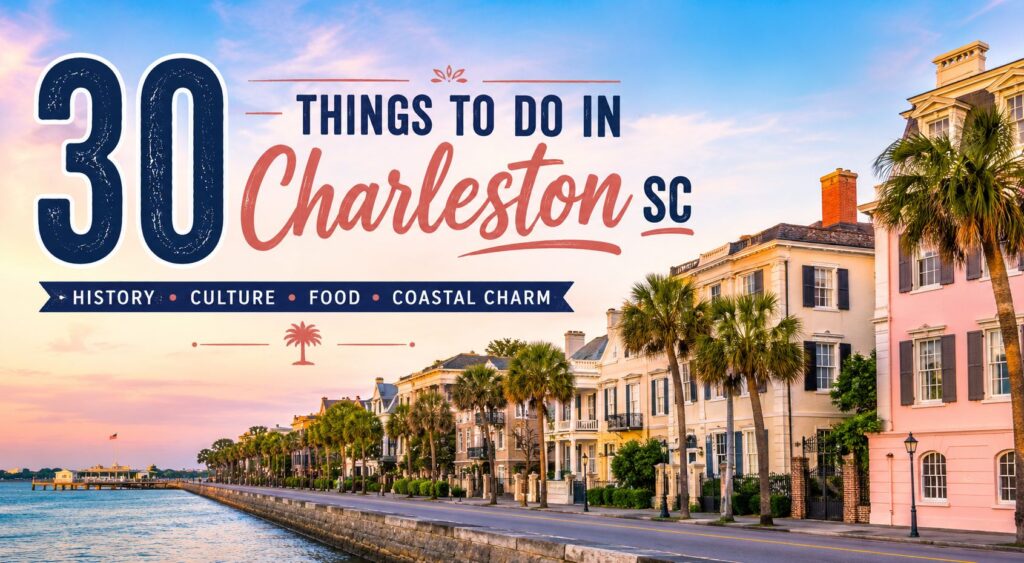
That specific combination the physical beauty of the architecture and the harbor, and the historical weight of what happened here is what makes Charleston sc different from every comparable Southern American city. Savannah has the squares and the Spanish moss but lacks the specific civic gravity. Charleston carries both. The houses on South of Broad Street have been continuously occupied since the 1730s and 1740s. Rainbow Row, the most photographed streetscape in the American South, is 13 Georgian townhouses built between 1740 and 1750 and painted in the pastel colors that residents applied in the 1930s and have maintained since. The French Quarter of Charleston predates the French Quarter of New Orleans. None of this is museum recreation. It is a living city that happens to be the most architecturally preserved colonial American urban environment in the country.
This guide covers the 30 best things to do in charleston sc organized by neighborhood, from the most essential historic sites to the finest places to eat shrimp and grits and the day trips that show the Lowcountry landscape Charleston sits within. It is written for US visitors who represent 96% of all searches for this keyword and covers every budget from the completely free to the properly excellent. For more Southern city guides, read our complete articles on things to do in New Orleans, things to do in Savannah GA and things to do in Nashville.
Charleston SC At a Glance: Quick Reference Table
| Activity | Neighborhood | Entry | Duration | Best For | Best Time |
|---|---|---|---|---|---|
| The Battery and White Point Garden | South of Broad | Free | 1 to 1.5 hours | Civil War history, harbor views, architecture | Morning or dusk |
| Rainbow Row | French Quarter | Free | 20 to 30 mins | Most photographed Charleston streetscape | Morning light |
| Waterfront Park | French Quarter | Free | 45 minutes to 1 hour | Harbor views, Pineapple Fountain, locals | Sunset |
| French Quarter Neighborhood Walk | French Quarter | Free | 1.5 to 2 hours | Finest antebellum architecture in Charleston | Morning |
| Fort Sumter National Monument | Ferry from Liberty Square | $24 to $30 | 3 hours including ferry | Where the Civil War began, April 1861 | Any time |
| International African American Museum | Upper peninsula | $25 to $28 | 1.5 to 2 hours | Most important new museum in Charleston | Any time |
| Charleston City Market | Market District | Free | 1 to 2 hours | Sweetgrass baskets, local crafts, local life | Morning |
| King Street Shopping and Dining | Downtown | Free | 2 to 3 hours | Finest independent retail street in Charleston | Weekend |
| Nathaniel Russell House | South of Broad | $12 to $15 | 45 minutes | Finest Federal-period interior in Charleston | Any time |
| Aiken-Rhett House | Ansonborough | $12 to $15 | 45 minutes | Best-preserved antebellum urban plantation | Any time |
| Old Exchange and Provost Dungeon | French Quarter | $12 to $16 | 1 hour | Revolutionary War history, slave trade | Any time |
| Husk Restaurant | French Quarter | $35 to $65 | Dinner | The restaurant that defined Southern food | Dinner, reserve ahead |
| FIG Restaurant | French Quarter | $40 to $75 | Dinner | Farm-to-table, finest modern Southern dining | Dinner, reserve ahead |
| Bertha’s Kitchen | North Charleston | $12 to $18 | Lunch | Most authentic Gullah Geechee cooking in the city | Weekday lunch |
| Martha Lou’s Kitchen | North End | $10 to $16 | Lunch | Best soul food in Charleston | Weekday lunch |
| Magnolia Plantation and Gardens | Highway 61, 10 miles | $20 to $32 | 2 to 3 hours | Oldest public garden in the US, azalea season | Spring bloom |
| Boone Hall Plantation | Mt. Pleasant, 8 miles | $24 to $28 | 1.5 to 2 hours | Avenue of oaks, Gullah Geechee history | Any time |
| Angel Oak Tree | Johns Island, 12 miles | Free | 45 minutes | 400-to-500-year-old live oak tree | Any time |
| Folly Beach | Folly Island, 12 miles | Free | Half to full day | Beach, surfing, informal Charleston | Summer |
| Sullivan’s Island Beach | Sullivan’s Island, 8 miles | Free | Half day | Quieter beach, Fort Moultrie, local families | Any time |
| Gibbes Museum of Art | French Quarter | $15 | 1 to 1.5 hours | Southern portrait collection, American art | Any time |
| South Carolina Aquarium | Waterfront | $28 to $33 | 1.5 to 2 hours | Lowcountry marine life, sea turtles | Families |
| College of Charleston Campus | Downtown | Free | 1 hour | Greek Revival campus, oldest municipal college | Any time |
| Edmondston-Alston House | The Battery | $15 to $18 | 45 minutes | Overlooking the harbor, 1838 Greek Revival | Any time |
| Kahal Kadosh Beth Elohim | Hasell Street | $10 | 30 to 45 mins | Oldest Reform Jewish synagogue in the US (1840) | Any time |
| Rainbow Row Morning Walk | French Quarter | Free | 20 to 30 mins | Golden-hour photography, quiet streets | 7 to 9 AM |
| Sullivan’s Island and Fort Moultrie | Sullivan’s Island | $10 per vehicle | Half day | Revolutionary War fort, Sullivan’s Island character | Any time |
| Middleton Place Plantation | Ashley River Road | $29 to $39 | 2 to 3 hours | America’s oldest landscaped garden (1741), rice fields | Spring |
| Kiawah Island Beachwalker Park | Kiawah, 25 miles | $10 | Full day | Finest beach near Charleston, birding, sea turtles | Summer and fall |
| Congaree National Park | Columbia, 1.5 hours | Free | 2 to 3 hours | Old-growth bottomland hardwood forest, paddling | Any time |
The Battery, South of Broad, and the Harbor
The southern tip of the Charleston peninsula, where Meeting Street ends at White Point Garden and the Battery promenade runs along the water’s edge of the harbor, is the geographical and historical heart of Charleston. From this exact location, at the corner of East Battery and Murray Boulevard, Charleston residents stood on the night of April 12, 1861, and watched the Confederate bombardment of Fort Sumter across the harbor begin the first shots of the American Civil War, fired at a federal fort 3.4 miles away and clearly visible from this point on a clear day. The fort is still there. The Battery is still here. No other American city allows you to stand in the same civilian viewing position for one of the most consequential events in American history and still see the site across the water.
1. The Battery and White Point Garden
Neighborhood: South of Broad | Entry: Free | Duration: 1 to 1.5 hours | Best time: Morning or dusk
The Battery, the sea wall and promenade running along the southern edge of the Charleston peninsula where the Ashley and Cooper Rivers meet Charleston Harbor, is the finest free walk in Charleston and the city’s most historically saturated public space. White Point Garden, the 4-acre park at the tip of the peninsula, contains Civil War cannon, Confederate and Union monument plaques, massive live oak trees draped in Spanish moss, and the specific atmosphere of a public park that has been the city’s gathering point since the early 18th century.
The promenade along East Battery Street delivers the most impressive uninterrupted view of Charleston Harbor and its sea islands available from the peninsula. The antebellum mansions facing the water along East Battery the Roper House, the Edmondston-Alston House, the William Ravenel House are the largest and most architecturally significant residential buildings in Charleston, their piazzas facing the harbor in the specific Charleston way that maximizes cross-ventilation in a subtropical climate.
Practical tips:
- Walk East Battery from White Point Garden north to Waterfront Park along the harbor promenade for the full Battery experience. The complete walk takes 30 minutes at a comfortable pace
- The morning light from 7 to 9 AM on East Battery, hitting the harbor and the mansion facades from the east, is the finest photography light in Charleston
- Fort Sumter is visible from the Battery on clear days as a low stone structure on an island in the harbor. Binoculars make it clearly identifiable
2. Rainbow Row
Neighborhood: French Quarter, East Bay Street | Entry: Free | Duration: 20 to 30 minutes | Best time: Early morning light (7 to 9 AM)
Rainbow Row, the 13 contiguous Georgian row houses at 79 to 107 East Bay Street built between 1740 and 1750, is the most photographed streetscape in the American South and the single most recognizable visual of Charleston South Carolina. The pastel color scheme peach, pink, yellow, terracotta, sage was applied by new owners beginning in the 1930s during a restoration period and has been maintained as a neighborhood identity since. The buildings themselves are genuine 18th-century merchant townhouses, originally ground-floor shops with residential floors above, serving the harbor trade that made Charleston the wealthiest city in colonial North America.
The best version of Rainbow Row is at 8 AM on a weekday in April, when the morning light hits the south-facing facades directly and the tourist volume is at its lowest. By 10 AM the sidewalk is occupied by tour groups and the photographs are more crowded. The houses are private residences. Do not enter courtyards.
Practical tips:
- Walk south from Rainbow Row to the Battery in 10 minutes. Build both into the same morning walk
- The view of Rainbow Row from across East Bay Street, standing on the east sidewalk looking west, is the standard photograph. The buildings are on the west side of East Bay Street
- The Edmondston-Alston House at the south end of the Battery complex offers a museum tour that includes access to a piazza overlooking the harbor. The view is worth the $15 entry
3. Waterfront Park
Neighborhood: French Quarter, Concord Street | Entry: Free | Duration: 45 minutes to 1 hour | Best time: Sunset
Waterfront Park, the eight-acre public park running along the Cooper River waterfront north of the Battery, is Charleston’s finest public park and the correct location for a sunset over the harbor. The Pineapple Fountain at the park entrance, the pier extending into the Cooper River, and the swing benches overlooking the water create a public space that operates simultaneously as a local evening gathering point and a visitor destination without the tension that usually produces.
The pier extending from Waterfront Park into the Cooper River delivers the finest accessible views of the Charleston harbor, the Arthur Ravenel Jr. Bridge, and the harbor islands. At sunset from the end of the pier, looking south toward the Battery and east toward Fort Sumter, the light turns the harbor surface copper and the silhouette of the Arthur Ravenel Bridge frames the sky above.
Practical tips:
- Waterfront Park is a 10-minute walk from the City Market and 5 minutes from Rainbow Row. Build all three into a connected morning or afternoon
- The park is one of the few public spaces in Charleston with accessible waterfront seating. The swing benches fill on weekend evenings arrive early
- The park’s pineapple fountain is the symbol of Charleston hospitality (the pineapple was the 18th-century colonial symbol of welcome). The symbolism is explained on a plaque near the fountain
4. French Quarter Neighborhood Walking Tour
Neighborhood: French Quarter | Entry: Free | Duration: 1.5 to 2 hours | Best time: Weekday morning
The Charleston French Quarter, the historic district bounded by Market Street to the north, East Bay Street to the east, Broad Street to the south, and Meeting Street to the west, contains the finest concentration of 18th-century American domestic architecture in the United States. The streets Chalmers, Church, Queen, Tradd are lined with single houses (the uniquely Charleston architecture of one-room-wide houses turned sideways to the street with a piazza running the full length), double houses, tenement buildings from the 1740s, and churches representing every major Protestant denomination that existed in colonial America.
The self-guided walking tour from the Historic Charleston Foundation, available free online and at the foundation’s headquarters at 40 East Bay Street, covers the 30 most architecturally significant buildings in the French Quarter with historical context for each. The tour takes 1.5 to 2 hours at an unhurried pace.
Practical tips:
- Chalmers Street, the cobblestone street connecting Church Street to Meeting Street, is the most atmospheric single block in the Charleston French Quarter and the most intact 18th-century streetscape in the city
- The Pink House at 17 Chalmers Street, built around 1712, is the oldest building in South Carolina and the oldest tavern in the American South. It is a private art gallery and open during business hours
- The First Scots Presbyterian Church at 53 Meeting Street, built in 1731, has the finest Georgian religious interior in Charleston and is open for free self-guided tours on weekday mornings
5. Fort Sumter National Monument
Departure: Liberty Square Ferry Terminal, downtown Charleston | Entry: $24 to $30 per person | Duration: 3 hours including ferry | Best time: Any time, book ahead
Fort Sumter, the federal fortification in Charleston Harbor where Confederate forces opened fire on April 12, 1861, beginning the American Civil War, is accessible only by ferry from Liberty Square Terminal near the South Carolina Aquarium. The fort sits on an artificial island in the harbor 3.4 miles from the Charleston peninsula. Walking onto it and standing in the courtyard where the Union garrison was stationed when the bombardment began the iron caisson walls, the restored barracks, the flag pole over which the Union flag flew before the surrender is the most specifically historically charged experience in Charleston.
The ferry ride from Liberty Square takes 30 minutes each way and delivers views of the Charleston peninsula skyline, the harbor sea islands, and the approach to the fort from the same water angle that Confederate gunboats used in 1861. The National Park Service operates the fort with guided ranger tours at regular intervals after the ferry docks.
Practical tips:
- Book ferry tickets at fortsumtertours.com at least one week ahead in spring and fall. Weekend morning boats fill to capacity
- The ranger-guided tours at the fort are free with ferry admission and provide the historical context that makes the site comprehensible. Join the first tour after arrival
- The return ferry from the fort passes Sullivan’s Island and the entrance to the harbor. The view of the Charleston peninsula from the harbor at mid-channel is the finest perspective of the city available from the water
French Quarter and the Historic District
6. Nathaniel Russell House
Neighborhood: South of Broad | Entry: $12 to $15 | Duration: 45 minutes | Best time: Any time
The Nathaniel Russell House at 51 Meeting Street, built in 1808 for a wealthy Charleston merchant and rice factor, is the finest example of Federal-period interior architecture in South Carolina and one of the finest in the American South. The flying staircase a three-story elliptical staircase that appears to ascend without any visible support, cantilevered from the elliptical stair hall walls is the finest single architectural feature in any Charleston interior and one of the most technically accomplished staircases in 18th-century American architecture.
The house is operated by the Historic Charleston Foundation and is furnished with period-appropriate pieces that reflect the early Federal aesthetic. The garden behind the house, enclosed by the characteristic Charleston brick walls, is a restoration of the original Russell garden design.
Practical tips:
- Combine the Nathaniel Russell House with the Aiken-Rhett House, also operated by the Historic Charleston Foundation, for the full range of antebellum Charleston domestic architecture. The combination ticket is $18 to $22
- The house is two blocks from the Battery. Build both into the same South of Broad morning
- The Historic Charleston Foundation gift shop in the house sells the finest architectural history publications about Charleston available in the city
7. Aiken-Rhett House
Neighborhood: Ansonborough, 48 Elizabeth Street | Entry: $12 to $15 | Duration: 45 minutes | Best time: Any time
The Aiken-Rhett House at 48 Elizabeth Street is the most unusual domestic historic site in Charleston and the most historically complete. While most Charleston historic houses have been restored to specific periods, the Aiken-Rhett House has been preserved as found with the original plaster, wallpaper, and furnishings left in their deteriorated state to show the accumulated layers of 180 years of continuous occupation. The result is the best-preserved antebellum urban plantation complex in the United States, including the original slave quarters in the rear courtyard, the carriage house, and the kitchen building structures that most comparable sites have demolished or altered.
The self-guided audio tour, distributed at the entrance, is among the most thoughtfully constructed historical narratives at any Charleston museum site. The slavery section of the tour is frank in a way that most antebellum house museums still avoid.
Practical tips:
- The rear courtyard of the Aiken-Rhett House, with the preserved slave quarters facing the main house across the yard, is the most historically direct confrontation with the enslaved labor economy of antebellum Charleston available at any museum site
- The house is 10 minutes’ walk from the City Market and 15 minutes from the Battery easily combined with either in the same morning
- The deteriorated wallpaper in the main parlor, showing three different periods of decoration through the peeling layers, is the most visually compelling thing in the house
8. Old Exchange and Provost Dungeon
Neighborhood: French Quarter, 122 East Bay Street | Entry: $12 to $16 | Duration: 1 hour | Best time: Any time
The Old Exchange Building at 122 East Bay Street, completed in 1771 as the customs house and public exchange of colonial Charleston, is one of the three most historically significant colonial public buildings in the United States alongside Independence Hall in Philadelphia and Faneuil Hall in Boston. George Washington visited the building in 1791. The South Carolina legislature ratified the US Constitution in the building’s Great Hall in 1788. And below the building, the Provost Dungeon the original British fortification basement that housed American Revolutionary War prisoners during the British occupation of Charleston from 1780 to 1782 is still intact and accessible.
The building also has direct connection to the Charleston slave trade, operating as one of the primary market locations for enslaved people in colonial America. The museum interpretation addresses this history directly.
Practical tips:
- The Provost Dungeon in the basement is the most atmospheric part of the building. The British-era brick vaulting, the original colonial foundations, and the historical interpretation of the Revolutionary War prisoners create the most tangible connection to 18th-century Charleston
- The Great Hall on the upper floor, where the Constitutional ratification debate took place, is restored to its 1788 appearance and worth 20 minutes
- The building faces the Cooper River. The view from the east facade toward the harbor is one of the finest views of the water from a historic building in Charleston
9. Gibbes Museum of Art
Neighborhood: French Quarter, 135 Meeting Street | Entry: $15 | Duration: 1 to 1.5 hours | Best time: Any time
The Gibbes Museum of Art at 135 Meeting Street, established in 1905 and one of the oldest art museums in the American South, houses a permanent collection of over 10,000 works focused on American art with a particular strength in Charleston and South Carolina portraiture from the 18th century onward. The collection of colonial and Federal-period miniature portraits small oval portrait paintings on ivory or copper that were the primary form of personal portraiture before photography is the finest and most comprehensive accessible collection of this American art form in the South.
The museum’s regular special exhibitions, which focus on contemporary Southern art and on the social history of Charleston through its artistic record, are consistently among the finest regional exhibitions available in the state.
Practical tips:
- The Gibbes miniature portrait collection is in a dedicated gallery on the second floor. Allow 30 minutes specifically for this collection
- The museum is one block from the Old Exchange Building and three blocks from the Nathaniel Russell House easily combined in a single French Quarter art and history morning
- Thursday evening hours extend to 8 PM. The museum at 6 PM on a Thursday, after the daytime tour groups have left, is the most comfortable version
International African American Museum
10. International African American Museum
Neighborhood: Upper waterfront, 14 Wharfside Street | Entry: $25 to $28 | Duration: 1.5 to 2 hours | Best time: Any time, book ahead
The International African American Museum, opened in June 2023 on the upper Charleston waterfront at Gadsden’s Wharf the site where an estimated 40% of all enslaved Africans brought to North America first arrived in the colonial period is the most significant new cultural institution in Charleston and one of the most significant new history museums in the United States. The museum sits on elevated columns above the original wharf structure so that the ground level of the site the soil where hundreds of thousands of enslaved people arrived is visible beneath the building as a memorial space, physically unmarked and physically accessible.
The nine permanent galleries trace the African diaspora experience in America from the Middle Passage through slavery, the Civil War, Reconstruction, the Great Migration, and the civil rights movement, with particular emphasis on Charleston’s role at the center of the transatlantic slave trade and on the specific contributions of African Americans to the creation of American culture, agriculture, architecture, and civic life.
The Center for Family History, the museum’s genealogy research facility, provides free access for descendants of enslaved Americans to trace their family histories through the most comprehensive database of historical records related to enslaved people assembled in the United States.
Practical tips:
- Book timed-entry tickets in advance at iaamuseum.org. The museum sells out on weekends and during school holiday periods
- Allow the full 2 hours. The galleries are text-rich and reward reading rather than browsing
- The memorial space beneath the museum the original soil of Gadsden’s Wharf is accessible from the exterior before or after the museum visit. Spend 10 minutes there before entering the building
City Market, King Street, and the Market District
11. Charleston City Market
Neighborhood: Market District | Entry: Free | Duration: 1 to 2 hours | Best time: Morning
The Charleston City Market, the covered market structure running four blocks from Meeting Street to Church Street, has operated on this site continuously since 1804. The market’s most significant and most specifically Charleston offering is the sweetgrass basket weavers who have sold their work here for generations Gullah Geechee women whose basket-weaving tradition is a direct continuation of the West African coiled-basket tradition brought to South Carolina by enslaved people in the 17th century. The sweetgrass baskets are hand-woven from local bulrush, sweetgrass, and palmetto leaf. A small basket costs $60 to $80. A large work basket costs $200 to $400. They are worth every dollar as the most specifically Charleston craft object available.
The market also sells conventional tourist merchandise, local food products, and jewelry. The sweetgrass baskets are why you come.
Practical tips:
- The basket weavers in the market are the direct cultural heirs of a tradition that UNESCO recognizes as an endangered intangible heritage. Purchasing their work directly supports its continuation
- The Four Corners of Law intersection at Meeting and Broad Streets, two blocks from the market, gets its name from the four buildings at the intersection representing federal, state, city, and church law. It is worth the 5-minute walk for the architecture alone
- The market is open daily from 9:30 AM to 5 PM. Arrive at opening for the quietest experience
12. King Street Shopping and Dining
Neighborhood: Downtown Charleston | Entry: Free | Duration: 2 to 3 hours | Best time: Weekend afternoon
King Street, the primary commercial spine of the Charleston peninsula running north from Broad Street through the downtown core, is the finest shopping and dining street in South Carolina and one of the finest in the American South. The Lower King Street antique district, from Broad Street to Queen Street, concentrates the highest density of American antique dealers in a two-block area in any American city. The Middle King Street section from Queen to Calhoun contains the independent retailers, local restaurants, and design shops that most accurately reflect contemporary Charleston’s commercial identity.
King Street Pizza in the upper King section has been a local late-night institution since 1986. The Ordinary oyster bar at 544 King Street, in a restored 1927 bank building, is the finest accessible oyster and seafood restaurant on the street.
Practical tips:
- Lower King Street antique dealers are generally open Tuesday through Saturday. Call ahead before making a specific trip for a particular dealer
- The Cannonborough-Elliotborough neighborhood immediately west of Upper King Street, centered on Spring and Cannon Streets, is the finest residential neighborhood on the Charleston peninsula for a 30-minute walk. Turn west off King Street at any block between Calhoun and Spring
- Butcher and Bee at 1085 Morrison Drive serves the finest accessible sandwich and salad lunch in the upper King Street area
Charleston Food: Lowcountry Cuisine and Southern Cooking
Charleston food is the most distinctive regional American cuisine outside of New Orleans. The Lowcountry cooking tradition built on the West African rice-cultivation knowledge that enslaved people brought to the Carolina coast, the abundant seafood of the ACE Basin and the coastal waterways, the English and French colonial cooking techniques, and the specific agricultural products of the South Carolina sea island environment produces a food culture that belongs to no other place.
Shrimp and grits, the dish most associated with Charleston, is a Gullah Geechee fisherman’s breakfast that became the defining dish of the 1980s American fine dining revolution when Craig Claiborne wrote about it in the New York Times in 1985. It is now served in every restaurant in the city. The version at Husk is the one that most accurately represents the elevation of that tradition.
13. Husk Restaurant
Neighborhood: French Quarter, 76 Queen Street | Cost: $35 to $65 | Duration: Dinner | Best time: Dinner, reserve 2 weeks ahead
Husk at 76 Queen Street is the most historically significant restaurant in Charleston and the one that most specifically defines what the city’s food culture has become. Sean Brock’s 2010 manifesto that every ingredient on the Husk menu must originate from the American South a restriction that forced the kitchen to rediscover and champion Southern heritage grains, heirloom vegetables, and regional proteins that had been disappearing from commercial agriculture was the single most influential statement in the American regional food movement of the past 20 years. The shrimp and grits at Husk, made with Sea Island red pea grits and local shrimp, is the dish that most specifically represents what makes Charleston’s food tradition irreplaceable.
Practical tips:
- Reserve online at huskrestaurant.com 2 weeks ahead for weekend dinner. Monday and Tuesday dinner reservations are available closer to the date
- The Husk bar accepts walk-ins and the full dinner menu is available at the bar. On weeknights, the bar wait is 20 to 40 minutes
- The building at 76 Queen Street is an 1893 Victorian house. The porch dining in spring and fall, overlooking the side garden, is the finest alfresco dining experience in downtown Charleston
14. FIG Restaurant
Neighborhood: French Quarter, 232 Meeting Street | Cost: $40 to $75 | Duration: Dinner | Best time: Dinner, reserve 2 to 3 weeks ahead
FIG (Food Is Good) at 232 Meeting Street, opened by James Beard Award-winning chef Mike Lata in 2003, is the restaurant that established Charleston as a serious American food city a full seven years before Husk. The farm-to-table commitment at FIG specific farms named on the menu, specific provenance for every ingredient, a menu that genuinely changes with what is available from the farm relationships rather than a fixed menu with seasonal adjustments represents the most rigorous expression of locally-sourced restaurant cooking in Charleston.
The pasta at FIG is the menu item most consistently praised by regulars and critics. The whole roasted fish, when available, is the finest single expression of the farm-to-table philosophy in the kitchen.
Practical tips:
- FIG reservations open 30 days in advance on Resy. Reserve the day the window opens for weekend dinner
- The FIG bar counter has four seats and accepts walk-ins. The full dinner menu is available at the counter on a first-come first-served basis. Arrive at 5:45 PM for the best chance
- The white wine list at FIG is the finest in Charleston for Southern European varietals
15. Bertha’s Kitchen
Neighborhood: North Charleston, 2332 Meeting Street | Cost: $12 to $18 | Duration: Weekday lunch | Best time: Tuesday to Friday 11 AM to 2 PM
Bertha’s Kitchen at 2332 Meeting Street in North Charleston is the most important restaurant in the Charleston area for understanding Gullah Geechee cooking the food tradition of the Sea Island African American communities that stretches from Jacksonville to Wilmington and that is the direct culinary ancestor of everything that Husk and FIG celebrate. The buffet at Bertha’s rice and gravy, lima beans, pork chops, fried chicken, okra soup, collard greens cooked with ham hock, cornbread is the original and most specific version of Lowcountry home cooking available in a restaurant setting anywhere in the Charleston area.
Bertha’s Kitchen is a North Charleston neighborhood institution, not a tourist restaurant. It is consistently one of the highest-reviewed restaurants in the metropolitan area and is virtually unknown to visitors who stay on the peninsula.
Practical tips:
- Bertha’s Kitchen is open Tuesday through Friday for lunch only. Saturday hours are irregular. Call ahead before making the trip
- North Charleston is 20 minutes by car from the historic downtown peninsula. Rideshare is the practical option for visitors without a car
- The rice at Bertha’s is cooked in the West African pilau tradition each grain separate, the cooking water fully absorbed and is the finest cooked rice in the Charleston area
16. Shrimp and Grits in Charleston SC
Where: Multiple locations | Cost: $18 to $32 | Best time: Breakfast and dinner
Shrimp and grits is the dish that best represents what Charleston’s food culture has contributed to American cooking. The original version local creek shrimp cooked in butter with garlic and served over stone-ground hominy grits was a Gullah Geechee fisherman’s breakfast that became a national restaurant phenomenon after Craig Claiborne wrote about Carolina miller Bill Neal’s version in the New York Times in 1985. Every restaurant in Charleston now serves some version. The range in quality is significant.
The most accessible genuinely good version: Poogan’s Porch at 72 Queen Street serves a consistent mid-range shrimp and grits with tasso gravy at $22. The most historically correct version: The Ordinary at 544 King Street serves a simple shrimp over Sea Island grits that most directly represents the Gullah Geechee tradition. The most elaborate version: Husk’s version changes seasonally but consistently represents the finest technique applied to the dish.
Practical tips:
- Anson Restaurant at 12 Anson Street serves a shrimp and grits with andouille sausage and local tomatoes that represents the New Orleans-influenced Lowcountry cooking tradition. One of the finest versions in the city
- Stone-ground grits from Anson Mills, the Charleston heirloom grain company that supplied most of the fine dining restaurants listed above, are available at their retail location and online for replication at home
- The best free version: Charleston City Market vendors sometimes sell a cup of shrimp and grits for $8 to $12 during peak season
Day Trips and Beyond Charleston
17. Magnolia Plantation and Gardens
Location: Highway 61, 10 miles from downtown | Entry: $20 to $32 | Duration: 2 to 3 hours | Best time: Late February to April (azalea bloom)
Magnolia Plantation and Gardens, established in 1676 on the Ashley River 10 miles from downtown Charleston, is the oldest public garden in the United States and the first garden in America open to the public, operating continuously since 1870. The Barbados-style plantation house, the rice canals and tidal marshes of the original plantation landscape, and the informal English garden style that replaced the formal French gardens in the 19th century create the most historically layered landscape accessible on a day trip from Charleston. In spring, when 250 acres of azaleas bloom simultaneously in colors that range from white through every shade of pink and red, Magnolia Plantation is the finest single natural spectacle in the South Carolina Lowcountry.
Practical tips:
- The Slavery to Freedom tour at Magnolia, available as an addition to the garden admission, is the finest single interpretation of enslaved Gullah Geechee workers’ lives at any plantation site in the Charleston area. Worth the additional $8
- The nature tram tour covers the 70-acre wildlife refuge adjacent to the garden. Alligators, great blue herons, wood storks, and river otters are routinely visible. Worth adding for wildlife photography
- Azalea peak bloom typically runs from late February through mid-March. The specific peak varies by 2 to 3 weeks each year depending on winter temperatures check Magnolia’s social media the week before visiting
18. Boone Hall Plantation
Location: Mount Pleasant, 8 miles from downtown | Entry: $24 to $28 | Duration: 1.5 to 2 hours | Best time: Any time
Boone Hall Plantation at 1235 Long Point Road in Mount Pleasant, one of America’s oldest working plantations in continuous agriculture since 1681, is the most visited plantation site in the Charleston area. The Avenue of Oaks, the three-quarter-mile driveway of 90-foot live oaks planted by the first owner around 1743, is one of the most magnificent tree corridors in North America and the visual that most strongly defines Boone Hall’s identity. The nine original slave cabin structures along the driveway, now incorporated into the Gullah Geechee cultural exhibition, are the most accessible presentation of Sea Island African American history in the Mount Pleasant area.
Practical tips:
- The Gullah Geechee history interpretation in the slave cabins at Boone Hall is the most specific and most historically grounded cultural history presentation at any Charleston area plantation
- The strawberry harvest at Boone Hall’s farm stand, running from April through June, is the finest local farm stand experience in the Charleston area
- Boone Hall is 8 miles from downtown Charleston across the Arthur Ravenel Jr. Bridge. Drive or rideshare no practical transit option
19. Angel Oak Tree
Location: Johns Island, 14 miles from downtown | Entry: Free | Duration: 45 minutes | Best time: Early morning or late afternoon
The Angel Oak, the southern live oak at 3688 Angel Oak Road on Johns Island that is estimated to be between 400 and 500 years old, is the oldest living thing east of the Mississippi River and one of the largest and most magnificent trees in the United States. The tree’s main trunk measures 28 feet in circumference. The limbs, which grow horizontally and then curve back down to touch the ground before rising again, cover an area of 17,200 square feet under their canopy. Standing under the Angel Oak and looking up through the canopy of a tree that was already old when the first European settlers arrived in South Carolina is the most specifically humbling natural experience accessible from Charleston.
Practical tips:
- The Angel Oak is a free city park open to the public. Arrive before 9 AM to experience the tree with minimal other visitors
- The tree is 14 miles from downtown Charleston. Johns Island is also the location of Bohicket Road farm stands, Sea Island wine and spirits producers, and the road to Kiawah Island
- Photographing the Angel Oak requires a wide-angle lens to capture the full canopy spread
20. Folly Beach
Location: Folly Island, 12 miles from downtown | Entry: Free | Duration: Half to full day | Best time: May to September for swimming, any time for surfing
Folly Beach, the barrier island community 12 miles south of downtown Charleston on Folly Island, is Charleston’s most accessible beach and the most informal coastal experience near the city. The 12-foot surf break at The Washout, the only consistent surfable wave in South Carolina, makes Folly Beach the surfing center of the state and the only place within reasonable driving distance of Charleston where you can rent a board and take a lesson.
Folly Beach is not the prettiest beach in the Charleston area that is Kiawah Island. It is the most genuinely local, the most accessible, and the least self-conscious about what it is: a barrier island where the Charleston residents go when they want to be at the beach without paying resort prices.
Practical tips:
- The Folly Beach County Park at the west end of Center Street has the best-maintained public beach access with lifeguards in summer and parking at $2 per hour
- The stretch of Center Street from the beach access north through the Folly Beach commercial district has the best food truck, taco stand, and casual seafood options in the Charleston beach area
- The Folly Beach fishing pier, extending 1,000 feet into the Atlantic from the east end of Arctic Avenue, is free to walk and delivers the best views of the beach from above
Charleston SC Practical Guide
Getting Around Charleston
Walking: The Charleston peninsula historic district from Broad Street to Calhoun Street, east to east Battery and west to King Street is entirely walkable in 30 to 45 minutes from end to end. The flat terrain makes Charleston one of the most walkable small American cities. Most first-time visitors can cover the core historic district on foot over two days without requiring transit.
CARTA Bus and Jolley Trolley: Charleston Area Regional Transportation Authority bus routes cover the full peninsula. The free DASH (Downtown Area Shuttle) trolley runs along Meeting Street from the Visitor Reception and Transportation Center on Meeting Street to Broad Street. The Folly Beach route from downtown takes 45 minutes by bus.
Ride Share: Uber and Lyft operate throughout the Charleston area and are the most practical option for plantation day trips, Folly Beach, Sullivan’s Island, and the North Charleston restaurants. Fares average $8 to $18 for most peninsula-to-neighborhood trips.
Driving: Parking in the historic district requires a garage or hotel parking. The Visitor Reception and Transportation Center on Meeting Street has the largest public parking facility near the historic district. On-street parking in South of Broad and the French Quarter is limited and regularly enforced. For day trips to Angel Oak, Magnolia Plantation, and the beaches, a car or rideshare is required.
Where to Stay in Charleston
South of Broad and the Battery: The most atmospheric location for a Charleston stay within walking distance of the Battery, Rainbow Row, and the French Quarter. The highest-priced area. Boutique inns and historic bed and breakfasts at $200 to $500 per night.
French Quarter and Market area: Best for walking access to the City Market, Husk and FIG restaurants, the Old Exchange, and King Street. Hotel options range from budget boutique to upscale. $150 to $400 per night.
Upper King Street and Cannonborough: Best for visitors who want the dining and nightlife of Upper King Street and a slightly lower price point. $100 to $250 per night.
Mount Pleasant: Best for visitors making day trips to Boone Hall Plantation, Sullivan’s Island, and Isle of Palms. Requires a car. $90 to $200 per night.
Charleston Budget Guide
Budget traveler (inn or B&B, City Market lunch, free attractions): $90 to $150 per day. The Battery, Rainbow Row, Waterfront Park, French Quarter walk, City Market, College of Charleston campus, and White Point Garden are all free. Bertha’s Kitchen lunch at $15 and Poogan’s Porch shrimp and grits dinner at $22 keeps the food budget reasonable. The Charleston Free Walking Tour, departing daily from Waterfront Park, covers the French Quarter history at zero cost.
Mid-range traveler (boutique hotel, restaurant meals, paid attractions): $190 to $320 per day. Fort Sumter ferry ($24), Nathaniel Russell House and Aiken-Rhett House combination ($22), International African American Museum ($25), Husk dinner reservation, FIG lunch, and the Magnolia Plantation garden tour cover the essential Charleston experience at this range.
Luxury traveler (historic inn, fine dining, private tours): $400 and above per day. A room at Zero George Street or The Spectator, FIG dinner and Husk lunch, a private Fort Sumter guided tour, the Middleton Place plantation experience, and a Kiawah Island beach day represent Charleston at its most considered.
Best Time to Visit Charleston SC
March to May: The finest season. The Magnolia Plantation azalea bloom peaks in late February to mid-March. Spring temperatures average 65 to 78 degrees Fahrenheit. The MOJA Arts Festival in late spring and Spoleto USA, the performing arts festival running late May through mid-June, are the finest cultural events in Charleston. Crowds build significantly in late April and May.
October to November: The second-best season. The summer heat breaks. Fall temperatures average 60 to 75 degrees Fahrenheit and the humidity drops to comfortable levels. The beach season has ended and the peninsula reverts primarily to residents. Hotel prices drop from the spring peak.
June to September: Hot and humid in a way that makes midday outdoor walking genuinely uncomfortable. The summer heat in Charleston South Carolina reaches 90 to 95 degrees Fahrenheit with high humidity from June through August. Beach season, however, is at its peak. Folly Beach and Sullivan’s Island are the correct outdoor destinations from June through September.
December to February: The quietest tourist season and the most affordable hotel pricing. Temperatures average 45 to 60 degrees Fahrenheit comfortable for walking the historic district without the summer heat. The winter garden at Middleton Place is the finest accessible winter garden in South Carolina.
Frequently Asked Questions About Charleston SC
How many days do you need in Charleston SC? Three days covers the essential charleston sc things to do: the Battery walk, Rainbow Row, Fort Sumter ferry, and Husk dinner on day one. French Quarter walk, International African American Museum, City Market, and FIG dinner on day two. King Street, a plantation day trip (Magnolia or Boone Hall), and the Nathaniel Russell House on day three. Four days adds Folly Beach or Sullivan’s Island. Five days allows Middleton Place and the full Gullah Geechee food exploration including Bertha’s Kitchen.
What is Charleston most famous for? Charleston South Carolina is most famous for its antebellum architecture, its role as the site where the American Civil War began at Fort Sumter, the Lowcountry cuisine tradition (shrimp and grits, she-crab soup, Gullah Geechee cooking), Rainbow Row and the Battery, and the well-preserved historic district that makes it one of the most architecturally complete 18th-century American cities.
Is Charleston SC worth visiting? Yes, consistently and across traveler types. Charleston has more historically significant 18th and 19th-century architecture per block than any American city except New Orleans. The food scene is among the most distinctive in the country. The International African American Museum, opened in 2023 on the site of the largest slave market in North America, is the most important new history museum in the American South. Fort Sumter across the harbor delivers a physical confrontation with Civil War history available nowhere else in the country.
What is the best free thing to do in charleston sc? The Battery walk at White Point Garden free, with the finest harbor views in the city and the specific historical weight of the Civil War’s beginning visible across the water. The French Quarter neighborhood walk, Rainbow Row, Waterfront Park, the Angel Oak Tree on Johns Island, Folly Beach, and Sullivan’s Island are all free and together constitute a full day of genuinely excellent Charleston experience at minimal cost.
What is best things to do in charleston sc for history lovers? Fort Sumter is the most essential. The International African American Museum on the site of Gadsden’s Wharf, where 40% of all enslaved Africans entered North America, is the most significant. The Aiken-Rhett House provides the most complete antebellum urban plantation experience. The Old Exchange and Provost Dungeon covers the Revolutionary War period. The Battery provides the specific geography of the Civil War’s beginning. All five together constitute the most comprehensive American history experience available in a single city.
What is the Charleston sc food scene known for? Charleston’s food is known for shrimp and grits (the dish that defined the Southern food movement of the 1980s), she-crab soup, the Gullah Geechee cooking tradition brought to the Lowcountry by enslaved West Africans, the farm-to-table movement anchored by FIG (2003) and Husk (2010), the sweetgrass basket tradition of the City Market weavers, and the most specific rice culture in American food history South Carolina was the rice capital of colonial North America, and the knowledge of how to grow it came from enslaved people from the rice-growing regions of West Africa.
Final Word: Charleston Rewards the Visitor Who Understands What They Are Looking At
The most common thing I hear from visitors who come to Charleston expecting pretty houses and good food is that they were surprised by the weight of the history. They expected Southern charm. They found the Battery and looked across the harbor to where the Civil War started. They found the International African American Museum on the site where hundreds of thousands of people arrived in chains. They found Rainbow Row as an 18th-century merchant street built by an economy of enslaved labor. They found that the prettiest city in the American South is also the one carrying the most specific and the most significant American history.
Charleston does not hide any of this. It has gotten significantly more direct about it in the past decade. The IAAM opened in 2023. The plantation tours are more honest. The museum interpretations are more specific. The city is in the middle of a decades-long reckoning with what made it wealthy and what that wealth cost.
This reckoning is not separate from the beauty of the architecture and the quality of the shrimp and grits and the walk along East Battery at dusk. It is the same city. Understanding that they are the same city is what makes Charleston worth the trip.
For more US city guides, read our complete articles on things to do in New Orleans, things to do in Savannah GA, things to do in Nashville and things to do in Washington DC. The full USA planning guide is at best places to visit in the USA.
What surprised you most about Charleston? Tell us in the comments below.