
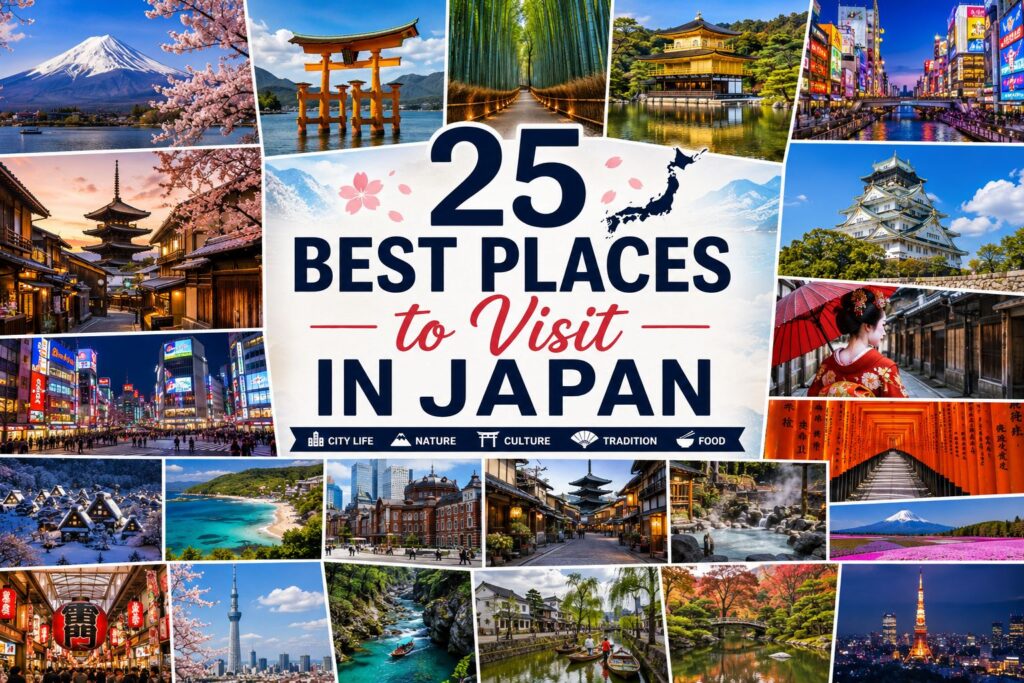
Japan is the travel destination that most consistently exceeds expectations, and it exceeds them differently for every visitor. The traveler who arrives expecting temples and cherry blossoms finds them in abundance. The traveler who arrives expecting food culture finds one of the most extraordinary culinary traditions in the world. The traveler who arrives expecting modernity finds a country that has placed the most advanced technology in the world alongside 1,200-year-old wooden temples in the same city block and seen no contradiction in the arrangement.
I have visited Japan four times across different seasons and have not yet run out of things I want to return to see. The country has an inexhaustible quality that very few destinations share. Each visit I have discovered a neighborhood, a regional cuisine, or an entire city that I had not previously understood existed at the level it does.
This guide covers the 25 best places to visit in Japan organized to help you build an itinerary across the country’s full geographic and cultural range. It covers the essential destinations and the regional destinations that reward visitors who go beyond the Golden Route. For city-level guides to specific destinations, read our full guides to things to do in Tokyo and everything else at Travel Destinations Plan.
How to Use This Guide
- Kanto Region: Tokyo, Kamakura, Nikko, Hakone
- Kansai Region: Kyoto, Osaka, Nara, Kobe
- Hiroshima and Western Honshu: Hiroshima, Miyajima, Kurashiki, Okayama
- Chubu and the Japanese Alps: Takayama, Shirakawa-go, Matsumoto, Nagano
- Tohoku Region: Sendai, Matsushima, Aomori, Nikko
- Kyushu: Fukuoka, Nagasaki, Beppu, Kumamoto
- Hokkaido: Sapporo, Otaru, Furano
- Okinawa: Naha, remote islands
- Japan Planning Guide: JR Pass, transport, budget, best time
- FAQ: Most common Japan questions answered
Kanto Region: The Gateway to Japan
1. Tokyo
Region: Kanto | Days recommended: 5 to 7 | Best for: Everything
Tokyo is the finest city in the world for visitors who want maximum density of experience per day. The 13.9 million people of the city proper and the 37 million in the greater metropolitan area live in a system of 23 distinctive wards, each functioning as a separate city with its own character, its own food culture, and its own reason for existing. Shibuya and Shinjuku are the entertainment and commercial centers. Asakusa is old Tokyo. Yanaka is the neighborhood that survived the 1923 earthquake and shows what the city looked like a century ago. Shimokitazawa is the creative quarter. Akihabara is electronics and anime culture taken to its ultimate expression.
What makes Tokyo unmissable: The Shibuya Crossing at peak evening hour when hundreds of people cross in every direction simultaneously in perfect silence. Senso-ji Temple in Asakusa before 8 AM when the incense smoke is thickest and the light comes gold through the gate. TeamLab Planets digital art installation. Tsukiji Outer Market breakfast at 7 AM. The view from the free Tokyo Metropolitan Government Building observation deck at dusk.
Best neighborhoods to explore: Asakusa for old Tokyo character, Shimokitazawa for creative culture, Yanaka for preserved historic streets, Shinjuku Golden Gai for 200 tiny bars in narrow alleys.
Practical tips:
- Get a Suica IC card at any station immediately on arrival, covers every train, metro, and bus
- The Tokyo Metro 24-hour pass at 600 yen covers unlimited Metro rides
- Book TeamLab Planets online months in advance, it sells out daily year-round
2. Kamakura
Region: Kanto | **Day trip or overnight from Tokyo | Days recommended: 1 to 2
Kamakura, 50 kilometers south of Tokyo on the Shonan coast, was Japan’s de facto capital from 1185 to 1333 and retains the most complete collection of medieval Buddhist and Shinto sites accessible as a day trip from any major city in Japan. The Kotoku-in Great Buddha, a 13.4-meter bronze statue completed in 1252 and now seated in the open air after the wooden hall that housed it was destroyed by a 1498 tsunami, is one of the finest surviving examples of Kamakura period sculpture in Japan.
The Tsurugaoka Hachimangu Shrine complex, connected by the Komachi-dori shopping street to the main station, anchors the city’s historical center. The hiking trail connecting Kamakura’s major temples, the Daibutsu Hiking Course, delivers the temples and the Pacific Ocean views in a 2-hour moderate walk.
Best experiences: The Great Buddha up close, Zeniarai Benzaiten Shrine built into a cave, the coastal walk from Kamakura to Enoshima Island, fresh sashimi at the harbor seafood restaurants.
3. Nikko
Region: Kanto | **Day trip or overnight from Tokyo | Days recommended: 1 to 2
Nikko, in the mountains 140 kilometers north of Tokyo, is a UNESCO World Heritage Site housing the Tosho-gu Shrine complex, the mausoleum of Tokugawa Ieyasu, the shogun who unified Japan in 1600 and established the dynasty that ruled for 268 years. The shrine represents the most ornately decorated Shinto architecture in Japan, every surface covered in lacquer, gold leaf, colored carvings, and the intricate decorative program that deliberately contrasted with the restrained aesthetics of other major shrine complexes.
The three wise monkeys carving at Tosho-gu, the original source of the “see no evil, hear no evil, speak no evil” imagery, is here. The Yomeimon Gate, which took 2 years to carve and contains 508 decorative carvings, is the most elaborate single gate in Japanese architecture.
Practical tips:
- The Nikko Pass covers all local buses and transport within the site complex
- Kegon Falls, 15 minutes by bus from the shrine area, drops 97 meters from Lake Chuzenji
4. Hakone
Region: Kanto | Days recommended: 2 | Best for: Mount Fuji views, onsen
Hakone, in the volcanic mountains 85 kilometers southwest of Tokyo, combines the most accessible high-quality onsen hot spring experience from the capital with the finest clear-weather views of Mount Fuji available from any accessible location. The Hakone Ropeway over the Owakudani volcanic valley, where sulfurous steam rises through the volcanic earth and the eggs boiled in the hot springs turn black, delivers the most dramatic accessible volcanic landscape in the Kanto region.
Lake Ashi below, with the torii gate of the Hakone Shrine rising from the water and Mount Fuji appearing above the lake rim on clear days, is the most photographed Fuji view available outside the mountain itself. The Hakone Open Air Museum, holding an extraordinary collection of 20th-century sculpture by Moore, Rodin, Calder, and Picasso in outdoor gardens with Fuji visible on clear days, is one of the finest outdoor sculpture parks in Asia.
Best experiences: Overnight ryokan with private onsen, ropeway over Owakudani, Lake Ashi boat crossing, Open Air Museum.
Practical tips:
- The Hakone Free Pass covers all transport within Hakone including the ropeway and boat
- Mount Fuji views are most reliable in the morning before atmospheric haze builds, particularly October to February
Kansai Region: The Cultural Heart of Japan
5. Kyoto
Region: Kansai | Days recommended: 4 to 5 | Best for: Temples, traditional culture
Kyoto served as Japan’s capital for over a thousand years, from 794 to 1869, and retains the most complete surviving collection of Japanese classical architecture, garden design, and traditional culture of any city in the country. The city has 17 UNESCO World Heritage Sites, over 1,600 Buddhist temples, over 400 Shinto shrines, and the most concentrated collection of traditional Japanese arts and crafts traditions in the world.
The Arashiyama district in the city’s western hills contains the bamboo grove, the Tenryu-ji garden, the Togetsukyo bridge, and the monkey park on Iwatayama that together make it the finest half-day excursion within the city. The Higashiyama neighborhood, running from Kiyomizudera Temple through the preserved merchant streets of Ninenzaka and Sannenzaka to Gion, delivers the most complete experience of traditional Kyoto at street level.
The unmissable Kyoto experiences: Fushimi Inari Shrine, the mountain covered in 10,000 vermilion torii gates that create tunnels of color extending up the hillside. Kinkaku-ji the Golden Pavilion reflected in the Kyoko-chi pond. The Rock Garden at Ryoan-ji, 15 stones arranged in raked gravel in a pattern that has resisted interpretation for 500 years. Nishiki Market, the covered market on Nishiki Street called Kyoto’s Kitchen. A kaiseki multi-course dinner in Gion. Geisha spotting in Hanamikoji Street at dusk in Gion.
Practical tips:
- Arashiyama bamboo grove is crowded from 9 AM, arrive before 7 AM for the empty morning
- The Kyoto City Bus 1-day pass at 700 yen covers most major temple routes
- Kyoto accommodation in cherry blossom season and autumn leaf season requires booking 6 months in advance
6. Osaka
Region: Kansai | Days recommended: 2 to 3 | Best for: Food, nightlife, energy
Osaka is Japan’s second city in spirit if not in size, a city that operates at a different energy level from Tokyo and Kyoto and takes considerable pride in this difference. The Osaka character, called Osaka-jin, is defined by a directness and humor and appetite for pleasure that the city’s food culture expresses most directly.
Dotonbori, the entertainment district along the canal in the Namba area, is the most energetically commercial urban space in Japan, lined with enormous 3D advertising installations, street food vendors, and restaurants serving the specific Osaka specialties that have made the city’s food culture internationally renowned. Takoyaki octopus balls and okonomiyaki savory pancakes are the two most specifically Osaka foods and both are available at their finest quality from the street vendors and small restaurants of Dotonbori.
Best Osaka experiences: Dotonbori at night, Kuromon Ichiba market breakfast, Osaka Castle and the surrounding park, Den Den Town electronics district, the bar streets of Shinsaibashi. Universal Studios Japan for families.
Practical tips:
- The Osaka Amazing Pass covers most attractions and unlimited transport for 1 to 2 days
- Food in Osaka is significantly cheaper than in Tokyo for equivalent quality
- Day trips to Kyoto and Nara are straightforward from Osaka by express train
7. Nara
Region: Kansai | **Day trip or overnight | Days recommended: 1
Nara, the first permanent capital of Japan from 710 to 784, retains the finest collection of 8th-century Buddhist architecture in the country and is home to approximately 1,200 wild deer that roam freely through the Nara Park and surrounding areas. The deer, considered sacred messengers of the Shinto gods, have been protected since 768 and will approach visitors directly, particularly those carrying the shika senbei crackers sold by vendors throughout the park.
Todai-ji, the wooden temple housing the Great Buddha of Nara, a 15-meter bronze Vairocana Buddha completed in 752 and the world’s largest bronze statue, is the world’s largest wooden building. The main hall is 57 meters wide, 50 meters deep, and 49 meters tall, despite being rebuilt at two-thirds of its original size after fires.
Best experiences: Feeding the deer at Nara Park, Todai-ji Great Buddha, Kasuga-taisha Shrine lantern corridor, Naramachi historic merchant district.
8. Kobe
Region: Kansai | Days recommended: 1 to 2 | Best for: Food, Kitano, harbor
Kobe, the port city between Osaka Bay and the Rokko Mountains, is Japan’s most cosmopolitan city and the home of the most internationally famous Japanese food product: Kobe beef, the wagyu cattle raised in Hyogo Prefecture and served in restaurants in the city that gave it its name. The specific intramuscular fat distribution of authentic Kobe beef produces a texture unlike any other beef in the world, and eating it in one of the licensed Kobe beef restaurants at a counter where the beef is grilled in front of you is one of the finest single food experiences available in Japan.
The Kitano district, where foreign merchants built Western-style houses during Japan’s opening to trade in the Meiji era, preserves the most complete collection of 19th-century Western residential architecture in Japan in a hill neighborhood above the port. The Kobe harbor waterfront at Meriken Park, with the Port Tower and the Maritime Museum, delivers the finest harbor panorama in the Kansai region.
Practical tips:
- Reserve Kobe beef restaurants in advance, the most respected houses have limited seating
- The Rokko Mountain ropeway above Kitano provides views across Osaka Bay to Awaji Island
Hiroshima and Western Honshu
9. Hiroshima
Region: Western Honshu | Days recommended: 1 to 2 | Best for: History, peace memorial
Hiroshima is one of the most important places to visit in Japan and one of the most important places to visit in the world. The city where the first atomic bomb was deployed on August 6, 1945, killing approximately 140,000 people by the end of 1945, has rebuilt entirely in the eight decades since and created in the Peace Memorial Park the most carefully considered memorial to civilian war casualties in existence.
The Atomic Bomb Dome, the shell of the former Hiroshima Prefectural Industrial Promotion Hall that was the only structure near the hypocenter to survive in recognizable form, has been preserved exactly as it stood after the blast. Standing before it with the knowledge of what it represents is one of those specific experiences that changes the abstract historical knowledge into something physical and immediate in a way that no museum exhibit elsewhere can replicate.
The Peace Memorial Museum presents the history of the bombing and its aftermath with precision, specificity, and humanity. The exhibit is not easy to experience. It is entirely necessary.
The city itself, rebuilt from nothing, is a pleasant, prosperous, livable Japanese city with excellent food, Hiroshima-style okonomiyaki, a layered version distinct from the Osaka style, is the local specialty, and a warmth toward international visitors that reflects the city’s specific relationship with its own history.
Practical tips:
- The Peace Memorial Museum requires minimum 2 hours to experience properly
- The flame in the Peace Memorial Park has burned continuously since 1964 and will be extinguished only when all nuclear weapons on Earth are destroyed
10. Miyajima Island
Region: Western Honshu | **Day trip from Hiroshima | Days recommended: 1
Miyajima, the island in Hiroshima Bay 30 minutes by ferry from the city, is home to the Itsukushima Shrine and its torii gate, the iconic image of Japan that appears on every promotional material and that is genuinely more beautiful in person than in any photograph. The O-torii gate, standing in the bay at the water’s edge and appearing to float at high tide, is the most recognized symbol of Shinto architecture worldwide and was first erected in 1168.
The island’s deer, smaller and less aggressive than the Nara deer, roam freely through the shopping street and the shrine precincts. The five-story pagoda above the shrine, the maple leaf-covered approach path in autumn, and the Daisho-in Temple complex on the hill above the shrine together make Miyajima one of the most rewarding half-day excursions in Japan.
Practical tips:
- High tide timing for the floating torii effect is posted at the ferry terminal and the island tourist office
- The JR Pass covers the ferry crossing to Miyajima
11. Kurashiki
Region: Western Honshu | Days recommended: 1 | Best for: Bikan Canal, art museums
Kurashiki, 45 minutes west of Hiroshima by Shinkansen, is the finest example of Edo-period merchant town preservation in western Japan. The Bikan Historical Quarter, centered on a canal lined with white-walled kura storehouses built from the 17th century onward, is the most visually complete surviving merchant townscape in western Honshu. Weeping willows trail into the canal and black-tiled white warehouses reflected in the still water create a scene that has been largely unchanged for three centuries.
The Ohara Museum of Art in the Bikan district is the oldest Western art museum in Japan, founded in 1930 and housing works by El Greco, Monet, Picasso, Matisse, and Renoir that were collected by Japanese industrialist Magosaburo Ohara with the help of painter Torajiro Kojima in the 1920s.
12. Okayama
Region: Western Honshu | Days recommended: 1 | Best for: Korakuen Garden
Okayama, the gateway city to Kurashiki, houses Korakuen, one of the Three Great Gardens of Japan alongside Kenroku-en in Kanazawa and Kairaku-en in Mito. The 13.3-hectare strolling garden, created from 1686 to 1700 by the Ikeda clan, presents the finest example of the Edo-period Japanese garden aesthetic in western Japan. The seasonal character changes are dramatic: plum blossoms in February, irises in June, cranes in winter.
Chubu and the Japanese Alps
13. Takayama
Region: Chubu (Gifu Prefecture) | Days recommended: 2 | Best for: Preserved Edo merchant town
Takayama, in the Hida Mountains of Gifu Prefecture, is the finest example of a preserved Edo-period merchant town in Japan and one of the finest anywhere in Asia. The Sanmachi Suji historic district, three parallel streets of intact sake breweries, merchant houses, and craft shops with their distinctive hanging cedar ball sake indicators, represents the most complete surviving example of late Edo-period commercial town architecture in Japan.
The Hida Folk Village open-air museum on the outskirts of the city relocates 30 traditional gassho-zukuri thatched farmhouses from the surrounding mountains to a single preserved landscape that demonstrates the vernacular building traditions of the Hida region at extraordinary scale.
Takayama Matsuri, held twice yearly in spring and autumn, is consistently ranked as one of the three most beautiful festivals in Japan, with elaborately decorated festival floats maintained since the 17th century.
Practical tips:
- Takayama is 2.5 hours from Nagoya by limited express train
- The morning markets on Jinya-mae and Kajibashi Bridge sell local crafts and produce daily except January and February
14. Shirakawa-go
Region: Chubu (Gifu Prefecture) | **Day trip from Takayama | Days recommended: Half to full day
Shirakawa-go, a UNESCO World Heritage village 50 minutes by bus from Takayama, contains the finest collection of gassho-zukuri thatched farmhouses in Japan, large multi-story farmhouses with steeply pitched thatched roofs designed to bear the enormous snow loads of the Shirakawa Valley winter. The village sits in a valley surrounded by mountains and the combination of the architectural tradition, the agricultural landscape, and the seasonal character changes creates one of the most photographed rural landscapes in Japan.
In winter from December through February, when snow covers the roofs and the valley, the village is illuminated on select evenings and the sight of the gassho farmhouses in falling snow against the dark mountain backdrop is one of the most atmospheric seasonal experiences in Japan.
Practical tips:
- The Ogimachi Observation Deck above the village provides the finest aerial view of the farmhouse landscape
- Advance booking is essential for the winter illumination evenings
15. Matsumoto
Region: Chubu (Nagano Prefecture) | Days recommended: 1 to 2 | Best for: Castle, Alps access
Matsumoto, the gateway to the Northern Japan Alps, houses Matsumoto Castle, one of Japan’s twelve original surviving castles and the finest example of crow castle architecture, the black-painted exterior walls that give the style its name. The castle keep, completed in 1597, is the oldest surviving wooden castle tower in Japan and sits reflected in the moat surrounded by the snow-capped Alps on clear days.
The approach to Matsumoto from Nagoya or Tokyo delivers some of the finest mountain scenery in Japan. The Kamikochi alpine valley above Matsumoto, accessible from May to November and closed to private vehicles, preserves the most extraordinary accessible mountain landscape in the Japanese Alps.
16. Nagano and Jigokudani Snow Monkeys
Region: Chubu (Nagano Prefecture) | **Day trip or overnight | Days recommended: 1
The Jigokudani Yaen-koen monkey park in Nagano Prefecture is the only place in the world where wild Japanese macaques regularly bathe in natural hot spring pools. The Yudanaka Onsen area monkeys descend from the mountain forest in winter to warm themselves in the onsen bath maintained by the park, and the sight of groups of wild monkeys sitting in steaming water with snow falling around them is one of the most specifically extraordinary natural experiences available in Japan.
The Zenkoji Temple in Nagano city, one of Japan’s most important Buddhist temples, houses a gilt-bronze Buddha triad that is Japan’s oldest Buddhist image and has never been publicly displayed since its installation.
Tohoku Region: Northern Honshu
17. Sendai and Matsushima
Region: Tohoku | Days recommended: 1 to 2 | Best for: Matsushima Bay, Date Masamune legacy
Matsushima Bay, 30 minutes from Sendai, contains over 260 pine-covered islands in a configuration that has been considered one of the Three Views of Japan for over 400 years. The bay cruise from Matsushima town navigates among the islands, whose distinct shapes and sizes create a seascape of unusual visual variety. The Zuigan-ji Temple at Matsushima, founded in 828 and rebuilt in 1609 by the warlord Date Masamune, is the finest Momoyama-period temple in the Tohoku region.
Sendai itself is the largest city in Tohoku and the base for Zuihoden, the mausoleum of Date Masamune, and for access to the Yamadera Risshaku-ji mountain temple complex carved into a cliff face north of the city.
18. Aomori and Towada
Region: Tohoku | Days recommended: 2 | Best for: Nebuta Festival, Hirosaki Castle
Aomori Prefecture in the far north of Honshu is the least visited major region of Japan relative to its cultural and natural significance. The Nebuta Festival in Aomori city, held in August, involves enormous illuminated float sculptures of mythological and historical figures paraded through the city at night, and is one of the most spectacular festivals in Japan.
Hirosaki Castle in Hirosaki, surrounded by 2,600 cherry trees that are among the oldest in Japan, is the finest cherry blossom viewing site in northern Japan and dramatically less crowded than the Yoshino or Ueno sites further south. Lake Towada in the mountains above Aomori is one of the finest caldera lakes in Japan and the setting for Kotaro Takamura’s 1953 sculpture Woman that is the most reproduced artwork in the Tohoku region.
Kyushu: Southern Japan
19. Fukuoka
Region: Kyushu | Days recommended: 2 to 3 | Best for: Hakata ramen, yatai food stalls, gateway to Kyushu
Fukuoka is Japan’s fastest-growing major city and its most internationally oriented, serving as the western gateway to Japan for travelers from Korea, China, and Southeast Asia. The city has a specific energy that distinguishes it from Osaka and Tokyo, more open, more casual, and with a food culture centered on the yatai outdoor food stalls that line the Nakasu island and the Tenjin waterfront in the evenings.
Hakata ramen, the Fukuoka regional style with its cloudy tonkotsu pork bone broth and thin straight noodles, is the most specifically local of Japan’s major ramen traditions. Ichiran and Shin-Shin are the most respected Hakata ramen houses but the finest version is typically found at a counter yatai stall at 10 PM with a glass of shochu.
Dazaifu Tenmangu Shrine, 15 minutes from Fukuoka, is one of the three most important Tenmangu shrines in Japan dedicated to Sugawara no Michizane, the deified patron of learning, and the most visited single attraction accessible from the city.
20. Nagasaki
Region: Kyushu | Days recommended: 1 to 2 | Best for: WWII history, Dutch colonial heritage
Nagasaki, the second city targeted by an atomic bomb on August 9, 1945, presents the Peace Park and Atomic Bomb Museum as the equivalent institutions to Hiroshima’s memorial complex. The Nagasaki Atomic Bomb Museum covers the second bombing with the same level of detailed historical account as the Hiroshima museum and is equally essential for any visitor who visits Hiroshima.
Beyond its WWII history, Nagasaki is the most internationally influenced city in Japan, having been the only Japanese port open to Dutch and Chinese trade during the two centuries of national isolation from 1641 to 1853. Dejima, the artificial island in Nagasaki Harbor where Dutch merchants were confined, is now a partial reconstruction of the Dutch trading post and the most direct physical evidence of Japan’s limited but historically consequential engagement with the outside world during the Edo period.
The Glover Garden on the Higashiyama Hands hillside above the harbor preserves the residences of foreign merchants including Thomas Blake Glover whose life partly inspired the story of Madama Butterfly.
21. Beppu
Region: Kyushu (Oita Prefecture) | Days recommended: 1 to 2 | Best for: Hot springs capital of Japan
Beppu is Japan’s hottest hot spring city, producing more geothermal water than any location on Earth outside Iceland at over 130,000 tons of hot spring water per day across eight separate hot spring areas called Beppu Hatto. The Jigoku or Hell Springs, seven hot spring pools of exceptional visual character including the Umi-jigoku cobalt blue sea hell and the Chi-no-ike-jigoku blood red pond hell, are the most dramatic geothermal landscapes accessible in Japan.
The sand bath experience at Beppu, where attendants bury visitors in naturally heated volcanic sand and allow the geothermal heat to produce a sweating effect, is one of the most specifically unusual Japanese bathing traditions and entirely worth the mild claustrophobia of the burial process.
22. Kumamoto
Region: Kyushu | Days recommended: 1 | Best for: Castle, gateway to Aso volcano
Kumamoto Castle, one of Japan’s three finest original castle complexes alongside Himeji and Matsumoto, was severely damaged in the 2016 Kumamoto earthquake and has been undergoing reconstruction since. The main tower reopened in 2021 and the restoration process, visible from designated viewing points around the castle grounds, is itself a demonstration of traditional Japanese carpentry and castle construction techniques.
Mount Aso, 40 minutes east of Kumamoto, is one of the largest active caldera volcanoes in the world with an outer caldera 25 kilometers in diameter enclosing a populated agricultural area and five central volcanic cones. The Nakadake crater, accessible when sulfur dioxide levels permit, delivers the most dramatic accessible volcanic crater view in Japan.
Hokkaido: Japan’s Northern Frontier
23. Sapporo and Hokkaido
Region: Hokkaido | Days recommended: 3 to 5 | Best for: Skiing, seafood, nature
Hokkaido, Japan’s northernmost main island, offers the most dramatic seasonal contrasts of any Japanese region. In winter from November through March, the island receives the heaviest snowfall in any populated area of Japan and operates the finest ski resorts in Asia at Niseko, Rusutsu, and Furano. The Sapporo Snow Festival in February, when ice sculptures of extraordinary scale and detail are installed throughout Odori Park, is the most impressive single winter event in Japan and draws millions of visitors annually.
In summer the same landscape produces lavender fields at Furano Farm Tomita, the finest flower farm scenery in Japan, and the Shiretoko Peninsula in the far northeast provides the finest brown bear viewing in Japan from Shiretoko Five Lakes trail.
Sapporo itself is the finest food city in Japan for dairy products, seafood, and the specific Hokkaido food culture built on the island’s dairy farming and fishing industries. The Sapporo Ramen Yokocho alley in the Susukino entertainment district, and the Nijo Market for fresh Hokkaido king crab and sea urchin, are the two essential Sapporo food experiences.
Practical tips:
- Niseko ski resort is 1.5 hours from Sapporo by bus and has the most English-language infrastructure of any Japanese ski resort
- The Hokkaido Rail Pass covers the island’s JR network and provides excellent value for extensive regional travel
24. Otaru
Region: Hokkaido | **Day trip from Sapporo | Days recommended: Half to full day
Otaru, 40 minutes west of Sapporo by train, is the finest canal town in Hokkaido and one of the most photogenic small cities in Japan. The Otaru Canal, built in the 1920s when Otaru was the most important port in Hokkaido, is lined with converted red-brick warehouses and gas lamps that create a specific nostalgic atmosphere. The canal at night, when the gas lamps are lit and the brick warehouses are reflected in the still water, is the most atmospheric night photograph available in Hokkaido.
Otaru’s music box and glass crafts tradition, centered on the Sakaemachi street shops, makes it the most specific craft shopping destination in the region. The Otaru Sushi Street concentrates some of the finest sushi at prices significantly lower than equivalent quality in Tokyo.
Okinawa: Japan’s Tropical Islands
25. Okinawa and the Ryukyu Islands
Region: Okinawa | Days recommended: 3 to 5 | Best for: Beaches, Ryukyu culture, diving
Okinawa, Japan’s southernmost prefecture covering a chain of islands stretching 1,000 kilometers from Kyushu toward Taiwan, operates as a genuinely distinct cultural region within Japan. The Ryukyu Kingdom, which ruled the islands independently until 1879, developed its own architectural tradition, its own textile crafts, its own cuisine, and its own musical culture that differs from mainland Japanese traditions in every significant respect.
Shuri Castle in Naha, the former palace of the Ryukyu kings first built in the 14th century and rebuilt most recently after a 2019 fire, is the finest example of Ryukyuan architecture accessible in Japan. The reconstruction process, using traditional Ryukyuan red tiles and structural techniques, is visible from the castle grounds and is one of the most ambitious traditional architectural restoration projects currently underway in Asia.
The beaches and coral reefs of the outer Ryukyu islands, particularly Miyako-jima and Ishigaki-jima, are among the finest in East Asia. The water clarity at the outer islands exceeds most destinations in Southeast Asia and the coral reef condition, while damaged by bleaching events in recent years, remains exceptional relative to global standards.
The Okinawan food culture, goya champuru bitter melon stir-fry, rafute braised pork belly, Okinawan soba using pork and kamaboko rather than wheat noodles, is the most distinct regional cuisine in Japan and entirely worth exploring as a separate food culture from the mainland traditions.
Practical tips:
- Direct flights from Tokyo Haneda to Naha take 3 hours and are relatively inexpensive
- Miyako-jima and Ishigaki-jima are accessible by short domestic flights from Naha
Planning Your Japan Trip
Japan by Season
Spring (late March to early May): Cherry blossom season, Japan’s most celebrated seasonal event. Peak bloom lasts 5 to 10 days and varies by location from late March in Tokyo and Kyoto to early May in Hokkaido. Book accommodation 6 months in advance. The most beautiful and the most crowded season.
Summer (June to August): Rainy season in June followed by heat and humidity from July through August. The festival season, Gion Matsuri in Kyoto in July, Nebuta Festival in Aomori in August, Awa Odori in Tokushima in August, is the most culturally rich period. Hokkaido is the most comfortable Japanese destination in July and August.
Autumn (October to November): The finest season for landscape photography. Autumn foliage koyo progresses from north to south from mid-October through late November. Kyoto in November, when the maple trees turn crimson and the crowds are smaller than cherry blossom season, is the most beautiful single month-place combination in Japan.
Winter (December to March): The ski season in Hokkaido and Nagano. Snow illuminations at Shirakawa-go and other historic sites. The least crowded season for temples and cities. Onsen culture is most rewarding when the weather outside is cold.
The JR Pass: What You Need to Know
The Japan Rail Pass, purchased outside Japan before arrival, covers unlimited travel on most JR trains including most Shinkansen bullet train services for 7, 14, or 21 consecutive days. The pass is significant value for visitors covering multiple regions.
7-day JR Pass cost: Approximately 50,000 yen (roughly 330 USD) 14-day JR Pass cost: Approximately 80,000 yen (roughly 530 USD)
The pass is worth buying if you travel between Tokyo, Kyoto, Osaka, and either Hiroshima or a Kyushu destination, as the Shinkansen fares for these journeys alone exceed the pass cost.
Regional passes covering Hokkaido, Kyushu, and other areas provide better value for regional travel.
Japan Budget Guide
Budget traveler (hostels, convenience store meals, ramen and set lunches): 7,000 to 10,000 yen per day (46 to 65 USD).
Mid-range traveler (business hotel, restaurant meals, paid attractions): 18,000 to 30,000 yen per day (120 to 200 USD).
Luxury traveler (ryokan, kaiseki dining, private experiences): 60,000 yen and above per day (400 USD and above).
Japan is significantly more affordable than its international reputation suggests, particularly for food. Convenience store meals at 7-Eleven and FamilyMart are genuinely excellent and cost 500 to 1,000 yen. Ramen at a specialist shop costs 800 to 1,500 yen. A set lunch at a good restaurant costs 1,000 to 2,000 yen. The main expense drivers are accommodation, the JR Pass, and any ryokan nights.
Frequently Asked Questions About Japan Travel
-
Fourteen days is the ideal minimum for a meaningful first visit covering Tokyo, Kyoto, Osaka, Hiroshima, and Nara with time to breathe. Ten days is achievable if you focus on the core Golden Route. Three weeks or more allows you to add Kanazawa, Takayama, Hakone, and a regional destination like Hokkaido or Okinawa.
-
Japan is more affordable than most Western visitors expect, particularly for food and local transport. A budget traveler can manage comfortably on 7,000 to 10,000 yen per day. The main expenses are accommodation and the JR Pass. Mid-range travel runs 18,000 to 30,000 yen per day with comfortable hotels and good restaurants. The perception of Japan as expensive comes primarily from accommodation costs in central Tokyo and Kyoto during peak season.
-
Japan consistently ranks among the safest countries in the world for international travelers. Violent crime is extremely rare. Public transport is safe at all hours. Children ride the Tokyo Metro alone from quite young ages by local standards. Lost property is routinely returned. The country’s safety standards are among the reasons it has become one of the world’s most visited destinations.
-
No. Major cities have extensive English signage. Google Translate handles menus and local communication effectively. Hotel staff in tourist areas speak functional English. Rural areas are more challenging but local people are helpful and patient. Learning ten basic Japanese phrases — including thank you, excuse me, do you speak English, where is the station, and how much does this cost — is appreciated and makes interactions noticeably warmer.
-
Eat as widely as possible and prioritize local and regional specialties over international food. Accept recommendations from accommodation hosts and local staff. Walk into restaurants that look busy with Japanese customers at lunchtime. Visit department store food basements called depachika for extraordinary prepared food at moderate prices. Try convenience store food seriously because it is genuinely excellent. Visit at least one standing sushi bar, one ramen shop, and one izakaya pub restaurant.
-
Japan as a whole is exceptionally family-friendly. The best destinations for families are Tokyo for TeamLab and Disneyland, Hakone for the ropeway and onsen, Nara for the deer park, Kyoto for accessible temple history, and Osaka for Universal Studios Japan. Our complete guide to the best places to travel with kids covers Japan as one of the top global family destinations in detail.
-
This question has no correct answer because the competition is genuine. If forced to choose one dish, most experienced Japan travelers would say ramen — specifically the regional variation from whichever city you are in, eaten at a counter at a small specialist shop at lunch or late at night. The gap between good ramen and the best ramen is significant, and the gap between the best ramen in Japan and anything served in most Western countries is enormous.
Final Word: Japan Gives Back Whatever You Give It
The visitors who leave Japan most satisfied are always the ones who were curious rather than efficient. Who stopped when something caught their attention. Who ate something unfamiliar because the restaurant looked right. Who arrived at a temple before the crowds and stayed until after them. Who asked the hotel concierge not where to go but what they themselves would eat for breakfast.
Japan is a country that rewards engagement with its specific culture rather than passive consumption of its surfaces. The temples are more meaningful when you understand what they represent. The food is more interesting when you understand its regional context. The people are more open when you have made some attempt to meet them on their own terms.
For city-level guides covering specific Japanese destinations in depth, read our complete guide to things to do in Tokyo. For our complete worldwide destination collection, visit Travel Destinations Plan.
Found this guide useful? Share it with someone planning a Japan trip. Drop a comment below with the Japan destination you are most excited to visit. We read and respond to every one.