
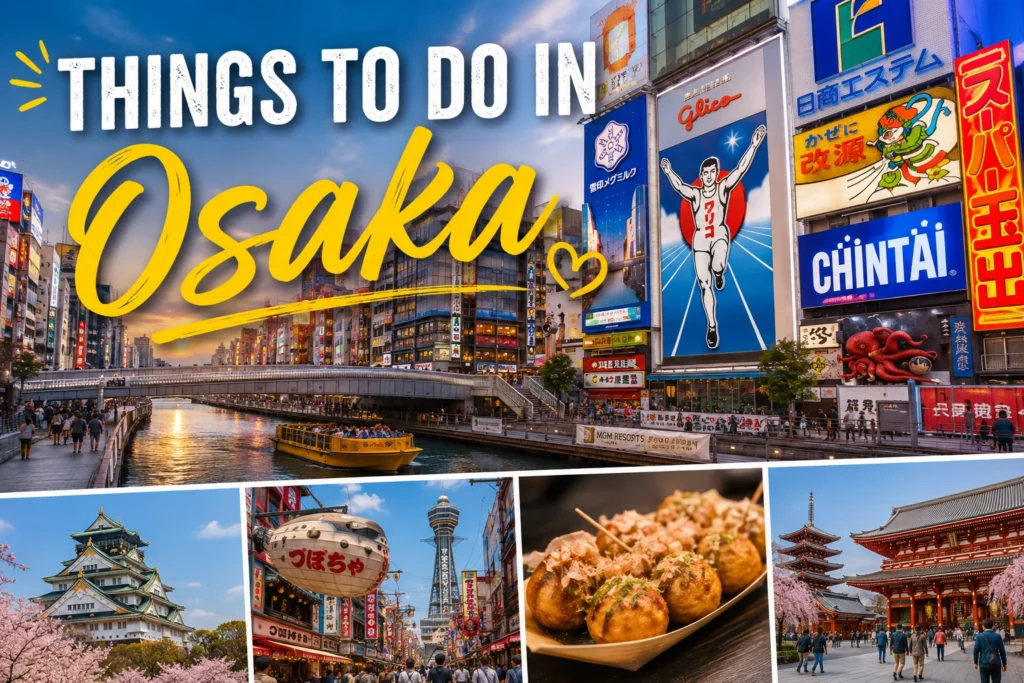
25 Best Things to Do in Osaka in 2026 (Complete City Guide)
By Sarah Mitchell | Travel Expert and Founder
I have planned Osaka trips for years, and the thing I tell everyone first is the one that surprises them most: this is Japan’s food capital, not Tokyo, and locals will tell you so without hesitation. Osaka is where takoyaki and okonomiyaki were invented, where the phrase “kuidaore” (eat until you drop) originated as the city’s unofficial motto, and where a 16th-century castle keep shares the skyline with Japan’s tallest building and Asia’s most-visited theme park. 2026 is a particularly good year to be here: Expo 2025 wrapped up on Yumeshima Island in October, and the transport upgrades and new waterfront infrastructure built for it are now fully bedded in, giving visitors better access to the bay with none of the Expo-year crowds.
This guide covers the 25 best things to do in Osaka in 2026, ordered the way I would actually plan a trip, with current prices, honest time estimates, and one genuinely useful fact nobody explains clearly enough: the weak yen has made Osaka one of the cheapest major Asian cities for overseas visitors right now, and a comfortable daily budget for food and transport runs roughly ¥7,000 to ¥10,000 per person, excluding accommodation. For more of Japan, see my things to do in Tokyo and things to do in Kyoto guides on Travel Destinations Plan.
Osaka At a Glance: Quick Reference Table
| # | Activity | Area | Entry | Duration | Best For | Best Time |
|---|---|---|---|---|---|---|
| 1 | Osaka Castle | Osaka Castle Park | ~¥1,200 | 2 to 3 hours | History lovers; first-timers | Morning; spring for cherry blossoms |
| 2 | Dotonbori | Minami | Free to walk | 2 to 4 hours | All visitors; foodies; nightlife | Evening for the neon |
| 3 | Universal Studios Japan | Osaka Bay | ~¥8,600-9,800 | Full day | Families; theme park fans | Weekday; book Express Pass ahead |
| 4 | Kuromon Ichiba Market | Namba area | Free to enter | 1.5 to 2 hours | Foodies | Late morning |
| 5 | Osaka Aquarium Kaiyukan | Osaka Bay / Tempozan | ~¥2,700-3,700 | 2 to 3 hours | Families; marine life fans | Weekday mornings |
| 6 | Shinsekai & Tsutenkaku Tower | Tennoji area | ~¥900-1,000 (tower) | 1.5 to 2 hours | Retro atmosphere seekers; foodies | Late afternoon into evening |
| 7 | Abeno Harukas | Tennoji | ~¥2,000 (Harukas 300) | 1 hour | View seekers | Sunset |
| 8 | Umeda Sky Building | Kita / Umeda | ~¥2,000 | 1 hour | Views; couples | Sunset |
| 9 | Shitennoji Temple | Tennoji | ~¥300 (inner precinct) | 1 to 1.5 hours | History and culture lovers | Morning |
| 10 | Namba & Shinsaibashi shopping | Minami | Free to walk | 2 to 4 hours | Shoppers | Afternoon into evening |
| 11 | Dotonbori River Cruise | Minami | ~¥1,000 | 20 to 40 mins | Photographers; couples | Evening |
| 12 | Osaka street food crawl | Citywide, concentrated in Dotonbori & Shinsekai | Meals ~¥500-1,500 each | 2 to 3 hours | Foodies | Lunch and dinner |
| 13 | Sumiyoshi Taisha | South Osaka | Free | 1 hour | Shrine and history lovers | Morning |
| 14 | Nakanoshima | Between Kita and Minami | Free to walk | 1.5 to 2 hours | Architecture and culture lovers | Afternoon |
| 15 | Spa World | Tennoji area | ~¥1,500-3,000 | 2 to 4 hours | Relaxation seekers | Weekday afternoons |
| 16 | Tempozan Harbor Village & Ferris Wheel | Osaka Bay | Ferris wheel ~¥900 | 1.5 to 2 hours | Families; views | Sunset |
| 17 | Cup Noodles Museum (day trip) | Ikeda, ~30 mins | ~¥500 (make-your-own noodles extra) | 2 hours | Families; the curious | Weekday mornings |
| 18 | Osaka Museum of History | Near Osaka Castle | ~¥600 | 1.5 hours | History lovers | Anytime |
| 19 | Den Den Town | Nipponbashi | Free to walk | 1.5 to 2 hours | Anime and electronics fans | Afternoon |
| 20 | Nakazakicho | Kita, near Umeda | Free to walk | 1.5 to 2 hours | Coffee lovers; the curious | Late morning |
| 21 | Osaka Castle Illuminage | Osaka Castle Park | ~¥2,000 adults | 1.5 to 2 hours | Winter visitors; couples | Nightly, winter season |
| 22 | Yumeshima post-Expo waterfront | Osaka Bay | Varies by attraction | Half day | Architecture and design fans | Weekday |
| 23 | Kyoto day trip | ~30 mins by train | Train ~¥580 one-way | Full day | Culture and history lovers | Weekday; early start |
| 24 | Nara day trip | ~45 mins by train | Train ~¥570 one-way; park free | Full day | Families; wildlife and history lovers | Weekday morning |
| 25 | Himeji Castle day trip | ~1 hour by Shinkansen | ~¥1,000 castle entry | Full day | Architecture and history lovers | Weekday; spring for blossoms |
1. Osaka Castle
Area: Osaka Castle Park | Entry: ~¥1,200 | Duration: 2 to 3 hours | Best time: Morning; spring for cherry blossoms
Osaka Castle is the city’s defining landmark, a reconstructed 16th-century keep originally built by the warlord Toyotomi Hideyoshi, now housing an eight-floor history museum and an observation deck at the top with sweeping views over the castle park and the modern skyline beyond. The surrounding park, with its massive stone walls and moat, is one of the best cherry blossom spots in the city each spring.
Osaka Castle, a reconstructed 16th-century keep built by warlord Toyotomi Hideyoshi, houses an eight-floor museum with a rooftop observation deck. It is the single essential landmark and history experience in Osaka.
Practical tips:
- Budget a genuine two to three hours: an hour to 90 minutes inside the keep and Stone Wall Museum, plus time in the grounds and the walk from the station.
- Visit in spring if your dates allow; the cherry blossoms against the stone walls and moat are one of the most photographed scenes in the city.
- What I tell first-timers: pair a castle morning with Dotonbori in the evening. Ride the JR Loop Line south to Namba for dinner and neon, the classic first-day route.
2. Dotonbori
Area: Minami | Entry: Free to walk | Duration: 2 to 4 hours | Best time: Evening for the neon
Dotonbori is Osaka’s neon-soaked canal-side entertainment district, its skyline of oversized illuminated signboards (the running Glico Man is the most photographed of all of them) reflecting off the water alongside theaters, arcades, and some of the densest street food concentration in the country. It is the district that defines Osaka’s visual identity more than any other single place in the city.
Dotonbori’s neon signboards, anchored by the iconic running Glico Man sign, reflect off the canal to create Osaka’s most recognizable nighttime scene. It is the essential evening experience in the city.
Practical tips:
- Go at night specifically; the neon and the crowd energy are the entire point, and daytime Dotonbori is a different, far less atmospheric place.
- Stand on Ebisu-bashi Bridge for the classic photo angle looking down the canal toward the Glico sign.
- Combine with a river cruise (entry 11) and a street food crawl (entry 12), both of which operate directly in this same district.
3. Universal Studios Japan
Area: Osaka Bay, Universal City Station | Entry: ~¥8,600-9,800 one-day pass; Express Passes ~¥4,500-14,000-plus | Duration: Full day | Best time: Weekdays; book an Express Pass ahead for weekends and holidays
Universal Studios Japan is Asia’s most-visited theme park, home to Super Nintendo World, the Wizarding World of Harry Potter complete with a full-scale Hogwarts Castle, Jurassic World, Minion Park, and rotating Universal Cool Japan events built around anime franchises like Demon Slayer and Jujutsu Kaisen. The Donkey Kong Country expansion is now in its first full year, adding a genuinely major new land to the park’s Nintendo offerings.
Universal Studios Japan is Asia’s most-visited theme park, combining Super Nintendo World, a full-scale Hogwarts Castle, and the newly established Donkey Kong Country expansion. It is the best single-day theme park experience in Japan.
Practical tips:
- Book an Express Pass for weekends and holidays; the wait times for Super Nintendo World’s headline rides regularly exceed two hours without one.
- The park runs rotating Universal Cool Japan events tied to popular anime series; check the current lineup before your visit if a specific franchise matters to you.
- Budget the entire day. Between Super Nintendo World, the Wizarding World, and the newer Donkey Kong Country land, rushing means missing entire sections.
4. Kuromon Ichiba Market
Area: Near Namba, Minami | Entry: Free to enter | Duration: 1.5 to 2 hours | Best time: Late morning
Kuromon Ichiba Market is a roughly 600-metre covered market street that has served as Osaka’s kitchen since the Edo period, with stalls selling fresh seafood, wagyu skewers, and produce alongside counters where you can eat what you just bought standing at the stall. It is the most concentrated, most walkable food market experience in the city.
Kuromon Ichiba Market’s 600 metres of covered stalls have served as Osaka’s kitchen since the Edo period, with fresh seafood and wagyu available to eat on the spot. It is the best single-stop food market in the city.
Practical tips:
- Eat as you go; most stalls sell single portions meant to be consumed standing right there, so pace yourself across multiple vendors rather than filling up at the first one.
- Fresh uni, grilled scallops, and wagyu skewers are the specific things to seek out here over generic tourist snacks.
- Late morning avoids both the breakfast rush and the lunchtime crowds that build by early afternoon.
5. Osaka Aquarium Kaiyukan
Area: Osaka Bay, Tempozan | Entry: ~¥2,700-3,700 adults | Duration: 2 to 3 hours | Best time: Weekday mornings
Kaiyukan is one of the largest and best-designed aquariums in the world, built around a central Pacific Ocean tank nine metres deep holding 5,400 cubic metres of water, home to whale sharks, manta rays, and thousands of fish visible from a spiraling walkway that descends past every major ocean habitat on the way down.
Kaiyukan’s central Pacific Ocean tank, nine metres deep and holding 5,400 cubic metres of water, contains whale sharks and manta rays visible from a spiraling descending walkway. It is one of the best-designed aquariums in the world.
Practical tips:
- The spiral design means you naturally pass every major tank on a single downward route; there is no need for a separate map or plan.
- Weekday mornings are significantly calmer than weekend afternoons, when the aquarium draws heavy family crowds.
- Combine it with Tempozan Harbor Village and the Ferris wheel (entry 16), both immediately adjacent on the same waterfront.
6. Shinsekai & Tsutenkaku Tower
Area: Tennoji area | Entry: Free to walk; tower observation deck ~¥900-1,000 | Duration: 1.5 to 2 hours | Best time: Late afternoon into evening
Shinsekai (“New World”) is Osaka’s retro entertainment district, built in the early 20th century around Tsutenkaku Tower, its streets lined with old-fashioned kushikatsu (deep-fried skewer) restaurants and a specific nostalgic character that contrasts sharply with the city’s more modern districts. The tower’s observation deck gives a view over this district and toward the modern skyline beyond.
Shinsekai, Osaka’s early 20th-century retro district built around Tsutenkaku Tower, is the best place in the city for classic kushikatsu skewers and old-fashioned Osaka atmosphere. It is a genuine time capsule within a modern city.
Practical tips:
- Eat kushikatsu here specifically; the district’s specific style, dip-and-eat skewers with a shared communal sauce (never double-dip, a firmly enforced local rule) originated in these streets.
- Late afternoon into evening shows the district at its most atmospheric, when the retro signage lights up.
- Combine with a walk to Shitennoji Temple (entry 9), a short distance away in the same general Tennoji area.
7. Abeno Harukas
Area: Tennoji | Entry: ~¥2,000 for the Harukas 300 observation deck | Duration: 1 hour | Best time: Sunset
Abeno Harukas is the tallest building in Japan at 300 metres, its Harukas 300 observation deck on the top floors giving the highest unobstructed view in the country, stretching across the entire Osaka plain toward the mountains and, on clear days, as far as Kyoto and Kobe.
Abeno Harukas, Japan’s tallest building at 300 metres, offers the highest observation deck view in the country from its top-floor Harukas 300. It is the best single elevated view in Osaka.
Practical tips:
- Go for sunset; the deck’s height means you catch both the daylight cityscape and the transition into Osaka’s illuminated night skyline in one visit.
- The building also contains a large department store and museum at lower floors, worth combining with the observation deck ticket if time allows.
- It sits directly above Tennoji Station, making it one of the most transit-convenient attractions in the city.
8. Umeda Sky Building
Area: Kita / Umeda | Entry: ~¥2,000 | Duration: 1 hour | Best time: Sunset
The Umeda Sky Building is one of the most architecturally distinctive structures in Osaka, two towers connected at the top by a “Floating Garden Observatory,” an open-air rooftop deck reached by a glass escalator that itself is part of the experience, giving 360-degree views over the northern half of the city.
The Umeda Sky Building’s Floating Garden Observatory connects two towers via an open-air rooftop deck reached by a dramatic glass escalator. It is the most architecturally unique viewpoint in Osaka.
Practical tips:
- The glass escalator ride up to the observatory is itself a memorable part of the experience, not just a means of transport.
- Sunset timing gives the best light over the Kita district and the Yodo River below.
- It sits a short walk from Osaka Station, making it easy to combine with Umeda shopping or a Kita district evening.
9. Shitennoji Temple
Area: Tennoji | Entry: Free for the outer grounds; ~¥300 for the inner precinct | Duration: 1 to 1.5 hours | Best time: Morning
Shitennoji is one of Japan’s oldest formally administered Buddhist temples, originally founded in 593 CE by Prince Shotoku, making it a genuinely significant site in the early history of Buddhism’s arrival in Japan, even though the current buildings are reconstructions following historical fires. Its five-story pagoda and central gate follow the original layout with remarkable historical fidelity.
Shitennoji, founded in 593 CE, is one of Japan’s oldest formally administered Buddhist temples, marking a foundational moment in the religion’s early history in the country. It is the most historically significant temple site in Osaka.
Practical tips:
- The inner precinct’s small entry fee grants access to the pagoda and main hall interiors, worth paying for beyond just viewing the grounds for free.
- Morning visits give the calmest, most contemplative experience before tour groups arrive later in the day.
- Combine with Shinsekai (entry 6), which sits within walking distance in the same Tennoji area.
10. Namba & Shinsaibashi Shopping
Area: Minami | Entry: Free to walk | Duration: 2 to 4 hours | Best time: Afternoon into evening
Namba and the adjoining Shinsaibashi-suji covered shopping arcade form Osaka’s primary shopping and entertainment core, a dense network of department stores, boutiques, and the Namba Parks complex, all connected by covered arcades that make shopping here comfortable regardless of Osaka’s frequent summer rain.
Namba and Shinsaibashi-suji form Osaka’s primary shopping district, a covered arcade network connecting department stores and boutiques that stays comfortable in any weather. It is the best shopping destination in the city.
Practical tips:
- The covered arcades mean this is a genuinely good rainy-day plan when Osaka’s summer showers disrupt outdoor sightseeing elsewhere.
- Namba Parks, a large shopping complex with rooftop gardens, is worth a specific stop beyond the main arcade strip.
- It connects directly into Dotonbori, making the two a natural single afternoon-into-evening combination.
11. Dotonbori River Cruise
Area: Minami | Entry: ~¥1,000 | Duration: 20 to 40 minutes | Best time: Evening
A short cruise along the Dotonbori River gives a water-level perspective on the district’s famous neon signage, with departures roughly every 30 minutes from 1 PM to 9 PM daily and lively onboard commentary included. The evening runs, when the neon reflects fully onto the dark water, are the version worth prioritizing.
A Dotonbori River Cruise offers a water-level view of the district’s famous neon signage, with the evening departures showing the full reflected light show on the water. It is the best short, affordable way to see Dotonbori from a different angle.
Practical tips:
- Time your ride for after dark specifically; the neon reflection on the water is the entire reason to take this over simply walking the canal-side path.
- At roughly ¥1,000, it is one of the cheapest organized experiences in this entire guide relative to what it delivers.
- Combine it with dinner in Dotonbori before or after, since the departure points sit directly within the district.
12. Osaka Street Food Crawl
Area: Citywide, concentrated in Dotonbori and Shinsekai | Entry: Individual items ~¥500-1,500 | Duration: 2 to 3 hours | Best time: Lunch and dinner
Osaka’s food identity rests on three specific dishes: takoyaki (batter balls filled with diced octopus, cooked in a special molded pan and topped with sauce, mayo, and bonito flakes), okonomiyaki (a savory cabbage pancake, sometimes called Japanese pizza, though the comparison undersells it), and kushikatsu (breaded, deep-fried skewers of meat and vegetables, dipped in a shared communal sauce). Eating your way through all three is as essential as any single landmark on this list.
Osaka’s culinary identity centers on takoyaki, okonomiyaki, and kushikatsu, three dishes either invented here or perfected here. Eating through all three is the most essential food experience in the city.
Practical tips:
- Try takoyaki from a stall with a visible queue of locals rather than the most tourist-facing storefront; the wait is usually the best signal of quality.
- The kushikatsu “no double-dipping” rule in the shared sauce container is strictly enforced social etiquette; use the provided cabbage to scoop extra sauce instead.
- What I tell first-timers: order okonomiyaki “Osaka-style” specifically, since Hiroshima’s version (layered rather than mixed) is a genuinely different dish despite the same name.
13. Sumiyoshi Taisha
Area: South Osaka | Entry: Free | Duration: 1 hour | Best time: Morning
Sumiyoshi Taisha is one of Japan’s oldest Shinto shrines, its distinctive architectural style (Sumiyoshi-zukuri) predating the Buddhist influence visible in most later Japanese shrine architecture, making its straight-lined, unpainted wooden halls a genuinely different visual experience from more elaborately decorated shrines elsewhere in Japan.
Sumiyoshi Taisha’s distinctive Sumiyoshi-zukuri architectural style predates Buddhist influence on Japanese shrine design, giving it a starkly different visual character from more ornate shrines. It is the most architecturally significant Shinto shrine in Osaka.
Practical tips:
- The iconic arched bridge (Sorihashi) at the shrine’s entrance is one of the most photographed single structures in the city; morning light gives the best photos with fewer people crossing it.
- It is less visited by international tourists than Osaka’s more famous landmarks, giving a calmer, more contemplative experience.
- Free admission makes it an easy addition to a South Osaka day without any budget consideration.
14. Nakanoshima
Area: Between Kita and Minami, on the river islands | Entry: Free to walk | Duration: 1.5 to 2 hours | Best time: Afternoon
Nakanoshima is a narrow island district between two branches of the Yodo River, holding a mix of early 20th-century Western-style architecture (including the domed Central Public Hall) alongside contemporary museums and a riverside rose garden, giving the most architecturally varied walk in central Osaka.
Nakanoshima’s river island setting combines early 20th-century Western-style architecture with contemporary museums and a riverside rose garden. It is the most architecturally diverse walking district in central Osaka.
Practical tips:
- The Nakanoshima Rose Garden, free to enter, is at its best in May and October when the roses are in full bloom.
- The Central Public Hall’s illuminated dome at night is one of the most elegant free sights in the city.
- It sits conveniently between Kita and Minami, making it a natural midday stop when moving between the two main districts.
15. Spa World
Area: Tennoji area | Entry: ~¥1,500-3,000 depending on time and package | Duration: 2 to 4 hours | Best time: Weekday afternoons
Spa World is a large indoor onsen (hot spring) complex with themed bathing floors representing different world regions (European and Asian zones that rotate between genders monthly), plus a water park section, making it one of the most accessible ways for visitors unfamiliar with traditional onsen etiquette to experience Japanese bathing culture in a tourist-friendly format.
Spa World’s themed bathing floors, representing different world regions, offer visitors an accessible introduction to Japanese onsen culture in a large indoor complex. It is the best bathing experience for onsen newcomers.
Practical tips:
- Tattoos are still restricted in some traditional onsen in Japan; Spa World is generally more accommodating, but check current policy before visiting if this applies to you.
- The zones rotate between male and female access monthly, so which specific themed area you experience depends on your visit date.
- Weekday afternoons are calmer than weekend visits, when the complex draws significant local family traffic.
16. Tempozan Harbor Village & Ferris Wheel
Area: Osaka Bay | Entry: Ferris wheel ~¥900 | Duration: 1.5 to 2 hours | Best time: Sunset
Tempozan Harbor Village is Osaka Bay’s waterfront leisure complex, anchored by a large Ferris wheel offering panoramic views over the bay, Kaiyukan aquarium next door, and a shopping and dining mall, making it a natural single-stop combination with the aquarium visit.
Tempozan Harbor Village combines a large bayfront Ferris wheel with shopping, dining, and direct access to Kaiyukan aquarium next door. It is the most convenient waterfront combination stop in Osaka.
Practical tips:
- Ride the Ferris wheel at sunset for the best light over Osaka Bay and the distant skyline.
- Combine it directly with Kaiyukan (entry 5), since both sit within a few minutes’ walk of each other on the same waterfront.
- The mall here has a good range of casual dining options, useful for a meal between bay-area activities.
17. Cup Noodles Museum (Day Trip)
Area: Ikeda, about 30 minutes from central Osaka | Entry: ~¥500 for the museum; the make-your-own noodle experience is a separate small fee | Duration: 2 hours | Best time: Weekday mornings
The Cup Noodles Museum in Ikeda, on the outskirts of the Osaka metro area, documents the invention of instant ramen by Momofuku Ando, with an interactive workshop where visitors design and package their own custom cup of instant noodles to take home, making it one of the most specifically fun, hands-on small museums in the region.
The Cup Noodles Museum in Ikeda documents the invention of instant ramen and lets visitors design their own custom cup noodle to take home. It is the most specifically fun hands-on museum near Osaka.
Practical tips:
- Book the make-your-own noodle workshop slot ahead if possible; it is the highlight of the visit and can fill up on busy days.
- It is a short train ride from central Osaka, making it an easy half-day addition rather than a full day trip commitment.
- Great for families with kids specifically, given the hands-on, tactile nature of the noodle-making activity.
18. Osaka Museum of History
Area: Near Osaka Castle | Entry: ~¥600 | Duration: 1.5 hours | Best time: Anytime
The Osaka Museum of History occupies a modern building with upper-floor windows offering a direct view onto Osaka Castle, and its exhibits trace the city’s history from ancient times, including excavated remains of the 7th-century Naniwa Palace beneath the building itself, through the Edo period merchant city that gave Osaka its enduring commercial character.
The Osaka Museum of History displays excavated remains of the 7th-century Naniwa Palace beneath the building, with upper floors offering direct views onto Osaka Castle. It is the best place to understand the city’s deep history alongside its most famous landmark.
Practical tips:
- The castle view from the upper floors is worth timing your visit around, since it frames the castle in a way street-level photography cannot replicate.
- It sits close enough to Osaka Castle to combine both in one morning without significant additional travel time.
- The excavated palace remains beneath the building give tangible, walkable context to Osaka’s history before the castle era.
19. Den Den Town
Area: Nipponbashi | Entry: Free to walk | Duration: 1.5 to 2 hours | Best time: Afternoon
Den Den Town is Osaka’s version of Tokyo’s Akihabara, a district of electronics shops, anime and manga stores, and collectible retailers spread across several blocks in Nipponbashi. It is smaller and generally less crowded than its Tokyo counterpart, making it a more relaxed browsing experience for the same category of specialty shopping.
Den Den Town is Osaka’s answer to Akihabara, a district of electronics and anime shops that is smaller and less crowded than its Tokyo counterpart. It is the best specialty shopping destination for anime and electronics fans.
Practical tips:
- It is genuinely quieter than Akihabara, making it a more comfortable browsing experience if you have already visited Tokyo’s equivalent district.
- Several shops specialize specifically in vintage and used collectibles, worth checking for anyone seeking rarer items.
- Afternoon hours show the district at its most active, with most specialty shops opening later than typical retail hours.
20. Nakazakicho
Area: Kita, near Umeda | Entry: Free to walk | Duration: 1.5 to 2 hours | Best time: Late morning
Nakazakicho is Osaka’s bohemian, low-key neighborhood of narrow lanes lined with independent cafes, vintage shops, and converted old wooden houses, sitting in surprising contrast just steps from Umeda’s high-rise business district. It is the closest thing Osaka has to a hipster enclave, and most tourists never find it.
Nakazakicho’s narrow lanes of independent cafes and vintage shops sit in quiet contrast to nearby Umeda’s high-rises. It is Osaka’s most overlooked bohemian neighborhood.
Practical tips:
- Spend a slow late morning here over coffee at one of the converted old-house cafes rather than rushing through as a photo stop.
- It is a short walk from Umeda Station, making it an easy addition to a Kita district day without extra transit time.
- Where I send repeat Osaka visitors: here, once the major landmarks are checked off, for a genuinely different neighborhood texture.
21. Osaka Castle Illuminage
Area: Osaka Castle Park | Entry: ~¥2,000 adults, ~¥1,000 children | Duration: 1.5 to 2 hours | Best time: Nightly through the winter season
Osaka Castle Illuminage transforms the castle grounds into a nighttime light display each winter, running nightly from 5 PM to 10 PM (lights ending at 9:30 PM), with an “Osaka Illumination Tourist Spot Series” extending the theme to landmarks like Tsutenkaku and Dotonbori, including a specifically playful three-dimensional illuminated takoyaki display.
Osaka Castle Illuminage transforms the castle grounds into a nightly winter light display, including a three-dimensional illuminated takoyaki sculpture. It is the best seasonal event for a winter Osaka visit.
Practical tips:
- Special Christmas-period tickets are required for entry between December 21 and 25, when visitor numbers peak significantly; book ahead for these specific dates.
- The illuminated castle keep itself, lit against the night sky, is the visual centerpiece worth prioritizing if your time at the event is limited.
- Combine with dinner in the nearby Kyobashi area before or after, since the castle park sits within reasonable walking or transit distance.
22. Yumeshima Post-Expo Waterfront
Area: Osaka Bay, Yumeshima Island | Entry: Varies by specific attraction | Duration: Half day | Best time: Weekday
Yumeshima Island hosted Expo 2025 Osaka from April to October 2025, and 2026 is genuinely the first full post-Expo year: the transport upgrades and waterfront infrastructure built for the exposition are now fully operational, giving visitors improved access to the bay area without the massive Expo-year crowds that defined the site throughout 2025.
Yumeshima Island’s Expo 2025 infrastructure, now fully bedded in for 2026, gives visitors improved access to Osaka Bay’s waterfront attractions without the exposition-era crowds. It is the best time to explore this area since the transport upgrades were built.
Practical tips:
- Check current attraction status on Yumeshima specifically, since post-Expo redevelopment plans for the site continue to evolve through 2026.
- The improved bay-area transit connections make combining this with Kaiyukan and Tempozan Harbor Village (entries 5 and 16) more convenient than in prior years.
- This is a genuinely evolving area; treat any specific attraction claims as worth verifying closer to your travel dates.
23. Kyoto Day Trip
Area: About 30 minutes by train from Osaka | Entry: Train ~¥580 one-way | Duration: Full day | Best time: Weekday; early start
Kyoto, Japan’s former imperial capital, sits close enough to Osaka for an easy day trip, with Fushimi Inari Shrine’s thousands of vermillion torii gates, the historic Gion geisha district, and Kinkaku-ji’s golden pavilion all reachable within a single well-planned day, though the city genuinely rewards a multi-day visit if your schedule allows.
Kyoto, Japan’s former imperial capital, is just 30 minutes from Osaka by train, making its temples, shrines, and historic districts an easy and essential day trip. It is the most rewarding single day trip from Osaka.
Practical tips:
- Start early, ideally arriving by opening time at Fushimi Inari, since it is free, always open, and becomes genuinely crowded by mid-morning.
- Pick two or three specific sites rather than attempting a comprehensive Kyoto tour in a single day; the city rewards depth over breadth.
- The train connection is frequent and fast, making this one of the lowest-effort, highest-reward day trips available from any major city in Japan.
24. Nara Day Trip
Area: About 45 minutes by train from Osaka | Entry: Train ~¥570 one-way; Nara Park is free | Duration: Full day | Best time: Weekday morning
Nara, another former Japanese capital, is famous for Nara Park’s population of more than 1,000 free-roaming deer, considered sacred messengers in Shinto tradition and accustomed enough to visitors to bow for the specific “shika senbei” deer crackers sold throughout the park, alongside Todai-ji Temple’s massive bronze Buddha statue, one of the largest in the world.
Nara Park’s more than 1,000 free-roaming, bowing deer, alongside Todai-ji Temple’s massive bronze Buddha, make it one of the most distinctive day trips in Japan. It is the best combination of wildlife and history near Osaka.
Practical tips:
- Buy deer crackers from the designated vendors in the park; the deer are genuinely accustomed to this specific interaction and many will bow for a cracker.
- Todai-ji’s Great Buddha Hall is the largest wooden building in the world by some historical measures and worth the modest separate entry fee.
- Weekday mornings give the calmest experience with both the deer and the temple grounds before tour bus groups arrive in force.
25. Himeji Castle Day Trip
Area: About 1 hour by Shinkansen from Osaka | Entry: ~¥1,000 | Duration: Full day | Best time: Weekday; spring for cherry blossoms
Himeji Castle is Japan’s most spectacular surviving original castle, a UNESCO World Heritage Site nicknamed the White Heron Castle for its brilliant white plastered exterior, and unlike Osaka Castle’s modern concrete reconstruction, Himeji’s main keep is the genuine 17th-century wooden structure, making it the most historically authentic castle experience within easy reach of Osaka.
Himeji Castle, a UNESCO World Heritage Site and Japan’s most spectacular original castle, retains its genuine 17th-century wooden structure unlike Osaka Castle’s modern reconstruction. It is the most historically authentic castle day trip from Osaka.
Practical tips:
- The Shinkansen connection makes this a fast, comfortable day trip despite the greater distance compared to Kyoto or Nara.
- Spring cherry blossom season against the castle’s white walls is spectacular and, correspondingly, the most crowded time to visit.
- Budget real time for the climb through the castle’s original wooden interior; the multiple floors and steep traditional staircases take longer to navigate than a modern building of similar size.
Osaka Practical Guide
Getting Around Osaka
Osaka’s subway and JR Loop Line cover the city efficiently, with the Midosuji subway line connecting most major districts (a single ride costs roughly ¥190-240). The Osaka Amazing Pass, covering unlimited subway rides plus free entry to more than 20 paid attractions, is genuinely worth considering if you plan to hit several ticketed sights in a single day. Most of central Osaka’s headline attractions, Osaka Castle, Kuromon Market, Shitennoji, Shinsekai, and Dotonbori, can realistically be covered in one busy day using this transit network.
One thing I always tell first-timers in 2026 specifically: the weak yen has made Osaka one of the most affordable major Asian cities for overseas visitors right now. Mid-range hotels run roughly ¥10,000 to ¥18,000 per night, and a comfortable daily food and transport budget sits around ¥7,000 to ¥10,000 per person. Book accommodation two to three months ahead for spring and autumn travel, since both seasons draw the heaviest domestic and international demand.
Where to Stay in Osaka
Namba / Dotonbori (Minami): Walkable to the neon district, Kuromon Market, and the best nightlife. Best for first-timers wanting to be in the center of the action.
Osaka Castle area / Kyobashi: Quieter, mid-range pricing, with direct castle access, though requiring a short metro ride to the entertainment districts. Best for travelers prioritizing history and a calmer base.
Osaka Bay / near Universal Studios: Convenient for families spending multiple days at the theme park, though with fewer walkable attractions beyond the park itself. Best for USJ-focused visits.
Osaka Budget Guide
Budget traveler (budget hotel or hostel, free attractions like Dotonbori, Sumiyoshi Taisha, and Nakanoshima, street food meals, subway pass): roughly ¥8,000 to ¥14,000 per day (excluding accommodation). Osaka’s food-forward culture makes eating well on a budget genuinely easy.
Mid-range traveler (comfortable hotel, Osaka Castle and one major museum, a Universal Studios day, sit-down dining): roughly ¥20,000 to ¥35,000 per day, with the USJ ticket as the single biggest cost if included.
Higher-spend traveler (upscale hotel, Universal Studios with Express Pass, fine dining, a Kyoto or Himeji day trip by Shinkansen): ¥45,000 or more per day, driven mainly by premium theme park access and dining.
Frequently Asked Questions About Osaka
How many days do you need in Osaka? Two to three days covers Osaka Castle, Dotonbori, Kuromon Market, Shinsekai, and one observation deck comfortably. Four to five days lets you add Universal Studios Japan (a full day on its own), Kaiyukan, and one day trip to Kyoto, Nara, or Himeji.
Is Osaka expensive to visit? No. Osaka is one of the cheapest major Asian cities for overseas visitors in 2026, helped significantly by the weak yen. Mid-range hotels run ¥10,000 to ¥18,000 per night, takoyaki costs around ¥600, a ramen lunch runs ¥1,000 to ¥1,200, and a comfortable daily food and transport budget is roughly ¥7,000 to ¥10,000 per person.
What is Osaka most famous for? Its food culture (takoyaki, okonomiyaki, and kushikatsu all trace their origins here), Osaka Castle, Dotonbori’s neon entertainment district, Universal Studios Japan, and its reputation as Japan’s most food-obsessed, friendliest, and least formal major city.
What happened to Expo 2025 in Osaka? Expo 2025 Osaka ran from April 13 to October 13, 2025, on Yumeshima Island, and has now concluded. 2026 is the first full post-Expo year, with the transport upgrades and waterfront infrastructure built for the exposition now fully operational and available to visitors without the Expo-year crowds.
Do I need to book Osaka attractions in advance? Book an Express Pass for Universal Studios Japan if visiting on a weekend or holiday; wait times for headline rides can exceed two hours otherwise. Most other attractions, Osaka Castle, the observation decks, and the markets, do not require advance booking outside of peak holiday periods like the Osaka Castle Illuminage’s Christmas dates.
Is a car necessary in Osaka? No. Osaka’s subway, JR Loop Line, and extensive walkable districts cover the entire city efficiently, and a car is unnecessary and impractical given the dense urban layout and limited parking. Day trips to Kyoto, Nara, and Himeji are all easily reached by train without a car.
The Final Word
If you take one thing from this guide, take this: Osaka rewards visitors who come hungry, literally. This is the city that invented takoyaki and okonomiyaki, coined the phrase “eat until you drop” as a civic motto, and consistently ranks its food culture above even its considerable historical and architectural attractions. Build the trip around eating, and everything else, the castle, the neon, the aquarium, becomes the excellent supporting cast to what is genuinely the main event.
Where I would spend the money: a full day at Universal Studios Japan with an Express Pass if visiting on a weekend, Osaka Castle’s museum and observation deck, and one proper kushikatsu dinner in Shinsekai. Where the magic is free or nearly free: Dotonbori after dark, Kuromon Market’s grazing lunch, Sumiyoshi Taisha’s distinctive shrine architecture, and a slow morning in Nakazakicho’s overlooked cafes. The mistake I watch visitors make is treating Osaka as a quick Kyoto add-on rather than a destination in its own right. Give it its own three days, and the food alone will make the case for why locals insist their city, not Tokyo, is where Japan actually eats.
Have an Osaka tip I missed, or a favorite takoyaki stall, or an opinion on Kyoto versus Nara for a single day trip? Tell me in the comments. I update this guide as prices, seasons, and the post-Expo waterfront continue to develop.
For more Japan and Asia travel guides, visit Travel Destinations Plan.