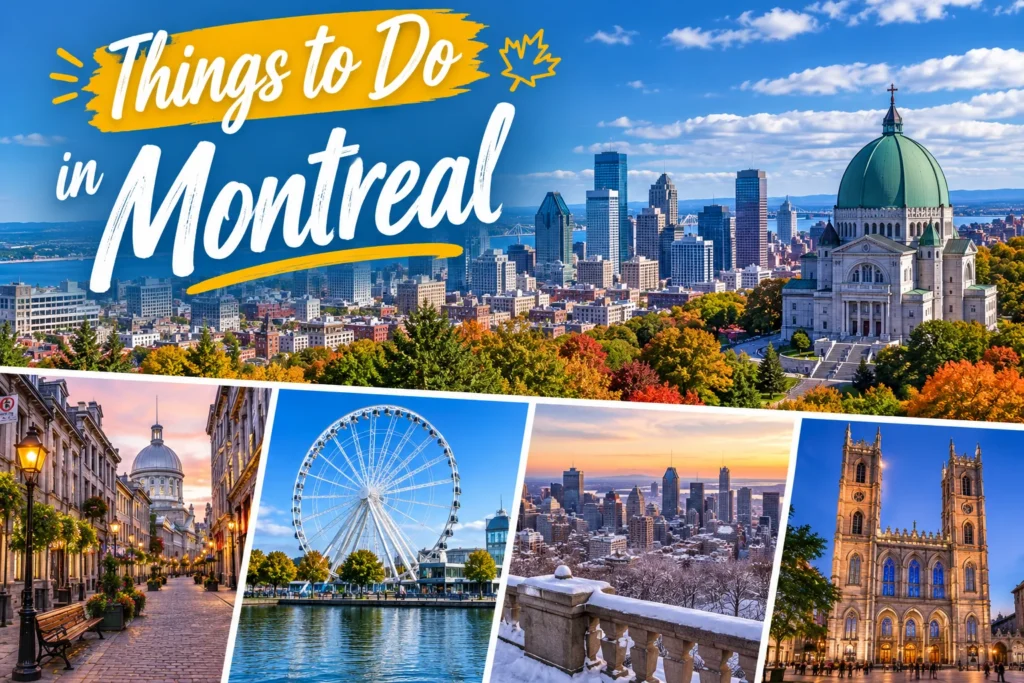
25 Best Things to Do in Montreal in 2026 (Complete City Guide)
By Sarah Mitchell | Travel Expert and Founder
I have planned Montreal trips for years, and the thing I tell everyone first is the one that changes how they think about the city: this is not “Canada’s Paris.” It is something more interesting than that. Montreal is the most specifically bilingual city in North America, where conversations switch between French and English mid-sentence, menus are in French with the translation occasionally optional, and the cultural life swings between the Francophone majority and the Anglophone minority in a way that produces something genuinely unlike anywhere else on the continent. It is also shockingly affordable for what it delivers: a world-class Jazz Festival that is mostly free, a smoked-meat sandwich that costs $15, a 470-acre park designed by the creator of Central Park, and a 33-kilometre underground city that lets you traverse the downtown core in winter without ever putting on a coat.
2026 is a landmark year: the Montreal International Jazz Festival’s 46th edition (June 25 to July 4) marks what would have been the 100th birthdays of Miles Davis, John Coltrane, and Tony Bennett, all born in 1926. Two-thirds of 350-plus shows are free. This guide covers the 25 best things to do in Montreal in 2026, with current prices, honest time estimates, and the practical details most guides skip. For more of the region, see my things to do in New York and things to do in Toronto guides on Travel Destinations Plan.
Montreal At a Glance: Quick Reference Table
| # | Activity | Area | Entry (CAD) | Duration | Best For | Best Time |
|---|---|---|---|---|---|---|
| 1 | Notre-Dame Basilica & AURA | Old Montreal | ~$16 day; AURA ~$30-37; combo from $45 | 1.5 to 2 hours | All visitors; first-timers | Book AURA ahead; evening |
| 2 | Old Montreal (Vieux-Montréal) | Old Montreal | Free to walk | 2 to 3 hours | History lovers; couples | Morning or evening |
| 3 | Mount Royal Park | Central | Free | 1.5 to 3 hours | All visitors; nature lovers | Dawn year-round; winter for snowshoeing |
| 4 | Montreal International Jazz Festival | Quartier des Spectacles | Free outdoor; ticketed indoor | Full evening | Music lovers; all visitors | June 25 to July 4, 2026 |
| 5 | Jean-Talon Market | Little Italy | Free to enter | 1 to 2 hours | Foodies | Saturday mornings |
| 6 | Schwartz’s Deli | Plateau-Mont-Royal | ~$14-16 sandwich | 1 hour | Foodies; tradition seekers | Off-peak hours to skip the queue |
| 7 | Mile End neighborhood | Mile End | Free to walk | 2 to 3 hours | Culture seekers; foodies; music fans | Morning for bagels; evening for bars |
| 8 | Plateau-Mont-Royal | Plateau | Free to walk | 2 to 3 hours | Locals’ Montreal; couples | Weekend afternoons |
| 9 | Montreal Biodome | Olympic Park | ~$22-25 adults | 2 to 3 hours | Families; nature lovers | Anytime |
| 10 | Montreal Museum of Fine Arts | Golden Square Mile | Check mbam.qc.ca | 2 to 3 hours | Art lovers | Weekday mornings |
| 11 | Pointe-à-Callière Museum | Old Montreal | ~$20-25 adults | 1.5 to 2 hours | History lovers | Anytime |
| 12 | Saint Joseph’s Oratory | Côte-des-Neiges | Free | 1 to 1.5 hours | Architecture; spiritual seekers | Weekday mornings |
| 13 | Underground City (RÉSO) | Downtown | Free to walk | 1 to 2 hours | All visitors; winter escape | Winter especially |
| 14 | Lachine Canal cycling | Old Port to Lachine | Bike hire from ~$10/hour | 2 to 4 hours | Cyclists; families | May to October |
| 15 | Old Port (Vieux-Port) | Waterfront | Free to walk; activities vary | 1.5 to 2 hours | Families; couples | Summer evenings; winter ice rink |
| 16 | St-Viateur Bagel | Mile End | ~$2 per bagel | 30 mins | Foodies; early risers | Anytime (open 24 hours) |
| 17 | Quartier des Spectacles | Downtown | Free outdoor events | 1 to 3 hours | Festival and culture lovers | Summer festival season |
| 18 | Atwater Market | Saint-Henri | Free to enter | 1 to 1.5 hours | Foodies; local atmosphere | Saturday mornings |
| 19 | Montreal Botanical Garden | Olympic Park | ~$22 adults | 2 to 3 hours | Nature and garden lovers | Summer; fall for lanterns |
| 20 | Parc Jean-Drapeau | Île Sainte-Hélène | Free to enter; activities vary | Half day | Families; outdoor lovers | Summer |
| 21 | Just for Laughs Festival | Quartier des Spectacles | Free outdoor; ticketed indoor | Full evening | Comedy lovers | July (check hahaha.com) |
| 22 | La Grande Roue de Montréal | Old Port | Check lagranderoue.com | 30 to 45 mins | Views; couples | After dark |
| 23 | Habitat 67 (exterior) | Cité du Havre | Free to view exterior | 30 mins | Architecture fans | Anytime |
| 24 | Tam-Tams at Mount Royal | Monument on Mount Royal | Free | 2 to 3 hours | Locals’ Montreal; families | Sundays, warm months |
| 25 | Igloofest | Old Port | ~$30-50 per night | Full evening | Nightlife; electronic music fans | January to February |
1. Notre-Dame Basilica & the AURA Experience
Area: Old Montreal, Place d’Armes | Entry: Day visit ~CAD$16 adults; AURA ~$30-37 adults; combined day + AURA from $45 | Duration: 1.5 to 2 hours (day visit plus AURA) | Best time: Book AURA online ahead; evening shows
Notre-Dame Basilica is the most spectacular church interior in North America: a neo-Gothic nave painted deep cobalt blue and studded with gold stars, walls covered in hand-carved gilded wood, and the Casavant Brothers pipe organ towering behind the altar. The AURA Experience, a 25-minute immersive sound and light show by Moment Factory, projects onto the basilica’s interior after dark and has drawn over a million visitors since its launch.
Notre-Dame Basilica has the most theatrically beautiful church interior in North America, and the AURA night show by Moment Factory transforms it with projections and light. The combined day visit plus AURA package (from $45) is the best single-attraction value in Montreal.
Practical tips:
- Book the AURA Experience online before visiting. After 4 PM, all AURA tickets must be purchased online, and it sells out regularly in summer and during Jazz Festival week.
- The combined day visit plus AURA package (from $45, a 12% savings) is the best value: see the basilica by day, return for the light show in the evening, and understand the building in two registers.
- What I always do: see the basilica in the morning for the natural light on the carvings, then return for AURA after dinner in Old Montreal.
2. Old Montreal (Vieux-Montréal)
Area: Waterfront, south of downtown | Entry: Free to walk | Duration: 2 to 3 hours | Best time: Early morning or evening
Old Montreal is the original French colonial settlement: the cobblestone streets, the 1693 Sulpician Seminary (the oldest building in Montreal), Place d’Armes with its statue of the city’s founder Paul de Chomedey, Rue Saint-Paul lined with 18th-century stone facades, and the most concentrated European urban atmosphere available anywhere in North America.
Old Montreal is the most European-feeling neighborhood in North America, with cobblestone streets, 17th-century stone buildings, and Place d’Armes at its center. It is the essential first walk in the city.
Practical tips:
- Walk Rue Saint-Paul from east to west first thing in the morning, before the shops open and the tour groups arrive, for the most atmospheric version.
- The winter ice rink at the Old Port is one of the largest outdoor rinks in Canada and free to use (skate rental available).
- Where I send people for the most quiet, beautiful corner: Rue de la Commune along the waterfront at dusk, looking out over the river and the lights coming on.
3. Mount Royal Park
Area: Central Montreal | Entry: Free | Duration: 1.5 to 3 hours | Best time: Dawn year-round; winter for cross-country skiing and snowshoeing
Mount Royal is the 470-acre hilltop park at the geographic center of Montreal, designed by Frederick Law Olmsted (the landscape architect behind Central Park) in 1876. The Kondiaronk Belvedere at the summit gives the most complete panoramic view of the downtown skyline, the St. Lawrence River, and the Olympic Stadium’s inclined tower. The park is Montreal’s year-round backyard: cyclists and joggers in summer, cross-country skiers and snowshoers in winter, and the Beaver Lake skating rink at its center.
Mount Royal is a 470-acre park designed by the creator of Central Park, with a summit viewpoint overlooking the entire city. It is the best free outdoor experience in Montreal, in every season.
Practical tips:
- The Kondiaronk Belvedere at dawn, when the city is quiet and the eastern light catches the skyline, is the best single free viewpoint in Montreal.
- Winter is the best season for the park: snowshoeing the groomed trails, skating on Beaver Lake (free, skate rental available), and the specific beauty of a forest above a city with snow on everything.
- What I tell everyone: do not just drive up to the lookout. Walk the trails. The park rewards time, not a quick car stop.
4. Montreal International Jazz Festival 2026
Area: Quartier des Spectacles, Place des Festivals | Entry: Free outdoor concerts (the majority); indoor ticketed shows from ~$30-100+ | Duration: Full evening | Best time: June 25 to July 4, 2026
The Montreal Jazz Festival is the largest jazz festival in the world: 350-plus concerts over 10 days, drawing 2 million people, with two-thirds of shows free and outdoors on the Place des Festivals. 2026’s 46th edition is a landmark: it marks what would have been the 100th birthdays of three giants all born in 1926, Miles Davis, John Coltrane, and Tony Bennett, and the programming will reflect that centenary.
The Montreal International Jazz Festival is the largest in the world, with 350-plus shows over 10 days, two-thirds of them free. The 2026 edition marks the 100th birthdays of Miles Davis, Coltrane, and Tony Bennett.
Practical tips:
- The free outdoor concerts on the Place des Festivals are full professional productions with major artists, not a B-side. They are the real draw, and they are free.
- Book accommodation for Jazz Festival week as far ahead as possible. Hotels fill and prices spike more during this 10-day window than any other period on the Montreal calendar.
- What I tell first-timers: even if jazz is not your thing, the festival transforms the Quartier des Spectacles into the best outdoor party in Canada. Come for the atmosphere.
5. Jean-Talon Market
Area: Little Italy | Entry: Free to enter | Duration: 1 to 2 hours | Best time: Saturday mornings
Jean-Talon Market is the largest open-air market in North America: a covered market hall surrounded by outdoor stalls in Little Italy, where Quebec-grown produce (the tomatoes, strawberries, and sweet corn of August; the apples and maple products of fall) meets the Italian, Greek, and French-Canadian food traditions of the surrounding neighborhoods.
Jean-Talon Market is the largest open-air market in North America, with Quebec produce and the city’s most diverse food vendors. It is the most complete Montreal food experience at a single address.
Practical tips:
- Go Saturday morning for the fullest experience: the outdoor stalls at their peak, the crowd at its most energetic, and the seasonal produce at its freshest.
- The maple products are the most specifically Quebec element: the range of syrups, maple butter, maple taffy on snow, and maple vinegar reflects the specific agriculture of the region.
- What I skip: the prepared-food stalls near the entrance aimed at tourists. What I do: walk to the back where the local producers and butchers operate for the real market.
6. Schwartz’s Hebrew Delicatessen
Area: Boulevard Saint-Laurent, Plateau-Mont-Royal | Entry: ~CAD$14-16 smoked meat sandwich; full meal ~$20-25 | Duration: 1 hour | Best time: Off-peak hours to skip the queue (avoid noon to 2 PM on weekends)
Schwartz’s has been at 3895 Boulevard Saint-Laurent since 1928, making it the oldest deli in Canada. The room is small, the tables are shared, the service is fast, and the smoked meat, a beef brisket dry-cured with spices and hot-smoked for ten hours, is the reason 97 years of this have continued without modification.
Schwartz’s has served its specific recipe of dry-cured, ten-hour hot-smoked beef brisket from the same address since 1928. It is the oldest deli in Canada and the benchmark for Montreal smoked meat.
Practical tips:
- Order your smoked meat “medium” for the traditional balance of fat and lean. “Lean” is drier and loses some of the flavor carried by the fat.
- Order on rye bread with yellow mustard and a Cott’s black cherry soda. That is the traditional combination and has been since the beginning.
- If the 30-to-60-minute queue at Schwartz’s is not for you, Lester’s Deli (1057 Avenue Bernard, Outremont) serves smoked meat many locals consider equally good, without the line.
7. Mile End Neighborhood
Area: North of the Plateau, east of Outremont | Entry: Free to walk | Duration: 2 to 3 hours | Best time: Morning for bagels; evening for bars and music
Mile End is the most specifically interesting neighborhood in Montreal: Victorian houses with the distinctive iron external staircases that exist almost nowhere else, Portuguese chicken restaurants, Greek coffee shops, Jewish delis, the independent music venues that produced Arcade Fire, and a creative energy that makes every block feel like it was curated by someone who understands what a neighborhood is supposed to feel like.
Mile End is Montreal’s most creative and culturally layered neighborhood, where Jewish delis, Portuguese restaurants, and indie music venues sit side by side on streets lined with Montreal’s signature iron staircases. It is where the city is most itself.
Practical tips:
- St-Viateur Bagel (entry 16) is here: open 24 hours, wood-oven baked, and the reason to come to Mile End in the morning or at 2 AM.
- The iron external staircases on the residential streets are uniquely Montreal (built externally to save interior space and meet fire codes), and they are most photogenic in this neighborhood.
- Where I send people who want to understand Montreal: spend a morning here eating bagels, then wander south into the Plateau (entry 8) for the afternoon. That circuit is the real city.
8. Plateau-Mont-Royal
Area: Central-east Montreal | Entry: Free to walk | Duration: 2 to 3 hours | Best time: Weekend afternoons and evenings
The Plateau is where Montreal lives when it is most itself: Victorian rowhouses with those iron external staircases, corner dépanneurs selling beer and wine, terrasse restaurant seating colonizing every sidewalk from April through October, and the most specifically French-speaking, student-and-artist residential neighborhood energy in any North American city.
The Plateau-Mont-Royal is Montreal’s most vibrant residential neighborhood, with Victorian rowhouses, sidewalk terrasses, and the most authentically local dining and nightlife in the city. It is the neighborhood that most feels like living here.
Practical tips:
- Walk from Avenue du Mont-Royal south to Boulevard Saint-Laurent, then north on Saint-Laurent to Avenue Laurier, for the most complete Plateau circuit on foot.
- The terrasses are the Plateau’s defining feature in warm months: grab a chair, order a beer, and watch the neighborhood go by. That is the experience.
- One honest tip: the Plateau is where locals live and eat, not a tourist attraction. Treat it accordingly, come for the atmosphere and the restaurants rather than a checklist.
9. Montreal Biodome
Area: Olympic Park | Entry: ~CAD$22-25 adults; combined Space for Life pass covers Biodome, Insectarium, Planetarium, and Botanical Garden | Duration: 2 to 3 hours | Best time: Anytime; families especially
The Biodome was built inside the velodrome from the 1976 Montreal Olympics and recreates five ecosystems of the Americas under one roof: a tropical forest, a Laurentian maple forest, the Gulf of St. Lawrence, sub-Antarctic islands, and the Labrador coast. Over 250 animal species and 500 plant species live in these environments, maintained at their native temperatures and humidity levels.
The Montreal Biodome recreates five complete ecosystems inside the 1976 Olympic velodrome, from tropical rainforest to sub-Antarctic. It is the best family attraction in Montreal.
Practical tips:
- The combined Space for Life pass (Biodome, Insectarium, Planetarium, and Botanical Garden) is excellent value if you plan to visit more than one.
- The Tropical Forest is the most immediately immersive room; the sub-Antarctic penguins are the most popular with kids.
- The Olympic Stadium’s 175-metre inclined tower (the tallest inclined structure in the world) is adjacent and accessible by funicular for the highest viewpoint in Montreal.
10. Montreal Museum of Fine Arts (MBAM)
Area: Sherbrooke Street, Golden Square Mile | Entry: Check mbam.qc.ca for current 2026 pricing; the permanent collection has historically been included | Duration: 2 to 3 hours | Best time: Weekday mornings
The MBAM holds nearly 47,000 works across five connected pavilions, spanning antiquities through contemporary art, with specific strengths in Canadian art (the Group of Seven landscapes), Quebec figurative painting, decorative arts, and rotating international exhibitions that regularly bring major loans from European and American institutions. It is one of the most visited museums in Canada.
The Montreal Museum of Fine Arts holds 47,000 works across five pavilions, with the finest Canadian and Quebec art collection in the province. It is the best art museum in Montreal.
Practical tips:
- The Canadian art and Quebec figurative painting collections are the most specifically important reason to come here rather than to a generic major museum.
- The rotating international exhibitions are consistently high quality; check what is running before your visit.
- The museum sits on Sherbrooke Street in the Golden Square Mile, surrounded by the 19th-century mansions of the families who built Canada’s banking system. The walk to and from the museum is part of the experience.
11. Pointe-à-Callière Museum
Area: Old Montreal, Place Royale | Entry: ~CAD$20-25 adults | Duration: 1.5 to 2 hours | Best time: Anytime
Pointe-à-Callière is built on the archaeological site of the original 1642 settlement of Ville-Marie, the founding point of Montreal. Through glass floors and underground exhibition spaces, you walk directly over the 17th-century foundations, the original fortification ditch, and the buried remnants of three centuries of continuous urban occupation. It is the most directly primary-source encounter with colonial North American history available at any Canadian museum.
Pointe-à-Callière is built on the actual 1642 founding site of Montreal, with original 17th-century foundations visible underfoot. It is the most direct archaeological encounter with Canadian colonial history.
Practical tips:
- The underground archaeological walk is the highlight; the 17th-century foundations and the burial ground beneath the building are genuinely moving.
- The Éperon Building (the museum’s prow-shaped entrance at the waterfront) is the most architecturally distinctive museum entrance in Old Montreal.
- Combine with a walk through the rest of Old Montreal (entry 2) for a full historical morning.
12. Saint Joseph’s Oratory
Area: Côte-des-Neiges, on Mount Royal | Entry: Free | Duration: 1 to 1.5 hours | Best time: Weekday mornings for the most contemplative atmosphere
Saint Joseph’s Oratory is the largest church in Canada and the world’s largest shrine dedicated to Saint Joseph, with a dome second in size only to St Peter’s in Rome. Built through the efforts of Brother André Bessette (canonized in 2010), who began attracting pilgrims with his reputation for miraculous cures in 1904, the Oratory receives roughly 2 million visitors annually.
Saint Joseph’s Oratory is the largest church in Canada, with a dome second only to St Peter’s in Rome, and it is completely free to visit. It is the most architecturally impressive free attraction in Montreal.
Practical tips:
- The crypt where Brother André is buried is smaller and simpler than the main basilica, and for many visitors, more emotionally affecting.
- The exterior terrace at the top of the main staircase gives the second-best elevated view in Montreal after the Mount Royal Belvedere, free and rarely crowded.
- Pilgrims still climb the 283 steps on their knees. Whether or not you share the faith, watching this act of devotion is genuinely humbling.
13. Underground City (RÉSO)
Area: Downtown core | Entry: Free to walk | Duration: 1 to 2 hours | Best time: Winter especially, but useful year-round
The RÉSO is 33 kilometres of climate-controlled pedestrian tunnels connecting 10 metro stations, 2,000 shops, 200 restaurants, 60 office buildings, and 30 hotels beneath downtown Montreal. It is not an attraction in the conventional sense; it is infrastructure that solves the problem of a city where winter temperatures hit minus 20°C. Using it as a tool, to move between hotels, restaurants, and the metro without putting on a coat, is the correct approach.
The RÉSO is a 33-kilometre underground network connecting 10 metro stations, 2,000 shops, and 200 restaurants beneath downtown. It is the most practical free infrastructure in Montreal and a winter lifesaver.
Practical tips:
- Do not try to walk the whole thing; that is exhausting and repetitive. Use it as a tool to move between specific points without surface exposure.
- The food courts beneath Place Ville-Marie and Les Promenades de la Cathédrale are the most diverse underground eating options.
- In summer, it is useful as shelter during the afternoon thunderstorms that Montreal gets reliably from June through August.
14. Lachine Canal Cycling
Area: Old Port to Lachine, 14 km | Entry: Bike hire from ~CAD$10/hour; BIXI bike-share from ~$8/ride | Duration: 2 to 4 hours | Best time: May to October
The Lachine Canal cycling path runs 14 flat kilometres from the Old Port to the town of Lachine along a former industrial waterway converted to a recreational park in 2002. The ride passes the Atwater Market (entry 18), the Saint-Henri neighborhood, Habitat 67 (entry 23), and the industrial-turned-residential canal banks. It is the most specifically civilized outdoor activity in Montreal.
The Lachine Canal cycling path runs 14 flat kilometres from the Old Port to Lachine along a converted industrial waterway. It is the best cycling route in Montreal and one of the finest urban bike paths in Canada.
Practical tips:
- Rent a BIXI bike-share (Montreal’s city bike system, from ~$8 per ride or ~$20 day pass) from any docking station rather than a dedicated hire shop if you only need the bike for a few hours.
- Stop at the Atwater Market (entry 18) at the midpoint for cheese, bread, and a canal-side picnic.
- The ride is flat and paved, making it family-friendly and accessible at any fitness level.
15. Old Port (Vieux-Port)
Area: Waterfront, adjacent to Old Montreal | Entry: Free to walk; activities vary | Duration: 1.5 to 2 hours | Best time: Summer evenings; winter for the ice rink
The Old Port is Montreal’s waterfront promenade along the St. Lawrence, with a summer beach, pedal boats, the La Grande Roue observation wheel (entry 22), zip lines, and a winter ice rink that is one of the largest outdoor rinks in Canada. It connects directly to Old Montreal’s cobblestone streets and functions as the city’s most active free waterfront.
The Old Port is Montreal’s waterfront promenade with summer activities, a beach, and one of Canada’s largest winter ice rinks. It is the best free outdoor waterfront in the city.
Practical tips:
- The winter ice rink is free to use (skate rental available) and genuinely excellent, one of the best outdoor skating experiences in Canada.
- In summer, the Clock Tower beach and the zip line are the family-friendly headliners.
- Walk from Old Montreal through the Old Port and along the waterfront toward the Lachine Canal for the most complete waterfront loop.
16. St-Viateur Bagel
Area: Mile End, 5629 Avenue Saint-Viateur West | Entry: ~CAD$2 per bagel | Duration: 30 minutes | Best time: Anytime (open 24 hours)
St-Viateur Bagel has been baking in a wood-burning oven 24 hours a day for decades, producing bagels that are smaller, denser, and slightly sweeter than New York bagels because they are boiled in honey water before baking. The wood oven produces a specific charred-surface sweetness that an electric oven cannot replicate. It is, along with Fairmount Bagel a few blocks away, the institution on which Montreal’s specific claim to bagel supremacy rests.
St-Viateur Bagel bakes in a wood-burning oven 24 hours a day, producing honey-water-boiled bagels with a charred sweetness no electric oven can replicate. It is the most essential food stop in Montreal.
Practical tips:
- Go at 2 AM if you want to watch the bakers hand-rolling dough and pulling bagels from the wood oven. The 24-hour operation is real and the quiet nighttime visit is a genuine Montreal experience.
- The Montreal bagel debate versus New York is genuine, long-running, and specifically incapable of resolution. Try both; form your opinion.
- Buy a dozen to take back to your hotel. They are best warm, but even cold the next morning they are better than most cities’ best effort.
17. Quartier des Spectacles
Area: Downtown, around Place des Festivals | Entry: Free outdoor events | Duration: 1 to 3 hours | Best time: May through September festival season
The Quartier des Spectacles is Montreal’s purpose-built festival and performance district: a 1-square-kilometre zone around the Place des Festivals designed since 2009 as a permanent outdoor performance space. From May through September, the stages, light installations, and food markets transform it into the most specifically programmed outdoor cultural district in North America.
The Quartier des Spectacles is Montreal’s purpose-built festival district, hosting free outdoor concerts, light installations, and festivals from May through September. It is the cultural heart of summer Montreal.
Practical tips:
- In summer, walking between a jazz performance, a comedy stage, and an electronic music installation within the same block on the same evening is genuinely possible and specifically Montreal.
- The winter Luminothérapie installations (free light displays) activate the district even in the cold months.
- Check the programming calendar at quartierdesspectacles.com before your visit to see what is running during your dates.
18. Atwater Market
Area: Saint-Henri, at the Lachine Canal | Entry: Free to enter | Duration: 1 to 1.5 hours | Best time: Saturday mornings
Atwater Market is a 1933 Art Deco market hall on the Lachine Canal, covered year-round with outdoor stalls expanding from May. It is the city’s other great market alongside Jean-Talon (entry 5), smaller and less touristed, with a stronger focus on artisan cheeses, charcuterie, breads, and prepared foods. Buying from the cheese counter, grabbing bread from the boulangerie, and eating at a canal-side picnic table is the most specifically Montreal lunch available for under $15.
Atwater Market is a 1933 Art Deco food hall on the Lachine Canal, less touristed than Jean-Talon and famous for its cheese and charcuterie. A canal-side picnic from its stalls is the best cheap lunch in Montreal.
Practical tips:
- The cheese and charcuterie vendors are the stars here; buy from the counters inside the main hall for the best selection.
- It sits right on the Lachine Canal cycling path (entry 14), making it the ideal midpoint stop for a canal ride.
- Saturday morning is the most active, but unlike Jean-Talon, it is rarely overwhelming even at peak times.
19. Montreal Botanical Garden
Area: Olympic Park | Entry: ~CAD$22 adults; included in the Space for Life pass | Duration: 2 to 3 hours | Best time: Summer for peak bloom; fall for the Gardens of Light lantern festival
The Montreal Botanical Garden is the third largest in the world, with 22,000 plant species across 75 hectares. The Chinese Garden (the largest of its kind outside China, built to Ming Dynasty specifications) and the Japanese Garden are the two most specifically beautiful sections. In autumn, the Gardens of Light lantern festival illuminates the gardens after dark in one of the most visually stunning seasonal events in the city.
The Montreal Botanical Garden is the third largest in the world, with 22,000 species and a Chinese Garden built to Ming Dynasty standards. It is the most beautiful green space in the city beyond Mount Royal.
Practical tips:
- The Gardens of Light in fall (typically September to October) is one of the best events in Montreal: illuminated lanterns throughout the Chinese and Japanese gardens after dark.
- It is on the Space for Life campus with the Biodome (entry 9), Insectarium, and Planetarium; the combined pass is excellent value for a full day.
- Summer is peak bloom, but the garden is genuinely beautiful in every season, including the winter greenhouses.
20. Parc Jean-Drapeau
Area: Île Sainte-Hélène and Île Notre-Dame, accessible by metro | Entry: Free to enter; activities vary | Duration: Half day | Best time: Summer
Parc Jean-Drapeau spans two islands in the St. Lawrence reachable by metro, holding the Biosphere (an environment museum inside the Buckminster Fuller geodesic dome built for Expo 67), the Circuit Gilles Villeneuve (the Formula 1 Canadian Grand Prix track, which hosts the race annually in June), a free summer swimming beach, and extensive cycling paths.
Parc Jean-Drapeau spans two islands with the iconic Biosphere dome, the Formula 1 circuit, a free beach, and cycling paths. It is the best car-free outdoor escape in Montreal.
Practical tips:
- The Biosphere is visually striking from outside even if you do not enter the museum; the Fuller dome is one of the most photographed structures in Montreal.
- The F1 Canadian Grand Prix is run here in June; if your dates align, it is one of the best urban F1 circuits in the world.
- Take the metro (Yellow Line to Jean-Drapeau); no car is needed or particularly useful on the islands.
21. Just for Laughs Festival
Area: Quartier des Spectacles and citywide venues | Entry: Free outdoor; ticketed indoor from ~$30-80 | Duration: Full evening | Best time: July (check hahaha.com for 2026 dates)
Just for Laughs is the largest comedy festival in the world, running for over 40 years in Montreal, with free outdoor performances and indoor shows by the biggest names in comedy. It follows immediately after the Jazz Festival, meaning a late-June-to-mid-July visit covers both festivals in the same district in continuous programming.
Just for Laughs is the largest comedy festival in the world, with free outdoor performances and ticketed headliner shows. Back to back with the Jazz Festival, it makes Montreal the undisputed festival capital of North America.
Practical tips:
- The free outdoor galas and street performances in the Quartier des Spectacles are genuinely funny and genuinely free.
- Indoor headliner shows sell out; book through hahaha.com ahead of your visit.
- The late-June-to-mid-July window covering both Jazz and Just for Laughs is the best two-week stretch for a Montreal visit, but also the most expensive for accommodation.
22. La Grande Roue de Montréal
Area: Old Port | Entry: Check lagranderoue.com for current pricing | Duration: 30 to 45 minutes | Best time: After dark
La Grande Roue is the largest observation wheel in Canada, standing at the Old Port with enclosed, climate-controlled cabins giving panoramic views over Old Montreal, the river, Mount Royal, and the city skyline. The ride at night, with the city lit below and the river reflecting the lights, is the most romantic paid viewpoint in Montreal.
La Grande Roue is the largest observation wheel in Canada, with enclosed cabins and night views over Montreal’s skyline and the St. Lawrence. It is the best paid viewpoint in the city.
Practical tips:
- Ride it after dark for the best views, when the city and Old Montreal are fully lit.
- It is at the Old Port, so combine it with an Old Montreal evening walk and dinner.
- Cabins are climate-controlled, making this one of the few outdoor-view experiences in Montreal that is comfortable even in winter.
23. Habitat 67 (Exterior)
Area: Cité du Havre peninsula, near Old Port | Entry: Free to view from outside | Duration: 30 minutes | Best time: Anytime; best photographed from the cycling path or waterfront
Habitat 67 is a residential complex of 354 interlocking concrete modules designed by Moshe Safdie for Expo 67, still occupied as private homes and still one of the most recognizable pieces of architecture in Canada. It is best seen from the Lachine Canal cycling path or the Old Port waterfront, where the full stacked geometry of the building is visible against the river.
Habitat 67 is a 354-unit interlocking concrete housing complex designed for Expo 67, still occupied as private homes. It is the most architecturally famous residential building in Canada.
Practical tips:
- It is a private residence, so you cannot enter the units, but the exterior is the point and is visible and photogenic from public viewpoints nearby.
- The cycling path along the Lachine Canal passes right by it, making it a natural stop on a canal ride (entry 14).
- Occasional guided tours of the exterior and common areas are offered through special programs; check the Habitat 67 website for availability.
24. Tam-Tams at Mount Royal
Area: George-Étienne Cartier Monument, Mount Royal Park | Entry: Free | Duration: 2 to 3 hours | Best time: Sunday afternoons, warm months (roughly May through September)
The Tam-Tams is Montreal’s beloved Sunday drum circle and gathering at the monument on Mount Royal: hundreds of drummers, dancers, slackliners, LARPers with foam swords, food vendors, and Montrealers of every description gathering on the grass for a free, anarchic, joyful Sunday afternoon that has been running for decades. It is the most purely fun, most specifically Montreal free event on the weekly calendar.
The Tam-Tams is a massive, joyful Sunday drum circle and gathering at Mount Royal’s monument, running weekly in warm months. It is the most specifically Montreal free event and the best Sunday afternoon in the city.
Practical tips:
- It runs every Sunday afternoon in warm months, roughly from 1 PM until dusk, at the base of the George-Étienne Cartier Monument.
- Bring a blanket, a picnic, and a drum if you have one. Or just come and watch; the energy is infectious.
- It is the most democratic, most representative free gathering in the city: families, students, tourists, and locals all mixed together on the grass. That is Montreal.
25. Igloofest
Area: Old Port, Jacques-Cartier Quay | Entry: ~CAD$30-50 per night | Duration: Full evening | Best time: January to February
Igloofest is the most specifically implausible enjoyable event in Canada: an outdoor electronic music festival held on the Old Port in January and February, when temperatures regularly drop to minus 15 or minus 20°C. The crowd dances in parkas and toques to international DJs, the city skyline glitters behind the stage, and the whole thing proves that Montreal does not merely survive winter; it throws a party in it.
Igloofest is an outdoor electronic music festival held in Montreal’s Old Port in minus-20°C winter conditions. It is the most defiantly fun winter event in Canada and proof that Montreal thrives in the cold.
Practical tips:
- Dress in layers, with a windproof outer shell, insulated boots, and hand warmers. The cold is real and sustained; underdressing is the fastest way to leave early.
- Tickets are per-night and sell out for the headliner weekends; buy ahead at igloofest.ca.
- Who I send here: anyone who claims they do not like winter. Igloofest changes minds.
Montreal Practical Guide
Getting Around Montreal
Montreal’s metro is clean, efficient, and reaches most attractions: the Orange and Green lines cover downtown, Old Montreal (Place-d’Armes or Champ-de-Mars stations), the Plateau (Mont-Royal station), Mile End (Laurier station), and the Olympic Park (Pie-IX station). A single ride costs ~CAD$3.75; the 3-day unlimited pass (~$21) is worth it for any stay of 3-plus days. Get an OPUS card ($6 deposit) or use contactless payment. BIXI bike-share covers the warm months. Georgetown is a 15-minute walk from the metro, and the Underground City (RÉSO) lets you move through downtown without surface exposure in winter.
One thing I always tell first-timers: Montreal is bilingual, and French is genuinely the primary language. You can get by entirely in English in tourist areas, but greeting shopkeepers and waiters in French first (“Bonjour”) before switching to English is both polite and appreciated. It is a small thing that changes how people respond to you.
Where to Stay in Montreal
Old Montreal: Cobblestone streets, the Basilica, and the waterfront at your door. Best for first-timers who want the most atmospheric and walkable base.
Plateau-Mont-Royal / Mile End: The neighborhoods where locals live, eat, and drink. Best for repeat visitors, foodies, and anyone wanting the real Montreal over the tourist Montreal.
Downtown: Central, connected to the RÉSO, and close to museums, shopping, and the Quartier des Spectacles. Best for winter visits when underground connectivity matters most.
Montreal Budget Guide
Budget traveler (hostel, free attractions like Mount Royal, Old Montreal, and the Tam-Tams, market food and bagels, free Jazz Festival concerts): roughly CAD$80-130 per day. Montreal’s best experiences, the free festivals, the parks, the neighborhoods, and a smoked-meat sandwich, cost very little.
Mid-range traveler (boutique hotel, Notre-Dame Basilica plus AURA, Biodome, sit-down dining, metro pass): roughly CAD$200-350 per day.
Higher-spend traveler (premium hotel, ticketed Jazz Festival shows, museum days, fine dining, La Grande Roue): CAD$400 or more per day, driven by accommodation and dining rather than attractions, since so many top experiences are free.
Frequently Asked Questions About Montreal
How many days do you need in Montreal? Three to four days covers Old Montreal, Notre-Dame Basilica plus AURA, Mount Royal, the Plateau and Mile End, a market visit, Schwartz’s and St-Viateur, and the Biodome comfortably. Five days adds the Museum of Fine Arts, Pointe-à-Callière, the Lachine Canal, and proper time in the neighborhoods. A Jazz Festival visit deserves at least three or four days of its own.
Is Montreal expensive? By North American standards, Montreal is one of the more affordable major cities for visitors: accommodation is cheaper than Toronto, Vancouver, or New York; food is exceptional value even at mid-range restaurants; and the Jazz Festival, Mount Royal, Old Montreal, and most neighborhood experiences cost nothing. The CAD-to-USD exchange rate (roughly $1 USD to $1.38-1.40 CAD) makes it additionally affordable for US visitors.
What is Montreal most famous for? The Montreal International Jazz Festival (the world’s largest), Notre-Dame Basilica and the AURA experience, Old Montreal’s cobblestone streets, Schwartz’s smoked meat and St-Viateur bagels, the bilingual French-English culture, the Plateau-Mont-Royal neighborhood, the Biodome, Mount Royal, and the winter culture (Igloofest, the RÉSO, snowshoeing on Mount Royal).
When is the best time to visit Montreal? June and July for the Jazz Festival, Just for Laughs, and full outdoor terrasse culture. October for fall color on Mount Royal and the most atmospheric restaurant season. January and February for Igloofest, Montréal en Lumière, and the specific winter Montreal experience. Avoid late November through mid-December: the cold has arrived but the specific winter events have not yet started.
Do I need to book Montreal attractions in advance? Book the AURA Experience at Notre-Dame Basilica ahead (sells out in summer and during Jazz Festival week). Book accommodation far ahead for Jazz Festival dates (June 25 to July 4, 2026). Book indoor Jazz and Just for Laughs shows ahead. Free attractions like Mount Royal, Old Montreal, the Tam-Tams, and the markets need no booking.
Do I need a car in Montreal? No. The metro, BIXI bike-share, and walking cover everything in this guide except a Lachine Canal cycling trip, which uses the BIXI bikes. Montreal is the most walkable and transit-friendly city covered in this guide. A car is unnecessary and parking is expensive.
The Final Word
If you take one thing from this guide, take this: Montreal is the most underpriced great city trip in North America. The Jazz Festival puts 350-plus concerts on the street and charges nothing for two-thirds of them. The smoked meat and the bagels are national treasures that cost pocket change. Mount Royal was designed by the same genius who created Central Park and costs nothing to walk. The most powerful church interior on the continent costs $16, and the light show inside it costs $30. Everything this city does best, it does affordably, and the bilingual, neighborhood-driven, festival-obsessed culture that holds it all together is unlike anywhere else on the continent.
Where I would spend the money: the AURA combined package ($45) at Notre-Dame, one great dinner in the Plateau, and an indoor Jazz Festival headliner show. Where the magic is free: the Tam-Tams on a Sunday afternoon, dawn at the Mount Royal Belvedere, the Jazz Festival on the Place des Festivals at midnight, a bagel from St-Viateur at 2 AM, and walking the Plateau terrasses with a beer at golden hour. The mistake I watch people make is spending all their time in Old Montreal and treating the neighborhoods as an afterthought. Old Montreal is the postcard. The Plateau, Mile End, and Jean-Talon Market are the city.
Have a Montreal tip I missed, or a strong take on Schwartz’s versus Lester’s, or the best Jazz Festival free stage? Tell me in the comments. I update this guide as festivals, prices, and seasons change.
For more Canada and US city guides, visit Travel Destinations Plan.