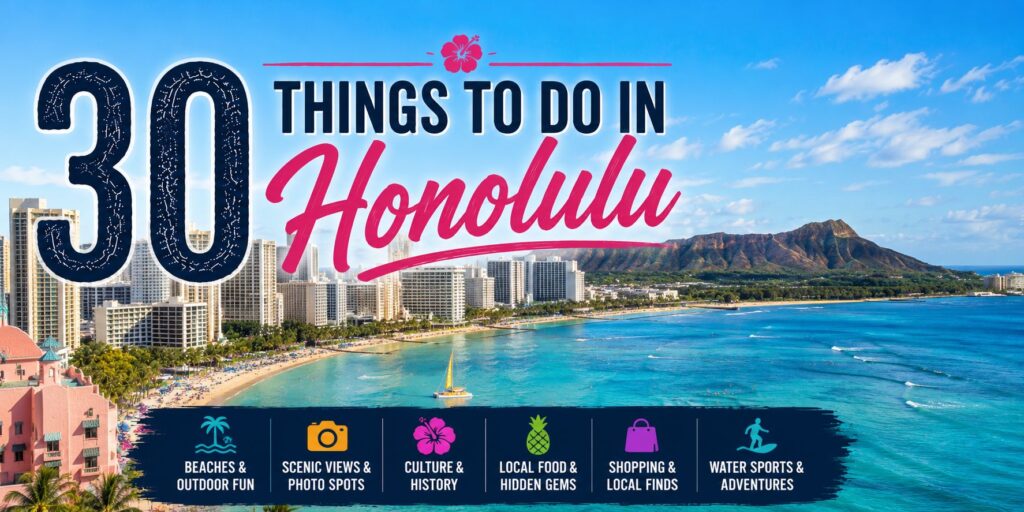
Honolulu is the only American state capital that sits on a Pacific island, the only one that requires a flight over open ocean to reach from the continental United States, and the only one where the most visited attraction in the entire state is a sunken warship. The USS Arizona Memorial receives more visitors per year than any other site in Hawaii – more than Waikiki Beach, more than Diamond Head, more than the Polynesian Cultural Center – because the 1,177 sailors and Marines entombed in the hull below the memorial’s white concrete floor represent the specific morning in December 1941 that changed the direction of American history. I have stood above that hull three times. The water is clear enough to see the oil still rising from the wreck 80 years later. I have also surfed the break at Waikiki on a rented longboard, eaten spam musubi from a 7-Eleven at 7 AM, hiked to the Diamond Head summit before the tour buses arrived, and spent an afternoon in Chinatown eating my way from one block to the next without repeating a cuisine. All of it is Honolulu. None of it is more or less the real version.
For more Hawaii and Pacific travel destinations guides, read our things to do in Maui and our Hawaii island-by-island guide.
Honolulu At a Glance: Quick Reference Table
| Activity | Area | Entry | Duration | Best For | Best Time |
|---|---|---|---|---|---|
| 1. Pearl Harbor National Memorial and USS Arizona | Pearl Harbor | Free (+ $1 reservation fee) | 3 to 5 hours | All visitors, history buffs | Weekdays; book 60 days in advance |
| 2. Diamond Head State Monument | Honolulu | $5/person non-residents, $10 parking | 2 to 3 hours | Hikers, view seekers | Sunrise; book online in advance |
| 3. Waikiki Beach | Waikiki | Free | 2 to 4 hours | All visitors, surfers, swimmers | Morning before 9 AM |
| 4. Hanauma Bay Nature Preserve | Southeast Oahu | $25/person (non-residents) | 3 to 4 hours | Snorkelers, marine life lovers | Weekdays; book 48 hours in advance |
| 5. Bishop Museum | Kalihi | $27 adults, $19 ages 4-12 | 2 to 3 hours | Culture lovers, families | Weekday mornings |
| 6. Iolani Palace | Downtown Honolulu | $27 adults (guided tour) | 1.5 to 2 hours | History buffs, all visitors | Wednesday to Saturday mornings |
| 7. Honolulu Museum of Art | Downtown | $20 adults, free ages 17 and under | 2 to 3 hours | Art lovers | First Sunday of month (free) |
| 8. Manoa Falls Trail | Manoa Valley | Free (parking $5) | 1.5 to 2 hours | Hikers, nature lovers | Weekday mornings |
| 9. Battleship Missouri Memorial | Pearl Harbor, Ford Island | $35 adults, $17 ages 4-12 | 2 to 3 hours | History buffs, Pearl Harbor visitors | Combine with USS Arizona visit |
| 10. Chinatown Honolulu | Chinatown | Free to explore | 2 to 3 hours | Food lovers, art seekers | Saturday morning market |
| 11. Waikiki Surfing Lesson | Waikiki | $65 to $90 per person | 2 hours | First-time surfers, families | Morning 7-10 AM |
| 12. Nuuanu Pali Lookout | Pali Highway | $7 per vehicle | 30 to 45 minutes | View seekers, history lovers | Morning for clearest views |
| 13. Pacific Aviation Museum | Pearl Harbor, Ford Island | $26 adults, $16 ages 4-12 | 2 to 3 hours | Aviation history fans, families | Combine with Pearl Harbor day |
| 14. Koko Head Crater Trail | Hawaii Kai | Free | 1 to 1.5 hours | Serious hikers, fitness seekers | Sunrise; weekdays only |
| 15. Kapiolani Park and Honolulu Zoo | Waikiki | Free park; $25 zoo adults | 2 to 3 hours | Families, casual visitors | Morning year-round |
| 16. North Shore Day Trip | North Shore, 1 hour away | Free (surfing lessons $60-80) | Full day | Surfers, shrimp truck fans, beach lovers | November to February for big waves |
| 17. Shangri La Museum of Islamic Art | Kahala | $25 adults (tour required) | 2 hours | Architecture, art history lovers | Wednesday to Saturday |
| 18. Waimea Valley | North Shore | $22 adults, $11 ages 4-12 | 2 to 3 hours | Nature lovers, waterfall seekers | Morning weekdays |
| 19. Byodo-In Temple | Valley of the Temples | $5 adults, $2 ages 2-12 | 1 hour | Photography, peaceful visits | Early morning |
| 20. Lanikai Beach | Kailua | Free | 2 to 3 hours | Beach lovers, kayakers | Morning year-round |
| 21. Hawaii State Art Museum | Downtown | Free | 1 to 1.5 hours | Art lovers, architecture fans | Tuesday to Saturday |
| 22. Tantalus Drive and Puu Ualakaa State Wayside | Upper Punchbowl area | Free | 1.5 to 2 hours | Scenic drivers, photographers | Morning or sunset |
| 23. Liliha Bakery | Liliha | $3 to $8 | 30 minutes | Food lovers, coco puff devotees | Morning weekdays |
| 24. Queen Emma Summer Palace | Nuuanu Valley | $10 adults | 1 hour | History buffs, Hawaii royalty fans | Wednesday to Sunday |
| 25. USS Bowfin Submarine Museum | Pearl Harbor | $20 adults, $10 ages 4-12 | 1 to 1.5 hours | History buffs, families | Combine with Pearl Harbor day |
| 26. Waikiki Aquarium | Waikiki | $12 adults, $5 ages 5-12 | 1.5 to 2 hours | Marine biology lovers, families | Morning year-round |
| 27. National Memorial Cemetery of the Pacific (Punchbowl) | Punchbowl Crater | Free | 1 hour | History buffs, quiet reflection | Morning year-round |
| 28. Makapu’u Point Lighthouse Trail | East Oahu | Free | 1.5 to 2 hours | Hikers, whale watchers (Jan-March) | Sunrise; January to March for whales |
| 29. Honolulu Chinatown Art Night | Chinatown | Free | 2 to 3 hours | Art, nightlife, local culture seekers | First Friday of each month |
| 30. Kualoa Ranch Day Trip | Windward Oahu | $50 to $160 per activity | Half to full day | Film location fans, adventure seekers | Morning tours year-round |
Pearl Harbor
1. Pearl Harbor National Memorial and USS Arizona
Area: Pearl Harbor, 1 Arizona Memorial Place | Entry: Free (Pearl Harbor Visitor Center); $1 reservation fee for USS Arizona Memorial program | Duration: 3 to 5 hours | Best time: Weekdays; book the USS Arizona tickets on recreation.gov exactly 60 days in advance
Pearl Harbor National Memorial is the most visited attraction in Hawaii. The experience has four distinct sites: the Pearl Harbor Visitor Center (free, no reservation), the USS Arizona Memorial (free program, $1 reservation fee, extremely limited tickets), the Battleship Missouri Memorial (separate admission, $35 adults), and the Pacific Aviation Museum (separate admission, $26 adults). Most visitors make the mistake of arriving without USS Arizona tickets and discover same-day walk-up tickets are no longer available at the visitor center – they must be reserved online through recreation.gov. The USS Arizona Memorial program – a 23-minute film about the December 7 attack, a boat ride across the harbor to the white concrete memorial built directly above the sunken battleship, and 15 minutes standing above the hull where 1,177 men remain entombed – is the most emotionally weighted 60-minute experience available to any American traveler anywhere in the country, and standing on the memorial’s viewing platform looking down into the clear water where oil still seeps from the wreck 85 years later puts a specific and irreversible period at the end of everything you thought you knew about Pearl Harbor from textbooks. I have done this three times and it has not become easier.
The Pearl Harbor Visitor Center alone – with its outdoor exhibits, 21 scale models of the attack vessels, and the memorial walk along the harbor – is worth a visit even without Arizona tickets. The adjacent Battleship Missouri, where the Japanese surrender documents were signed in September 1945, and the Pacific Aviation Museum in a restored WWII hangar on Ford Island are reached by free shuttle from the visitor center.
Practical tips:
- Reserve USS Arizona Memorial tickets on recreation.gov exactly 60 days before your target visit date – tickets are released at midnight Hawaii time and the most popular morning time slots are gone within minutes on weekdays and within seconds on weekends from October through March.
- If you miss the 60-day window, check recreation.gov daily from 30 days out as cancellations are released – also check at 6 AM on your intended visit date as late cancellations occasionally appear overnight.
- Plan a full morning for Pearl Harbor – the visitor center alone merits 45 minutes, the Arizona program runs 60 minutes from check-in to return, and adding the Battleship Missouri via the free Ford Island shuttle adds 2 more hours; budget 4 to 5 hours and bring water and a hat for the outdoor sections.
9. Battleship Missouri Memorial
Area: Ford Island, Pearl Harbor (shuttle from Visitor Center) | Entry: $35 adults, $17 ages 4-12 | Duration: 2 to 3 hours | Best time: Morning, combine with USS Arizona on the same Pearl Harbor day
The USS Missouri (BB-63) is a 45,000-ton Iowa-class battleship launched in 1944, commissioned just in time for the final year of the Pacific War, and now moored permanently on Ford Island at Pearl Harbor approximately 500 feet from the spot where the USS Arizona sits on the harbor floor. The ship is open for guided and self-guided tours of its gun turrets, bridge, engine rooms, and the teak-decked surrender deck – the exact location on the ship where General Douglas MacArthur accepted the Japanese Instrument of Surrender on September 2, 1945, ending World War II. The specific pairing of the USS Arizona and the USS Missouri at Pearl Harbor – the ship sunk on the first day of the Pacific War and the ship on whose deck the war ended – is one of the more deliberately resonant historical juxtapositions available at any single site in American history, and standing on both decks in the same morning gives the 4-year arc of the Pacific War a physical scale that no museum exhibit replicates. I did both on a Tuesday in January and the combination was the most historically compressed morning I have spent anywhere.
Practical tips:
- The guided Battle Stations Tour ($50 adults, approximately 2 hours) accesses areas of the Missouri not included in general admission, including the engine rooms, the fire control director, and the crew quarters – worth the additional cost for anyone with a serious interest in naval history or WWII.
- The free shuttle from the Pearl Harbor Visitor Center to Ford Island runs every 15 to 20 minutes starting at 8 AM – the first shuttle is the least crowded and positions you to have the Battleship Missouri largely to yourself for the first 45 minutes before the tour groups arrive.
- The surrender deck plaque marking the exact location where MacArthur stood during the signing ceremony is on the starboard side of the main deck toward the stern – it is easy to miss without a guide pointing it out, and it is the single most specific physical location at the entire Pearl Harbor site.
13. Pacific Aviation Museum Pearl Harbor
Area: Ford Island, Pearl Harbor (shuttle from Visitor Center) | Entry: $26 adults, $16 ages 4-12 | Duration: 2 to 3 hours | Best time: Combine with Battleship Missouri on a full Pearl Harbor day
The Pacific Aviation Museum occupies two WWII-era hangars on Ford Island that were present during the December 7 attack – bullet holes from Japanese strafing runs are still visible in the walls of Hangar 37, preserved behind protective glass. The collection covers the full arc of Pacific aviation from the Wright Brothers through the Korean War, with intact aircraft including a Mitsubishi Zero, a Curtiss P-40 Warhawk, and a Boeing B-17 Flying Fortress, displayed in the original hangar spaces where mechanics would have serviced similar planes in 1941 and 1942. The bullet holes in Hangar 37 at the Pacific Aviation Museum are the most unmediated physical artifact of the December 7 attack accessible to visitors – not a reconstruction, not a reproduction, but the original wall of the original hangar with the original Japanese Zero ammunition still visible in the original masonry – and the fact that they sit in a functioning aviation museum rather than a sealed historical display makes them more rather than less affecting. I walked past them three times before stopping.
Practical tips:
- The museum’s flight simulator ($10 per session) puts visitors in a replica Zero cockpit for a first-person experience of the Pearl Harbor attack approach – appropriate for adults and children over 10, and the best hands-on interactive element in the Pearl Harbor museum complex.
- Plan the Pacific Aviation Museum as the third Pearl Harbor stop after the USS Arizona Memorial program and the Battleship Missouri, rather than the first – arriving at Ford Island early prioritizes the Missouri’s smaller crowd window, leaving the Aviation Museum for the mid-morning when its interior spaces are fully open.
- The museum café inside Hangar 79 serves a reasonable lunch – booking a full Pearl Harbor day benefits from eating on Ford Island rather than driving back to Waikiki at noon, as the lunch window at the museum is shorter than the lunch rush on Kalakaua Avenue.
Diamond Head and Honolulu Hiking
2. Diamond Head State Monument
Area: Diamond Head Road, 2 miles east of Waikiki | Entry: $5/person non-residents, $10 parking | Duration: 2 to 3 hours | Best time: Arrive at 6 AM for the first entry slot; closed Wednesdays
Diamond Head is a 300,000-year-old volcanic tuff cone rising 763 feet above the southeastern edge of Honolulu, visible from anywhere in Waikiki and recognizable on the Hawaii state seal. The trail to the summit is 0.8 miles with 560 feet of elevation gain through WWII military tunnels, concrete stairs, and a final spiral staircase to the Fire Control Station at the top, with an unobstructed 360-degree view of the Honolulu coastline from Koko Head to Pearl Harbor. The summit view from Diamond Head at 6:30 AM on a clear Tuesday morning – Waikiki’s hotel towers compressed to the west, the Pacific extending without interruption to the horizon in the south, and the crater itself visible below your feet – is the single most complete visual orientation to Honolulu’s geography available, and arriving at the first entry slot means sharing it with fewer than 20 people rather than the 200-plus who crowd the trail from 9 AM onward. I have done it at both hours. The difference in the experience is not subtle.
Diamond Head requires advance reservations for non-Hawaii residents, available at gostateparks.hawaii.gov up to 30 days in advance. The monument is closed every Wednesday for maintenance.
Practical tips:
- Book the 6 AM entry slot on a Tuesday, Thursday, Friday, Saturday, or Sunday – the 6 AM slot at Diamond Head is the most underbooked of the day because most visitors prefer to sleep in, and the combination of the early light on the crater walls and the near-empty trail makes the hour worth setting the alarm for.
- The trail involves 225 steps, two tunnels, and a 99-step spiral staircase at the summit – it is moderately demanding and not suitable for visitors with significant knee or mobility limitations; the final spiral staircase is narrow and steep in both directions.
- Parking inside the crater fills completely by 8 AM on weekends – taking a rideshare to the crater entrance ($12 to $15 from Waikiki) is the most practical option for morning visits, and the Diamond Head Road approach is not particularly walkable from Waikiki at 5:30 AM.
8. Manoa Falls Trail
Area: Manoa Valley, 3 miles from Waikiki | Entry: Free (parking $5 in the Lyon Arboretum lot) | Duration: 1.5 to 2 hours | Best time: Weekday mornings; avoid the day after rain when the trail becomes very muddy
Manoa Valley is the lush green valley visible directly inland from Waikiki, and the Manoa Falls Trail is a 1.6-mile round-trip hike through dense tropical rainforest to a 150-foot waterfall at the head of the valley. The trail passes through guava, ti, and bamboo forest, crosses a stream multiple times on wooden bridges, and ends at a pool below the falls that is closed to swimming due to leptospirosis risk in the stream water. The Manoa Falls Trail is the specific hike that captures the version of Oahu that is not Waikiki – the green, wet, forest-covered mountain interior that exists 20 minutes from Kalakaua Avenue and that most Waikiki visitors never reach, because the buildings along the beach make it easy to forget that the Ko’olau Mountains start approximately 2 miles from the ocean. I have done this trail in both morning and afternoon and the morning, before the valley clouds build, is dramatically better.
Practical tips:
- Wear waterproof shoes or trail runners rather than flip-flops – the trail has significant mud sections regardless of recent rain, and the stream crossings get slippery with algae in sections; multiple visitors I have seen on this trail were limping back in sandals that were entirely the wrong footwear choice.
- The Lyon Arboretum, accessible from the same parking area, is a 194-acre research arboretum with self-guided walking paths through labeled tropical plantings – adding 45 minutes for the arboretum before or after the Manoa Falls trail makes the full morning one of the best nature experiences within easy reach of Waikiki.
- Arrive before 8:30 AM on weekdays and before 8 AM on weekends – the parking area at the trailhead has approximately 20 spaces that fill completely early on weekends, and rideshare from Waikiki runs $10 to $14 and is more reliable than hoping for street parking.
14. Koko Head Crater Trail
Area: Hawaii Kai, 8 miles east of Waikiki | Entry: Free | Duration: 1 to 1.5 hours | Best time: Sunrise on weekdays; avoid weekends when the trail is at maximum capacity
Koko Head Crater Trail is 1,048 railroad tie steps climbing straight up the outer rim of Koko Head Crater from sea level to 1,208 feet elevation – the steepest sustained hiking challenge accessible within driving distance of Waikiki, with no switchbacks and no shade after the first 200 steps. The views from the summit encompass Hanauma Bay, Makapuu Point, and the windward coast. The trail uses the actual wooden railway ties from the WWII military tramway that supplied the crater’s summit installations. Koko Head is the trail that Honolulu residents use as a fitness benchmark – 1,048 steps, no shade, an average grade steep enough that sections require using your hands on the ties – and the combination of the specific physical challenge and the 360-degree summit view makes it the most honest physical test available within 20 minutes of Waikiki for visitors who want to know what effort feels like in Hawaiian heat and humidity. The summit view at sunrise, when the sky over the ocean east of Makapu’u is turning color and there are 15 people rather than 150 on the steps, is one of the better views from any Oahu summit.
Practical tips:
- Start no later than 6:15 AM to reach the summit at sunrise – the drive from Waikiki takes 25 minutes, the hike up takes 25 to 45 minutes depending on fitness, and the summit light from 6:30 to 7:15 AM on a clear morning is specific and worth the alarm.
- Bring significantly more water than you expect to need – the 1,048-step ascent with no shade in Hawaii’s humidity is more demanding than the 30-minute duration suggests, and dehydration at the top is common among visitors who brought “enough” water from a mainland hiking perspective.
- The “bridge” section – a stretch approximately 2/3 of the way up where the railway ties span an open gap over a drainage gulch with a significant drop visible below – is the section that stops some visitors; it is structurally sound and regularly maintained, but the exposure underfoot requires comfort with heights in a way the rest of the trail does not.
28. Makapu’u Point Lighthouse Trail
Area: East Oahu, 12 miles east of Waikiki | Entry: Free | Duration: 1.5 to 2 hours | Best time: Sunrise; January through March for humpback whale sightings
The Makapu’u Point Lighthouse Trail is a 2-mile round-trip paved path climbing the eastern tip of Oahu to a viewpoint above the 1909 Makapu’u Lighthouse, with panoramic views of the windward coast, the offshore islands of Manana (Rabbit Island) and Kaohikaipu, and – from January through March – humpback whales breaching in the channel below. The Makapu’u trail from January through March, when humpback whales pass through the Kaiwi Channel on their annual migration between the North Pacific feeding grounds and the Hawaiian breeding waters, is one of the only places in the continental United States and its territories where whale watching requires nothing more than walking to a cliff edge and looking down – the whales pass close enough to the trail’s overlook that I have watched a cow-calf pair breach repeatedly with the lighthouse in the foreground. No boat required. No ticket required. Sunrise is ideal.
Practical tips:
- The Makapu’u parking area on Kalanianaole Highway fills by 7:30 AM on weekends – arrive before 6:45 AM for sunrise and guaranteed parking, or visit on a weekday morning when the lot is rarely full before 8 AM.
- The trail is fully paved and accessible for most visitors, including those with strollers or light mobility limitations – the grade is steady but moderate, and the paved surface makes it the most accessible of the Honolulu coastal hikes.
- Bring binoculars for the January through March whale season – the channel view from the Makapu’u overlook is excellent but the whales are far enough offshore that naked-eye viewing misses the detail that makes the experience memorable.
Waikiki
3. Waikiki Beach
Area: Waikiki | Entry: Free | Duration: 2 to 4 hours | Best time: 7 AM to 9 AM before the beach reaches capacity; evenings for sunset
Waikiki is a 2-mile crescent of beach backed by the most concentrated strip of hotels in the Pacific, fronting a consistent, gentle surf break that has been the definitive learning ground for recreational surfing since Duke Kahanamoku taught the world to ride waves here in the early 20th century. The beach itself is public land – all beaches in Hawaii are public by law – and the water at Waikiki is warm, clear, and shallow enough for confident non-swimmers, with lifeguards posted year-round. Waikiki at 7 AM, before the beach chairs are fully deployed and the tour boats have launched and the hotel pools have opened and the sunscreen application begins in earnest, is a beach that feels like it belongs to whoever arrived first – local surfers catching the morning glass, a few fitness walkers on the path along the seawall, and the Diamond Head silhouette catching the first direct light – and it is a version of Waikiki that is available every morning for free to anyone willing to be there early. By 10 AM it is a different place entirely, and that version is also real and worth knowing.
Practical tips:
- The public beach access points at Kapahulu Avenue, Kuhio Beach Park, and the Fort DeRussy Beach Park entrances provide parking-lot-free beach access without walking through any hotel property – use these rather than walking through hotel lobbies, which is technically permitted but creates a navigational maze.
- The shallow reef section at the eastern end of Waikiki near the Kapahulu Groin is the best area for snorkeling accessible from the beach itself – bring a mask and fins from a rental shop on Kalakaua Avenue ($10 to $15 per day) and the reef between the groin and the jetty regularly has sea turtles, reef fish, and occasional octopus in 4 to 8 feet of water.
- The free Friday evening fireworks from the Hilton Hawaiian Village pier run every Friday at 7:45 PM year-round and are visible from anywhere on the Waikiki beachfront – no admission, no reservation, and a legitimately good fireworks show by any standard.
11. Waikiki Surfing Lesson
Area: Waikiki Beach | Entry: $65 to $90 per person | Duration: 2 hours | Best time: 7 AM to 10 AM before the break gets crowded
Duke Kahanamoku, the Hawaiian swimmer who won Olympic gold medals in 1912 and 1920, is the reason recreational surfing exists as a global sport – he demonstrated it to crowds in Australia and the continental United States and is credited with spreading what had been a Hawaiian cultural practice into the worldwide activity it became. The Waikiki surf break, where he taught, is the same break where surf schools give lessons today: slow, consistent 2 to 3 foot waves breaking over a sandy bottom in warm water, with virtually no physical consequence for falling off. The Waikiki surf lesson for a first-time surfer produces a specific ratio of physical effort to success that almost no other beginner activity matches: within 60 minutes of standing on a board for the first time, the majority of people who take a Waikiki lesson have ridden at least one wave to the shore, because the break is genuinely ideal for learning and the instructors have taught thousands of people the same sequence. I stood up on the third attempt. The instructor seemed unsurprised.
Practical tips:
- Book through one of the established beach concession operators at Waikiki rather than through a third-party booking site – Hans Hedemann Surf School, Aloha Beach Services, and Ohana Surf Project all operate directly on the beach and the instructors working there are both qualified and familiar with the specific conditions at each section of the break.
- Morning lessons before 9 AM have the best wave consistency and the least crowd pressure from other surfers and paddleboarders – afternoon lessons run in more congested water as the beach fills, and the experience of sharing the break with 40 other learners is substantially less enjoyable than a morning session.
- Rash guards are provided by most Waikiki surf schools as part of the lesson equipment – wear or bring a swimsuit with board shorts rather than a loose two-piece, as loose swimwear creates significant drag when paddling and makes the pop-up harder.
Hanauma Bay
4. Hanauma Bay Nature Preserve
Area: Hawaii Kai, 10 miles east of Waikiki | Entry: $25 non-residents (ages 13 and up); $3 parking | Duration: 3 to 4 hours | Best time: Weekdays; Tuesday to Friday for the best availability; book exactly 48 hours in advance
Hanauma Bay is a 2,000-year-old volcanic bay on the southeastern coast of Oahu, now a marine life conservation district with a coral reef housing more than 400 species of fish, green sea turtles, and Hawaiian monk seals. The bay is enclosed on three sides by the crater walls, creating a calm, protected snorkeling environment with visibility often exceeding 40 feet. Entry is strictly managed: a maximum of 720 non-resident visitors per day, advance online reservations required, a mandatory 9-minute conservation video before entering the water, and a no-feeding policy enforced by staff. Hanauma Bay is the most densely populated snorkeling location in the Pacific – on a clear Tuesday morning the reef holds more fish visible within arm’s reach than any other accessible reef in Hawaii – and the management system that makes it feel restrictive to book is the direct reason the reef has recovered to the condition that makes the visit worth taking. The fish are there because the rules work.
The bay is closed Tuesdays and Wednesday mornings for reef recovery. Non-resident reservations must be made online at honoluludaytours.com exactly 48 hours in advance and sell out within minutes of becoming available.
Practical tips:
- Set a calendar alarm for exactly 48 hours before your target visit date and attempt booking the moment the window opens – Hanauma Bay reservations for popular days (Thursday through Sunday) are gone within 10 to 15 minutes of opening, and waiting until the next morning means no availability for that date.
- If you cannot secure an advance reservation, check the Hanauma Bay website at 7 AM on your intended visit date for any last-minute cancellations – a small number of same-day slots are occasionally available, though this is not reliable enough to be a primary strategy.
- Bring your own snorkeling equipment rather than renting at the bay ($12 mask and fins rental) – the rental equipment is functional but generic, and having a well-fitting mask from a dive shop in Waikiki ($25 to $40 for a basic set) makes the difference between a clear underwater view and one that leaks.
Honolulu History and Culture
6. Iolani Palace
Area: Downtown Honolulu, 364 South King Street | Entry: $27 adults (guided tour), $22 (audio tour) | Duration: 1.5 to 2 hours | Best time: Wednesday to Saturday mornings; book tours in advance at iolanipalace.org
Iolani Palace is the only official royal palace on American soil, built in 1882 by King David Kalakaua as the official residence of the Hawaiian Kingdom’s monarchy and designed to impress the heads of state and diplomatic representatives he intended to receive there. The palace has electric lights and telephones installed 4 years before the White House. Queen Liliuokalani, the last sovereign monarch of Hawaii, was imprisoned in her own palace for 8 months following the 1893 overthrow of the Hawaiian Kingdom by American businessmen backed by US Marines. The specific history of Iolani Palace – a sovereign Hawaiian monarch imprisoned in her throne room, a kingdom dissolved by people whose legal authority to dissolve it is disputed to this day, and a building that the United States eventually used as the territorial capitol while the kingdom it displaced was administered as an American possession – is not the version of Hawaii statehood history most visitors arrive having been taught, and the palace tour delivers it directly and without apology. I left the palace with a significantly revised understanding of what Hawaii’s statehood actually cost.
Practical tips:
- The audio self-guided tour ($22) provides more depth and flexibility than the guided tour for visitors comfortable managing their own pace – the audio content is substantive and the ability to linger in the throne room and the queen’s bedroom without a group moving you along improves the experience of the palace considerably.
- Book tour tickets at iolanipalace.org at least 3 to 5 days before your intended visit – the palace is a working preservation site with limited daily capacity, and weekend tours fill completely, particularly from November through March when mainland visitor numbers are highest.
- The palace grounds are free to explore without a tour ticket and include the Royal Bandstand, where the Royal Hawaiian Band still performs free concerts on most Friday lunchtimes from 12 PM to 1 PM – the combination of a free lunchtime concert in the historic palace grounds and the affordable downtown Chinatown lunch options 3 blocks away makes Friday noon the most underrated free hour in downtown Honolulu.
5. Bishop Museum
Area: Kalihi, 1525 Bernice Street | Entry: $27 adults, $19 ages 4-12 | Duration: 2 to 3 hours | Best time: Weekday mornings
The Bishop Museum is the largest museum in Hawaii and the leading natural and cultural history institution in the Pacific, with a collection of more than 24 million artifacts representing Hawaiian royalty, Pacific Island cultures, and natural history specimens from the Hawaiian island chain. The main Hawaiian Hall is a three-story Victorian stone building with galleries arranged around a central atrium, displaying feathered capes, carved wooden deity figures, royal regalia, and cultural objects of the Hawaiian Kingdom that are among the most significant collections of their type in the world. The Hawaiian feather cloaks and capes in the Bishop Museum’s Hawaiian Hall are the most technically complex objects in any museum in Hawaii – some requiring 450,000 individual feathers from now-extinct or endangered honeycreeper birds, each tied individually by hand over years of work, representing the accumulated tribute of an entire island’s bird population – and understanding that each cape represents a literal depletion of Hawaiian forest bird populations gives the collection a weight that goes well beyond aesthetic appreciation. No other collection in the Pacific comes close.
Practical tips:
- The Science Adventure Center on the museum grounds is a separate building with interactive exhibits on Pacific geology, volcanology, and marine biology – it is the most engaging component of the museum for children under 12 and worth the 45 minutes separately from the Hawaiian Hall and the Polynesian cultural galleries.
- The museum’s café serves a decent plate lunch – the combination of Hawaiian Hall in the morning and a plate lunch at the café before driving back to Waikiki is a natural 3-hour morning without needing to backtrack for food.
- The Bishop Museum is in the Kalihi neighborhood, 3 miles northwest of downtown Honolulu, and is not walkable from Waikiki – it requires a car, rideshare ($15 to $20 from Waikiki), or the No. 2 TheBus from downtown.
10. Chinatown Honolulu
Area: Chinatown district, downtown Honolulu | Entry: Free to explore | Duration: 2 to 3 hours | Best time: Saturday morning for the market; First Friday evening for art galleries
Honolulu’s Chinatown is one of the oldest Chinatowns in the United States, established in the 1850s when Chinese laborers arrived for the sugar plantation era. The neighborhood today holds a mix of Chinese, Vietnamese, Filipino, and Thai restaurants, lei stands supplying the city’s enormous daily demand for fresh flower garlands, fresh fish and produce markets operating from the early hours, herb shops, art galleries, and bars that occupy the former brothels and gaming halls of the plantation-era district. The lei stands of Chinatown – narrow storefronts stacked floor to ceiling with fresh plumeria, pikake, tuberose, and orchid garlands assembled by hand in operations that have been in the same families for two and three generations – are the most directly sensory experience in all of Honolulu, and buying a $10 fresh lei from Cindy’s Lei Shoppe or Lin’s Lei Shop on Maunakea Street and wearing it for the afternoon is the single most specifically Hawaiian thing a visitor can do in the city for the cost of a cup of coffee. Do not skip this.
Practical tips:
- The Saturday morning market at the Oahu Market area on North King Street runs from 6 AM to noon with fresh produce, prepared food, and lei vendors at their maximum volume – arriving before 8 AM gives you the full fresh-fish, tropical fruit, and prepared-food experience before the best items sell out.
- The First Friday art gallery walk (first Friday of every month from 5 PM to 9 PM) opens 20 to 30 galleries simultaneously in the Chinatown arts district along Hotel Street and Nuuanu Avenue – it is the most locally attended free arts event in Honolulu and the best single evening for experiencing Chinatown’s current cultural character.
- Lunch in Chinatown offers the best value-for-quality eating in all of Honolulu: Little Village Noodle House, Lucky Belly, and Livestock Tavern represent the range from traditional Chinese to creative local cuisine, all at prices well below Waikiki restaurant levels for equivalent quality.
Art Museums and Hidden Honolulu
7. Honolulu Museum of Art
Area: Downtown, 900 South Beretania Street | Entry: $20 adults, free ages 17 and under | Duration: 2 to 3 hours | Best time: First Sunday of each month (free for all); Thursday to Sunday regular hours
The Honolulu Museum of Art holds a collection of more than 55,000 works of art spanning 5,000 years, with exceptional holdings in Asian art (one of the finest collections in the United States), works on paper, and the Hawaiian and Pacific art collection. The building itself is a 1927 Spanish Mission-style complex organized around six courtyard gardens – the architecture of movement between interior galleries and outdoor courtyards is one of the more elegant museum experiences in the Pacific, particularly in the morning when the courtyard gardens are quiet. The Honolulu Museum of Art’s Asian collection – built by an institution at the center of the Pacific with direct collecting relationships to Japan, China, Korea, and Southeast Asia across a century – is the strongest single collection of Asian art west of Chicago and east of Tokyo, a fact that is almost universally unknown to the mainland American visitors who are 20 feet from it in Waikiki and don’t know it exists. I spent 90 minutes in the Japanese woodblock print gallery alone.
Practical tips:
- The first Sunday of every month provides free admission for all visitors without restriction – the galleries are open 10 AM to 5 PM on first Sundays and the crowd is local rather than tourist-heavy, making it the best day to visit on both cost and atmosphere grounds.
- The museum café in the main courtyard garden serves a good lunch from 11 AM to 1:30 PM on open days – the setting in the central garden with the surrounding architecture visible on all sides makes it the best museum café dining setting in Honolulu.
- The Doris Duke Theatre at the museum shows international and independent cinema most evenings ($10 to $12 per screening) – checking the film calendar at honolulumuseum.org before your visit and adding a film to an afternoon museum visit makes the institution more than a daytime attraction.
17. Shangri La Museum of Islamic Art
Area: Kahala, tours depart from Honolulu Museum of Art | Entry: $25 adults, $15 ages 13-17 | Duration: 2 hours | Best time: Wednesday to Saturday; advance booking required
Shangri La is the oceanfront estate built by tobacco heiress Doris Duke in 1937 and assembled over 50 years into a 14,000-square-foot showcase of Islamic art and architecture. The estate sits on 5 acres of Diamond Head’s coast with a direct Pacific ocean view, and its interiors are layered with Syrian tiles, Moroccan plasterwork, Persian miniature paintings, Damascus Room panels, and Indian Mughal objects that Duke acquired directly during years of travel through the Islamic world. Shangri La is the most architecturally specific house museum in Hawaii and one of the more concentrated collections of Islamic decorative arts in the United States, built on a Diamond Head oceanfront estate by a woman who spent decades traveling through Syria, Iran, India, and Morocco acquiring objects that she then incorporated into the architecture of the house itself – and the combination of the Pacific setting, the Islamic architecture, and the biography of the collector makes it a specific experience that has no equivalent anywhere in Hawaii. Tours are limited to 12 people and departures are by advance reservation only from the Honolulu Museum of Art.
Practical tips:
- Reserve Shangri La tours at honolulumuseum.org at least 2 to 3 weeks in advance for visits from November through March – the 12-person cap means available slots are limited and popular departure times fill weeks out during peak season.
- Tours depart from the Honolulu Museum of Art on Beretania Street, not from the estate itself – factor in the transportation to the museum in your timing and arrive 15 minutes before your departure time.
- The estate tour includes access to the oceanfront lawn with a view of the Pacific and Diamond Head from the south side – this specific view, from the Shangri La terrace looking east toward the crater, is one of the less-photographed and more specific visual moments in Honolulu.
Day Trips from Honolulu
16. North Shore Day Trip
Area: North Shore of Oahu, 1 hour from Waikiki | Entry: Free (surfing lessons $60 to $80) | Duration: Full day | Best time: November to February for big wave season; June to September for calm water and easier snorkeling
The North Shore of Oahu is where serious surfing happens. Sunset Beach, Pipeline, and Waimea Bay are the three breaks that define big-wave surfing globally, and from November through February when the North Pacific swells arrive, the waves at Pipeline reach 20 to 25 feet – some of the heaviest surf accessible to spectators anywhere in the world, free to watch from the beach. The Eddie Aikau Big Wave Invitational at Waimea Bay, held only when waves exceed 20 feet, is the most anticipated single-day surf event in the sport. The North Shore in summer is the opposite – small, clear, swimmable waves at the same breaks that terrify experts in winter. The food trucks on Kamehameha Highway between Haleiwa town and Sunset Beach constitute the most satisfying fast-casual eating corridor in all of Hawaii: Romy’s Kahuku Prawns, Giovanni’s Shrimp Truck, and the Matsumoto Shave Ice shop in Haleiwa are individual institutions that people make the one-hour drive from Waikiki specifically to visit, and the combination of a North Shore beach morning with a shrimp plate and shave ice in the afternoon is the closest thing to a canonical Oahu day outside of Pearl Harbor. I have done this drive more times than I have done any other single day trip from Honolulu.
Practical tips:
- The Matsumoto Shave Ice line in Haleiwa on a Saturday afternoon runs 20 to 40 minutes in summer – arrive before 10:30 AM or after 2:30 PM to minimize the wait, and order the ice cream base underneath the shave ice and the azuki beans on top, which is the configuration most of the people who grew up eating it use.
- Pipeline (Ehukai Beach Park) is viewable from the beach from a position 30 to 50 feet from the break during the November to February big wave season – arrive before 9 AM on weekdays for the best combination of crowd level and swell quality, and understand that on the biggest days the crowd of spectators and photographers makes the beach itself extremely crowded.
- The drive from Waikiki to the North Shore takes 45 to 60 minutes on H-2 north to Kamehameha Highway – Haleiwa town at the western end of the North Shore is the natural starting point, with the shrimp trucks and Matsumoto’s before working east along Kamehameha Highway to Sunset Beach, Ehukai (Pipeline), and Waimea Bay.
30. Kualoa Ranch Day Trip
Area: Windward Oahu, 30 miles from Waikiki | Entry: $50 to $160 per activity | Duration: Half to full day | Best time: Morning tours year-round
Kualoa Ranch is a 4,000-acre working cattle ranch on the windward coast of Oahu in Kaneohe Bay that has served as a film location for Jurassic Park, Lost, 50 First Dates, Kong: Skull Island, Godzilla, and more than 50 other productions using its combination of volcanic mountain backdrop, tropical valley, and ocean frontage. The ranch operates tours ranging from ATV rides and horseback experiences through the Ka’a’awa Valley film locations to guided hiking and ocean kayaking. The Ka’a’awa Valley at Kualoa, where the original Jurassic Park jeep chase sequence was filmed in a location that looks essentially unchanged from the 1992 production, is the most specifically recognizable film location in Hawaii and possibly in all of North America – and standing in the valley with the same volcanic walls on three sides and the same grass and the same light that Spielberg used is the specific experience that people who loved that film come to Hawaii to have. The ranch has been running these tours since the 1990s with no apparent intention of stopping.
Practical tips:
- Book Kualoa Ranch activities at kualoa.com at least 1 week in advance for weekday visits and 2 to 3 weeks in advance for weekend dates – the most popular tours (Movie Sites Tour, ATV, Jurassic Valley zipline) reach capacity and the ranch does not accommodate walk-up activity bookings.
- The Movie Sites Tour ($50 per person, 90 minutes) is the most efficient introduction to the ranch for first-time visitors who want the film location experience without a full-day commitment – the tour covers the primary Jurassic Park, Lost, and Kong filming locations in the valley by bus with guide narration.
- Combine the Kualoa Ranch visit with a stop at Lanikai Beach in Kailua on the return to Waikiki – the 15-minute drive from Kualoa to Lanikai puts you at one of the most consistently rated beaches in Hawaii for a late afternoon swim before the hour drive back to Waikiki.
Honolulu Practical Guide
Getting Around Honolulu
Waikiki and downtown Honolulu are walkable for visitors staying in the main hotel corridor – Kalakaua Avenue runs the full length of the beach strip and connects to downtown in 20 to 25 minutes on foot. TheBus, Honolulu’s public transit system, provides affordable city-wide access at $3 per ride (exact change only) and covers most major attractions including Pearl Harbor, the Bishop Museum, Chinatown, and the North Shore. The No. 20 bus runs from Waikiki directly to Pearl Harbor.
For Diamond Head, Hanauma Bay, Koko Head, Makapu’u, and the North Shore day trip, a rental car or rideshare is the most practical option. Rental cars are available at Honolulu International Airport and at Waikiki hotel desks from major agencies. Lyft and Uber are reliable throughout Honolulu with average waits of 5 to 10 minutes.
Parking in Waikiki runs $25 to $45 per day at most hotel garages. Street parking along Kalakaua Avenue and in the Waikiki residential blocks is nearly impossible during peak hours. Visitors staying more than 3 days benefit from renting a car for only the day trips rather than paying daily Waikiki parking rates.
Where to Stay in Honolulu
Waikiki Beachfront ($350 to $700+ per night): The Moana Surfrider (1901, the oldest hotel in Waikiki), the Royal Hawaiian (1927, the Pink Palace), and the Outrigger Reef represent the historic beachfront tier. Direct beach access, the most walkable location in Honolulu, and the highest prices. Best for visitors making Waikiki the primary focus.
Waikiki Mid-Strip ($180 to $350 per night): The majority of Waikiki’s hotel inventory occupies the blocks one to three streets from the beach along Kalakaua and Kuhio Avenues. A 3 to 8 minute walk from the ocean. The Hilton Hawaiian Village, the Sheraton Waikiki, and the Hyatt Regency Waikiki represent this category. Better value than beachfront for visitors who prioritize Pearl Harbor, hiking, and cultural activities over maximum beach proximity.
Downtown Honolulu ($140 to $240 per night): The Ala Moana Hotel and several boutique properties near Chinatown provide less expensive accommodation within 15 minutes of downtown attractions. Not walkable to Waikiki without a bus or rideshare. Best for visitors prioritizing Iolani Palace, the Bishop Museum, and the Honolulu Museum of Art over beach access.
Diamond Head and East Honolulu ($200 to $350 per night): Properties near Kapiolani Park at the eastern end of Waikiki are quieter than the main Waikiki strip and closer to Diamond Head, Koko Head, and the east side beaches. Good for visitors planning to spend significant time hiking and at east-side beaches.
Honolulu Budget Guide
Budget traveler (mid-range Waikiki hotel several blocks from the beach, TheBus for transportation, plate lunch for most meals, self-guided hiking and free beaches as activity anchors): Expect $160 to $230 per day. A hotel 3 to 4 blocks from the beach in Waikiki runs $140 to $190 per night. The biggest free experiences in Honolulu are genuinely excellent: Waikiki Beach, the Pearl Harbor Visitor Center, Manoa Falls Trail, Koko Head, Makapu’u, Chinatown, and the royal palace grounds. TheBus day pass is $7.50. Plate lunch from a local spot in Chinatown or a food truck at Ala Moana runs $10 to $14. Diamond Head at $5 per person and Hanauma Bay at $25 are the main activity costs on a budget day.
Mid-range traveler (Waikiki hotel near the beach, USS Arizona and Pearl Harbor full day, Diamond Head, Hanauma Bay, surfing lesson, Iolani Palace tour, mix of local restaurant and plate lunch dining): Budget $280 to $420 per day. A mid-range Waikiki hotel runs $230 to $300 per night in peak season. The Pearl Harbor day with USS Arizona ($1 reservation fee) plus Battleship Missouri ($35) runs $36 per person. Diamond Head ($5), Hanauma Bay ($25), and a surfing lesson ($75) represent the main activity day costs. Dinner at a good Waikiki restaurant – Marukame Udon for affordable excellent, MW Restaurant for a genuine dinner splurge – runs $15 to $65 per person. At this level, Honolulu delivers the complete Hawaii experience.
Luxury traveler (Royal Hawaiian or Moana Surfrider beachfront, Shangri La tour, private surf lesson, helicopter tour, fine dining): Plan $600 to $1,200 per day. The Royal Hawaiian starts at $500 per night for its standard oceanview rooms and runs considerably higher for ocean front. A helicopter tour of Oahu covering the North Shore, the Pali, and the Na Pali coast equivalent on Oahu (the windward cliffs) costs $250 to $350 per person for a 45-minute flight. Private surf lessons from a former professional surfer through one of the premium Waikiki concession operators run $150 to $200 for 2 hours. Dinner at Nobu Honolulu or the La Mer restaurant at the Halekulani runs $120 to $200 per person.
Best Time to Visit Honolulu
December through April is the primary visitor season. Hotels are at peak pricing, Pearl Harbor and Diamond Head reservations are at maximum competition, and Waikiki is at its most crowded. The weather is Honolulu’s best: temperatures in the low 80s Fahrenheit, low humidity by Hawaii standards, and the ocean on the North Shore delivering its most dramatic surfing conditions. Humpback whales are visible off Makapu’u and the south coast from January through March.
May through September is summer. Temperatures reach 85 to 90 degrees Fahrenheit with higher humidity. The North Shore is flat and swimmable. Fewer crowds than December through April at Pearl Harbor and Diamond Head mean more available reservations and slightly shorter lines. Hotel prices moderate slightly from the December-March peak. The best time for beach-focused visitors with no specific interest in whale watching or big wave surfing.
October and November are the shoulder season – good weather, moderating crowds, and the beginning of the North Shore swell season in late October. Hotel prices are at their most accessible of any enjoyable-weather period. October and November are consistently the best value months in Honolulu for visitors with schedule flexibility.
Frequently Asked Questions About Honolulu
How many days do you need in Honolulu? Four to five days covers the primary Honolulu experience well. Day one for Waikiki orientation, a surfing lesson, and the sunset at Kapiolani Park. Day two for a full Pearl Harbor day including the USS Arizona Memorial, Battleship Missouri, and Pacific Aviation Museum. Day three for Diamond Head at sunrise and Hanauma Bay in the morning. Day four for Iolani Palace, Chinatown for lunch, and the Honolulu Museum of Art or Bishop Museum. Day five for the North Shore drive. Three days is possible but forces hard choices between Pearl Harbor depth and everything else.
What is Honolulu most famous for? Honolulu is most famous for Waikiki Beach, Pearl Harbor and the USS Arizona Memorial, Diamond Head, and as the gateway to the Hawaiian Islands. It is also known for Iolani Palace (the only royal palace on American soil), the Bishop Museum, the surfing culture of Waikiki, and the specific combination of Pacific Island, Asian, and American mainland cultures that has produced Hawaii’s distinct food, music, and social character.
What are the best things to do in Honolulu with kids? The Bishop Museum’s Science Adventure Center is the best children’s museum-style experience in Honolulu. Waikiki Beach and a beginner surfing lesson work well for children 7 and up. Hanauma Bay snorkeling is excellent for children 8 and up who are comfortable in the ocean. Kualoa Ranch’s ATV and horseback tours are suitable for children 7 and up. The Pearl Harbor Visitor Center (free) engages older children, though the USS Arizona Memorial itself is more appropriate for children 10 and up given its emotional weight. Manoa Falls Trail is the best family hike in the Honolulu area for children from age 4.
When is the best time to visit Honolulu? October through November for the best combination of good weather, moderating crowds, improving North Shore surf, and the most accessible hotel prices of any enjoyable season. January through March for whale watching at Makapu’u, big wave surfing on the North Shore, and ideal hiking temperatures. May through September for maximum beach time and the flattest, calmest ocean conditions for families. Avoid the week between Christmas and New Year when Waikiki reaches maximum crowd and pricing levels simultaneously.
Do I need a car in Honolulu? Not for the Waikiki-based portion of your visit. TheBus covers Pearl Harbor, downtown Honolulu, Chinatown, and the Bishop Museum affordably from Waikiki without a car. Diamond Head and Hanauma Bay are accessible by rideshare ($15 to $20 each way). A rental car becomes valuable for the North Shore day trip, the Kualoa Ranch visit, and for visitors who want flexibility on east-side beaches (Lanikai, Kailua) without managing bus schedules. Two to three days with a rental car and the rest using TheBus and rideshare is the most practical and cost-effective approach.
Is Honolulu expensive? Yes. Hawaii consistently ranks as the most expensive state in the United States for cost of living, and Honolulu prices reflect that. Expect to pay $18 to $28 for a plate lunch at a sit-down local restaurant, $25 to $35 for a dinner entrée at a mid-range restaurant, $35 for parking per day in Waikiki, $200 to $350 per night for a mid-range hotel several blocks from the beach, and $25 for Hanauma Bay admission on top of transportation. The free attractions – Waikiki Beach, Pearl Harbor Visitor Center, Iolani Palace grounds, Chinatown, Manoa Falls, Makapu’u Trail, Kapiolani Park – are genuinely excellent and provide multiple full days of activity at no cost beyond transportation.
Final Word: The City That Contains Everything
Honolulu is the only place I have been where I stood above an active war grave in the morning and surfed a break named after an Olympic champion in the afternoon. That compression – the weight of December 7 and the lightness of a longboard wave, separated by 20 miles and 80 years – is not a contradiction. It is the specific character of a city that exists at the crossroads of Pacific history, American ambition, and Hawaiian culture, and has been absorbing all three simultaneously for longer than most American cities have existed.
The USS Arizona oil still rises. The waves at Waikiki still break the same way they did when Duke Kahanamoku stood on them. Both are worth your full attention.
What did Honolulu give you that you didn’t expect? Drop it in the comments.