
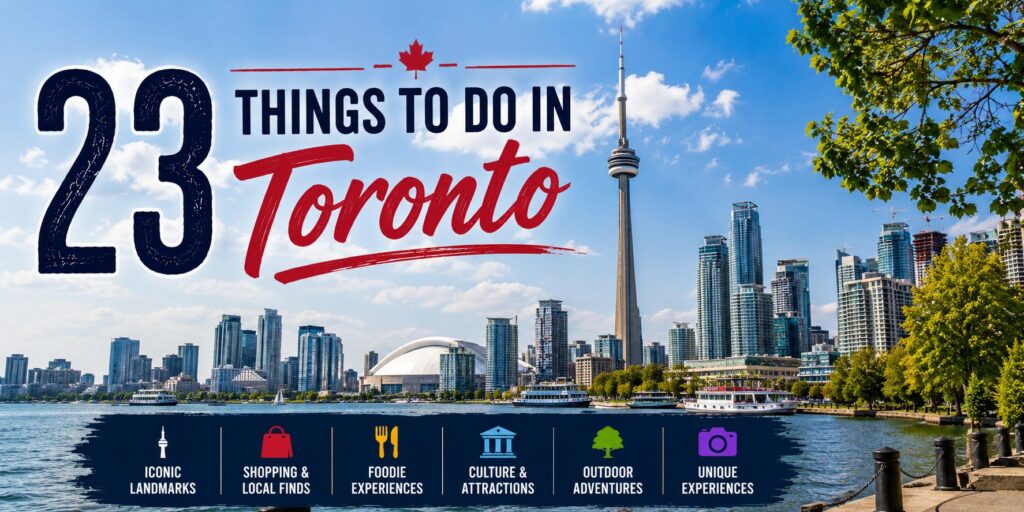
More than 200 languages are spoken in Toronto. Statistics Canada confirms this regularly, and the number makes Toronto the most linguistically diverse city on earth. This is also the most specific reason to visit: the fact translates directly into food that no other North American city can match. A single afternoon moving through Toronto’s neighborhoods delivers genuine Cantonese dim sum in Spadina’s Chinatown, Caribbean jerk in Kensington Market, Portuguese grilled bacalhau in Little Portugal on Dundas, South Indian masala dosa in Scarborough, and Vietnamese pho on College Street without a tourist-adjusted version of any of it. No fusion, no simplified menus, no adapted recipes. The people cooking the food grew up eating it.
This is Toronto’s actual competitive advantage as a travel destinations, and it is the thing that visitors from American cities with excellent food scenes consistently describe as the most unexpected part of the trip. They come for the CN Tower and the Distillery District. They leave talking about the $8 jerk chicken sandwich from a Kensington Market cart and the fact that the dim sum in Scarborough is genuinely better than what they can find at home.
The rest of Toronto earns its visit independently: the Royal Ontario Museum and the Art Gallery of Ontario are genuinely world-class institutions, Casa Loma is the most dramatic Gothic castle in North America, the Toronto Islands deliver a ferry ride to a car-free green space with the finest skyline views in the country, and Niagara Falls is 90 minutes away on the QEW highway for the finest natural-wonder day trip accessible from any major North American city. This guide covers the 30 best things to do in toronto canada organized by neighborhood and category, written for both Canadian visitors and Americans crossing the border, and covering every budget from the free to the exceptional. For more Canada and international city guides, read our article on best places to visit in the world.
Toronto At a Glance: Quick Reference Table
| Activity | Area | Entry | Duration | Best For | Best Time |
|---|---|---|---|---|---|
| CN Tower | Downtown | $43 to $58 CAD | 1.5 to 2 hours | Most iconic view in Canada | Sunset |
| CN Tower EdgeWalk | Downtown | $225 CAD | 1.5 hours | Highest external walk on any building in the world | Any time, book ahead |
| Royal Ontario Museum (ROM) | Bloor / Yorkville | $23 to $28 CAD | 3 to 4 hours | World-class natural history and world cultures | Any time |
| Art Gallery of Ontario (AGO) | Downtown / Chinatown | $25 CAD | 2 to 3 hours | Largest art museum in Canada, Frank Gehry building | Wednesday evening (free) |
| Kensington Market | Downtown West | Free | 2 to 3 hours | Most authentic Toronto neighborhood, food and culture | Saturday morning |
| St. Lawrence Market | Old Town | Free | 1.5 to 2 hours | Best market in Canada, 200 vendors | Saturday morning |
| Distillery District | East Downtown | Free | 2 to 3 hours | Victorian industrial complex, galleries, restaurants | Weekend afternoon |
| Toronto Islands | Harbourfront | $9.50 CAD ferry | Half day | City skyline views, beaches, car-free green space | Summer weekends |
| Casa Loma | Midtown | $35 to $40 CAD | 2 to 3 hours | Gothic castle, finest historic building in Toronto | Any time |
| Hockey Hall of Fame | Downtown | $25 CAD | 1.5 to 2 hours | Stanley Cup, hockey history, interactive exhibits | Any time |
| Aga Khan Museum | North York | $20 CAD | 1.5 to 2 hours | World-class Islamic art and architecture | Any time |
| High Park | West End | Free | 1.5 to 3 hours | 400-acre urban park, cherry blossoms, zoo | Late April for cherry blossoms |
| Harbourfront Centre | Downtown Waterfront | Free | 1 to 2 hours | Waterfront arts programming, lake views | Summer evenings |
| Chinatown / Spadina | Downtown West | Free | 1.5 to 2 hours | Best accessible Chinatown in Canada | Saturday morning |
| Queen Street West | Downtown West | Free | 2 hours | Gallery Row, indie fashion, street art | Any time |
| The Annex | Midtown | Free | 1 to 2 hours | University culture, bookshops, cafes | Weekday morning |
| Leslieville | East End | Free | 1.5 hours | Best brunch neighborhood in Toronto | Weekend morning |
| Yorkville | Midtown | Free | 1 to 2 hours | Luxury galleries, finest restaurants, design | Afternoon |
| Evergreen Brick Works | Don Valley | Free to $10 | 1.5 to 2 hours | Heritage industrial site, Saturday farmers market | Saturday |
| PATH Underground | Downtown | Free | 1 to 2 hours | World’s longest underground pedestrian network | Winter or rainy days |
| Toronto Raptors Game | Scotiabank Arena | $80 to $400+ CAD | 3 hours | NBA basketball, world-class arena atmosphere | November to April |
| Toronto Blue Jays Game | Rogers Centre | $35 to $120 CAD | 3 hours | MLB baseball, retractable roof stadium | April to September |
| Toronto Maple Leafs Game | Scotiabank Arena | $150 to $600+ CAD | 3 hours | NHL hockey, most legendary franchise in Canada | October to April |
| Scarborough Bluffs | Scarborough | Free | 1.5 hours | 90-metre chalk cliffs above Lake Ontario | Any time |
| Rouge National Urban Park | Scarborough | Free | 2 to 4 hours | Largest urban national park in Canada | Any time |
| Dim Sum in Scarborough | Scarborough (Pacific Mall area) | $20 to $35 CAD | 2 hours | Finest regional Chinese cooking in North America | Weekend morning |
| Toronto Christmas Market | Distillery District | $8 CAD | 2 to 3 hours | Best Christmas market in Canada | November to December |
| High Park Cherry Blossoms | West End | Free | 1.5 hours | Most beautiful natural spectacle in urban Toronto | Late April to early May |
| TIFF Bell Lightbox | Entertainment District | Varies | 2 to 3 hours | Toronto International Film Festival hub, year-round cinema | September for TIFF |
| Niagara Falls Day Trip | 90 min via QEW | Free park access | Full day | Most powerful waterfall in North America | Any time |
Downtown Core and the Waterfront
1. CN Tower
Area: Downtown Waterfront | Entry: $43 to $58 CAD adults | Duration: 1.5 to 2 hours | Best time: Sunset for the finest light on the city
The CN Tower, the 553-metre telecommunications and observation tower completed in 1976 that dominated every list of “world’s tallest structures” for 32 years until the Burj Khalifa opened, is Toronto’s most recognizable landmark and the required first stop for first-time visitors. The LookOut Level at 346 metres delivers the finest panoramic view available in Canada on clear days, the horizon extends across Lake Ontario to the south shore in New York State, across the flat Ontario farmland to the north horizon, and across the full sweep of the Toronto metro from Mississauga in the west to Scarborough in the east. The glass floor panels at the LookOut Level, transparent beneath visitors’ feet at 342 metres, are the specific experience that most consistently produces genuine physical fear responses in visitors who consider themselves comfortable with heights.
The EdgeWalk, the ticketed external walking experience around the roof of the main pod at 356 metres, is the highest external walk on any building in the world. Participants are harnessed to an overhead rail, walk around the entire external circumference of the tower roof, and can lean out over the city at a 20-degree angle. The $225 CAD price is the specific amount that separates the people who have done it from the people who stand at the LookOut Level glass floor and decide they have experienced enough.
Practical tips:
- The 360 Restaurant at 351 metres rotates once per 72 minutes and serves Canadian cuisine with a Toronto-focused menu. A dinner reservation includes skip-the-line access to the observation deck. At $70 to $100 CAD per person for dinner, it is the best value premium experience the CN Tower offers
- Buy tickets online in advance to avoid the 30 to 60 minute ground-level queue during summer peak
- Sunset visits are the most photographically productive. The light on the downtown core and the lake turns distinctly orange from the observation deck 30 minutes before sunset
2. Distillery District
Area: East Downtown, King Street East | Entry: Free | Duration: 2 to 3 hours | Best time: Weekend afternoon or evenings
The Distillery District, the 13-acre Victorian-era industrial complex of brick buildings, cobblestone lanes, and cast-iron infrastructure that was the Gooderham & Worts Distillery from 1832 to 1990, is the finest preserved industrial heritage site in Canada and the Toronto neighborhood that most consistently receives the specific compliment “I didn’t know this existed here.” The 40-plus heritage buildings, now occupied by art galleries, independent restaurants, design studios, a microbrewery, a chocolate factory, a theatre company, and specialty shops, form the most cohesive and genuinely beautiful urban public space in Toronto. The cobblestone pedestrian streets, closed to vehicle traffic, allow the Victorian brick architecture to read as a complete environment rather than a fragment.
The Distillery District hosts the Toronto Christmas Market from late November through December the finest Christmas market in Canada, with 50 vendors, mulled wine, and nightly programming in the cobblestone streets lit by thousands of white lights.
Practical tips:
- The microbrewery at Mill Street Brewery, operating in one of the original distillery buildings, produces the most specifically place-identified beer in Toronto. The Tank House Pale Ale is the standard order
- The David Crombie Park pedestrian route from the King Street East streetcar to the Distillery District entrance is the most pleasant 10-minute walk in East Downtown
- The Distillery District is at its most atmospheric on winter evenings during the Christmas market period the Victorian brick and cobblestone have a specific resonance with the seasonal lighting that the summer version does not match
3. St. Lawrence Market
Area: Old Town, King and Jarvis | Entry: Free | Duration: 1.5 to 2 hours | Best time: Saturday morning, 7 AM to early afternoon**
St. Lawrence Market, the covered public market at King and Jarvis in Old Town Toronto that National Geographic named the world’s best food market in 2012, occupies a heritage building from 1845 and the surrounding market complex with approximately 120 food vendors in the South Market, a Saturday Farmers Market in the North Market, and an Antique Market on Sundays. The South Market’s permanent vendors Carousel Bakery (the city’s most celebrated peameal bacon sandwich), Alex Farm Products (finest cheese selection in the city), Stonemill Bakehouse, Olympic Cheese, and the dozen prepared food stalls that run the full length of the ground floor collectively constitute the most varied and highest-quality public market food experience in Canada. Peameal bacon sandwiches, a Toronto specific preparation of pork loin rolled in cornmeal and grilled, are the food item most specifically identified with St. Lawrence Market and the one item worth arriving specifically for.
Practical tips:
- Carousel Bakery’s peameal bacon sandwich ($7 CAD) has lines from opening. Arrive before 9 AM on Saturdays to avoid a 20-minute wait
- The Saturday Farmers Market in the North Market (open 5 AM to 3 PM) carries the finest selection of Ontario produce, artisanal bread, and regional specialties. Budget at least $30 for produce and breakfast combined
- St. Lawrence Market is closed Sundays (replaced by the Antique Market) and Mondays. The South Market is open Tuesday through Saturday
4. Harbourfront Centre
Area: Queens Quay West Waterfront | Entry: Free | Duration: 1 to 2 hours + events | Best time: Summer evenings
Harbourfront Centre, the cultural complex on the waterfront west of the CN Tower, operates the finest accessible waterfront public space in Toronto a combination of outdoor performance spaces, the Power Plant Contemporary Art Gallery, the Artport artist-in-residence studios, the York Quay Centre craft studios (ceramics, glass, textiles), and the waterfront promenade running along Lake Ontario. The free outdoor programming at Harbourfront during summer live music, dance, film, and community events every weekend from May through September delivers the specific experience of a world-class waterfront that Toronto’s winter city identity obscures. Lake Ontario from the Harbourfront promenade looks like a sea. The opposite shore is invisible.
Practical tips:
- Canada Day (July 1) at Harbourfront Centre is the finest free celebration in Toronto free performances, fireworks over the lake, and the specific civic warmth of a genuinely multicultural Canadian crowd
- The Power Plant Contemporary Art Gallery at Harbourfront is free Thursday and Friday evenings (5 to 8 PM). The current and recent exhibition programming is among the finest accessible contemporary art in Canada
- The Toronto Ferry Terminal for Toronto Islands is at the foot of Bay Street, a 10-minute walk east of Harbourfront
5. Toronto Islands
Area: In Lake Ontario, accessed by ferry from Jack Layton Ferry Terminal | Entry: $9.50 CAD round-trip ferry | Duration: Half day | Best time: Summer weekdays for least crowded experience
The Toronto Islands, the chain of low-lying islands in Lake Ontario 500 metres south of the downtown waterfront, provide the most specific and most undervisited experience in Toronto: the view of the city skyline from the lake side. Standing on the southern beach of Ward’s Island or Centre Island looking north at the full Toronto skyline across the blue of Lake Ontario the CN Tower to the left, the glass towers of the financial district in the center, the green of the Harbourfront trees at the waterline is the finest skyline view in Canada and one of the finest urban skyline views in North America. Visitors who spend time in Toronto without making the 10-minute ferry crossing leave having missed the version of the city that photographers and residents consider definitive.
The islands are car-free. Centre Island has Centreville Amusement Park, adequate for children under 10. Hanlan’s Point at the west end has the finest sandy beach, a clothing-optional beach section (the longest-operating clothing-optional public beach in Canada), and the least-crowded summer afternoon in the island group. Ward’s Island at the east end has a residential community of 600 permanent residents, a community garden, and the finest tree-shaded walk in the island group.
Practical tips:
- The ferry to Ward’s Island (the least crowded) departs less frequently than the Centre Island ferry but delivers the most pleasant experience for adult visitors without children
- Bring food from St. Lawrence Market or the Kensington Market for a lake-side picnic. The island snack bars are expensive and mediocre
- The last ferry back to the mainland departs at approximately 11:45 PM in summer. Miss it and you are sleeping outdoors. Check the schedule at toronto.ca/islands
Toronto’s Neighborhoods
6. Kensington Market
Area: Downtown West, west of Spadina between College and Dundas | Entry: Free | Duration: 2 to 3 hours | Best time: Saturday morning**
Kensington Market, the dense grid of Victorian houses and storefronts west of Spadina between College and Dundas streets that has been declared a National Historic Site of Canada, is the most authentic and most specifically Toronto neighborhood in the city. A single walk through the four main Kensington streets Augusta Avenue, Kensington Avenue, Baldwin Street, and Nassau Street delivers Caribbean jerk chicken from a sidewalk drum beside a Jamaican roti shop beside a Vietnamese banh mi counter beside a Mexican taqueria beside a vintage clothing store with $5 racks beside a cat cafe beside a Portuguese custard tart bakery. No single block in any other Canadian city covers this range.
Pedestrian Sundays in summer (the last Sunday of each month, May through October) close Kensington to vehicle traffic entirely and bring street musicians, additional food vendors, and the specific atmosphere of a neighborhood that is genuinely doing what it always does but with better light and more room.
Practical tips:
- Bunners Bake Shop at 248 Augusta Avenue produces the finest vegan baked goods in Toronto and the city’s best cinnamon roll by several visitor accounts. It is the most specifically Kensington Market food experience for visitors who do not eat meat
- The Cheese Boutique is technically in Roncesvalles rather than Kensington but is the finest cheese shop in Toronto by general consensus. Worth the 15-minute walk west
- Arrive at Kensington on a Saturday before 11 AM. The market becomes difficult to navigate with stroller-and-brunch-crowd density by noon
7. Chinatown and Spadina Avenue
Area: Downtown West, Spadina and Dundas | Entry: Free | Duration: 1.5 to 2 hours | Best time: Saturday or Sunday morning
Toronto has multiple Chinatowns the Spadina and Dundas original, the Scarborough Agincourt neighborhood around Pacific Mall, and the Markham Richmond Hill corridor to the north. The Spadina Avenue Chinatown is the most accessible to downtown visitors and the most atmospherically traditional, but experienced dim sum visitors specifically go to the Scarborough and Markham Chinatowns for the highest quality regional Chinese cooking in North America outside of Vancouver’s Richmond suburb. The specific praise for Toronto’s Chinese food diaspora cooking is consistent among people who have eaten their way through San Francisco’s Chinatown, New York’s Flushing, and Toronto: the Toronto suburban Chinese restaurant ecosystem produces the finest hand-pulled noodles, the most technically correct Cantonese dim sum, and the best Sichuan cooking on the continent.
Practical tips:
- Congee Queen on Spadina is the most consistent value breakfast in downtown Toronto’s Chinese food corridor
- For genuine Cantonese dim sum: take the TTC subway east to Scarborough and visit Casa Imperial, Bamboo Yuen, or O’Mei. Allow two hours and arrive before 11 AM to avoid the wait
- The Spadina Chinatown night market on summer weekends is the finest free evening entertainment in Downtown West
8. Queen Street West
Area: Downtown West, Queen Street between Bathurst and Ossington | Entry: Free | Duration: 2 hours | Best time: Any time**
Queen Street West, the stretch of Queen Street between Bathurst and Ossington known informally as Gallery Row, is Toronto’s most visually dense independent retail and gallery corridor. The concentration of independent galleries, vintage clothing dealers, design studios, specialty coffee shops, and independent bookstores in the four-block stretch between Bathurst and Dovercourt makes Queen Street West the city street most specifically identified with Toronto’s contemporary visual culture. The Gladstone Hotel at the corner of Gladstone Avenue serves double function as a hotel and an arts venue with rotating gallery programming in its public spaces.
Practical tips:
- The Drake Hotel at 1150 Queen Street West is the finest hotel for visitors who want to be embedded in the Queen West scene. The Drake’s Hotel Cafe hosts live music Thursday through Saturday
- The stretch of Queen Street west of Ossington (called Roncesvalles or “Roncy” by residents) is the finest Polish neighborhood in Canada, with pierogies, Polish delis, and a residential character that contrasts with the commercial density of the Gallery Row stretch
- The AGO (Art Gallery of Ontario) is three blocks north of Queen Street on Dundas, making the two easily combined in a single afternoon
9. The Annex
Area: Midtown, Bloor Street West between Spadina and Bathurst | Entry: Free | Duration: 1.5 to 2 hours | Best time: Weekday morning
The Annex, the University of Toronto-adjacent neighborhood along Bloor Street West between Spadina and Bathurst, is the most intellectually concentrated neighborhood in Toronto the combination of the U of T campus, the density of independent bookshops (BMV Books is the finest secondhand bookstore in Canada), the political culture of the neighborhood (Canada’s federal NDP has historically drawn major support from Annex voters), and the specific mix of academics, graduate students, and longtime residents creates the neighborhood with the highest concentration of “good conversation in a coffee shop” per square block in the city.
Practical tips:
- BMV Books at 471 Bloor Street West is the most specifically Toronto independent bookshop experience. Three floors, genuinely curated used and remaindered selection, and prices significantly below any online competitor
- Bloor Street Korean restaurants (the Koreatown strip runs from Bathurst west to Christie) are the finest accessible Korean food in Toronto and a necessary stop before or after the Annex walk
- The ROM is at the east end of Bloor at Queen’s Park, making the Annex-ROM-Yorkville sequence the finest single midtown Toronto walking day
10. Leslieville and the East End
Area: East Toronto, Queen Street East between Broadview and Leslie | Entry: Free | Duration: 1.5 to 2 hours | Best time: Weekend morning for brunch
Leslieville, the strip of Queen Street East between Broadview and Leslie streets that transitioned from working-class to creative-class over the 2000s decade, is the finest brunch neighborhood in Toronto and the East End district most worth a specific visit. The concentration of Leslieville’s independent breakfast and lunch restaurants Lady Marmalade, Flock, Tabule, Bonjour Brioche represents the highest density of specifically praised brunch destinations in any Toronto neighborhood, and the Sunday morning Leslieville experience of a two-hour lineup at Lady Marmalade followed by a Broadview park walk is the most specifically Toronto version of a weekend morning available in the city.
Practical tips:
- Lady Marmalade at 898 Queen Street East consistently tops best brunch lists for Toronto and is specifically known for the eggs Benedict variations
- The Leslieville Pumps gas station converted to a coffee bar, and the Broadview Hotel rooftop bar with its east-end skyline views, are the two most architecturally interesting stops in the neighborhood
- The Broadview Hotel rooftop (open seasonally) is the finest elevated cocktail experience in the East End, with the CN Tower framed at the end of Queen Street
Museums and Cultural Institutions
11. Royal Ontario Museum (ROM)
Location: 100 Queens Park, Bloor and Avenue Road | Entry: $23 to $28 CAD | Duration: 3 to 4 hours | Best time: Any time**
The Royal Ontario Museum, the largest museum in Canada and one of the ten largest in the world, contains approximately 13 million objects across 40 permanent galleries covering natural history, world cultures, art, and science. The ROM’s specific distinction in North America: the collection covers the full range of human civilisation from every inhabited region of the world at a depth that most similarly-sized American museums concentrate into a narrower cultural or geographic scope. The Chinese collection is the most comprehensive outside of mainland China and Taiwan; the Egyptian collection is the finest in Canada; the First Nations and Indigenous Canadian galleries are the most extensively developed in any Canadian institution. The Michael Lee-Chin Crystal, Daniel Libeskind’s controversial angular glass addition completed in 2007, has become as architecturally debated and as specifically Toronto as the ROM’s Victorian heritage building it emerged from.
Practical tips:
- The ROM After Dark series (adult-only Thursday evenings) provides a different register for the museum and the finest ROM cocktail bar experience
- The dinosaur gallery (Teck Suite of Galleries: Earth’s Treasures) contains the most complete Albertaceratops skeleton ever found a specifically Canadian fossil discovery accessible in its most complete form here
- The Member Perqs program at $75 CAD per year includes unlimited admission and reduced guest tickets. For visitors planning more than two ROM visits in a calendar year it pays for itself immediately
12. Art Gallery of Ontario (AGO)
Location: 317 Dundas Street West | Entry: $25 CAD adults; free Wednesday evenings 6 to 9 PM | Duration: 2 to 3 hours | Best time: Wednesday evening for free admission
The Art Gallery of Ontario, Canada’s largest art museum, houses a collection of 95,000 works spanning 700 years of art history in a building expanded by Frank Gehry (a Toronto native) in a 2008 renovation that doubled the gallery space and added the Galleria Italia a curving 64-metre wood and glass vitrine along the Dundas Street facade that is the finest piece of accessible public architecture in Toronto. The AGO’s specific collection strengths are the Group of Seven (the Canadian landscape painting movement that established a distinctly Canadian visual identity in the 1920s) and the Henry Moore Sculpture Centre, which holds the largest public collection of Henry Moore’s work in the world. The Thomson Collection, donated by Kenneth Thomson in 2008, added 2,000 works including Peter Paul Rubens, Rembrandt, and the finest collection of European ship models in the world.
Practical tips:
- Wednesday evening admission is free from 6 to 9 PM. The evening light through Gehry’s Galleria Italia is the finest architectural experience the building offers
- The Group of Seven galleries are the most specifically Canadian cultural experience available in any Toronto museum. Knowing who Tom Thomson was and why he matters before visiting the AGO significantly enhances the collection
- The AGO restaurant (Bistro by Frank Gehry) on the gallery’s lower level is the finest museum restaurant in Toronto and worth booking for a lunch alongside a gallery visit
13. Casa Loma
Location: 1 Austin Terrace, Midtown | Entry: $35 to $40 CAD | Duration: 2 to 3 hours | Best time: Any time
Casa Loma, the 98-room Gothic Revival castle built by Sir Henry Pellatt between 1911 and 1914 before a series of financial reversals ended his ability to maintain it, is the most dramatic historic building in Toronto and the one that most consistently surprises visitors who arrive with minimal expectations. The castle’s scale 98 rooms, two towers rising above the midtown Toronto roofline, a conservatory with a Spanish tile dome, underground tunnels connecting the main castle to the stables, and a Great Hall with a 60-foot decorated ceiling exceeds what the word “castle” typically implies to North American visitors unfamiliar with the ambitions of Edwardian-era industrialists. The rooftop walkway along the top of the round tower, with its view across the Toronto skyline south to Lake Ontario, is the finest accessible elevated viewpoint in midtown Toronto.
Practical tips:
- The self-guided audio tour (included with admission) takes 90 minutes through the main castle floors, the towers, and the tunnels. The tunnels connecting the castle to the carriage house and stables are the most specifically atmospheric Casa Loma experience
- Casa Loma hosts a Halloween event in late October and a winter seasonal event in December that use the castle’s Gothic atmosphere productively. Both sell out
- The Gardiner Museum of Ceramic Art, 10 minutes walk south on Queen’s Park near the ROM, pairs well with Casa Loma for a full midtown cultural day
14. Hockey Hall of Fame
Location: 30 Yonge Street, BCE Place, Downtown | Entry: $25 CAD | Duration: 1.5 to 2 hours | Best time: Any time**
The Hockey Hall of Fame, housed in the 1885 Bank of Montreal building in BCE Place at Yonge and Front streets downtown, is the finest single-sport museum in Canada and the one that most specifically rewards visitors who understand what the Stanley Cup represents to Canadian culture. The Stanley Cup, the oldest professional sports trophy in North America (first awarded in 1893), is on display in the Great Hall of the old bank building in a room with 50-foot ceilings, marble columns, and the specific reverence of a space designed to hold money but now holding the thing that Canadian hockey culture regards as equivalent. The interactive exhibits shooting simulators, goalie stance challenges, and the broadcast booth where you can call a famous goal make the Hall engaging even for visitors who do not follow the sport.
Practical tips:
- The Esso Great Hall where the Stanley Cup is displayed is the most photographically impressive room in the Hockey Hall of Fame. Allow time to be in it without the interactive exhibit crowds
- The Hockey Hall of Fame is 5 minutes walk from Union Station, making it the most convenient museum in Toronto for visitors arriving by train from Niagara Falls or other Ontario destinations
- Toronto Maple Leafs home game tickets can sometimes be purchased at the box office on game day for standing room. Check at the Scotiabank Arena box office before paying secondary market prices
Parks and Natural Spaces
15. High Park
Location: West End, Bloor Street West at Keele | Entry: Free | Duration: 1.5 to 3 hours | Best time: Late April for cherry blossoms, summer for full park experience**
High Park, the 400-acre public park in Toronto’s west end that is the largest park in the downtown urban core, contains the finest cherry blossom display in Toronto (approximately 2,000 Somei Yoshino trees planted from Japan as a gift from Japanese-Canadians), a free outdoor zoo (High Park Zoo, Canada geese, peacocks, bison, highland cattle, capybara), the Grenadier Pond with its winter skating and summer paddle boating, natural woodland areas with trails through mature Toronto forest, and Hillside Gardens with the finest formal garden planting in the west end. The late April cherry blossom peak at High Park, lasting 5 to 10 days depending on the year’s temperature progression, is the most concentrated and most spectacular natural spectacle available for free in urban Toronto, and the specific event that most clearly illustrates what Toronto’s multicultural community does with Japanese cultural traditions the hanami (flower-viewing) picnics under the Sakura Avenue trees fill the park with families who grew up with the tradition and families experiencing it for the first time simultaneously.
Practical tips:
- The cherry blossom peak typically falls in the last week of April or first week of May and lasts approximately one week. Toronto’s High Park cherry blossom webcam (highparktoronto.com) provides current bloom status
- High Park during cherry blossom peak is very crowded on weekends. Weekday morning visits (before 10 AM) allow the experience without the crowd density
- The Grenadier Cafe in High Park is the finest accessible brunch option for visitors who want to eat in the park
16. Evergreen Brick Works
Location: 550 Bayview Avenue, Don Valley | Entry: Free (most programming), $10 CAD for market | Duration: 1.5 to 2 hours | Best time: Saturday for farmers market**
Evergreen Brick Works, the adaptive reuse of the Don Valley Brick Works industrial complex (the source of the orange brick that built most of Victorian-era Toronto) into a community environmental center, is the most architecturally interesting and most Instagram-specific destination in the Don Valley ravine system. The heritage industrial buildings towering kilns, raw brick walls, the massive open-air kiln sheds now used as a farmers market hall provide the specific industrial-heritage atmosphere that the Distillery District has but in a less commercially developed and more community-connected context. The Saturday Farmers Market (October through May indoors, May through October in the outdoor heritage grounds) is the finest small-scale specialty food market in Toronto after St. Lawrence.
Practical tips:
- The Brick Works is accessible by a 10-minute walk through the Don Valley ravine from Broadview subway station, or by shuttle from Broadview Station on market days
- The Saturday market runs from 8 AM to 1 PM. Arrive before 10 AM for the full vendor selection
- The adjacent Crothers Woods trail system in the Don Valley provides 2 to 4 hours of forest trail walking accessible from the Brick Works parking area
17. Scarborough Bluffs
Location: Eastern Scarborough, Bluffer’s Park | Entry: Free | Duration: 1.5 hours | Best time: Any time, late afternoon light**
The Scarborough Bluffs, the 15-kilometre stretch of white and buff-coloured clay and sand cliffs rising up to 90 metres above the Lake Ontario shoreline in eastern Scarborough, are the finest natural landscape accessible within Toronto’s city limits. The specific visual quality white chalk-coloured pinnacles and columns eroded from the main cliff face, framing a view of Lake Ontario that extends to the New York State horizon on clear days has been described as resembling the English coast that Elizabeth Simcoe, York’s first resident artist, specifically compared the cliffs to when she named them after Scarborough in Yorkshire in 1796. Bluffer’s Park at the base of the bluffs provides the finest lake-level view looking up at the full cliff face.
Practical tips:
- The upper bluff path runs the full length of the Scarborough Bluffs with views down to the lake and across to the cliff formations. The lower Bluffer’s Park provides the lake-level view. Visiting both requires a car or two separate transit trips
- Swimming at Bluffer’s Park is available in the designated beach area in summer the water is deep and clear compared to downtown Toronto beaches
- The drive through Scarborough along Kingston Road east of Victoria Park Avenue is the correct route for visitors combining the Bluffs with a dim sum lunch in the Agincourt Chinatown
Sports in Toronto
Toronto is the only North American city with franchises in all four major professional sports leagues NBA (Raptors), NHL (Maple Leafs), MLB (Blue Jays), and MLS (Toronto FC). It is also the only Canadian city with an NBA team and the city whose relationship to the NHL is simultaneously the most commercially successful and most specifically tortured franchise relationship in professional sports (the Maple Leafs have not won the Stanley Cup since 1967 and remain the highest-valued franchise in the NHL).
18. Toronto Maple Leafs at Scotiabank Arena
Location: 40 Bay Street, Downtown | Tickets: $150 to $600+ CAD | Duration: 3 hours | Best time: October to April
A Toronto Maple Leafs home game at Scotiabank Arena is the most specifically Canadian sports experience available in North America and the specific test case for understanding how a franchise with a 58-year Stanley Cup drought maintains both the highest ticket prices and the most devoted fan base in the NHL simultaneously. The arena, the capacity crowd in blue-and-white jerseys, the specific intensity of a Canadian hockey audience that has been following this team for decades, and the national anthem sung by 19,000 people make a Maple Leafs game the most atmospherically powerful live sports experience in Canada. Whether the Leafs win or lose is the wrong question. The question is what it feels like to be in that building.
Practical tips:
- Leafs tickets on the secondary market are expensive. Standing room tickets at the Scotiabank Arena box office on game day are the most affordable legal option at $40 to $80 CAD
- Wearing a Leafs jersey in Toronto during any playoff run even a first-round exit generates conversations with strangers that no other artifact of Toronto culture produces
- The pre-game experience on Bremner Boulevard outside the arena, with street vendors and bars filling the Entertainment District, is the finest accessible version of game-day Toronto without a ticket
19. Toronto Blue Jays at Rogers Centre
Location: 1 Blue Jays Way, Downtown adjacent to CN Tower | Tickets: $35 to $120 CAD | Duration: 3 hours | Best time: April to September**
Toronto Blue Jays games at Rogers Centre, the retractable-roof stadium immediately adjacent to the CN Tower, are the most affordable live professional sports experience in downtown Toronto and the finest summer afternoon option for visitors who want to spend three hours in a comfortable stadium seat watching baseball with the CN Tower visible through the outfield window. The specific attraction of Rogers Centre as a baseball venue: the retractable roof means the game runs regardless of weather, the seats are comfortable and sightlines good throughout, and the $35 to $60 CAD baseline ticket price makes it the most accessible of Toronto’s major professional sports. The Blue Jays are the only MLB team based in Canada, which gives a regular-season Jays-Yankees or Jays-Red Sox game a specific cross-border sporting culture context.
Practical tips:
- Lower-bowl tickets on the third-base side provide the finest views of the CN Tower through the outfield window the specific Rogers Centre aesthetic that separates it from every other MLB stadium
- The Blue Jays play 81 home games per season from April through September. Weeknight games have significantly shorter lines at the gates and more affordable secondary market prices
- The Rogers Centre is adjacent to Union Station, making pre-game and post-game travel the simplest transit connection of any Toronto sports venue
The Food Why Toronto Is North America’s Best City for Diverse Eating
20. Dim Sum in Scarborough
Location: Pacific Mall area, Agincourt (Scarborough) | Cost: $20 to $35 CAD per person | Duration: 1.5 to 2 hours | Best time: Saturday or Sunday, arrive before 10:30 AM
The Scarborough Agincourt Chinatown, centered on the strip malls of Sheppard Avenue East and Kennedy Road east of the Pacific Mall, contains the finest regional Chinese cooking in Canada and, by informed consensus among food critics who have eaten in Vancouver, San Francisco, New York, and Toronto, the best accessible Cantonese dim sum in North America east of Richmond, British Columbia. The specific claim is consistent across sources: Casa Imperial, O’Mei Restaurant, and Bamboo Yuen serve push-cart and order-card dim sum at the technical level of Hong Kong dai pai dong operations har gow with translucent wrappers of the correct thickness, cheung fun of the correct silkiness, char siu bao with the specific orange-tinted window that distinguishes genuine char siu from approximate versions. This is the food experience that makes Toronto specifically worth the trip for visitors whose reference point for Chinese-Canadian cooking is their local suburban dim sum.
Practical tips:
- The TTC subway to Kennedy Station followed by the 43 Kennedy bus north to Sheppard is the transit route to the Scarborough Agincourt dim sum corridor
- Arrive before 10:30 AM on weekends. The quality restaurants fill by 11 AM and the wait becomes 30 to 45 minutes
- Pacific Mall, 4300 Steeles Avenue East, is the largest indoor Asian mall in North America and the most specifically Scarborough non-food experience 500 vendors across 180,000 square feet
21. Kensington Market Food Walk
Location: Kensington Market, Downtown West | Cost: $20 to $40 CAD | Duration: 2 to 3 hours | Best time: Saturday morning
The Kensington Market food walk moving between the half-dozen nationalities represented in the market’s food vendors within a four-block area is the most compressed version of Toronto’s food diversity available in a single location. The specific sequence that produces the most flavors per dollar: the Jumbo Empanadas at 245 Augusta Avenue ($3 each, genuine Argentinian empanadas), the Rasta Pasta at Kensington Market Burritos (fusion but done locally), an agua fresca from a Mexican street cart, and a finish at Bunners Bake Shop for the cinnamon roll, all within a 400-metre radius. This covers four distinct culinary traditions in under two hours for approximately $25 CAD.
Practical tips:
- Global Cheese at 76 Kensington Avenue is the finest cheese vendor in the market and the correct stop for sourcing Quebec cheeses oka, brie de Meaux-style, and the aged cheddars from Eastern Ontario
- Seven Lives Tacos at 69 Kensington Avenue consistently appears on Toronto best restaurant lists for its Baja-style fish tacos. The line extends outside at lunch
- The Cheese Boutique at 45 Ripley Avenue (15 minutes walk west into Roncesvalles) is technically outside Kensington but is the most specific specialty food experience in Toronto’s west end
Day Trips from Toronto
22. Niagara Falls
Location: 90 minutes south via QEW | Entry: Free (park access) | Duration: Full day | Best time: Any time; summer evenings for illumination**
Niagara Falls, the system of three waterfalls on the Niagara River at the Ontario-New York border 130 kilometres south of Toronto, is the most powerful waterfall system in the world by water volume the Horseshoe Falls on the Canadian side alone moves approximately 2,800 cubic metres of water per second over a crest line 670 metres wide. The specific experience of standing at the Horseshoe Falls railing at Table Rock, with the full volume of the falls within arm’s reach and the spray visible from 15 kilometres away creating a specific low thunder that visitors feel in their chests before they hear it, is the most physically immediate natural phenomenon accessible from any major North American city. No photograph of Niagara Falls and no description of the volume statistics prepares a first-time visitor for the scale of the actual falls.
The Maid of the Mist boat tour, which approaches the Horseshoe Falls basin by boat, is the finest way to understand the falls’ scale from below. The Journey Behind the Falls tour, accessible from Table Rock, provides the geological and historical context through tunnels carved through the rock beside the falling water.
Practical tips:
- Niagara Falls is 90 minutes from Toronto via the QEW highway. Via Rail’s Toronto to Niagara Falls service, when operating, departs from Union Station
- The view from the Canadian side is definitively superior to the American side. Horseshoe Falls faces north and is visible in full from the Canadian Table Rock viewing area
- The summer evening illumination of the falls (9 PM to midnight in peak season) and the weekly fireworks program are the finest time-specific reasons to time a Niagara day trip for a summer evening
23. Niagara-on-the-Lake
Location: 10 minutes north of Niagara Falls, 1.5 hours from Toronto | Entry: Free (town) | Duration: Half day combined with Niagara Falls | Best time: May to October**
Niagara-on-the-Lake, the historic loyalist town at the northern end of the Niagara Peninsula where the Niagara River meets Lake Ontario, is the most specifically pleasant day-trip town accessible from Toronto a preserved 19th-century main street, 60-plus licensed wineries along the Niagara-on-the-Lake wine route, the Shaw Festival Theatre (one of Canada’s premiere professional theatre festivals running from April to November), and the finest accessible ice wine production in the world. The Niagara-on-the-Lake wine region produces the finest Vidal and Riesling ice wine in the world grapes left on the vine until temperatures reach -8 to -13 degrees Celsius are pressed while frozen, producing a dessert wine with a sugar concentration and intensity that no warm-climate region can reproduce.
Practical tips:
- The Niagara-on-the-Lake winery circuit Peller Estates, Inniskillin, Pillitteri Estates, and Jackson-Triggs are the most accessible of the 60-plus licensed wineries covers the full range of Niagara wine production in half a day
- The main street of Niagara-on-the-Lake (Queen Street) is the most intact 19th-century commercial streetscape in Ontario and the most specifically colonial-era Canadian townscape accessible from Toronto
- Combine Niagara Falls and Niagara-on-the-Lake in a single day: morning at the falls, afternoon on the Niagara wine route, evening back in Toronto
Toronto Practical Guide
Getting Around Toronto
Toronto Transit Commission (TTC): The TTC subway, streetcar, and bus network covers all major tourist destinations. A single fare is $3.30 CAD (exact change or tap with credit/debit card). The Presto card (reloadable transit card) provides the same fare rate without requiring exact change. The TTC is the practical transit solution for all downtown and midtown Toronto destinations.
Subway lines: The Yonge-University line (the U-shaped line) covers Union Station, the Entertainment District, Bloor, the Annex, Spadina, and the main north-south corridor. The Bloor-Danforth line covers east-west movement through Kensington Market (Spadina or Bathurst stations), Leslieville (Broadview or Chester), and Scarborough.
Streetcars: The King Street, Queen Street, and Spadina streetcar routes cover the neighborhoods most relevant to visitors. Download the TTC app for real-time arrivals.
Bixi: Toronto’s bikeshare program operates April through November with stations throughout the downtown and midtown. Day passes ($15 CAD) provide unlimited 30-minute rides.
Driving and parking: Drive and park only for day trips outside the city. Downtown Toronto parking averages $25 to $50 CAD per day in commercial lots.
Where to Stay in Toronto
Downtown Core (Financial District / Entertainment District): Best for CN Tower, Rogers Centre, Scotiabank Arena, and walking access to Distillery District and St. Lawrence Market. Major chains Marriott, Sheraton, Hilton, Fairmont Royal York. $200 to $450 CAD per night.
Midtown (Bloor and Yorkville): Best for ROM, AGO, Casa Loma, The Annex, and Yorkville shopping. Boutique hotels and mid-size properties. $180 to $400 CAD per night.
West End (Queen Street West / Kensington Market area): Best for Kensington Market, Queen Street West, and the Distillery District access. Independent boutique hotels and Airbnbs. $130 to $280 CAD per night.
East End (Leslieville / Riverdale): Best for visitors who want a residential Toronto neighborhood experience. Short-term rentals predominate. $100 to $200 CAD per night.
Toronto Budget Guide
Budget traveler (hostel or Airbnb room, transit, market food): $80 to $130 CAD per day. The AGO free Wednesday evening, High Park (free), Toronto Islands ferry ($9.50 CAD), and St. Lawrence Market (free entry, $15 CAD for lunch from vendors) deliver a full Toronto day for under $50 CAD in admission and transit costs. Kensington Market food walk at $25 CAD. A hostel in the downtown core costs $40 to $70 CAD per night.
Mid-range traveler (hotel, 1-2 paid attractions per day, restaurants): $180 to $300 CAD per day. The ROM ($28) or AGO ($25), Casa Loma ($40), CN Tower general ($48), and meals at proper Toronto restaurants ($40 to $60 per person for dinner) with a mid-range hotel ($160 to $250 per night) cover the essential Toronto experience.
Luxury traveler (boutique hotel, fine dining, premium experiences): $500 and above per day. The Four Seasons Toronto in Yorkville ($600 to $900 per night), dinner at Canoe ($150 per person) on the 54th floor of the TD Centre, a Leafs game with lower-bowl tickets ($300 to $600), and the EdgeWalk ($225) represent the full premium Toronto experience.
Best Time to Visit Toronto
Late April to May: Cherry blossom season at High Park (late April, lasts approximately one week), warm but not hot temperatures (15 to 22 degrees C), lower hotel prices than peak summer.
June to August: Toronto Pride (late June, one of the largest Pride celebrations in the world), Canada Day (July 1, Harbourfront fireworks), full summer programming at Harbourfront and the islands. Highest temperatures (25 to 32 degrees C), highest hotel prices, highest tourist activity.
September: Toronto International Film Festival (TIFF, first two weeks of September) brings the highest celebrity density and most culturally specific event in Toronto’s calendar. Hotel prices peak during TIFF. The weather is ideal warm days, cool evenings, no humidity.
November to December: Silver Boughs Christmas Market at the Distillery District (best Christmas market in Canada), fewer tourists, lowest hotel prices, cold but generally manageable (0 to 8 degrees C).
Winter: Toronto in winter is not for all visitors. It is cold (January averages -7 degrees C, with wind chill reaching -20 on extreme days). The PATH underground pedestrian network (28 kilometres of underground walkways connecting Union Station to 75 buildings in the Financial District) is the specific infrastructure that Toronto built for exactly this reason.
Frequently Asked Questions About Things to Do in Toronto
How many days do you need in Toronto? Four days covers the essential Toronto experience: one day for downtown (CN Tower, St. Lawrence Market, Distillery District, Harbourfront), one day for midtown and museum (ROM or AGO, Casa Loma, The Annex walk), one day for neighborhoods (Kensington Market, Chinatown, Queen Street West, Leslieville brunch), and one day for the Niagara Falls and Niagara-on-the-Lake day trip. Five days adds a Scarborough Bluffs and dim sum day. Seven days allows the full Toronto experience without rushing any component.
What is Toronto most famous for? Toronto is internationally famous for being the most multicultural city in the world (54 languages are first languages for at least 1,000 residents, with over 200 languages spoken in total), for the Toronto International Film Festival (the most commercially important film festival in the world for studio acquisitions), for the CN Tower, for the Toronto Maple Leafs, and among food writers specifically for producing the finest regional Chinese cooking in North America outside of Vancouver’s Richmond suburb.
Is Toronto safe for tourists? Yes. Toronto consistently ranks among the safest large cities in the world by both reported crime statistics and experiential surveys of visitors. The specific areas that visitors are advised to be aware of some sections of Regent Park and Jane and Finch are not tourist destinations and are not on any standard Toronto itinerary. The downtown core, midtown, the waterfront, and all neighborhood destinations in this guide are as safe for solo visitors at any hour as any comparable major North American city.
What are the best things to do in toronto canada with kids? Casa Loma (children’s interactive elements throughout), the Hockey Hall of Fame (shooting simulators, interactive exhibits), the Centreville Amusement Park on Centre Island (appropriate for under-10), the High Park Zoo (free, accessible), the ROM’s dinosaur galleries, and the Ripley’s Aquarium of Canada (at the base of the CN Tower, excellent for children) are the seven most consistently child-specific Toronto attractions. Niagara Falls as a day trip is universally effective for children of all ages.
Do I need a visa to visit Toronto from the United States? American citizens do not require a visa to enter Canada. A valid US passport is required (enhanced driver’s licenses from some border states are also accepted at land crossings). The Canada eTA (Electronic Travel Authorization) is required for air travel by citizens of visa-exempt countries other than the United States.
What is the local currency in Toronto and should I carry cash? Toronto operates in Canadian Dollars (CAD). Credit and debit cards with tap functionality are accepted almost universally most Toronto vendors including markets, food trucks, and small cafes accept tap-to-pay. Carrying $40 to $60 CAD in cash covers the specific scenarios (some Kensington Market street vendors, parking meters in older lots) where cards are not accepted. The best exchange rate for American visitors is an ATM withdrawal from a major Canadian bank.
Final Word: The Multicultural City Isn’t Marketing
Most cities that describe themselves as diverse mean that they have visible immigrant communities. Toronto means something specific and measurable: the majority of the population was born outside of Canada. The people serving the food at the Scarborough dim sum restaurants grew up eating that food in Hong Kong. The person making the jerk chicken in Kensington Market grew up in Jamaica. The Portuguese custard tart at the Kensington bakery was made by someone who learned the recipe in Lisbon. The city’s food is authentic not because Toronto has great chefs who studied authentic techniques but because Toronto has a large percentage of its population who brought authentic techniques with them.
This is what makes Toronto specifically worth visiting rather than merely worth visiting. The CN Tower is impressive. The ROM is world-class. Casa Loma is more surprising than almost any historic building in North America. But the specific Toronto experience the one that visitors describe for months afterward is eating your way through a city that genuinely is what it says it is.
Have you discovered a Toronto neighborhood or restaurant that belongs on this list? Tell us in the comments below.
Pingback: 25 Best Things to Do in Montreal 2026 (Local Guide)