
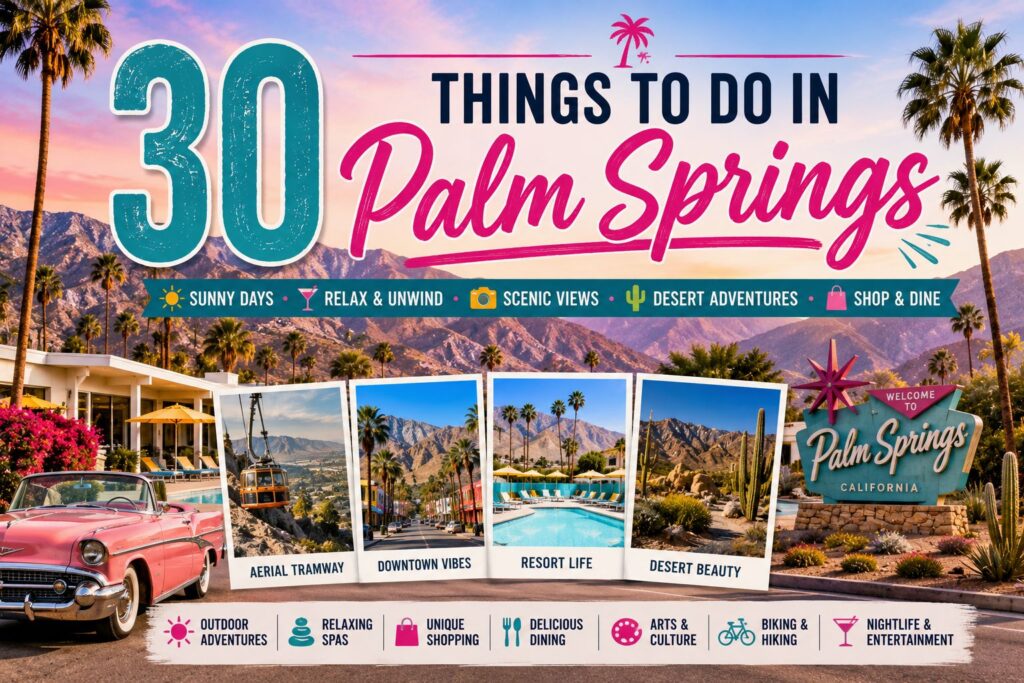
Palm Springs has a population of around 48,000 people and more mid-century modern architecture per square mile than anywhere else on earth. The city has the highest concentration of preserved 1950s and 1960s residential design in the United States – more than 2,500 documented structures built between 1940 and 1969. Architects like Richard Neutra, Albert Frey, John Lautner, and Donald Wexler used this desert city as a laboratory for the modern American home, and most of those buildings are still standing, still occupied, and in many cases still furnished with the original furniture. I have been to Palm Springs in every season. I have visited during Modernism Week when the streets fill with people in Rat Pack-era clothing who have traveled from forty countries to look at houses. I have visited in July when the temperature was 114 degrees and the hotels were half the price. I have visited on long weekends when every pool at every boutique hotel had a DJ and nobody was bothering to look at architecture. All three versions of Palm Springs are real, and all three are worth knowing before you book.
For more California travel destinations guides, read our things to do in Los Angeles and things to do in San Francisco.
Palm Springs At a Glance: Quick Reference Table
| Activity | Area | Entry | Duration | Best For | Best Time |
|---|---|---|---|---|---|
| 1. Palm Springs Art Museum | Downtown | $17 adults, free Thursdays 4-8 PM | 2 to 3 hours | Art and architecture lovers | Thursday evenings (free) |
| 2. Palm Springs Aerial Tramway | Chino Canyon | $32.95 adults | 3 to 5 hours | All visitors | September to May, weekday mornings |
| 3. Sunnylands Center and Gardens | Rancho Mirage | Free (grounds), $45 house tour | 1.5 to 2 hours | History buffs, garden lovers | October to May |
| 4. Indian Canyons | South Palm Springs | $12 adults | 2 to 4 hours | Hikers, nature lovers | October to April |
| 5. The Living Desert Zoo and Gardens | Palm Desert | $22.95 adults | 3 to 4 hours | Families with kids | October to April mornings |
| 6. Modernism Week Architecture Tours | Various | $40 to $125 per tour | 2 to 3 hours | Architecture enthusiasts | February only |
| 7. Palm Springs Walk of Stars | Palm Canyon Drive | Free | 30 to 60 minutes | Casual strollers, classic Hollywood fans | Morning or evening year-round |
| 8. Tahquitz Canyon | West Palm Springs | $15 adults | 2 to 3 hours | Hikers, waterfall seekers | October to May |
| 9. Downtown Art Walk | Downtown | Free | 2 to 3 hours | Art lovers, evening crowd | First Friday of each month |
| 10. Coachella Valley Preserve | Thousand Palms | Free | 2 to 4 hours | Birders, nature lovers | November to March |
| 11. Elvis Honeymoon Hideaway | Uptown Design District | $35 per person | 45 to 60 minutes | Pop culture fans, architecture lovers | Year-round, Friday to Sunday |
| 12. Palm Springs Air Museum | Airport district | $19 adults | 2 to 3 hours | History buffs, aviation fans | October to May |
| 13. Knott’s Soak City Palm Springs | East Palm Springs | $42 adults | Full day | Families, summer visitors | May to September |
| 14. Moorten Botanical Garden | South Palm Springs | $5 adults | 1 to 1.5 hours | Plant enthusiasts, slow walkers | Morning year-round |
| 15. Murray Canyon Trail | Agua Caliente | $12 adults | 2 to 3 hours | Moderate hikers | November to April |
| 16. Palm Springs Farmers Market | Frances Stevens Park | Free entry | 1 to 2 hours | Food lovers, locals | Saturday mornings, October to May |
| 17. Agua Caliente Cultural Museum | Downtown | Free | 1 to 2 hours | History and culture seekers | October to May |
| 18. Uptown Design District Shopping | North Palm Canyon Drive | Free to browse | 2 to 3 hours | Vintage and design lovers | Saturday mornings |
| 19. Shields Date Garden | Indio | Free grounds, $5 theater | 1 to 1.5 hours | Food tourists, date lovers | October to May |
| 20. Cabot’s Pueblo Museum | Desert Hot Springs | $14 adults | 1 to 1.5 hours | History and quirky attraction fans | October to April |
| 21. Palm Springs Vintage Market | Various venues | $5 entry | 3 to 4 hours | Vintage shoppers, designers | Second Sunday monthly |
| 22. Big Morongo Canyon Preserve | Morongo Valley | Free | 2 to 3 hours | Birdwatchers, serious hikers | April to May for migration |
| 23. Smoke Tree Stables | West Palm Springs | $60 per hour | 1 to 2 hours | Families, horseback riders | October to April mornings |
| 24. Desert Hot Springs Spas | Desert Hot Springs | $15 to $40 day pass | 2 to 3 hours | Relaxation seekers | November to March |
| 25. Windmill Tours | North Palm Springs | $30 adults | 2 hours | Curious travelers | October to April |
| 26. Thousand Palms Oasis Preserve | Thousand Palms | Free | 1 to 2 hours | Nature lovers, photographers | November to March mornings |
| 27. Palm Springs Celebrity Home Tours | Downtown | $30 per person | 2 hours | Classic Hollywood fans | Year-round, multiple daily |
| 28. Coachella Valley History Museum | Indio | $5 adults | 1 to 1.5 hours | Local history buffs | October to May |
| 29. Tahquitz Creek Golf Resort | South Palm Springs | $55 to $95 per round | 4 to 5 hours | Golfers | November to April |
| 30. Joshua Tree National Park Day Trip | 45 min from downtown | $35 per vehicle | Full day | Outdoor adventurers | October to May |
Downtown Palm Springs
1. Palm Springs Art Museum
Area: Downtown | Entry: $17 adults, free Thursdays 4-8 PM | Duration: 2 to 3 hours | Best time: Thursday evenings for free admission
The Palm Springs Art Museum holds a permanent collection of more than 20,000 objects, including significant holdings in Native American art, glass sculpture, and 20th-century photography that most visitors arrive completely unprepared for. The glass sculpture wing contains work by Dale Chihuly, Lino Tagliapietra, and other major figures that would anchor the permanent collection of any museum in a major American city – the fact that it sits in a desert resort town is one of the more pleasantly disorienting discoveries in Palm Springs. I walked in expecting a regional collection and spent 90 minutes in the sculpture galleries without moving to anything else.
The museum also has a strong contemporary photography section and rotating exhibitions that frequently pull from national collections. The architecture of the building itself – designed in 1976 and expanded in 1996 – is worth noting: the interior uses light in ways that feel deliberate and considered rather than merely functional.
Practical tips:
- Thursday evenings from 4 PM to 8 PM admission is free for all visitors, not just members – this is the best value in downtown Palm Springs, and the crowd on Thursday evenings is local rather than tourist-heavy, which makes the experience noticeably different.
- The museum is connected to the Annex, a satellite space across the street at 101 Museum Drive that houses larger installation work and frequently has separate exhibitions running simultaneously – include 20 to 30 minutes for the Annex if it is open during your visit.
- Parking in the structure one block east of the museum on Museum Drive is validated by the museum at the front desk, which saves the $2 to $4 hourly street parking cost and eliminates the frustration of feeding a meter mid-visit.
7. Palm Springs Walk of Stars
Area: Palm Canyon Drive | Entry: Free | Duration: 30 to 60 minutes | Best time: Morning or evening to avoid peak heat on the sidewalk
Palm Springs has its own Hollywood Walk of Fame running along Palm Canyon Drive, with over 400 bronze stars embedded in the sidewalk honoring entertainers who lived in or had a significant connection to the desert. The list reads like a catalog of mid-20th century American popular culture: Frank Sinatra, Dean Martin, Sammy Davis Jr., Lucille Ball, Bob Hope, Bing Crosby, Elvis Presley, and dozens of others who maintained houses here during the 1950s and 1960s when Palm Springs was the weekend destination for the Los Angeles entertainment industry. I walked the full length of it on a Tuesday morning and found myself genuinely absorbed in it in a way I did not expect.
The Walk of Stars runs approximately one mile along the main drag and takes you past the majority of downtown Palm Springs retail and restaurant options, so combining it with a morning or evening stroll along the commercial strip is the natural approach.
Practical tips:
- Start at the intersection of Palm Canyon Drive and Tahquitz Canyon Way and walk north toward the Uptown Design District – this gives you the densest concentration of stars in the first four blocks and puts you closer to the interesting retail at the northern end when you finish.
- The stars for Frank Sinatra, Bob Hope, and Liberace are among the most photographed and are located in the middle section of the walk between Andreas Road and Amado Road – look for the slightly more polished and frequently re-cleaned stars to identify them if you don’t have a printed map.
- The Palm Springs Visitor Center at 2901 North Palm Canyon Drive has a free printed map of all star locations, which is easier to follow than the inconsistent mobile apps and significantly more reliable than trying to find them by memory.
9. Downtown Art Walk
Area: Downtown | Entry: Free | Duration: 2 to 3 hours | Best time: First Friday of each month, 6 PM to 9 PM
On the first Friday of every month from October through May, the galleries, boutiques, and public spaces along Palm Canyon Drive and the side streets open their doors simultaneously for a free walkable art event that draws between 2,000 and 4,000 people on a typical night. This is the event that shows you what Palm Springs looks like when its residents are actually out rather than its tourists – the mix of gallery-quality contemporary work, outdoor performers, food vendors, and the particular desert evening light at 7 PM in November is specific to this city in a way that no daytime attraction fully replicates. I have attended four times across different years and it remains my single favorite free evening in the Coachella Valley.
The galleries that participate include spaces representing serious contemporary work alongside the decorative and the purely commercial – the quality ranges widely, but the walk itself is worth doing regardless of your interest in purchasing anything.
Practical tips:
- Arrive by 6:15 PM rather than the official 6 PM start – many galleries and pop-up vendors set up 15 minutes before the official time and the first hour has the best crowd density before it becomes truly packed on the main blocks.
- The galleries on the side streets running east off Palm Canyon Drive – particularly along Arenas Road and Indian Canyon Drive – tend to show more adventurous work than the main drag and have notably less crowd pressure, making conversation with the artists and gallery staff actually possible.
- Street parking within four blocks of Palm Canyon Drive fills completely by 6:30 PM on Art Walk nights – park in the public garage at 200 South Belardo Road, which has 400 spaces and is a 5-minute walk to the center of the walk.
Palm Springs Aerial Tramway and the Mountains
2. Palm Springs Aerial Tramway
Area: Chino Canyon, northwest of downtown | Entry: $32.95 adults, $20.95 children 3-10 | Duration: 3 to 5 hours | Best time: Weekday mornings, September to May
The Palm Springs Aerial Tramway is one of the most dramatic rides in the United States. In approximately 10 minutes, the rotating gondola climbs 5,873 vertical feet from the Coachella Valley desert floor at 2,643 feet elevation to the Mountain Station at 8,516 feet inside Mount San Jacinto State Park. The temperature at the top is typically 30 to 40 degrees Fahrenheit cooler than the desert floor below, which means that on a 105-degree July afternoon in Palm Springs, you step off the tram into 65-degree alpine forest with 50 miles of hiking trails and a snow season that runs from December through March. I have ridden it in July when the contrast was so extreme I brought a jacket I genuinely needed, and in February when there was 4 feet of snow at the top and the hiking trails required snowshoes.
The Mountain Station has two restaurants, observation decks, and access to the state park trail system. The 11-mile round-trip trail to Mount San Jacinto Peak at 10,834 feet is one of the better full-day hikes in Southern California for experienced hikers.
Practical tips:
- Purchase tickets online at least 3 days in advance for weekend visits between October and April – walk-up tickets on Saturday and Sunday during peak season can result in 45 to 90 minute waits, and online tickets allow you to board in the reserved line with minimal delay.
- Bring a layer regardless of the temperature in Palm Springs that day – the Mountain Station sits above 8,500 feet and wind chill at the observation deck can be significant even in summer; a light fleece in your bag costs nothing and the alternative is buying an overpriced sweatshirt from the gift shop.
- The Peaks Restaurant at the Mountain Station requires reservations for dinner on weekends and serves a surprisingly good meal with views across the Coachella Valley at sunset – if you time your tram ride to arrive at the top around 5 PM on a clear evening, the dinner reservation is worth planning around.
Indian Canyons and the Desert Trails
4. Indian Canyons
Area: South Palm Springs, 3 miles from downtown | Entry: $12 adults, $6 children 6-12 | Duration: 2 to 4 hours | Best time: October to April, arrive by 8 AM on weekends
The Indian Canyons are a network of five canyons on the Agua Caliente Band of Cahuilla Indians reservation that cuts into the San Jacinto Mountains directly south of downtown Palm Springs. Palm Canyon, at 15 miles long, contains the largest natural California fan palm oasis in the world – roughly 3,000 fan palms growing in a canyon bottom fed by a year-round stream, with canyon walls rising 2,000 feet on either side, and the entire thing sitting 3 miles from the center of a resort town that most of its visitors never leave. I have walked the Palm Canyon trail five times and it does not feel repetitive – the light in the canyon changes completely by season and time of day.
Andreas Canyon is smaller than Palm Canyon but geologically more interesting, with bedrock grinding holes made by Cahuilla women processing seeds visible along the canyon floor. Tahquitz Canyon (covered separately below) requires a separate ticket and guided entry.
Practical tips:
- The Trading Post at the entrance to Palm Canyon rents hiking poles for $5 and sells detailed trail maps for $2 – if you plan to go beyond the first mile of Palm Canyon into the upper canyon, the trail map is worth having because the side trails are not clearly signed and several connect to the main trail in ways that can confuse your return route.
- The canyons close at 5 PM from April through October and at 4 PM from November through March – plan your arrival accordingly, especially if you intend to hike to the upper reaches of Palm Canyon which requires 2.5 to 3 hours round trip from the Trading Post.
- Arrive before 8 AM on Saturday and Sunday mornings from November through February to have the canyon largely to yourself – after 10 AM on peak weekends the first mile of Palm Canyon has enough foot traffic to significantly diminish the experience.
8. Tahquitz Canyon
Area: West Palm Springs | Entry: $15 adults, $7.50 children 6-12 | Duration: 2 to 3 hours | Best time: October to May
Tahquitz Canyon is the one Indian Canyons experience that requires a guided tour rather than self-guided entry, and it is also the one most visitors to Palm Springs skip because they don’t realize it’s separate from the Indian Canyons ticket. The 60-foot waterfall at the end of the 1.8-mile trail is a legitimate surprise – a full-volume waterfall in a desert canyon 2 miles from the Palm Springs city center, accessible in under an hour of easy hiking, fed by a permanent stream. I have brought people who thought I was overselling it and had them admit I was underselling it.
The canyon was closed to the public for nearly 20 years starting in the 1960s after becoming a gathering place for counterculture campers who caused significant environmental damage. The Agua Caliente tribe restored and reopened it in 1994 and now manages it closely with ranger-led tours that depart every hour.
Practical tips:
- Tours depart from the Tahquitz Canyon Visitor Center at 500 West Mesquite Avenue starting at 7:30 AM daily from October through June and at 8 AM from July through September – the first tour of the day has the best light at the waterfall and the coolest temperatures on the return uphill section of the trail.
- The 1.8-mile round-trip trail gains 350 feet of elevation and includes some uneven rock surfaces – it is rated moderate rather than easy, and I would not describe it as suitable for young children under 6 or for anyone with significant mobility limitations.
- The visitor center has an excellent free exhibit on Cahuilla history and canyon ecology that takes 20 minutes and meaningfully adds to the experience of the hike – arrive 20 minutes before your tour departure to walk through it.
15. Murray Canyon Trail
Area: Agua Caliente reservation | Entry: $12 adults (included with Indian Canyons ticket) | Duration: 2 to 3 hours | Best time: November to April
Murray Canyon is the least-visited of the main Indian Canyons trails and the one I recommend most consistently to repeat visitors who have already done Palm Canyon. The 3.8-mile round-trip trail follows Andreas Creek into a narrowing canyon dense with fan palms before arriving at a series of small waterfalls and pools. The trail crosses the creek 11 times and ends at a series of tiered pools fed by year-round water – it has the feel of a slot canyon in southern Utah more than a Southern California desert trail, and on a November or December weekday morning I have walked it with fewer than a dozen other people despite Palm Springs being 4 miles away. The contrast between the exposed desert scrub at the trailhead and the palm-shaded creek bottom 30 minutes in is one of the better surprises in the valley.
Practical tips:
- The creek crossings require stepping on rocks and getting your feet wet if the water level is more than ankle-deep – wear trail shoes rather than sandals from November through April when water levels are highest, and check current water conditions at the Trading Post before heading to Murray Canyon specifically.
- The trail is accessible from the Andreas Canyon parking area with the same Indian Canyons ticket – park at Andreas Canyon rather than the main Palm Canyon Trading Post to cut the approach walk to the Murray Canyon trailhead to under 10 minutes.
- Bighorn sheep are frequently spotted on the canyon walls above the palm grove section of the trail, particularly in the morning hours from January through March – bring binoculars if you have them, as the sheep are often visible from a significant distance but appear as light tan shapes on tan rock without magnification.
Mid-Century Modern Architecture
6. Modernism Week Architecture Tours
Area: Various Palm Springs locations | Entry: $40 to $125 per tour | Duration: 2 to 3 hours per tour | Best time: February only (event runs 11 days in mid-February)
Modernism Week is a 10-day event held every February in Palm Springs that draws more than 150,000 visitors from around the world specifically to see, tour, and discuss mid-century modern architecture and design. The event includes more than 350 individual programs: tours of private homes normally closed to the public, architect-led walking tours, double-decker bus tours, pool parties at landmark properties, and a massive outdoor antique modernism marketplace at the Palm Springs Convention Center. The access to private residential architecture during Modernism Week is genuinely extraordinary – homes designed by Albert Frey, William Krisel, Hugh Kaptur, and Donald Wexler that spend the other 354 days of the year behind gates and driveways open their doors for 2-hour interior tours that fill within minutes of tickets going on sale. I attended my first Modernism Week in 2019 not knowing what to expect and came away having stood in six living rooms designed by architects I had studied in books.
Tickets for the most popular tours sell out within days of going on sale in October for the following February event. The free events – street fairs, exterior walking tours, marketplace – require no pre-booking.
Practical tips:
- Create an account on the Modernism Week website in September and check back daily starting in early October when the full program is released – the most sought-after interior home tours sell out within 72 hours of going on sale, and there is no waitlist system, so missing the first wave means missing those specific tours entirely.
- The free Modernism Week Marketplace at the Palm Springs Convention Center parking structure is open Thursday through Sunday of the main weekend and has 150 to 200 vendors selling mid-century furniture, lighting, ceramics, and art – it is worth two hours of your time regardless of your budget and does not require Modernism Week registration to attend.
- If you are visiting Palm Springs outside of February, the self-guided architecture tour using the Palm Springs Modern Committee’s free walking tour maps (available at the visitor center and online) covers most of the same exterior landmarks without the crowds and without the $40 to $125 tour price – what you lose is interior access, but for first-time visitors, the exteriors alone are sufficient.
11. Elvis Honeymoon Hideaway
Area: Uptown Design District | Entry: $35 per person | Duration: 45 to 60 minutes | Best time: Year-round, Friday through Sunday
The Alexander Estate, known as the Elvis Honeymoon Hideaway, is a 1960 William Krisel-designed home where Elvis Presley and Priscilla spent the first days of their marriage in May 1967. The house was rented to Elvis by the developer Robert Alexander – whose family built more than 2,000 homes in Palm Springs and surrounding communities – and has been preserved with period furnishings and decor that reflect the 1960s aesthetic of the original design. The architecture of the house is more interesting than its celebrity history: the butterfly roofline, the 15-foot glass walls, the relationship between the interior spaces and the pool terrace represent Krisel’s residential work at its most refined, and the house would be worth touring even if no famous person had ever stayed in it. I say this as someone who is not particularly interested in Elvis Presley and still found the house genuinely engaging.
The tour is conducted by the property owners and runs approximately 45 to 60 minutes with a detailed explanation of both the architectural history and the Presley connection.
Practical tips:
- Tours are only offered Friday through Sunday and require advance reservation through the Hideaway’s website – walk-up visitors are turned away on busy weekends, and the tour size is limited to 8 people per session, making it feel like a private experience rather than a crowded attraction.
- The neighborhood around the house – the Alexander homes section in the Las Vegas Estates area northeast of downtown – contains dozens of other Krisel-designed residences that make the surrounding 4 to 5 blocks worth a slow drive or walk after the tour: this is what residential mid-century modern design looks like at scale.
- If you are visiting during Modernism Week in February, this specific property is on the official tour circuit and sells out within hours – book the regular Friday through Sunday tour instead during Modernism Week weekend, as the crowds at official events can make the reserved-seating tours feel rushed.
Museums and Culture
12. Palm Springs Air Museum
Area: Airport district, east of downtown | Entry: $19 adults, $9 children 6-12 | Duration: 2 to 3 hours | Best time: October to May, weekday mornings
The Palm Springs Air Museum has one of the largest collections of flying World War II aircraft in the world – more than 60 aircraft maintained in airworthy condition, including examples of the P-51 Mustang, the B-17 Flying Fortress, the F4U Corsair, and the Supermarine Spitfire. What separates this museum from comparable aviation collections is that the aircraft are not static displays: most of the warbirds in the collection fly regularly, and the docents who guide visitors through the hangars are primarily veterans and pilots with direct operational experience who can explain what it actually felt like to fly these aircraft rather than just describe their specifications. I spent two hours in this museum with someone who had zero interest in World War II aviation history and they stayed for a third hour voluntarily because of the quality of the docent conversation.
The museum hosts flying events several times per year where the warbirds take to the air above the Palm Springs airport – the schedule is posted on the museum website and these events draw significantly larger crowds than regular visiting days.
Practical tips:
- If you visit during a period when flights are scheduled, purchase the flight experience ticket ($395 to $795 depending on aircraft) well in advance – availability is extremely limited and the opportunity to fly in a B-25 Mitchell or TBM Avenger is not offered at many places on earth at any price.
- The museum gift shop has a better selection of aviation history books than most specialized bookstores – titles covering the Pacific theater, the Tuskegee Airmen, and specific aircraft types that are genuinely hard to find elsewhere, at standard retail prices.
- Plan for a 15-minute drive from downtown Palm Springs rather than walking – the museum is adjacent to the Palm Springs International Airport at 745 North Gene Autry Trail and has ample free parking, but the location is not walkable from the city center.
17. Agua Caliente Cultural Museum
Area: Downtown Palm Springs | Entry: Free | Duration: 1 to 2 hours | Best time: October to May
The Agua Caliente Band of Cahuilla Indians has occupied the Coachella Valley for more than 3,000 years, and the Agua Caliente Cultural Museum in downtown Palm Springs is the primary institution dedicated to presenting that history. The museum reopened in its current form in 2020 and has a permanent collection covering Cahuilla material culture, oral history, and the tribe’s modern legal and political history – including the land rights disputes that shaped the development of Palm Springs itself. The story of how the Agua Caliente Band retained ownership of the alternating sections of land within the Palm Springs city grid through decades of legal battles with the city and the federal government – land that is now worth billions of dollars – is one of the more important and underreported episodes in American Indigenous history, and the museum tells it clearly and without softening the details. The modern section of the exhibition is as interesting as the historical material.
Practical tips:
- The museum is free to enter but requests a voluntary donation of $5 per visitor – contribute it; the institution is doing genuinely important preservation work and operates on a limited budget relative to the quality of its exhibitions.
- The museum is located in the Agua Caliente Casino complex on Museum Drive just off Palm Canyon Drive – parking in the casino structure is free and validated, making it the easiest downtown parking option in Palm Springs, particularly useful if you plan to combine the museum with the Palm Springs Art Museum across the street on the same visit.
- The museum’s research library and archive (accessible by appointment) holds a significant collection of historical photographs of the Coachella Valley from the late 19th and early 20th centuries that are not reproduced in the permanent exhibition – contact the museum directly if you have a specific research interest.
21. Palm Springs Vintage Market
Area: Various venues (check current location on website) | Entry: $5 | Duration: 3 to 4 hours | Best time: Second Sunday of each month, 7 AM to 2 PM
The Palm Springs Vintage Market is a monthly outdoor antique and vintage market with 100 to 150 vendors selling mid-century furniture, clothing, ceramics, art, and accessories. The market functions as a practical extension of the Modernism Week aesthetic into a format accessible every month – the vendor mix consistently includes estate sale pieces from Coachella Valley homes being cleared out, which means authentic Palm Springs-provenance mid-century furniture and decor appearing at market prices rather than antique dealer prices. I have been four times and found different things each visit – the inventory turns over substantially from month to month.
Practical tips:
- Arrive between 7 AM and 8 AM if you are serious about buying rather than browsing – the dealers from Los Angeles and Scottsdale who attend specifically to source inventory arrive at opening time and the best pieces in any booth are frequently gone by 9 AM.
- Bring cash in small bills – the majority of vendors accept Venmo or Zelle but a small number are cash-only, and having $20 bills available speeds up transactions on smaller purchases where vendors prefer not to run a card reader.
- The market vendor list and location for each month is posted on the Palm Springs Vintage Market Instagram and website approximately two weeks in advance – confirm the location before making the drive as the market occasionally moves between venues.
The Coachella Valley Beyond Palm Springs
3. Sunnylands Center and Gardens
Area: Rancho Mirage, 8 miles from downtown Palm Springs | Entry: Free (grounds and visitor center), $45 per person for house tours | Duration: 1.5 to 2 hours | Best time: October to May
Sunnylands is the 200-acre estate built in 1966 by Walter and Leonore Annenberg and used as a retreat for every sitting US president from Richard Nixon through Barack Obama, as well as dozens of foreign heads of state and the full catalog of mid-20th century entertainment figures. The grounds are a 9-acre desert garden designed by landscape architect James Burnett that replaces the original golf course that the Annenbergs ripped out in 2008. The house interior, accessible only by pre-booked tour, is a time capsule of serious mid-century collecting – Renoir, Monet, van Gogh, and Picasso originals displayed in a Frank Sinatra-era house in the desert outside Palm Springs, in rooms that feel simultaneously like a museum and like someone’s actual living room, because until 2002 it was. I have done the house tour twice and noticed different things each time.
The garden and visitor center are free and accessible without a tour booking. The visitor center film about the Annenbergs and Sunnylands runs 14 minutes and provides context that makes the garden walk significantly more interesting.
Practical tips:
- House tour tickets must be booked in advance through the Sunnylands website and sell out 3 to 4 weeks ahead on weekends from November through April – check availability when you first plan your trip rather than the week before you arrive.
- The garden is at its most photogenic from late January through early April when the desert plantings are in peak bloom – the visitor center staff can tell you what is currently flowering if you call ahead.
- Sunnylands offers free Thursday morning yoga sessions in the garden from October through May that are open to the public without reservation – the combination of the garden setting, the architecture visible from the lawn, and the early morning desert light makes this one of the more specific free experiences in the Coachella Valley.
5. The Living Desert Zoo and Gardens
Area: Palm Desert, 14 miles from downtown Palm Springs | Entry: $22.95 adults, $11.95 children 3-12 | Duration: 3 to 4 hours | Best time: October to April, arrive by 9 AM
The Living Desert is a zoo and botanical garden focused exclusively on desert ecosystems from around the world – the Sonoran, Mojave, and Chihuahuan deserts of North America alongside the Saharan, Arabian, and Kalahari environments of Africa, Asia, and Australia. The giraffe feeding experience, where visitors stand on a raised platform and hand-feed giraffes from a height that puts you at eye level with the animals, is one of the more disarmingly affecting wildlife interactions I have had anywhere in the world, and it costs $7 on top of the admission price. The botanical garden section, which covers 1,200 acres of native desert habitat, is more extensive than most visitors expect from a zoo admission.
The Living Desert is one of the few Coachella Valley attractions that genuinely functions well for children under 10 without boring the adults accompanying them – the carousel, butterfly garden, and splash pad make it a reliable full morning for families.
Practical tips:
- The Living Desert has a reciprocal membership agreement with more than 150 other zoos and botanical gardens nationwide through the American Horticultural Society and AZA programs – if you hold a membership at your home city’s zoo or botanical garden, verify before visiting whether it provides free or discounted admission here, as it frequently does.
- The African section of the zoo, which includes meerkats, hyenas, and the large African herbivore enclosures, is at the far eastern end of the property and takes 20 to 25 minutes to walk to – allocate enough time to make it there and back, as it contains some of the zoo’s best animal viewing and is the section most visitors run out of time for.
- Arrive before 9 AM to see the animals at their most active – desert zoo animals in the Coachella Valley, like the wildlife they represent, are most active in the cool morning hours and spend the midday period in shaded enclosures where they are largely invisible to visitors.
19. Shields Date Garden
Area: Indio, 25 miles from downtown Palm Springs | Entry: Free (grounds), $5 for the Romance and Sex Life of the Date film | Duration: 1 to 1.5 hours | Best time: October to May
Shields Date Garden has been operating continuously since 1924, making it one of the oldest agricultural tourist attractions in California. The Coachella Valley produces approximately 95 percent of all US-grown dates, and Shields is the most historically intact of the valley’s date gardens, with 2,000 date palms, an original mid-century roadside retail building, and a 15-minute film with the extraordinary title “The Romance and Sex Life of the Date” that has been running continuously since 1957. The date shake – blended date ice cream served thick enough to stand a spoon in – is the single food item most closely associated with the Coachella Valley that most visitors to Palm Springs never get around to trying, and the version at Shields, made from Medjool dates grown on-site, is the standard against which all others are measured. I have been arguing this point to skeptical people since 2018.
Practical tips:
- The farm store at Shields sells multiple date varieties for tasting before purchase – ask the staff to walk you through the differences between the Medjool, Deglet Noor, Honey, and Zahidi dates they grow, as the flavor differences are substantial and worth understanding before buying a 3-pound box to bring home.
- The best time to visit for agricultural interest is October and November when the date harvest is underway and the harvesting process is visible from the garden paths – staff are available to explain the process during harvest season and the garden smells entirely different with fresh-picked dates curing in the packing shed.
- The film “The Romance and Sex Life of the Date” is genuinely funny in its clinical deadpan delivery of date palm biology – the $5 admission to the small theater is worth it as a purely historical artifact of mid-century agricultural education filmmaking.
Day Trips from Palm Springs
30. Joshua Tree National Park Day Trip
Area: 45 minutes northeast of downtown Palm Springs | Entry: $35 per vehicle (valid 7 days) | Duration: Full day | Best time: October to May, avoid weekends in March
Joshua Tree National Park sits where the Mojave Desert and the Sonoran Desert meet, and the resulting landscape – enormous granite boulder formations, Joshua tree forests, and open bajadas – is unlike anything else in Southern California. The park covers 800,000 acres with the main visitor areas concentrated near the town of Joshua Tree in the northwest and near the Cottonwood Visitor Center in the south. The night sky at Joshua Tree is one of the darkest accessible to Los Angeles and Palm Springs residents – the park is a certified International Dark Sky Park, and on a clear night between October and April the Milky Way is visible to the naked eye above the boulder formations in a way that is entirely inaccessible to anyone who lives in a major metropolitan area without making a specific effort to get here. I have done the drive from Palm Springs specifically for the dark sky experience three times, always on nights with no moon.
Practical tips:
- The drive from Palm Springs to the main park entrance at the West Entrance near the town of Joshua Tree takes 45 minutes via Highway 62 – the Cottonwood Entrance in the south is 30 minutes from Palm Springs but places you at the less-visited southern portion of the park, which is better for solitude but requires driving the full length of the park to reach the most photogenic boulder areas in the north.
- The Cholla Cactus Garden, located 20 miles north of the Cottonwood Entrance, is a 0.25-mile paved loop through a dense stand of teddy bear cholla cactus that looks extraordinarily photogenic in morning and afternoon light – it takes 15 minutes and is worth stopping for even if it is not your primary destination.
- Bring significantly more water than you think you need – the standard recommendation of 1 liter per person per hour of hiking is appropriate here, and the desert sun at elevations between 3,000 and 5,000 feet produces dehydration faster than most visitors anticipate from the relatively moderate daytime temperatures in the shoulder seasons.
Desert Hot Springs Spas
24. Desert Hot Springs Spas
Area: Desert Hot Springs, 10 miles north of downtown Palm Springs | Entry: $15 to $40 day pass at most spas | Duration: 2 to 3 hours | Best time: November to March
Desert Hot Springs sits directly above one of the world’s largest reserves of naturally heated underground water, and the town has built its identity around the dozens of small spa hotels and day spas that pipe this geothermal water directly into pools with no chemical heating required. The water that comes out of the ground in Desert Hot Springs tests at 148 degrees Fahrenheit at the source and is cooled to various temperatures before entering the pools. Unlike the large resort spas in Palm Springs proper that charge $40 to $80 for pool access in facilities that could be anywhere, the Desert Hot Springs spa hotels are small, family-operated, occasionally slightly weathered, and sitting directly on top of a geological feature that is genuinely remarkable – the difference between soaking in geothermally heated mineral water and soaking in a chlorinated pool heated by a gas boiler is immediately apparent to anyone who has done both. Sam’s Family Spa, Two Bunch Palms, and Hope Springs are the three properties I return to consistently.
Practical tips:
- Two Bunch Palms is the most spa-resort-like of the Desert Hot Springs properties with a full treatment menu, a good restaurant, and grounds that feel genuinely beautiful – day pass pricing starts at $40 per person and advance booking through their website is required; walk-up day passes are not available.
- Sam’s Family Spa caters primarily to families and long-term RV guests and has the most relaxed atmosphere of the major DHS spas – the mineral pools are large, the day pass is $15 to $20, and it is the easiest introduction to Desert Hot Springs spa culture for visitors who want to try it without committing to a full resort experience.
- The optimal Desert Hot Springs day trip pairs a morning at a spa hotel with lunch at one of the Desert Hot Springs restaurants – Denny’s Date Garden or Pancho’s Restaurante for something local – and an afternoon at Indian Canyons or the Tram on the return to Palm Springs.
Palm Springs Practical Guide
Getting Around Palm Springs
Palm Springs is a car-optional city for visitors staying in the downtown corridor – the area between Palm Canyon Drive and Indian Canyon Drive from Ramon Road in the south to Alejo Road in the north is walkable, and the Uptown Design District is a comfortable 15-minute walk north from the center. Beyond this core, a car or rideshare is necessary.
Lyft and Uber are reliable in Palm Springs with average waits of 3 to 7 minutes throughout the day and evening. Rental cars are available at Palm Springs International Airport from all major agencies and from downtown Palm Springs rental offices. Having a car is worthwhile for any itinerary that includes the Aerial Tramway, Indian Canyons, Joshua Tree, the Living Desert, Sunnylands, or Desert Hot Springs.
The SunBus (SunLine Transit) covers the Coachella Valley with routes connecting Palm Springs to Palm Desert, Rancho Mirage, and Indio. The Route 111 bus runs along the main commercial corridor and costs $1 per ride. It is functional for beach-free travel between valley cities but significantly slower than a car for itinerary-heavy days.
Where to Stay in Palm Springs
Downtown Palm Springs ($150 to $350 per night): The strip along Palm Canyon Drive and the streets immediately surrounding it contains the highest concentration of boutique hotels, most within walking distance of restaurants and the Walk of Stars. Properties like the Arrive Hotel, Hotel Zoso, and the Saguaro put you in the center of the walkable city. This suits visitors who want to minimize car use.
North Palm Springs / Uptown Design District ($120 to $280 per night): Slightly quieter than downtown, with a mix of mid-century boutique properties and larger mid-range hotels. Closer to the Aerial Tramway. Suitable for visitors prioritizing architecture tourism and the design district shopping.
Luxury Resort Properties ($350 to $800+ per night): The Parker Palm Springs, Korakia Pensione, Colony Palms Hotel, and La Quinta Resort fall in this category. The Parker in particular has a well-regarded bar and restaurant scene that draws non-guests on weekend evenings.
Desert Hot Springs ($80 to $180 per night): Staying directly in Desert Hot Springs at a spa hotel gives you access to the geothermal pools at any hour, which changes the experience significantly from a day pass visit. Two Bunch Palms and Hope Springs are the most appealing overnight options in this category.
Budget Palm Springs ($60 to $130 per night): The Howard Johnson, the Motel 6, and several independently operated motels along East Palm Canyon Drive offer accessible pricing in the shoulder and summer seasons. July through September rates across all categories drop by 30 to 50 percent from peak-season prices.
Palm Springs Budget Guide
Budget traveler (hostel or budget motel, eating at casual restaurants and markets, self-guided attractions): Expect to spend $120 to $160 per day in Palm Springs. A budget motel on East Palm Canyon Drive runs $60 to $90 per night. Meals at casual spots along Palm Canyon Drive average $12 to $18 for lunch and $20 to $28 for dinner. The biggest daily variable is activities: the Aerial Tramway at $32.95 and the Indian Canyons at $12 are the main paid attractions, and they can be done on the same day. Several of the best things to do in Palm Springs are free – the Walk of Stars, the Art Walk, the Agua Caliente Cultural Museum, and the Coachella Valley Preserve require no admission. A realistic budget day costs $50 to $80 in activities and food on top of accommodation.
Mid-range traveler (boutique hotel in downtown Palm Springs, mix of casual and sit-down dining, one or two paid attractions daily): Budget $220 to $350 per day. A mid-range boutique hotel in downtown Palm Springs runs $150 to $250 per night during peak season (October through May) and $90 to $160 in summer. Dining at mid-range restaurants – Lulu California Bistro, Cheeky’s, Workshop Kitchen and Bar – averages $20 to $30 for lunch and $40 to $60 per person for dinner. At this level, the Sunnylands house tour ($45), the Air Museum ($19), and the Aerial Tramway ($32.95) are comfortable additions to a single day without straining the budget.
Luxury traveler (the Parker Palm Springs or comparable resort, spa treatments, fine dining, private tours): Plan for $500 to $800 per day at minimum. The Parker Palm Springs starts at $350 per night, and rates above $500 per night are common for the better rooms during Modernism Week and other peak periods. Dinner at Norma’s at the Parker or Miro’s Restaurant runs $80 to $120 per person. A private architecture tour during Modernism Week runs $80 to $125. A flight experience at the Air Museum is $400 to $800. Spa day packages at Two Bunch Palms or the resort spas at the Parker or the Riviera run $150 to $350 per person. At this level, Palm Springs is a genuinely capable luxury destination with a depth of programming that extends well beyond poolside relaxation.
Best Time to Visit Palm Springs
October through early November is the period I consistently recommend for first-time visitors. The summer crowds have departed, hotel prices have not yet reached their winter-spring peak, daytime temperatures are in the mid-80s to low 90s Fahrenheit, evenings drop to the mid-60s, and every outdoor attraction in the valley is running full operations. The desert light in October has a quality specific to the post-summer transition that photographers chase specifically.
December through February is peak season, with prices to match. February specifically is Modernism Week month, which means accommodations book out 3 to 4 months in advance and prices run 30 to 50 percent above standard peak rates. The Coachella music festival in April drives a similar pricing spike. If you are not specifically attending these events, avoiding their dates saves significant money.
March and April are warm and beautiful but increasingly crowded. Daytime temperatures reach 85 to 95 degrees Fahrenheit in April, making midday outdoor activity uncomfortable without planning around it. Spring break visitors from Los Angeles and Phoenix fill the downtown hotel pools on weekends.
Summer (June through September) is legitimately hot. July averages reach 108 to 112 degrees Fahrenheit with lows in the mid-80s. The upside is meaningful: hotel prices drop 40 to 60 percent across all categories, the crowds disappear almost entirely, and the Aerial Tramway to the 8,516-foot Mountain Station becomes actively appealing rather than merely interesting – stepping from 110-degree desert into 65-degree alpine forest in 10 minutes is a specific experience available only in summer.
Frequently Asked Questions About Palm Springs
How many days do you need in Palm Springs? Three days is the right amount for a thorough first visit to Palm Springs. Day one covers downtown – the Art Museum, the Walk of Stars, an afternoon pool session, and dinner on Palm Canyon Drive. Day two is the Aerial Tramway in the morning and Indian Canyons or Tahquitz Canyon in the afternoon. Day three works best as a valley day – Sunnylands, the Living Desert, and Shields Date Garden cover the Rancho Mirage-Palm Desert-Indio corridor. A fourth day adds Joshua Tree. Two days is possible but feels rushed if you are trying to understand the city rather than just pass through it.
What is Palm Springs most famous for? Palm Springs is famous for three overlapping things: the mid-century modern architecture (the largest concentration of preserved 1940s to 1960s residential design in the United States), the celebrity history (it was the weekend playground of Frank Sinatra, Dean Martin, Marilyn Monroe, and the broader Rat Pack-era entertainment industry), and the desert resort culture (pools, spas, golf, and warm winters that made it a refuge for Los Angeles residents for 80 years). The Aerial Tramway, Indian Canyons, and the Coachella music festival are its most internationally recognized individual attractions.
What are the best things to do in Palm Springs with kids? The Living Desert Zoo and Gardens in Palm Desert is the most reliably successful Palm Springs-area attraction for families with children under 12 – the giraffe feeding, the carousel, and the splash pad give kids multiple points of engagement across a 3 to 4 hour visit. Knott’s Soak City is the obvious summer water park option. The Aerial Tramway works well for children over 6 who can handle the elevation change, and the snow at the Mountain Station from December through March is a reliably exciting surprise for Southern California kids who rarely encounter it. The Indian Canyons are suitable for confident walking children over 5 on the Palm Canyon loop trail.
When is the best time to visit Palm Springs? October through early November for first-time visitors – good temperatures, no event surcharges, full operations at all attractions. February for architecture enthusiasts who want Modernism Week access to private homes. Summer (July through September) for budget travelers willing to manage heat: prices drop significantly and the crowds disappear, while the Aerial Tramway provides genuine relief. Avoid Modernism Week (mid-February) and Coachella Festival weekends (two April weekends) unless you are specifically attending those events, as accommodation prices spike dramatically and availability is limited.
Is Palm Springs walkable? The downtown core is walkable – Palm Canyon Drive from Tahquitz Canyon Way north to Alejo Road covers the main retail, restaurant, and nightlife strip and is comfortable on foot. The Uptown Design District is a 15-minute walk north. Beyond this central corridor, a car or rideshare is necessary for most attractions. Indian Canyons, the Aerial Tramway, the Air Museum, and every destination in the broader Coachella Valley require transportation. Palm Springs is not a city where visitors without a car feel stranded, but it rewards having one.
What is the Coachella Valley and how does it relate to Palm Springs? The Coachella Valley is the larger geographic region of which Palm Springs is the most well-known city. The valley stretches approximately 45 miles southeast from Palm Springs through Cathedral City, Rancho Mirage, Palm Desert, Indian Wells, La Quinta, and Indio. Many of the best things to do in Palm Springs California are technically in these neighboring cities – the Living Desert is in Palm Desert, Sunnylands is in Rancho Mirage, Shields Date Garden is in Indio, and the Coachella Festival itself takes place in the city of Indio. Visitors based in Palm Springs can reach any of them within 15 to 30 minutes by car.
Final Word: The City That Practiced the Future in the Desert {#final-word}
Palm Springs is a city that a specific group of architects decided to use as a laboratory. In the 1950s and 1960s, when the entertainment industry was spending weekends in the desert and developers were building as fast as they could pour concrete, Albert Frey, Richard Neutra, Donald Wexler, and William Krisel treated the flat desert lots of this small resort town as an opportunity to test ideas about how Americans should live. The flat roofs, the glass walls, the carports, the relationship between indoor and outdoor space that every new house and apartment building now takes for granted – Palm Springs got all of that first, in quantity, and in the full sun.
Most of those buildings are still here. Approximately 2,500 of them are documented. You can drive past them on any residential street north of downtown and south of the Tramway road. You can walk past them on the way to dinner. You can stay in one of them at three different price points. Most visitors to Palm Springs spend three days here and never fully register that the city they are walking around in is functionally a living museum of the most influential residential design movement of the 20th century.
The other thing to register about Palm Springs is that the land it sits on – the alternating sections of the city grid, the Indian Canyons immediately south of downtown, the palm oases and the hiking trails – belongs to the Agua Caliente Band of Cahuilla Indians, and has for 3,000 years. The history of how that relationship between a tribal nation and a resort city developed, and how the tribe retained the land rights that now give them significant economic and political power in the Coachella Valley, is told clearly at the Agua Caliente Cultural Museum and is worth an hour of anyone’s time who wants to understand the place they are actually standing in.
The architecture is what brought me the first time. The canyons and the mountains kept me coming back. The date shake at Shields is non-negotiable. What about you – what brought you here, or what is making you think about coming?